|
recaplica
Euclidean Geometry: What It Is and How Euclid's Postulates Work |
| © 2026 Recaplica · recaplica.com — All rights reserved |
Euclidean Geometry: What It Is and How Euclid's Postulates WorkWhat to print Page numbers appear when printing with default margins. SlidesChoose a cut Flash10 slidesThe essential thread, to present in classFull15 slidesEvery chapter and the deeper detailBoth come with speaker notes. In 30 seconds quick readEuclidean geometry is the system Euclid built in Alexandria, Egypt, around 300 BC, across the thirteen books of the Elements. It starts from a short list of stated truths — five postulates and five common notions, terms often used interchangeably with "axioms" — and derives every theorem from them through rigorous proof, without leaning on measurement or direct observation. For more than two thousand years it stood as the standard model for geometry itself, until nineteenth-century mathematicians questioned the fifth postulate and opened the door to alternative systems, the non-Euclidean geometries. Almost nothing is known about Euclid the person; even his birth and death dates remain guesses. Key Points
Key figures
Deep DiveEuclid worked in Alexandria, Egypt, the intellectual hub of the Hellenistic world under Ptolemy I, who took the throne around 305 BC. The city was home to the Museum, part academy and part research center, with an attached library that grew to hold over 500,000 papyrus scrolls. Ancient sources place Euclid in that period, Proclus, writing around 450 AD, reports that he lived “in the time of the first Ptolemy” and was younger than Plato’s circle but older than Eratosthenes and Archimedes. That is a testimony written centuries later, not a direct biography, and very little is reliably known about Euclid’s life, some historians have even questioned whether a single individual stood behind the name. Beyond the Elements, tradition credits him with works on conics, statics, music, optics, and astronomy, not all of which have survived. The Structure of the ElementsThe Elements is a thirteen-book work. Books 1 through 6 cover plane geometry, books 7-9 number theory, book 10 irrational numbers, and the final three (11-13) solid geometry, covering polyhedra and the properties of three-dimensional space. For more than twenty centuries this work stood as the reference model for geometry itself, until non-Euclidean geometries emerged in the early decades of the nineteenth century. Book I, the one that lays the foundation for everything that follows, opens with 23 definitions of basic geometric objects, the point, the line, the plane, the angle, and continues with five postulates and five common notions. The terminology needs some care here, Treccani specifically calls the common notions “axioms”, meaning general truths such as “the whole is greater than the part” that hold even outside geometry, while the “postulates” remain the five specific assumptions about geometric constructions, such as “a straight line can be drawn joining any two given points”. The two terms are not interchangeable, even though everyday usage sometimes blurs them. The first three postulates concern constructions, drawing a straight line between two points, extending a segment indefinitely, describing a circle given a center and a radius. The fourth states that all right angles are equal to one another. The fifth postulate is the one that has traveled furthest through the history of mathematics, and also the one with the clunkiest phrasing. In its standard English rendering, “if a straight line falling on two straight lines makes the interior angles on the same side less than two right angles, the two straight lines, if produced indefinitely, meet on that side.” In practice, through a point outside a given line, exactly one line parallel to that line can be drawn. That is why it is also called the “parallel postulate”, even though, by the terminology above, it counts as a postulate rather than an axiom. How a Theorem Gets Proved with This MethodFrom Book I onward, every proposition builds on the ones before it, always tracing back to the same starting premises. It is the same hypothetical-deductive structure that shows up, with different symbols, in algebra, there too the work starts from stated rules and proceeds through controlled steps, rather than checking a result case by case.
A second example is Thales’ theorem on the angle inscribed in a semicircle, proved in proposition 31 of Book III, an angle with its vertex on a circle and its sides passing through the ends of a diameter is always a right angle. This result, which pairs naturally with probability and statistics for review, also comes from the same Book I premises, without needing to measure anything with an instrument. Books 7-9 of the Elements, devoted to number theory, show that Euclid’s method of proof was never limited to geometry, some of the results on divisibility and prime numbers anticipate questions that arithmetic and, many centuries later, calculus would pick up again with different tools. The Fifth Postulate and the Birth of Non-Euclidean GeometryFor centuries the fifth postulate carried a peculiar reputation, less self-evident than the other four, to the point that more than one mathematician tried to prove it as a consequence of the first four rather than accept it as an independent premise. In the 1600s John Wallis tried to derive it from the assumption that polygons of different size but the same shape exist, an assumption that, it later turned out, needed its own proof, because it was effectively equivalent to the very postulate it was meant to establish. In the 1700s Girolamo Saccheri attempted a proof by contradiction, deriving a long chain of propositions from the postulate’s denial until reaching one he declared contrary to “the nature of the straight line”, but that notion of the “nature of the line” was itself rooted in Euclidean geometry, and his conclusion assumed what it was supposed to prove. The breakthrough came in the 1820s, when Nikolai Lobachevsky and János Bolyai approached the question in a radically different way, rather than chase a proof, they took the postulate’s denial as a starting point and showed the resulting system held together just as well. Lobachevsky called his system “imaginary” geometry, Bolyai isolated the postulate from the rest of the Euclidean framework, calling what remained “absolute geometry”. Carl Friedrich Gauss had been working on the same problem since the late 1790s, but held off publishing for fear of the reaction it would draw. Because Lobachevsky published first, the system built on absolute geometry plus the denial of Euclid’s postulate carries his name, Lobachevskian geometry. That discovery is the root of what is called non-Euclidean geometry, a distinct field with its own room for exploration, what matters here is mainly the point of method, the fifth postulate is neither more nor less arbitrary than the other four, and it is the choice to treat it as an independent starting point that defines Euclidean geometry. Anyone studying the structure of space more generally, including higher dimensions, soon meets ideas that linear algebra represents through vectors and matrices, tools far removed from a straightedge and compass. Slide deckSlides ready to download and make your own in PowerPoint or Google Slides, with speaker notes. Pick the Flash cut or the Full one.     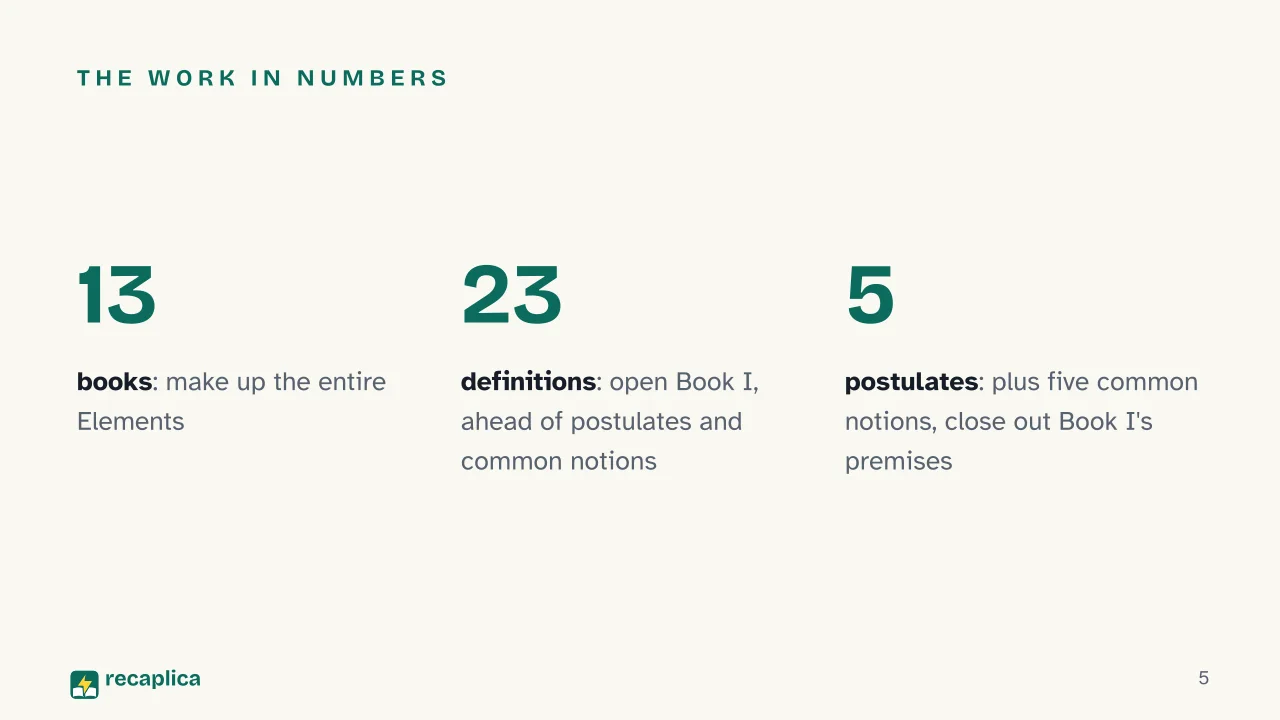 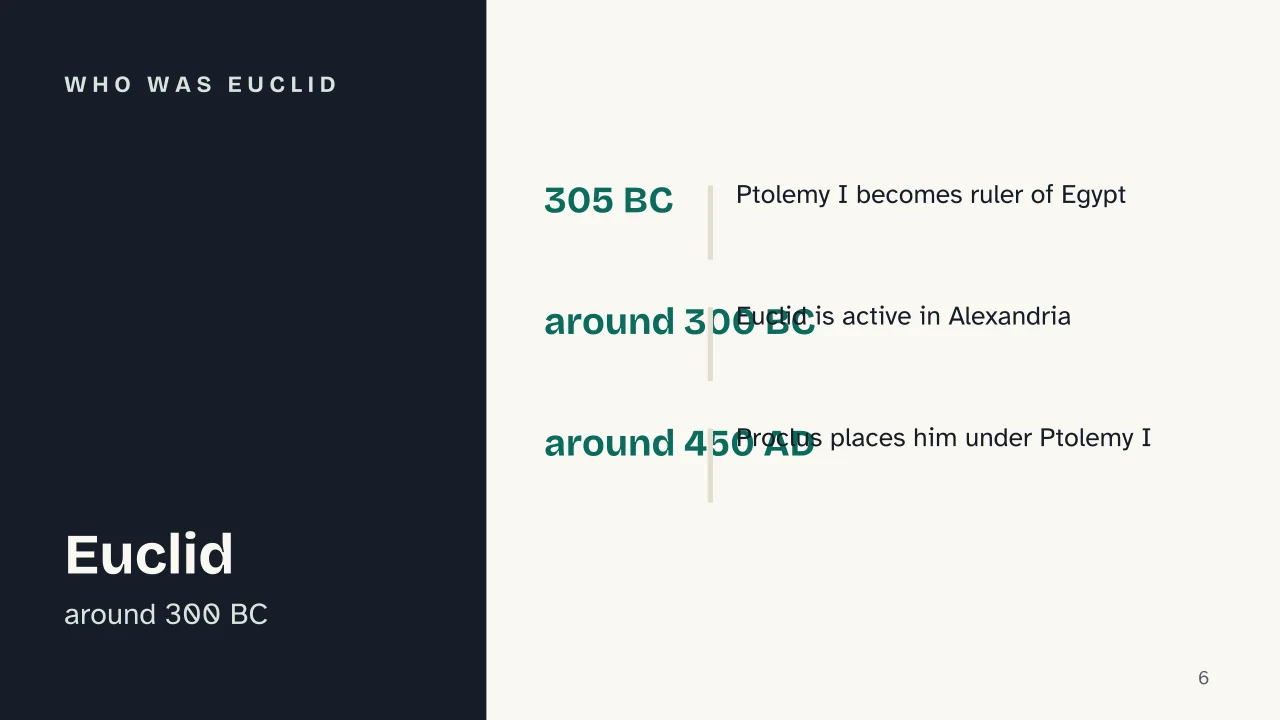  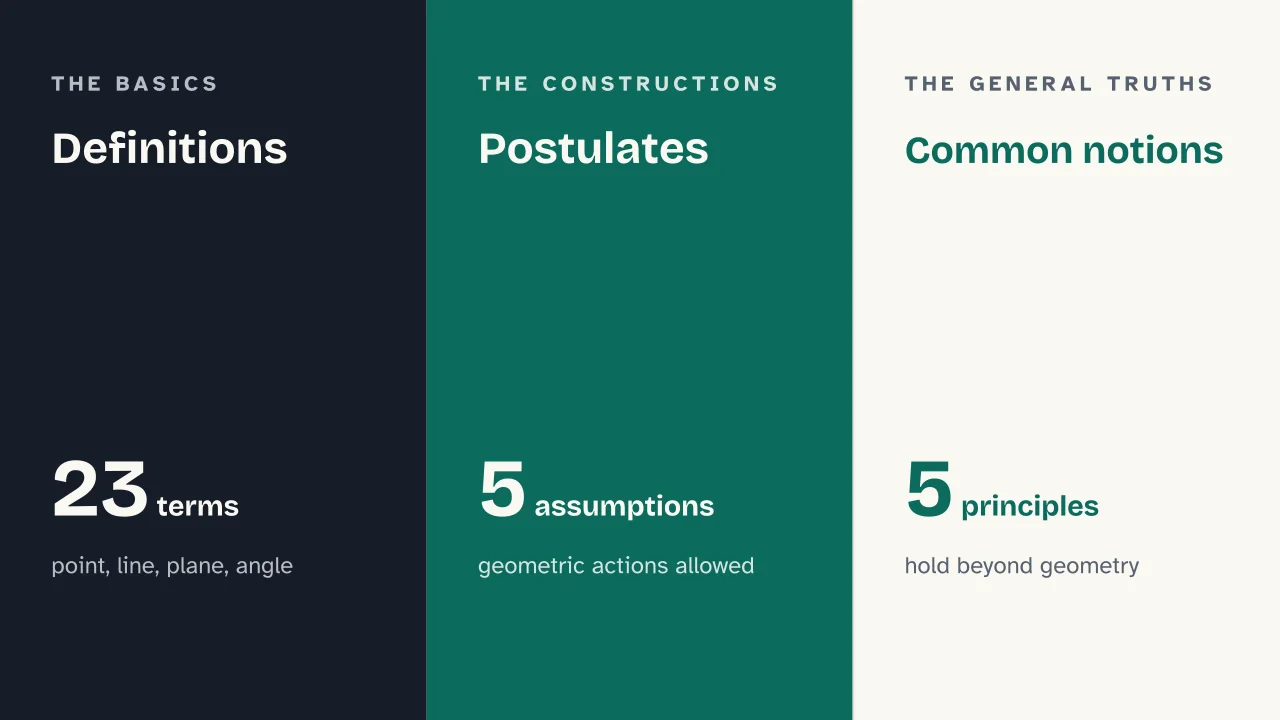  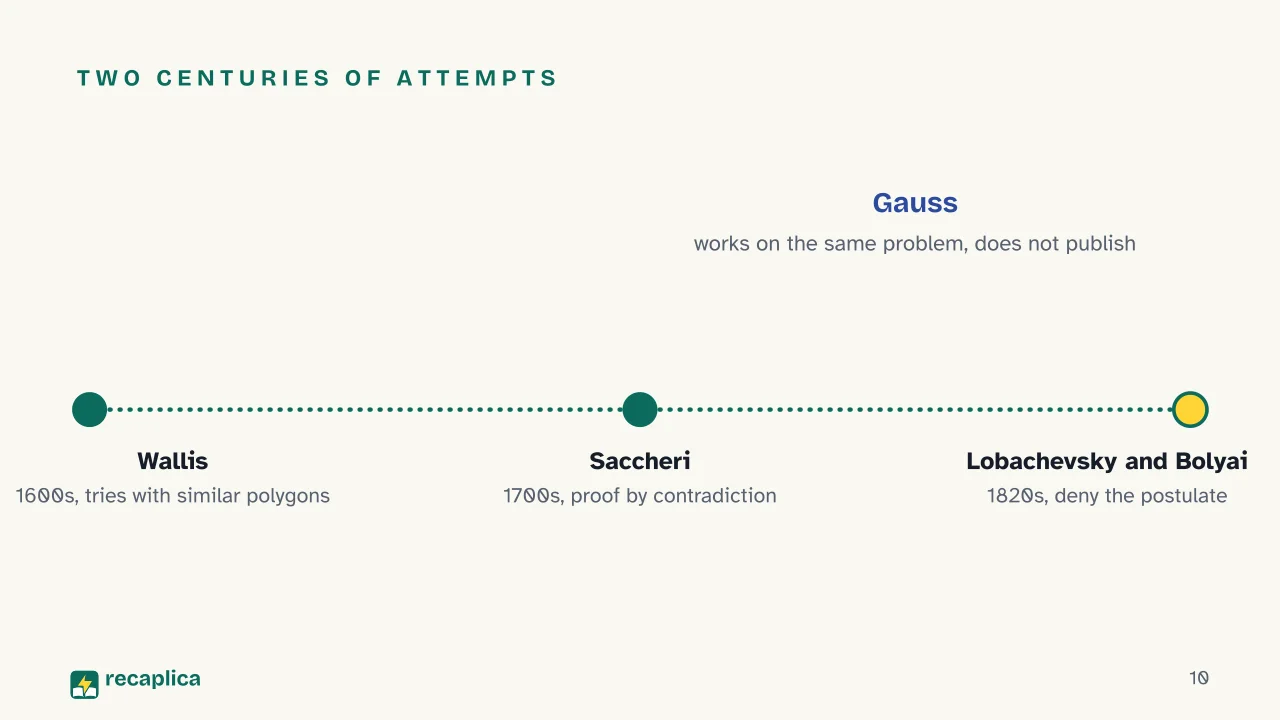 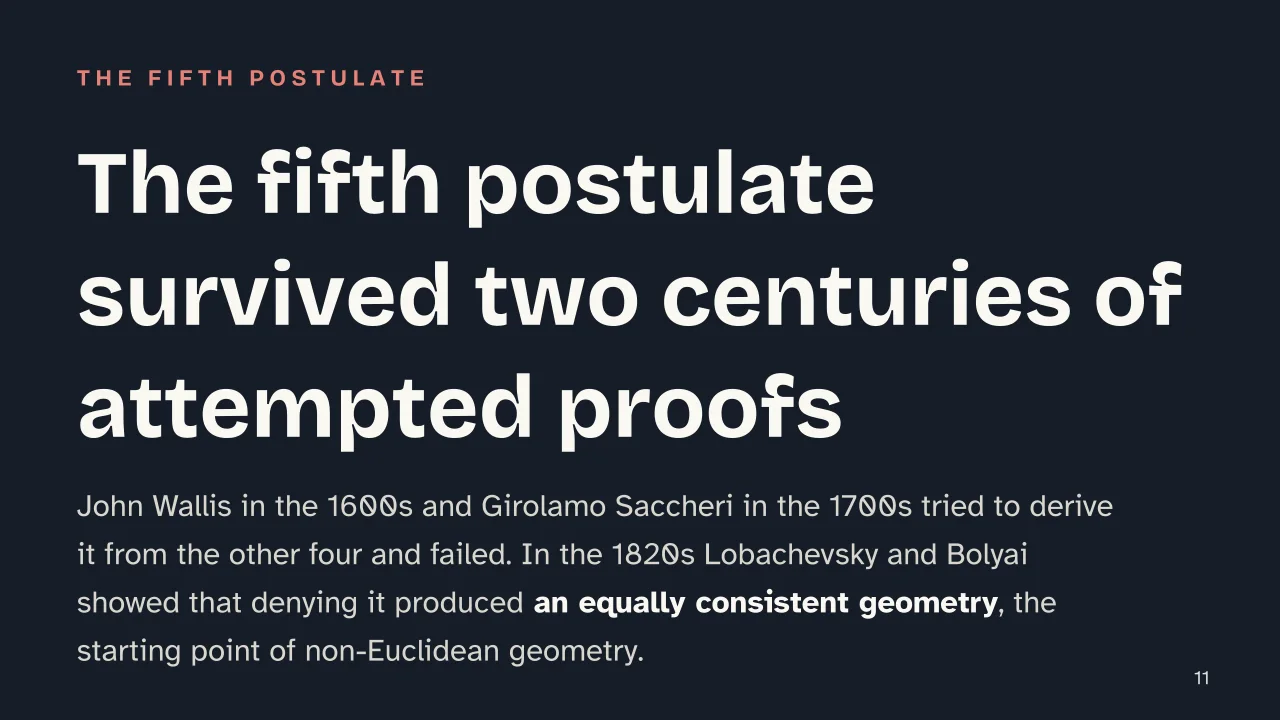  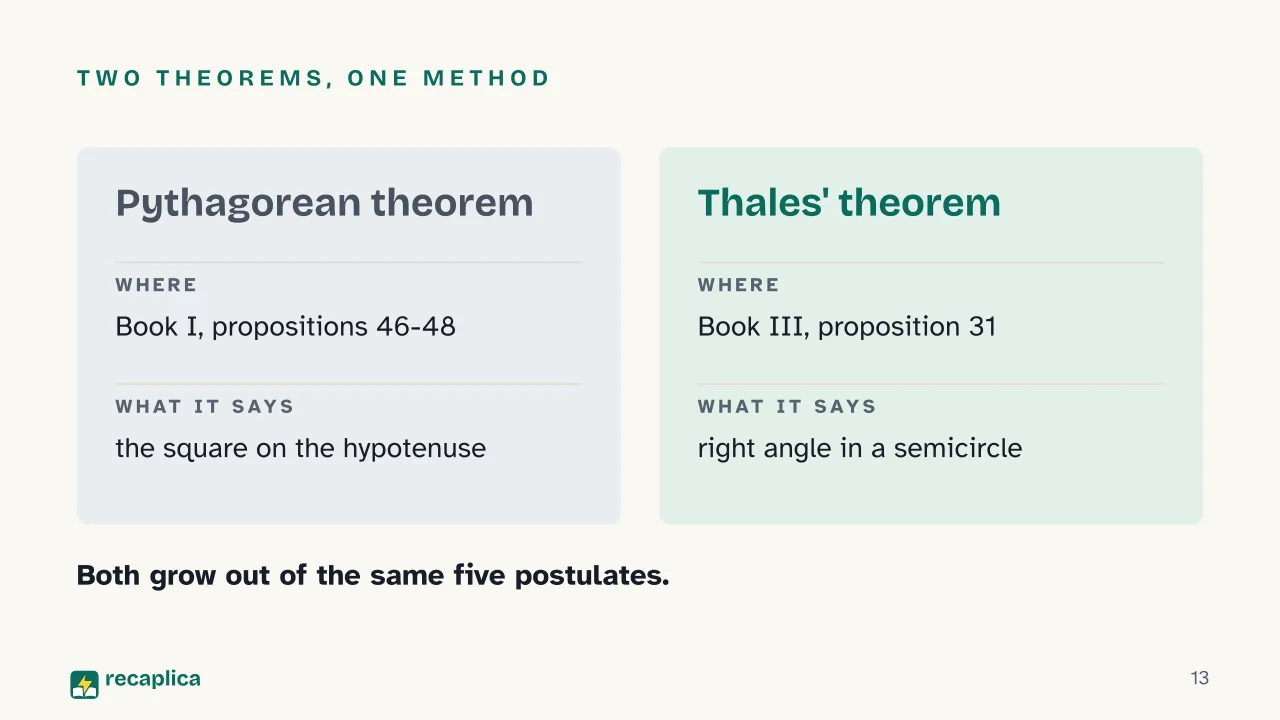 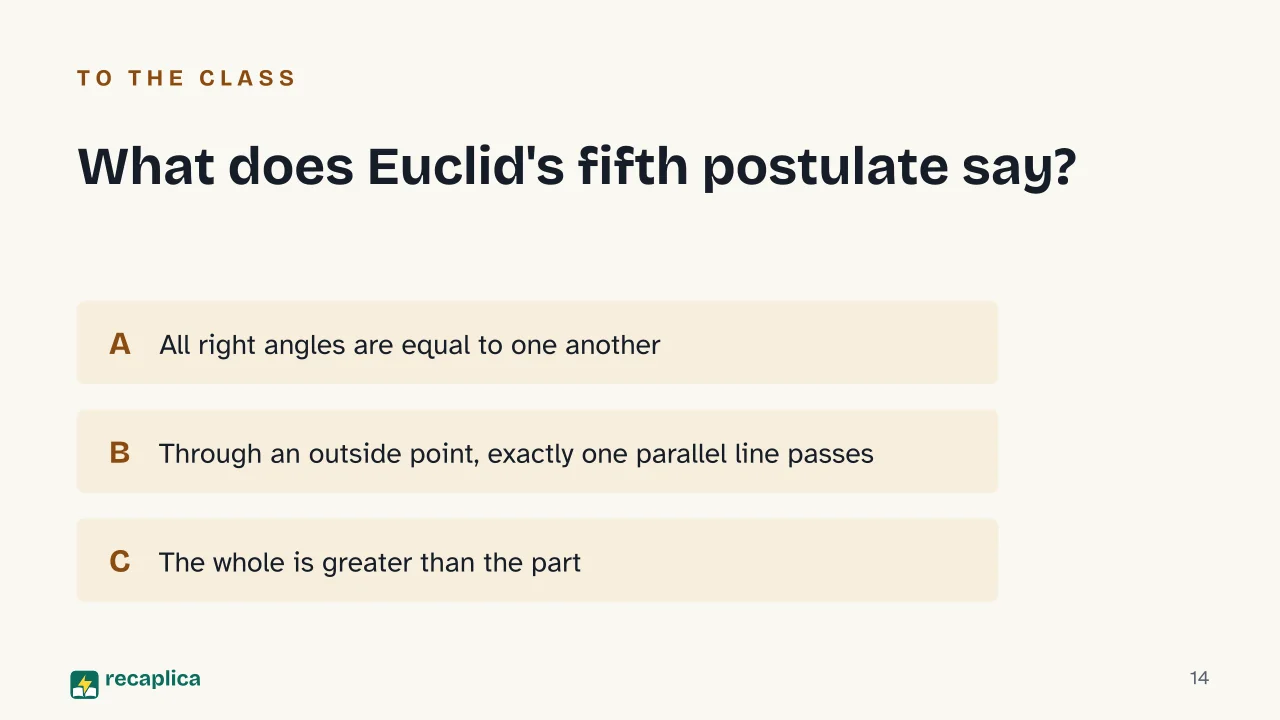  Common myths
Mind mapDrag the background to move around and the nodes to reposition them; use − and + to collapse and expand branches. 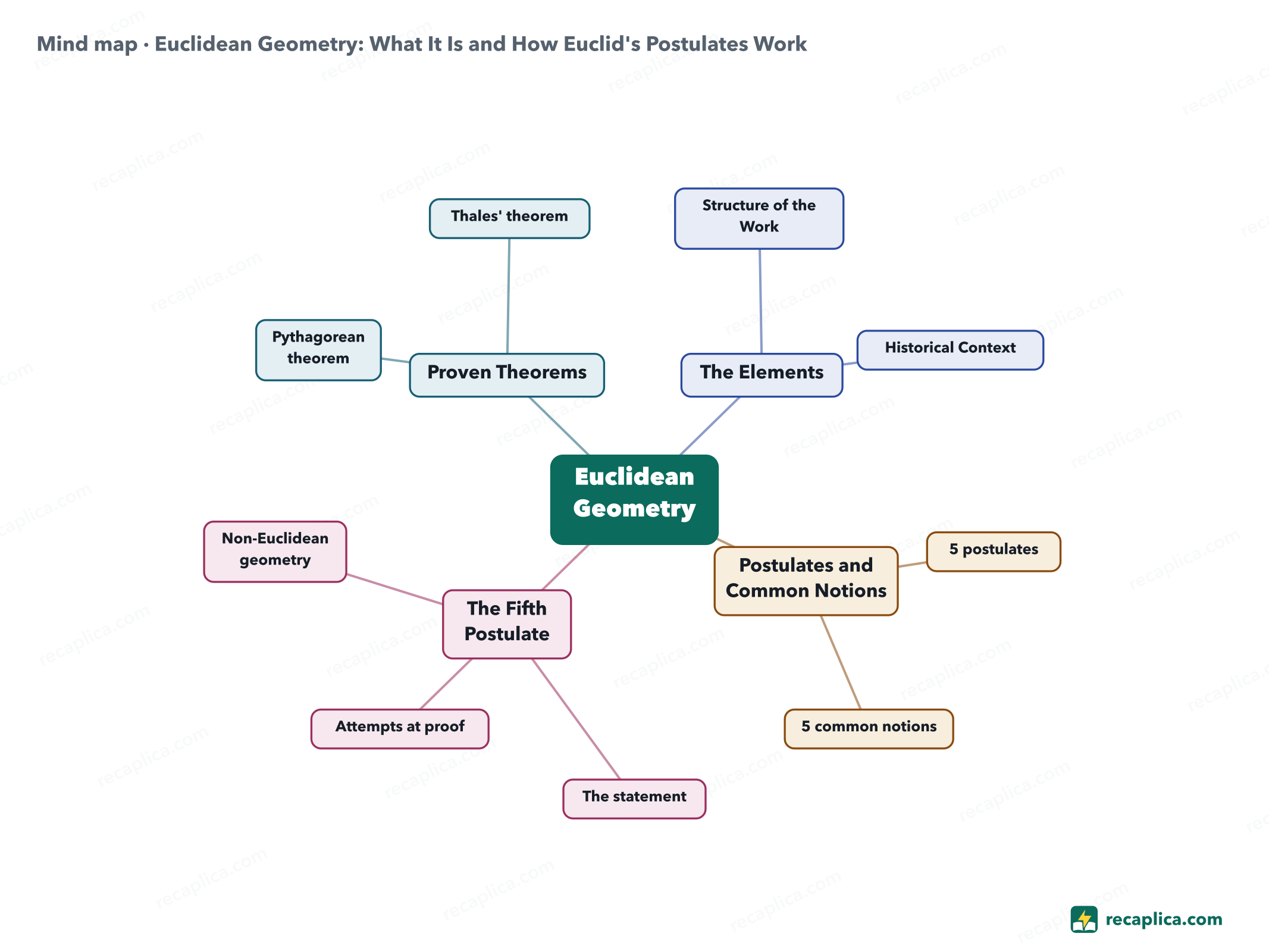
Quiz: test yourselfAnswer the questions to check what you have learned: you get instant feedback and a short explanation. Grade 0/10 0/5
FlashcardsTap the card to flip it and check whether you remember the answer, then move to the next one. 1 / 7 Explain it in your own wordsThe ultimate test: if you can explain it in simple words, you've truly understood it. Write your explanation, then compare it with the Recap. Your explanation is saved only on this device.
Frequently asked questionsWhat is Euclid's fifth postulate?In the standard English rendering, if a straight line falling on two straight lines makes interior angles on the same side whose sum is less than two right angles, those two lines, extended indefinitely, meet on that side. In practice, through a point outside a given line, exactly one parallel to that line can be drawn, which is why it is also called the "parallel postulate". What is the difference between postulates and axioms in the Elements?By Treccani's terminology, the axioms (the five common notions) are general truths, such as "the whole is greater than the part", valid even outside geometry, while the postulates are the five specific assumptions about geometric constructions, such as "a straight line can be drawn joining two given points". What is non-Euclidean geometry?It is the family of consistent geometric systems built on a fifth postulate different from Euclid's, first developed in the 1820s by Lobachevsky and Bolyai. It remains a distinct topic from the Euclidean geometry described in this Recap. Who was Euclid and when did he live?He was a mathematician active in Alexandria, Egypt, the intellectual hub of the Hellenistic world under Ptolemy I. Ancient sources, chiefly the testimony of Proclus writing around 450 AD, place him in the time of Ptolemy I's reign, around 300 BC, but very little is known about his life. Which theorems are proved using Euclidean geometry?The best-known examples are the Pythagorean theorem, proved in propositions 46-48 of Book I, and Thales' theorem on the angle inscribed in a semicircle, proved in proposition 31 of Book III. Both rest on the same starting points, definitions, postulates and common notions, that open the Elements. Every Recap goes through an independent review before publication. |