|
recaplica
Algebra: What It Is and How Symbolic Notation Works | ||||||||||||
| © 2026 Recaplica · recaplica.com — All rights reserved | ||||||||||||
Algebra: What It Is and How Symbolic Notation WorksWhat to print Page numbers appear when printing with default margins. SlidesChoose a cut Flash10 slidesThe essential thread, to present in classFull14 slidesEvery chapter and the deeper detailBoth come with speaker notes. In 30 seconds quick readAlgebra is the branch of mathematics that uses letters instead of numbers to describe relationships that hold for any case, not just one specific problem. Its central tool is symbolic notation: the rules learned in arithmetic, rewritten with general symbols like a, b and c, stay true for every value those symbols can take. The name comes from the Arabic al-jabr, a precise operation described in the 9th century by the mathematician Muhammad ibn Musa al-Khwarizmi in Baghdad, which meant moving a term from one side of an equation to the other. From there spring the study of equations, and later analytic geometry and trigonometry, branches that apply the same symbolic tools to different problems. Key Points
Deep DiveWhere the word «algebra» comes fromThe name comes from the Arabic al-jabr, first used in a mathematical sense by Muhammad ibn Musa al-Khwarizmi, a mathematician active in Baghdad in the 9th century, at the House of Wisdom, under the patronage of the caliph Al-Ma’mun (who became caliph in 813). In his treatise, devoted to symbolic notation and the theory of equations, al-jabr named a precise technical operation: “completion,” meaning the move of a term from one side of an equation to the other, along with the sign change that move requires. It’s the same move still made today solving x + 3 = 7, taking the 3 to the other side as −3. The title of “father of algebra” remains a debated question among historians. According to the historian Gandz, al-Khwarizmi has a stronger claim to it than the Greek mathematician Diophantus, because he was among the first to treat algebra as a discipline in its own right, independent of the number theory in which Diophantus framed it. Al-Khwarizmi’s own name, garbled through medieval Latin, also gave us the word algorithm: the step-by-step procedures that make computers work. Symbolic notation, or letters instead of numbersSymbolic notation is the set of rules and procedures that use letters of the alphabet to stand for general numbers. Because a letter like a or b can equal any number in a given set, the properties and rules derived through symbolic notation carry general validity: they stay true for every numerical value the variables can take.
Symbolic notation is what defines algebra and is used across every field of mathematics: it’s the language algebra uses to study the theory of equations in particular, the set of rules for solving equations or systems of equations in one or more unknowns. Arithmetic and algebra: where the difference startsArithmetic works with fixed, already-known numbers: 3 + 5 has only one possible result, and it stays that way. Algebra introduces, through symbolic notation, a more general way of representing numbers: the basic operations of arithmetic are handled using letters instead of numbers, which makes it possible to reach solutions that hold regardless of the specific case at hand.
The line between them is simple: arithmetic stays with numbers already known, algebra starts once a number is still to be found. Equations, analytic geometry and trigonometry: after symbolic notationSymbolic notation is the foundation several branches of mathematics build on, each deserving a Recap of its own. The study of equations uses symbolic notation to find the value of one or more unknowns. Analytic geometry applies the same letters and the same rules to points, lines and shapes, describing them with numerical coordinates. Trigonometry, finally, uses symbolic formulas to relate the angles and sides of triangles. These are three different applications of the same tool, not three separate branches of mathematics. Beyond pure mathematics, symbolic notation is also the language physics laws are written in: Newton’s three laws of motion, for instance, are expressed with algebraic formulas like F = m · a, where the letters stand for any force, mass and acceleration, not one specific case. The same language is also at work inside machine learning: a model learns by updating letters that represent its parameters, not numbers fixed in advance. Elementary algebra and abstract algebraWhat’s been described so far is elementary algebra, the same kind taught in school: numbers, letters, equations. A development and generalization of symbolic notation is instead abstract algebra, which examines in more detail the settings — sets of numbers or other objects — where the general laws of operations are laid down as axioms. That’s a later stage of study, typically at university level, and falls outside the scope of this Recap. Slide deckSlides ready to download and make your own in PowerPoint or Google Slides, with speaker notes. Pick the Flash cut or the Full one.     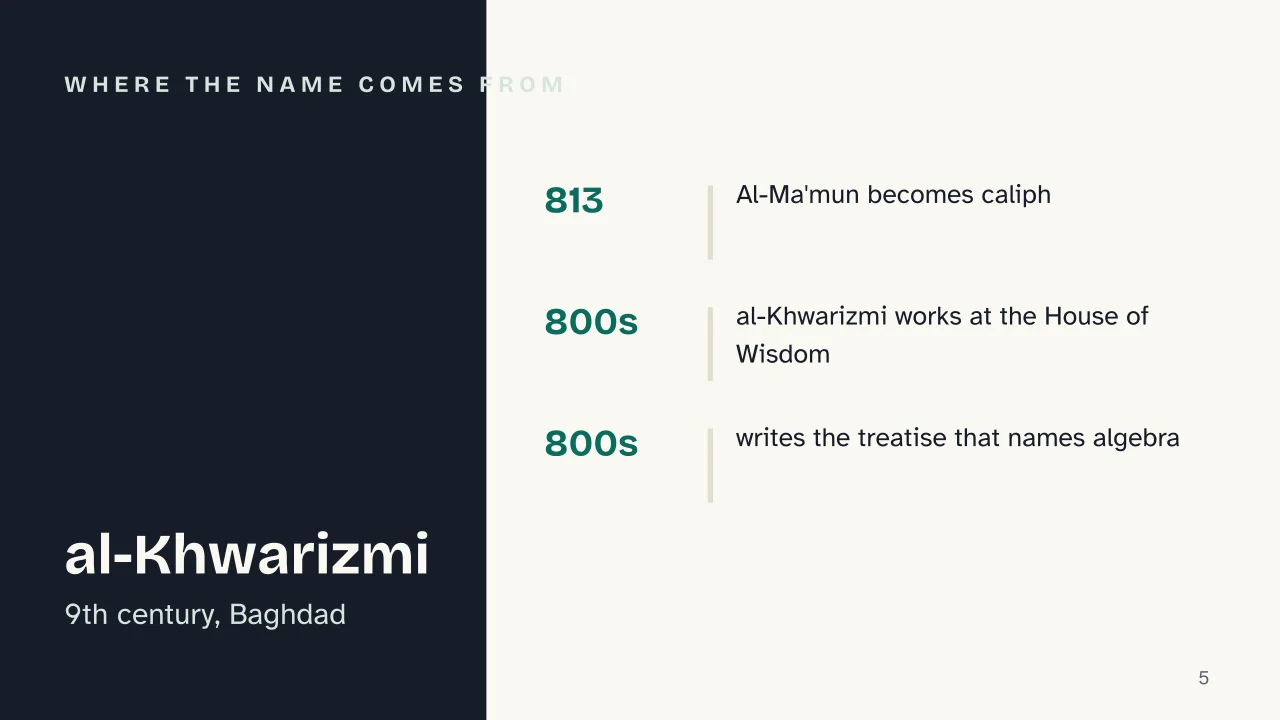 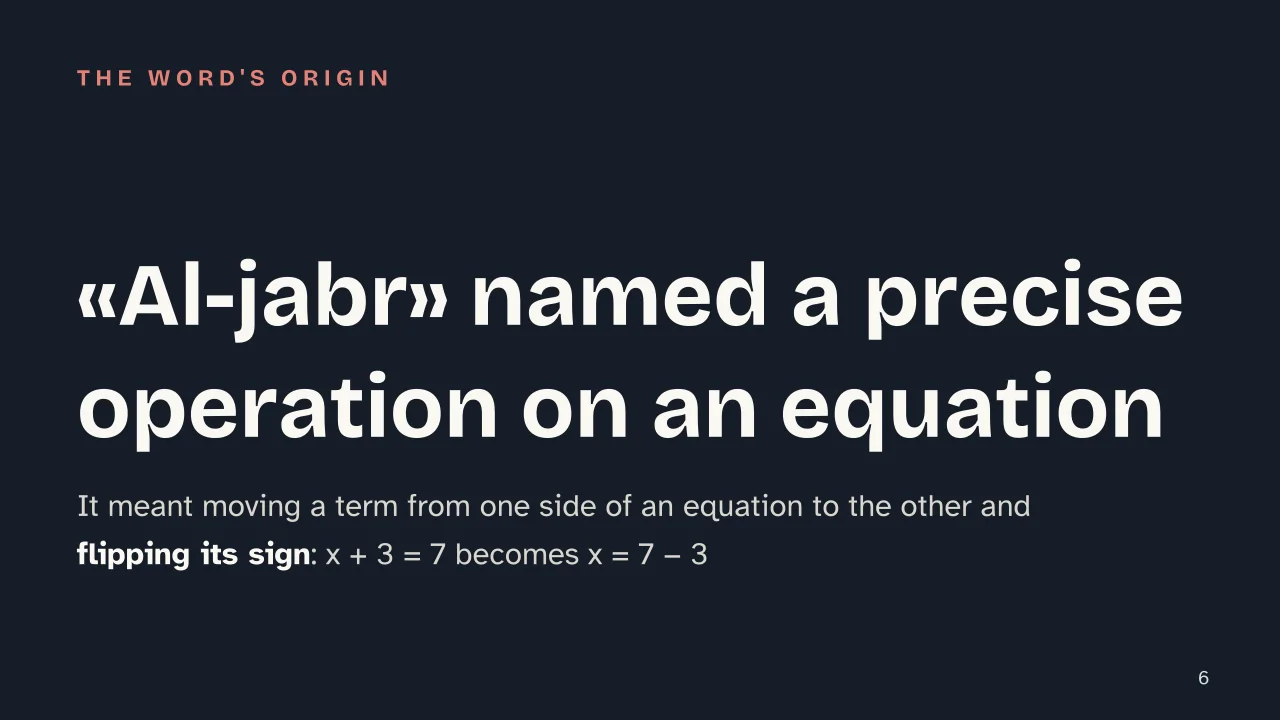  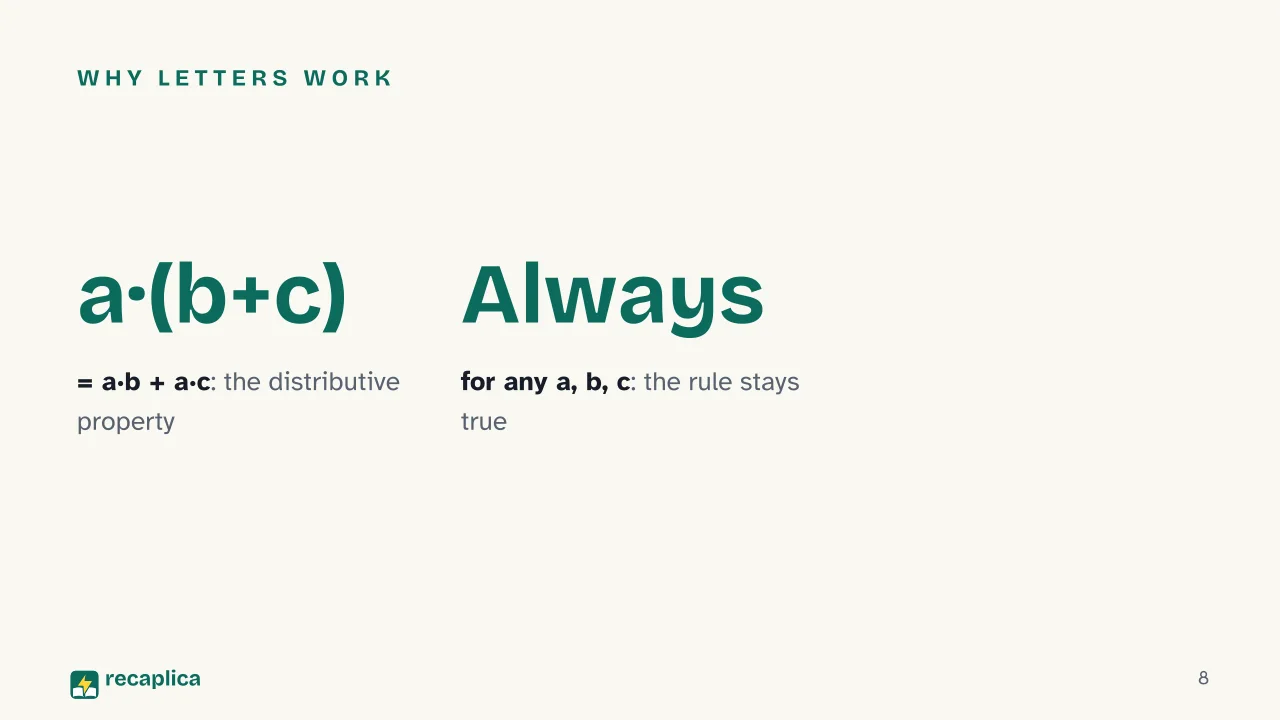  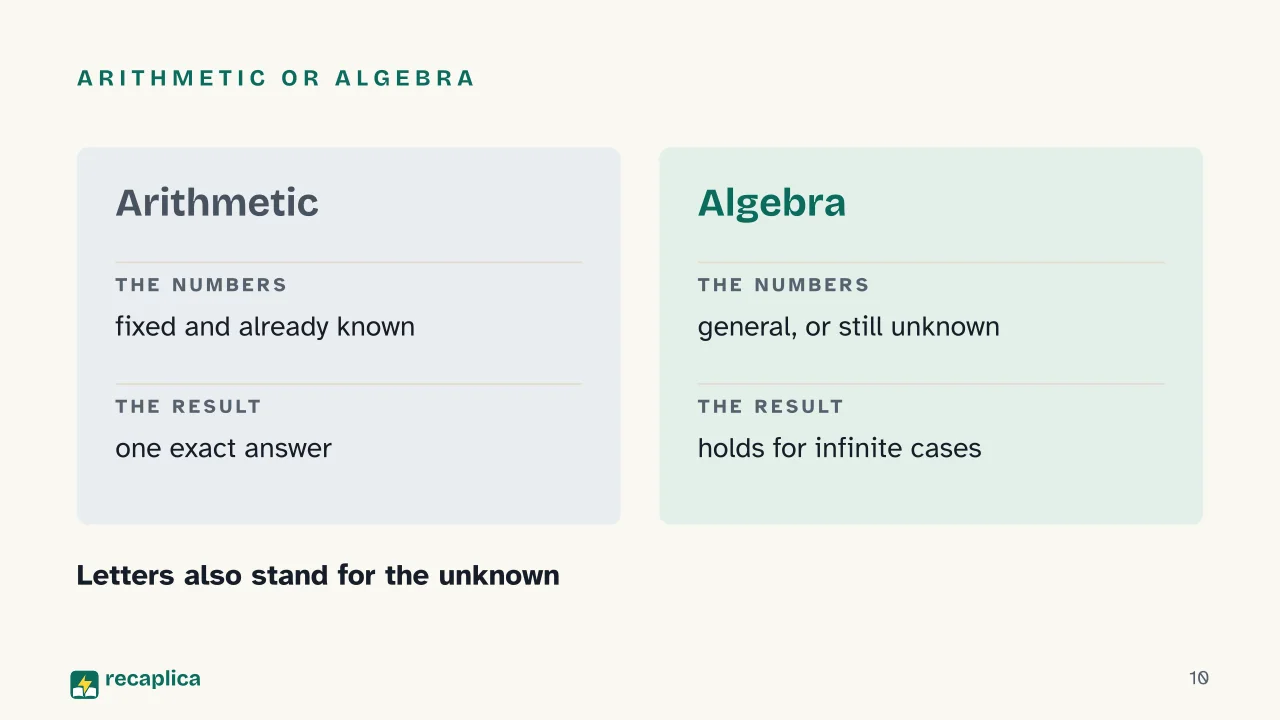  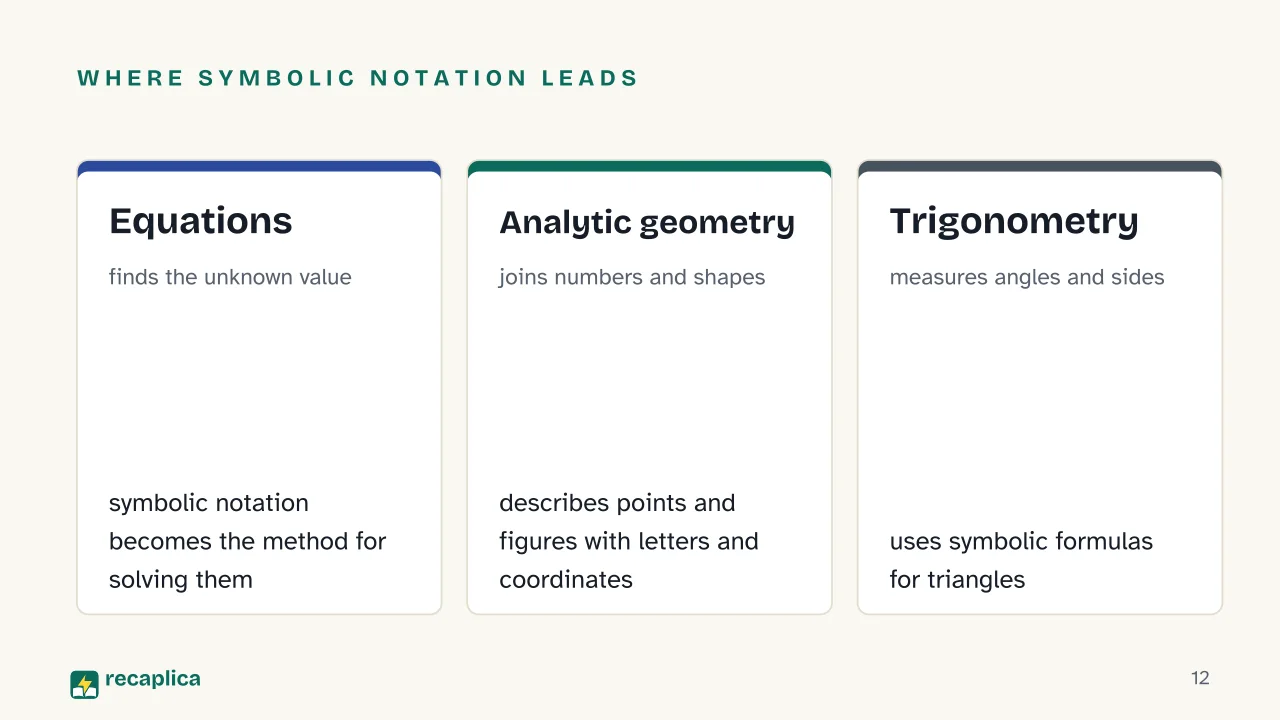   Common myths
Mind mapDrag the background to move around and the nodes to reposition them; use − and + to collapse and expand branches. 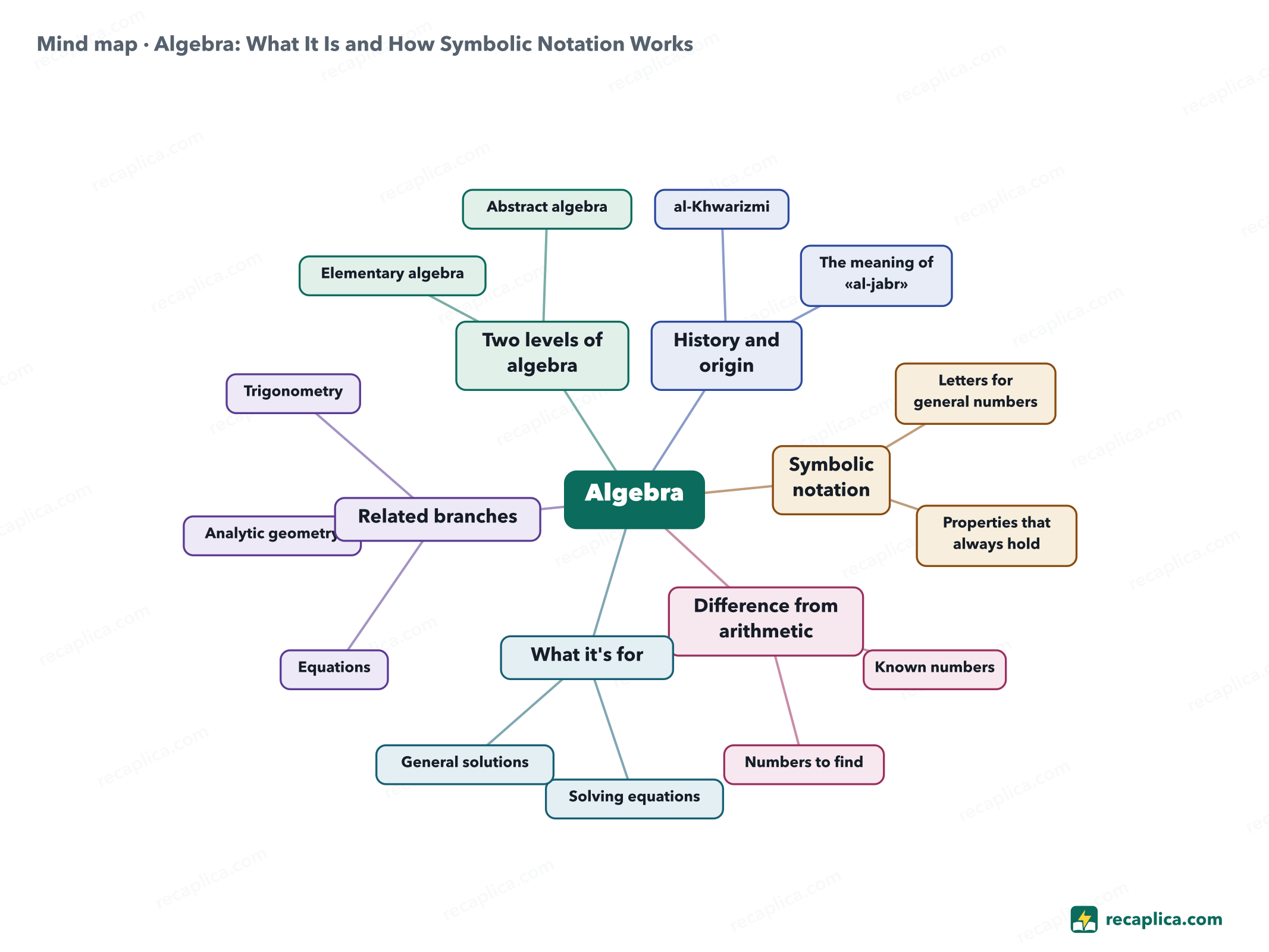
Quiz: test yourselfAnswer the questions to check what you have learned: you get instant feedback and a short explanation. Grade 0/10 0/5
FlashcardsTap the card to flip it and check whether you remember the answer, then move to the next one. 1 / 7 Explain it in your own wordsThe ultimate test: if you can explain it in simple words, you've truly understood it. Write your explanation, then compare it with the Recap. Your explanation is saved only on this device.
Frequently asked questionsWhat is the difference between arithmetic and algebra?Arithmetic calculates with fixed, already-known numbers: 3 + 5, for instance, has only one possible result. Algebra introduces, through symbolic notation, a more general way of representing numbers: it uses letters to stand for any quantity or still-unknown values, so a rule written once with letters holds for infinitely many numerical cases, not just one calculation. Why is algebra called that?The name comes from the Arabic al-jabr, the word first used in a mathematical sense by the mathematician Muhammad ibn Musa al-Khwarizmi, active in Baghdad in the 9th century. It named a precise operation: moving a term from one side of an equation to the other and flipping its sign. What is symbolic notation?It's the set of rules and procedures that use letters of the alphabet to stand for general numbers. Because a letter can equal any number in a given set, the properties derived through symbolic notation, such as a·(b+c) = a·b + a·c, stay valid for every numerical value the letters can take. Who invented algebra?It doesn't have a single inventor: the term «algebra» is attributed to al-Khwarizmi, who in the 9th century treated algebra as its own discipline in his treatise written in Baghdad. Before him, the Greek mathematician Diophantus had already tackled similar problems, but within number theory; that's why the historian Gandz assigns the title of «father of algebra» to al-Khwarizmi rather than Diophantus, though the question remains debated among historians of mathematics. What are elementary algebra and abstract algebra?Elementary algebra is the kind taught in school: numbers, letters, equations. Abstract algebra is a later, more general stage of study, typically at university level, that examines in detail the sets of numbers or other objects where the same laws of operations are laid down as axioms. Every Recap goes through an independent review before publication. |