Skip to content
recaplica

    One moment: security check

    Cloudflare wants to make sure you're not a robot. Tick the box below and your search will continue on its own.

    IT
    recaplica Linear Algebra: What It Is and How Vectors and Matrices Work
    © 2026 Recaplica · recaplica.com — All rights reserved
    Home › Science

    Linear Algebra: What It Is and How Vectors and Matrices Work

    By Recaplica Newsroom · Updated on September 18, 2026

    What to print

    Page numbers appear when printing with default margins.

    Slides

    Choose a cut

    Flash10 slidesThe essential thread, to present in classFull18 slidesEvery chapter and the deeper detail

    Both come with speaker notes.

    Telegram channel
    recaplica Clear in 30 seconds, yours in 10 minutes.
    In 30 seconds Key points Figures Deep dive Slides Myths Mind map Quiz Flashcards FAQ

    In 30 seconds quick read

    Linear algebra is the branch of mathematics that studies systems of linear equations, matrices and their determinants and, more broadly, vector spaces and the linear transformations between them. Its central objects are vectors, matrices and the transformations that relate them. Practical methods for solving systems of equations go back to ancient China, while the modern axiomatic treatment took shape in the nineteenth century, with Hermann Grassmann in 1844 and Giuseppe Peano in 1888. Today it underpins fields as different as computer graphics, statistics and engineering.

    Key Points

    • Linear algebra studies systems of linear equations, matrices and their determinants and, more broadly, vector spaces and the linear transformations between them.
    • A vector is an element of a vector space; a matrix is a rectangular table of numbers that can represent a system of equations or a linear transformation.
    • A linear transformation is a function between vector spaces that preserves vector addition and scalar multiplication.
    • The eigenvalues and eigenvectors of a matrix A satisfy AX = λX and describe how a linear transformation acts on a space, for instance in stability analysis or the study of vibrations.
    • Gaussian elimination, the method Wolfram MathWorld calls the most numerically robust way to solve a linear system, has a long history: similar column-based procedures appear in the Chinese text Nine Chapters on the Mathematical Art, dated to around the second century BCE.
    • The word 'matrix' was coined in 1850 by James Joseph Sylvester; the first abstract definition of a matrix is credited to Arthur Cayley, in 1858.

    Key figures

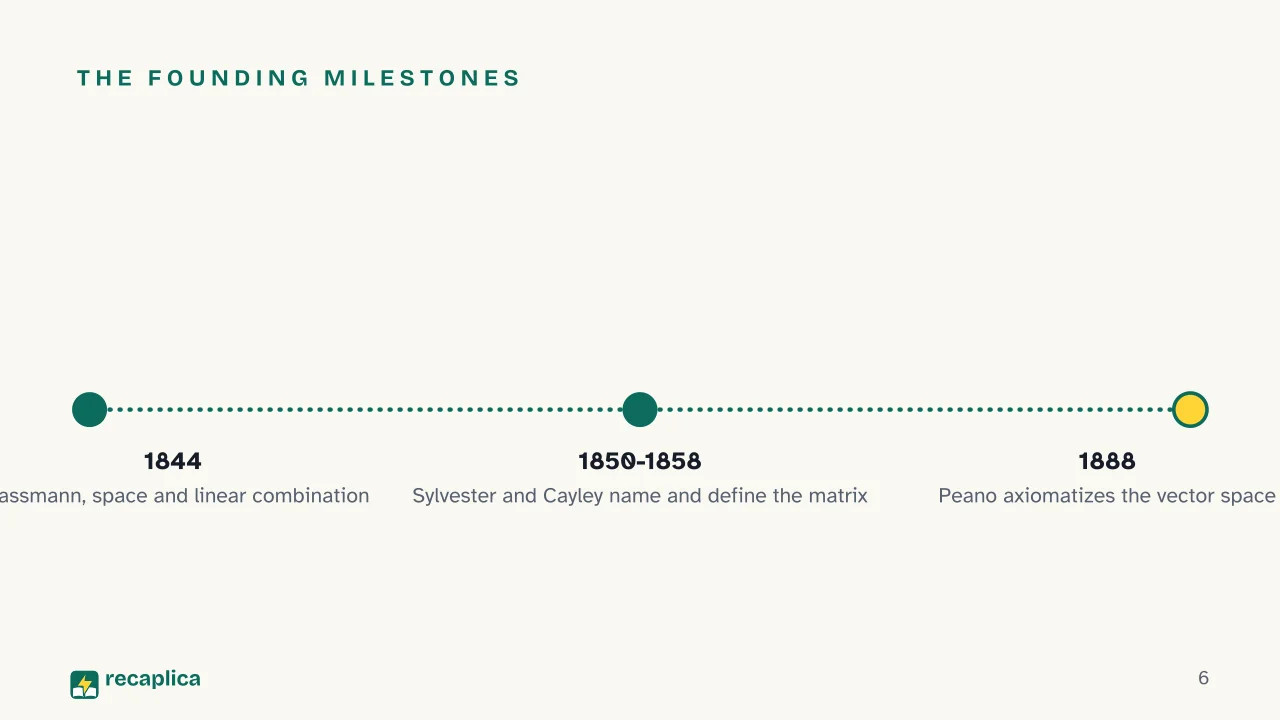
    • 1844 Publication year of Hermann Grassmann's Die lineale Ausdehnungslehre, the text usually cited as the origin of linear algebra, which already contains the concepts of a space and a linear combination. Source: Treccani, Enciclopedia della Matematica
    • 1888 Year in which Giuseppe Peano, building on Grassmann's work, gave the first axiomatic definition of a real vector space and of a linear map. Source: MacTutor History of Mathematics
    • 1858 Year of Arthur Cayley's Memoir on the theory of matrices, which contains the first abstract definition of a matrix and the first proof of the Cayley-Hamilton theorem for 2×2 matrices. Source: MacTutor History of Mathematics

    Deep Dive

    What linear algebra is

    Wolfram MathWorld defines linear algebra as the study of linear systems of equations and their transformation properties — matrices and determinants sit at its computational core, and in a broader sense so do vector spaces and the linear maps between them. The same entry flags a small terminological quirk: in the strict technical sense, an “algebra” is a structure with its own internal multiplication, and an ordinary vector space doesn’t carry one by default, so the name “linear algebra”, applied to the whole field, is a bit misleading relative to that narrower meaning.

    For anyone arriving from algebra and arithmetic, linear algebra doesn’t introduce a new kind of calculation so much as a new set of objects — vectors, matrices, vector spaces — to which familiar calculation rules still largely apply.

    Vectors, matrices and vector spaces

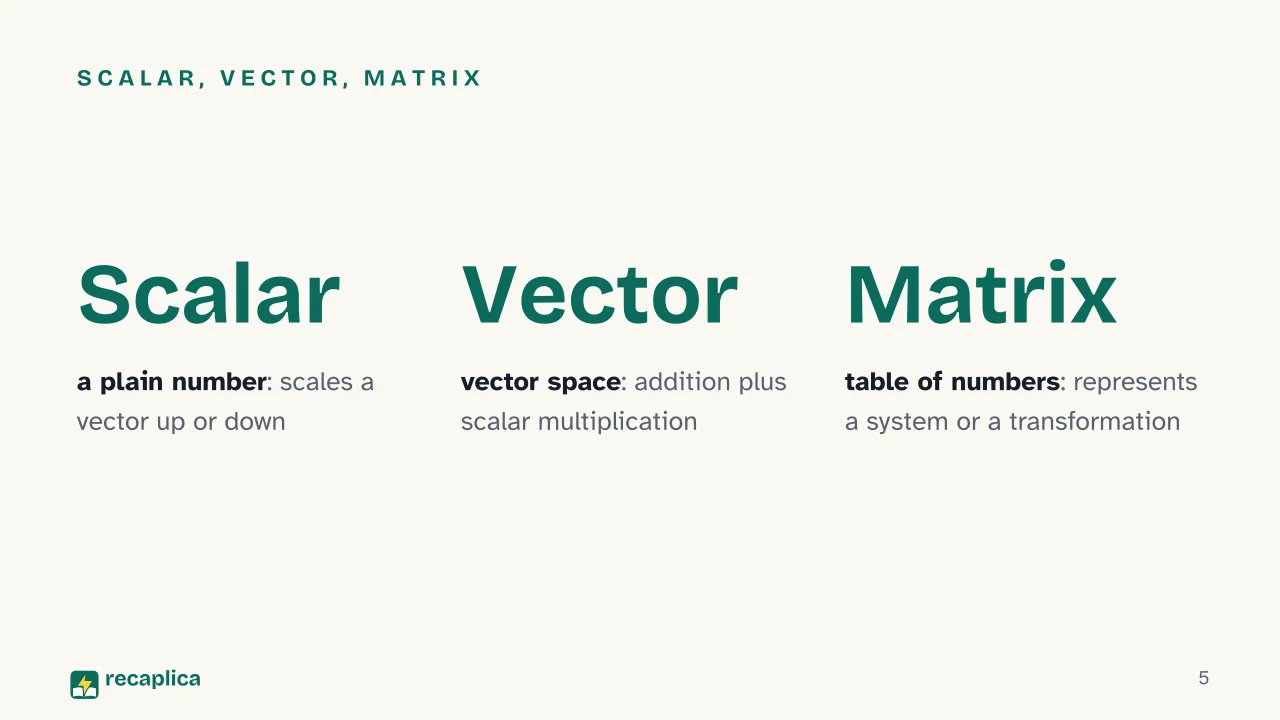
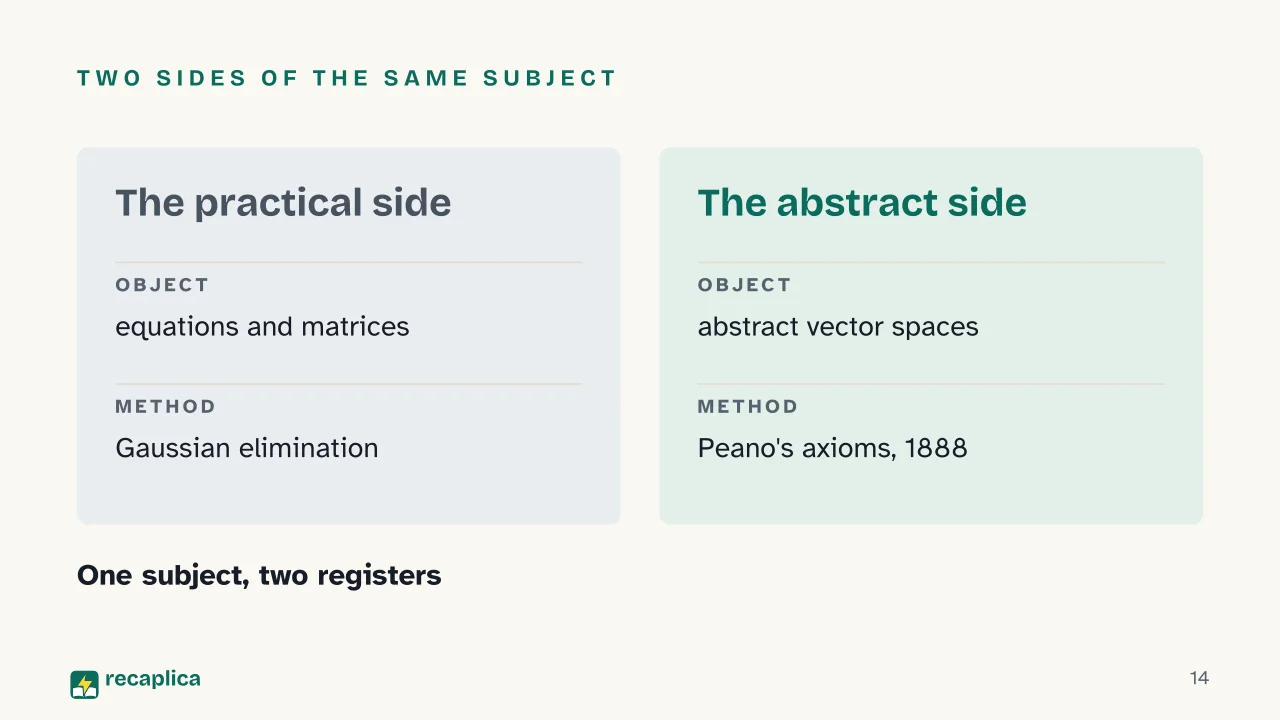
    A vector space is a set of elements, called vectors, on which two operations are defined: addition between vectors, and multiplication of a vector by a scalar — that is, a plain number. Giuseppe Peano gave the first axiomatic definition of a real vector space in 1888, building on the work of Hermann Grassmann, who in 1844 had published Die lineale Ausdehnungslehre (Theory of Linear Extension), the text usually credited as the origin of the field.

    A matrix is a rectangular table of numbers. The term was coined in 1850 by the English mathematician Sylvester, who described it as an oblong arrangement of terms; the first abstract definition of a matrix, together with the first proof of the Cayley-Hamilton theorem for 2×2 matrices, appears in Arthur Cayley’s Memoir on the Theory of Matrices, from 1858. Matrix calculations — addition, multiplication, computing a determinant — form, in MathWorld’s phrasing, one of the extremely useful toolkits of linear algebra.

    ScalarVectorMatrix
    What it isA single numberAn element of a vector spaceA rectangular table of numbers
    Example5(2, -1, 3)a 2×2 grid of numbers
    Used forScaling a vector up or downRepresenting a quantity or a point in spaceRepresenting a system of equations or a transformation

    Linear systems and Gaussian elimination

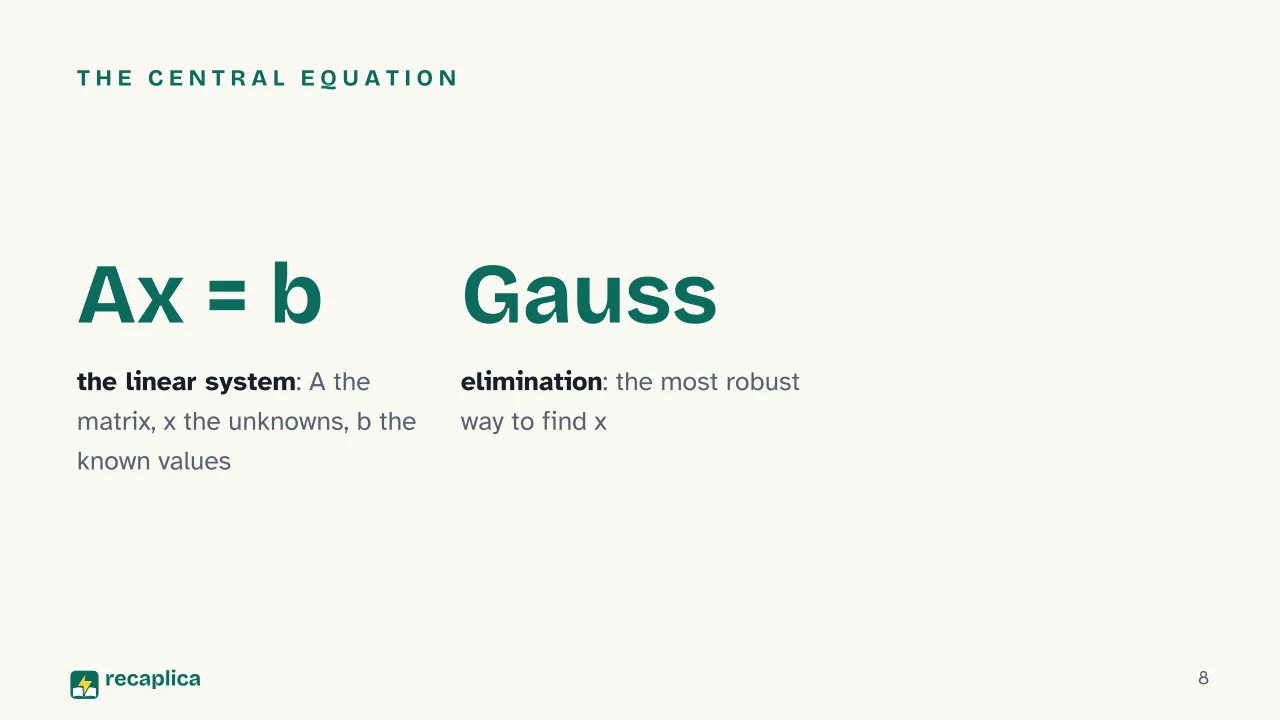
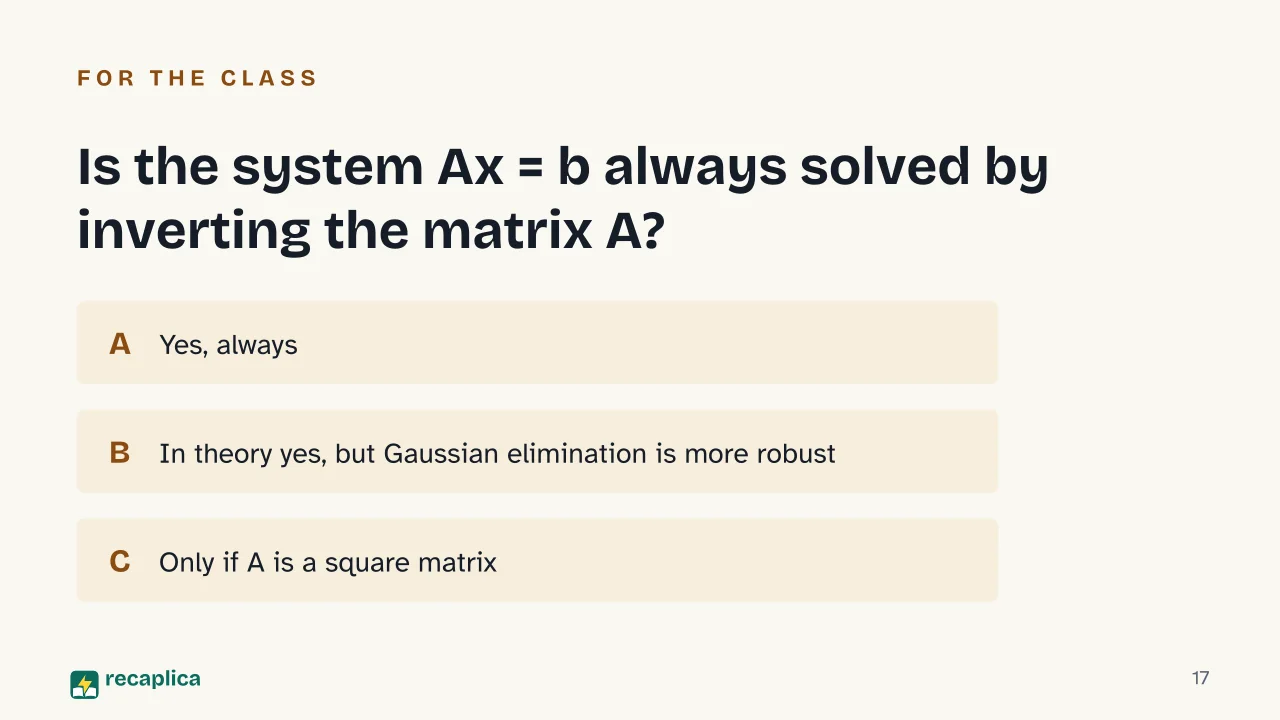
    A system of linear equations in several unknowns can be written compactly as Ax = b, where A is the matrix of coefficients, x the vector of unknowns and b the vector of known values. MathWorld notes that although the equation can, in principle, be solved by inverting the matrix (x = A⁻¹b), Gaussian elimination remains the numerically most robust method for finding x in practice.

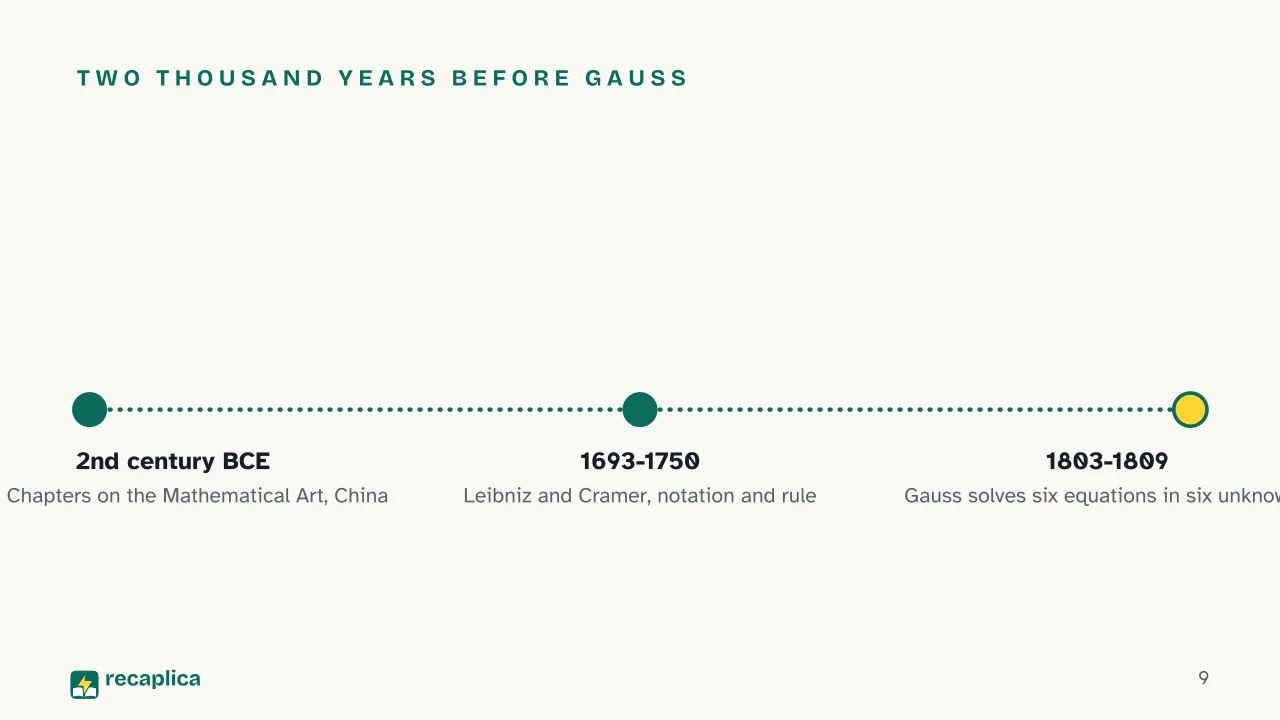
    Procedures of this kind are older than the name attached to them. In the Chinese text Nine Chapters on the Mathematical Art, dated by historians to around the second century BCE, MacTutor identifies what it calls the earliest known example of matrix methods: the text instructs the reader to multiply one column of coefficients by a factor and subtract it from another, a column-by-column way of eliminating unknowns one at a time that anticipates, in substance, Gaussian elimination. In Europe, Gottfried Leibniz developed a double-index notation for systems of equations in 1693, a forerunner of determinant notation; Gabriel Cramer described in 1750 the method now known as Cramer’s rule, which expresses each unknown as a ratio of determinants. Carl Friedrich Gauss introduced the term “determinant” in the Disquisitiones Arithmeticae of 1801; years later, while computing the orbit of the asteroid Pallas from observations taken between 1803 and 1809, he solved a system of six linear equations in six unknowns using precisely the elimination procedure that today bears his name.

    Practical example: a system Ax = b shows up whenever several quantities are tied together by several equations at once — for instance an electrical circuit with multiple loops, where the unknown currents are found by solving Kirchhoff’s equations together, written in matrix form.

    Linear transformations, eigenvalues and eigenvectors

    A linear transformation is a function between vector spaces that preserves the two defining operations of a vector space: transforming the sum of two vectors gives the same result as summing their transformations, and the same holds for scalar multiplication. Linear transformations, and their representation as matrices, sit alongside linear dependence among the central ideas of the field.

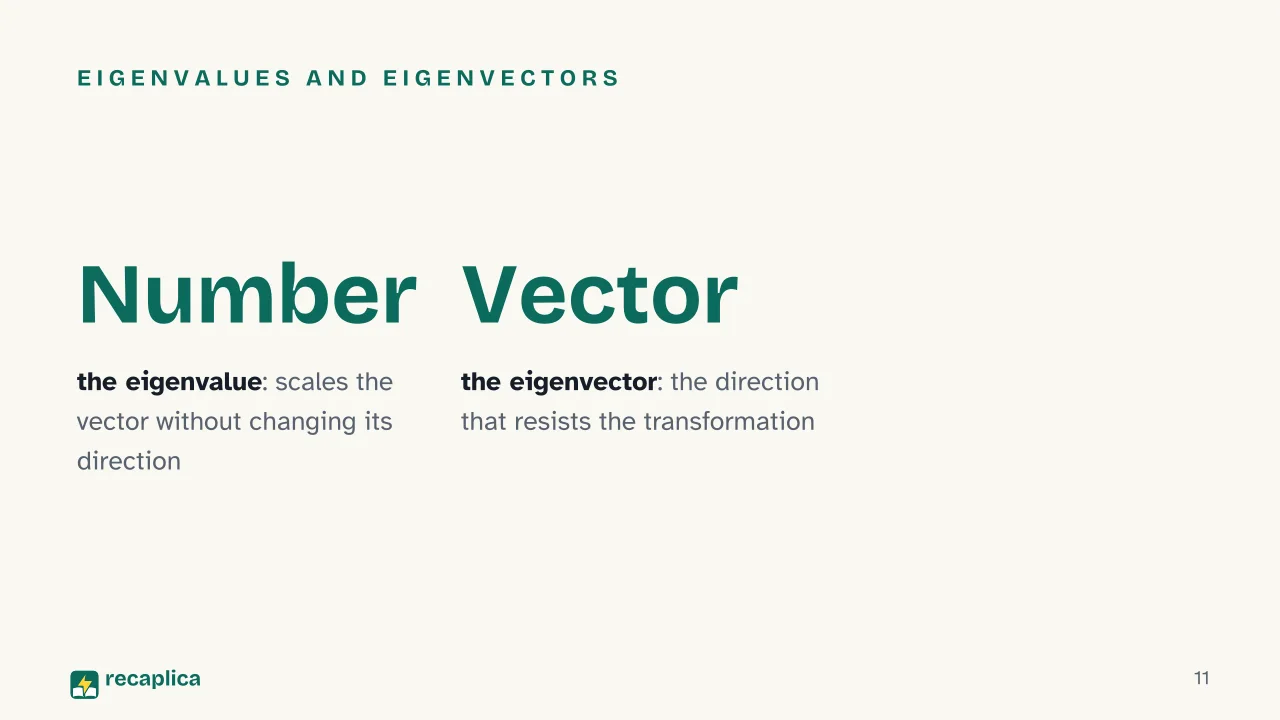
    A particular but central case is that of eigenvalues and eigenvectors. Given a square matrix A and a nonzero vector X, if there is a scalar λ such that AX = λX, then λ is called an eigenvalue of A and X the corresponding eigenvector. Eigenvalues are found by solving the characteristic equation det(A - λI) = 0, where I is the identity matrix; MathWorld notes that for symmetric matrices, eigenvectors associated with distinct eigenvalues are always orthogonal to one another.

    MathWorld links the search for eigenvalues and eigenvectors to matrix diagonalization, a calculation that comes up in concrete applications such as stability analysis, the physics of rotating bodies, and the study of small oscillations in vibrating systems.

    Linear algebra and geometry

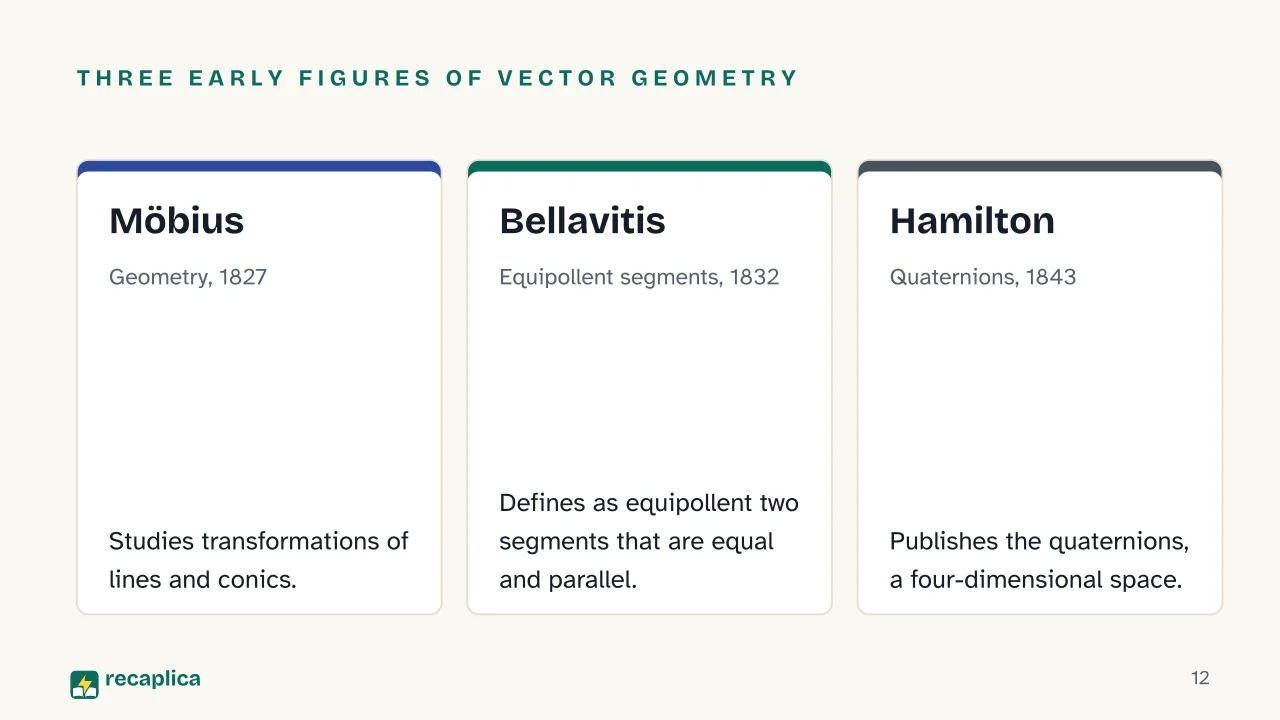
    Linear algebra is used widely beyond abstract algebra and functional analysis — Treccani’s Enciclopedia della Matematica singles out geometry in particular. The connection has clear historical roots: in 1827 Möbius published Der barycentrische Calcul, a geometry book studying transformations of lines and conics; in 1832 Bellavitis defined two segments as “equipollent” when equal and parallel, an idea MacTutor describes as essentially a vector space. Hamilton gave, in 1843, an important example of a four-dimensional vector space with his quaternions.

    Vectors, matrices and linear transformations are the tools used to describe rotations, projections and changes of coordinate system in space. Many university courses teach the two subjects together, often under a combined name such as geometry and linear algebra.

    A history spanning more than two thousand years

    The remote origins of linear algebra stretch from ancient China through seventeenth- and eighteenth-century Europe, while its modern formalization is compressed into a few decades of the nineteenth century. Cayley introduced matrix algebras in 1857, opening the way toward more general abstract systems; the following year, in 1858, he published the first abstract definition of a matrix. Grassmann had already published the concepts of a space and a linear combination in 1844, though MacTutor describes his text as very difficult to read and notes that it did not find favor with mathematicians at the time. It was Peano, in 1888, who gave the idea a rigorous axiomatic form.

    Even the concept of a vector predates the nineteenth century in its earliest form: MacTutor traces the first steps of the idea to the work of Bernard Bolzano, at the start of the 1800s.

    Where it gets used

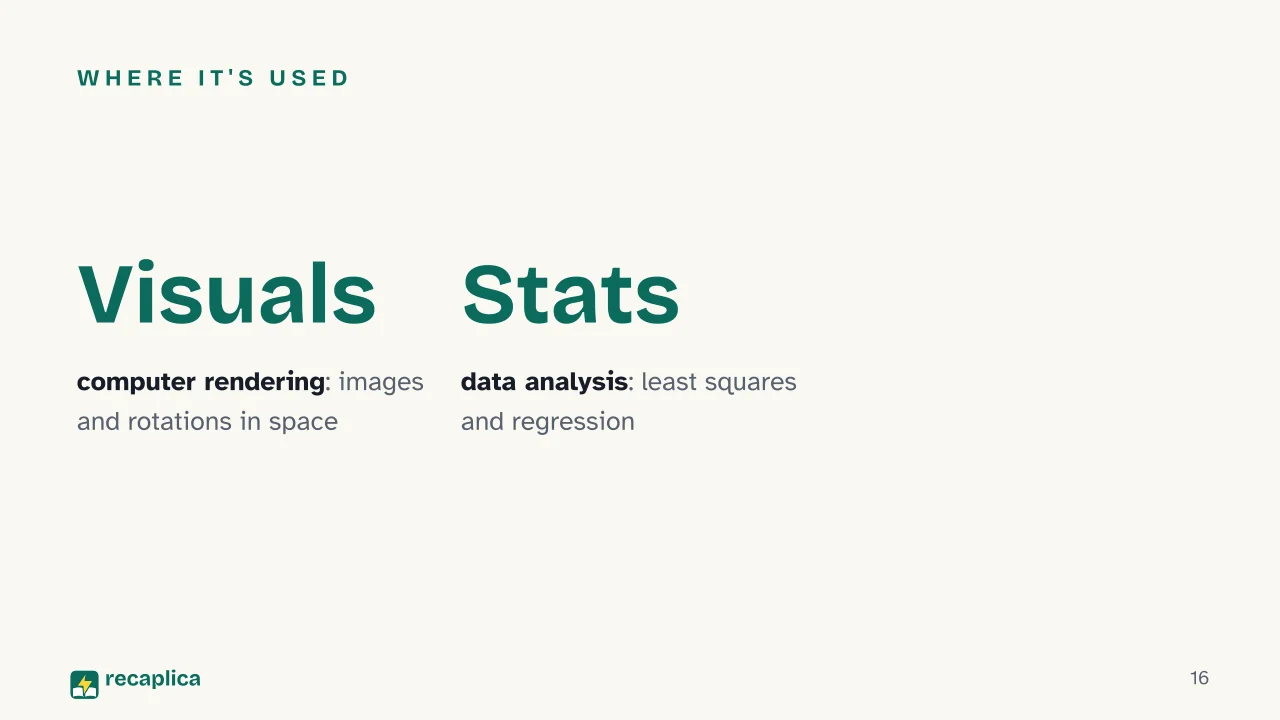
    The applications of linear algebra go well beyond pure mathematics. Encyclopaedia Britannica lists, among the uses of matrix multiplication, plotting graphs, rendering images, analyzing electrical circuits, guiding robots, developing medical scans, encrypting messages and carrying out statistical analysis — fields as different as engineering, computer science and probability and statistics.

    Data science and machine learning add a more recent layer to that list: data sets and model parameters are routinely stored as vectors and matrices, and training a model largely comes down to matrix operations on them.

    MIT’s course 18.06, taught by Gilbert Strang, sums up the backbone of the subject in six core topics: systems of equations, vector spaces, determinants, eigenvalues, similarity between matrices, and positive definite matrices — the same core of ideas covered in this Recap, from linear systems to eigenvalues. Anyone continuing their studies from here runs into calculus, which studies limits, derivatives and integrals using functions built with the tools of linear algebra.

    Slide deck

    Slides ready to download and make your own in PowerPoint or Google Slides, with speaker notes. Pick the Flash cut or the Full one.
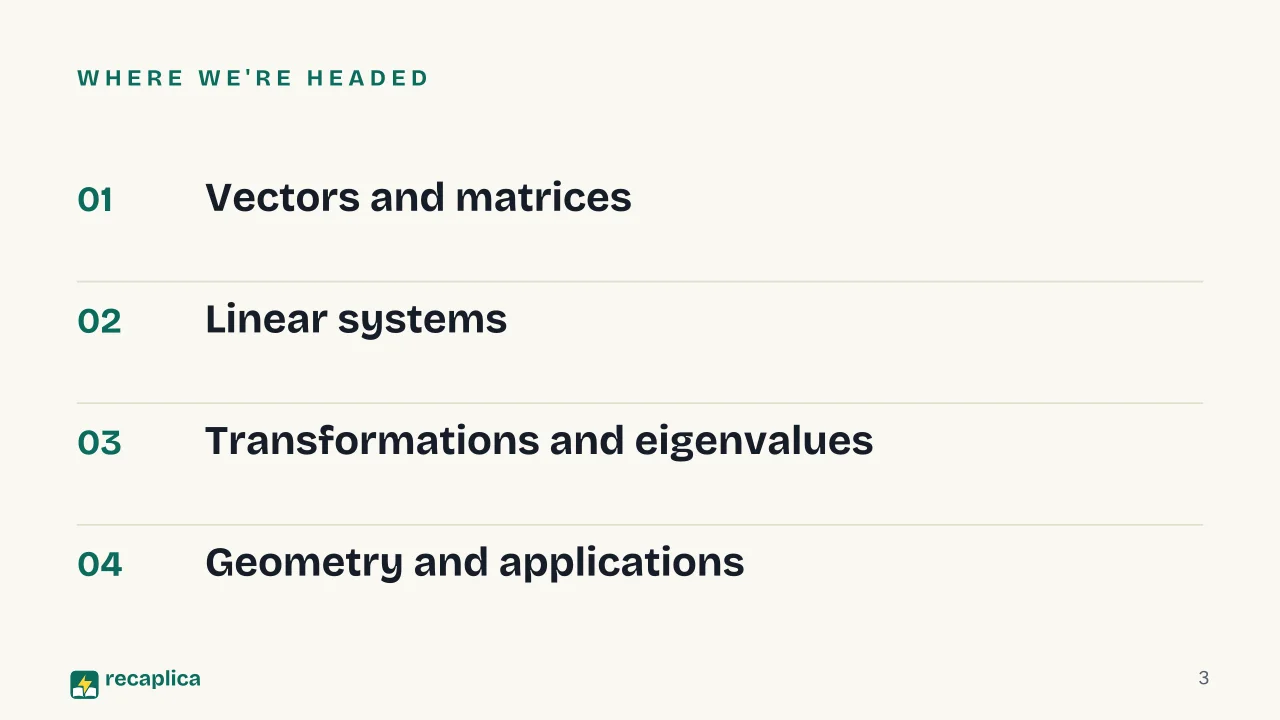
    Slide 1 of the presentation on Linear Algebra: Linear AlgebraSlide 2 of the presentation on Linear Algebra: What actually counts as linear algebra?Slide 3 of the presentation on Linear Algebra: Where we're headedSlide 4 of the presentation on Linear Algebra: Chapter 01: Vectors and matricesSlide 5 of the presentation on Linear Algebra: Scalar, vector, matrixSlide 6 of the presentation on Linear Algebra: The founding milestonesSlide 7 of the presentation on Linear Algebra: Chapter 02: Linear systemsSlide 8 of the presentation on Linear Algebra: The central equationSlide 9 of the presentation on Linear Algebra: Two thousand years before GaussSlide 10 of the presentation on Linear Algebra: Chapter 03: Transformations and eigenvaluesSlide 11 of the presentation on Linear Algebra: Eigenvalues and eigenvectorsSlide 12 of the presentation on Linear Algebra: Three early figures of vector geometry: Möbius, Bellavitis, HamiltonSlide 13 of the presentation on Linear Algebra: Chapter 04: Geometry and applicationsSlide 14 of the presentation on Linear Algebra: Two sides of the same subjectSlide 15 of the presentation on Linear Algebra: Linear algebra did not begin in the nineteenth centurySlide 16 of the presentation on Linear Algebra: Where it's usedSlide 17 of the presentation on Linear Algebra: Is the system Ax = b always solved by inverting the matrix A?Slide 18 of the presentation on Linear Algebra: The full Recap
    Flash10 slidesThe essential thread, to present in classFull18 slidesEvery chapter and the deeper detail

    Common myths

    • ✗ Myth Linear algebra is a recent invention, born with computers.

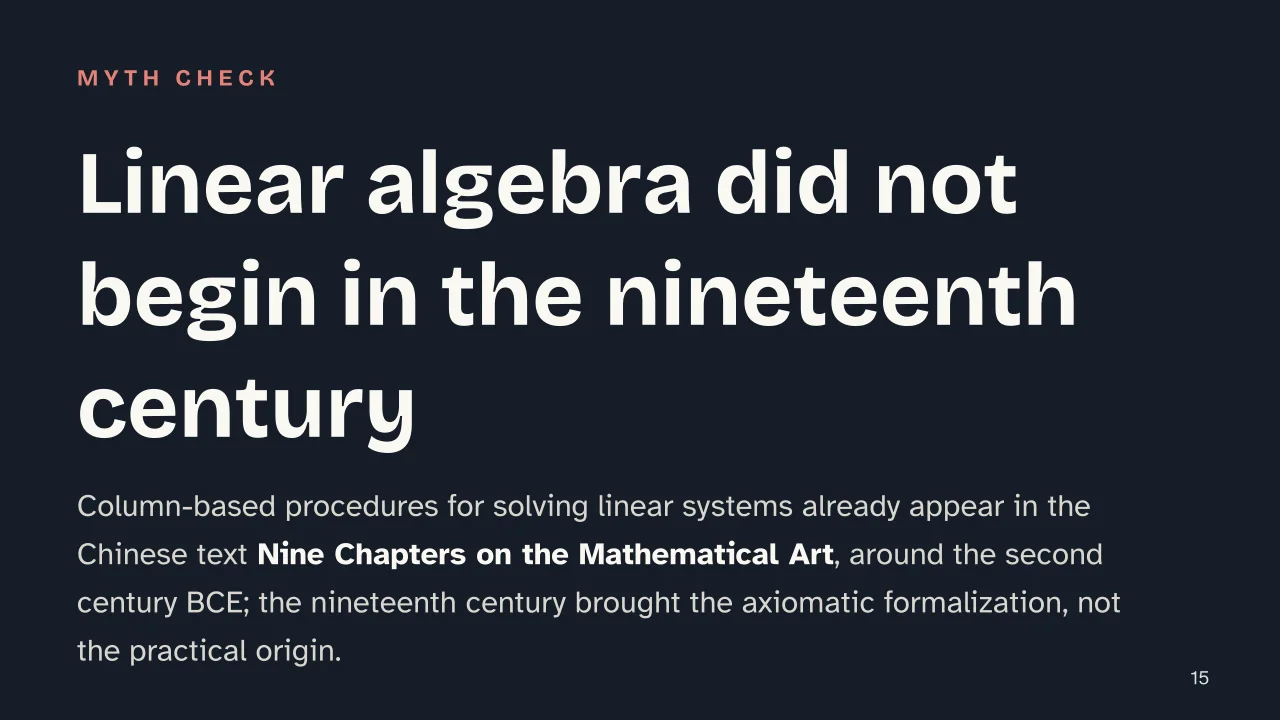
      ✓ Reality Column-based methods for solving systems of linear equations already appear in the Chinese text Nine Chapters on the Mathematical Art, dated to around the second century BCE — described by MacTutor as the earliest known example of matrix methods. The modern formal apparatus, with abstract vector spaces and matrices, only arrived in the nineteenth century, with Cayley in 1858 and Peano in 1888.

    • ✗ Myth Linear algebra is 'an algebra' in the strict technical sense, meaning a structure with a full multiplication defined between vectors.

      ✓ Reality Wolfram MathWorld points out that the name is somewhat misleading: the field studies systems of linear equations and their transformation properties, but an ordinary vector space carries no built-in multiplication between its elements. The technical term 'linear algebra', used strictly, instead names a richer structure, such as the set of square matrices or the set of linear maps from a space to itself.

    • ✗ Myth Matrices appeared together with modern linear algebra, in the nineteenth century.

      ✓ Reality The word 'matrix' was coined by James Joseph Sylvester in 1850, but procedures equivalent to today's row-and-column calculations were already in use in ancient China to solve linear systems, and in Europe Gottfried Leibniz had developed a double-index notation for systems of equations as early as 1693.

    Mind map

    Drag the background to move around and the nodes to reposition them; use − and + to collapse and expand branches.
    Customize
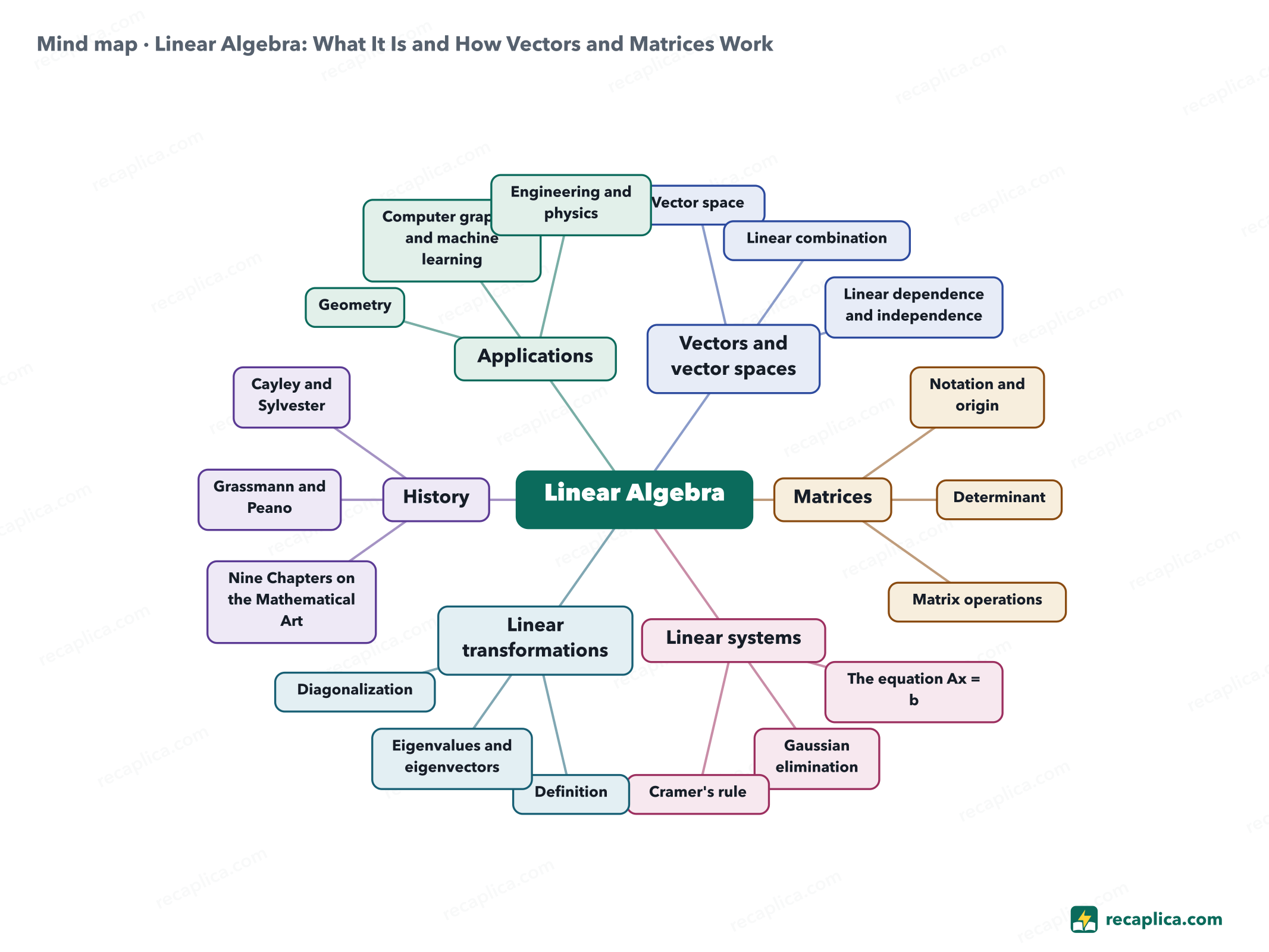
    Mind map: Linear Algebra: What It Is and How Vectors and Matrices Work
    • Linear Algebra
      • Vectors and vector spaces the basic building blocks
        • Vector space axiomatic definition, Peano 1888
        • Linear combination
        • Linear dependence and independence
      • Matrices rectangular tables of numbers
        • Notation and origin Sylvester, 1850
        • Determinant
        • Matrix operations
      • Linear systems equations solved together
        • The equation Ax = b
        • Gaussian elimination
        • Cramer's rule
      • Linear transformations functions between vector spaces
        • Definition preserves sums and scalars
        • Eigenvalues and eigenvectors
        • Diagonalization
      • History from ancient China to the nineteenth century
        • Nine Chapters on the Mathematical Art second century BCE
        • Grassmann and Peano 1844 and 1888
        • Cayley and Sylvester 1850 and 1858
      • Applications where it actually gets used
        • Geometry rotations and coordinate changes
        • Computer graphics and machine learning
        • Engineering and physics vibrations, stability

    Quiz: test yourself

    Answer the questions to check what you have learned: you get instant feedback and a short explanation.

    Grade 0/10 0/5
    1 What does linear algebra study, according to Wolfram MathWorld?

    MathWorld defines linear algebra as the study of linear systems of equations and their transformation properties — matrices and determinants, and more broadly vector spaces and the linear maps between them.

    2 What is a linear transformation?

    A linear transformation is a function between vector spaces that preserves the two defining operations of a vector space: adding vectors and multiplying a vector by a scalar.

    3 True or false: the equation det(A - λI) = 0 is used to find the eigenvalues of a matrix A.

    This is exactly the characteristic equation MathWorld gives for finding the eigenvalues λ of a square matrix A, where I is the identity matrix.

    4 Which procedure for solving systems of linear equations already appears in the Chinese text Nine Chapters on the Mathematical Art, dated to around the second century BCE?

    MacTutor reports that the text instructs the reader to multiply and subtract columns of coefficients to eliminate unknowns one at a time, a procedure that in substance anticipates Gaussian elimination.

    5 Who gave the first axiomatic definition of a real vector space, in 1888?

    Giuseppe Peano, building on Hermann Grassmann's 1844 work, gave the first axiomatic definition of a real vector space and of a linear map in 1888.

    Answers: 1-A · 2-A · 3-A · 4-A · 5-A

    Flashcards

    Tap the card to flip it and check whether you remember the answer, then move to the next one.

    1 / 8

    Explain it in your own words

    The ultimate test: if you can explain it in simple words, you've truly understood it. Write your explanation, then compare it with the Recap.

    Your explanation is saved only on this device.

    Linear algebra is the branch of mathematics that studies systems of linear equations, matrices and their determinants and, more broadly, vector spaces and the linear transformations between them. Its central objects are vectors, matrices and the transformations that relate them. Practical methods for solving systems of equations go back to ancient China, while the modern axiomatic treatment took shape in the nineteenth century, with Hermann Grassmann in 1844 and Giuseppe Peano in 1888. Today it underpins fields as different as computer graphics, statistics and engineering.

    Frequently asked questions

    What's the difference between algebra and linear algebra?

    [Algebra](/en/science/algebra/) deals more broadly with symbolic calculation — equations and expressions built from letters and numbers. Linear algebra narrows the focus to systems of linear equations, matrices and vector spaces, making it a specific branch within the wider field of algebra.

    How are linear algebra and geometry related?

    Vectors, matrices and linear transformations are the tools geometry uses to describe rotations, projections and changes of coordinate system in space. Many university courses teach the two subjects together, often under a combined name such as geometry and linear algebra.

    What is linear algebra actually used for?

    According to Encyclopaedia Britannica, matrix operations are used to plot graphs, render images, analyze electrical circuits, guide robots, develop medical scans, encrypt messages and carry out statistical analysis — a range of applications far wider than pure mathematics alone.

    Why does linear algebra matter for data science and machine learning?

    Data sets and the parameters of a machine-learning model are commonly represented as vectors and matrices, and training a model largely comes down to matrix operations on them.

    How far back do methods for solving linear systems go?

    Much further than the nineteenth century: MacTutor reports that the Chinese text Nine Chapters on the Mathematical Art, dated to around the second century BCE, already contains a column-based procedure that, in substance, anticipates Gaussian elimination.

    Sources

    • Treccani, Enciclopedia della Matematica, entry "Algebra lineare"
    • Wolfram MathWorld, "Linear Algebra"
    • Wolfram MathWorld, "Eigenvalue"
    • MacTutor History of Mathematics, "Abstract linear spaces"
    • MacTutor History of Mathematics, "Matrices and determinants"
    • MIT OpenCourseWare, 18.06 Linear Algebra (Gilbert Strang)
    • Encyclopaedia Britannica, entry "Linear algebra"
    • Encyclopaedia Britannica, entry "Eigenvalue"

    Every Recap goes through an independent review before publication.

    Every evening, the day's new Recaps on our Telegram channel. Join the channel →

    Keep learning

    • Science Cognitive Load Theory: The Definition Behind Sweller's Research Cognitive load is the amount of working memory a task uses up while you learn something new. Psychologist John Sweller first described it in 1988, starting from research on problem solving: a strategy that is too demanding leaves little room to build stable mental structures. Later research distinguishes three types of load, intrinsic, extraneous, and germane, though part of the field treats the third as indistinguishable from the first. Cutting extraneous load, with worked examples or less cluttered materials, frees up mental room for actual learning. Read the Recap →
    • Science Cognitivism: how the mind processes information Cognitivism is the psychological paradigm that treats the mind as a system for processing information, spanning perception, memory, reasoning and language. The shift began around 1956, while behaviorism, championed by Watson and Skinner, still ruled academic psychology and reduced the field to observable stimuli and responses. That same year, George Miller exposed the limits of short-term memory, and Chomsky joined McCarthy, Minsky, Newell and Simon in laying the groundwork for cognitive science. Donald Broadbent's attention model in 1958 and Ulric Neisser's 1967 book, which put the name cognitive psychology into common use, complete the roster of its founding figures. Read the Recap →
    • Science Behaviorism: What It Is and Where It Came From Behaviorism is the school of psychology that studies only observable behavior, leaving aside the thoughts and feelings that stay hidden inside the mind. It began in 1913, when the American psychologist John B. Watson published an essay calling for psychology to become an experimental science, without relying on introspection. After him, Ivan Pavlov studied conditioned reflexes and Edward Thorndike studied trial-and-error learning; Burrhus Skinner pushed the ideas to their most extreme form with radical behaviorism. The thread running through all of it is the stimulus-response model: a behavior is explained by what comes before it and what follows it, not by guessing what happens inside the head of the person doing it. Read the Recap →

    recaplica

    Clear in 30 seconds, yours in 10 minutes.

    Recaps Mind maps Request a Recap Telegram channel Mind map maker Our method About Privacy & cookies Legal notes & terms of use

    © 2026 Recaplica · A project by Curi S.r.l. — VAT IT05472000750

    Statistics, only if you say so

    To learn which Recaps help most we would use Google Analytics, with aggregate, anonymous data. It starts only with your OK, and you can change your mind anytime. Privacy policy