Skip to content
recaplica

    One moment: security check

    Cloudflare wants to make sure you're not a robot. Tick the box below and your search will continue on its own.

    IT
    recaplica Calculus: What It Is and How It Works
    © 2026 Recaplica · recaplica.com — All rights reserved
    Home › Science

    Calculus: What It Is and How It Works

    By Recaplica Newsroom · Updated on September 18, 2026

    What to print

    Page numbers appear when printing with default margins.

    Slides

    Choose a cut

    Flash10 slidesThe essential thread, to present in classFull18 slidesEvery chapter and the deeper detail

    Both come with speaker notes.

    Telegram channel
    recaplica Clear in 30 seconds, yours in 10 minutes.
    In 30 seconds Key points Figures Deep dive Slides Myths Mind map Quiz Flashcards FAQ

    In 30 seconds quick read

    Calculus is the branch of mathematics that studies functions defined on sets of real or complex numbers, and it builds up in a fixed order. A limit describes what a function approaches without needing to reach it there; continuity asks the graph not to break; the derivative measures how fast a function changes; the integral adds up infinitely many tiny pieces to reconstruct an area or a total quantity. This thread — function, limit, continuity, derivative, integral — was worked out independently by Newton and Leibniz in the 1600s, and the field became known as calculus.

    Key Points

    • Calculus studies functions defined on sets of real or complex numbers; it splits into real analysis and complex analysis, plus more specialized branches such as functional analysis.
    • A function pairs every element of its domain with exactly one element of its codomain: several inputs can share an output, but one input can never point to two outputs.
    • A limit is the value a function approaches at a point, even when the function isn't actually defined there.
    • A function is continuous at a point when its limit there exists and matches the function's value: continuity is necessary for differentiability but not enough on its own.
    • The derivative is the limit of the difference quotient and measures a function's instantaneous rate of change.
    • A definite integral adds up infinitely many infinitesimal pieces to compute an area; an indefinite integral is only defined up to a constant, because the derivative of a constant is zero.

    Key figures

    • 225 BC The approximate year, according to MacTutor, in which Archimedes computed the area of a parabolic segment using what the source describes as the earliest known example of summing an infinite series. Source: MacTutor History of Mathematics
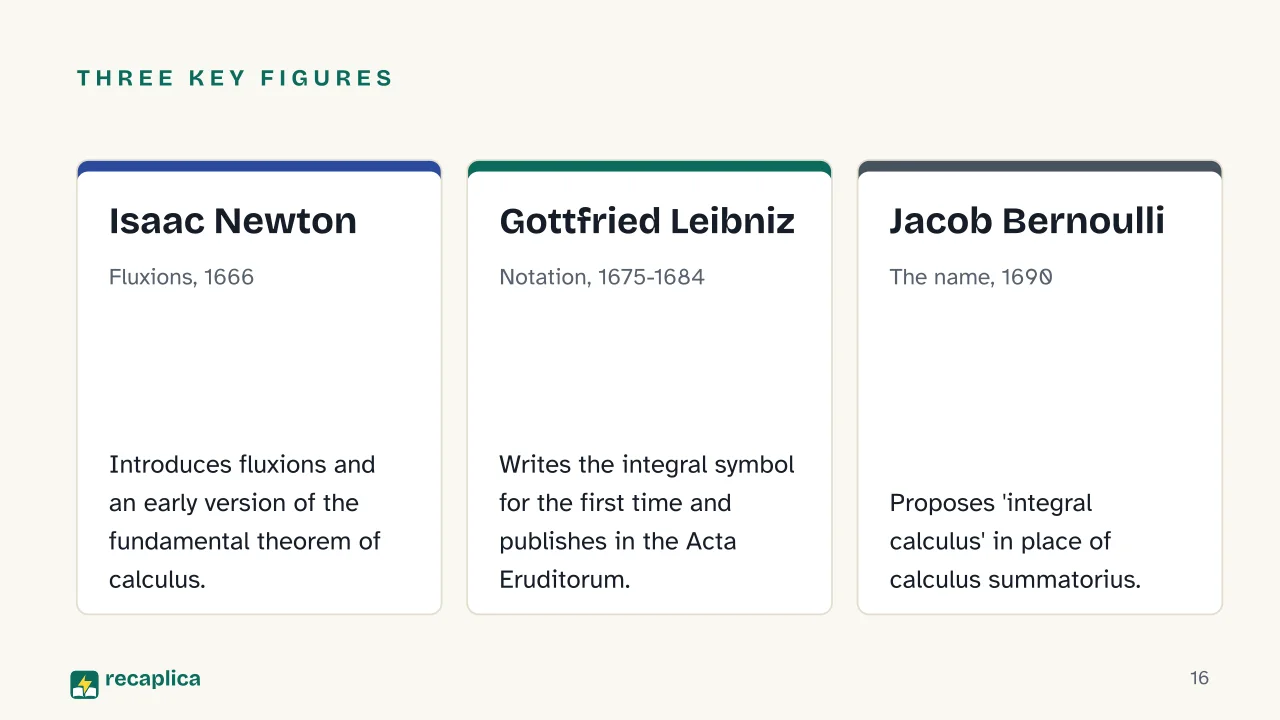
    • 1684 The year Leibniz published his first results on differential and integral calculus in the Acta Eruditorum. Source: MacTutor History of Mathematics
    • 1690 The year Jacob Bernoulli proposed the name 'integral calculus' for the branch previously known as calculus summatorius. Source: MacTutor History of Mathematics

    Deep Dive

    What calculus is

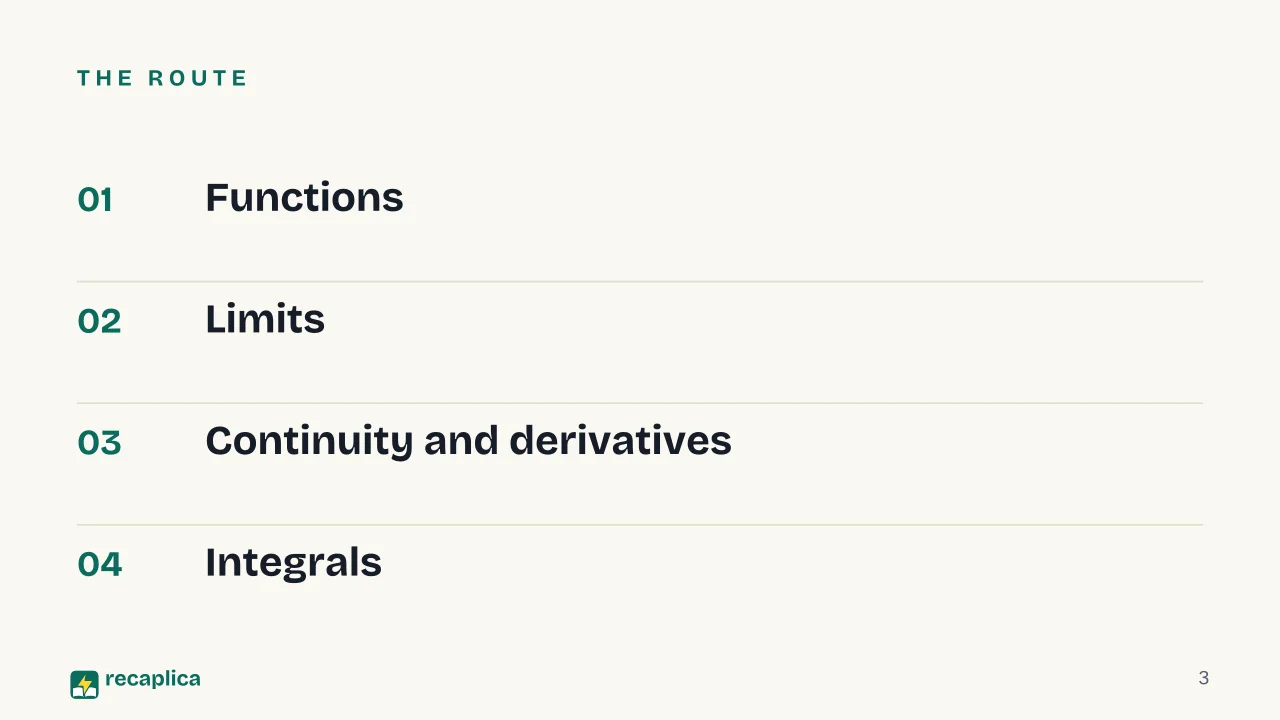
    The Treccani Encyclopedia of Mathematics defines the field, in its entry on “analisi matematica,” as the branch that studies functions defined on sets of real or complex numbers. Around that definition sit a handful of central ideas — limit, derivative, integral, series, differential equations — that build on one another: first the function, then the limit, then continuity, then the derivative, and finally the integral.

    The same entry splits the discipline into two main branches: real analysis, which studies real functions of a real variable, and complex analysis, which studies functions of a complex variable. Around these sit more specialized fields — harmonic analysis, nonstandard analysis, measure theory, functional analysis, differential equations — that fall outside the scope of this Recap; here the focus stays on the core, historically called infinitesimal analysis and known today, more often, simply as calculus.

    For anyone coming from algebra and arithmetic, calculus isn’t a separate field so much as a further step: functions are written and manipulated with the same rules of symbolic notation, but the goal shifts, since the point is no longer solving an equation but describing how a quantity changes or accumulates.

    Functions, the starting point

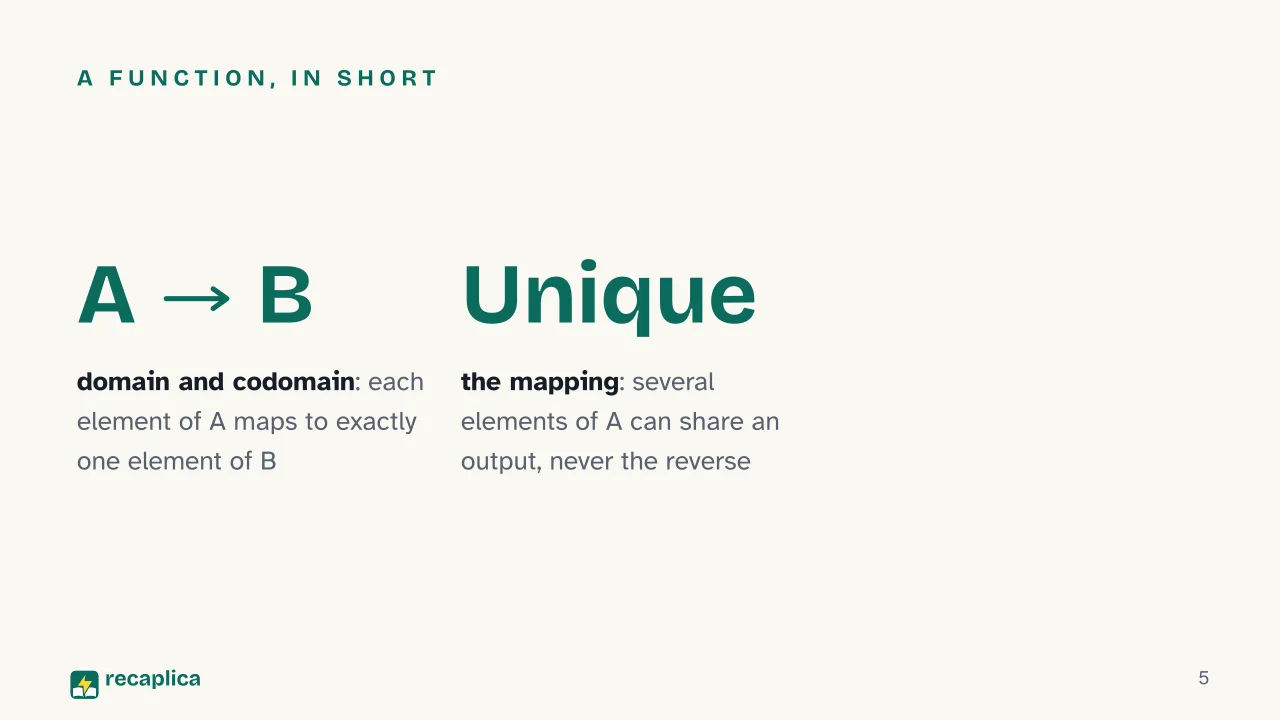
    Wolfram MathWorld defines a function as a mapping f from a set A, the domain, to a set B, the codomain, such that every element of A is paired with exactly one element f(a) of B. The relationship can be many-to-one — several elements of the domain can share the same image — but never the reverse: a single element of the domain can’t point to two different outputs.

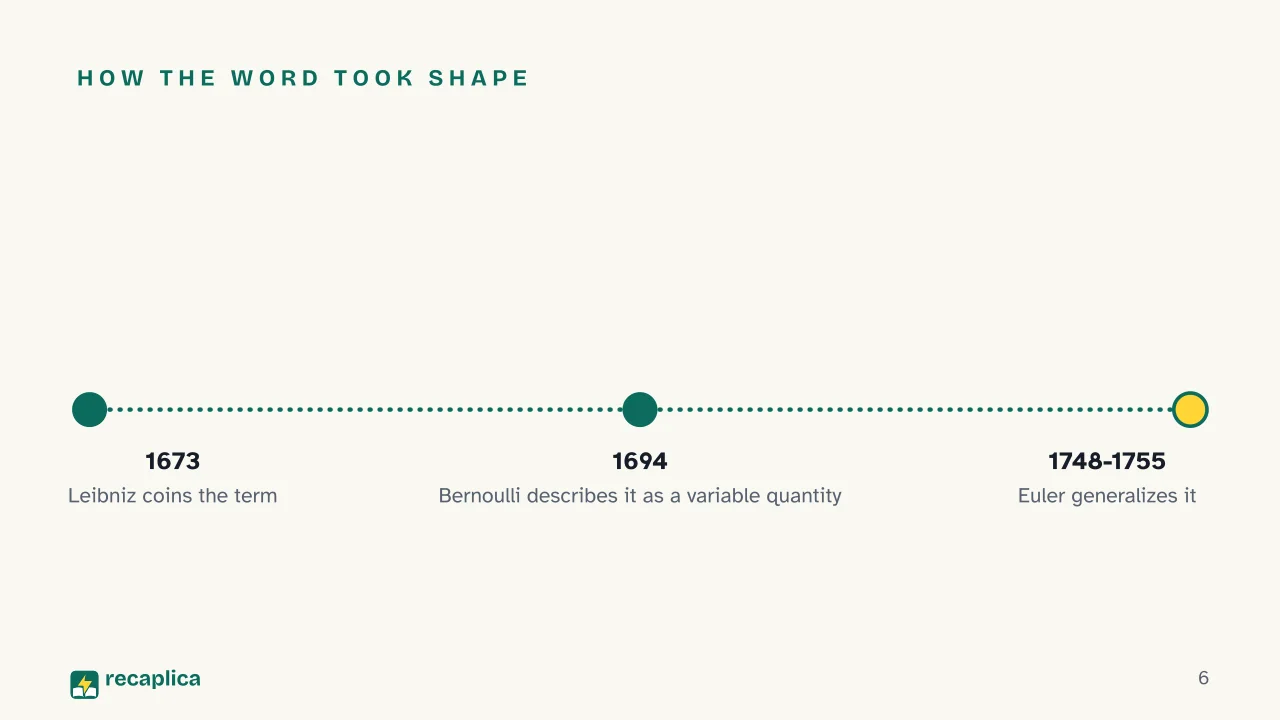
    The word “function” in a mathematical sense first appears in a letter Leibniz wrote in August 1673, still with a fairly loose meaning. It was Johann Bernoulli, in a letter to Leibniz dated 2 September 1694, who gave it a more technical description, as a quantity built from variable and constant quantities. Euler sharpened it further: in his 1748 Introductio in analysin infinitorum he defined it as an analytic expression composed in any way from the variable and constants; by 1755, in the Institutiones calculi differentialis, he offered a broader version tied not to an explicit formula but to plain dependence between quantities — if one changes whenever another does, the first is a function of the second.

    Limits, approaching without needing to arrive

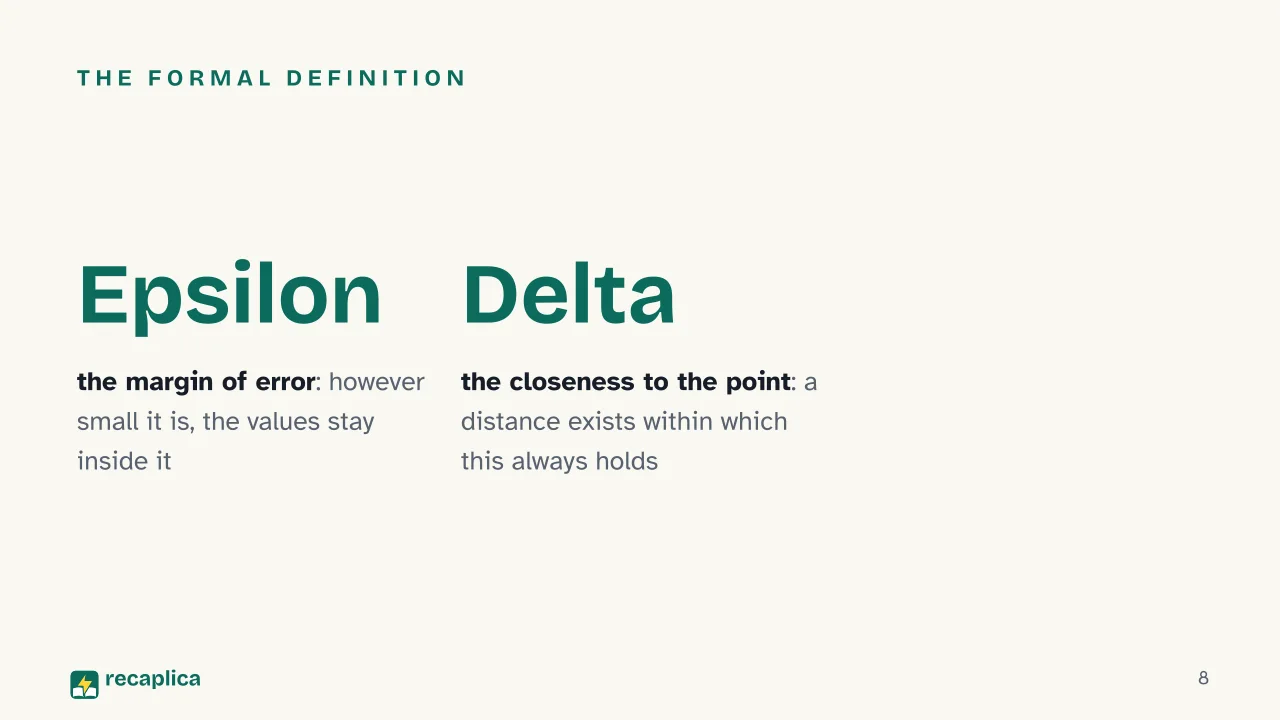
    A limit describes how a function behaves as the variable gets closer to a point, without requiring the function to be defined exactly there. In the formal “epsilon-delta” definition reported by MathWorld, a function has limit c at a point a if, for any margin of error chosen as small as one likes, there is a distance from the point within which the function’s values stay inside that margin. The same idea applies to sequences of numbers: a sequence has limit L if, from some index onward, every term stays as close to L as one wants.

    It’s a concept that underpins everything else: continuity, the derivative, and the integral are all defined starting from a limit.

    Continuity, when the graph doesn’t break

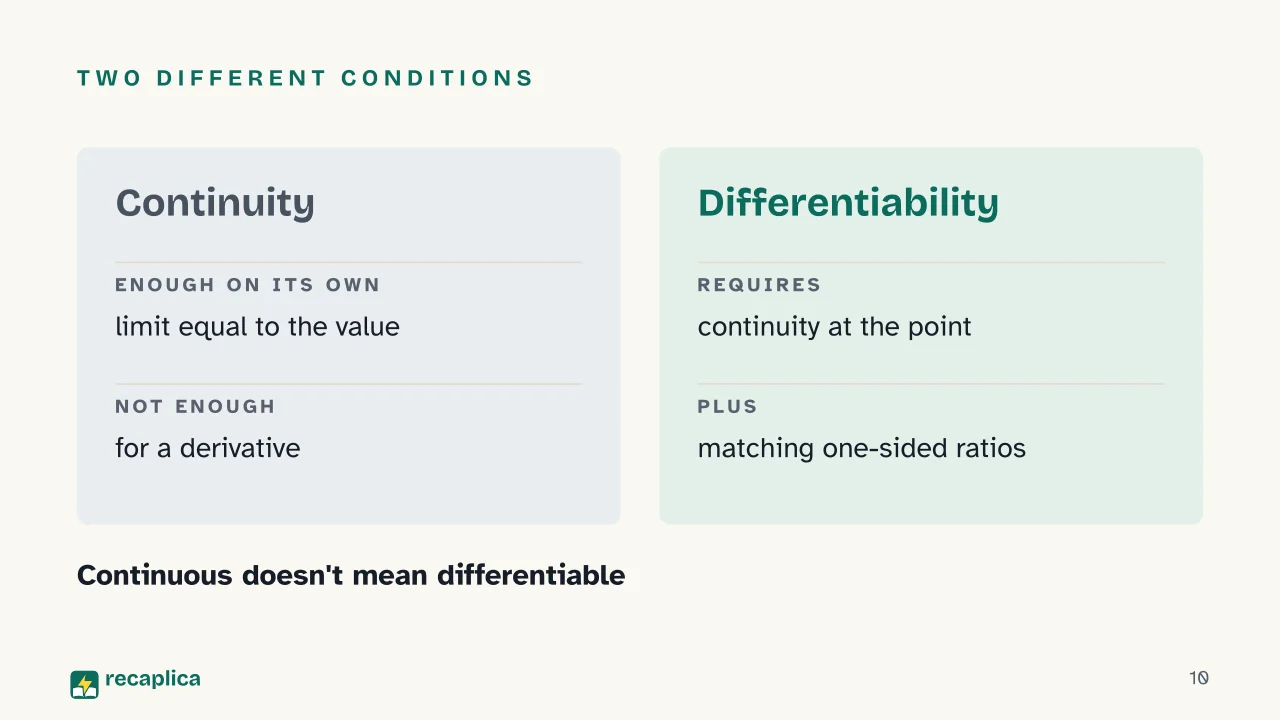
    A function is continuous at a point x₀ when three conditions hold together: the function is defined at x₀, its limit at x₀ exists, and that limit matches the function’s value at x₀. If even one of these three conditions fails, the function has a discontinuity there — a jump, a gap, or an oscillation with no limit.

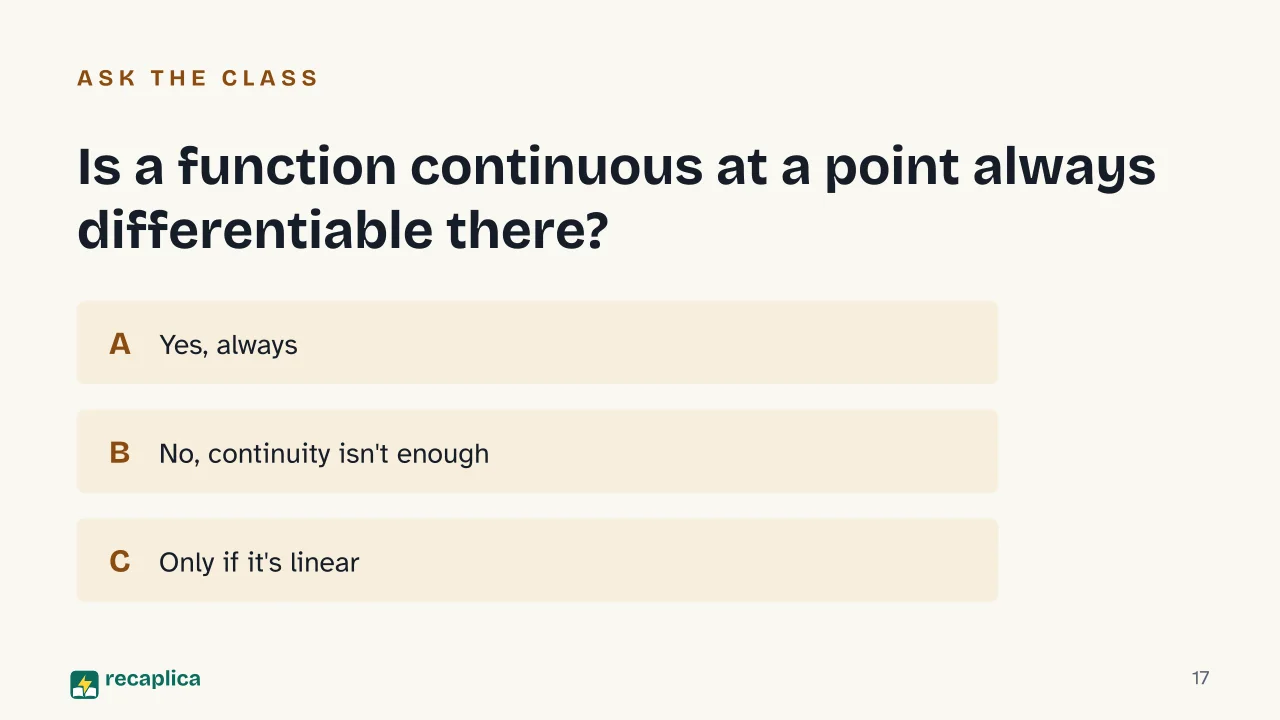
    Continuity is a necessary condition for differentiability, but it isn’t sufficient: a function can be continuous at a point and still have no derivative there, if the difference quotient doesn’t approach the same value from the right and from the left.

    The derivative, the speed of change

    The derivative of a function at a point is the limit of the difference quotient [f(x+h) - f(x)] / h as h approaches zero: it measures how fast the function changes right at that point, not its average change over an interval.

    Practical example: if a function describes an object’s position over time, its derivative describes that object’s instantaneous velocity at every moment — and it’s precisely in terms of instantaneous velocity and acceleration, that is, derivatives, that Newton’s three laws of motion are written.

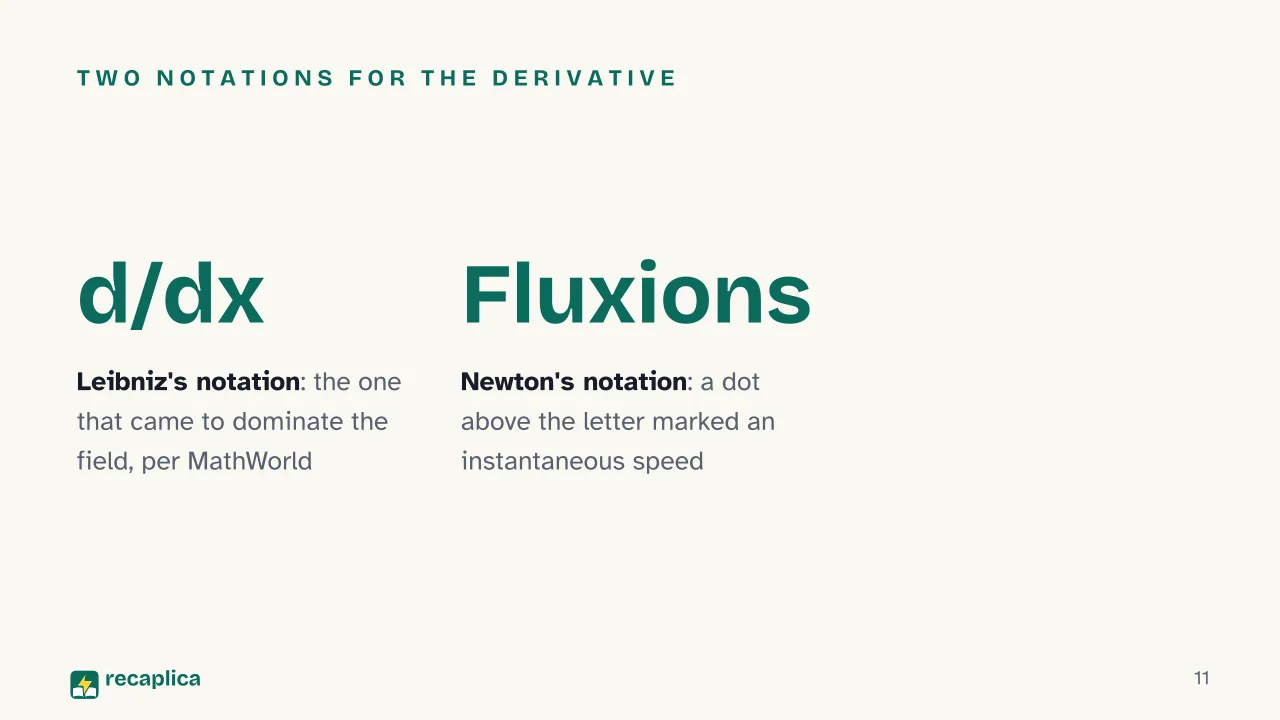
    Historically, the derivative had two parallel notations. Leibniz wrote d/dx; Newton used a dot above the letter to mark “fluxions,” instantaneous speeds — a notion he introduced as early as October 1666, in his Tract on Fluxions, alongside what MacTutor describes as the earliest explicit statement of the fundamental theorem of calculus. According to MathWorld, Leibniz’s notation eventually won out over Newton’s in everyday use.

    The integral, adding up infinitely many pieces

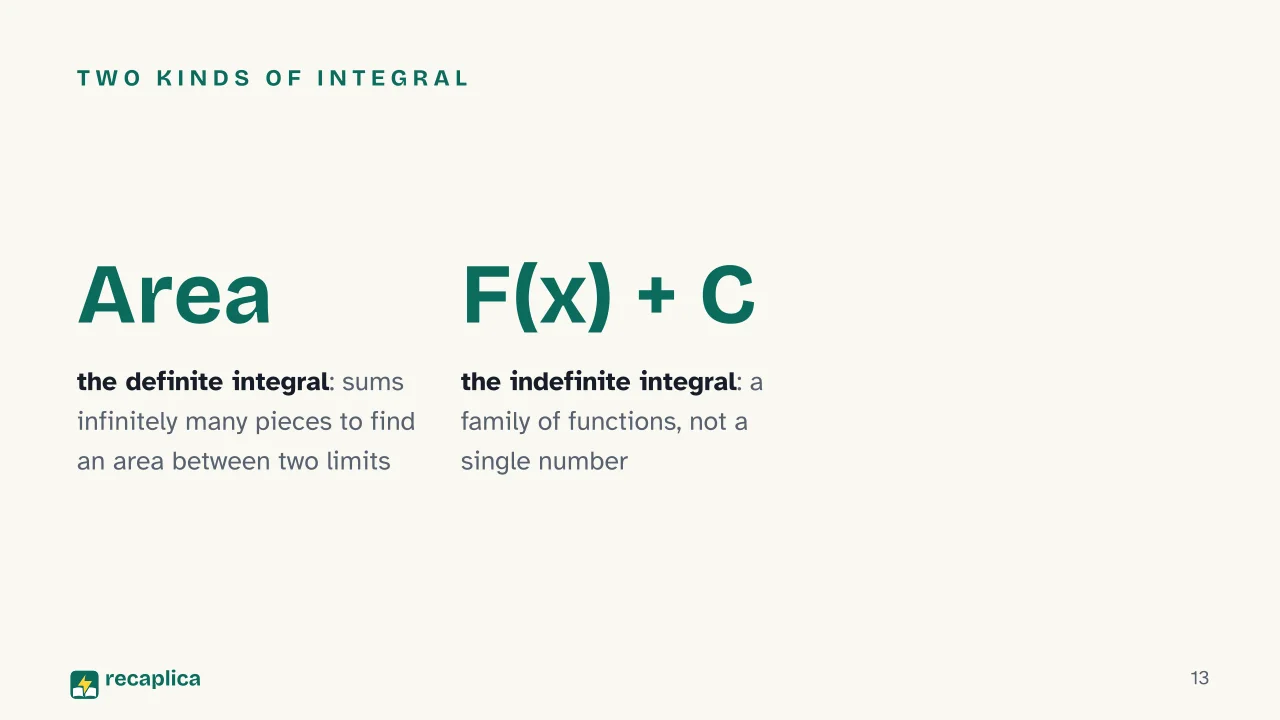
    The definite integral ∫ₐᵇ f(x)dx adds up infinitely many infinitesimal pieces to compute the content of a continuous region, typically an area under a function’s graph, between two limits a and b. The indefinite integral ∫f(x)dx, on the other hand, isn’t a number but a family of functions: it’s defined only up to an arbitrary constant C, because if F(x) is an antiderivative of f(x), then F(x)+C is one too, since the derivative of a constant is always zero.

    DerivativeIntegral
    What it measuresThe rate of change at a pointThe total accumulated over an interval
    ResultA number, or a new functionAn area (definite) or a family of functions (indefinite)
    Symbolf′(x), or d/dx∫f(x)dx

    The link between the two ideas is the fundamental theorem of calculus, whose first part — as reported by MathWorld — states that ∫ₐᵇ f(x)dx = F(b) - F(a), where F is an antiderivative of f: the derivative and the integral are, in a sense, inverse operations of one another.

    A story two thousand years long

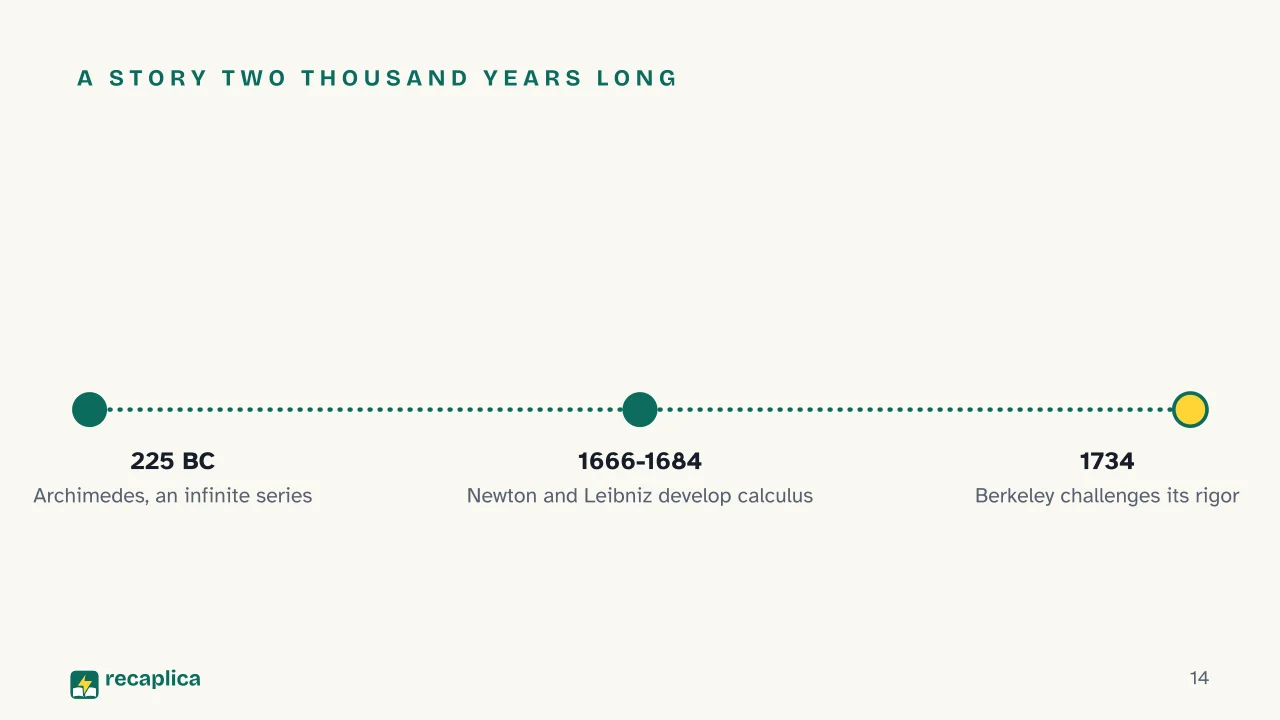
    The core idea of adding up infinitely many tiny pieces predates the 1600s by a wide margin: according to MacTutor, Archimedes, around 225 BC, already computed the area of a parabolic segment using what the source describes as the earliest known example of summing an infinite series.

    Calculus itself was born in the second half of the 1600s, when Newton and Leibniz arrived at similar results while working independently. Leibniz met Christiaan Huygens in Paris in 1672 and, the following year, bought mathematical works in London, including some by Isaac Barrow; in 1675 he wrote the first expression using the integral symbol, and he published his results on differential and integral calculus in the Acta Eruditorum in 1684 and 1686. Newton, for his part, had written Analysis with infinite series in 1669 and Method of fluxions in 1671, but only published them many years later, in 1711 and 1736 respectively; according to MacTutor, the failure of the publisher of one of Barrow’s works made publishers more cautious about printing mathematical texts for a period, a factor that contributed to the delay. It was Jacob Bernoulli, in 1690, who proposed the name “integral calculus” for the branch of the field previously called calculus summatorius.

    The rigor with which limit and continuity are defined arrived later. In 1734 the philosopher George Berkeley published The Analyst, a work that attacked the lack of solid foundations in the calculus of the time; his criticism opened, over the following decades, a path that culminated in Cauchy’s nineteenth-century work on the rigorous definitions of limit and continuity that later became standard.

    Slide deck

    Slides ready to download and make your own in PowerPoint or Google Slides, with speaker notes. Pick the Flash cut or the Full one.
    Slide 1 of the presentation on Calculus: CalculusSlide 2 of the presentation on Calculus: What is calculus, really?Slide 3 of the presentation on Calculus: The routeSlide 4 of the presentation on Calculus: Chapter 01: FunctionsSlide 5 of the presentation on Calculus: A function, in shortSlide 6 of the presentation on Calculus: How the word took shapeSlide 7 of the presentation on Calculus: Chapter 02: LimitsSlide 8 of the presentation on Calculus: The formal definitionSlide 9 of the presentation on Calculus: Chapter 03: Continuity and derivativesSlide 10 of the presentation on Calculus: Two different conditionsSlide 11 of the presentation on Calculus: Two notations for the derivativeSlide 12 of the presentation on Calculus: Chapter 04: IntegralsSlide 13 of the presentation on Calculus: Two kinds of integralSlide 14 of the presentation on Calculus: A story two thousand years longSlide 15 of the presentation on Calculus: Calculus doesn't have a single inventorSlide 16 of the presentation on Calculus: Three key figures: Isaac Newton, Gottfried Leibniz, Jacob BernoulliSlide 17 of the presentation on Calculus: Is a function continuous at a point always differentiable there?Slide 18 of the presentation on Calculus: The full Recap
    Flash10 slidesThe essential thread, to present in classFull18 slidesEvery chapter and the deeper detail

    Common myths

    • ✗ Myth Calculus was invented by a single person.

      ✓ Reality Modern historians recognize that Newton and Leibniz developed calculus independently, around the same time, using different notations: Newton worked mainly between 1665 and 1670, while Leibniz reached similar results in the years that followed and published first, in 1684, in the Acta Eruditorum.

    • ✗ Myth If a function is continuous at a point, it must also be differentiable there.

      ✓ Reality Continuity is a necessary but not sufficient condition for differentiability, because the existence of a derivative also requires the two one-sided limits of the difference quotient (from the right and from the left) to exist and match: a function can therefore be continuous without being differentiable.

    • ✗ Myth A function always has to be an algebraic expression or a formula.

      ✓ Reality Euler himself, who in 1748 defined a function as an analytic expression built from a variable, gave a broader definition in 1755 tied not to a formula but to plain dependence between quantities: if one changes whenever another does, the first is a function of the second.

    Mind map

    Drag the background to move around and the nodes to reposition them; use − and + to collapse and expand branches.
    Customize
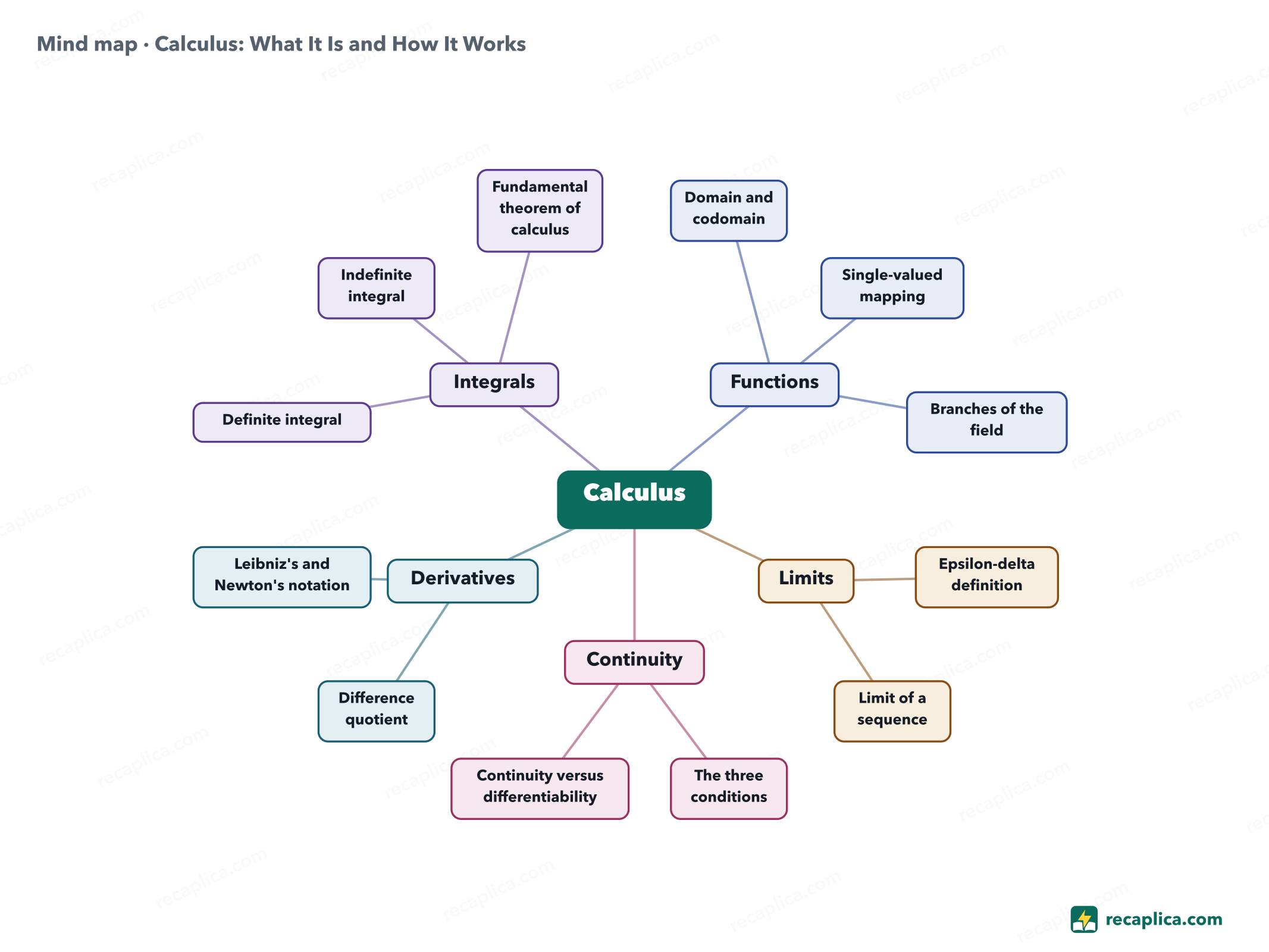
    Mind map: Calculus: What It Is and How It Works
    • Calculus
      • Functions the starting point
        • Domain and codomain the starting set and the arrival set
        • Single-valued mapping one input, one output
        • Branches of the field real analysis and complex analysis
      • Limits approaching without needing to arrive
        • Epsilon-delta definition
        • Limit of a sequence
      • Continuity the graph doesn't break
        • The three conditions
        • Continuity versus differentiability
      • Derivatives the speed of change
        • Difference quotient
        • Leibniz's and Newton's notation
      • Integrals adding up infinitely many pieces
        • Definite integral an area, a number
        • Indefinite integral a family of functions, the constant C
        • Fundamental theorem of calculus

    Quiz: test yourself

    Answer the questions to check what you have learned: you get instant feedback and a short explanation.

    Grade 0/10 0/5
    1 What does the Treccani Encyclopedia of Mathematics say calculus studies?

    Treccani defines calculus (analisi matematica) as the field that studies functions defined on sets of real or complex numbers, with real or complex values.

    2 What does it mean for a function to go from a domain A to a codomain B?

    Wolfram MathWorld defines a function as a mapping where every element of A is uniquely associated with an element f(a) of B; several elements of A can share the same image, but not the other way around.

    3 True or false: if a function is continuous at a point, it is also differentiable there.

    Continuity is necessary but not sufficient for differentiability: for the derivative to exist, the two one-sided limits of the difference quotient must also exist and agree with each other.

    4 What does the derivative of a function at a point measure?

    The derivative is the limit of the difference quotient [f(x+h)-f(x)]/h as h approaches zero, and it describes how quickly the function changes at one specific point.

    5 Why is the indefinite integral of a function defined 'up to a constant'?

    If F(x) is an antiderivative of f(x), then F(x)+C is one too for any constant C, because the derivative of a constant is zero: that's why the indefinite integral is written as ∫f(x)dx = F(x) + C.

    Answers: 1-A · 2-A · 3-B · 4-C · 5-B

    Flashcards

    Tap the card to flip it and check whether you remember the answer, then move to the next one.

    1 / 8

    Explain it in your own words

    The ultimate test: if you can explain it in simple words, you've truly understood it. Write your explanation, then compare it with the Recap.

    Your explanation is saved only on this device.

    Calculus is the branch of mathematics that studies functions defined on sets of real or complex numbers, and it builds up in a fixed order. A limit describes what a function approaches without needing to reach it there; continuity asks the graph not to break; the derivative measures how fast a function changes; the integral adds up infinitely many tiny pieces to reconstruct an area or a total quantity. This thread — function, limit, continuity, derivative, integral — was worked out independently by Newton and Leibniz in the 1600s, and the field became known as calculus.

    Frequently asked questions

    What's the difference between calculus and algebra?

    Algebra mainly works with equations and symbolic expressions built from numbers and letters; calculus studies functions through limits, continuity, derivatives, and integrals, tools built to describe change and accumulation rather than just to solve equations. The two fields stay connected: the functions studied in calculus are written using the same rules of symbolic notation from [algebra](/en/science/algebra/).

    What is calculus actually used for?

    Limits, continuity, derivatives, and integrals are the toolkit for describing quantities that change over time or space: speed and acceleration (derivative), areas and accumulated totals (integral). [Newton's three laws of motion](/en/science/newtons-laws-of-motion/), for instance, are written in terms of instantaneous velocity and acceleration, which are derivatives.

    Why does an indefinite integral have 'infinitely many solutions'?

    Because every antiderivative F(x) of a function f(x) stays an antiderivative after adding any constant C, since the derivative of a constant is zero: the expression ∫f(x)dx = F(x) + C therefore stands for a whole family of functions, not just one.

    Are calculus and mathematical analysis the same thing?

    In everyday use, yes, when the term refers to the historical core of the field, namely limits, derivatives, and integrals, born in the 1600s with Newton and Leibniz. More broadly, mathematical analysis also covers more specialized branches, such as complex analysis, functional analysis, and measure theory, which go beyond basic calculus.

    Since when has the integral symbol ∫ existed?

    Leibniz introduced it in 1675, writing for the first time an expression like ∫y dy = ½y²: according to MacTutor, he recorded it already in the form that has remained standard ever since.

    Sources

    • Treccani, Enciclopedia della Matematica, entry 'Analisi matematica'
    • Wolfram MathWorld, 'Function'
    • Wolfram MathWorld, 'Limit'
    • Wolfram MathWorld, 'Continuous Function'
    • Wolfram MathWorld, 'Derivative'
    • Wolfram MathWorld, 'Integral'
    • MacTutor History of Mathematics, 'The rise of calculus'
    • MacTutor History of Mathematics, 'A history of the calculus concept of a function'

    Every Recap goes through an independent review before publication.

    Every evening, the day's new Recaps on our Telegram channel. Join the channel →

    Keep learning

    • Science Cognitive Load Theory: The Definition Behind Sweller's Research Cognitive load is the amount of working memory a task uses up while you learn something new. Psychologist John Sweller first described it in 1988, starting from research on problem solving: a strategy that is too demanding leaves little room to build stable mental structures. Later research distinguishes three types of load, intrinsic, extraneous, and germane, though part of the field treats the third as indistinguishable from the first. Cutting extraneous load, with worked examples or less cluttered materials, frees up mental room for actual learning. Read the Recap →
    • Science Cognitivism: how the mind processes information Cognitivism is the psychological paradigm that treats the mind as a system for processing information, spanning perception, memory, reasoning and language. The shift began around 1956, while behaviorism, championed by Watson and Skinner, still ruled academic psychology and reduced the field to observable stimuli and responses. That same year, George Miller exposed the limits of short-term memory, and Chomsky joined McCarthy, Minsky, Newell and Simon in laying the groundwork for cognitive science. Donald Broadbent's attention model in 1958 and Ulric Neisser's 1967 book, which put the name cognitive psychology into common use, complete the roster of its founding figures. Read the Recap →
    • Science Behaviorism: What It Is and Where It Came From Behaviorism is the school of psychology that studies only observable behavior, leaving aside the thoughts and feelings that stay hidden inside the mind. It began in 1913, when the American psychologist John B. Watson published an essay calling for psychology to become an experimental science, without relying on introspection. After him, Ivan Pavlov studied conditioned reflexes and Edward Thorndike studied trial-and-error learning; Burrhus Skinner pushed the ideas to their most extreme form with radical behaviorism. The thread running through all of it is the stimulus-response model: a behavior is explained by what comes before it and what follows it, not by guessing what happens inside the head of the person doing it. Read the Recap →

    recaplica

    Clear in 30 seconds, yours in 10 minutes.

    Recaps Mind maps Request a Recap Telegram channel Mind map maker Our method About Privacy & cookies Legal notes & terms of use

    © 2026 Recaplica · A project by Curi S.r.l. — VAT IT05472000750

    Statistics, only if you say so

    To learn which Recaps help most we would use Google Analytics, with aggregate, anonymous data. It starts only with your OK, and you can change your mind anytime. Privacy policy