|
recaplica
Non-Euclidean Geometry: Hyperbolic and Elliptic Compared | ||||||||||||||||
| © 2026 Recaplica · recaplica.com — All rights reserved | ||||||||||||||||
Non-Euclidean Geometry: Hyperbolic and Elliptic ComparedWhat to print Page numbers appear when printing with default margins. SlidesChoose a cut Flash10 slidesThe essential thread, to present in classFull18 slidesEvery chapter and the deeper detailBoth come with speaker notes. In 30 seconds quick readNon-Euclidean geometry appears the moment you drop Euclid's fifth postulate, the one about parallel lines, while keeping everything else intact. Two different paths lead to opposite results: in hyperbolic geometry, at least two lines through a point outside a given line never meet it; in elliptic geometry, none do, because every pair of lines eventually crosses. The curvature of spacetime in Einstein's general relativity is written in the language Bernhard Riemann built in 1854. Understanding this geometry also means understanding why the angles of a triangle, taught in school as a fixed 180°, actually depend on the shape of the space that triangle sits in. Key Points
Deep DiveA postulate nobody could get rid ofIn his Elements (around 300 BC), Euclid built geometry on five postulates: statements assumed true without proof, the starting point from which everything else follows by logic. A theorem, by contrast, has to be proved from the postulates — the difference isn’t about importance, it’s about the role each plays in the system. According to MacTutor History of Mathematics, the fifth postulate, the one about parallel lines, stood apart from the other four from the start, and Euclid himself avoided using it for as long as he could in his own books. The original wording is awkward to read today: if a line crossing two other lines forms interior angles on one side that add up to less than two right angles, then those two lines, extended far enough, will meet on that side. Put differently: exactly one parallel passes through a point outside a given line. It’s the idea taught in school as obvious. For over two thousand years, mathematicians suspected it wasn’t really a postulate at all but a disguised theorem, something that should follow from the other four, and they tried to prove it. Attempt after attempt failed in much the same way: whoever thought they had proved the postulate had, somewhere in the argument, smuggled in an assumption equivalent to the postulate itself. John Wallis, in 1663, reduced it to another form instead of actually deriving it. Girolamo Saccheri, in 1697, tried the opposite route: he assumed the postulate was false, hoping to reach a logical contradiction that would prove it true by absurdity, but the conclusion he reached only struck him as “repugnant to the nature of the straight line,” not a genuine contradiction. Johann Heinrich Lambert, in 1766, followed Saccheri’s method without falling into his logical error, but without reaching a firm conclusion either. Adrien-Marie Legendre, according to MacTutor, spent forty years of his life on it. Jean le Rond D’Alembert, in 1767, went so far as to call the parallel postulate problem the scandal of elementary geometry. Two new geometries, discovered almost togetherThe breakthrough came when someone stopped trying to prove the postulate and tried denying it instead, just to see what would happen. János Bolyai, a Hungarian mathematician, and Nikolai Lobachevsky, a Russian mathematician, independently reached the same idea in the 1820s: remove the fifth postulate and leave the rest of Euclidean geometry untouched, and the resulting system isn’t contradictory at all. It’s a different geometry, not a mistake. Bolyai wrote to his father in 1823 that he had made an extraordinary discovery, and published his results as a slim 24-page appendix to a book by his father. Carl Friedrich Gauss, who had worked on the same problem privately since the 1790s without ever publishing — out of caution, according to the Stanford Encyclopedia of Philosophy, about the controversy it might stir — described Bolyai as “a geometer of the first rank.” Lobachevsky reached equivalent results by an independent route and published first, in 1829, in the Kazan Messenger, a journal little known outside Russia; a later paper of his was even rejected by the St. Petersburg Academy. That’s why the geometry born from denying Euclid’s fifth postulate is also called Lobachevskian geometry, more commonly hyperbolic geometry or one of the non-Euclidean geometries. Lobachevsky never lived to see it recognized: he died in 1856, and the mathematical community only accepted it between 1866 and 1887, through translations and the seminars of mathematicians such as Felix Klein. In hyperbolic geometry, at least two lines through a point outside a given line avoid it entirely, not just one: this is the alternative postulate Lobachevsky formulated. One direct consequence involves triangles: the sum of their interior angles is always less than 180°, and the bigger the triangle, the further that sum drifts from 180°.
Riemann and the geometry with no parallelsBernhard Riemann took the opposite route. In his habilitation lecture at the University of Göttingen, delivered on June 10, 1854, and titled On the Hypotheses Which Lie at the Foundations of Geometry, he described a geometry with no parallels at all: every line through a point outside a given line meets it anyway. The lecture wasn’t published until 1868, two years after Riemann’s death, and according to MacTutor it wasn’t fully understood for roughly sixty years. In elliptic geometry, the name the Riemannian approach eventually took, a triangle’s angles always add up to more than 180°. In 1871 Felix Klein completed the work Eugenio Beltrami had started three years earlier with the first concrete model of hyperbolic geometry, the pseudosphere, a surface generated by rotating a curve called a tractrix. Klein, building on a definition of distance proposed by Arthur Cayley in 1859, proved that three fundamentally different geometries exist, each fully consistent on its own terms. Here’s how they compare, point by point:
Euclidean geometry is the special case, the one with zero curvature, the “flat” space taught first in school, sitting inside a wider family of equally valid geometries. Curved space shows up in art, too. Between 1958 and 1960, the artist Maurits Cornelis Escher produced the Circle Limit series, built on hyperbolic geometry. The term “non-Euclidean” also left its mark on fiction: H.P. Lovecraft used it to describe the alien architecture in his stories, a use quite different from the rigorous mathematical one.
From a mathematics lecture to a theory of gravityFor decades, Riemann’s geometry stayed a chapter of pure mathematics, far from any visible application. That changed with Albert Einstein. In 1915, while working on general relativity, his colleague Marcel Grossmann introduced him to Riemann’s ideas about differential geometry: they turned out to be exactly the tool he needed to complete the theory that same year. In the mathematical language Riemann had built in 1854, refined by the absolute differential calculus developed later by Gregorio Ricci-Curbastro and Tullio Levi-Civita, spacetime is a curved space, and its curvature is what a gravitational field is: the more mass and energy present in a region, the more that region curves. Riemann built his geometry on the tools of differential calculus, the branch of mathematics that describes precisely how a quantity changes: without it, the idea of curvature in a space with more than two dimensions wouldn’t have had a precise definition to work with. All three geometries coexist, each consistent on its own terms. Physics picks whichever one best describes the space it happens to be studying. Slide deckSlides ready to download and make your own in PowerPoint or Google Slides, with speaker notes. Pick the Flash cut or the Full one.     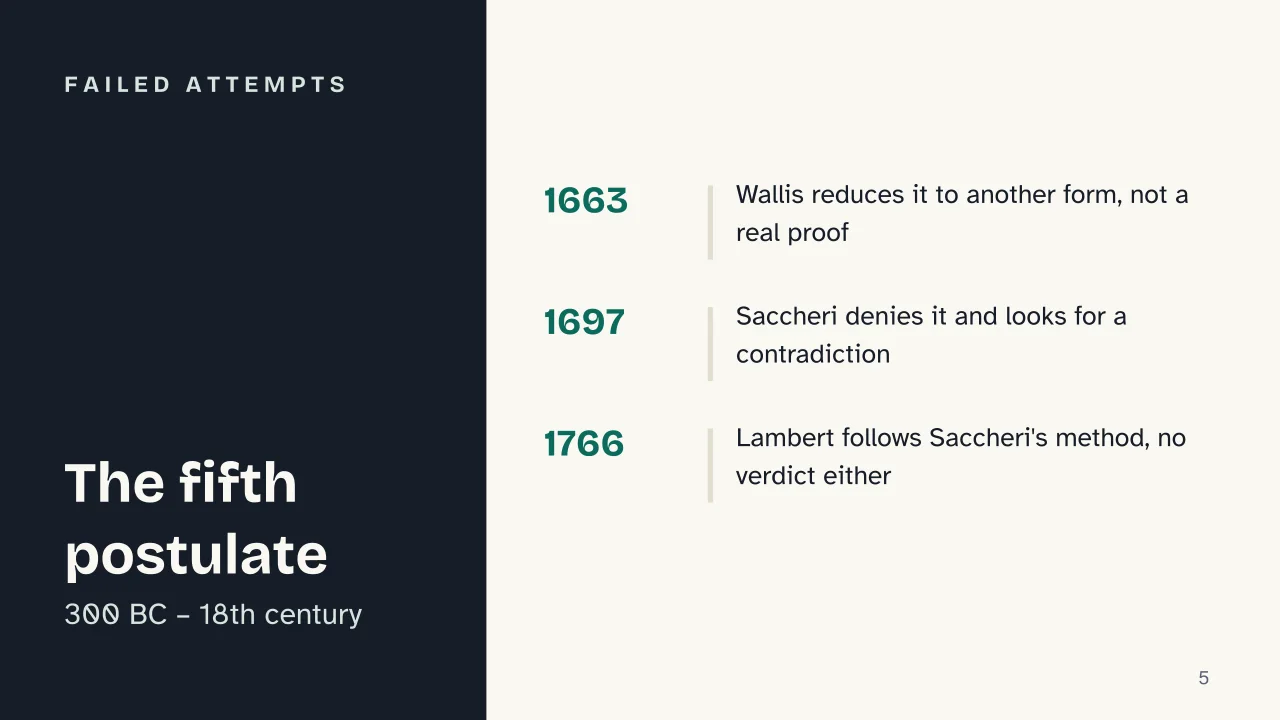   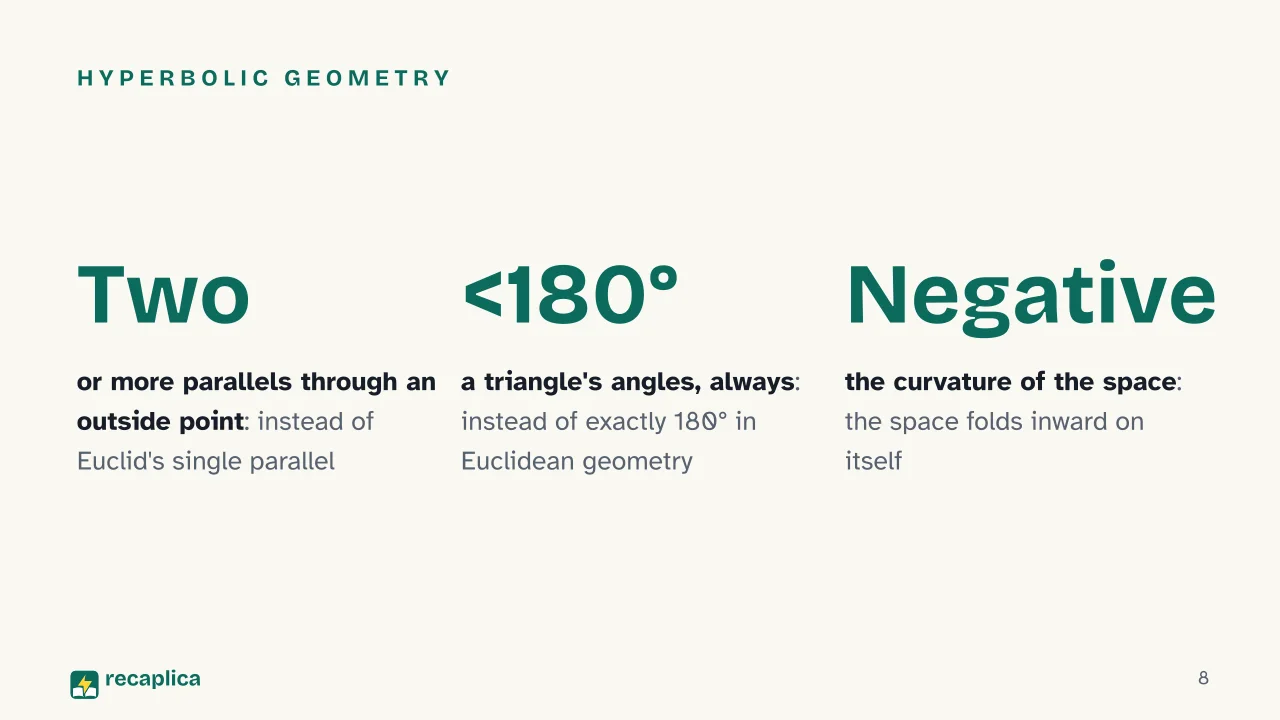  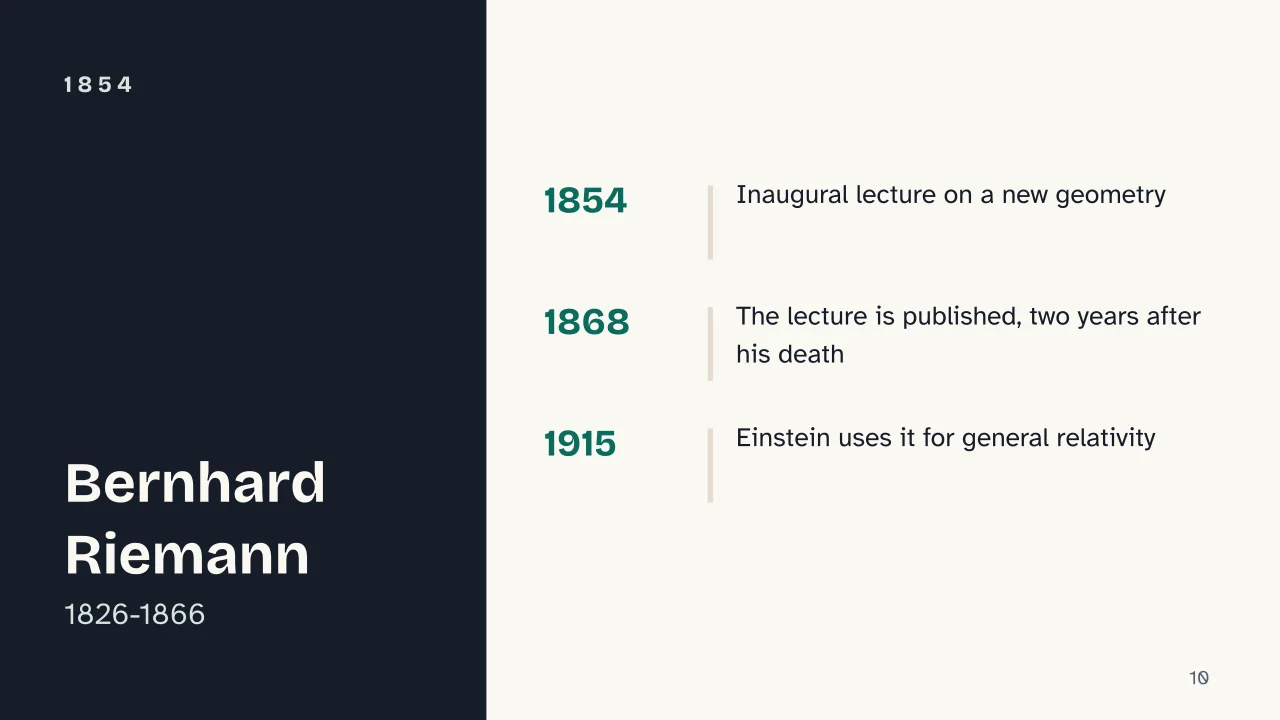 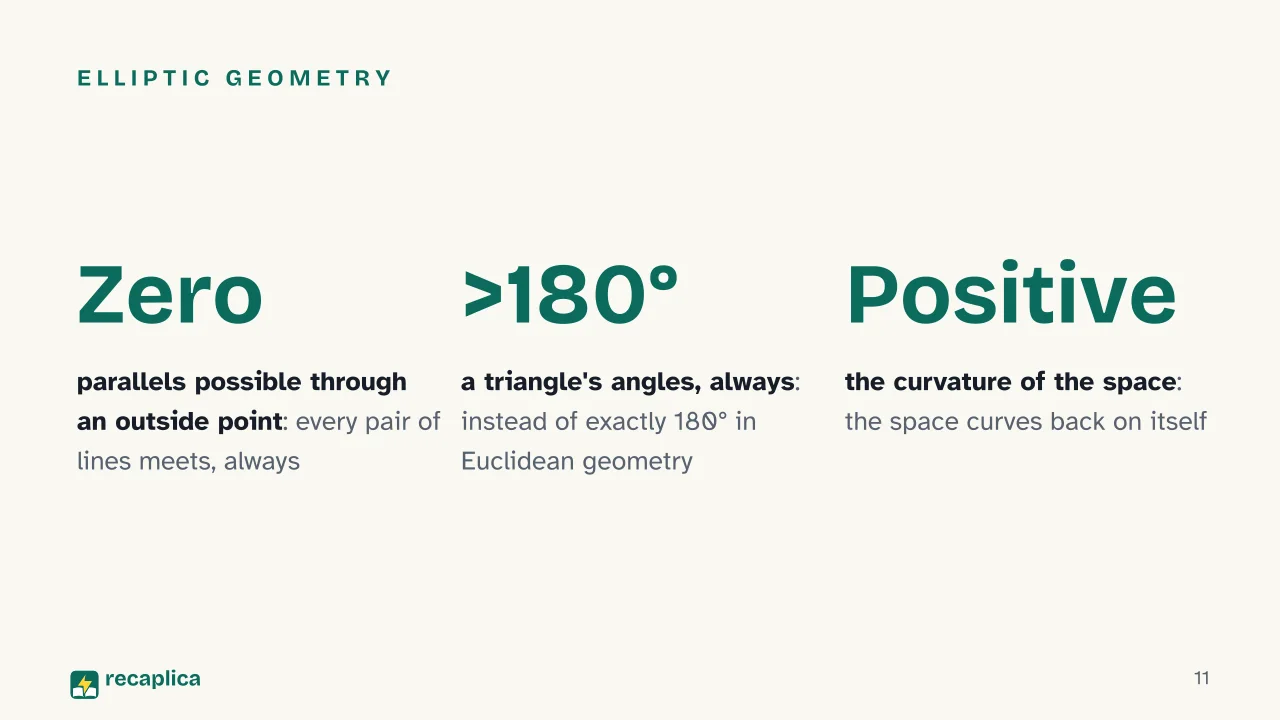 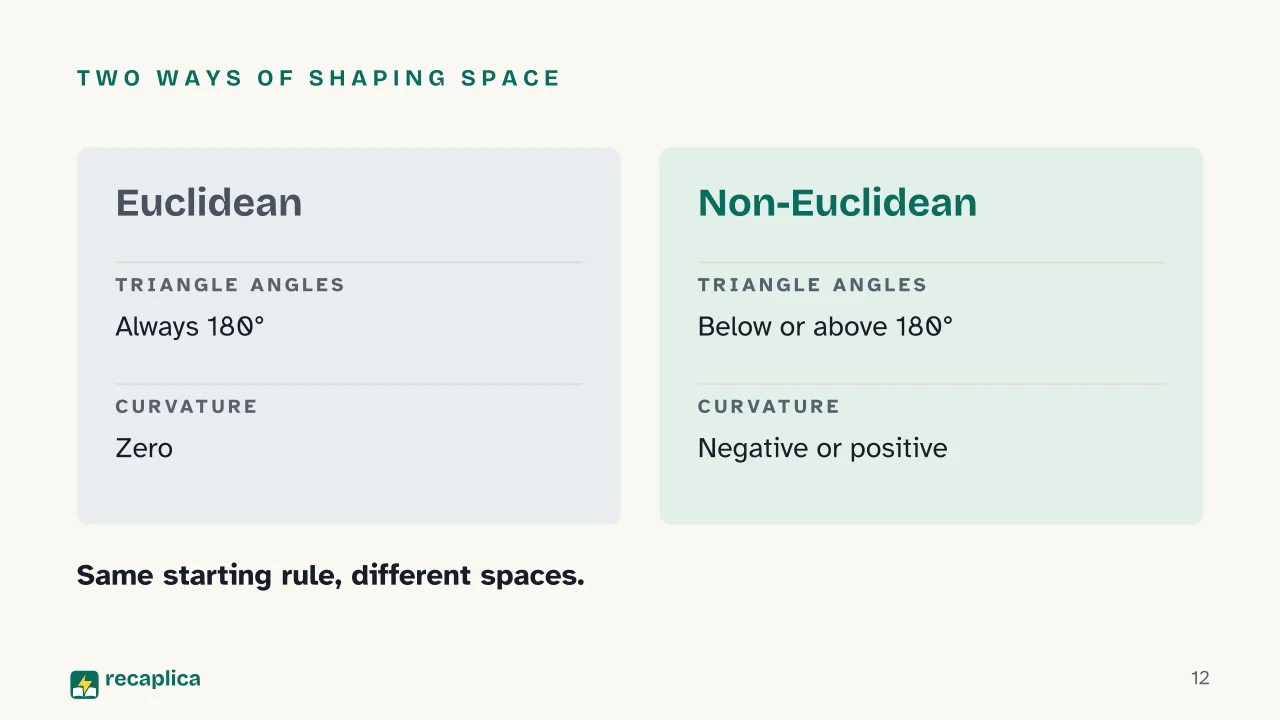  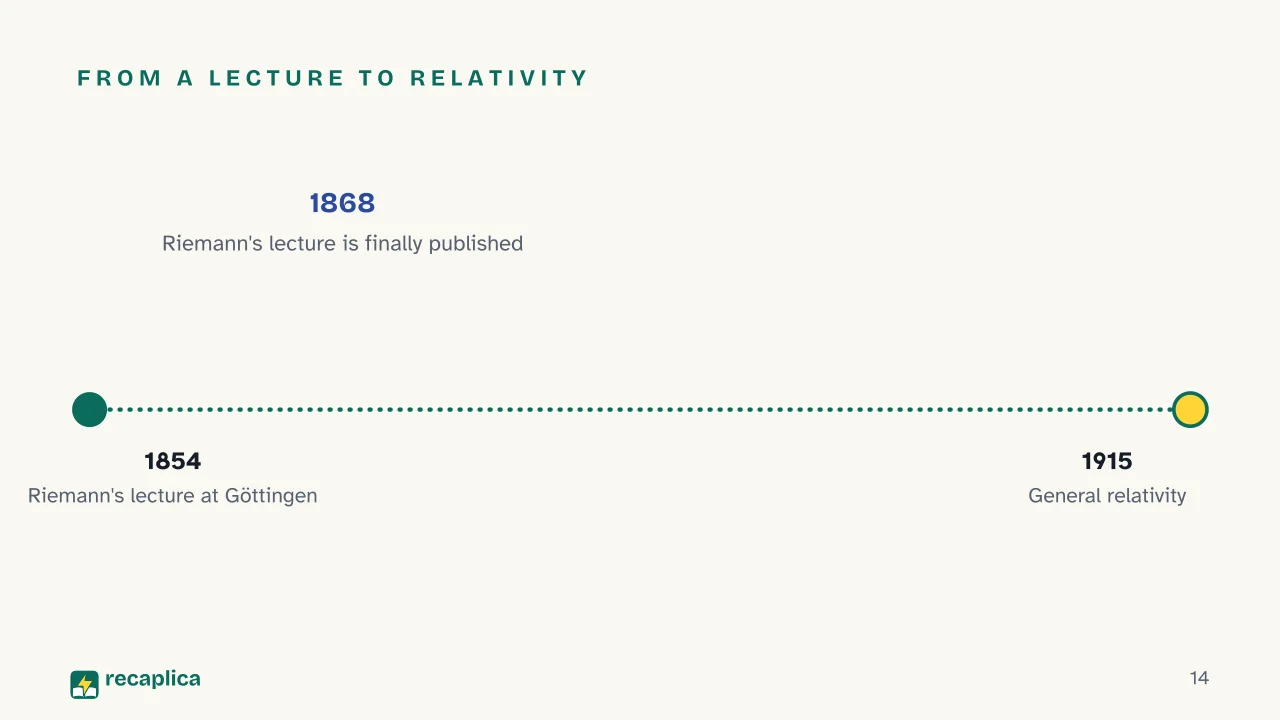 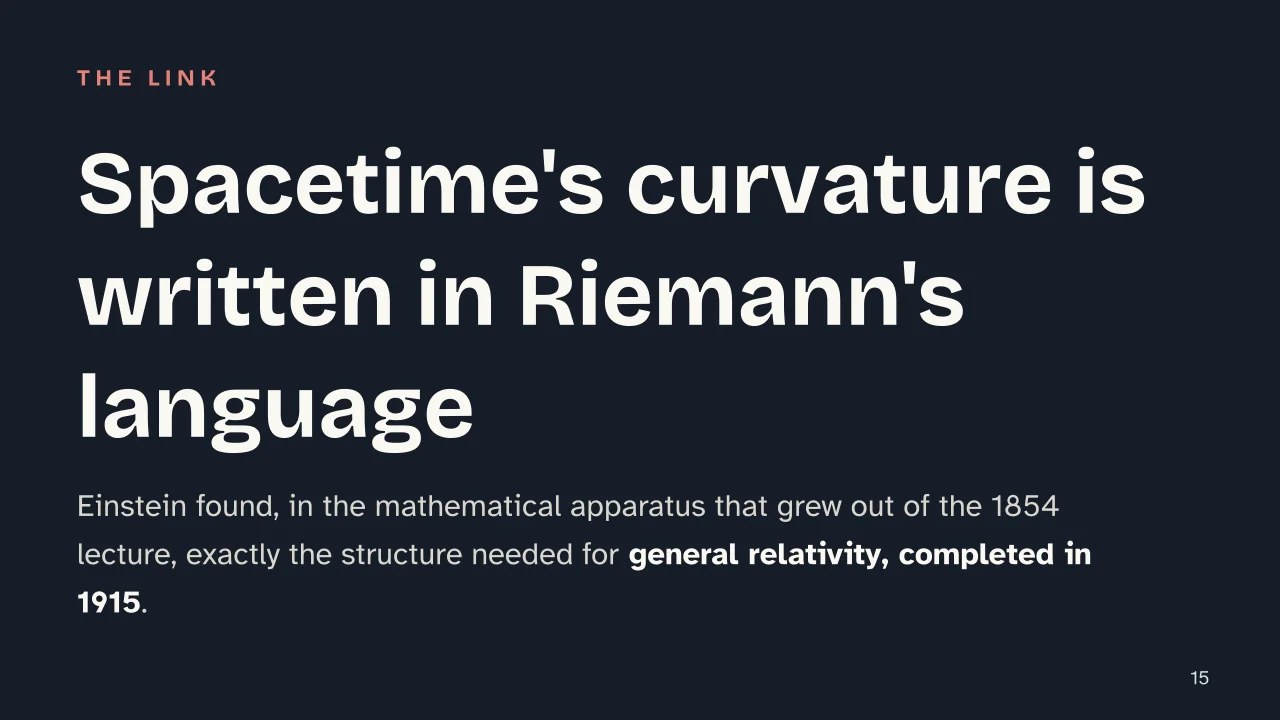 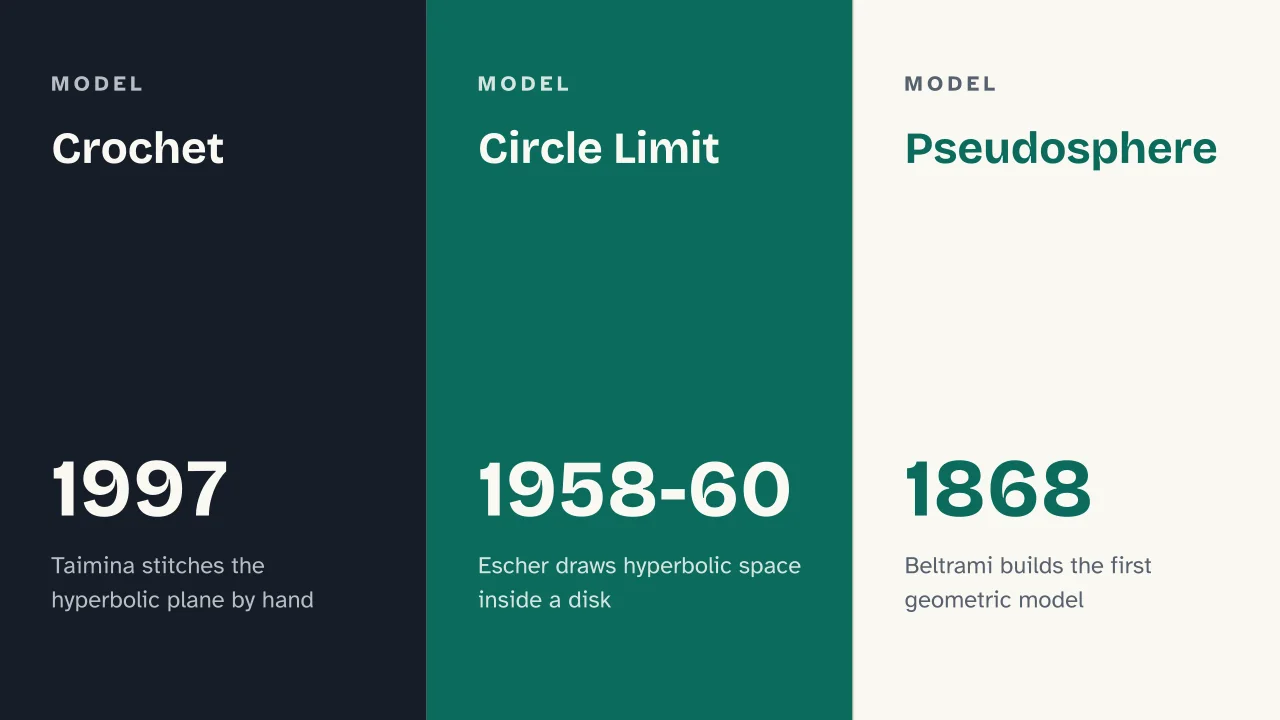 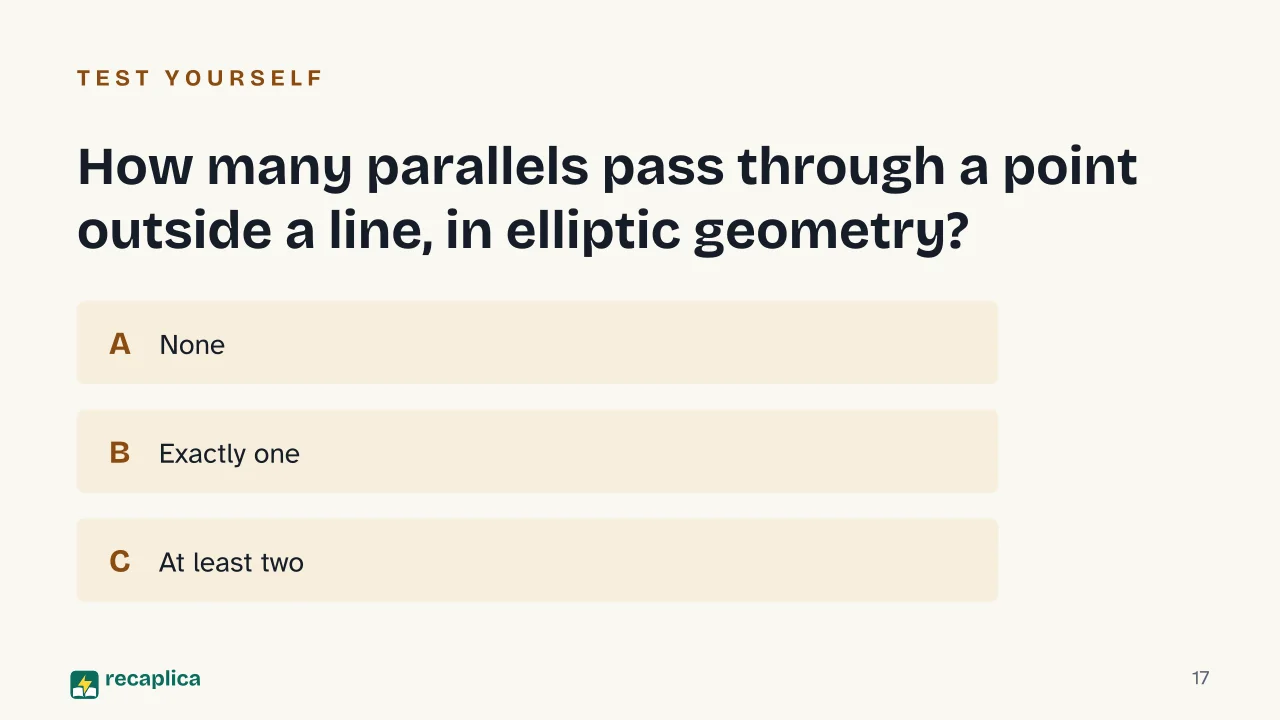  Common myths
Mind mapDrag the background to move around and the nodes to reposition them; use − and + to collapse and expand branches. 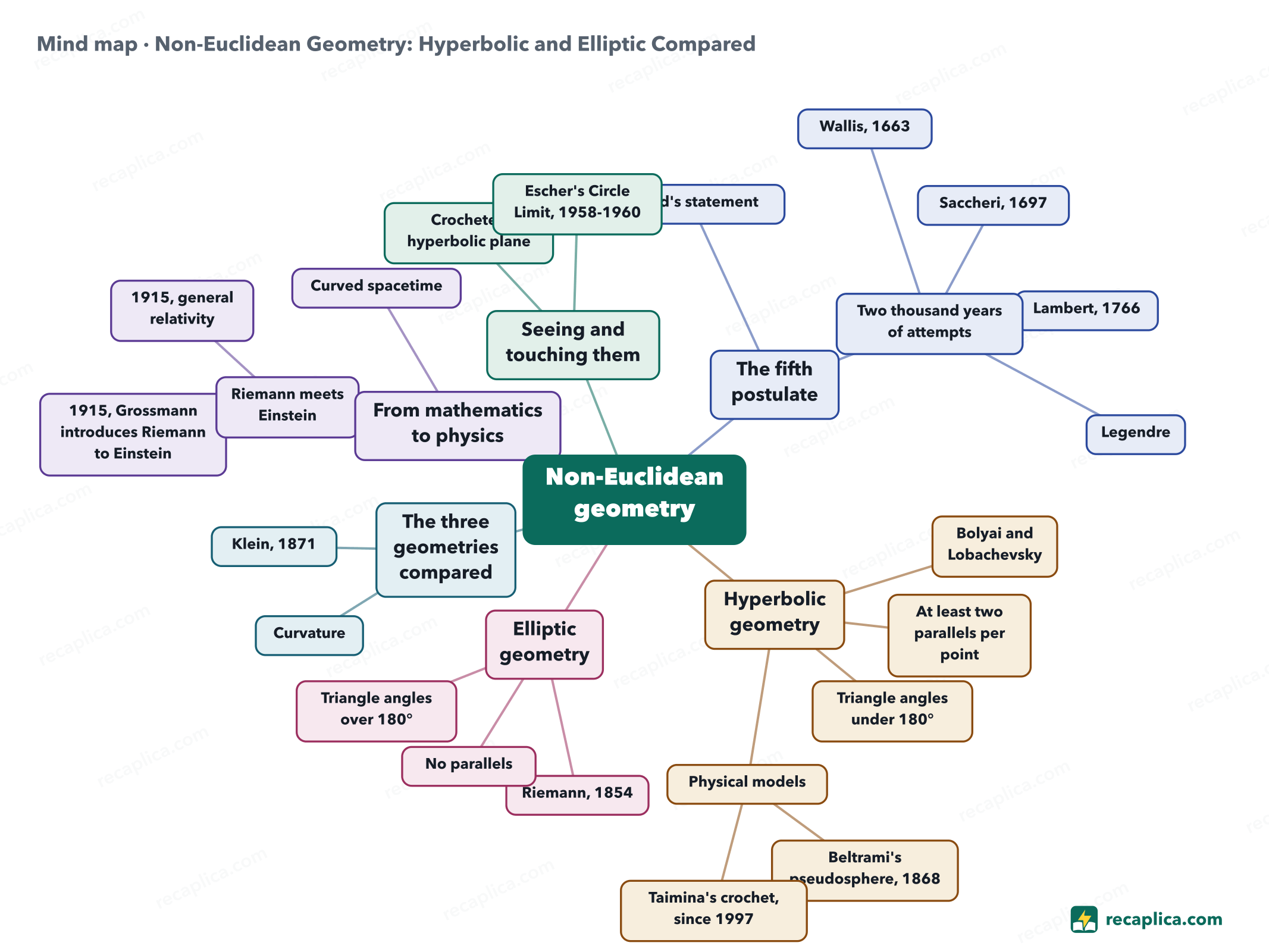
Quiz: test yourselfAnswer the questions to check what you have learned: you get instant feedback and a short explanation. Grade 0/10 0/5
FlashcardsTap the card to flip it and check whether you remember the answer, then move to the next one. 1 / 8 Explain it in your own wordsThe ultimate test: if you can explain it in simple words, you've truly understood it. Write your explanation, then compare it with the Recap. Your explanation is saved only on this device.
Frequently asked questionsWhat is non-Euclidean geometry?It's geometry built without Euclid's fifth postulate, the one about parallel lines. Once that postulate is removed, two coherent alternatives remain: hyperbolic geometry, where at least two lines pass through a point without meeting a given line, and elliptic geometry, where none do. What's the difference between hyperbolic geometry and elliptic geometry?In hyperbolic geometry, a triangle's angles add up to less than 180°, and at least two lines through a point outside a given line avoid it. In elliptic geometry, the sum exceeds 180° and no parallel exists at all: every pair of lines always meets. What are some real examples of non-Euclidean geometry?Curved space is the clearest one: the surface of a sphere behaves like elliptic geometry, and a saddle-shaped surface or a crocheted hyperbolic plane behaves like hyperbolic geometry. M.C. Escher's Circle Limit prints (1958-1960) draw hyperbolic space inside a disk, and general relativity uses Riemannian geometry to describe the curved shape of spacetime itself. Does non-Euclidean geometry have real-world applications?Yes. The geometric language Bernhard Riemann built in 1854 became, in 1915, the tool Albert Einstein used to construct general relativity: the curvature of spacetime, which is what gravity is, is described in exactly those terms. Who discovered non-Euclidean geometry?János Bolyai and Nikolai Lobachevsky independently reached hyperbolic geometry in the 1820s; Lobachevsky published first, in 1829. Bernhard Riemann introduced elliptic geometry in 1854. Carl Friedrich Gauss had also worked on the same problem privately, without ever publishing it. Why was Euclid's fifth postulate seen as a problem?Because, unlike the other four, it didn't feel self-evident: for over two thousand years mathematicians tried to prove it from the other postulates and kept failing, until it became clear that denying it still produces a coherent geometric system. Every Recap goes through an independent review before publication. |