Skip to content
recaplica

    One moment: security check

    Cloudflare wants to make sure you're not a robot. Tick the box below and your search will continue on its own.

    IT
    recaplica Cognitivism: how the mind processes information
    © 2026 Recaplica · recaplica.com — All rights reserved
    Home › Science

    Cognitivism: how the mind processes information

    By Recaplica Newsroom · Updated on September 24, 2026

    What to print

    Page numbers appear when printing with default margins.

    Slides

    Choose a cut

    Flash10 slidesThe essential thread, to present in classFull14 slidesEvery chapter and the deeper detail

    Both come with speaker notes.

    Telegram channel
    recaplica Clear in 30 seconds, yours in 10 minutes.
    In 30 seconds Key points Deep dive Slides Myths Mind map Quiz Flashcards FAQ

    In 30 seconds quick read

    Cognitivism is the psychological paradigm that treats the mind as a system for processing information, spanning perception, memory, reasoning and language. The shift began around 1956, while behaviorism, championed by Watson and Skinner, still ruled academic psychology and reduced the field to observable stimuli and responses. That same year, George Miller exposed the limits of short-term memory, and Chomsky joined McCarthy, Minsky, Newell and Simon in laying the groundwork for cognitive science. Donald Broadbent's attention model in 1958 and Ulric Neisser's 1967 book, which put the name cognitive psychology into common use, complete the roster of its founding figures.

    Key Points

    • Cognitivism treats the mind as an information-processing system, not a black box of stimuli and responses.
    • The paradigm took shape around 1956, breaking from the behaviorism of Watson and Skinner, which ruled mental processes out of scientific study.
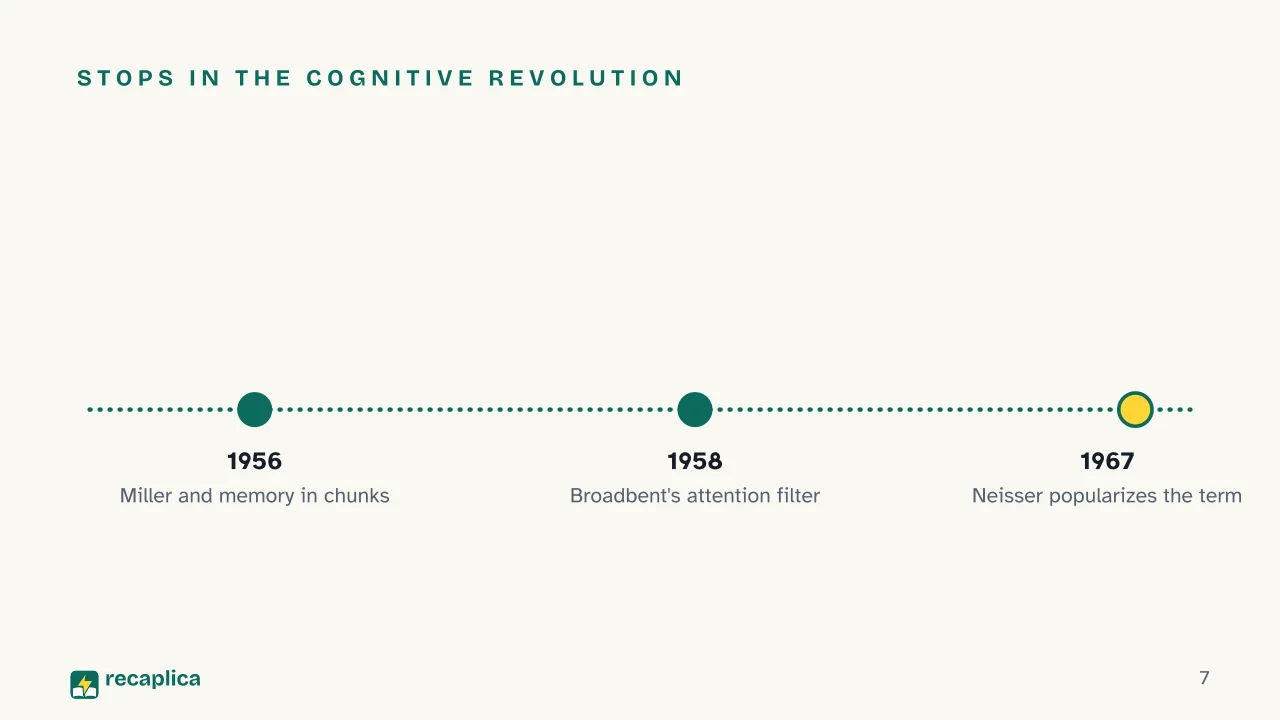
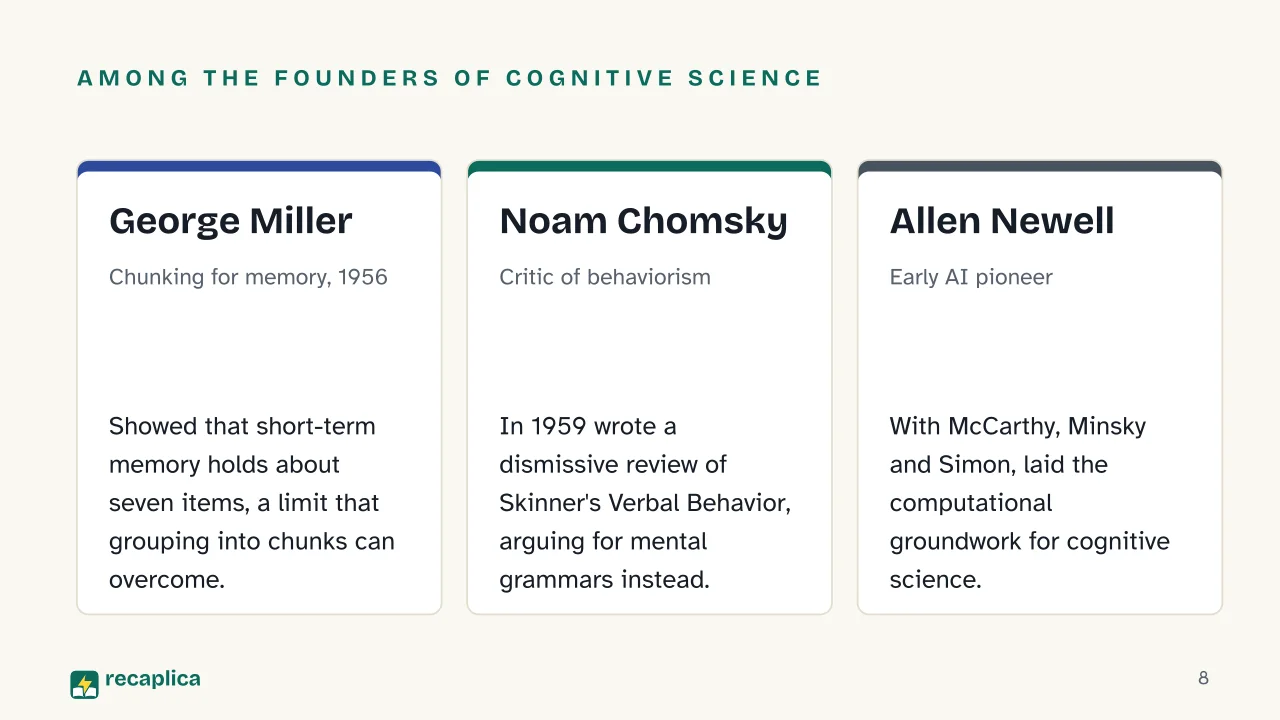
    • In 1956, George Miller showed that short-term memory holds roughly seven items, a limit that grouping information into chunks can overcome.
    • The Stanford Encyclopedia of Philosophy credits six researchers, Miller, Chomsky, McCarthy, Minsky, Newell and Simon, with founding cognitive science.
    • Donald Broadbent proposed an attention filter model in 1958, among the earliest uses of a computer analogy in psychology.
    • Ulric Neisser's 1967 book put the name cognitive psychology into common use, pulling together research on perception, attention and memory.

    Deep Dive

    Cognitivism is the paradigm in psychology that studies the mind as a system for processing information. The APA Dictionary of Psychology defines cognitive psychology as the branch exploring mental processes tied to perceiving, attending, thinking, language and memory, mostly through inference from observable behavior. Cognitivism doesn’t ignore behavior: it’s how the field gets at something that can’t be seen directly.

    Behaviorism, the paradigm cognitivism left behind

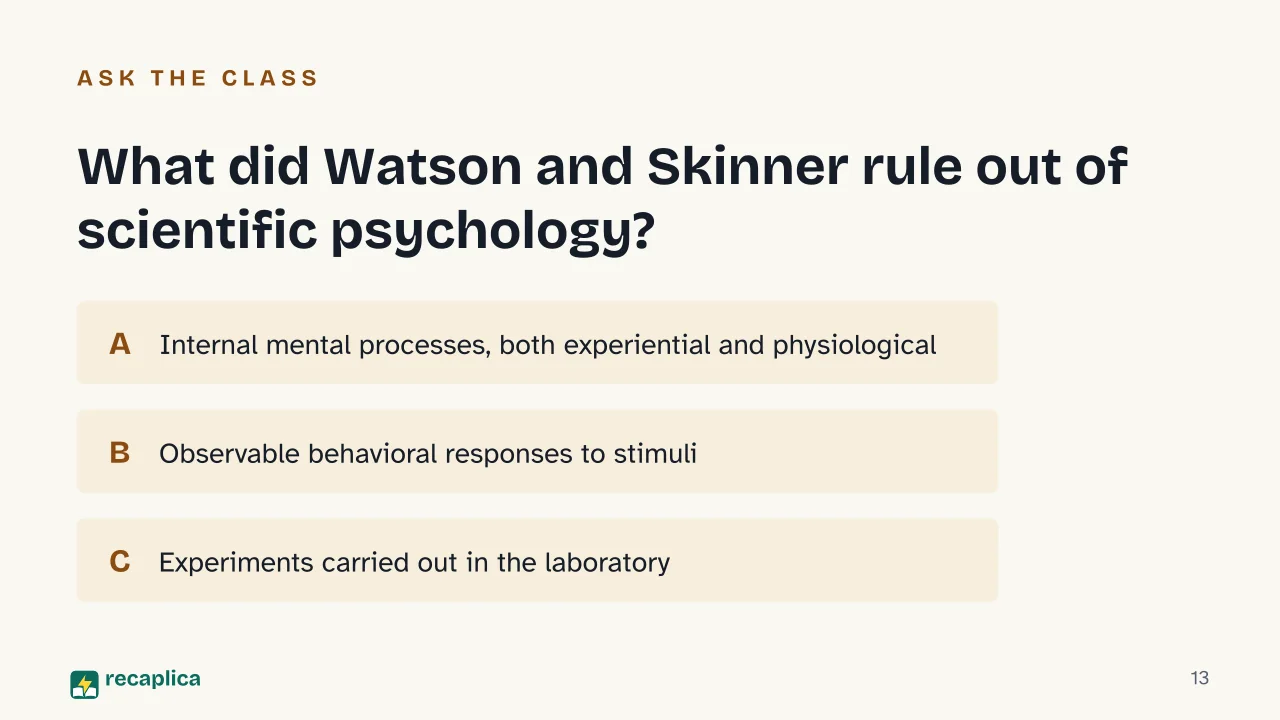
    Before cognitivism, experimental psychology — especially in North America — was dominated by behaviorism. In his 1913 manifesto, John B. Watson proposed abandoning introspective attempts to study consciousness in the lab, focusing instead on the behavioral manifestations of intelligence. B. F. Skinner pushed further, ruling out inner physiological processes as well as subjective experience from scientific concern. For a behaviorist, psychology had to stay within the relationship between observable stimuli and observable responses: talk of consciousness or mental representations sat outside the discipline’s boundaries.

    Early cognitivism focused mostly on perception, attention, memory and language, leaving emotion on the margins — a gap that psychology would close more fully in later work, covered in the Recap on human emotions.

    The mind as a computer

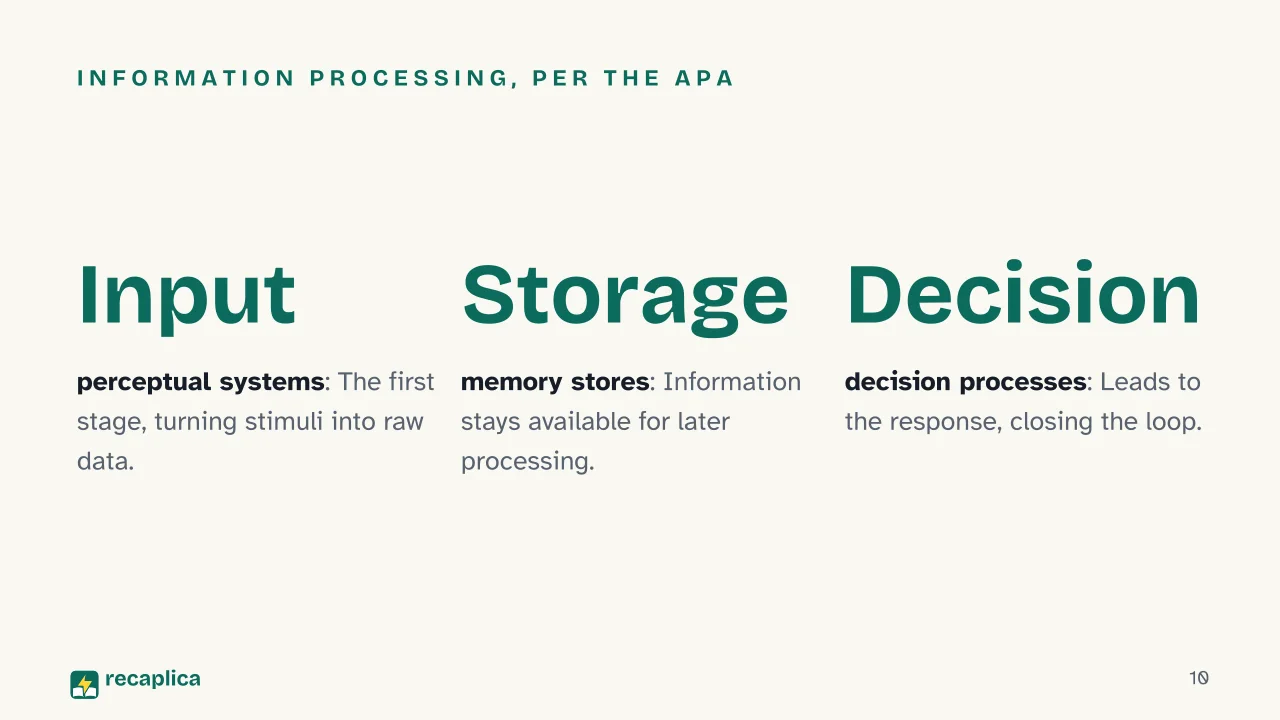
    What holds cognitivism together is the idea of information processing: the APA Dictionary of Psychology describes it as the flow of information through the nervous system, involving perceptual systems, memory stores, decision processes and response mechanisms. It’s the input-processing-output scheme borrowed from the first computers, which had existed for only a few years when the paradigm took shape: in this analogy, the mind receives data from the environment, works through it in stages and produces a response.

    Practical example: a ten-digit phone number is easier to remember split into two or three groups than digit by digit — grouping data into bigger units is exactly the “chunking” mechanism George Miller described in 1956.

    The mind-computer analogy still comes up as a reference point well outside psychology; the Recap on human cognition versus AI cognition looks at where that comparison holds and where it breaks down.

    1956, the break, and the six founders of cognitive science

    The Stanford Encyclopedia of Philosophy places the start of the shift around 1956. George Miller pulled together a wide range of studies pointing to a sharp limit on human thinking capacity: short-term memory, for instance, holds around seven items. He proposed that the limit could be overcome by recoding information into chunks, mental representations that require their own mental procedures to encode and decode. Decades later, John Sweller built cognitive load theory on that same limit: how much a learning task weighs on this narrow memory, and how teaching can be designed so it doesn’t overload it.

    Around the same time, with digital computers only a few years old, pioneers including John McCarthy, Marvin Minsky, Allen Newell and Herbert Simon were founding the field of artificial intelligence — a story the Recap on artificial intelligence traces from its origins onward. Noam Chomsky, for his part, rejected the behaviorist idea that language was simply a learned habit, arguing instead that language comprehension had to be explained through mental grammars made of rules; his dismissive 1959 review of Skinner’s “Verbal Behavior” is widely seen as a watershed moment. The Stanford Encyclopedia of Philosophy names these six researchers — Miller, McCarthy, Minsky, Newell, Simon and Chomsky — as the founders of cognitive science.

    Broadbent and the attention filter

    In the United Kingdom, working independently, Donald Broadbent was developing his own theories of selective attention and short-term memory, just as digital computers were becoming available to the academic world: he was among the first to use computer analogies to make a serious contribution to the study of human cognition. In his 1958 book, “Perception and Communication,” he laid out the attention filter model: the physical features of an auditory message, such as pitch and loudness, are used to focus attention on a single message at a time. It’s an early-selection model, because irrelevant messages get filtered out before their meaning is processed at all, through a theoretical filter sitting between the incoming sensory register and short-term memory.

    Neisser and the birth of cognitive psychology

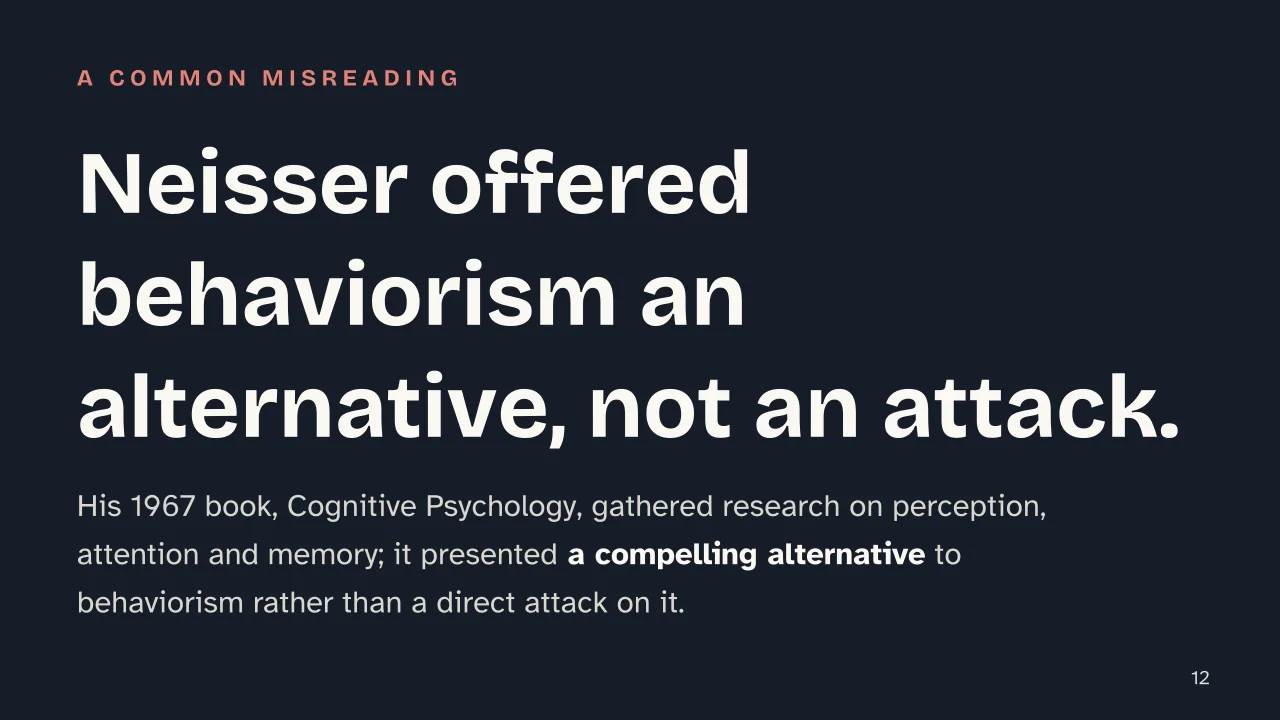
    Ulric Neisser is remembered as the “father of cognitive psychology.” His 1967 book, “Cognitive Psychology,” brought together existing research on perception, pattern recognition, attention, problem solving and memory, giving a single name to a field that had until then stayed fragmented. Neisser had developed an interest in information theory through his contacts with George Miller at Harvard and MIT, and in the book he highlighted both information processing and the constructive side of perception. He described his own work as an assault on behaviorism, but the text never attacked it head-on: he chose instead to lay out a compelling alternative.

    Cognitivism, behaviorism and psychoanalysis compared

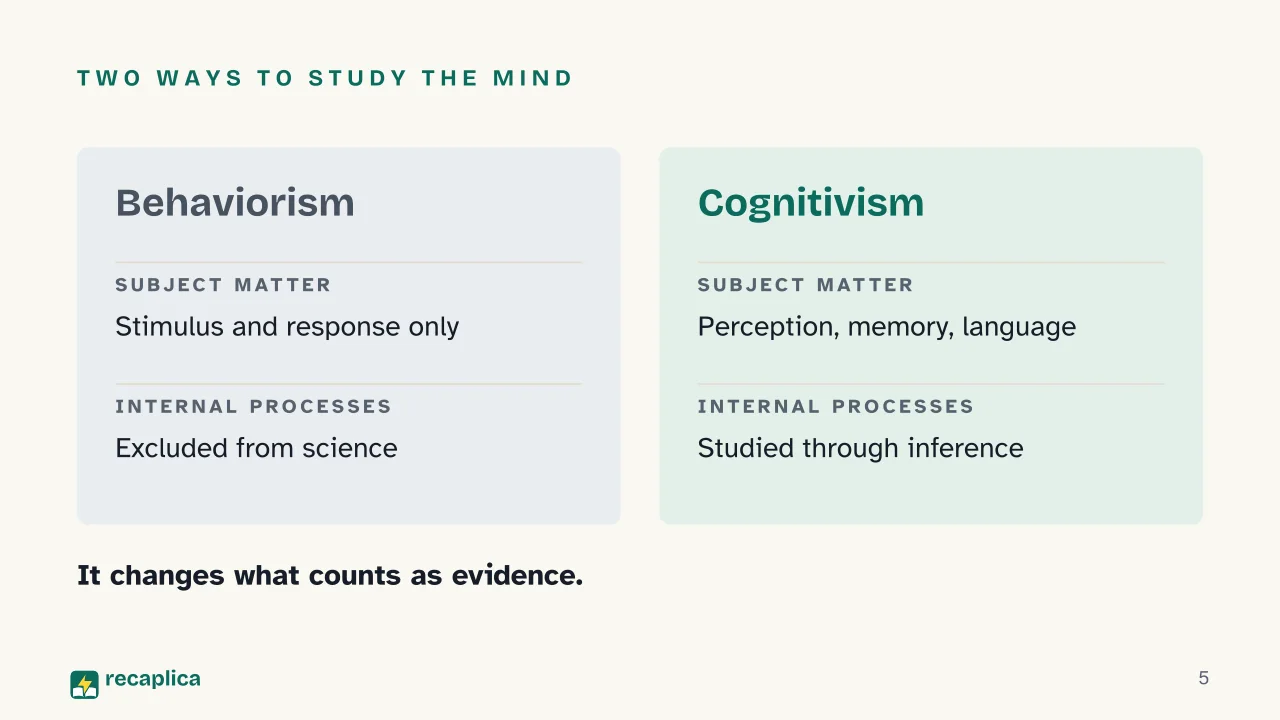
    Cognitivism took shape in the mid-twentieth century in opposition to two different approaches, not just one. Its split from behaviorism is about what psychology agrees to study; its split from psychoanalysis is about which level of the mind to look at.

    ApproachSubject matterWhat it rules out
    BehaviorismObservable stimulus and responseInternal mental processes, conscious or not
    CognitivismPerception, attention, memory, languageThe requirement to study only observable behavior
    PsychoanalysisInstincts and unconscious forcesThe higher mental processes central to cognitivism

    Per the APA Dictionary of Psychology, cognitivism’s focus on higher mental processes also sets it apart from psychoanalysis’s focus on instincts and other unconscious forces.

    Slide deck

    Slides ready to download and make your own in PowerPoint or Google Slides, with speaker notes. Pick the Flash cut or the Full one.
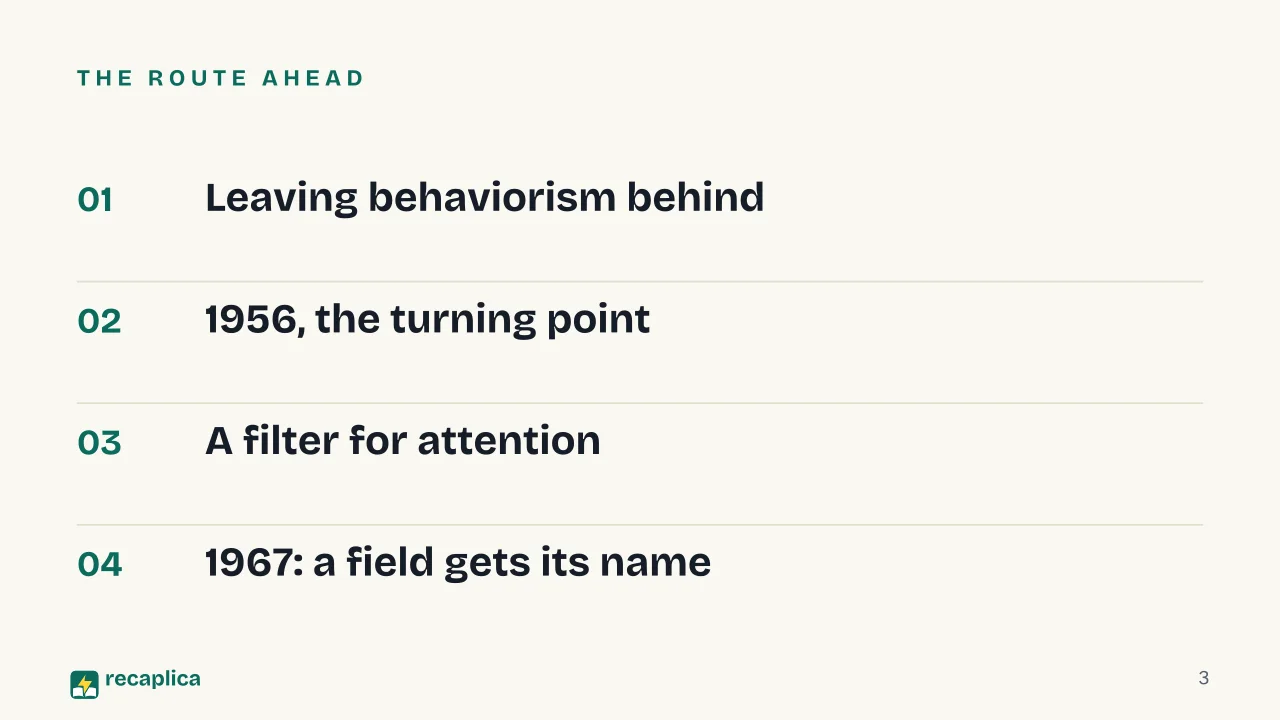
    Slide 1 of the presentation on Cognitivism: CognitivismSlide 2 of the presentation on Cognitivism: What turns a glance into a memory?Slide 3 of the presentation on Cognitivism: The route aheadSlide 4 of the presentation on Cognitivism: Chapter 01: Leaving behaviorism behindSlide 5 of the presentation on Cognitivism: Two ways to study the mindSlide 6 of the presentation on Cognitivism: Chapter 02: 1956, the turning pointSlide 7 of the presentation on Cognitivism: Stops in the cognitive revolutionSlide 8 of the presentation on Cognitivism: Among the founders of cognitive science: George Miller, Noam Chomsky, Allen NewellSlide 9 of the presentation on Cognitivism: Chapter 03: Broadbent's filterSlide 10 of the presentation on Cognitivism: Information processing, per the APASlide 11 of the presentation on Cognitivism: Chapter 04: Neisser and 1967Slide 12 of the presentation on Cognitivism: Neisser offered behaviorism an alternative, not an attack.Slide 13 of the presentation on Cognitivism: What did Watson and Skinner rule out of scientific psychology?Slide 14 of the presentation on Cognitivism: To go further
    Flash10 slidesThe essential thread, to present in classFull14 slidesEvery chapter and the deeper detail

    Common myths

    • ✗ Myth Cognitivism only studies thoughts, and has nothing to do with behavior.

      ✓ Reality The APA defines cognitive psychology as the study of mental processes, explored mainly through inference from behavior: behavior is still the evidence, only what psychologists conclude from it has changed.

    • ✗ Myth One researcher, usually Miller or Chomsky, single-handedly started the cognitive revolution.

      ✓ Reality The Stanford Encyclopedia of Philosophy names six founders of cognitive science, and around the same time, across the Atlantic, Donald Broadbent was reaching similar conclusions on an independent track.

    • ✗ Myth Cognitivism and psychoanalysis are the same idea under different names, since both look at the mind.

      ✓ Reality The APA notes that cognitivism concentrates on higher mental processes, perception, attention, memory, while psychoanalysis centers on instincts and unconscious forces: two different maps of the same mind.

    Mind map

    Drag the background to move around and the nodes to reposition them; use − and + to collapse and expand branches.
    Customize
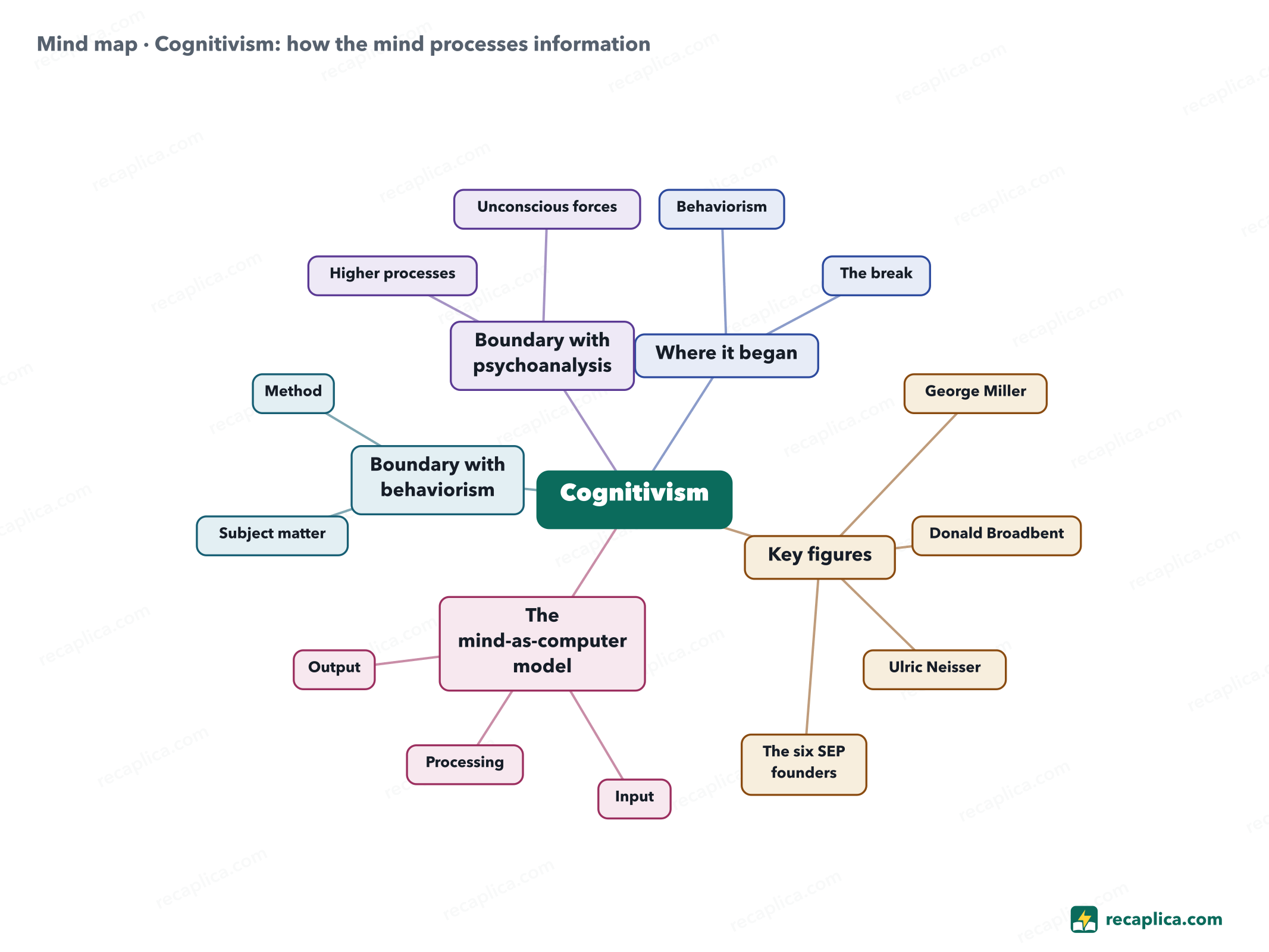
    Mind map: Cognitivism: how the mind processes information
    • Cognitivism
      • Where it began Mid-1950s, breaking from behaviorism
        • Behaviorism Watson and Skinner, only observable stimulus and response
        • The break Around 1956, per the Stanford Encyclopedia of Philosophy
      • Key figures
        • George Miller 1956, memory in chunks
        • Donald Broadbent 1958, the attention filter
        • Ulric Neisser 1967, popularizes the name cognitive psychology
        • The six SEP founders Miller, Chomsky, McCarthy, Minsky, Newell, Simon
      • The mind-as-computer model
        • Input Perception and attention
        • Processing Memory and reasoning
        • Output Behavioral response
      • Boundary with behaviorism
        • Subject matter Internal processes, not just stimulus-response
        • Method Inference from behavior, not only direct observation
      • Boundary with psychoanalysis
        • Higher processes Perception, memory, reasoning
        • Unconscious forces Central to psychoanalysis, not to cognitivism

    Quiz: test yourself

    Answer the questions to check what you have learned: you get instant feedback and a short explanation.

    Grade 0/10 0/5
    1 What model does cognitivism use to describe the mind?

    The APA defines information processing as the flow of information through the nervous system via perception, memory, decision-making and response — the model cognitivism is built on.

    2 What did Watson and Skinner's behaviorism rule out of the scientific study of psychology?

    Skinner went as far as excluding inner physiological processes along with subjective experience: for behaviorists, only the link between observable stimulus and observable response counted.

    3 According to the Stanford Encyclopedia of Philosophy, cognitive science was the work of a single researcher.

    The entry lists six founders, George Miller, Noam Chomsky, John McCarthy, Marvin Minsky, Allen Newell and Herbert Simon: the cognitive revolution had several parallel protagonists.

    4 What did George Miller propose in 1956?

    Miller showed that short-term memory is limited to about seven items, but that the limit can be overcome by chunking information together.

    5 What does Donald Broadbent's 1958 attention filter model describe?

    Broadbent's model is an early-selection model: the filter discards irrelevant messages based on physical sound features, before their meaning is even understood.

    Answers: 1-A · 2-A · 3-B · 4-A · 5-A

    Flashcards

    Tap the card to flip it and check whether you remember the answer, then move to the next one.

    1 / 7

    Explain it in your own words

    The ultimate test: if you can explain it in simple words, you've truly understood it. Write your explanation, then compare it with the Recap.

    Your explanation is saved only on this device.

    Cognitivism is the psychological paradigm that treats the mind as a system for processing information, spanning perception, memory, reasoning and language. The shift began around 1956, while behaviorism, championed by Watson and Skinner, still ruled academic psychology and reduced the field to observable stimuli and responses. That same year, George Miller exposed the limits of short-term memory, and Chomsky joined McCarthy, Minsky, Newell and Simon in laying the groundwork for cognitive science. Donald Broadbent's attention model in 1958 and Ulric Neisser's 1967 book, which put the name cognitive psychology into common use, complete the roster of its founding figures.

    Frequently asked questions

    What is cognitivism in psychology?

    It's the paradigm that describes the mind as a system processing information, perception, memory, reasoning and language, instead of only observing stimuli and responses.

    What's the difference between cognitivism and behaviorism?

    Behaviorism studies only the observable link between stimulus and response; cognitivism studies the internal mental processes that sit between the two, even though they can't be observed directly.

    Who founded cognitive science?

    The Stanford Encyclopedia of Philosophy names six founders: George Miller, Noam Chomsky, John McCarthy, Marvin Minsky, Allen Newell and Herbert Simon, active in the mid-1950s.

    What is meant by information processing?

    It's the flow of information through the nervous system across perception, memory, decision-making and response, as defined by the American Psychological Association.

    When did cognitivism begin?

    The Stanford Encyclopedia of Philosophy places the start of the shift around 1956, alongside George Miller's work on memory and the parallel emergence of artificial intelligence.

    Sources

    • Cognitive Science — Stanford Encyclopedia of Philosophy
    • Behaviorism — Internet Encyclopedia of Philosophy
    • cognitive psychology — APA Dictionary of Psychology
    • information processing (IP) — APA Dictionary of Psychology
    • The little-known roots of the cognitive revolution — APA Monitor on Psychology
    • Remembering the Father of Cognitive Psychology — Association for Psychological Science
    • Donald Broadbent — Wikipedia
    • Cognitive psychology — Wikipedia

    Every Recap goes through an independent review before publication.

    Every evening, the day's new Recaps on our Telegram channel. Join the channel →

    Keep learning

    • Science Cognitive Load Theory: The Definition Behind Sweller's Research Cognitive load is the amount of working memory a task uses up while you learn something new. Psychologist John Sweller first described it in 1988, starting from research on problem solving: a strategy that is too demanding leaves little room to build stable mental structures. Later research distinguishes three types of load, intrinsic, extraneous, and germane, though part of the field treats the third as indistinguishable from the first. Cutting extraneous load, with worked examples or less cluttered materials, frees up mental room for actual learning. Read the Recap →
    • Science Behaviorism: What It Is and Where It Came From Behaviorism is the school of psychology that studies only observable behavior, leaving aside the thoughts and feelings that stay hidden inside the mind. It began in 1913, when the American psychologist John B. Watson published an essay calling for psychology to become an experimental science, without relying on introspection. After him, Ivan Pavlov studied conditioned reflexes and Edward Thorndike studied trial-and-error learning; Burrhus Skinner pushed the ideas to their most extreme form with radical behaviorism. The thread running through all of it is the stimulus-response model: a behavior is explained by what comes before it and what follows it, not by guessing what happens inside the head of the person doing it. Read the Recap →
    • Science Psychological Science: What It Is and How It Differs From Common Sense Psychological science studies behavior and mental processes with the same method as any other empirical science: hypotheses that can be tested, data gathered under controlled procedures, conclusions checked by other researchers. What sets it apart from common sense is that it refuses to settle for what "feels obvious": a psychological claim only counts as scientific if it is falsifiable, meaning some observation could in principle prove it wrong. Common sense, left to its own devices, tends to explain everything after the fact and mistakes a correlation for a cause. That's why psychology relies on experimental design, statistics and variable control that everyday intuition skips right past. Read the Recap →

    recaplica

    Clear in 30 seconds, yours in 10 minutes.

    Recaps Mind maps Request a Recap Telegram channel Mind map maker Our method About Privacy & cookies Legal notes & terms of use

    © 2026 Recaplica · A project by Curi S.r.l. — VAT IT05472000750

    Statistics, only if you say so

    To learn which Recaps help most we would use Google Analytics, with aggregate, anonymous data. It starts only with your OK, and you can change your mind anytime. Privacy policy