|
recaplica
What Is Arithmetic? The Basics Explained |
| © 2026 Recaplica · recaplica.com — All rights reserved |
What Is Arithmetic? The Basics ExplainedWhat to print Page numbers appear when printing with default margins. SlidesChoose a cut Flash10 slidesThe essential thread, to present in classFull17 slidesEvery chapter and the deeper detailBoth come with speaker notes. In 30 seconds quick readArithmetic is the branch of mathematics that studies numbers and the operations that combine them: addition, subtraction, multiplication and division. It builds on a sequence of number sets, from the natural numbers up to the real numbers, and on precise rules that decide when a calculation can be reordered or regrouped without changing the result. Arithmetic is also where prime numbers come from, the indivisible "building blocks" every number can be broken down into, and where ratios between quantities turn into proportions once two ratios match. Key Points
Key figures
Deep DiveWhat Arithmetic IsArithmetic is the branch of mathematics that studies numbers and the properties that concern them, especially the natural numbers. According to the entry the Enciclopedia della Matematica Treccani dedicates to the subject, arithmetic is where the objects sitting at the foundation of the entire mathematical structure are found: it raises questions about consistency and meaning that go well beyond everyday calculation. Historically, according to Treccani, arithmetic takes on an organized shape already with Pythagoras, between the 5th and 4th centuries BC. About a century later, Euclid devotes three of the thirteen books of his Elements (books VII-IX) to whole numbers. The shift toward algebra, the discipline that generalizes numbers using letters, appears in the 3rd century AD with Diophantus of Alexandria; in 1202 Fibonacci introduces the positional number notation to Europe, in his Liber abaci — the same book that introduces the Fibonacci sequence, the best-known example of a number sequence built by recursion. The formal foundations of arithmetic, the ones that turn it into a coherent system rather than a set of practical rules, arrive much later, between the 19th and 20th centuries, through the work of Dedekind, Cantor and Godel. Number Sets: From N to RThe numbers arithmetic works with don’t form a single block, but a sequence of increasingly wide sets, each one contained in the next. The natural numbers, written N, are the ones used for counting. This is a point where sources don’t fully agree: according to Treccani, in the literature N sometimes excludes zero (N = {1, 2, 3…}) and sometimes includes it (N = {0, 1, 2, 3…}); the Wolfram MathWorld entry on natural numbers confirms there is no general agreement on the question either. Neither convention is mistaken, they’re simply two different ways of fixing the same starting point. Adding the negative numbers produces the integers, written Z: Z = {0, +1, -1, +2, -2…}. Widening the set further, to the rational numbers (Q), reaches every number that can be expressed as a fraction p/q, with p and q integers and q different from zero, the same definition used by both Treccani and Wolfram MathWorld. Q has a property that sets it apart from Z: it is dense, meaning that between any two rational numbers there are always infinitely many more rational numbers. Some numbers, though, cannot be written as a fraction of two integers: these are the irrational numbers, the ones missing from the rationals for the line to be continuous. The best-known case is the square root of 2, whose decimal expansion, according to Wolfram MathWorld, never ends and never settles into a repeating pattern. A story handed down through the centuries claims that the Pythagorean philosopher Hippasus proved its irrationality using a geometric argument while at sea, and was thrown overboard by his fellow Pythagoreans for it; the source itself presents this as legend, not verified history. Other proofs of irrationality carry precise dates: Euler proved it for e in 1737, and Lambert did the same for π in 1760. Combining the rationals and the irrationals produces the real numbers, R: a totally ordered, continuous field, in which every cut of Q picks out exactly one real number. Every one of these sets sits inside the next: N is contained in Z, which is contained in Q, which is contained in R — the full picture of these sets, with their symbols and an example for each, is in the Recap on number sets.
The Four Operations and Their PropertiesArithmetic rests on four operations: addition, subtraction, multiplication and division. Addition and multiplication follow a pair of precise rules, verifiable for any real number: the commutative property, where a+b = b+a and a·b = b·a, and the associative property, where (a+b)+c = a+(b+c) and (a·b)·c = a·(b·c). Alongside these sits the distributive property of multiplication over addition: a·(b+c) = a·b + a·c. Subtraction and division don’t share these properties: changing the order of the terms, or how they’re grouped, changes the result. 7 minus 3 is not the same as 3 minus 7, and the same holds for division. It’s a frequent source of confusion, because people tend to stretch rules that apply to two operations onto all four. Two numbers play a special role here, the identity elements: zero for addition (a+0 = a, for any number a) and one for multiplication (a·1 = a, for any number a). First Steps in Number TheoryInside arithmetic sits a chapter devoted to the deeper properties of whole numbers: number theory. Its starting concept is the prime number, a positive integer greater than 1 with no positive divisors other than 1 and itself. Integers greater than 1 that aren’t prime are called composite numbers. The Sieve of EratosthenesTables of prime numbers have long been built with a procedure called the Sieve of Eratosthenes, named after the Greek mathematician and astronomer Eratosthenes, who lived from about 276 to 194 BC, placing him in the 3rd century BC. The method, as described by Wolfram MathWorld, works like this: write down the numbers from 2 up to the chosen limit, then cross out every multiple of 2 (except 2 itself); among what’s left, take the smallest number not yet crossed out and cross out all of its multiples, and repeat, stopping once you reach the square root of the chosen limit. Whatever numbers survive are all prime. According to MacTutor, the Sieve of Eratosthenes, in a modified form, remains a tool used in number theory research. Modular Arithmetic in BriefOne chapter of arithmetic works not with the full result of a division, but with what’s left over: modular arithmetic. The easiest way to picture it is a clock face: past 12 hours, the count doesn’t continue to 13, 14, 15, it starts over from 1; what matters in this system isn’t the total number of hours that have passed, but the remainder left after dividing by 12. The same idea works with any number standing in for 12. Ratios and ProportionsA ratio between two numbers r and s is written r/s and is equivalent to their quotient, as Wolfram MathWorld defines it; Treccani adds that the ratio between two comparable quantities A and B measures the first against the second, taken as the unit. When two ratios are equal, the result is called a proportion, written a : b = c : d and read “a is to b as c is to d.” The four numbers have specific names: a and c are the antecedents (the numerators of the ratios), b and d are the consequents (the denominators); b and c are the means, a and d are the extremes. The fundamental property of proportions states that the product of the means always equals the product of the extremes: if a : b = c : d, then a·d = b·c.
Slide deckSlides ready to download and make your own in PowerPoint or Google Slides, with speaker notes. Pick the Flash cut or the Full one.     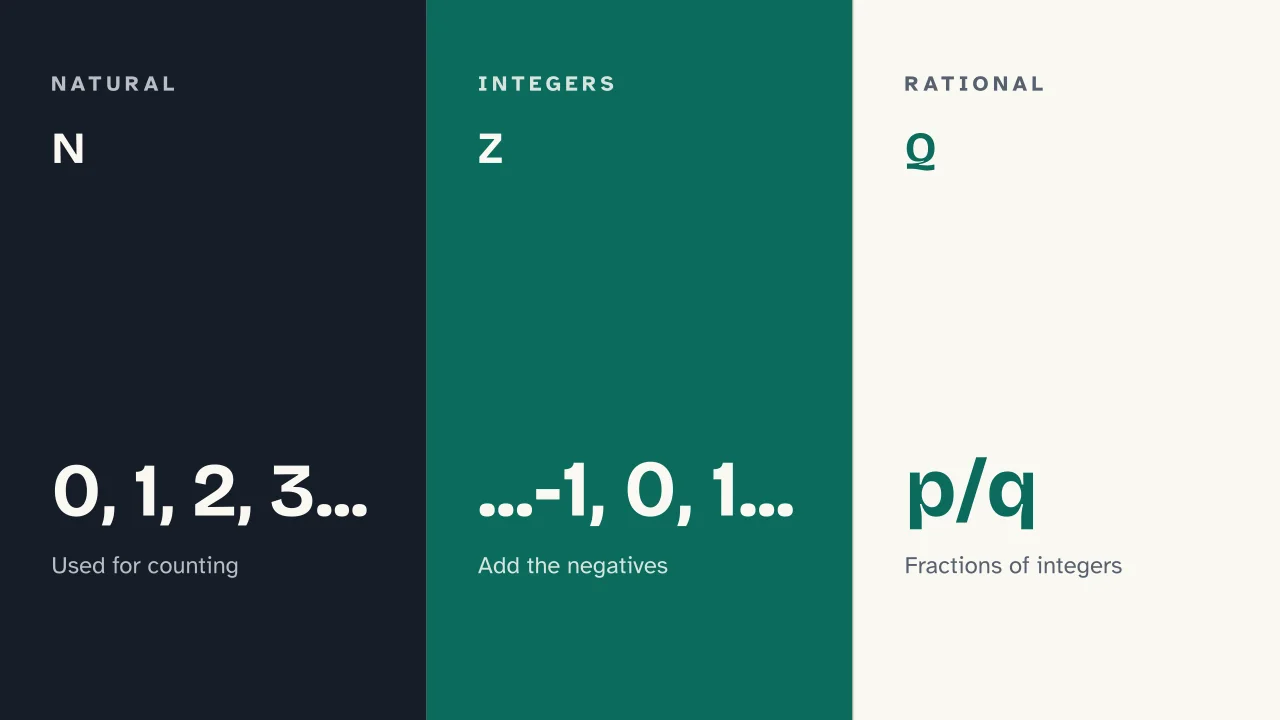 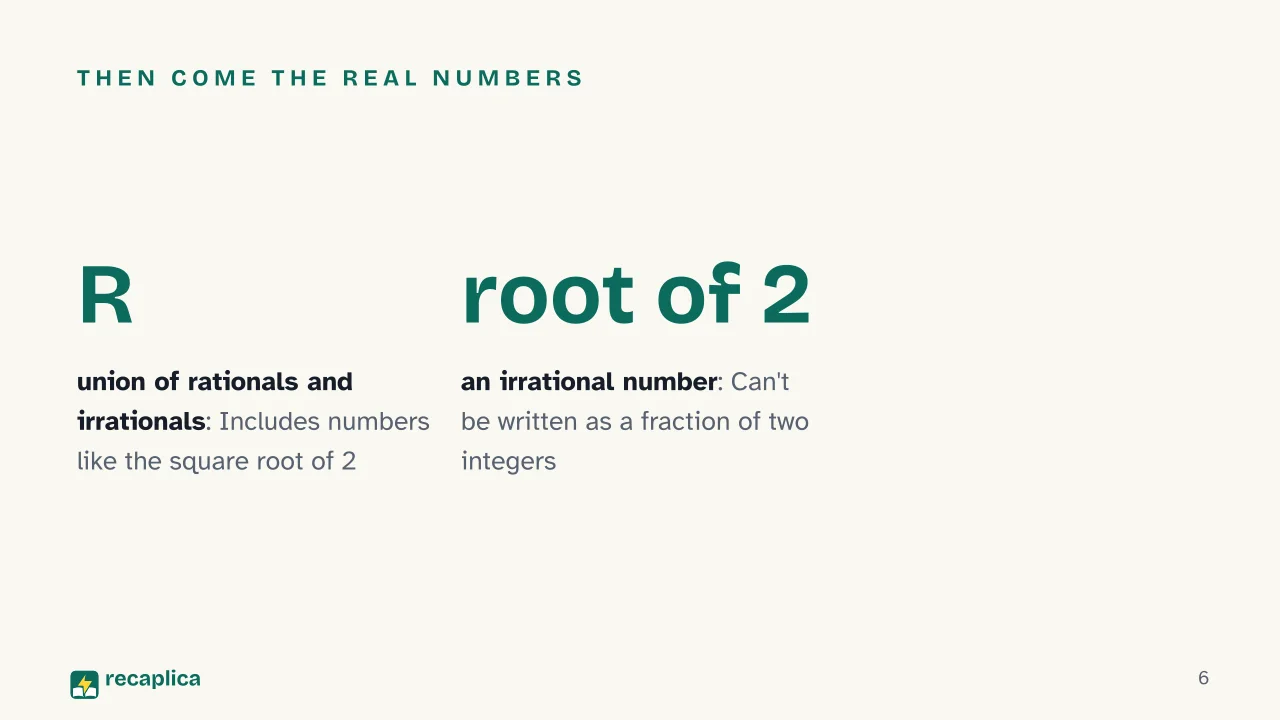  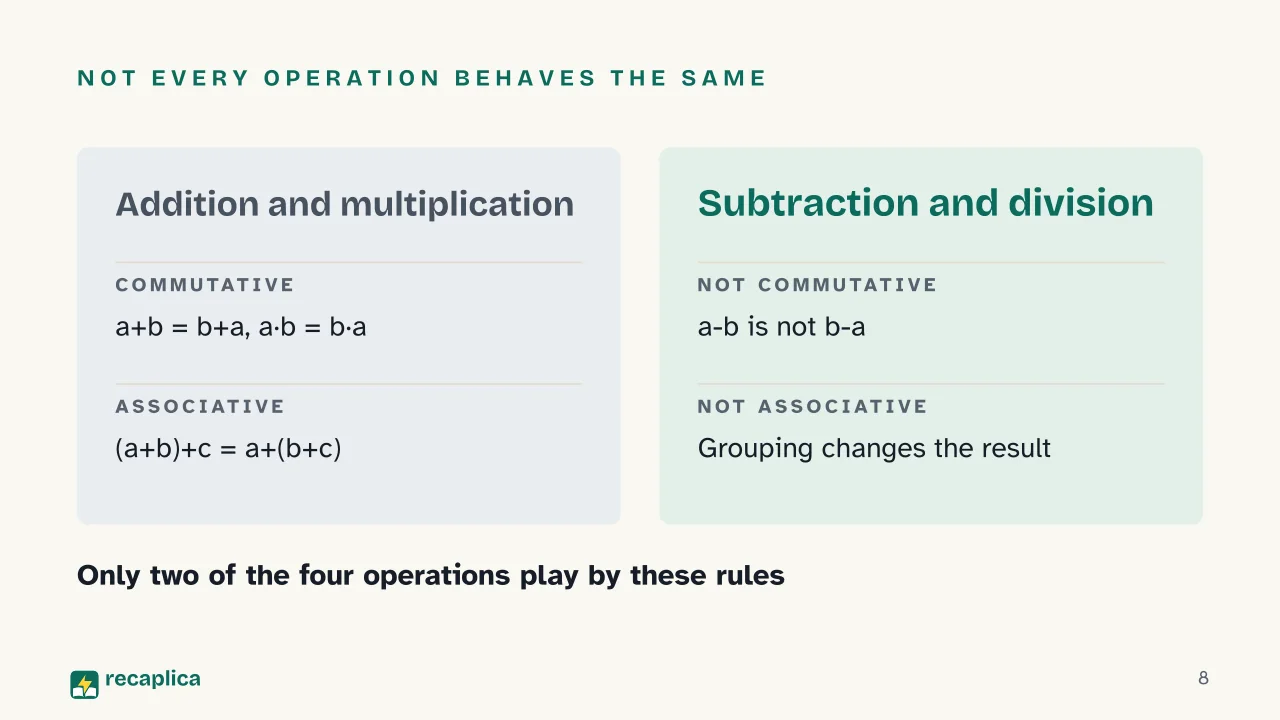 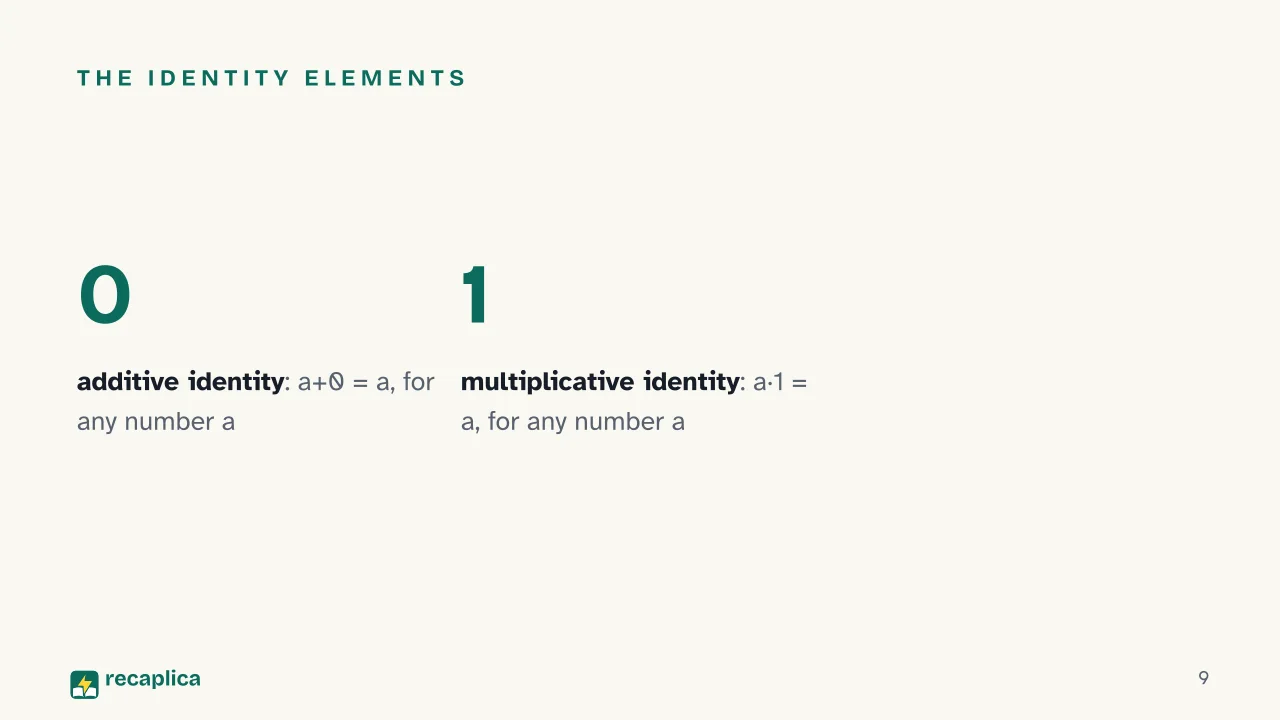  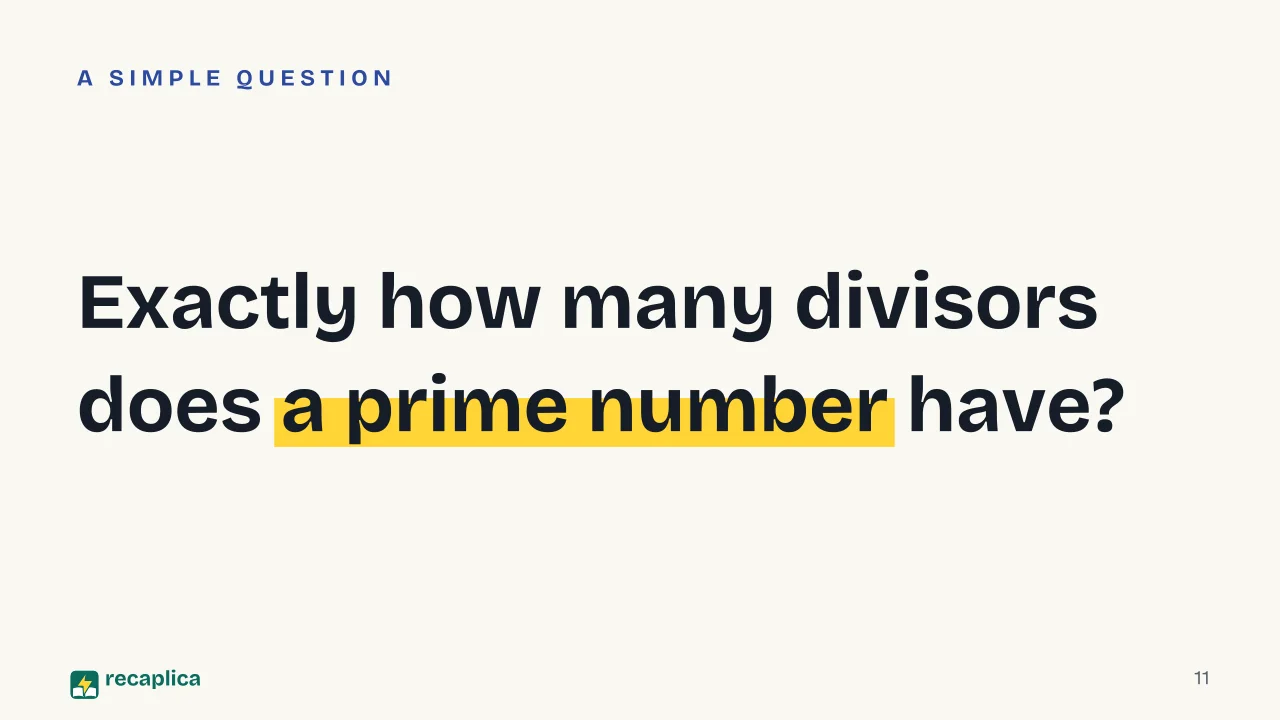 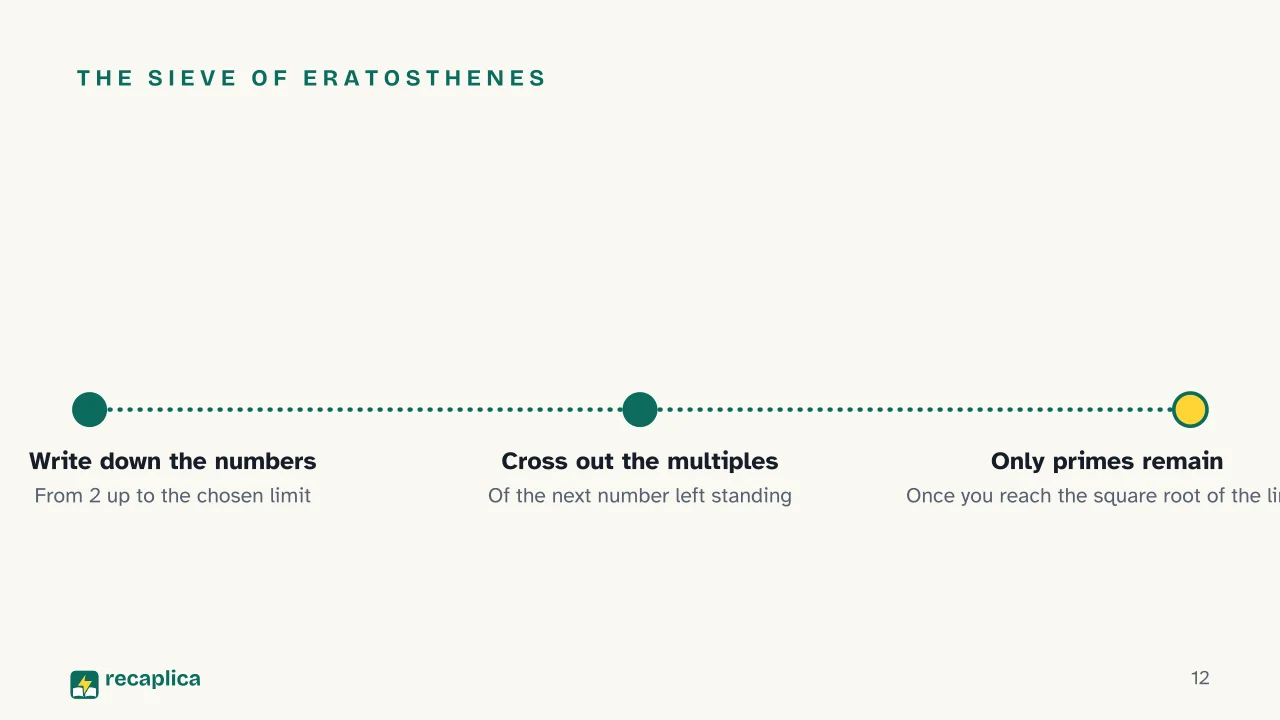 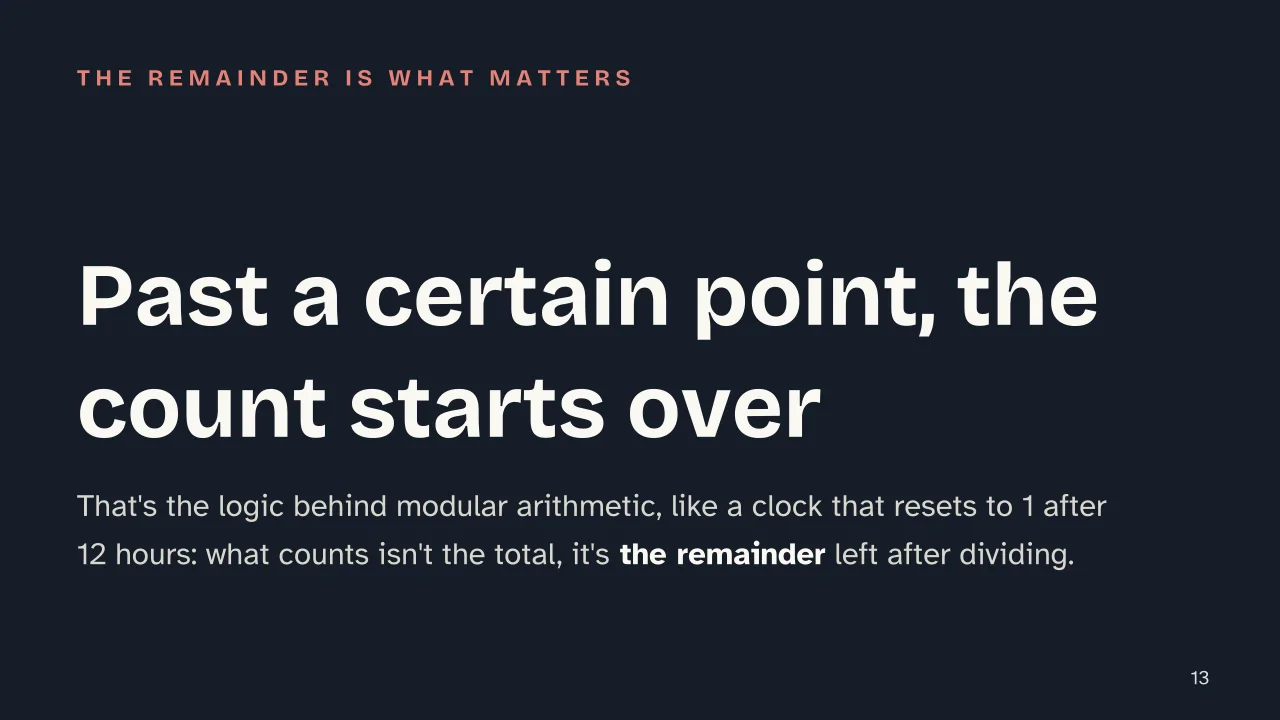  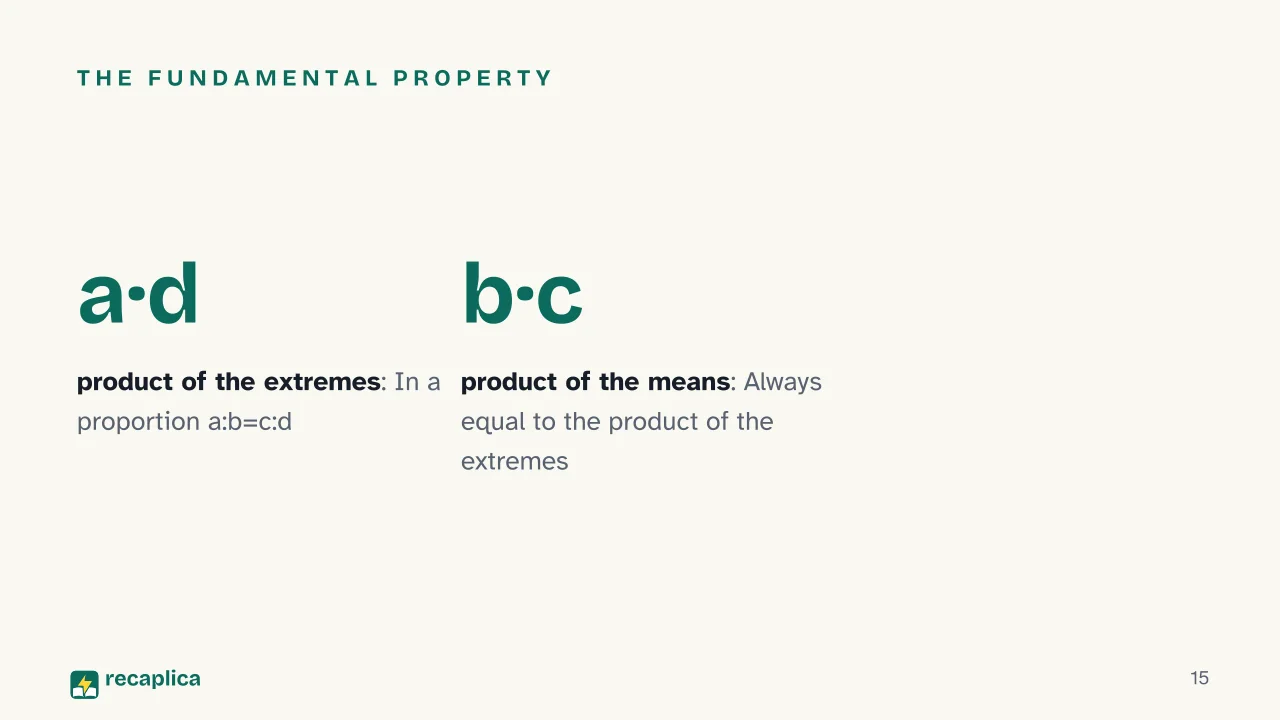 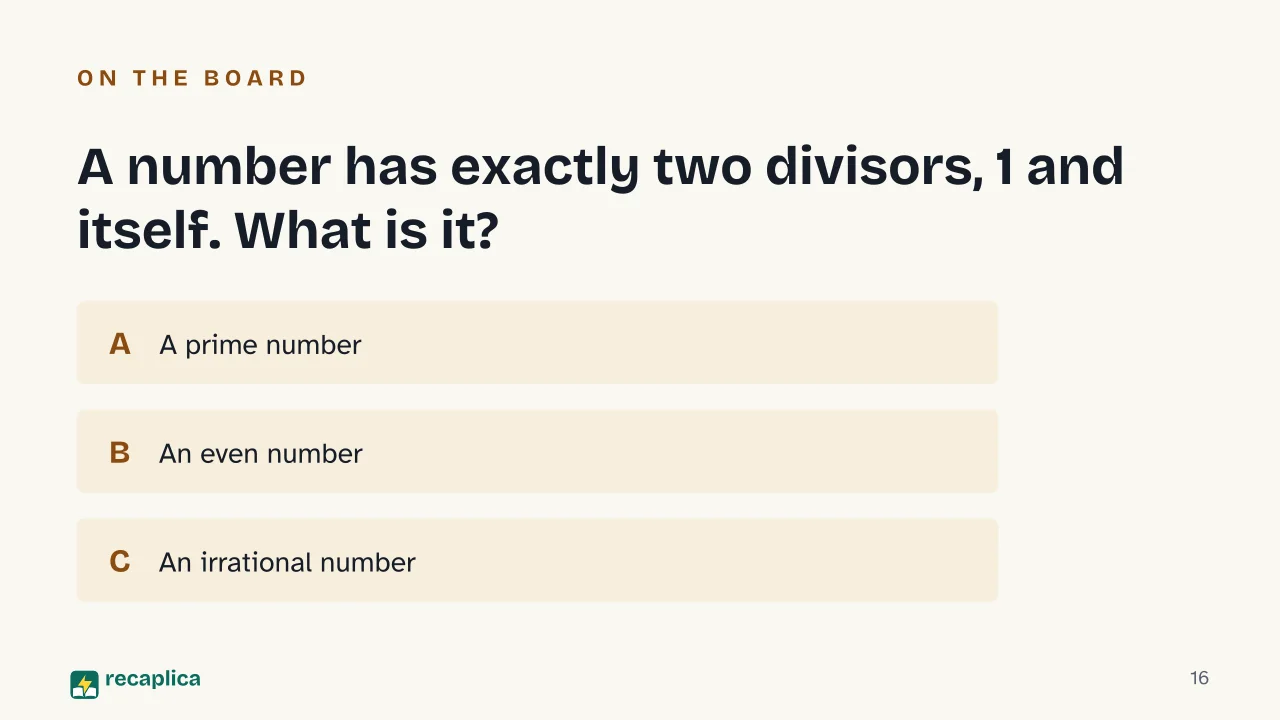  Common myths
Mind mapDrag the background to move around and the nodes to reposition them; use − and + to collapse and expand branches. 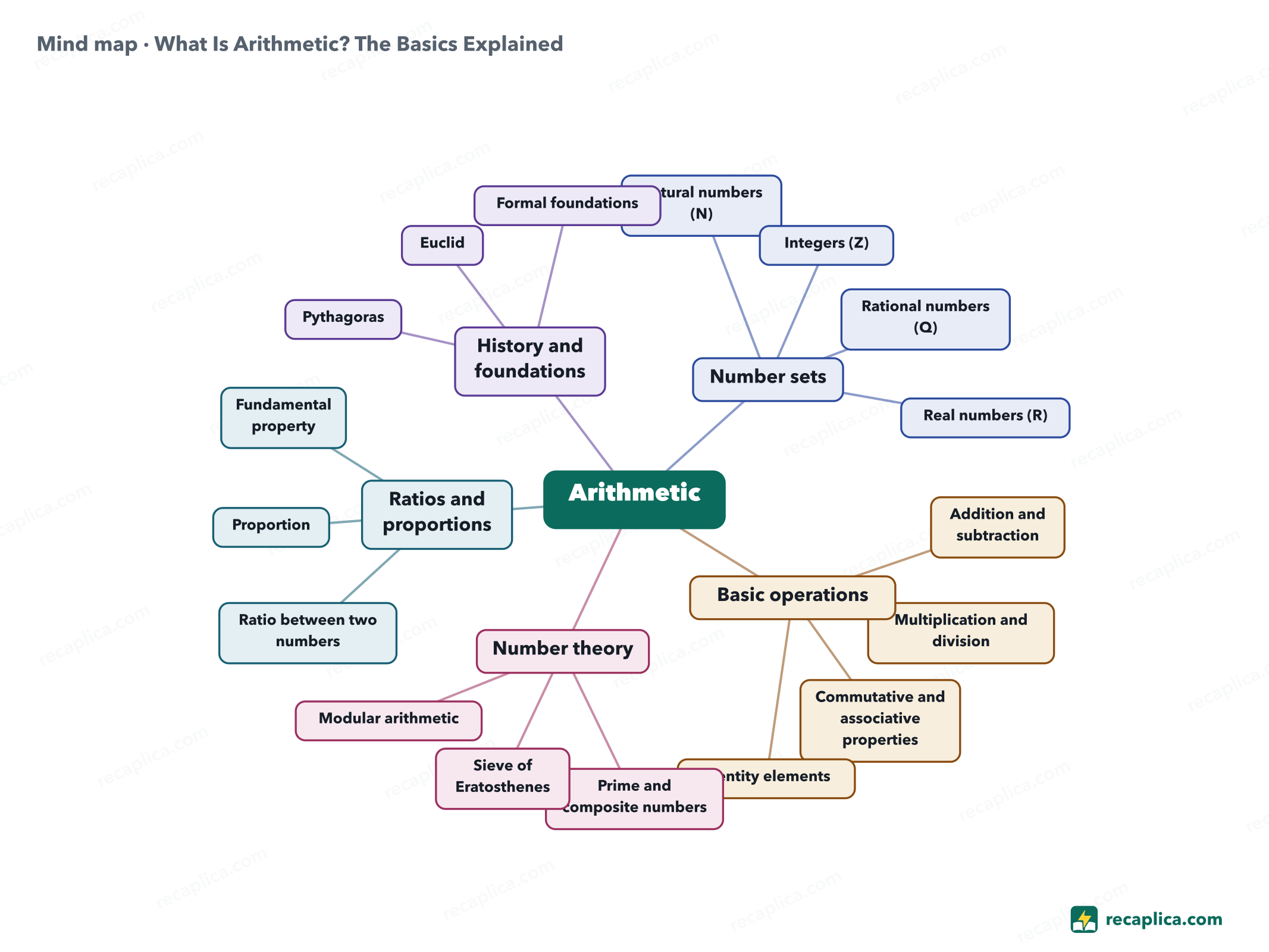
Quiz: test yourselfAnswer the questions to check what you have learned: you get instant feedback and a short explanation. Grade 0/10 0/5
FlashcardsTap the card to flip it and check whether you remember the answer, then move to the next one. 1 / 8 Explain it in your own wordsThe ultimate test: if you can explain it in simple words, you've truly understood it. Write your explanation, then compare it with the Recap. Your explanation is saved only on this device.
Frequently asked questionsWhat's the difference between arithmetic and algebra?Arithmetic works with specific numbers and the four operations between them. Algebra generalizes, using letters in place of numbers to represent entire families of problems governed by the same rules. The historical shift between the two fields already appears in the 3rd century AD, when Diophantus of Alexandria, according to Treccani, takes the step toward algebra. What is modular arithmetic?It's the branch of arithmetic that works with the remainder of a division rather than the whole quotient. The simplest model is a clock: after a fixed number of hours the count starts over, because what matters is the remainder left after dividing by 12 (or by 24), not the running total. Is zero a natural number?It depends on the convention: some definitions of N include zero (N = {0, 1, 2, 3...}), others start at 1 (N = {1, 2, 3...}). Both are in active use across mathematics texts, and neither one is wrong on its own. What is the Sieve of Eratosthenes used for?It's a procedure for building a table of prime numbers: write down the numbers from 2 onward, then repeatedly cross out the multiples of the smallest number not yet crossed out, stopping once you reach the square root of the chosen limit. Whatever numbers are left are prime. How do you recognize a prime number?A prime number is a positive integer greater than 1 with exactly two positive divisors: 1 and itself. If it has any other divisor, it's a composite number. Every Recap goes through an independent review before publication. |