|
recaplica
Cognitive Load Theory: The Definition Behind Sweller's Research | ||||||||
| © 2026 Recaplica · recaplica.com — All rights reserved | ||||||||
Cognitive Load Theory: The Definition Behind Sweller's ResearchWhat to print Page numbers appear when printing with default margins. SlidesChoose a cut Flash10 slidesThe essential thread, to present in classFull15 slidesEvery chapter and the deeper detailBoth come with speaker notes. In 30 seconds quick readCognitive load is the amount of working memory a task uses up while you learn something new. Psychologist John Sweller first described it in 1988, starting from research on problem solving: a strategy that is too demanding leaves little room to build stable mental structures. Later research distinguishes three types of load, intrinsic, extraneous, and germane, though part of the field treats the third as indistinguishable from the first. Cutting extraneous load, with worked examples or less cluttered materials, frees up mental room for actual learning. Key Points
Deep DiveCognitive load theory and the information processing modelCognitive load theory sits inside cognitivism, the paradigm that treats learning as information processing, breaking with behaviorism and its focus on observable stimuli and responses. Within that paradigm, the theory zeroes in on a specific bottleneck: working memory, the mental function that keeps information active while you use it. A 2018 review on collaboration and cognitive load traces this bottleneck’s limits back to the 1950s: a narrow capacity, established by George Miller in 1956, and a short duration, established by Peterson and Peterson in 1959. Sweller didn’t discover those limits. He used them as the foundation for a different question: what happens when a task asks working memory to hold more elements than it can manage at once. The origins: Sweller’s 1988 study on problem solvingIn 1988, educational psychologist John Sweller published the paper that gave the theory its name, in Cognitive Science. It didn’t start from a classification of load types — that came later — but from research on how people solve problems. Sweller studied a widespread strategy called means-ends analysis: to use it, a problem solver has to hold in mind, all at once, the current state of the problem, the goal state, the relationship between the two, the operators available, and, when multiple steps are involved, a stack of subgoals. According to Sweller, juggling all of that can absorb so much mental capacity that little is left for the theory’s real target: schema acquisition, the stable knowledge structures that remain once the problem is solved. That observation produced the theory’s first practical application: the goal-free effect. If a problem has no specific goal to reach, a solver can no longer rely on means-ends analysis, because that strategy needs a precise target to work backward from. Remove the target, and working memory has less to hold at once — Sweller already proposed this, in 1988, as a technique for lowering load during learning. The three types of cognitive load, and a caveatThe three-way split isn’t in the 1988 paper: later research, through the 1990s and 2000s, formalized it on top of that original work. A 2022 study in Frontiers in Psychology, focused on solving word problems, gives a compact description of the three.
A 2018 review on cognitive load in collaborative settings reports a position, attributed to a 2011 paper, holding that germane load is essentially indistinguishable from intrinsic load: both would arise from the same effort of processing content, and treating them as two separate categories ends up being redundant. The three-way split remains the most common framing in the research that followed Sweller, but the third entry, unlike the first two, isn’t something the field agrees on. Cutting extraneous load: examples from the researchSince intrinsic load depends on the content itself, it isn’t something instructional design can touch without changing what’s being taught. The room to maneuver is in extraneous load, and a 2020 review in the Journal of Education and Health Promotion lists concrete techniques for lowering it: completion tasks, goal-free problems, worked examples, merging multiple information sources into one material, using different modalities together (text and images, for instance), cutting redundancy, and minimizing interruptions during study. Among these, worked examples have a particular history. In 1988, Sweller cites them only as a bibliographic reference to another paper on teaching algebra; it’s a 2022 study that credits Sweller and colleagues, in 2011, with formalizing the worked-example effect: studying a problem that’s already solved, step by step, produces better outcomes and a lower load than solving the same problem alone, especially for someone new to a subject. The mechanism, according to a 2018 review, is that each step of the example can be considered on its own, without weighing alternative moves at the same time: the interaction between the problem’s elements, and with it extraneous load, goes down.
Anyone looking to apply these principles to everyday study, not just course design, will find practical pointers in how to study effectively: many of the techniques that cut mental clutter during study work precisely because of the cognitive load a disorganized material adds, unnecessarily, on top of what the subject already demands. Slide deckSlides ready to download and make your own in PowerPoint or Google Slides, with speaker notes. Pick the Flash cut or the Full one.     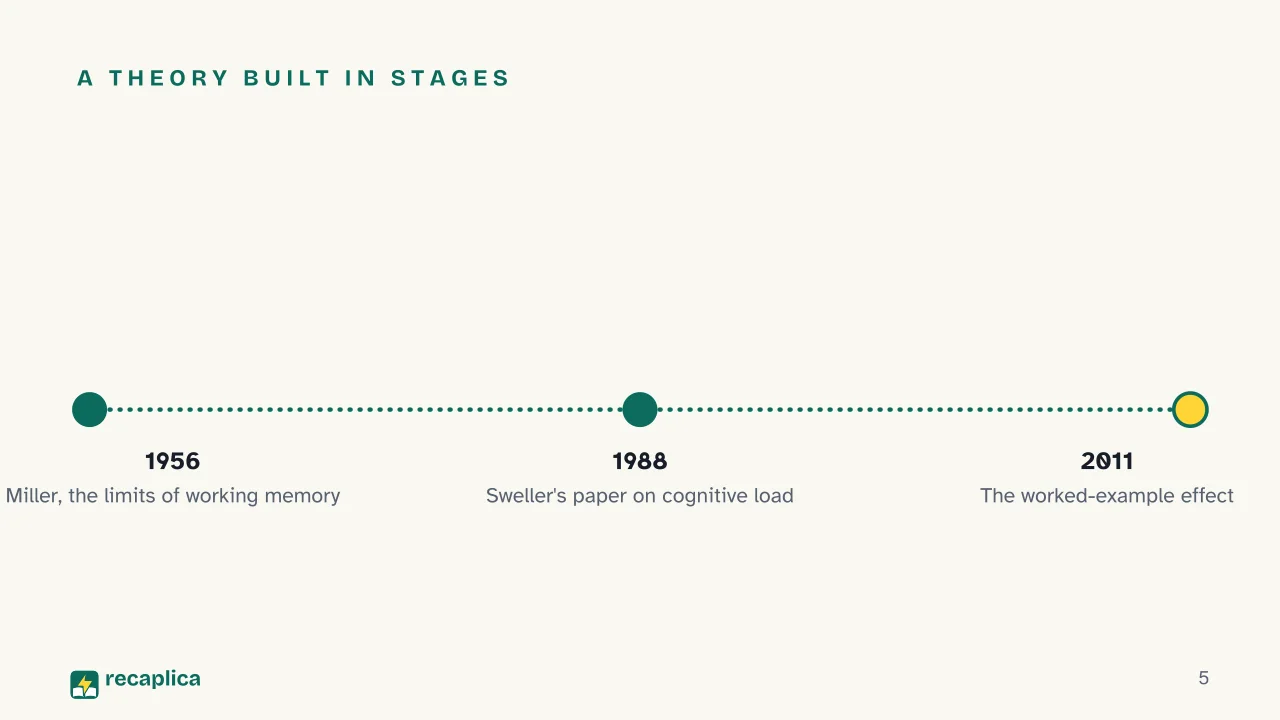  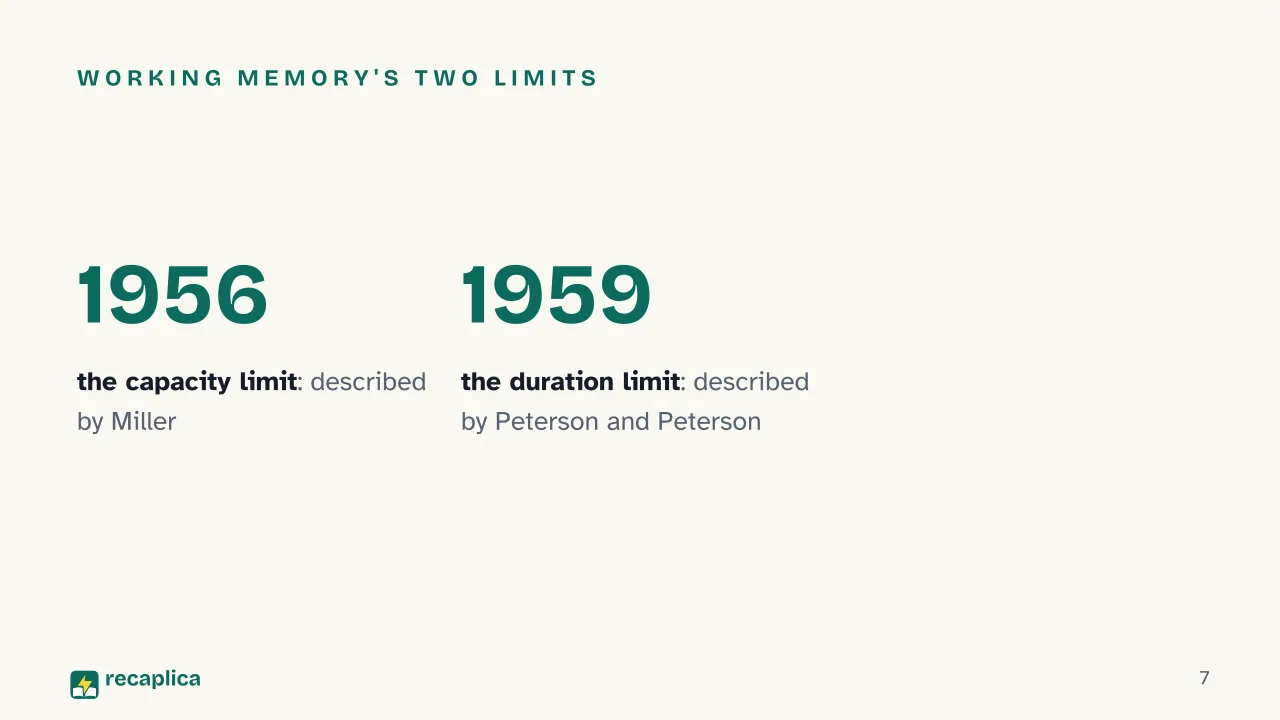  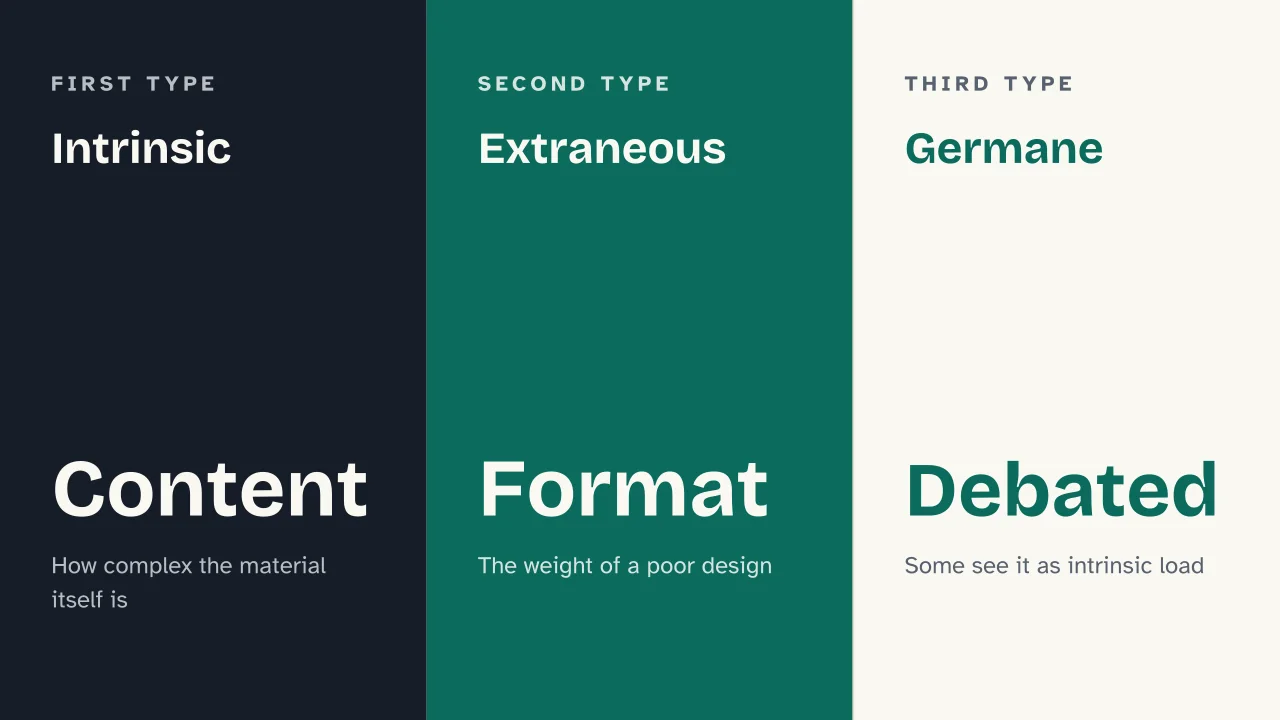 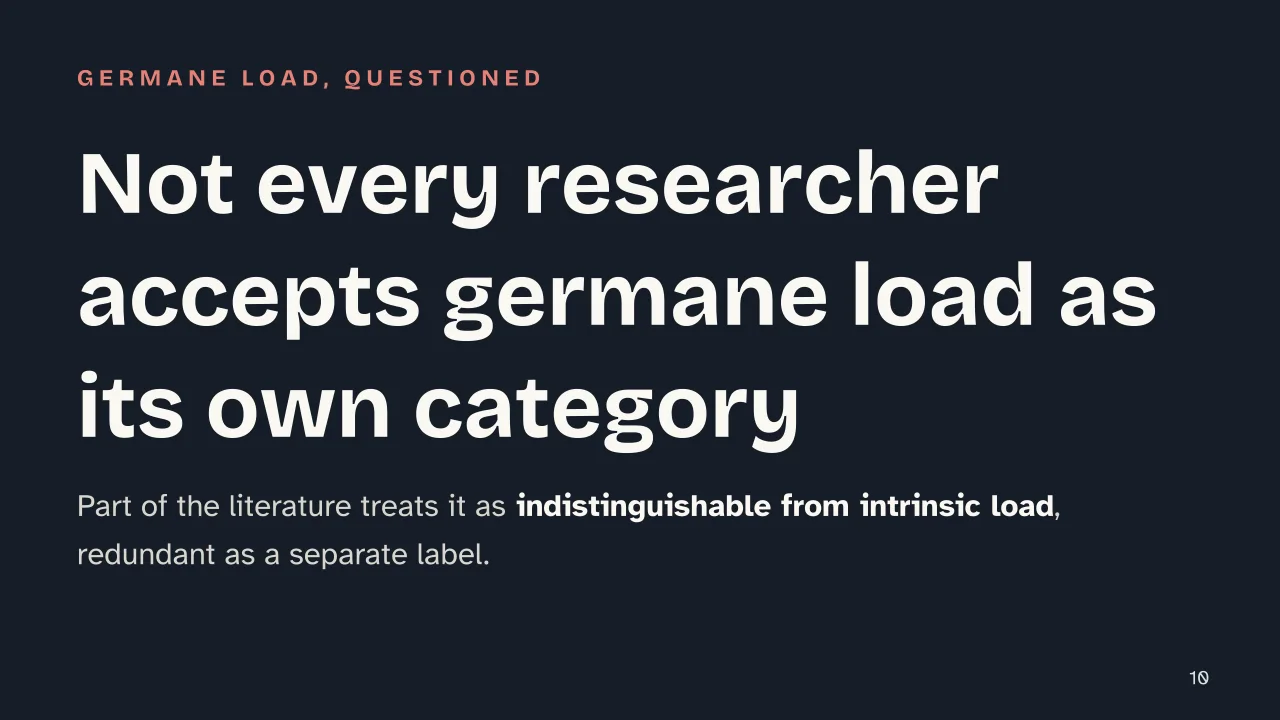  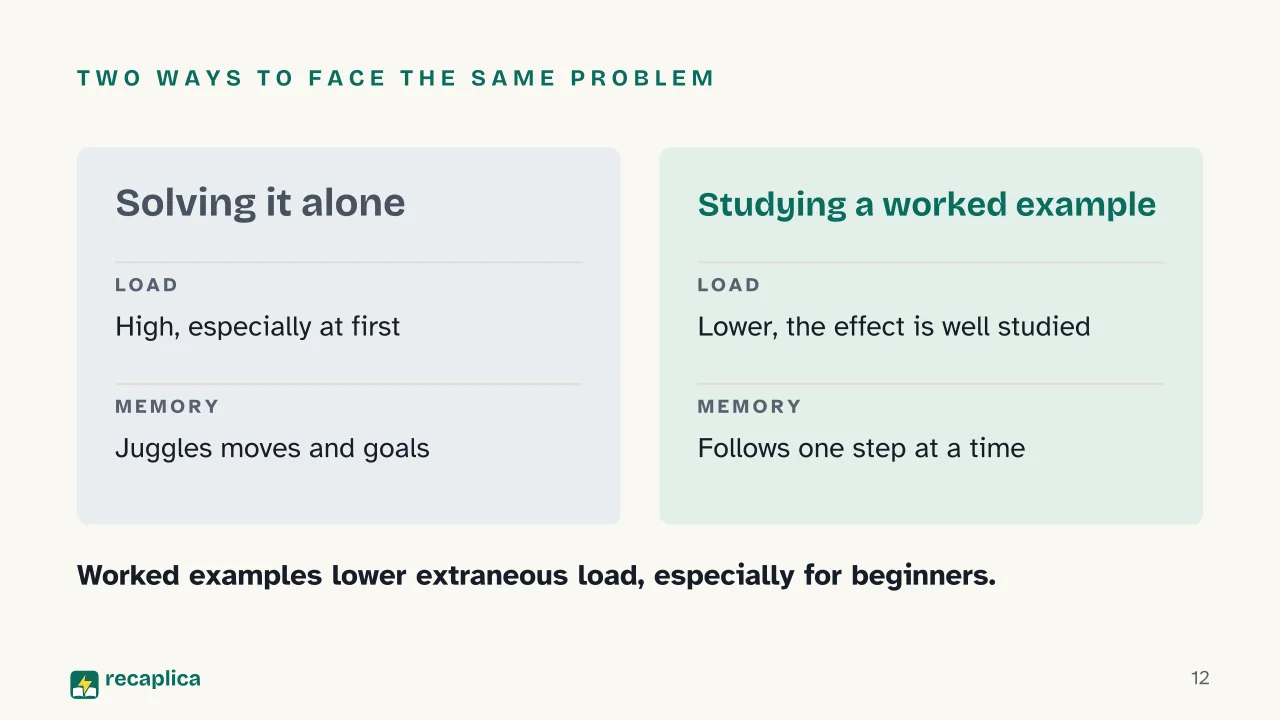 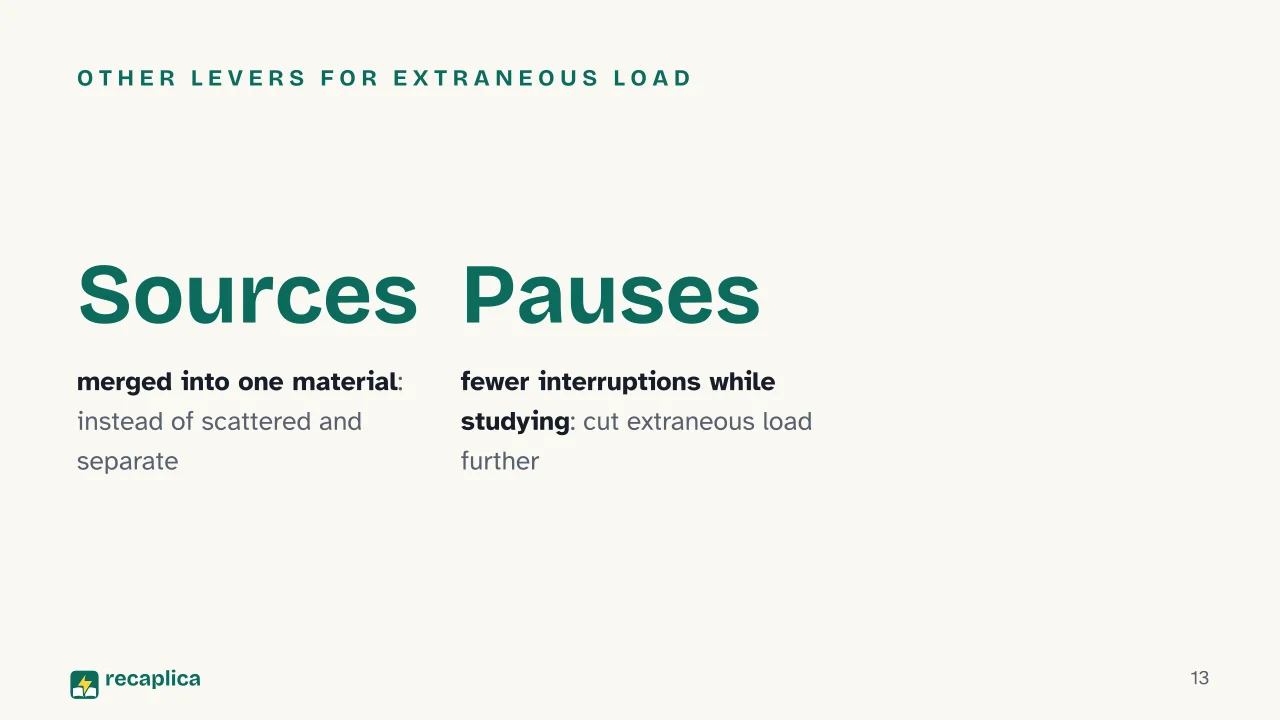 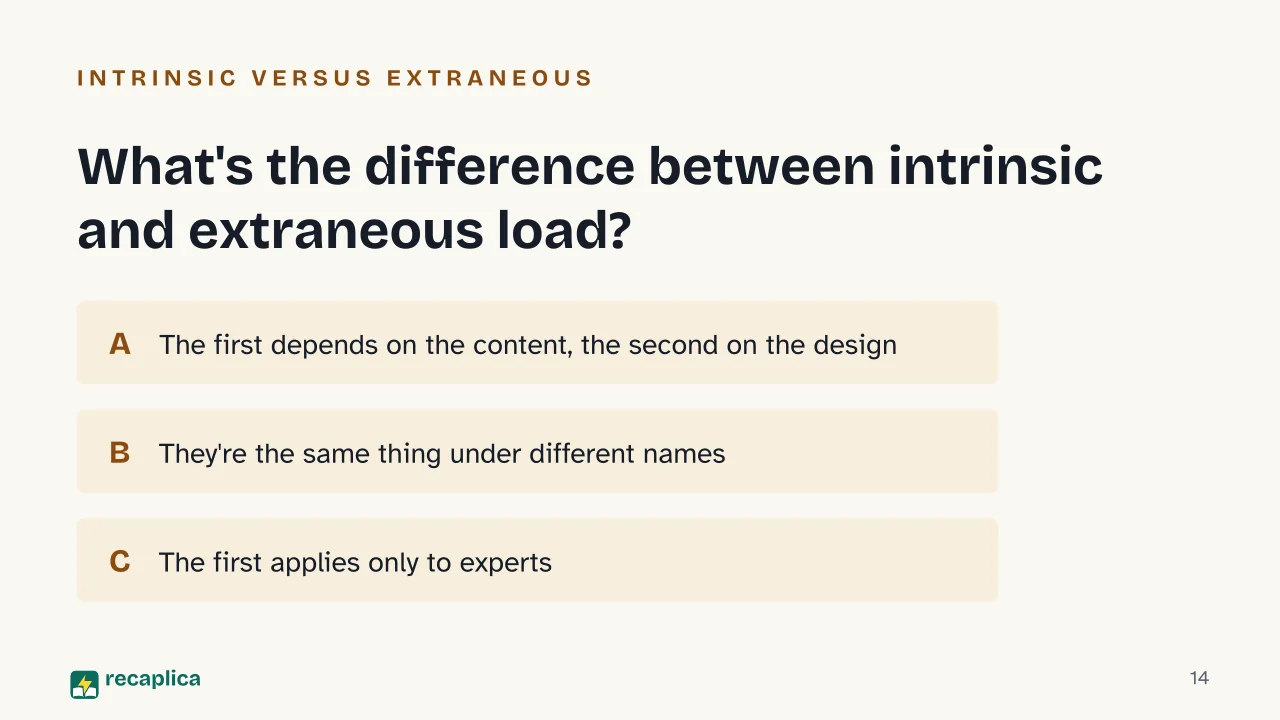  Common myths
Mind mapDrag the background to move around and the nodes to reposition them; use − and + to collapse and expand branches. 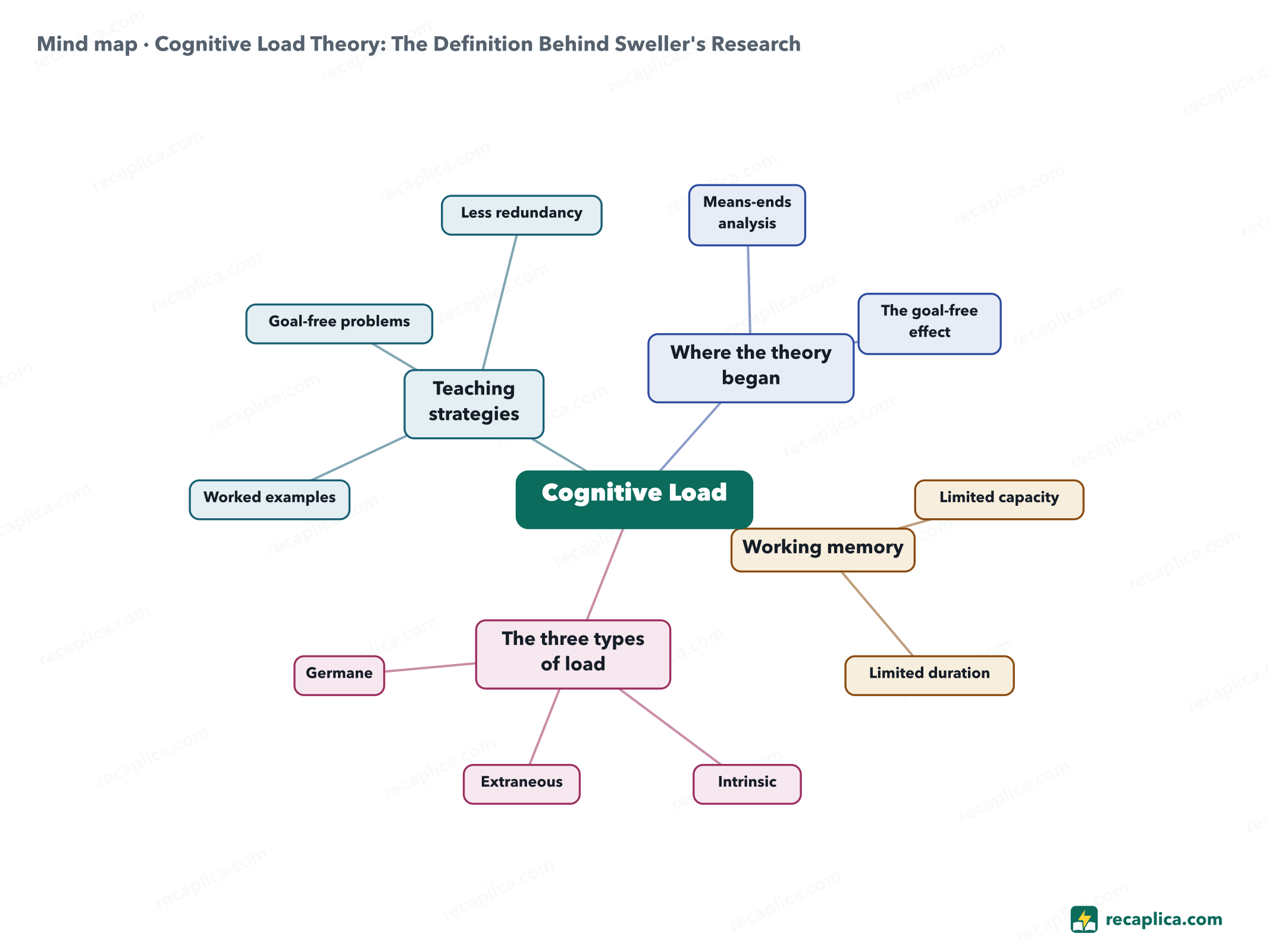
Quiz: test yourselfAnswer the questions to check what you have learned: you get instant feedback and a short explanation. Grade 0/10 0/5
FlashcardsTap the card to flip it and check whether you remember the answer, then move to the next one. 1 / 8 Explain it in your own wordsThe ultimate test: if you can explain it in simple words, you've truly understood it. Write your explanation, then compare it with the Recap. Your explanation is saved only on this device.
Frequently asked questionsWhat does cognitive load mean?It's the mental effort working memory carries while handling a new task: the more elements you need to hold in mind at once, the higher the load, and too much of it leaves little room for actual learning. What is extraneous cognitive load?It's the share of mental effort that doesn't help you learn, caused by how a material is organized, for example confusing instructions or redundant information, and that good instructional design can reduce. Who came up with cognitive load theory?Educational psychologist John Sweller, who first described it in a 1988 paper grown out of research on problem solving. What are the three types of cognitive load?Intrinsic load (the content's own difficulty), extraneous load (the weight added by inefficient design), and germane or pertinent load (the resources spent building stable knowledge); this last category is debated in the literature. What are some examples of cognitive load in learning?A student solving an equation from scratch juggles every possible move at once, a high load; the same student reading a worked example follows one step at a time, a lower load. Cluttered slides, redundant text-and-narration, or frequent interruptions during study are examples of extraneous load added on top. Every Recap goes through an independent review before publication. |