recaplica
Clear in 30 seconds, yours in 10 minutes.
In 30 seconds quick read
Behaviorism is the school of psychology that studies only observable behavior, leaving aside the thoughts and feelings that stay hidden inside the mind. It began in 1913, when the American psychologist John B. Watson published an essay calling for psychology to become an experimental science, without relying on introspection. After him, Ivan Pavlov studied conditioned reflexes and Edward Thorndike studied trial-and-error learning; Burrhus Skinner pushed the ideas to their most extreme form with radical behaviorism. The thread running through all of it is the stimulus-response model: a behavior is explained by what comes before it and what follows it, not by guessing what happens inside the head of the person doing it.
Key Points
Behaviorism began in 1913 with John B. Watson's essay "Psychology as the Behaviorist Views It," which called for an objective, experimental psychology.
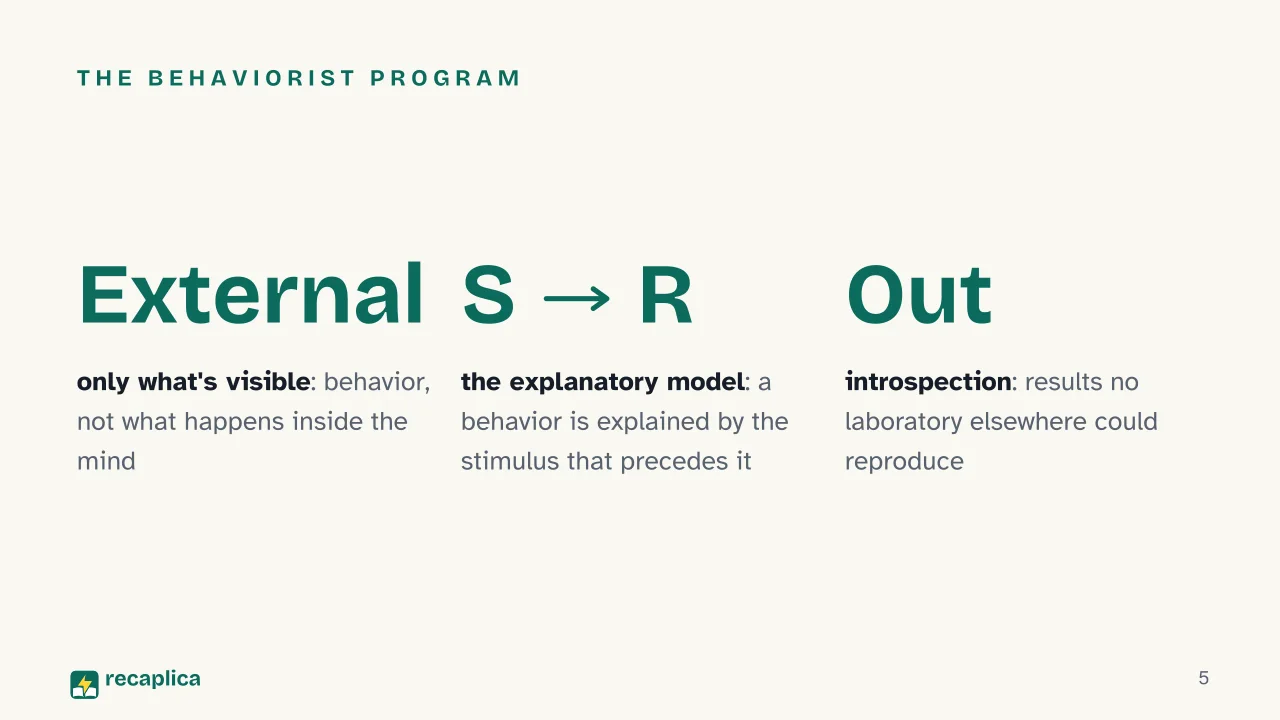
The method drops introspection: Watson argued that subjective reports carry no scientific weight, and the behaviorist draws no sharp line between human and animal behavior.
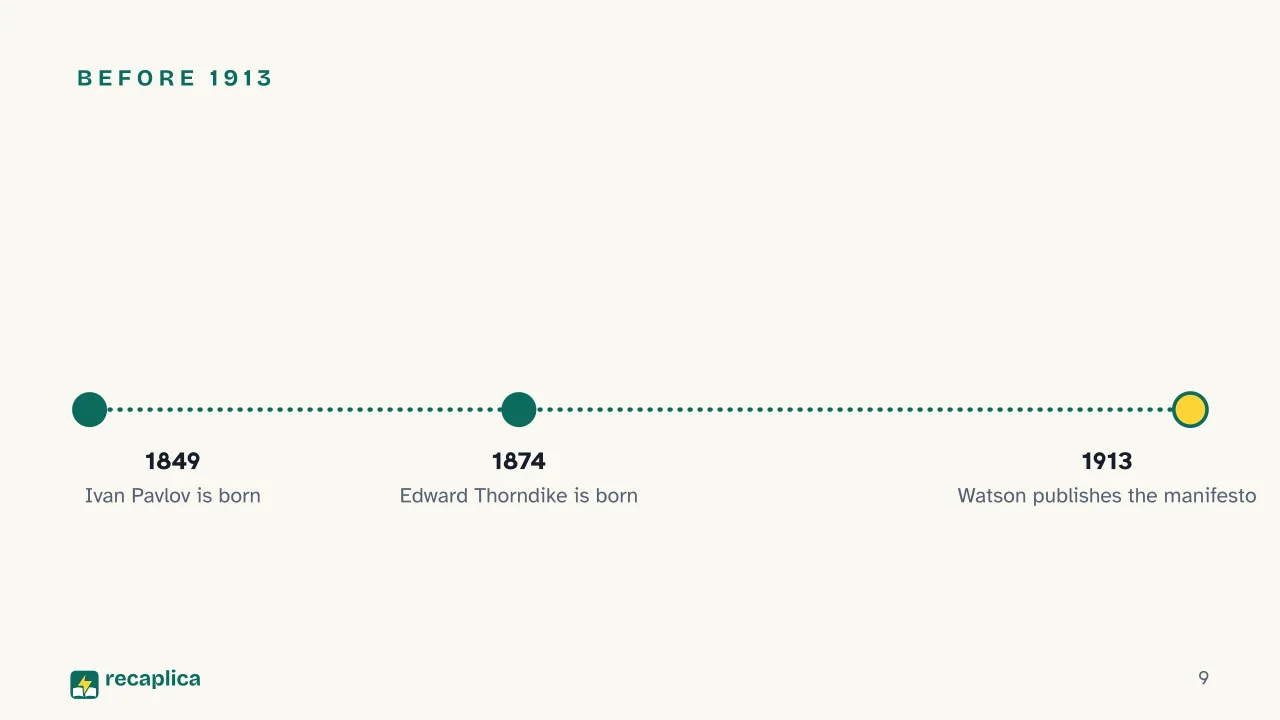
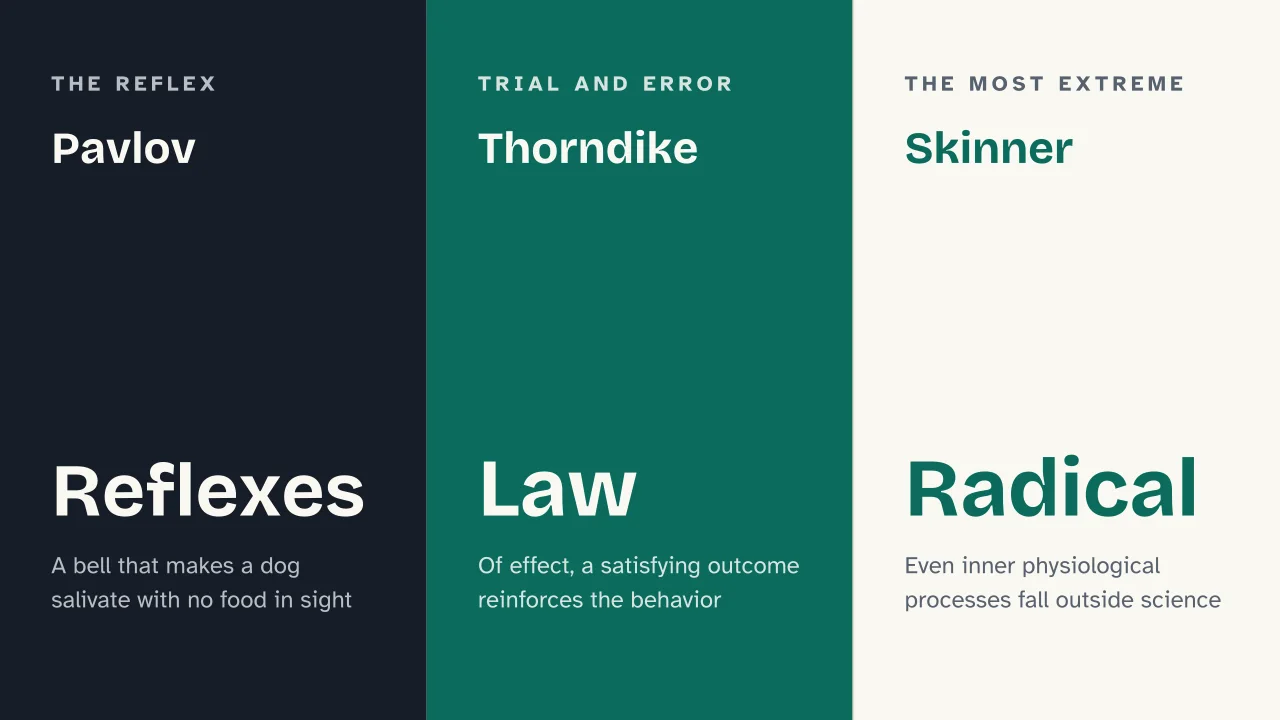
Ivan Pavlov (1849-1936) described conditioned reflexes through the stimulus-response model; Edward Thorndike (1874-1949) formulated the law of effect, on trial-and-error learning.
Burrhus Skinner called his own version "radical behaviorism," extended the rejection of inner processes to physiological ones as well, and described learning through operants, behaviors that grow more frequent when followed by reinforcement.
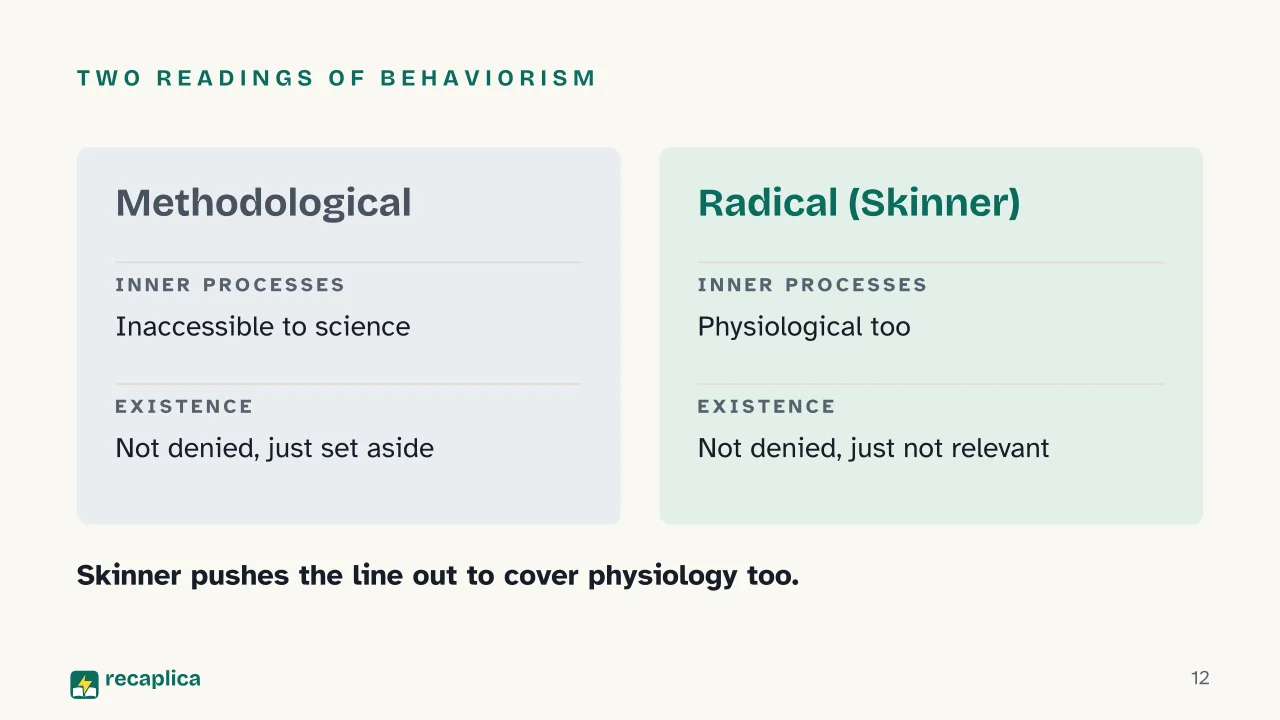
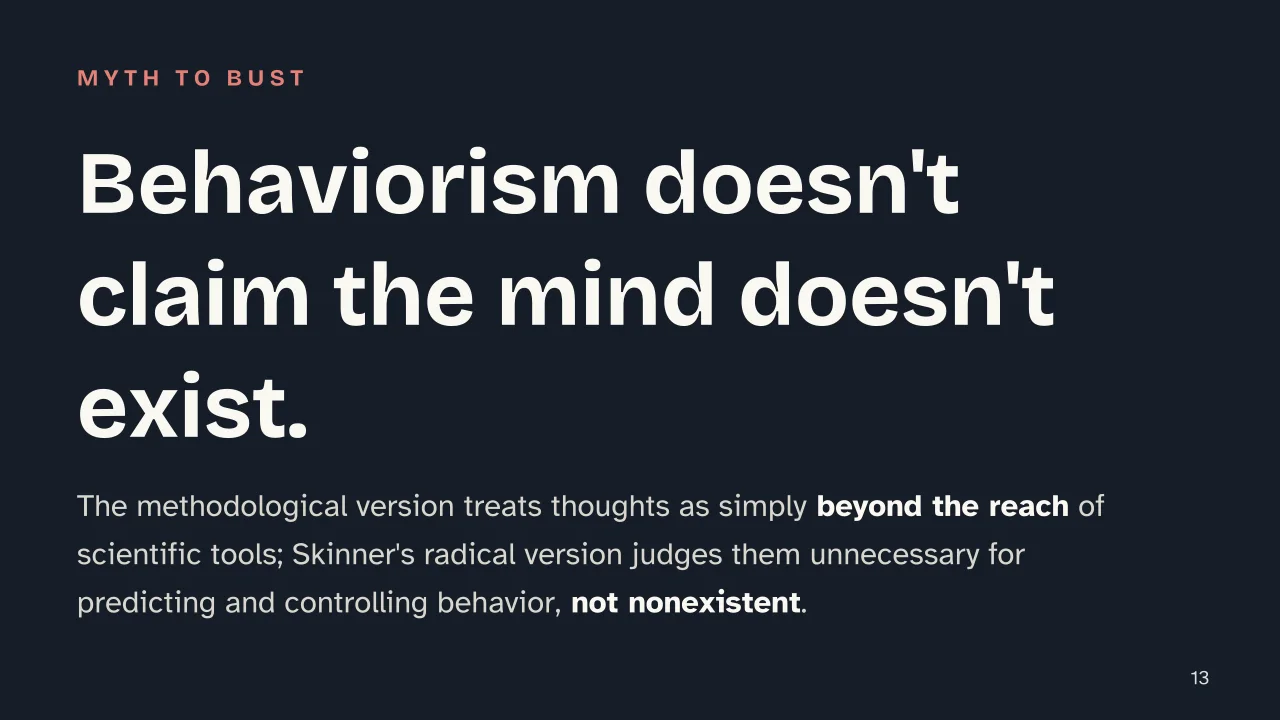
Methodological behaviorism treats thoughts as simply out of science's reach, not as nonexistent; Skinner's radical version judges them irrelevant for predicting and controlling behavior.
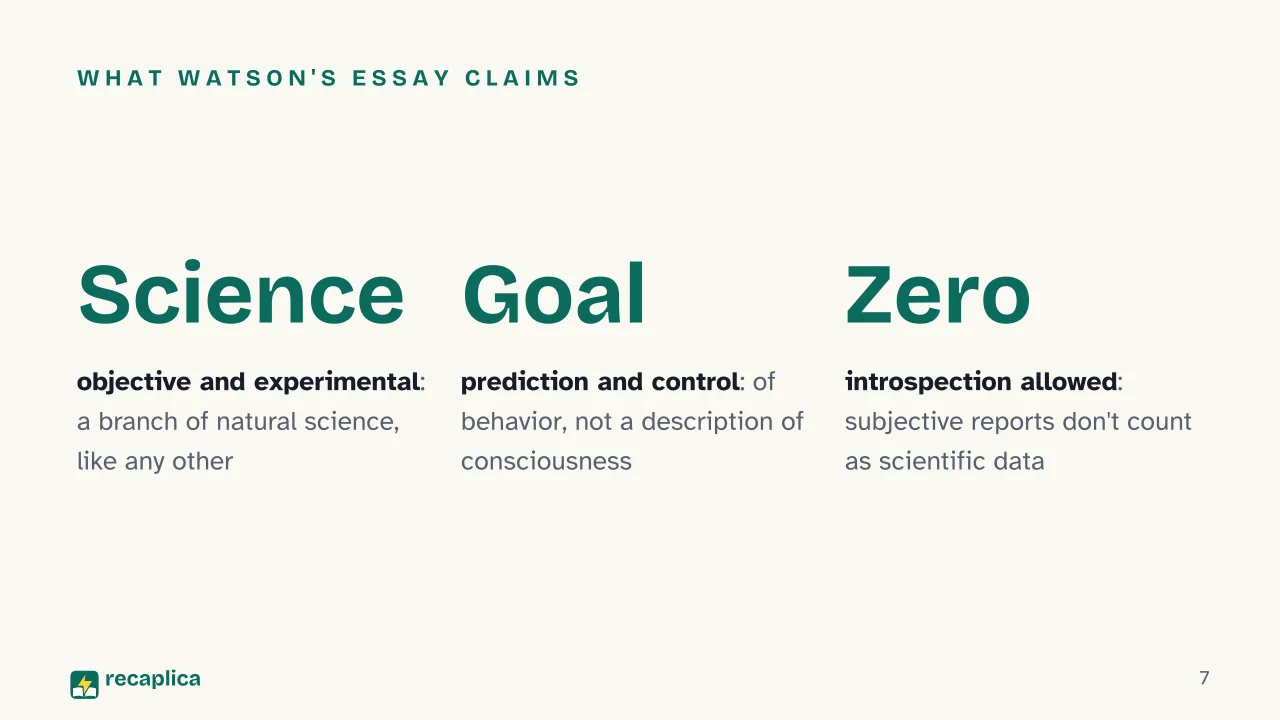
The goal Watson declares in 1913 is the prediction and control of behavior, not a description of consciousness.
Deep Dive
A manifesto published in 1913
In 1913 the American psychologist John B. Watson published, in the
journal Psychological Review, the essay that started the movement: he
proposed turning psychology into an experimental science on a par with
the other natural sciences, with a precise object of study, observable
behavior. The goal he set was not to describe consciousness, but to
predict and control behavior.
To get there, Watson set introspection aside, the account a person gives
of their own thoughts or sensations. It isn’t that behaviorists denied
people have thoughts: it’s that those reports, in Watson’s view, didn’t
hold up as scientific data, because two different laboratories couldn’t
reach the same results starting from the same introspective reports. A
science needs measurements that anyone, in any laboratory, can
reproduce.
Watson’s program is also broader than it looks at first glance: it draws
no sharp line between human and animal behavior. The same model that
explains why a rat presses a lever explains, for him, why a person
reacts to a situation, you look at what precedes the behavior, the
stimulus, and what follows it, the response, not at what happens inside
the head of the person doing it.
The stimulus-response model, with an example
Practical example: a dog hears the sound of a bell every time it
gets food. After a few repetitions, the dog salivates at the mere
sound of the bell, even when no food is coming. The bell, on its own,
has become capable of producing the response that only the food used
to produce: that’s the stimulus-response model at work, and it’s the
experiment through which Ivan Pavlov enters the history of
behaviorism.
Pavlov, born in 1849 and died in 1936, didn’t call himself a
behaviorist: he was a Russian physiologist, and he studied reflexes. His
way of working, measuring an observable response to a controlled
stimulus, with no need to know what the dog “thinks,” is the method
behaviorism adopts as its own.
Working alongside Pavlov was Edward Thorndike, born in 1874 and died in
1949. Thorndike studied how animals learn through trial and error: an animal
tries different actions until it finds the one that works, and repeats
it more and more often. From this comes his law of effect: a behavior followed by a
satisfying outcome tends to repeat; one followed by an unpleasant
outcome tends to fade away.
Skinner and radical behaviorism
Burrhus Skinner pushed Watson’s program to a more extreme point, one he
himself called radical behaviorism. Where Watson’s behaviorism sets
thoughts aside because they can’t be measured in a laboratory, Skinner’s
extends the same treatment to inner physiological processes too: for
predicting and controlling behavior, they aren’t needed.
Skinner describes learning through operant conditioning: a behavior, an
operant, that is followed by reinforcement grows more frequent. A
behavior that’s ignored or punished, instead, fades.
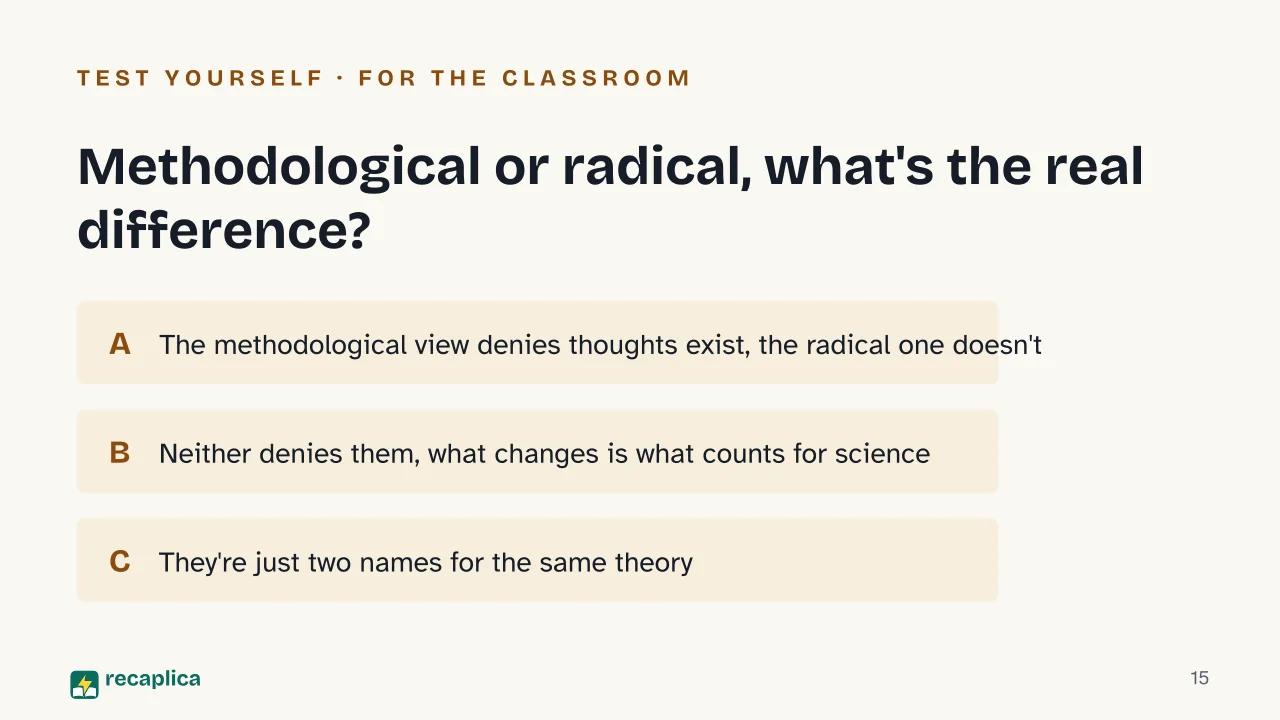
The difference between the two versions of behaviorism isn’t about what
exists, but about what counts for science.
Methodological behaviorism
Radical behaviorism (Skinner)
Inner processes
Scientifically inaccessible
Physiological too, not just mental
Do they exist?
Not denied
Not denied
What counts for prediction and control
Only observable behavior
Only observable behavior
A legacy beyond the animal lab
Behaviorism’s ideas didn’t stay confined to rats in cages and dogs with
bells. The stimulus-response model and the focus on observable behavior,
rather than on inner explanations, shaped how learning and education
were studied for decades, and reach into how we look at
human emotions as well: not to deny them,
but to ask what, about an emotion, can be observed and measured from the
outside.
Slide deck
Slides ready to download and make your own in PowerPoint or Google Slides, with speaker notes. Pick the Flash cut or the Full one.
✗ Myth Behaviorism claims that thoughts and feelings don't exist.
✓ Reality That's not the case: methodological behaviorism treats inner processes as scientifically inaccessible, not nonexistent, and even Skinner's radical version doesn't deny that thoughts and sensations exist. Skinner simply judges them irrelevant for predicting and controlling behavior, the discipline's real goal.
✗ Myth Watson reduced psychology to the study of laboratory animals.
✓ Reality Quite the opposite, Watson's program was meant to be a single science applicable to both humans and animals, with no sharp line between them. Studying a dog's reflexes or the lever a rat presses was a way to build an explanatory model Watson wanted valid for human behavior too.
✗ Myth Rejecting introspection means behaviorists ignored everything people said about their own thoughts.
✓ Reality Watson's problem wasn't the content of a report but its reliability as scientific evidence, introspective results weren't reproducible from one lab to another. What behaviorists rejected was treating those reports as a privileged, direct window into the mind, not ignoring everything people said.
Mind map
Drag the background to move around and the nodes to reposition them; use − and + to collapse and expand branches.
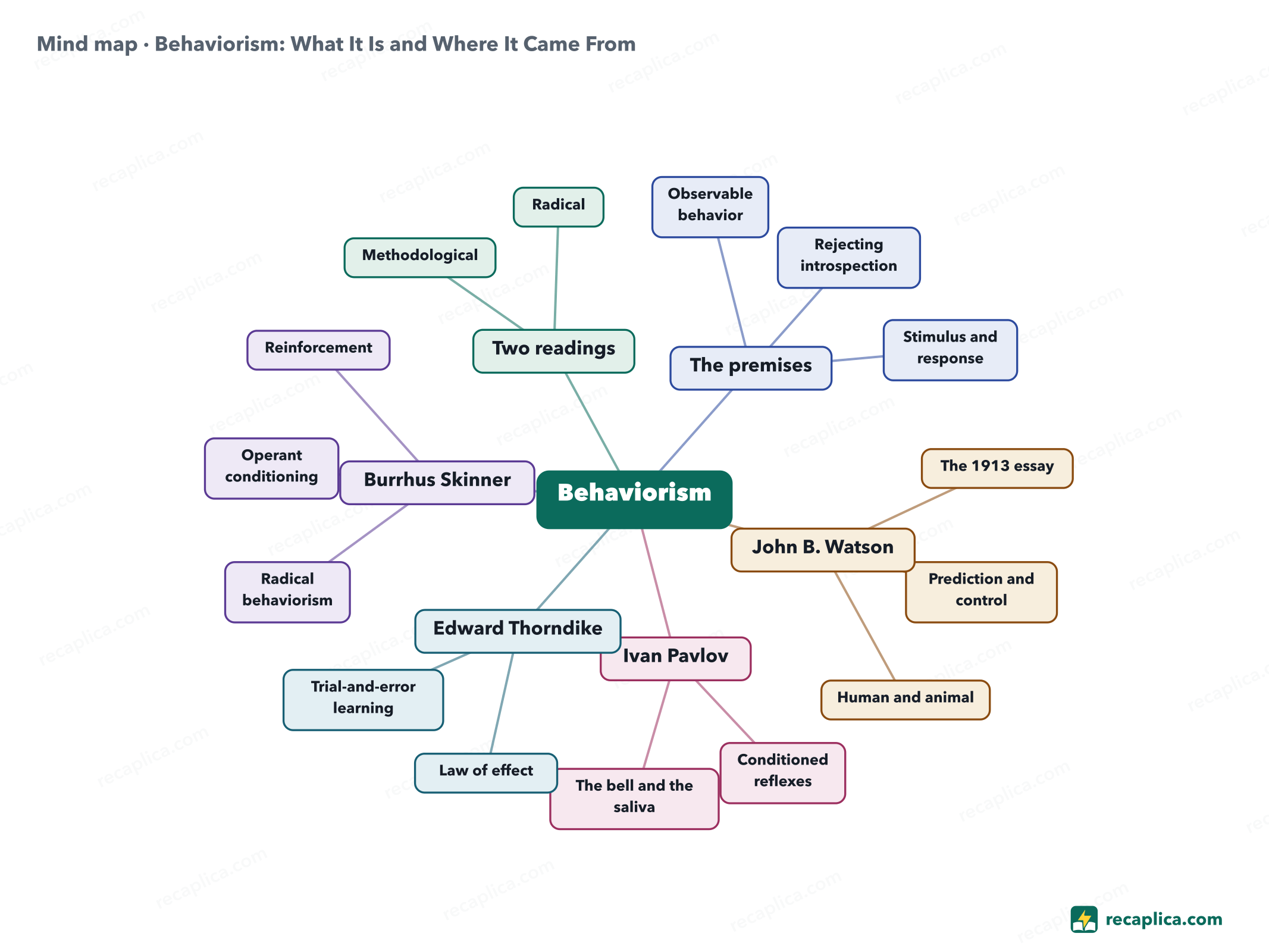
Observable behaviorThe only legitimate object of study
Rejecting introspectionSubjective reports can't be verified in a lab
Stimulus and responseA behavior is explained by what precedes it
John B. Watson
The 1913 essayPsychology as the Behaviorist Views It
Prediction and controlThe discipline's declared goal
Human and animalNo sharp line between the two, in Watson's program
Ivan Pavlov
Conditioned reflexesBorn in 1849, died in 1936
The bell and the salivaThe stimulus-response model at work
Edward Thorndike
Law of effectA satisfying outcome reinforces the behavior
Trial-and-error learningBorn in 1874, died in 1949
Burrhus Skinner
Radical behaviorismExtends the rejection to inner physiological processes too
Operant conditioningLearning explained through operants
ReinforcementAn operant followed by reinforcement grows more frequent
Two readings
MethodologicalInner processes inaccessible, not nonexistent
RadicalInner processes irrelevant for prediction and control
Quiz: test yourself
Answer the questions to check what you have learned: you get instant feedback and a short explanation.
Grade0/100/5
Answers: 1-B · 2-B · 3-A · 4-B · 5-B
Flashcards
Tap the card to flip it and check whether you remember the answer, then move to the next one.
1 / 8
Explain it in your own words
The ultimate test: if you can explain it in simple words, you've truly understood it. Write your explanation, then compare it with the Recap.
Your explanation is saved only on this device.
Behaviorism is the school of psychology that studies only observable behavior, leaving aside the thoughts and feelings that stay hidden inside the mind. It began in 1913, when the American psychologist John B. Watson published an essay calling for psychology to become an experimental science, without relying on introspection. After him, Ivan Pavlov studied conditioned reflexes and Edward Thorndike studied trial-and-error learning; Burrhus Skinner pushed the ideas to their most extreme form with radical behaviorism. The thread running through all of it is the stimulus-response model: a behavior is explained by what comes before it and what follows it, not by guessing what happens inside the head of the person doing it.
Frequently asked questions
What is behaviorism?
It's the school of psychology, begun in 1913 with John B. Watson's essay, holding that the discipline should study only observable behavior, explaining it through the stimulus-response model and leaving introspection out. Its declared goal is to predict and control behavior, not describe consciousness.
Who founded behaviorism?
John B. Watson, with the essay "Psychology as the Behaviorist Views It," published in 1913 in Psychological Review. After him the program was taken up and extended by Ivan Pavlov, Edward Thorndike, and, in a more extreme form, by Burrhus Skinner.
What's the difference between methodological and radical behaviorism?
Methodological behaviorism, Watson's version, treats thoughts and sensations as scientifically inaccessible, but doesn't deny they exist. Skinner's radical behaviorism extends the rejection to physiological inner processes too and judges them irrelevant for predicting and controlling behavior, not nonexistent.
Why does behaviorism reject introspection?
Because data gathered by asking people to describe their own thoughts weren't reproducible from one laboratory to another. Watson wanted psychology to have data that anyone could verify the same way, as in other experimental sciences.
What is Skinner's operant conditioning?
The mechanism Skinner uses to explain learning, an operant, a behavior, that is followed by reinforcement grows more frequent; one that is ignored or punished decreases.
Every Recap goes through an independent review before publication.
Statistics, only if you say so
To learn which Recaps help most we would use Google Analytics, with aggregate, anonymous data. It starts only with your OK, and you can change your mind anytime. Privacy policy