Skip to content
recaplica

    One moment: security check

    Cloudflare wants to make sure you're not a robot. Tick the box below and your search will continue on its own.

    IT
    recaplica Positivism: What Is Auguste Comte's Philosophy and Why It Backfired
    © 2026 Recaplica · recaplica.com — All rights reserved
    Home › History

    Positivism: What Is Auguste Comte's Philosophy and Why It Backfired

    By Recaplica Newsroom · Updated on October 15, 2026

    What to print

    Page numbers appear when printing with default margins.

    Slides

    Choose a cut

    Flash10 slidesThe essential thread, to present in classFull14 slidesEvery chapter and the deeper detail

    Both come with speaker notes.

    Telegram channel
    recaplica Clear in 30 seconds, yours in 10 minutes.
    In 30 seconds Key points Deep dive Slides Myths Mind map Quiz Flashcards FAQ

    In 30 seconds quick read

    Positivism is the philosophical and political movement Auguste Comte launched in the first half of the nineteenth century, and it spread widely in the decades that followed. Comte argued that human thought moves through three stages, from theology to metaphysics and finally to positive knowledge, the only kind content to describe how phenomena behave instead of chasing their ultimate causes. In the Cours de philosophie positive he put science at the center of philosophy; in the later Système de politique positive he pushed further and recast that philosophy as a secular faith, the Religion of Humanity. That shift drew sharp pushback: Mill broke with the later Comte, while in Germany Dilthey and Engels challenged his scientific claims from very different angles.

    Key Points

    • Auguste Comte founded positivism, a movement that took hold broadly in the second half of the eighteen-hundreds.
    • Comte's law divides the human mind into three stages, theological, metaphysical and positive: only the last one stops at observable laws instead of hunting for deeper causes.
    • Between the Cours de philosophie positive and the Système de politique positive, Comte's project turned from a scientific doctrine into a full secular creed, the Religion of Humanity.
    • Mill came to see that final phase as a form of total control over minds and public life, comparable in his view to Ignatius of Loyola.
    • To tell the two phases apart, Mill and Littré coined a label that stuck: a 'good Comte', author of the Cours, and a 'bad Comte', author of the Système.
    • In the twentieth century Comte's project lost ground to the logical positivism of the Vienna Circle, a movement that kept the name while breaking with much of the original program.

    Deep Dive

    Auguste Comte founded positivism, a philosophical and political current that gained wide traction across the second half of the nineteenth century. It’s often introduced as a scientific method first and foremost, but the Stanford Encyclopedia of Philosophy argues that Comte’s positivism is better read as a political philosophy than as a philosophy of science.

    Auguste Comte and positivism in sociology

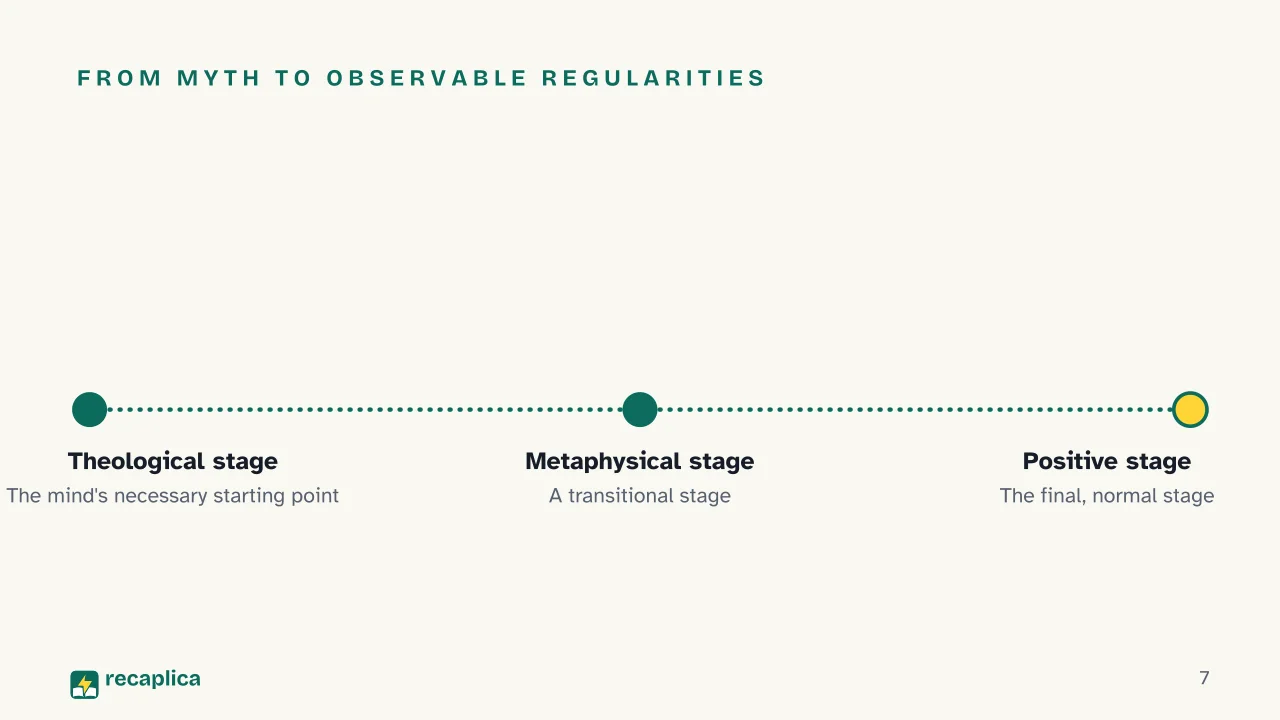
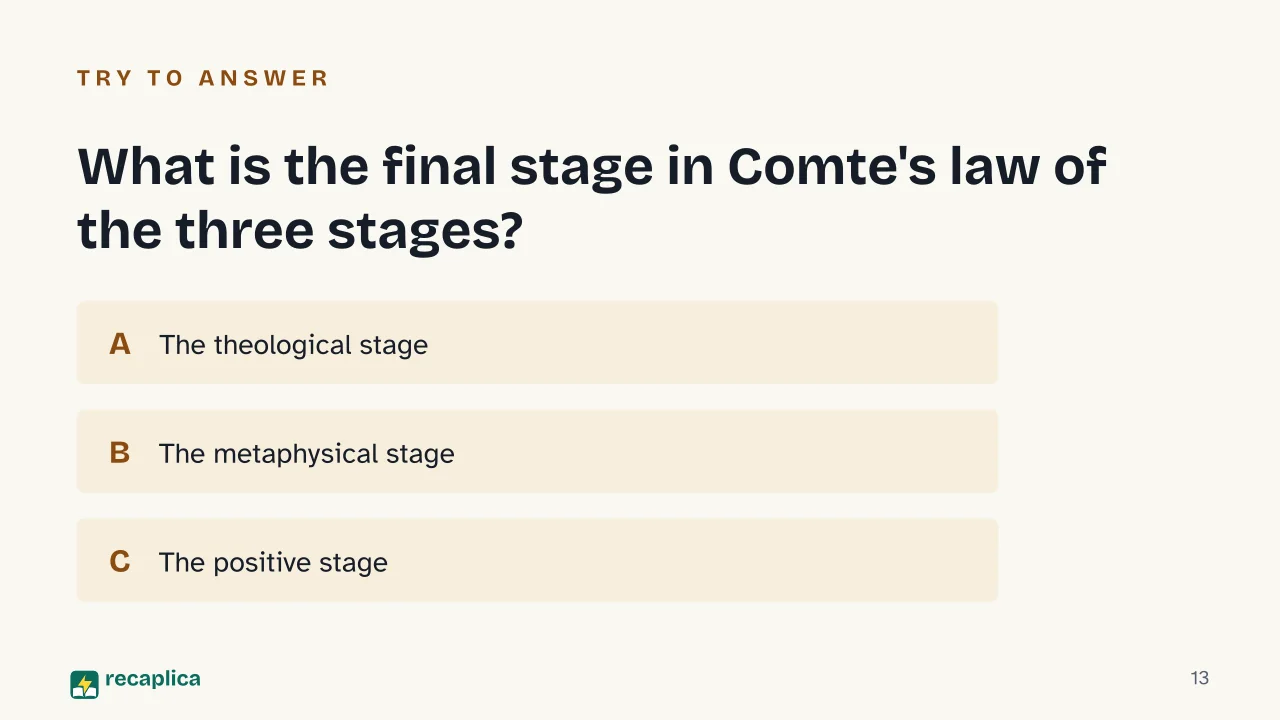
    The core of Comte’s thought is the law of the three stages. Under this law, humanity’s history as a whole and the growth of any single mind follow the same three phases: the theological stage, the mind’s necessary starting point; the metaphysical stage, a stage of transition; and the positive stage, the final and normal stage. In the positive stage, Comte held, the mind gives up looking for the ultimate causes of events and settles instead for identifying the laws that govern them.

    Practical example: faced with a lightning bolt, the theological stage explains it as the will of a god, the metaphysical stage as the effect of an abstract force, and the positive stage as an electrical phenomenon obeying verifiable physical laws, with no question asked about why those laws exist at all.

    For Comtean positivism, as Encyclopedia.com summarizes it, science is the only valid form of knowledge and facts are the sole possible objects of knowledge. Comte applied the same framework to the study of society, founding what he called “social physics”: sociology, split into social statics, the theory of order, and social dynamics, the theory of progress. The ambition was to treat social phenomena with the same rigor reserved for natural ones, chasing their laws rather than their ultimate causes.

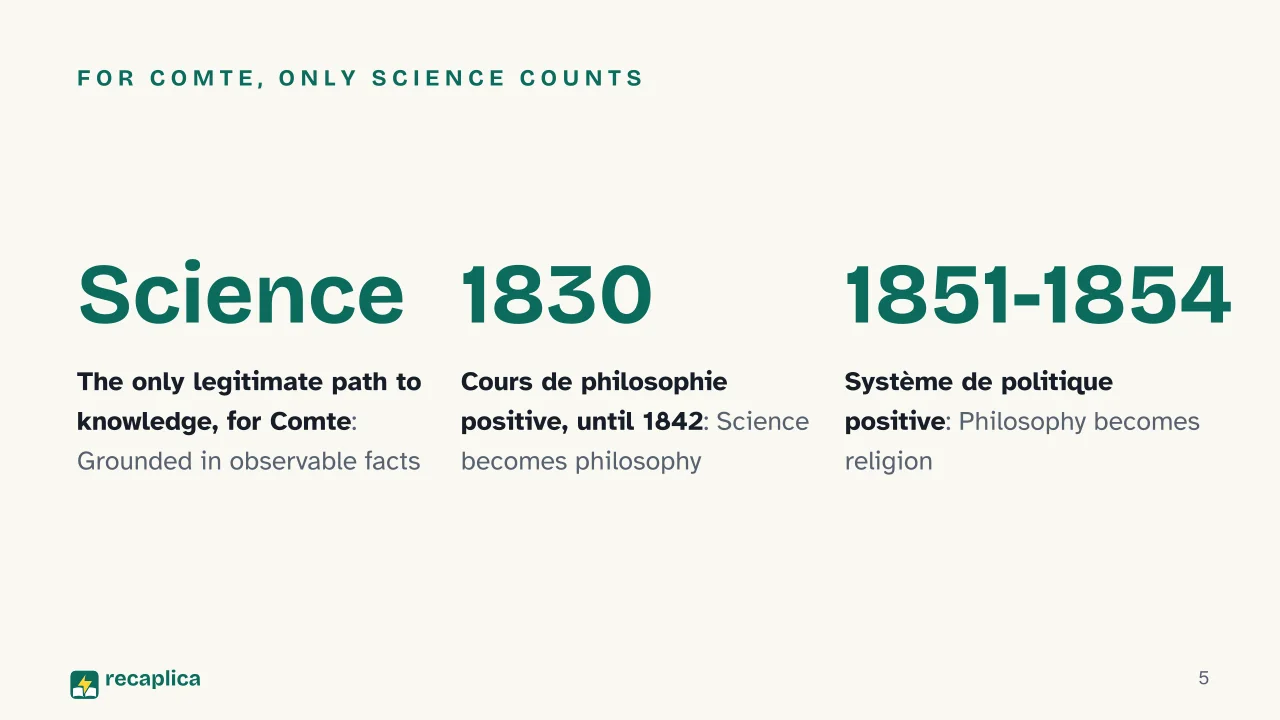
    Comte laid out this program in the Cours de philosophie positive, published between 1830 and 1842: there, he turned science into philosophy. In the later Système de politique positive, published between 1851 and 1854, he went a step further and turned that philosophy into a religion, the Religion of Humanity. It’s the most contested point in his body of work, and the one most of the criticism below takes as its target.

    The backlash against positivism

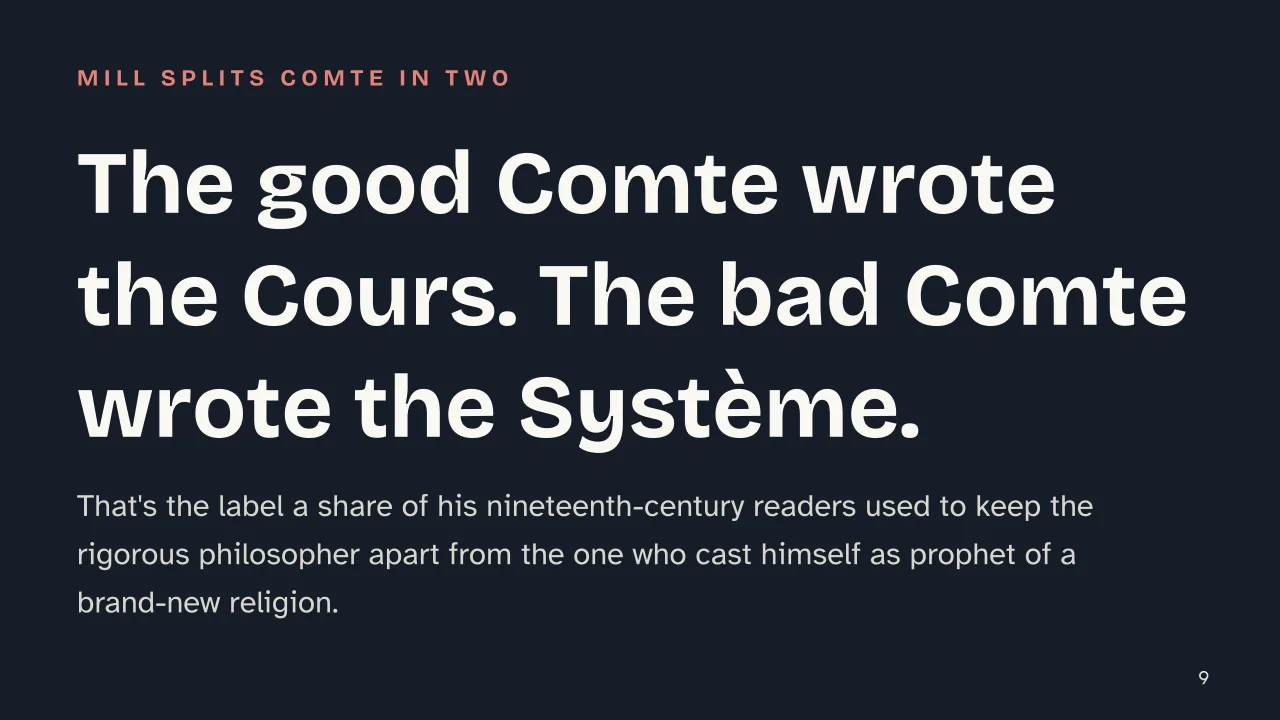
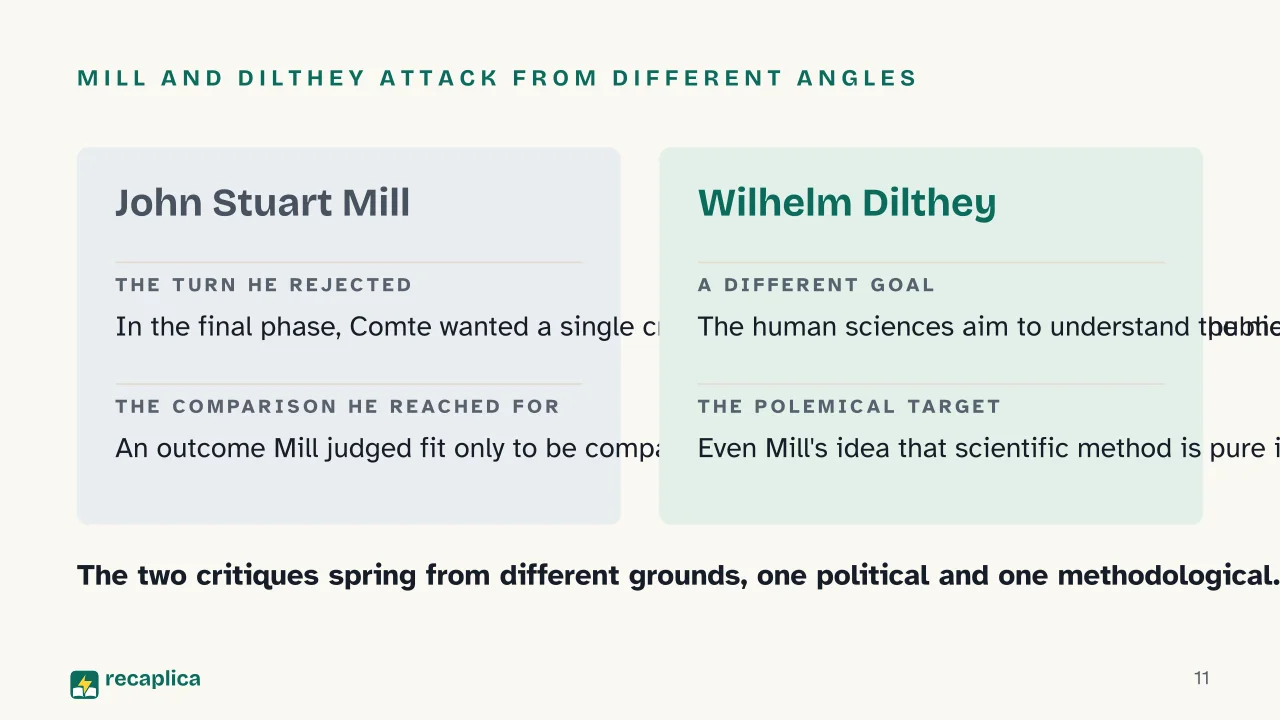
    John Stuart Mill was the most prominent of Comte’s critics. After an early period of closeness to Comte’s project, he turned sharply against it, calling the Système the most complete system of spiritual and temporal despotism ever conceived by a human mind, on a par, he wrote, with what Ignatius of Loyola had done. To separate the two phases of Comte’s thought, Mill and Littré put forward a distinction that became famous: a “good Comte,” author of the Cours, and a “bad Comte,” author of the Système.

    Dilthey’s objection came from a different angle, more methodological than political. The German philosopher Wilhelm Dilthey argued that the human sciences (Geisteswissenschaften) serve a different purpose than the positivist natural sciences: not causal prediction, but understanding the meaning of particular human situations. Tied to that objection, Mill’s own claim that scientific method was purely inductive was also challenged as a misleading and oversimplified account of how science actually proceeds.

    Criticism also came from the left. Engels judged metaphysical materialism, close in structure to positivism, to be obsolete, resting as it did on a scientific paradigm from the early modern period.

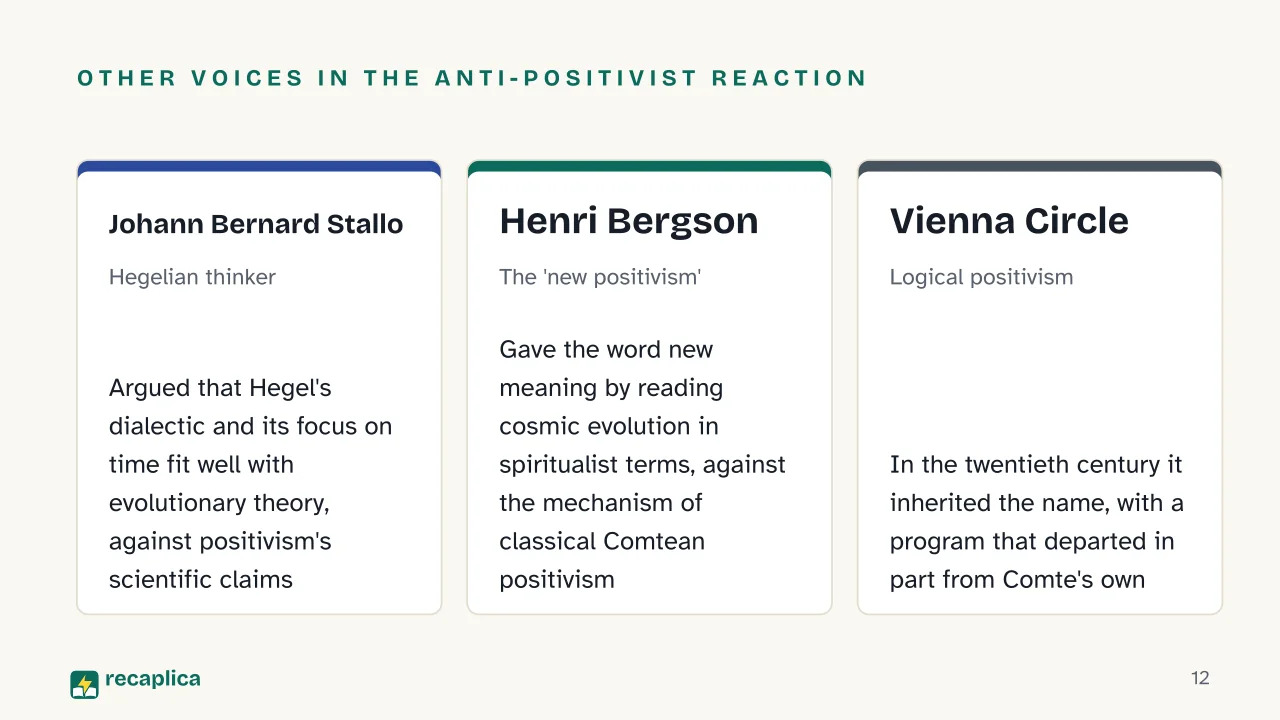
    On the opposite side, some Hegelian thinkers, among them Johann Bernard Stallo, argued that Hegel’s dialectic and its emphasis on time and change made that position compatible with evolutionary theory, in critical dialogue with positivism’s scientific claims. Compare this with Hegel’s German idealism, which started from premises opposite to Comte’s.

    CriticTarget of the critique
    John Stuart MillThe Système as a religious, authoritarian system
    Wilhelm DiltheyThe attempt to apply natural-science method to the human sciences
    Friedrich EngelsThe metaphysical framework, shared with materialism, judged obsolete
    Hegelian thinkers (e.g. Stallo)Positivism’s scientific claims, set against dialectic

    The Interdisciplinary Encyclopedia of Religion and Science notes that, while claiming to reject all metaphysics, positivists in practice put forward one of their own, immanent and materialist.

    On this point a counter-reaction took shape in philosophy, carried by figures associated with spiritualism, neo-idealism and neo-Kantianism.

    After Comte

    Positivism didn’t stay fixed to Comte’s own formulation. Henri Bergson’s approach was later described by some interpreters as a “new positivism,” though in a quite different sense: a spiritualist reading of cosmic evolution, set against the mechanism of classical positivism. It’s a use of the term that drifted far from where it started. The link to Darwin’s theory of natural selection therefore ran through very different readings, from those who found in it a confirmation of the positivist program to Bergson, who proposed turning it on its head. According to Encyclopedia.com, positivism still shared, despite the critical distance, some affinities with the other major philosophical movement of the nineteenth century, absolute idealism — a kinship that can surprise anyone who reads Comte and Hegel as mirror opposites, but one the scholarship records without flattening the two positions into each other.

    Over the course of the twentieth century, Comte’s positivism was eclipsed by neopositivism, meaning the logical positivism of the Vienna Circle. Twentieth-century logical positivism, a critical and partly distant heir of nineteenth-century positivism, held that philosophy’s real task was clarifying concepts and analyzing meanings instead of erecting metaphysical systems — a program that moved away from both social physics and Comte’s Religion of Humanity, even while claiming part of that legacy in name. Another current that carries the name lives in the philosophy of law, covered in the Recap on legal positivism. Readers who want to trace the background of this debate on method can start with the scientific method and, for the earlier historical setting, with the Age of Enlightenment and Kant’s Critique of Pure Reason.

    Slide deck

    Slides ready to download and make your own in PowerPoint or Google Slides, with speaker notes. Pick the Flash cut or the Full one.
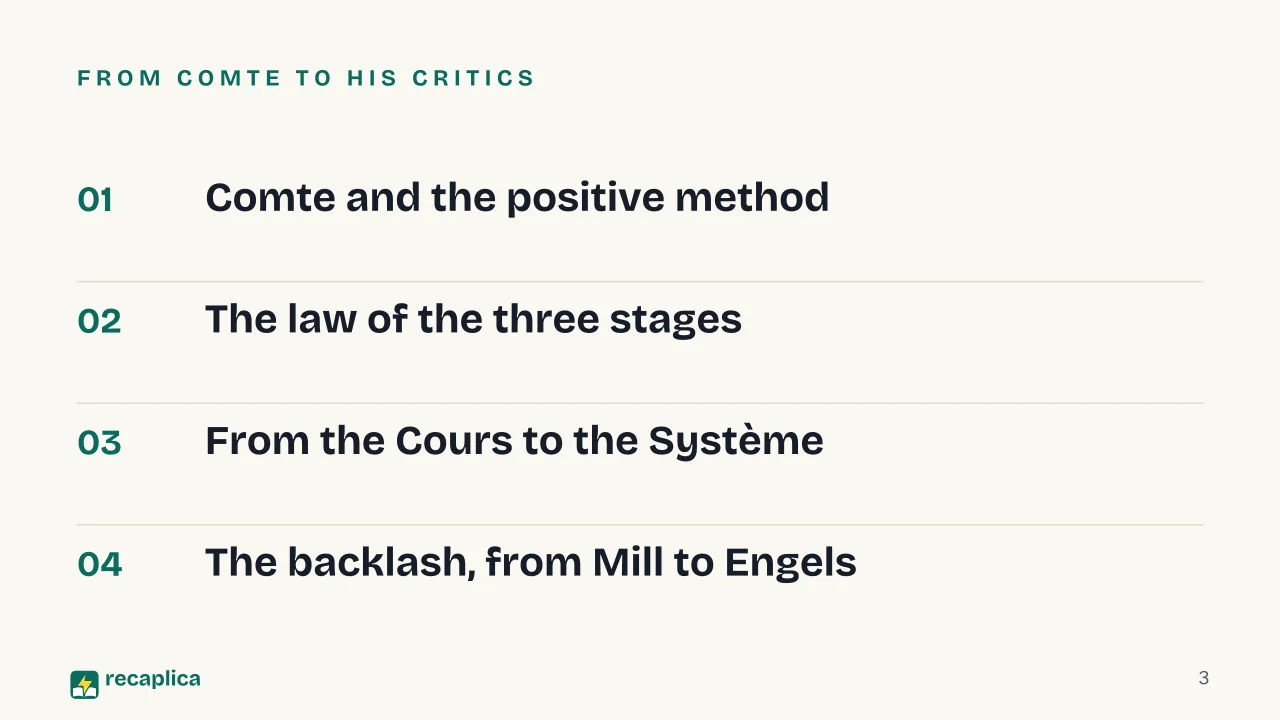
    Slide 1 of the presentation on Positivism: PositivismSlide 2 of the presentation on Positivism: Can science turn into a religion?Slide 3 of the presentation on Positivism: From Comte to his criticsSlide 4 of the presentation on Positivism: Chapter 01: Comte and the positive methodSlide 5 of the presentation on Positivism: For Comte, only science countsSlide 6 of the presentation on Positivism: Chapter 02: The law of the three stagesSlide 7 of the presentation on Positivism: From myth to observable regularitiesSlide 8 of the presentation on Positivism: Chapter 03: From the Cours to the SystèmeSlide 9 of the presentation on Positivism: The good Comte wrote the Cours. The bad Comte wrote the Système.Slide 10 of the presentation on Positivism: Chapter 04: The backlash, from Mill to EngelsSlide 11 of the presentation on Positivism: Mill and Dilthey attack from different anglesSlide 12 of the presentation on Positivism: Other voices in the anti-positivist reaction: Johann Bernard Stallo, Henri Bergson, Vienna CircleSlide 13 of the presentation on Positivism: What is the final stage in Comte's law of the three stages?Slide 14 of the presentation on Positivism: Now, a quick review
    Flash10 slidesThe essential thread, to present in classFull14 slidesEvery chapter and the deeper detail

    Common myths

    • ✗ Myth Comte's positivism was just a philosophy of science, a neutral method for studying natural and social phenomena.

      ✓ Reality The Stanford Encyclopedia of Philosophy disagrees: it reads Comte's project chiefly as political philosophy, not as a theory of science, and points to the Système de politique positive as proof, where that same philosophy turned into a religion, the Religion of Humanity.

    • ✗ Myth By rejecting metaphysics, positivists offered no general picture of reality at all.

      ✓ Reality The Interdisciplinary Encyclopedia of Religion and Science says otherwise: for all its talk of rejecting metaphysics, positivism ended up with a worldview of its own, one built on matter where religion once put the divine.

    Mind map

    Drag the background to move around and the nodes to reposition them; use − and + to collapse and expand branches.
    Customize
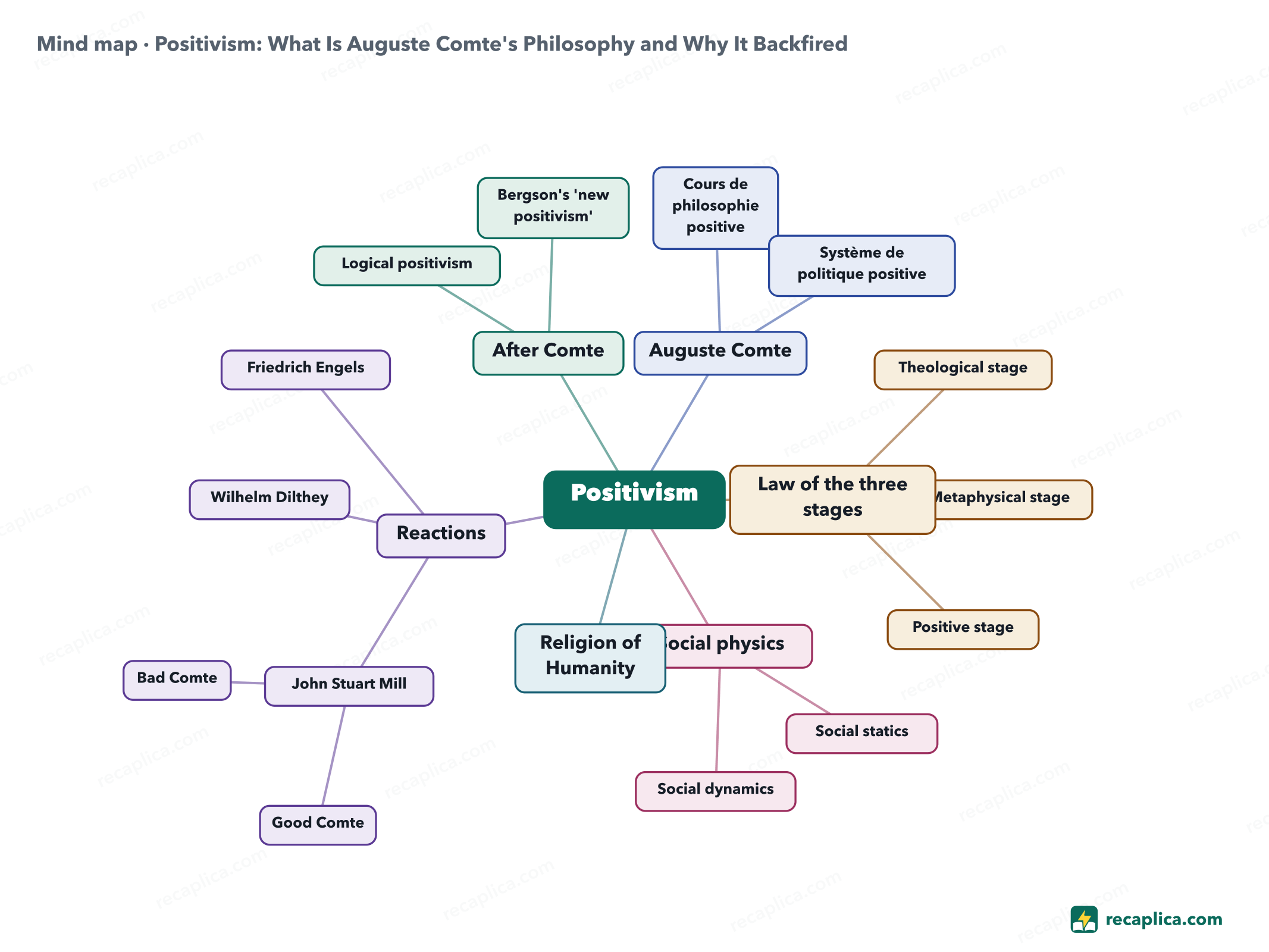
    Mind map: Positivism: What Is Auguste Comte's Philosophy and Why It Backfired
    • Positivism
      • Auguste Comte Founder of the movement
        • Cours de philosophie positive 1830-1842, science becomes philosophy
        • Système de politique positive 1851-1854, philosophy becomes religion
      • Law of the three stages
        • Theological stage Necessary starting point
        • Metaphysical stage Transitional stage
        • Positive stage Final, normal stage, laws without ultimate causes
      • Social physics
        • Social statics Theory of order
        • Social dynamics Theory of progress
      • Religion of Humanity Outcome of the Système, a secular cult of humanity
      • Reactions
        • John Stuart Mill Attacks the Système as spiritual despotism
          • Good Comte Author of the Cours, per Mill and Littré
          • Bad Comte Author of the Système, per Mill and Littré
        • Wilhelm Dilthey The human sciences seek meaning
        • Friedrich Engels Attacks the related metaphysical materialism
      • After Comte
        • Logical positivism Vienna Circle, eclipses Comte's positivism
        • Bergson's 'new positivism' Spiritualist reading of evolution

    Quiz: test yourself

    Answer the questions to check what you have learned: you get instant feedback and a short explanation.

    Grade 0/10 0/5
    1 In Comte's law of the three stages, which stage does humanity reach last?

    The positive stage: here thought stops searching for deeper causes and settles for describing the regularities it can observe.

    2 What changes between the Cours de philosophie positive and the Système de politique positive?

    The first book makes science the foundation of philosophy; the second turns that same philosophy into a cult devoted to humanity as a whole.

    3 How did John Stuart Mill describe Comte's Système de politique positive?

    Mill's verdict was harsh: a regime that fused control of conscience with control of civic life, a severity he reserved for the likes of Ignatius of Loyola.

    4 True or false: Wilhelm Dilthey argued that the human sciences should pursue the same goal as the positivist natural sciences.

    False: for Dilthey, the human sciences try to grasp the meaning of actual human affairs, not to predict their unfolding the way natural science does.

    5 How did Comte divide sociology, his 'social physics'?

    Comte split it into a branch that studies how societies stay stable, statics, and one that tracks how they change over time, dynamics.

    Answers: 1-C · 2-A · 3-A · 4-B · 5-A

    Flashcards

    Tap the card to flip it and check whether you remember the answer, then move to the next one.

    1 / 8

    Explain it in your own words

    The ultimate test: if you can explain it in simple words, you've truly understood it. Write your explanation, then compare it with the Recap.

    Your explanation is saved only on this device.

    Positivism is the philosophical and political movement Auguste Comte launched in the first half of the nineteenth century, and it spread widely in the decades that followed. Comte argued that human thought moves through three stages, from theology to metaphysics and finally to positive knowledge, the only kind content to describe how phenomena behave instead of chasing their ultimate causes. In the Cours de philosophie positive he put science at the center of philosophy; in the later Système de politique positive he pushed further and recast that philosophy as a secular faith, the Religion of Humanity. That shift drew sharp pushback: Mill broke with the later Comte, while in Germany Dilthey and Engels challenged his scientific claims from very different angles.

    Frequently asked questions

    What is positivism, in short?

    It's the philosophical and political movement Auguste Comte founded. For Comte, science was the only legitimate form of knowledge, and everything that counted for knowledge came down to observable facts.

    What is Auguste Comte's law of three stages?

    It holds that humanity, and each of us individually, passes through a religious stage, a stage of abstract concepts, and finally a stage that looks only for verifiable regularities in facts, without asking about their deeper causes.

    Why did Mill turn against Comte, after admiring him early on?

    Mill grew close to Comte in the early years but broke with him once the French philosopher pictured a total takeover of people's spiritual and civic lives, an outcome Mill compared only to Ignatius of Loyola.

    What's the difference between the 'good Comte' and the 'bad Comte'?

    It's the distinction Mill and Littré proposed: the 'good Comte' is the author of the Cours de philosophie positive, the 'bad Comte' is the author of the later Système, the one that turned positive philosophy into a religion.

    Does Auguste Comte's positivism still exist today the way he conceived it?

    No: in the twentieth century the torch passed to logical positivism, tied to the Vienna Circle, which started from premises that were partly new compared with Comte's.

    Sources

    • Auguste Comte, Stanford Encyclopedia of Philosophy
    • Nineteenth-Century Philosophy, Routledge Encyclopedia of Philosophy
    • Positivism, Encyclopedia.com
    • Positivism, Interdisciplinary Encyclopedia of Religion and Science

    Every Recap goes through an independent review before publication.

    Every evening, the day's new Recaps on our Telegram channel. Join the channel →

    Keep learning

    • History What Is Existentialism? Heidegger, Being and Time, and Dasein Existentialism is a current of twentieth-century philosophy centered on human existence, freedom and the search for meaning. According to the Stanford Encyclopedia of Philosophy, the German philosopher Martin Heidegger (1889-1976) shaped that current more than almost anyone else, even though he never accepted the label. In 1927 he published Being and Time, his major work, where he introduced the concept of Dasein: the human being as the one entity that questions its own existence. That book influenced Jean-Paul Sartre's existentialism, but in 1946, in the Letter on Humanism, Heidegger openly broke with Sartre and refused to be called an existentialist. In 1933 he was elected rector of the University of Freiburg and became a Nazi party member, keeping that membership until the regime fell - an episode Heidegger himself later denied or played down more than once. Read the Recap →
    • History What Is Phenomenology? Husserl's Philosophy Explained Edmund Husserl founded phenomenology as a philosophical discipline around 1900-1901, with his Logical Investigations. His method starts from the epoché, a suspension of our everyday, unquestioning stance toward the world, and moves toward phenomenological reduction: studying how things appear to consciousness rather than what they are in themselves. At the center sits intentionality, the idea that every experience is always an experience of something specific, whether hoping, perceiving, or desiring. The method Husserl built carried into the 20th century through Heidegger, Sartre, and Merleau-Ponty, moving from German philosophy into French philosophy along the way. Read the Recap →
    • History Legal Positivism: What It Is, from Austin to Kelsen and Hart According to the Stanford Encyclopedia of Philosophy, legal positivism measures legal validity against observable social facts, keeping moral judgment on a separate track. Its roots lie in Hobbes and Hume. Jeremy Bentham produced the theory's first full account, which John Austin later took up and spread: for Austin, a rule is law only when a sovereign commands it under threat of punishment. In the twentieth century, Hans Kelsen grounded legal validity in a hierarchy that traces back to a presupposed basic norm, while Herbert Hart located it instead in a rule of recognition actually followed by judges and officials. Natural law theory takes the opposite view: an unjust law is not really a law. Legal positivism disagrees — a law stays valid even when it is morally unjust, as long as it was made the way the system requires. Read the Recap →

    recaplica

    Clear in 30 seconds, yours in 10 minutes.

    Recaps Mind maps Request a Recap Telegram channel Mind map maker Our method About Privacy & cookies Legal notes & terms of use

    © 2026 Recaplica · A project by Curi S.r.l. — VAT IT05472000750

    Statistics, only if you say so

    To learn which Recaps help most we would use Google Analytics, with aggregate, anonymous data. It starts only with your OK, and you can change your mind anytime. Privacy policy