|
recaplica
Legal Positivism: What It Is, from Austin to Kelsen and Hart | ||||||||||||
| © 2026 Recaplica · recaplica.com — All rights reserved | ||||||||||||
Legal Positivism: What It Is, from Austin to Kelsen and HartWhat to print Page numbers appear when printing with default margins. SlidesChoose a cut Flash10 slidesThe essential thread, to present in classFull15 slidesEvery chapter and the deeper detailBoth come with speaker notes. In 30 seconds quick readAccording to the Stanford Encyclopedia of Philosophy, legal positivism measures legal validity against observable social facts, keeping moral judgment on a separate track. Its roots lie in Hobbes and Hume. Jeremy Bentham produced the theory's first full account, which John Austin later took up and spread: for Austin, a rule is law only when a sovereign commands it under threat of punishment. In the twentieth century, Hans Kelsen grounded legal validity in a hierarchy that traces back to a presupposed basic norm, while Herbert Hart located it instead in a rule of recognition actually followed by judges and officials. Natural law theory takes the opposite view: an unjust law is not really a law. Legal positivism disagrees — a law stays valid even when it is morally unjust, as long as it was made the way the system requires. Key Points
Deep DiveWhat Legal Positivism IsThe Stanford Encyclopedia of Philosophy defines legal positivism as the thesis that the existence and content of law depend on social facts, not on its moral merits: a law can be unjust and still be valid law. The “positivism” in the name has nothing to do with Comte’s positivism and the reactions it provoked, the nineteenth-century philosophical movement; the two theories simply share a word, coined in unrelated corners of philosophy. Readers who first want to pin down what sets a legal norm apart from other social rules can turn to the Recap on legal norms: what they are and how they differ from other rules. The separability thesis sits at the theory’s core, and legal philosophers read it narrowly: law can track morality for reasons of history or accident, yet that link stays a contingent fact, never a logical requirement. Historically, legal positivism grew out of opposition to classical natural law theory, grounding law in whatever a society actually produces — a sovereign’s command, a hierarchy of norms, a shared practice — apart from divine command, reason, or human rights. Origins: From Hobbes and Hume to the Sovereign’s CommandThe theory’s roots go back to Thomas Hobbes and David Hume, but the first full account of legal positivism belongs to Jeremy Bentham, who lived from 1748 to 1832; John Austin later picked it up and spread it. Both men treated law as a feature of societies that have a sovereign — a person or body holding supreme, de facto power. Under Austin’s command theory, a rule counts as legally valid in a society only when the sovereign issues it and threatens a sanction against anyone who disobeys, according to the Internet Encyclopedia of Philosophy.
Kelsen’s Pure Theory and the Basic NormHans Kelsen called his own theory “pure” because it aims at a knowledge of law focused solely on law itself, leaving out moral, sociological, or political elements. In his account, an act creates or changes law only when some separate, higher-ranking norm has first cleared the way for it — hence the stepped structure, a hierarchy of norms, that organizes the whole legal system. Climbing that hierarchy, in any legal system, eventually reaches a norm that authorizes the others without itself being authorized by anything higher: its validity can only be presupposed. Kelsen calls this presupposition the “basic norm” (Grundnorm), the content by which legal validity gets attached to a system’s first historical constitution. A norm, for Kelsen, is legally valid as long as it is part of a broader set of norms that, taken together, actually gets applied; a written constitution left unenforced for years loses, on this account, the capacity to hold up the entire structure. Hart and the Rule of RecognitionHerbert Hart identifies three secondary rules within a legal system’s structure; among these, the rule of recognition matters most, because it fixes the system’s ultimate criteria of validity. For Hart, the ultimate test of validity is not a norm, nor a presupposed norm as in Kelsen, but a social rule that exists because it is actually practiced by the system’s participants, judges and officials included. The rule of recognition specifies one or more features whose presence in a proposed rule counts as conclusive evidence that the rule genuinely belongs to the system, according to the Internet Encyclopedia of Philosophy. In his debate with Lon Fuller, Hart argued against the idea that the internal coherence of a purposive activity — even an activity such as poisoning — amounts by itself to a moral standard: for Hart, that would confuse a purposive activity with morality itself. Legal Positivism and Natural Law: A Practical DivideNatural law theory takes the opposite position from legal positivism: it denies any clean split between law and morality, holding that at least some laws draw their authority from a logical relation to moral standards, above and beyond simple human convention. This is the overlap thesis, set against the positivists’ separability thesis. In the classical natural law tradition, traced back to figures such as Saint Augustine and Thomas Aquinas, an unjust law is not really a law at all: a law that strays from natural law is a “perversion” of law, not genuine law. Legal positivism disagrees — such a norm remains law all the same, as long as it arose from the system’s own procedures: the sovereign for Austin, the rule of recognition for Hart, the basic norm for Kelsen.
Slide deckSlides ready to download and make your own in PowerPoint or Google Slides, with speaker notes. Pick the Flash cut or the Full one.     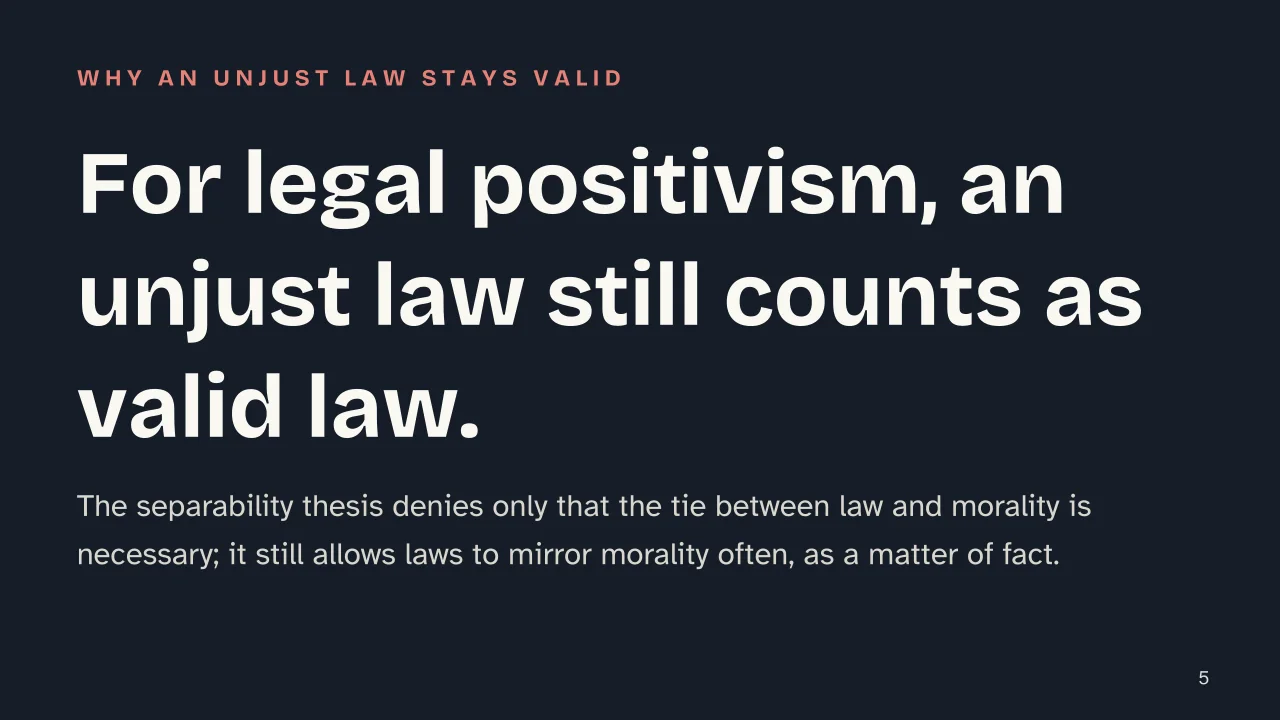    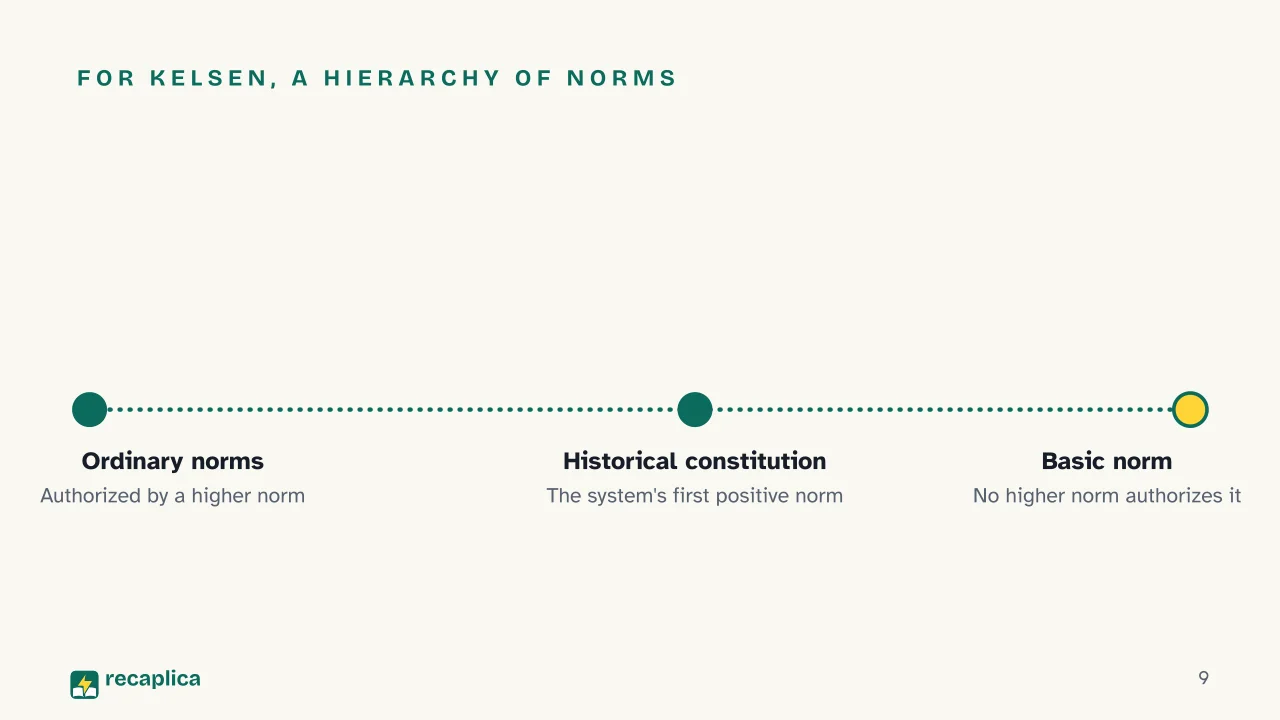  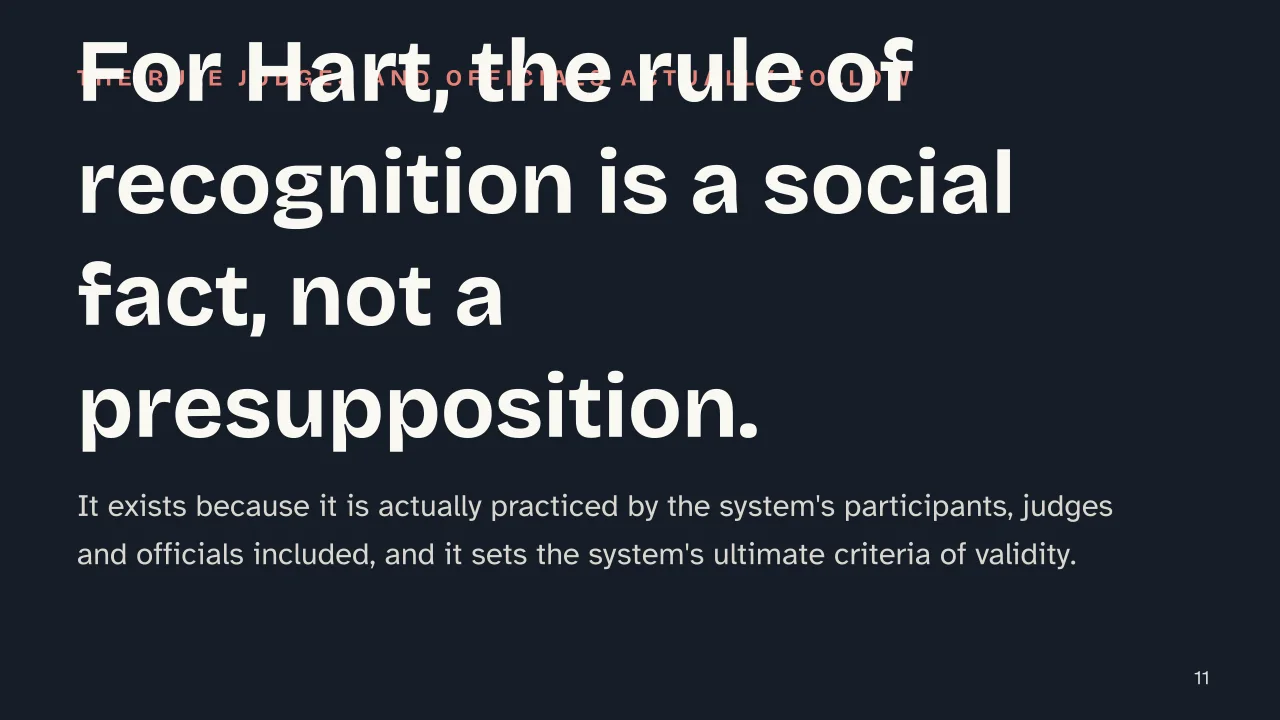  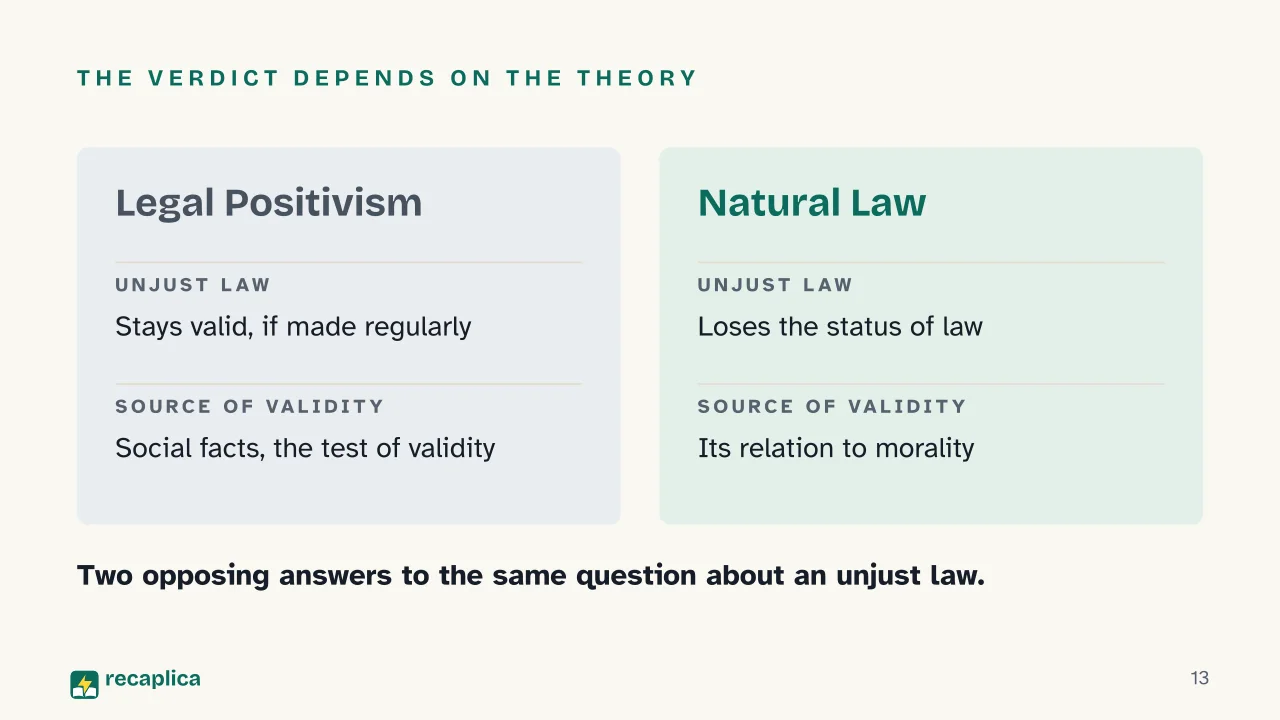   Common myths
Mind mapDrag the background to move around and the nodes to reposition them; use − and + to collapse and expand branches. 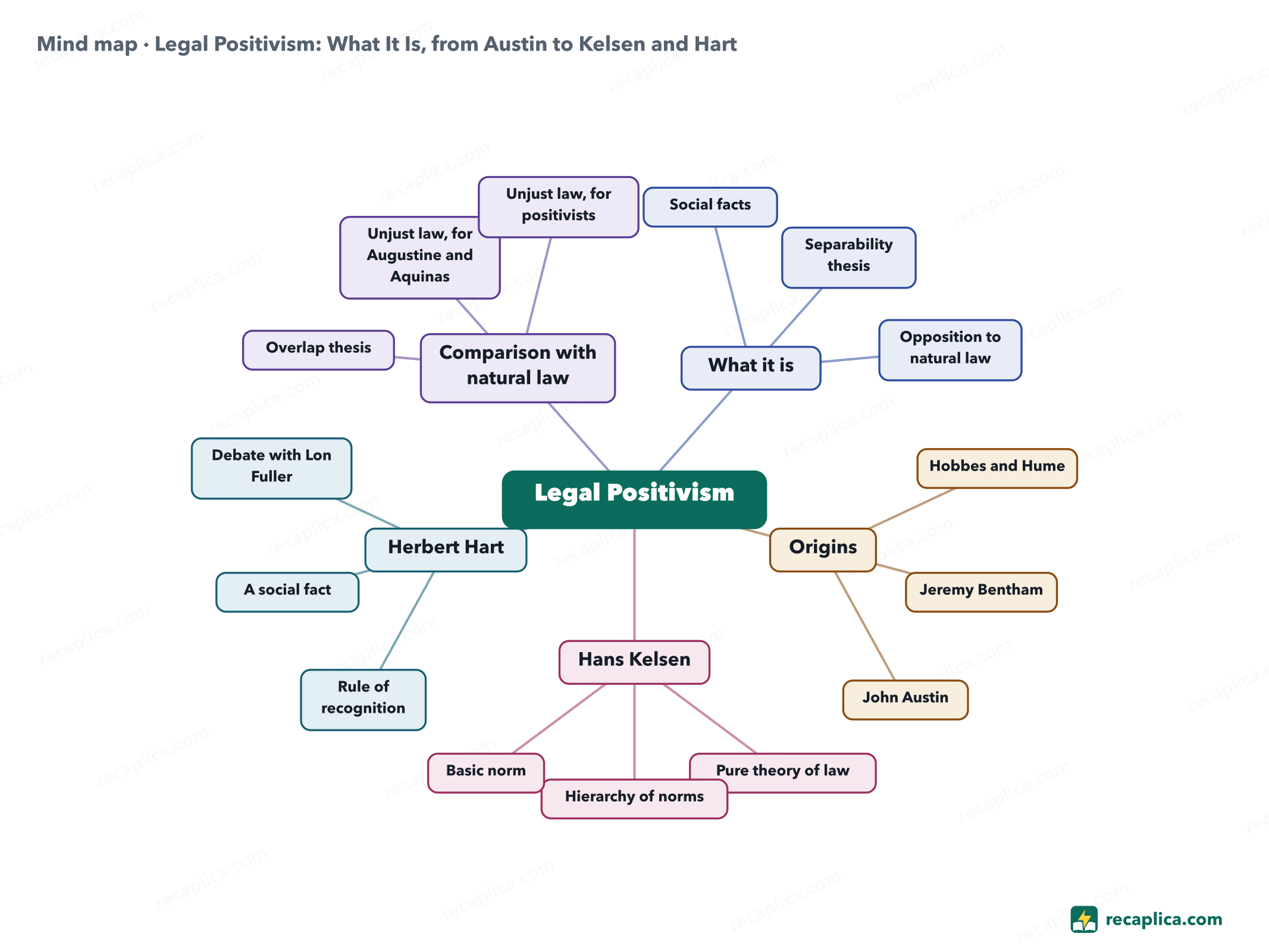
Quiz: test yourselfAnswer the questions to check what you have learned: you get instant feedback and a short explanation. Grade 0/10 0/5
FlashcardsTap the card to flip it and check whether you remember the answer, then move to the next one. 1 / 8 Explain it in your own wordsThe ultimate test: if you can explain it in simple words, you've truly understood it. Write your explanation, then compare it with the Recap. Your explanation is saved only on this device.
Frequently asked questionsWhat is legal positivism?It is the theory that a norm's validity depends on how it comes about within a society, a standard kept separate from its moral worth; even an unjust law can remain valid law. Who are legal positivism's main theorists?Jeremy Bentham and John Austin, with the command theory of the sovereign; in the twentieth century, Hans Kelsen with the pure theory of law, and Herbert Hart with the rule of recognition. Where does legal positivism fit in jurisprudence?It is one of jurisprudence's major schools on what makes law valid, standing opposite natural law theory: it treats validity as a question of social fact rather than of moral merit. What is Kelsen's basic norm?It is what must be presupposed to treat a system's first historical constitution as valid — the norm that authorizes every other norm without itself being authorized by any. How does legal positivism differ from natural law?Natural law ties some laws' authority to morality, to the point of denying an unjust norm the status of law; legal positivism keeps the two apart, and counts a morally questionable norm as valid law if it followed the system's procedures. Every Recap goes through an independent review before publication. |