|
recaplica
What Is Existentialism? Heidegger, Being and Time, and Dasein |
| © 2026 Recaplica · recaplica.com — All rights reserved |
What Is Existentialism? Heidegger, Being and Time, and DaseinWhat to print Page numbers appear when printing with default margins. SlidesChoose a cut Flash10 slidesThe essential thread, to present in classFull15 slidesEvery chapter and the deeper detailBoth come with speaker notes. In 30 seconds quick readExistentialism is a current of twentieth-century philosophy centered on human existence, freedom and the search for meaning. According to the Stanford Encyclopedia of Philosophy, the German philosopher Martin Heidegger (1889-1976) shaped that current more than almost anyone else, even though he never accepted the label. In 1927 he published Being and Time, his major work, where he introduced the concept of Dasein: the human being as the one entity that questions its own existence. That book influenced Jean-Paul Sartre's existentialism, but in 1946, in the Letter on Humanism, Heidegger openly broke with Sartre and refused to be called an existentialist. In 1933 he was elected rector of the University of Freiburg and became a Nazi party member, keeping that membership until the regime fell - an episode Heidegger himself later denied or played down more than once. Key Points
Key figures
Deep DiveWhat is existentialism, and who was HeideggerExistentialism is the twentieth-century current of philosophy centered on individual existence, freedom and the search for meaning. The Stanford Encyclopedia of Philosophy names one thinker above all as its shaping force: the German philosopher Martin Heidegger, born on 26 September 1889 in Meßkirch, in Baden, in southwestern Germany, and died on 26 May 1976 in Freiburg - even though Heidegger spent decades trying to shrug the label off. Readers who come to Heidegger from Kierkegaard’s Either/Or or from Hegel’s Phenomenology of Spirit will recognize familiar ground: the question of what it means to exist, not just what exists. Heidegger approaches it from a new angle, asking what it means to be, before asking what things there are in the world. Being and TimeHeidegger’s major work is Being and Time (Sein und Zeit), published in February 1927. Treccani calls it his most important book, and the Stanford Encyclopedia notes that it remained unfinished relative to the project that produced it: the part meant to carry it forward was never published in the form originally planned. The book opens with a single question: what does it mean to be? Heidegger does not ask it of ordinary objects, but of the one entity capable of asking it at all.
DaseinThe term Heidegger uses for the human being is Dasein, often rendered in English as “being-there.” The Stanford Encyclopedia, the Internet Encyclopedia of Philosophy and Treccani agree on one precise point: Dasein is not simply one entity among others, the way a stone or a table is. It stands apart from every other entity because it puts its own existence into question, and because it always carries at least a preliminary understanding of what it means to be. That starting point sets Heidegger apart from other major philosophical systems that ask first what we can know, such as Kant’s Critique of Pure Reason. His question sits a step earlier than Kant’s: whoever knows anything is already, from the start, an entity questioning its own existence. Existentialism: the label he refusedAccording to the Stanford Encyclopedia of Philosophy and the Internet Encyclopedia of Philosophy, Heidegger’s thought shaped Jean-Paul Sartre’s existentialism (the Internet Encyclopedia also mentions Ortega y Gasset). Yet in 1946, in the Letter on Humanism (Brief über den Humanismus), Heidegger distanced himself from those readings of his work and argued openly against Sartre, positioning himself against every form of humanism, which he regarded as still bound to metaphysics. The irony is hard to miss: the pages of Being and Time on Dasein fed an entire philosophical movement, yet the author of those pages later refused to be counted among its members, in a letter written for that very purpose. Readers tracing the existentialist root further back find related, if methodologically distinct, ground in Kierkegaard’s Fear and Trembling, where the individual’s leap in the face of the paradox of faith anticipates, from a religious angle, some of the questions Heidegger later poses in philosophical terms. Freiburg, 1933Shortly after Hitler’s rise to power, Heidegger was elected rector of the University of Freiburg in April 1933, and on 1 May of that same year he joined the Nazi party, remaining a member until the regime collapsed. This is a documented historical fact reported by the Stanford Encyclopedia of Philosophy, which also notes that after the war Heidegger repeatedly denied or minimized the real extent of his political involvement. The sources gathered here do not explain his personal reasons for that choice, nor do they draw a direct line from it to the philosophical content of Being and Time, published years earlier. What remains is the fact of the membership, its duration, and his later denials and minimizing of it: an episode central to historical assessments of his life. Historians continue to weigh his claims about being and Dasein on their own terms, judging the arguments for what they say. Slide deckSlides ready to download and make your own in PowerPoint or Google Slides, with speaker notes. Pick the Flash cut or the Full one.    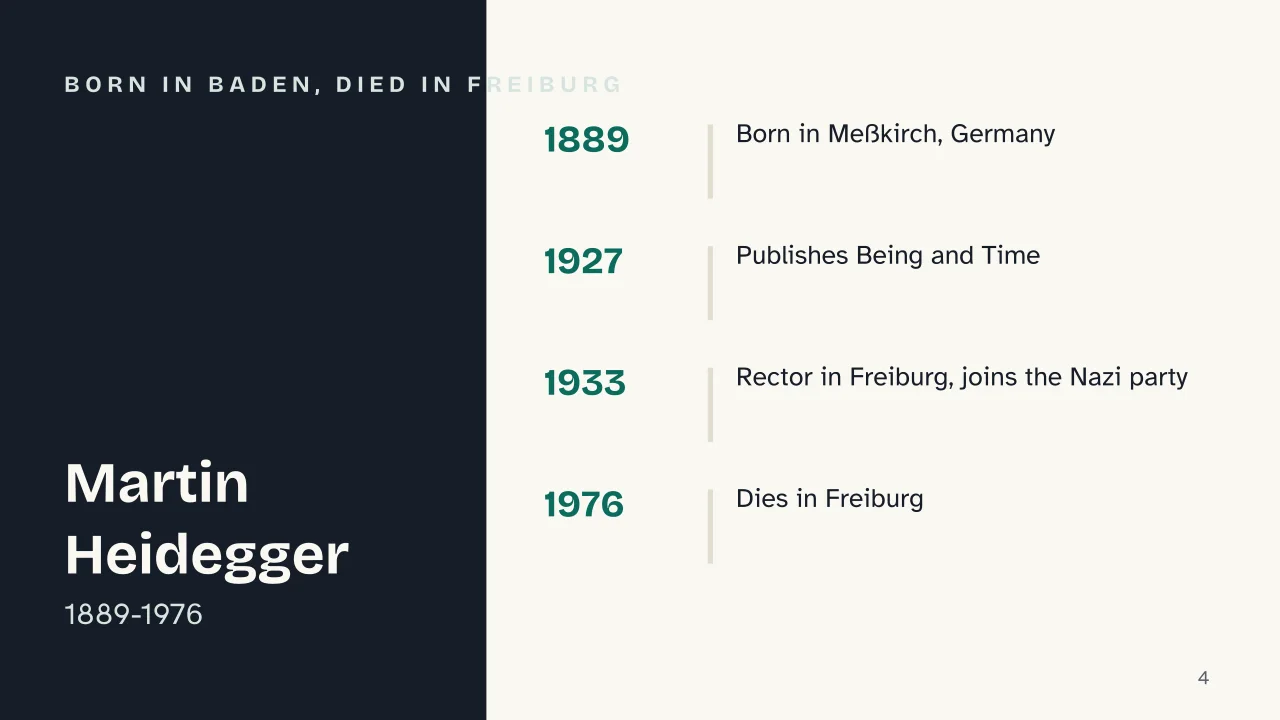  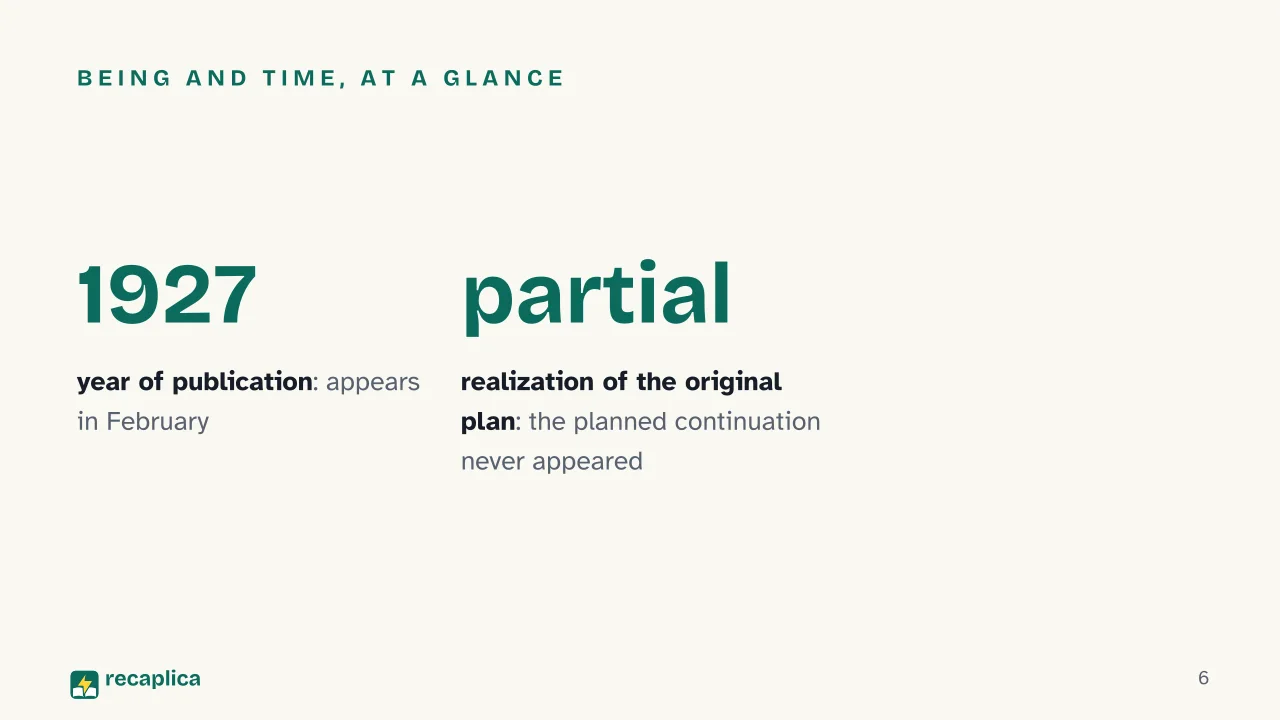    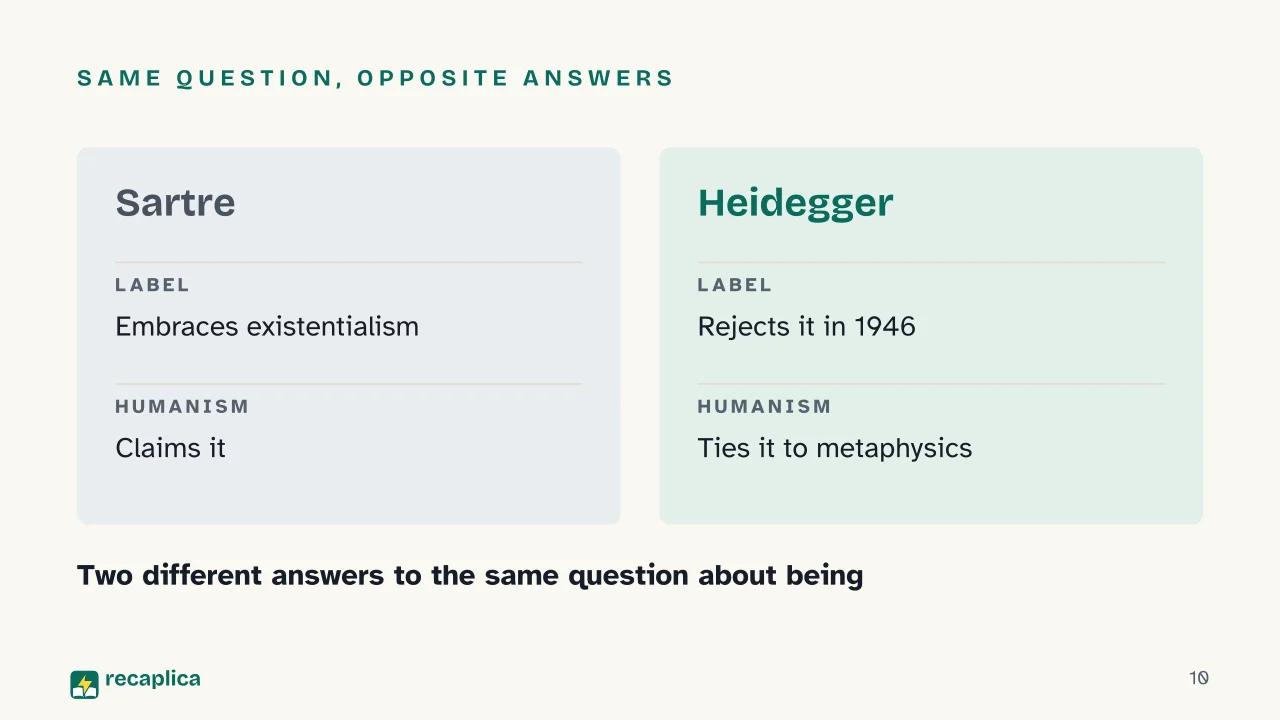 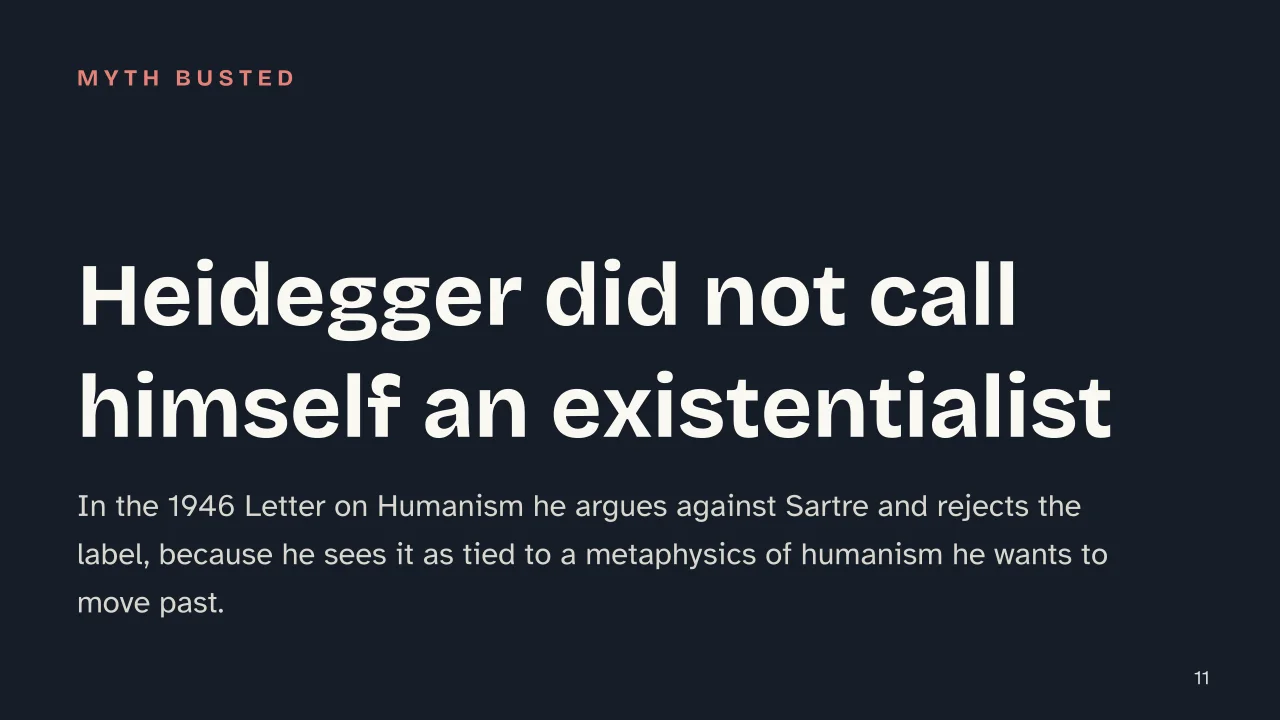  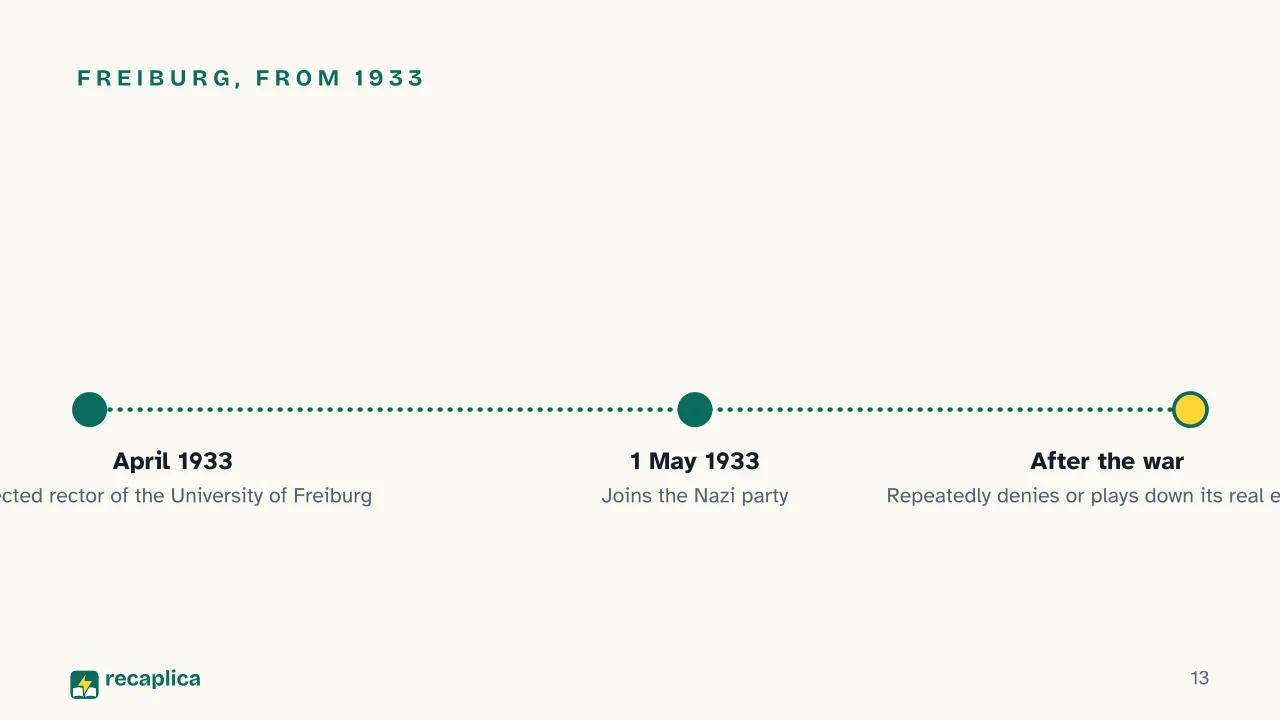 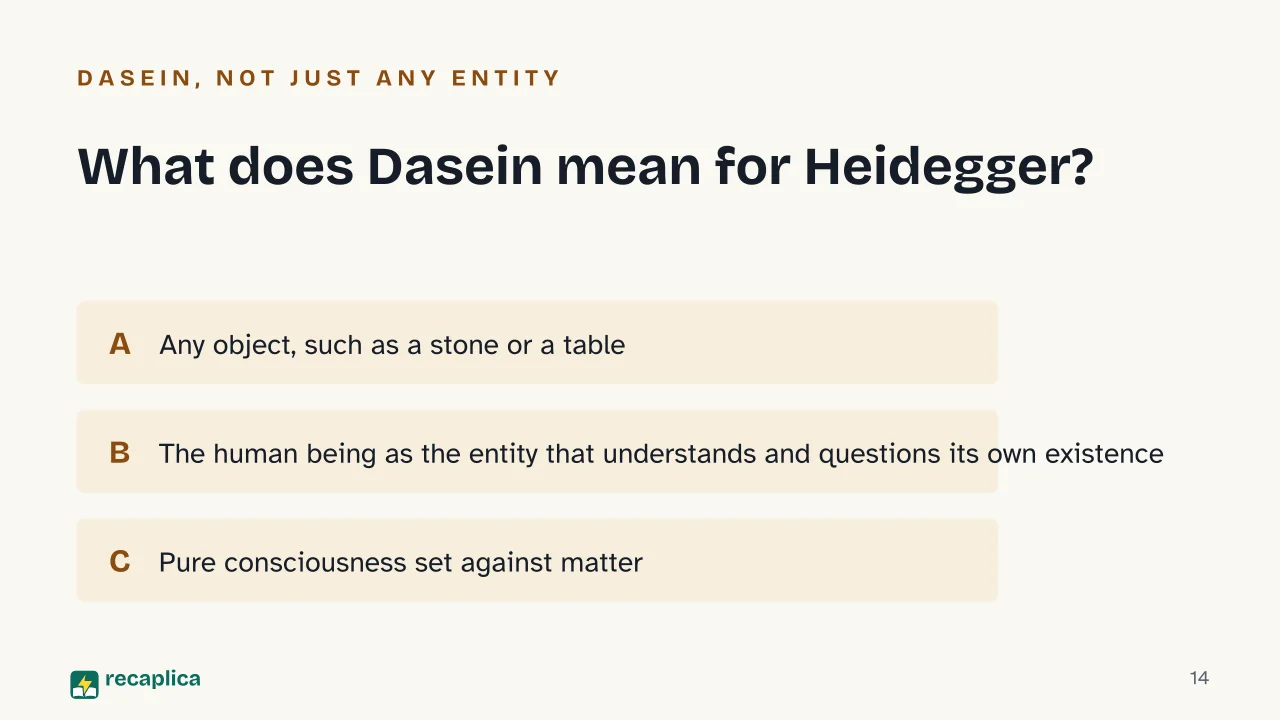  Common myths
Mind mapDrag the background to move around and the nodes to reposition them; use − and + to collapse and expand branches. 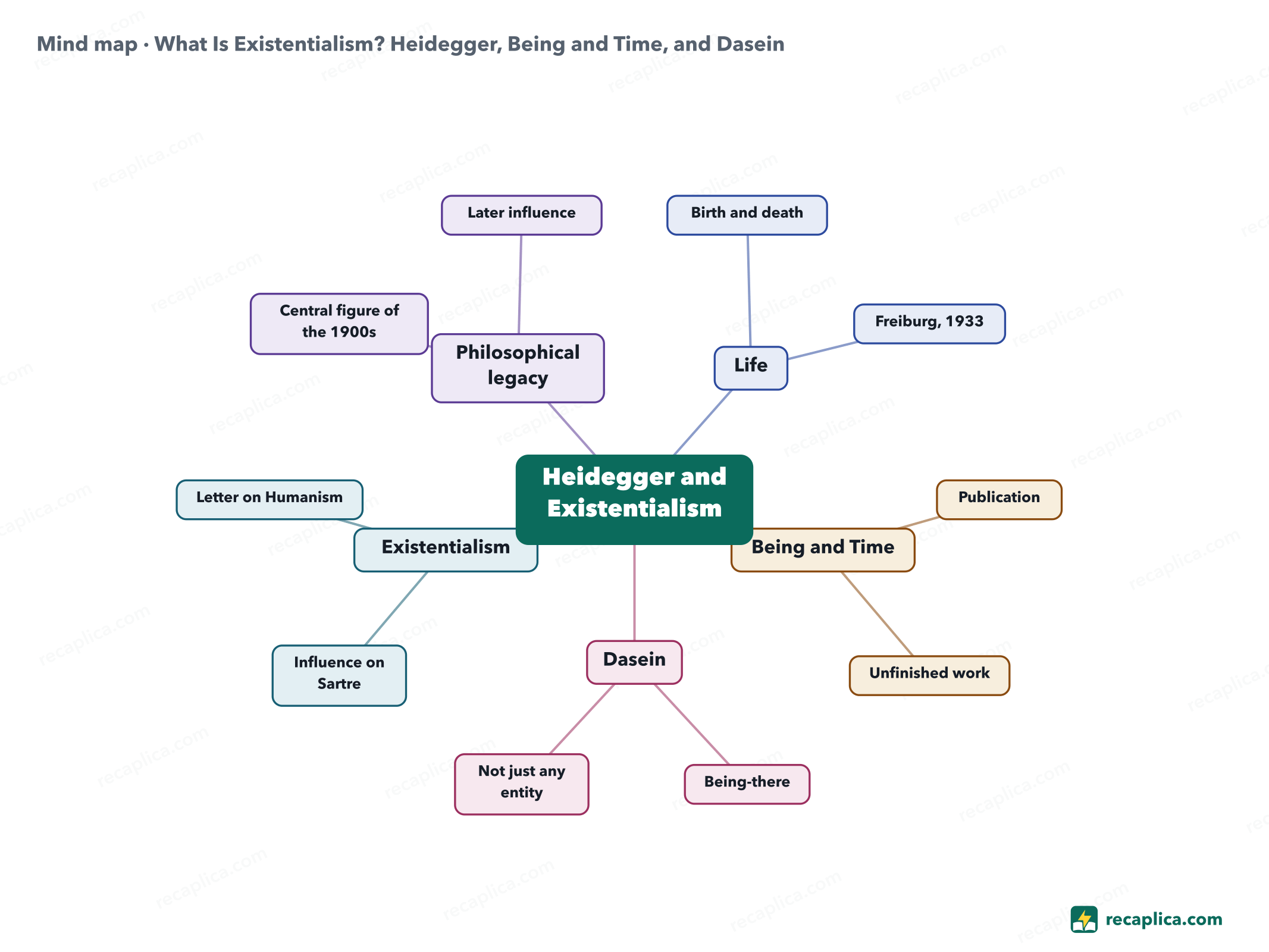
Quiz: test yourselfAnswer the questions to check what you have learned: you get instant feedback and a short explanation. Grade 0/10 0/5
FlashcardsTap the card to flip it and check whether you remember the answer, then move to the next one. 1 / 7 Explain it in your own wordsThe ultimate test: if you can explain it in simple words, you've truly understood it. Write your explanation, then compare it with the Recap. Your explanation is saved only on this device.
Frequently asked questionsWho was Martin Heidegger?A German philosopher, born in 1889 in Meßkirch and died in 1976 in Freiburg, considered by the Stanford Encyclopedia of Philosophy a central figure of twentieth-century European philosophy. His major work is Being and Time (1927). What is existentialism?A twentieth-century philosophical movement built around the lived experience of the individual - freedom, the search for meaning - more than around abstract systems describing the world in general. Heidegger's work on Dasein shaped it heavily, even though he refused the label himself. What is Dasein in Heidegger's philosophy?The term Heidegger uses for the human being: not just any entity, like a thing among things, but the only one that understands and questions its own existence. It is often rendered in English as 'being-there'. Was Heidegger an existentialist?His thought shaped Jean-Paul Sartre's existentialism, but Heidegger himself rejected the label: in the 1946 Letter on Humanism he argues against Sartre and against humanism in general, which he regards as still trapped in metaphysics. Why did Heidegger join the Nazi party?In 1933 he served as rector in Freiburg and joined the Nazi party on 1 May, remaining a member until the regime fell. The Stanford Encyclopedia notes that after the war he repeatedly denied or played down the real extent of his involvement; what we have is that historical fact and his later account of it, without a documented personal motive behind the original choice. Every Recap goes through an independent review before publication. |