Skip to content
recaplica

    One moment: security check

    Cloudflare wants to make sure you're not a robot. Tick the box below and your search will continue on its own.

    IT
    recaplica Darwin's Theory of Evolution: What Natural Selection Is and Isn't
    © 2026 Recaplica · recaplica.com — All rights reserved
    Home › Science

    Darwin's Theory of Evolution: What Natural Selection Is and Isn't

    By Recaplica Newsroom · Updated on September 12, 2026

    What to print

    Page numbers appear when printing with default margins.

    Slides

    Choose a cut

    Flash10 slidesThe essential thread, to present in classFull18 slidesEvery chapter and the deeper detail

    Both come with speaker notes.

    Telegram channel
    recaplica Clear in 30 seconds, yours in 10 minutes.
    In 30 seconds Key points Figures Deep dive Slides Myths Mind map Quiz Flashcards FAQ

    In 30 seconds quick read

    The theory of evolution by natural selection explains how living species change over generations. Charles Darwin works it out while observing plants and animals during the voyage of the brig HMS Beagle, between 1831 and 1836, and publishes it in «On the Origin of Species» in November 1859, after a letter from Alfred Russel Wallace pushes him to move faster. The mechanism is simple: individuals within a species vary from one another by chance, traits pass on to offspring, and those with traits better suited to the local environment tend to survive and reproduce more. It is neither a plan nor a ladder toward perfection, but a blind process that the Galápagos finches and the peppered moth show in action.

    Key Points

    • Charles Darwin works out the theory of natural selection while observing nature during the voyage of the Beagle (1831-1836) and publishes it in «On the Origin of Species», in November 1859.
    • Natural selection rests on three ingredients: random variation among individuals, the inheritance of traits by their offspring, and the struggle for existence, which lets those with the most favorable traits for their environment survive and reproduce more.
    • In 1858 Alfred Russel Wallace sends Darwin an essay describing a mechanism of species change strikingly similar to his own: the two present the theory jointly to the Linnean Society of London, before the book even appears.
    • The Galápagos finches, all descended from a single common ancestor, evolved different beaks suited to different foods: the textbook example of adaptive radiation.
    • The peppered moth (Biston betularia) demonstrates natural selection in action, and even in reverse, as industrial pollution and later its cleanup changed which form, light or dark, blended in better.
    • The phrase «survival of the fittest» is not Darwin's but Herbert Spencer's (1864); its social application, social Darwinism, is a separate, ideological idea, distinct from Darwin's biological theory.

    Key figures

    • 1859 the year «On the Origin of Species» was published, the book in which Darwin laid out the theory of natural selection systematically and publicly for the first time Source: Darwin Correspondence Project (University of Cambridge)
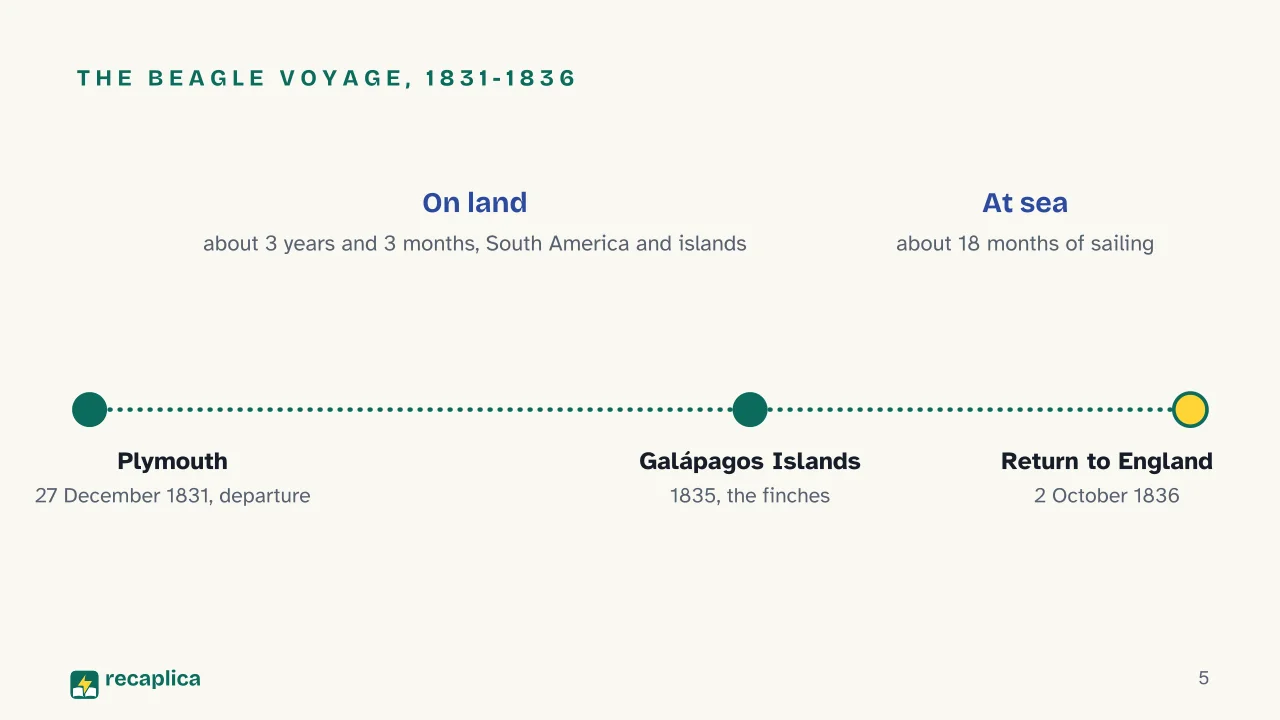
    • Nearly 5 years the length of the Beagle voyage, from 27 December 1831 to 2 October 1836, more than double the two years planned at departure Source: Encyclopaedia Britannica
    • 80% the frequency reached by the dark form of the peppered moth in the areas most polluted by the British Industrial Revolution Source: PMC, National Library of Medicine (NIH)

    Deep Dive

    A naturalist aboard a brig

    Charles Darwin signs on as naturalist aboard HMS Beagle, a Royal Navy brig on a surveying mission that leaves Plymouth Sound on 27 December 1831. The voyage is supposed to last two years; instead it stretches to almost five, and the Beagle does not return to England until 2 October 1836. Of that time, Darwin spends roughly three years and three months on land — exploring South America and the ocean islands, including the Galápagos — and about 18 months at sea.

    The zoological and geological collections, and the fossils gathered during the expedition, become the empirical foundation on which Darwin will build his theory of evolution in the years that follow.

    Finches that don’t look alike

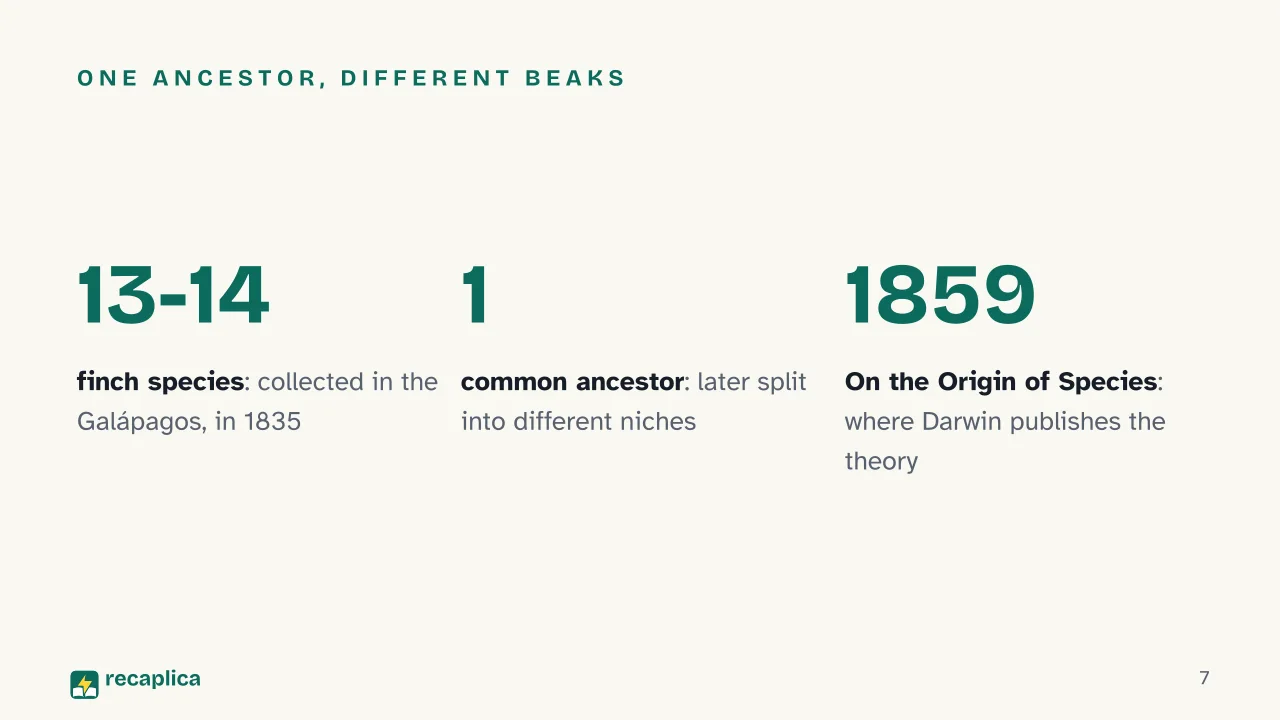
    In the Galápagos, in 1835, Darwin collects a group of finches — some 13-14 species, by later estimates — that at first glance look like little more than ordinary birds. Studying them, he realizes they all descend from a single common ancestor: scattered across different islands, with no contact between them, they had adapted to eat whatever food was locally available, seeds, insects, cactus flowers, in one case even the blood of other birds. Each species’ beak took a different shape depending on the food it had to handle.

    It is the textbook example of adaptive radiation: a single species that arrived on the islands and, over generations, split into distinct species, each suited to its own ecological niche. The mechanism that explains how this happens is natural selection.

    The mechanism: three simple ingredients

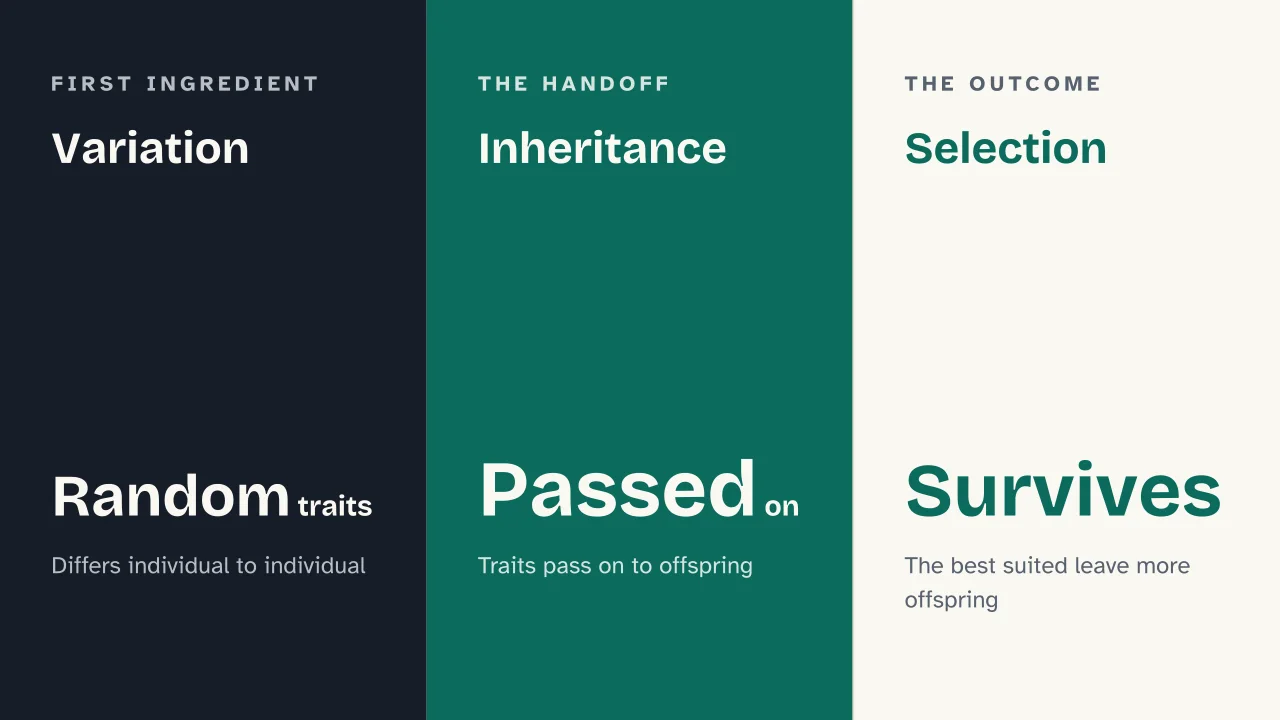
    Darwin’s theory rests on three components, and none of the three, on its own, would explain much.

    IngredientWhat happens
    VariationIndividuals within a species differ from one another by chance
    InheritanceAn individual’s traits can be passed on to its offspring
    Struggle for existenceThose with traits better suited to their environment are more likely to survive and reproduce

    Put together, these three ingredients let advantageous variants spread through later generations, while less advantageous ones tend to disappear. The Natural History Museum in London sums it up this way: natural selection is neither a conscious choice nor a force with a purpose, but simply the statistical consequence of the fact that whoever is better adapted to the local environment leaves, on average, more fertile offspring than others. Anyone curious about how the handing down of traits from one generation to the next actually works — the inheritance mechanism Darwin observed without knowing its details — can read the Recap on DNA and the one on mitosis vs meiosis.

    A letter that changed the plan

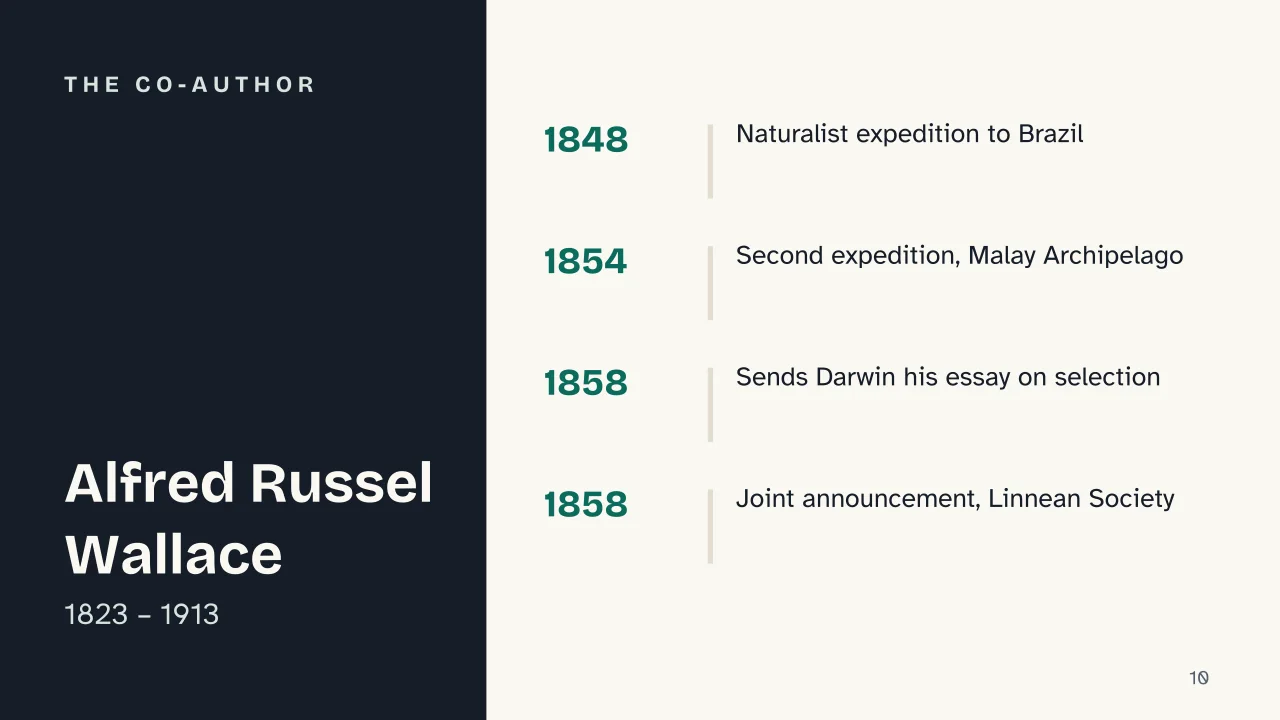
    Darwin has been working for years on a much longer manuscript about the transmutation of species, at his home in Down, Kent, when in 1858 he receives a letter from Alfred Russel Wallace. Wallace, an English naturalist who has led expeditions to Brazil (1848-1852) and the Malay Archipelago (1854-1862), sends him an essay written during the second voyage: it sets out a mechanism of species change strikingly similar to the one Darwin has been working on for years.

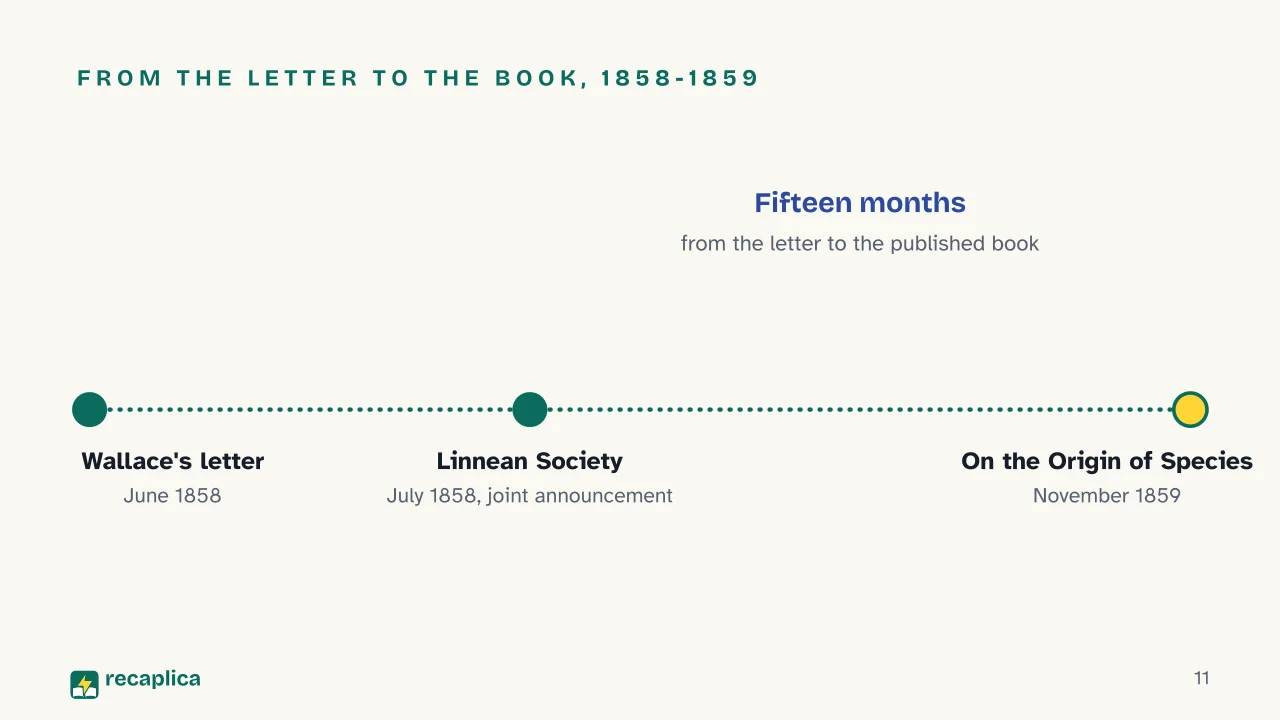
    The coincidence pushes Darwin to move faster. First comes a joint announcement, read to the Linnean Society of London in July 1858; then the book, «On the Origin of Species», published fifteen months later, in November 1859. Wallace himself later acknowledges that his own contribution had been to push Darwin to write and publish right away, while the bulk of the work — working out the theory’s details — remained Darwin’s, who had been at it for years before that letter ever arrived. The two keep up a relationship of mutual respect, even after their views later diverge over how natural selection applies to the human species.

    Charles DarwinAlfred Russel Wallace
    Working on the ideaFor years, in a long manuscriptDuring the Malay Archipelago expedition
    In 1858Receives Wallace’s letterSends his own essay to Darwin
    Publication«On the Origin of Species», November 1859Co-author of the 1858 announcement

    The moth that proves the theory, live

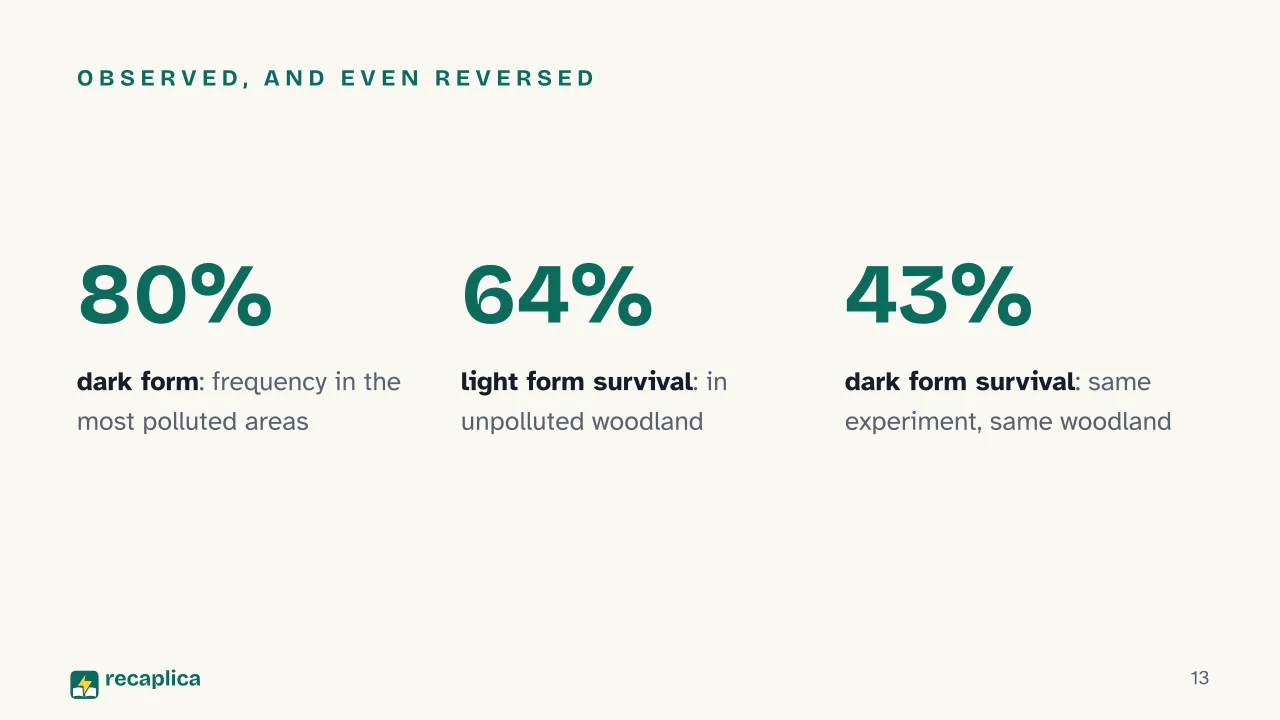
    You don’t have to wait millions of years to see natural selection at work: the case of the peppered moth (Biston betularia) shows it happening within a few decades. The species exists in a light form, dominant before the Industrial Revolution, and a dark form, which appeared and spread during British industrialization, roughly between 1760 and 1840. In the areas most polluted by factory smoke, the dark form comes to make up as much as 80% of the local population.

    Practical example: researchers placed 500 fake moths on trees in an unpolluted woodland, in Cornwall and Hampshire, and observed them for 48 hours. The light form had a survival rate of 64%, against 43% for the dark form. Models of predatory birds’ vision confirm why: against lichen-covered bark, the light form is nearly invisible, while the dark form stands out at once; pollution, by killing lichens and blackening bark, flips that advantage.

    After Britain’s Clean Air Acts, in the 1950s, pollution drops and the frequency of the light form climbs again, while the dark form declines. The phenomenon that made the peppered moth famous isn’t just observable: it’s reversible, as environmental conditions change. Anyone curious about the historical backdrop against which the dark form appeared can read the Recap on the Industrial Revolution.

    What natural selection is not

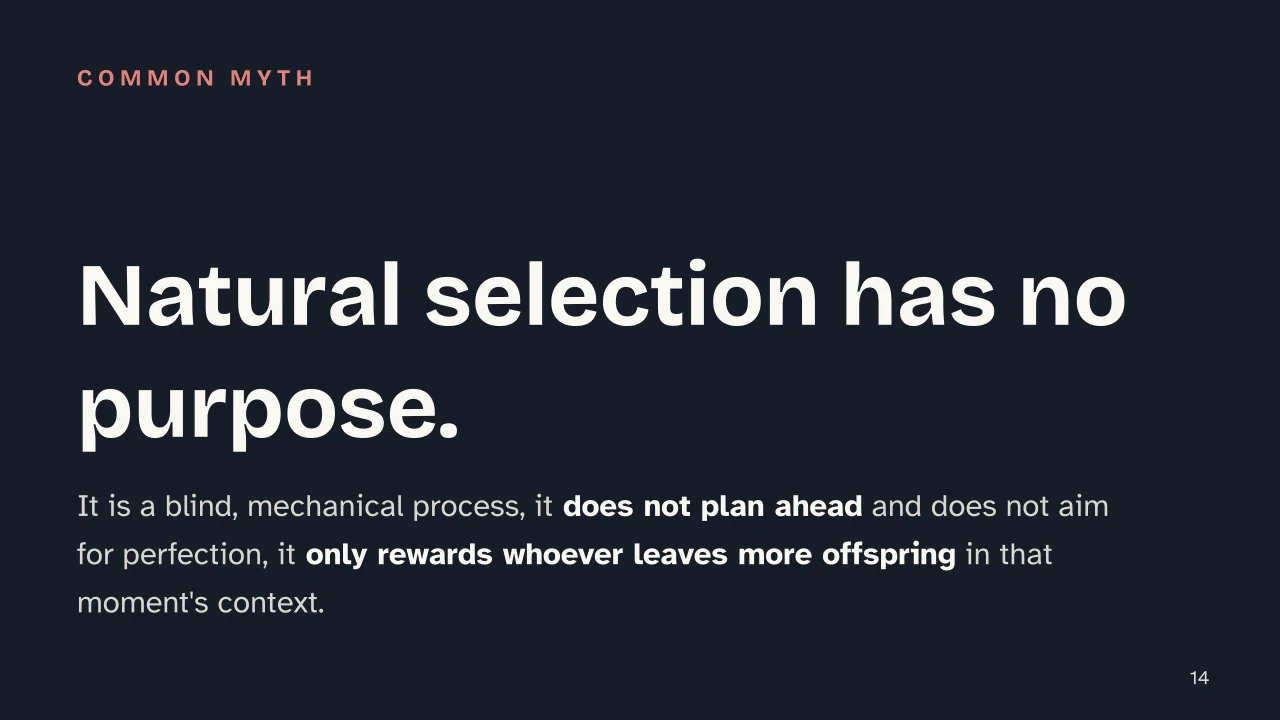
    Several persistent misunderstandings swirl around Darwin’s theory. The most common is that “survival of the fittest” means the strongest, or that evolution aims at progress, at an ever more perfect or complex form. It doesn’t: natural selection acts only on the variation already present in a population at a given moment, it doesn’t design ideal solutions from scratch, and “fit” simply means suited to that particular environment, not superior in any absolute sense.

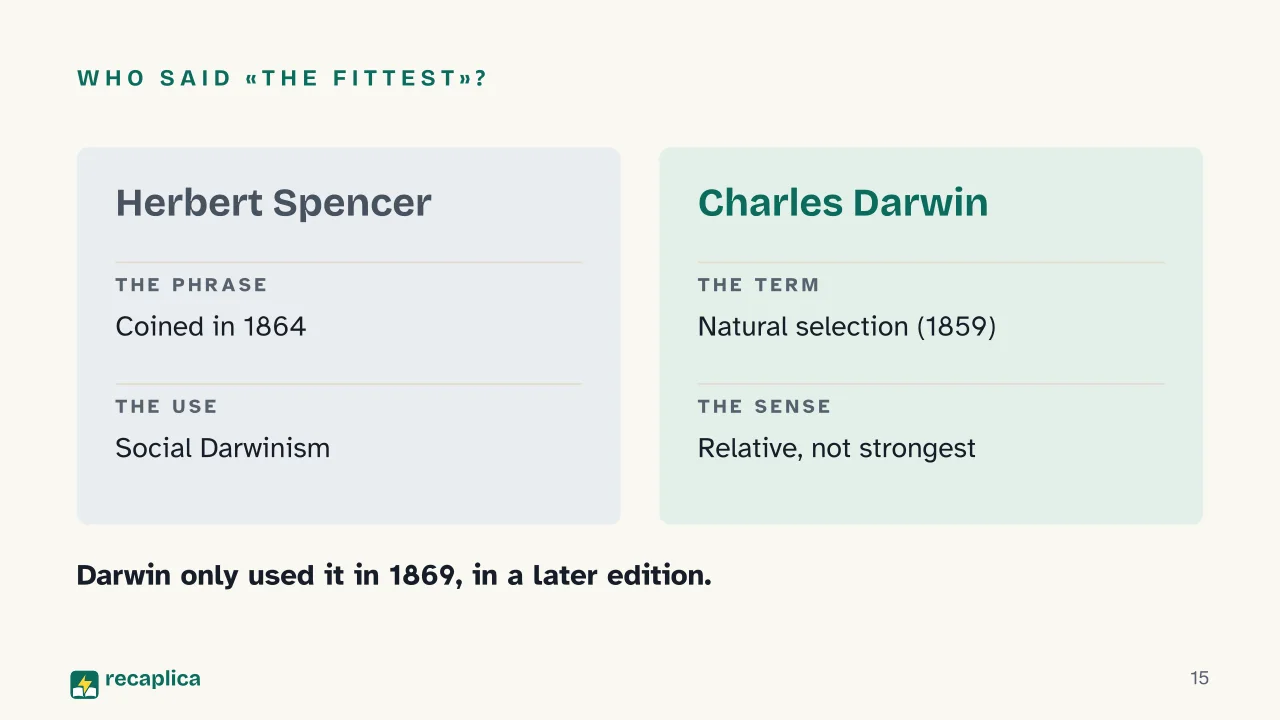
    The phrase itself, “survival of the fittest,” doesn’t originate with Darwin: philosopher Herbert Spencer coined it in 1864, in his work «Principles of Biology». It was Wallace who suggested Darwin adopt it, to reduce confusion around the original term “natural selection”; Darwin only inserted it in the fifth edition of the «Origin», in 1869, meaning it in a relative sense — the fittest for one’s own environment, not the strongest in any absolute way. Spencer, for his part, used it to justify, in his own social thinking, economic laissez-faire and a minimal state: that is the origin of what’s called social Darwinism, a later ideological application, distinct from Darwin’s biological theory, which dealt solely with the natural processes by which species adapt.

    When the book comes out, in November 1859, its success is immediate and wider than Darwin himself expected: he says as much in a letter to Charles Lyell a few weeks later, surprised by a reception he hadn’t foreseen. In the decades that follow, the theory establishes itself as biology’s central explanation, backed by lines of evidence Darwin could not even have imagined at the time, from fossils to genetics.

    Slide deck

    Slides ready to download and make your own in PowerPoint or Google Slides, with speaker notes. Pick the Flash cut or the Full one.
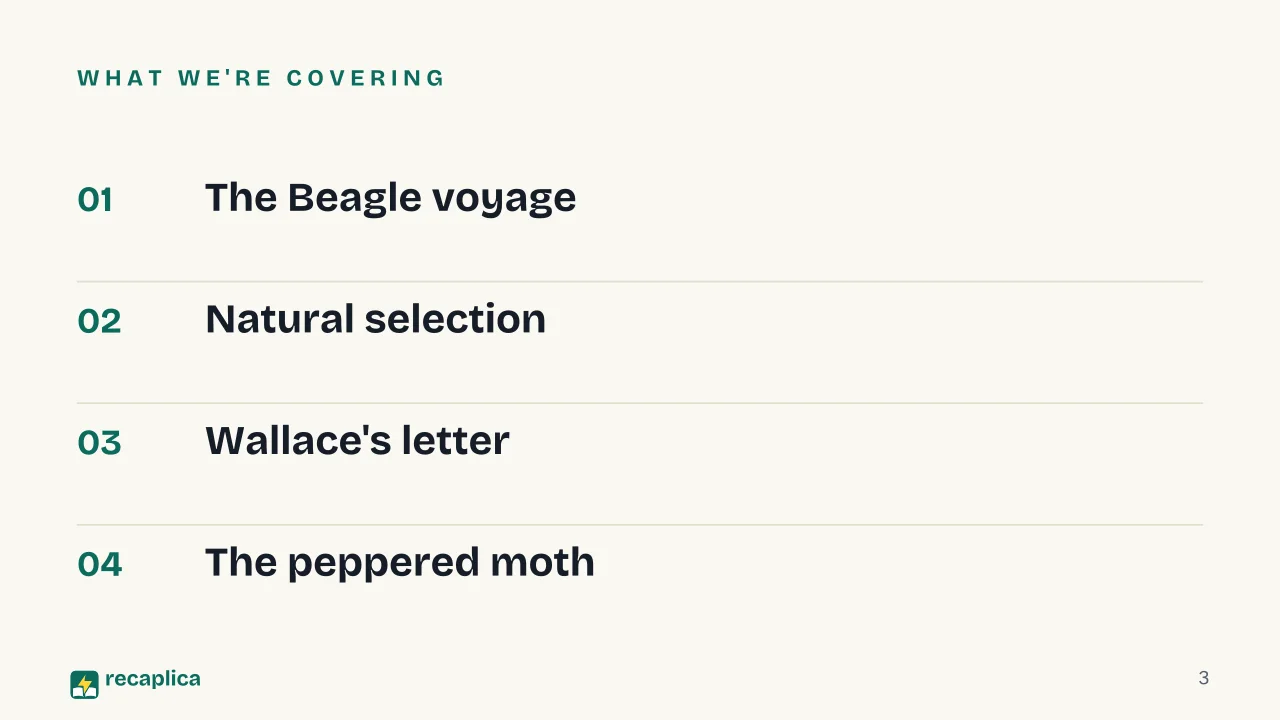
    Slide 1 of the presentation on Darwin's Theory of Evolution: Darwin's Theory of EvolutionSlide 2 of the presentation on Darwin's Theory of Evolution: Are apes our ancestors?Slide 3 of the presentation on Darwin's Theory of Evolution: What we're coveringSlide 4 of the presentation on Darwin's Theory of Evolution: Chapter 01: The Beagle voyageSlide 5 of the presentation on Darwin's Theory of Evolution: The Beagle voyage, 1831-1836Slide 6 of the presentation on Darwin's Theory of Evolution: Chapter 02: Natural selectionSlide 7 of the presentation on Darwin's Theory of Evolution: One ancestor, different beaksSlide 8 of the presentation on Darwin's Theory of Evolution: Variation · Inheritance · SelectionSlide 9 of the presentation on Darwin's Theory of Evolution: Chapter 03: Wallace's letterSlide 10 of the presentation on Darwin's Theory of Evolution: The co-authorSlide 11 of the presentation on Darwin's Theory of Evolution: From the letter to the book, 1858-1859Slide 12 of the presentation on Darwin's Theory of Evolution: Chapter 04: The peppered mothSlide 13 of the presentation on Darwin's Theory of Evolution: Observed, and even reversedSlide 14 of the presentation on Darwin's Theory of Evolution: Natural selection has no purpose.Slide 15 of the presentation on Darwin's Theory of Evolution: Who said «the fittest»?Slide 16 of the presentation on Darwin's Theory of Evolution: Do humans descend from today's apes?Slide 17 of the presentation on Darwin's Theory of Evolution: What does the case of the peppered moth show?Slide 18 of the presentation on Darwin's Theory of Evolution: Now for the recap
    Flash10 slidesThe essential thread, to present in classFull18 slidesEvery chapter and the deeper detail

    Common myths

    • ✗ Myth Darwin's theory says humans descend from apes.

      ✓ Reality That is not what the theory says. Humans and today's great apes share a common ancestor that lived millions of years ago: they are two branches of the same tree, not a ladder with humans standing a rung above today's apes. The tree of evolution branches out in every direction, and «change» does not mean «progress» toward a superior form.

    • ✗ Myth Evolution is «just a theory», so it isn't proven.

      ✓ Reality In scientific language, «theory» does not mean an uncertain guess: it is an explanation strongly supported by several independent lines of evidence, such as fossils, genetics, direct observation and the geographic distribution of species. That is a different use of the word from everyday speech, and it is exactly that mismatch that fuels the confusion.

    • ✗ Myth «Survival of the fittest» and social Darwinism are Darwin's science.

      ✓ Reality The phrase is not Darwin's: philosopher Herbert Spencer coined it in 1864, and Darwin only adopted it in the fifth edition of the Origin, in 1869, meaning it in a sense relative to the local environment, not «the strongest» in any absolute sense. Spencer himself used it to justify competition between individuals on social and economic grounds: a later, ideological idea, distinct from Darwin's biological theory of how species adapt naturally.

    Mind map

    Drag the background to move around and the nodes to reposition them; use − and + to collapse and expand branches.
    Customize
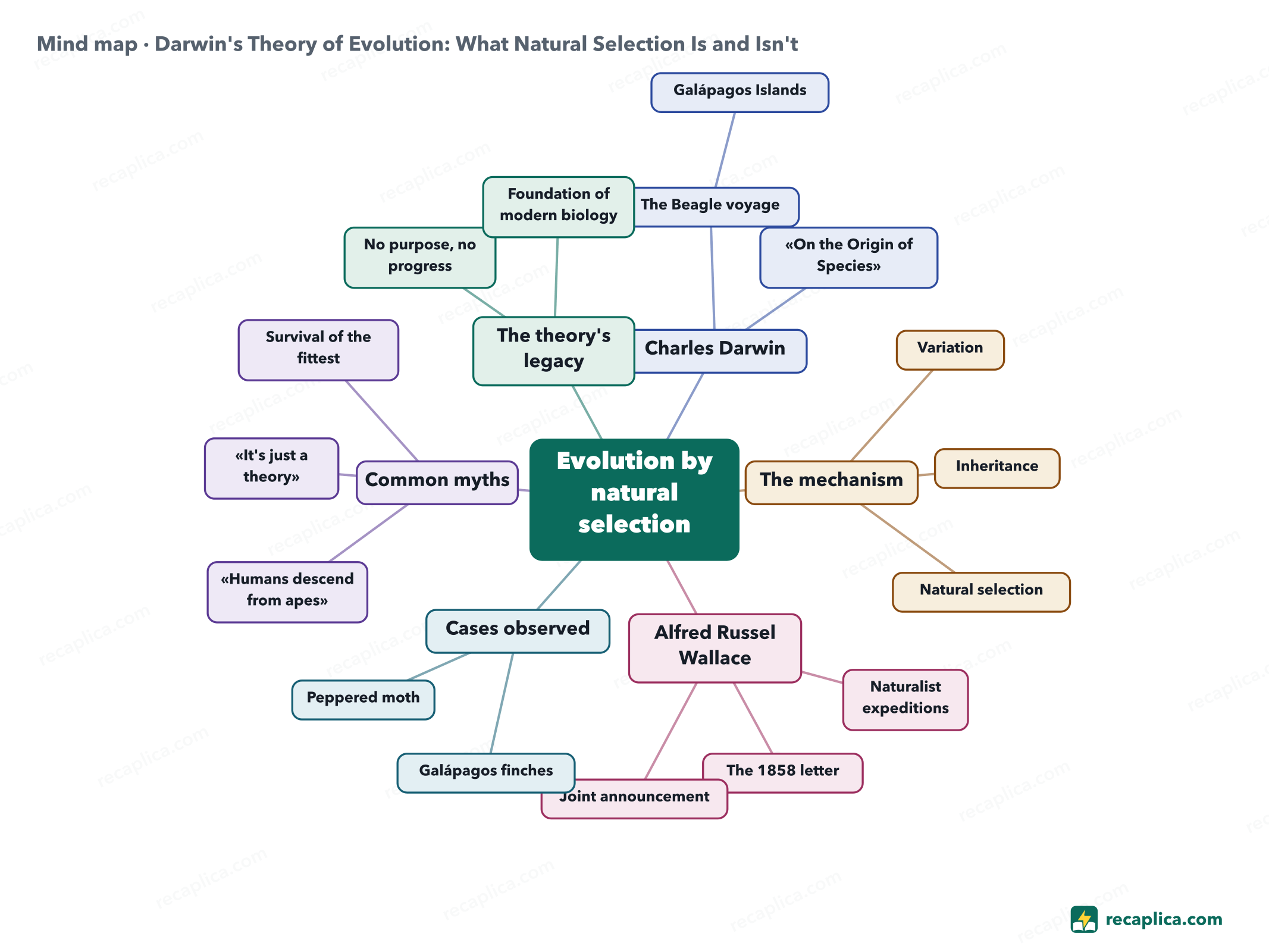
    Mind map: Darwin's Theory of Evolution: What Natural Selection Is and Isn't
    • Evolution by natural selection
      • Charles Darwin
        • The Beagle voyage 1831-1836, nearly 5 years
          • Galápagos Islands Finches and other specimens, in 1835
        • «On the Origin of Species» Published in November 1859
      • The mechanism
        • Variation Random, among individuals
        • Inheritance Traits pass on to offspring
        • Natural selection The best-suited survive
      • Alfred Russel Wallace
        • Naturalist expeditions Brazil, then Malay Archipelago
        • The 1858 letter A mechanism similar to Darwin's
        • Joint announcement Linnean Society of London, July 1858
      • Cases observed
        • Galápagos finches One ancestor, different beaks for different foods
        • Peppered moth Natural selection observed, and reversible
      • Common myths
        • «Humans descend from apes»
        • «It's just a theory»
        • Survival of the fittest Not Darwin's phrase, but Herbert Spencer's
      • The theory's legacy
        • No purpose, no progress A blind process, not a ladder
        • Foundation of modern biology

    Quiz: test yourself

    Answer the questions to check what you have learned: you get instant feedback and a short explanation.

    Grade 0/10 0/5
    1 In what year was Charles Darwin's «On the Origin of Species» published?

    The book came out in November 1859. 1858 is the year of the joint announcement with Wallace at the Linnean Society of London; 1869 is the fifth edition, the first in which Darwin used the phrase «survival of the fittest».

    2 How long did the Beagle voyage, the expedition during which Darwin gathered his observations, last?

    The voyage was meant to last two years but stretched to almost five: the Beagle left Plymouth on 27 December 1831 and did not return to England until 2 October 1836.

    3 True or false: according to Darwin's theory, humans descend directly from apes living today.

    False. Humans and great apes share a common ancestor that lived millions of years ago: they are two separate lines going back to the same point, not a single file with today's apes one step behind humans.

    4 Who coined the phrase «survival of the fittest»?

    It was the philosopher Herbert Spencer, in 1864. Darwin only adopted it in the fifth edition of the Origin, in 1869, and meant it in a sense relative to an individual's own environment, not as generically stronger.

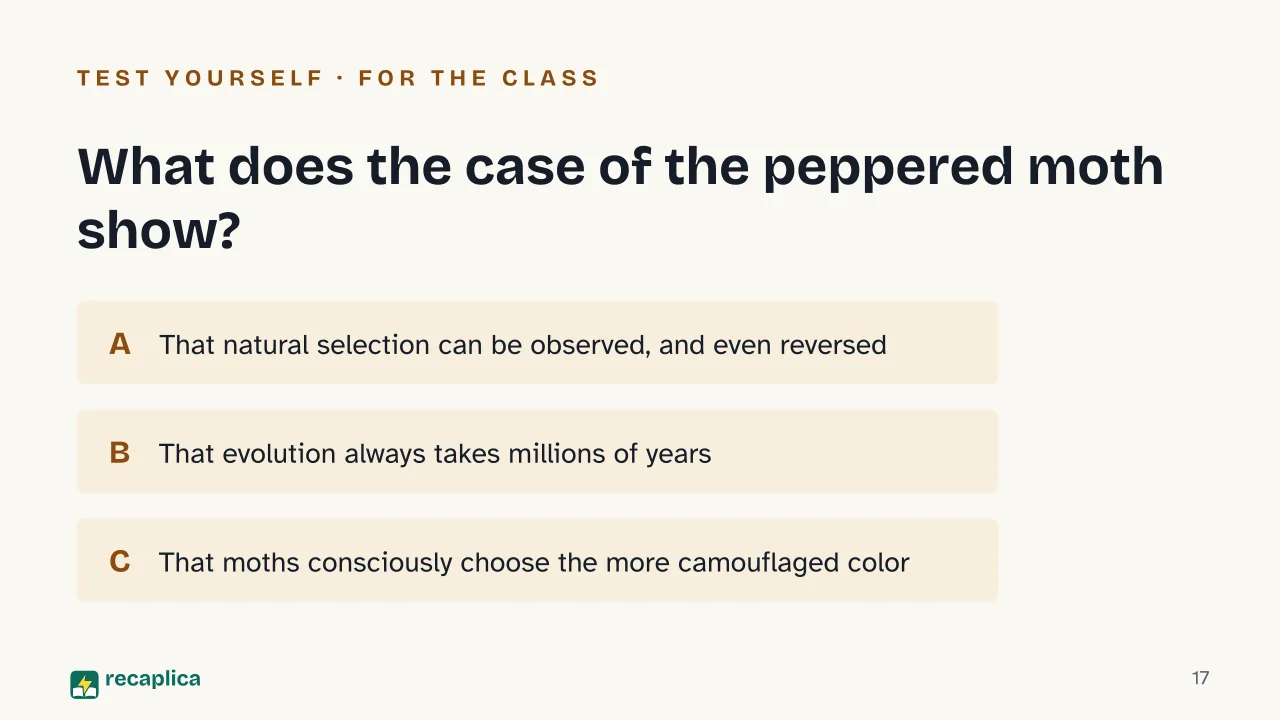
    5 What does the case of the peppered moth (Biston betularia) demonstrate?

    During the British Industrial Revolution the dark form of the moth came to exceed 80% in the most polluted areas, because it blended in better against soot-blackened bark. After pollution fell (the Clean Air Acts, in the 1950s) the light form became dominant again: an observed and reversible change, not a conscious choice by the moths.

    Answers: 1-C · 2-B · 3-B · 4-C · 5-A

    Flashcards

    Tap the card to flip it and check whether you remember the answer, then move to the next one.

    1 / 7

    Explain it in your own words

    The ultimate test: if you can explain it in simple words, you've truly understood it. Write your explanation, then compare it with the Recap.

    Your explanation is saved only on this device.

    The theory of evolution by natural selection explains how living species change over generations. Charles Darwin works it out while observing plants and animals during the voyage of the brig HMS Beagle, between 1831 and 1836, and publishes it in «On the Origin of Species» in November 1859, after a letter from Alfred Russel Wallace pushes him to move faster. The mechanism is simple: individuals within a species vary from one another by chance, traits pass on to offspring, and those with traits better suited to the local environment tend to survive and reproduce more. It is neither a plan nor a ladder toward perfection, but a blind process that the Galápagos finches and the peppered moth show in action.

    Frequently asked questions

    What is natural selection, in simple terms?

    It is the mechanism by which, within a population, individuals with traits better suited to the environment they live in are more likely to survive and to leave offspring. It is not a conscious choice, nor a force with a purpose: it is the statistical consequence of the fact that whoever is better adapted, on average, reproduces more.

    Did Darwin discover evolution on his own?

    The idea of natural selection came to Darwin after decades of observation, but in 1858 the naturalist Alfred Russel Wallace sent him an essay describing a mechanism strikingly similar to his own, developed during an expedition in the Malay Archipelago. The two presented the theory together, in a joint paper read to the Linnean Society of London in July 1858; Darwin's book, «On the Origin of Species», followed fifteen months later, in November 1859.

    Is it true that, according to Darwin, humans descend from apes?

    No, not in that sense. The theory says that humans and today's great apes share a common ancestor that lived millions of years ago: humans do not descend from today's chimpanzees or gorillas, but are a different branch of the same evolutionary tree, one that branches out in every direction and has no summit.

    What is social Darwinism, and does it really have anything to do with Darwin?

    It is the ideological use, in Herbert Spencer's thinking, of the phrase «survival of the fittest» to justify economic competition and a minimal state. It is a later social application, distinct from Darwin's biological theory, which dealt solely with the natural processes by which species adapt, not with human societies.

    How does the peppered moth show that natural selection really works?

    During the British Industrial Revolution, the dark form of the moth, better camouflaged against soot-blackened bark, came to exceed 80% in the most polluted areas. After pollution fell, in the 1950s, the light form became dominant again: a change observed directly, and even reversible as environmental conditions changed.

    Sources

    • Darwin Correspondence Project — On the Origin of Species
    • Darwin Correspondence Project — Alfred Russel Wallace
    • Encyclopaedia Britannica — Charles Darwin, On the Origin of Species
    • Encyclopaedia Britannica — The Beagle voyage
    • Encyclopaedia Britannica — Beagle (ship)
    • Encyclopaedia Britannica — Evolution, History of evolutionary theory
    • Encyclopaedia Britannica — Survival of the fittest
    • Natural History Museum — What is natural selection?
    • Natural History Museum — Charles Darwin, History's most famous biologist
    • Natural History Museum — Galápagos finches show beak differences (teaching resource)
    • Understanding Evolution (UC Museum of Paleontology, Berkeley) — Misconceptions about natural selection
    • Understanding Evolution (UC Museum of Paleontology, Berkeley) — Misconceptions about evolution
    • PMC (National Library of Medicine, NIH) — Avian vision models and field experiments on peppered moth camouflage

    Every Recap goes through an independent review before publication.

    Every evening, the day's new Recaps on our Telegram channel. Join the channel →

    Keep learning

    • Science CRISPR: What It Is and Where Gene Editing Hits Its Ethical Limits CRISPR-Cas9 is a tool that uses a short guide RNA to find an exact spot in a strand of DNA, then relies on the Cas9 protein to cut it, opening the door to deleting or inserting genetic code. The sharpest ethical line separates somatic editing, which affects only the treated person's own cells, from germline or heritable editing, which changes embryos or reproductive cells and passes the change on to future generations. In November 2018, Chinese researcher He Jiankui announced that he had used CRISPR to edit the embryos that became twin girls, the most debated case of heritable human gene editing to date. Around the same time, in December 2018, the World Health Organization set up an expert committee on the governance of human genome editing, which published international recommendations spanning nine areas in 2021. Bioethics bodies do not speak with one voice on banning heritable editing outright: the Nuffield Council on Bioethics allows it under very strict conditions, including proven clinical safety and broad public debate. Read the Recap →
    • Science Digestive System: How It Breaks Down Food, Step by Step The digestive system breaks food down, piece by piece, into molecules the body can absorb. It starts in the mouth, where teeth cut food into fragments and saliva carries the first enzymes, continues in the stomach, which churns food with gastric acid, and does most of its chemical work in the small intestine, according to StatPearls (2022). Along the way, the liver, pancreas, and gallbladder — organs outside the digestive tract itself — add bile and enzymes to the mix. What's left moves on to the large intestine, which reclaims water and minerals before waste leaves the body. Read the Recap →
    • Science How Beer Is Made: The Brewing Process, from Barley to Glass Beer comes from four ingredients — water, malted barley, hops and yeast — combined through four main steps: malting, mashing, boiling and fermentation. During malting, barley germinates and is then dried, developing the enzymes that mashing later uses to turn starch into fermentable sugar. Boiling dissolves the hops' alpha acids, which barely dissolve in water on their own, giving beer its characteristic bitterness. The yeast strain and fermentation temperature then determine whether the result is an ale, a lager, or a spontaneously fermented beer like Belgian lambic. Read the Recap →

    recaplica

    Clear in 30 seconds, yours in 10 minutes.

    Recaps Mind maps Request a Recap Telegram channel Mind map maker Our method About Privacy & cookies Legal notes & terms of use

    © 2026 Recaplica · A project by Curi S.r.l. — VAT IT05472000750

    Statistics, only if you say so

    To learn which Recaps help most we would use Google Analytics, with aggregate, anonymous data. It starts only with your OK, and you can change your mind anytime. Privacy policy