|
recaplica
Logical Positivism: What Is It, and Who Were the Vienna Circle Philosophers | |||||||||
| © 2026 Recaplica · recaplica.com — All rights reserved | |||||||||
Logical Positivism: What Is It, and Who Were the Vienna Circle PhilosophersWhat to print Page numbers appear when printing with default margins. SlidesChoose a cut Flash10 slidesThe essential thread, to present in classFull16 slidesEvery chapter and the deeper detailBoth come with speaker notes. In 30 seconds quick readThe Vienna Circle was a group of philosophers and scientists who met in Vienna, weekly during the academic terms, from 1924 to 1936, under the nominal leadership of Moritz Schlick. Its members included Rudolf Carnap, Otto Neurath and Hans Hahn, united around a single idea, logical positivism, holding that a sentence is meaningful only if it is an analytic a priori proposition or a verifiable empirical one. On this basis the group treated the claims of traditional metaphysics as cognitively meaningless, since they fit neither category. The movement stopped in the 1930s, amid the political closure of the Verein Ernst Mach, the killing of Schlick in 1936, and the scattering of most of its members, driven into emigration by Nazism. It should not be confused with Auguste Comte's nineteenth-century Positivism: the two are distinct philosophical currents from different centuries, often conflated by readers today. Key Points
Deep DiveWho they were, and where they metThe Vienna Circle formed in Vienna around Moritz Schlick, after his arrival in 1922. That year the University of Vienna appointed Schlick to its chair of philosophy of the inductive sciences, a post that had belonged to Ernst Mach. The regular, weekly meetings began only in 1924, though, and ran, during the academic terms, until 1936: two distinct moments, Schlick’s arrival and the start of the meetings, two years apart. The group mixed philosophers with a scientific training and scientists with a philosophical bent: besides Schlick, it included the mathematician Hans Hahn, the physicist Philipp Frank, the social scientist Otto Neurath, the mathematician Olga Hahn-Neurath, the philosopher Viktor Kraft and, from 1926, the philosopher and logician Rudolf Carnap. Other members joined among Schlick’s students, such as Friedrich Waismann and Herbert Feigl, and among Hahn’s, such as Karl Menger and Kurt Gödel. What counted as “meaningful”For the Circle, a meaningful statement had to carry factual content: it had to be an analytic, a priori proposition, like those of logic and mathematics, or an empirical, synthetic proposition, verifiable through experience. The criterion could not rest on immediate practical verification alone, though: taken literally, that stricter version would have stripped meaning from many scientific hypotheses that nobody, in the daily practice of a laboratory, can check right away. The Circle’s members noticed the problem themselves, and argued about it. On this basis the group rejected the claims to knowledge made by traditional metaphysics, since its statements fit neither the analytic a priori category nor the empirical, synthetic, verifiable one. Its members saw themselves as conceptual revolutionaries: for them metaphysics was not simply false, it was entirely without cognitive meaning, a distinction that can look subtle to a reader today but that for them marked the very boundary of knowledge.
The Circle’s verification criterion sits inside a tradition going back to David Hume’s empiricism, for which knowledge of the world comes from sense experience, and it clashes with Immanuel Kant’s claim that synthetic a priori judgments exist, known independently of experience yet not purely logical: a third category the Circle refused to admit. Wittgenstein, close but not insideLudwig Wittgenstein was never part of the Vienna Circle. He discussed his ideas privately with Schlick and Waismann, on two occasions, in December 1929 and January 1930, putting forward the thesis that the sense of a proposition coincides with the method for verifying it. The group’s meetings also discussed his Tractatus, and there were several direct encounters among Wittgenstein, Schlick, Waismann and Carnap: a constant presence in the discussions, yet always outside the Circle as an institution. The end of the CircleThe Circle did not break up for a single reason. From 1934, with antisemitism institutionalized in Austria, the Verein Ernst Mach, the association that hosted the meetings, was shut down for political reasons. After Schlick’s killing in 1936, by a student sympathetic to Nazism at the University of Vienna, only a small remaining group managed to keep meeting in Vienna for two more years, while the other members had already scattered into emigration and forced exile, many of them toward the United States. Logical positivism and Comte’s Positivism: two currents, not oneThe name “positivism” recurs at two distinct moments in philosophy, and it is worth telling them apart, as the Recap on Auguste Comte’s Positivism and the reactions it provoked also does. Over the twentieth century, Comte’s original, nineteenth-century positivism was largely forgotten, overshadowed by neopositivism, that is, by the Vienna Circle’s logical positivism. The twentieth-century critiques of Thomas Kuhn and Paul Feyerabend, which gave rise to so-called “post-positivism,” targeted Carnap’s neopositivism: the nineteenth-century Comte stayed outside that target, even though later commentators have often mixed the two up.
Readers who want to trace the scientific method the Circle looked to can find its roots in Galileo Galilei’s scientific revolution and in the debate on the theory of knowledge opened by Kant’s Critique of Pure Reason. Slide deckSlides ready to download and make your own in PowerPoint or Google Slides, with speaker notes. Pick the Flash cut or the Full one.     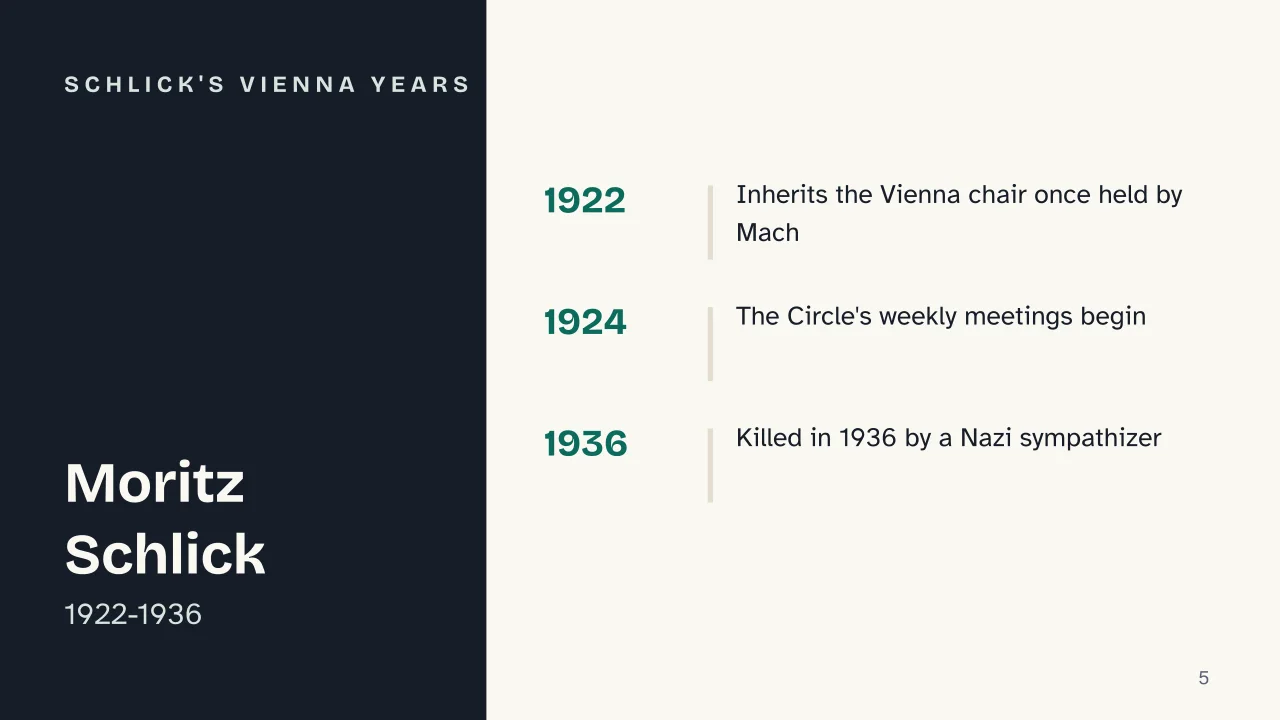 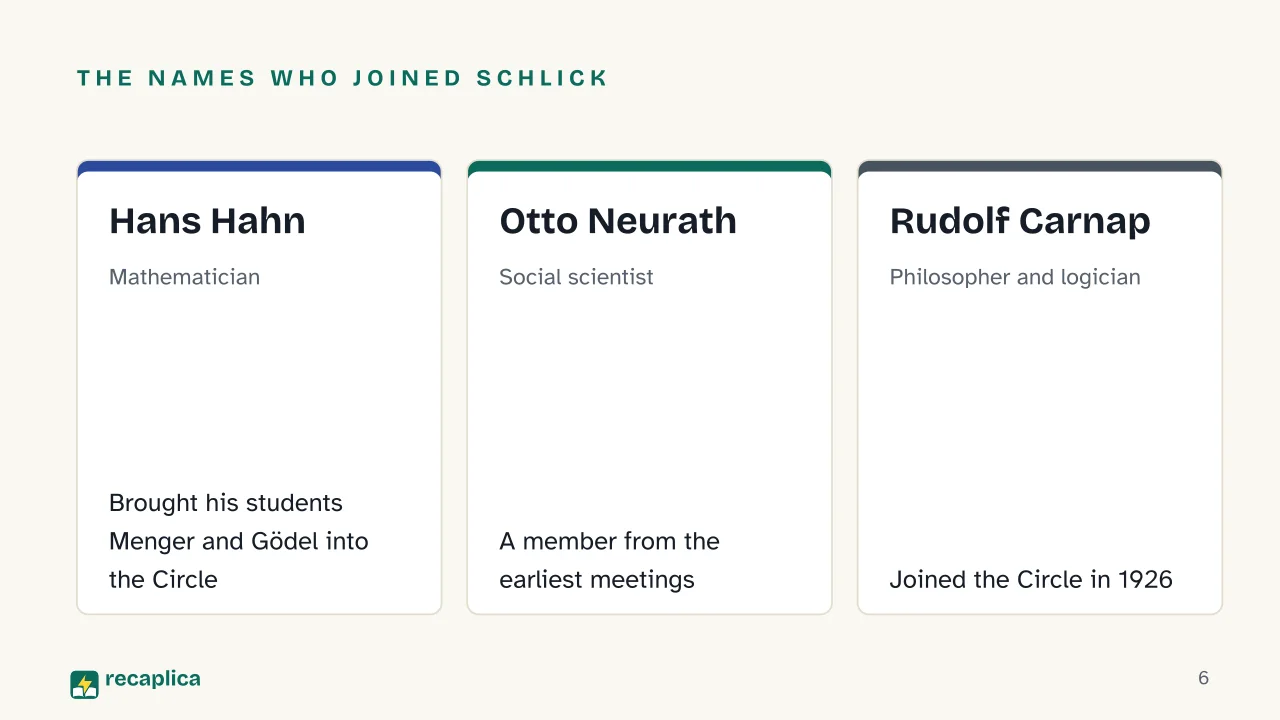  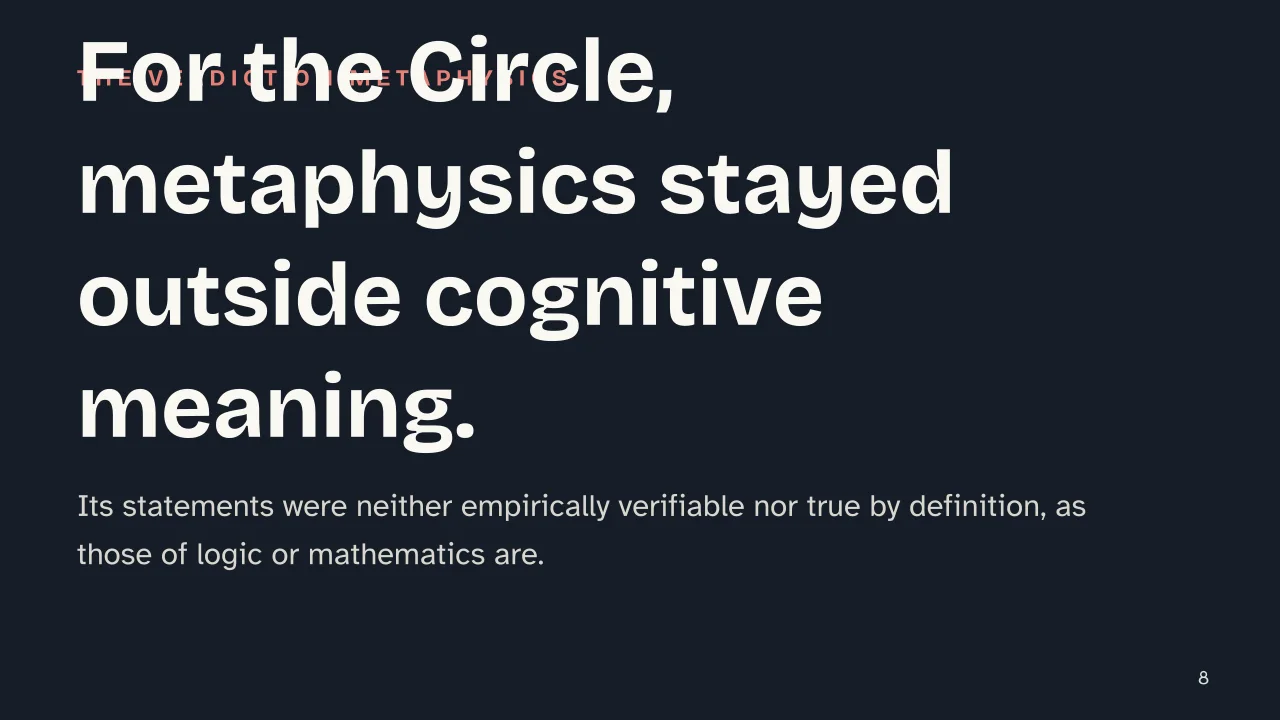  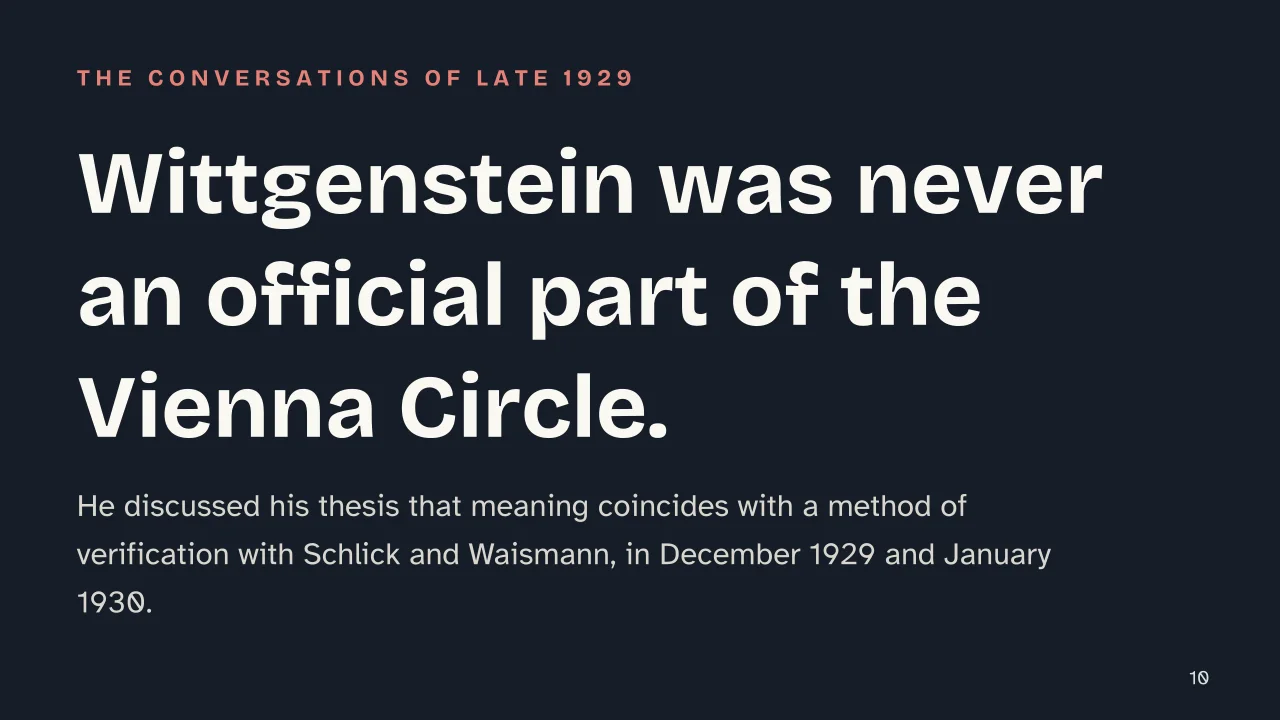  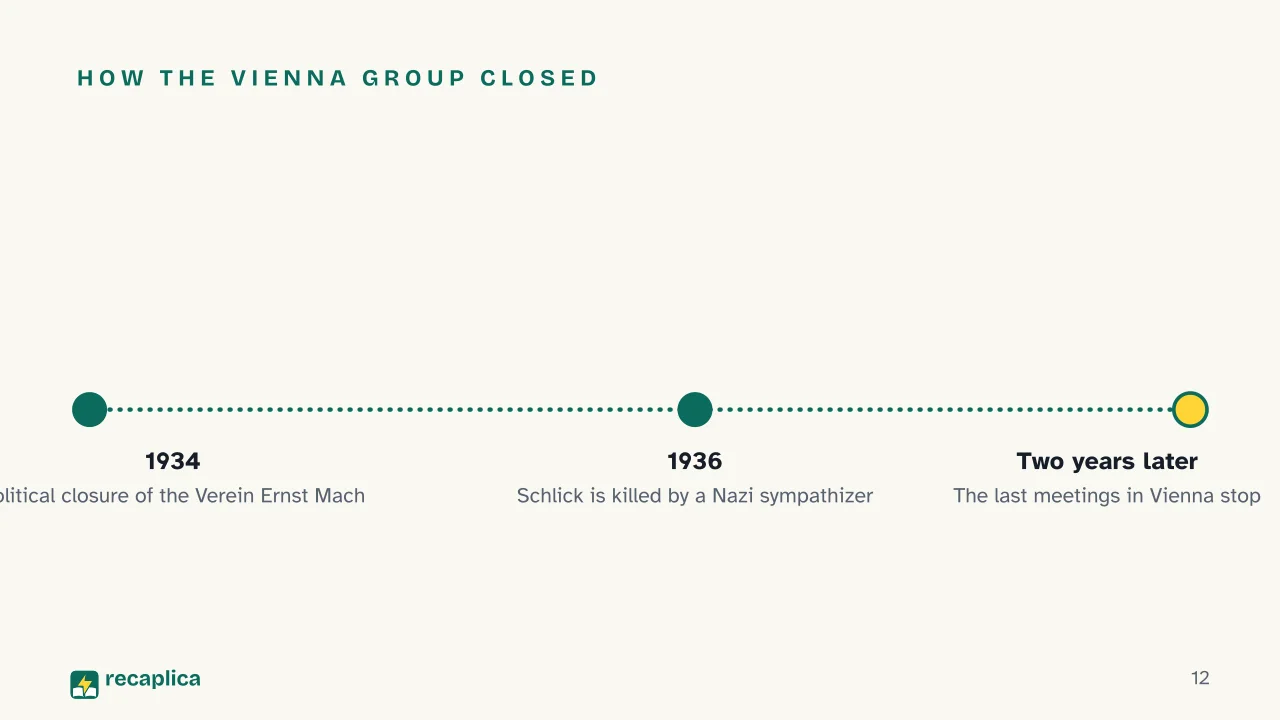  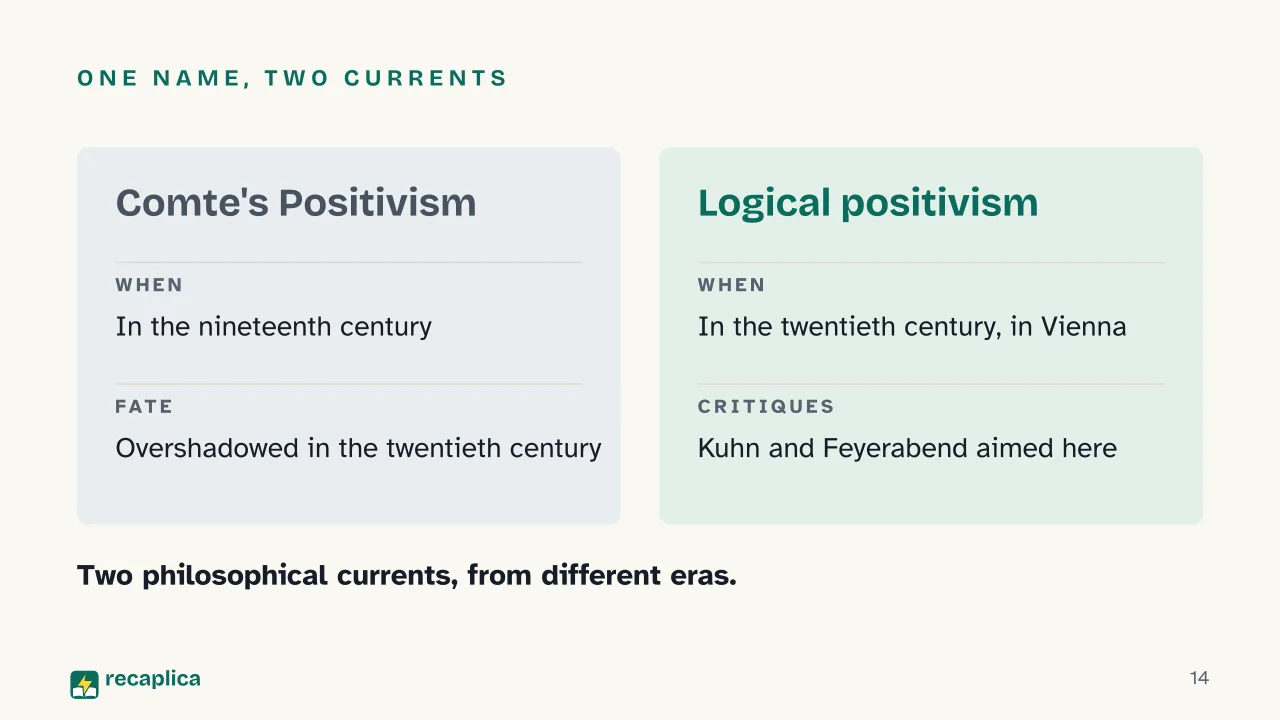 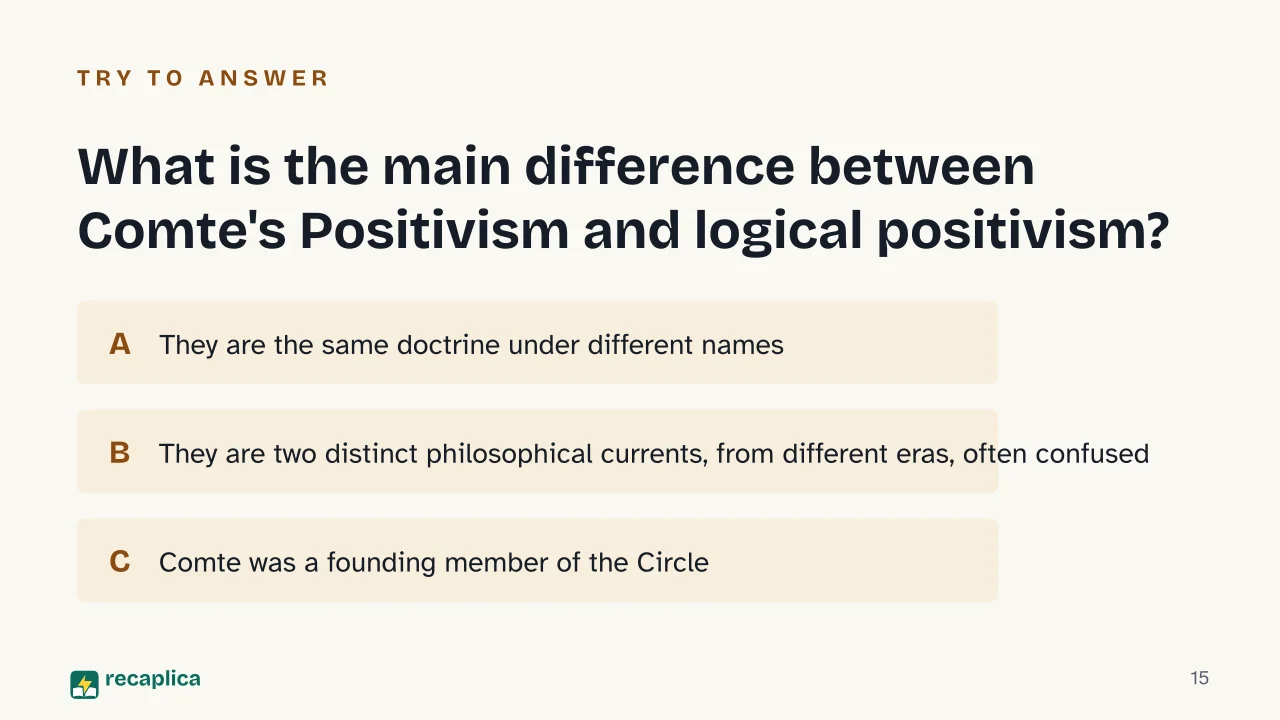  Common myths
Mind mapDrag the background to move around and the nodes to reposition them; use − and + to collapse and expand branches. 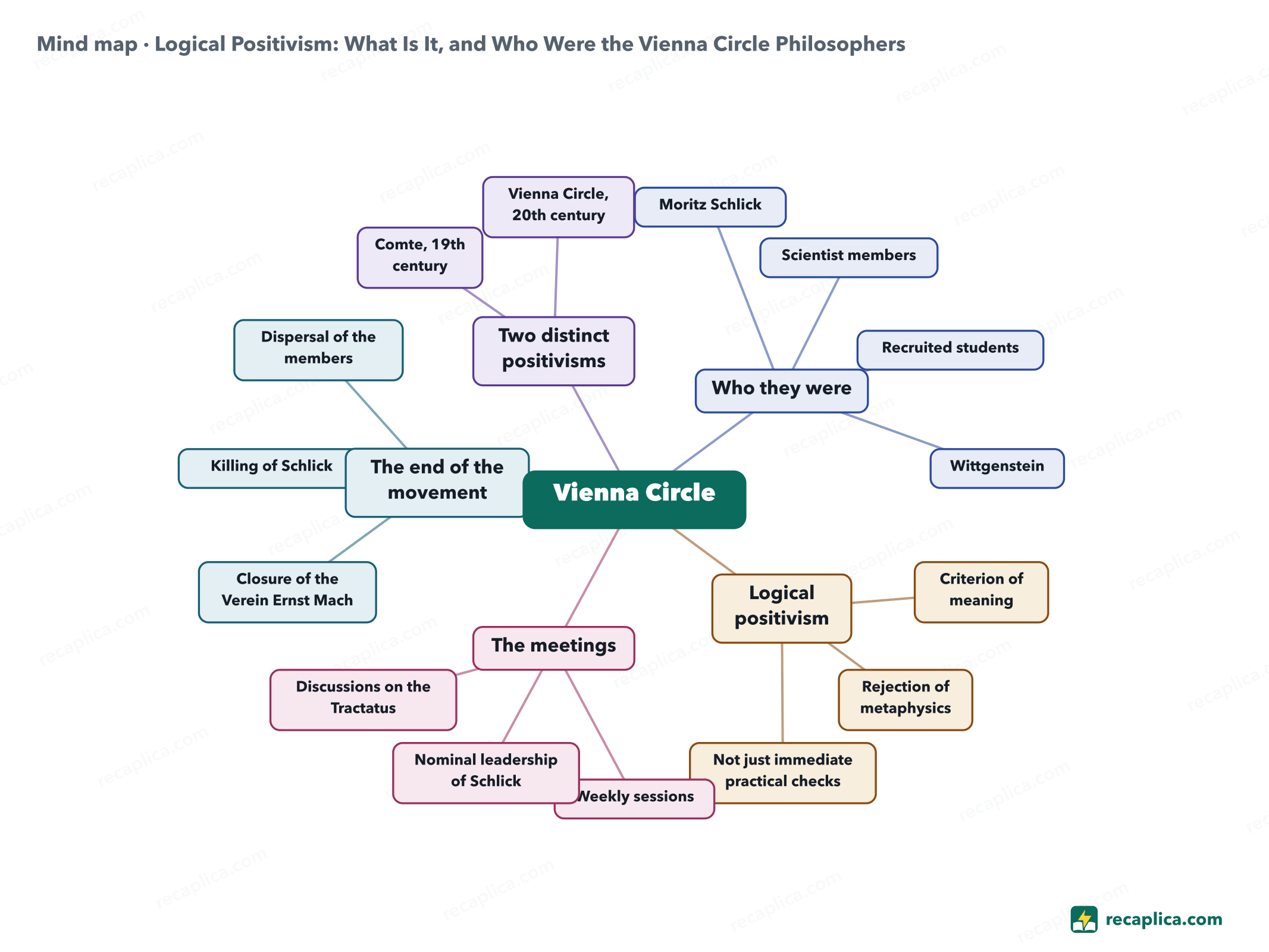
Quiz: test yourselfAnswer the questions to check what you have learned: you get instant feedback and a short explanation. Grade 0/10 0/5
FlashcardsTap the card to flip it and check whether you remember the answer, then move to the next one. 1 / 8 Explain it in your own wordsThe ultimate test: if you can explain it in simple words, you've truly understood it. Write your explanation, then compare it with the Recap. Your explanation is saved only on this device.
Frequently asked questionsWhat is logical positivism?It is the name the Vienna Circle gave to the criterion by which only what can be proven through logic or checked through experience makes sense; everything else, for its members, fell outside cognitive meaning, as was the case with the statements of traditional metaphysics. Who were the members of the Vienna Circle?The group met under the nominal leadership of Moritz Schlick and included, among others, Hans Hahn, Philipp Frank, Otto Neurath, Olga Hahn-Neurath, Viktor Kraft and, from 1926, Rudolf Carnap, along with students such as Friedrich Waismann, Herbert Feigl, Karl Menger and Kurt Gödel. Was Wittgenstein part of the Vienna Circle?No. He was a private interlocutor of Schlick and Waismann, never a member of the Circle; their meetings, in December 1929 and January 1930, addressed the thesis that a proposition makes sense only if it can be checked through experience. Why did the Vienna Circle come to an end?For several reasons that overlapped in the 1930s, the political closure of the Verein Ernst Mach association in 1934, the killing of Schlick in 1936, and the forced emigration of many members as Nazism advanced. What is the difference between the Vienna Circle and Comte's Positivism?They are two distinct philosophical currents, from different centuries. Auguste Comte's nineteenth-century positivism was largely overshadowed in the twentieth century by the Vienna Circle's neopositivism; the later critiques of Kuhn and Feyerabend concerned mainly the latter. Every Recap goes through an independent review before publication. |