|
recaplica
Age of Enlightenment: Summary of Its Origins and Ideas, with Concept Map | ||||||||
| © 2026 Recaplica · recaplica.com — All rights reserved | ||||||||
Age of Enlightenment: Summary of Its Origins and Ideas, with Concept MapWhat to print Page numbers appear when printing with default margins. SlidesChoose a cut Flash10 slidesThe essential thread, to present in classFull16 slidesEvery chapter and the deeper detailBoth come with speaker notes. In 30 seconds quick readThe Age of Enlightenment is the movement of thought that, in eighteenth-century Europe, places individual reason at the center of judgment on institutions, religion and knowledge. The philosopher Immanuel Kant, in 1784, describes it as the shift from relying on external authority to the autonomous use of one's own reason. Its roots reach back to an earlier era, the scientific revolution of the 16th and 17th centuries, and its path runs through to the French Revolution of 1789. Key Points
Deep DiveIn everyday language, the Enlightenment often gets reduced to an age of great books and Paris salons. The Stanford Encyclopedia of Philosophy distinguishes two levels: in the narrow sense, the loosely organized activity of French thinkers in the mid-eighteenth century; in the broader sense, a European movement spanning different countries and generations. What the two readings share is an attitude toward knowledge, more than a list of works. An attitude before an eraThat attitude, according to the Stanford Encyclopedia of Philosophy, is made of suspicion or outright hostility toward every other form or bearer of authority — tradition, superstition, prejudice, myth, miracles — whenever these compete with the authority of individual reason. An institution, a belief or a norm holds, on this view, if it survives the test of rational judgment: a standard different from simply having lasted over time. This shift also changes how Enlightenment thinkers look at established power. According to the same source, the Enlightenment’s critical reading considers existing political and social authority as wrapped in religious myth and built on obscure traditions, a judgment that explains why the movement was itself perceived as a threat by those who held that power.
What is Enlightenment? Kant’s answerThe question in this heading is also, almost word for word, the title of an essay: in 1784 Immanuel Kant published An Answer to the Question: What is Enlightenment? (Beantwortung der Frage: Was ist Aufklärung?). According to the Internet Encyclopedia of Philosophy, Kant defines Enlightenment there as humanity’s emergence from an immaturity it brought upon itself. Kant identifies this condition as immaturity, which he describes, again according to the Internet Encyclopedia of Philosophy, as relying on the authority of others — parents, rulers, priests — instead of using one’s own understanding. It is a condition people bring upon themselves, out of laziness or convenience, choosing to let someone else decide in their place. For Kant, leaving immaturity behind is an ongoing task: it takes the courage to think for oneself. Roots in the scientific revolutionThe Enlightenment has earlier roots. The Stanford Encyclopedia of Philosophy points to the scientific revolution of the 16th and 17th centuries as one of the main origins of the wider European movement: the same method that had made it possible to study the heavens and the motion of the planets — observation, verification, rejection of explanations that fail the test — gets applied, step by step, to law, religion, politics, education. The shift is not immediate: those who first apply observation and verification to natural phenomena still work inside a framework of religious and academic authority that only partly accepts their conclusions, and generations pass before the same method is openly applied to human institutions. Readers who want to trace that earlier shift can read about Galileo and the scientific revolution, which precedes the Enlightenment and prepares the ground for it. Treccani sets more precise boundaries for the historical period. The European Enlightenment runs from the end of the religious wars of the 17th century, or alternatively the English revolution of 1688, to the French Revolution of 1789; across this span, according to Treccani, the autonomy of reason is the principle underlying the entire Enlightenment culture.
From philosophical criticism to political reformThe critical work of Enlightenment thinkers, according to Treccani, reaches into politics as well. In politics and law they adopt a pragmatic outlook, setting aside the traditional treatment of governing problems in terms of raison d’État in favor of a concrete reform agenda. It is the same criticism of the spirit of system — the dogmatic constructions of the past — that Treccani describes as carried out with Lockean analytic tools. This reform agenda reaches, according to Treccani, a symbolic destination in 1789: the Declaration of the Rights of Man and of the Citizen, the legal realization of the rationalist demand that had matured over the preceding decades. The path toward that document, and toward the events of the French Revolution that same year, also passes through intermediate stages such as enlightened absolutism, through which some absolute rulers applied Enlightenment-inspired reforms while keeping all power in their own hands. The same questions crossed the Atlantic: in those same decades, the American Revolution put the legitimacy of political power to a similar test. One movement, many voicesThose who wrote the works of the Enlightenment did not form a school with a shared manual. French thinkers such as Voltaire, Montesquieu, Rousseau and Diderot are remembered as leading figures of the French philosophical movement, with different interests: law, the form of government, education, the compiling of knowledge. Alongside them stands the English empiricist tradition. Later in the century it comes to include David Hume, whose work ties knowledge to verifiable experience. Kant himself, though writing in the German-speaking world and in a different setting from the French one, belongs to this broader movement. His question about Enlightenment comes just a few years before the works in which he defines the limits and the possibilities of human reason, starting with Kant’s Critique of Pure Reason. What unites such different voices is the method: putting beliefs and institutions to the test of individual reason, rather than accepting them out of habit. For this reason, the Enlightenment is easier to recognize as a shared attitude among philosophers and scientists from different countries than to capture in a single formula. Slide deckSlides ready to download and make your own in PowerPoint or Google Slides, with speaker notes. Pick the Flash cut or the Full one.   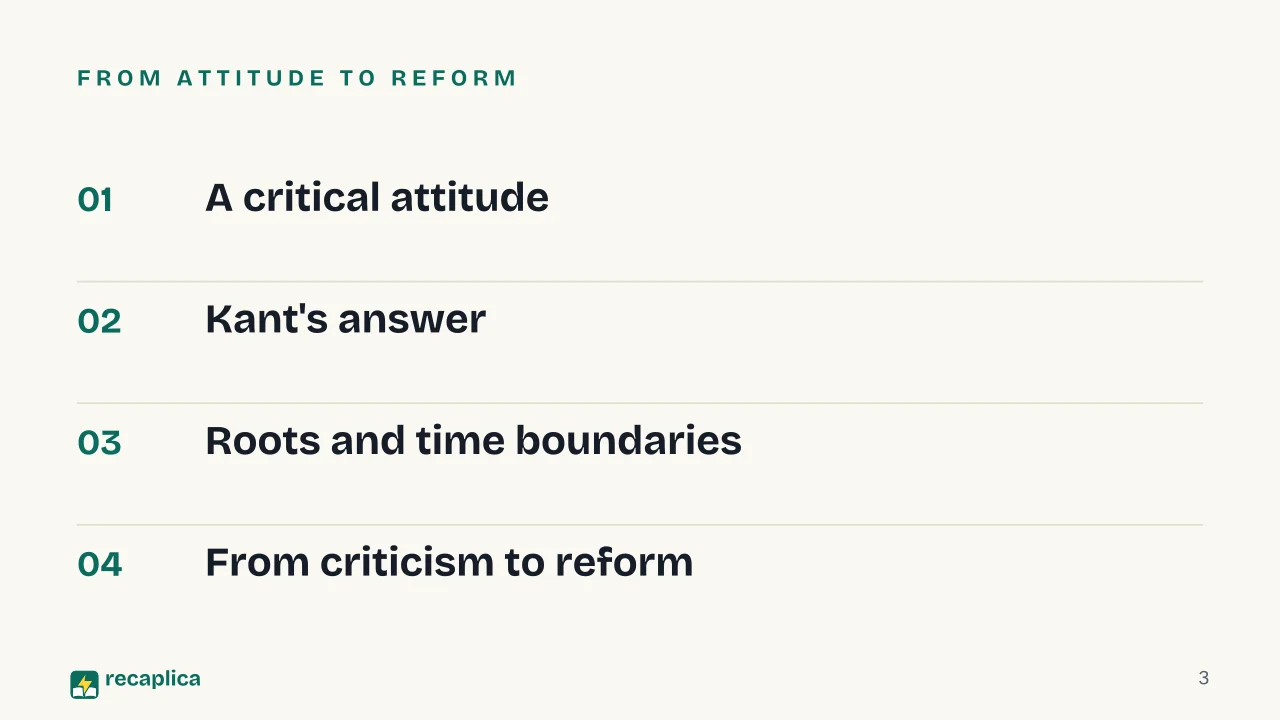  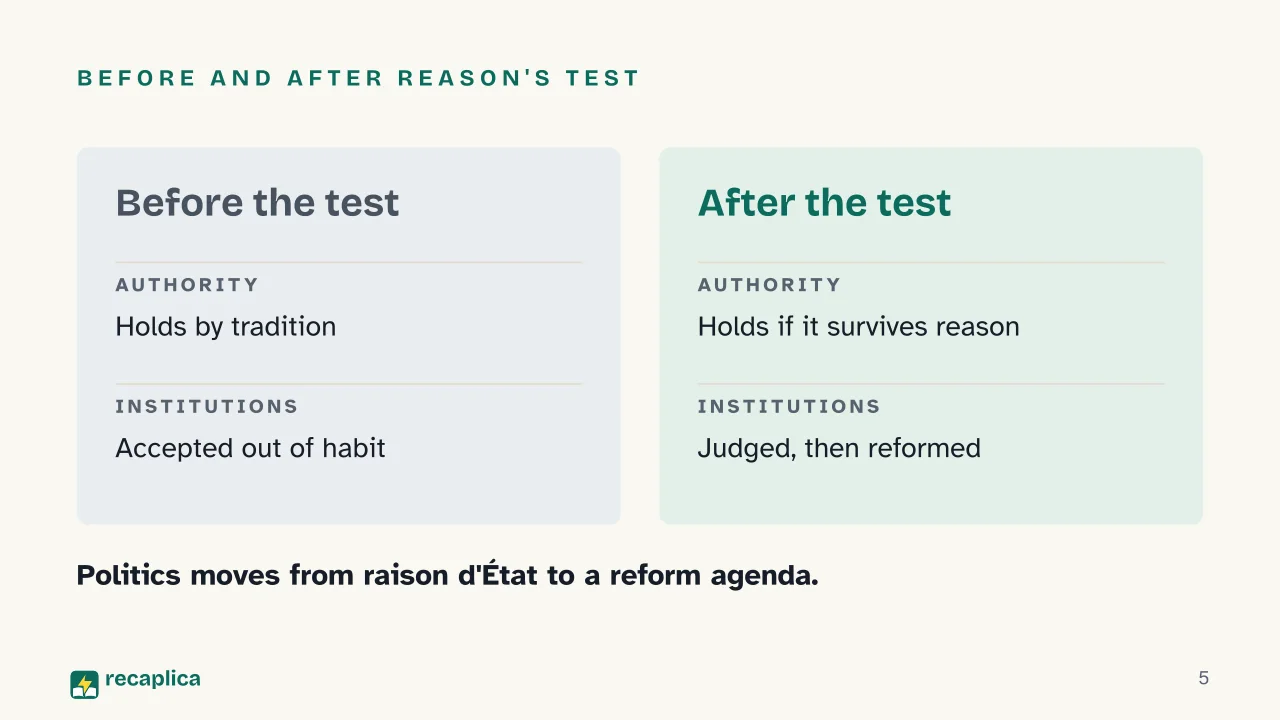    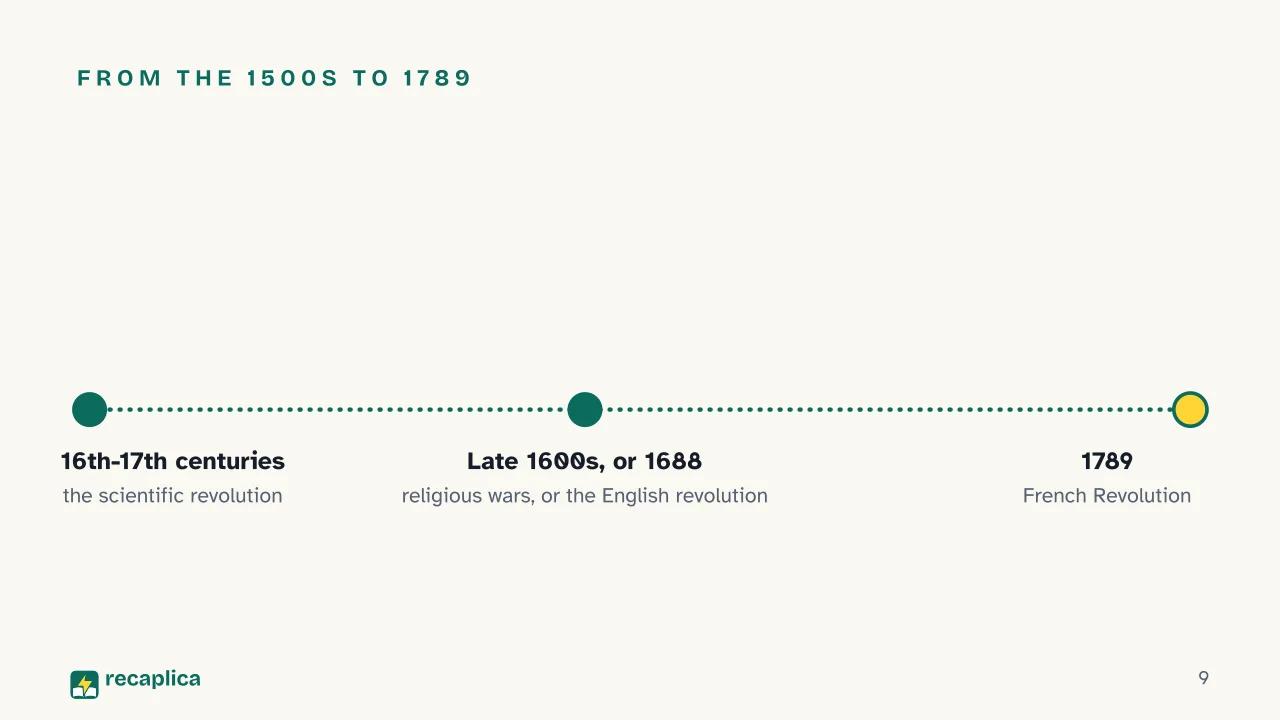 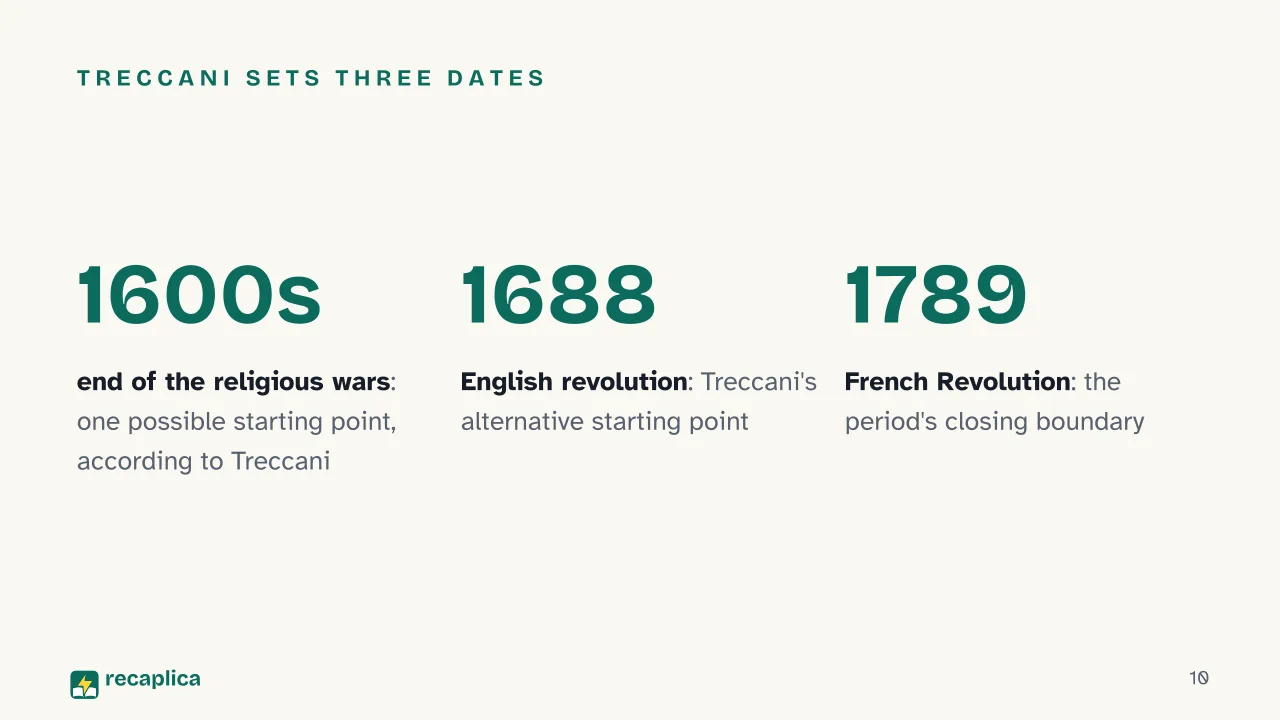  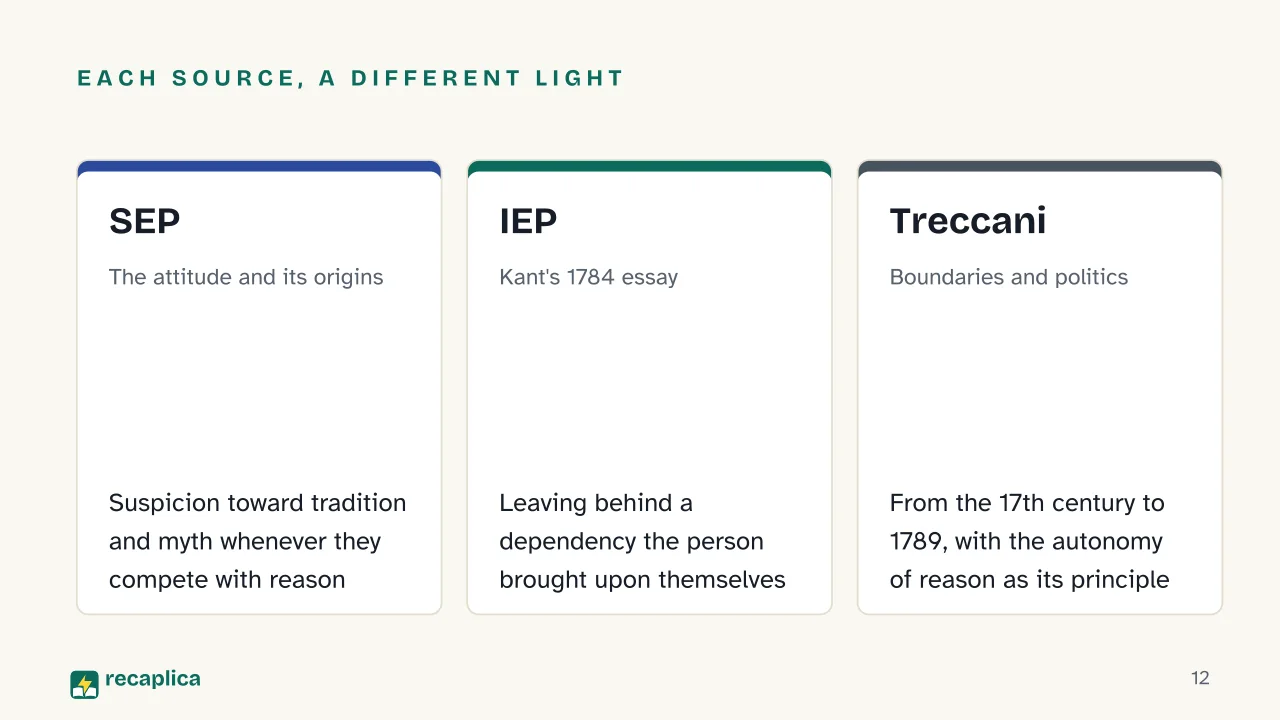 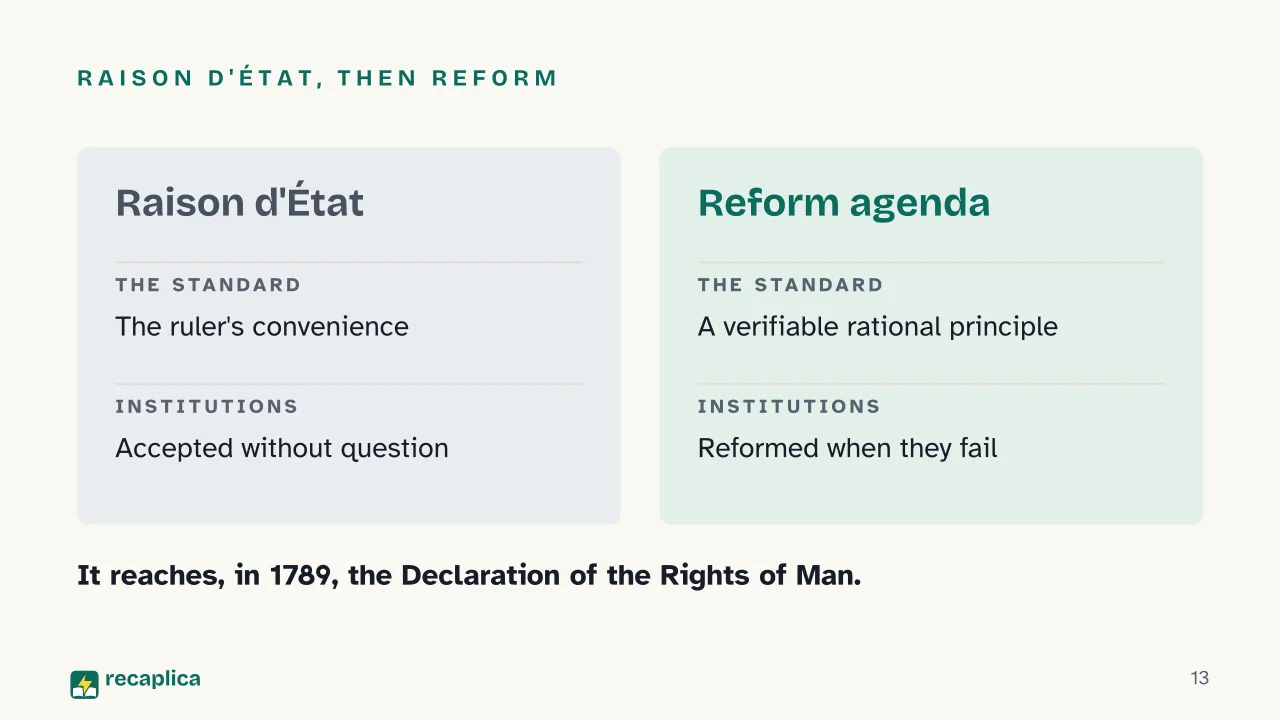 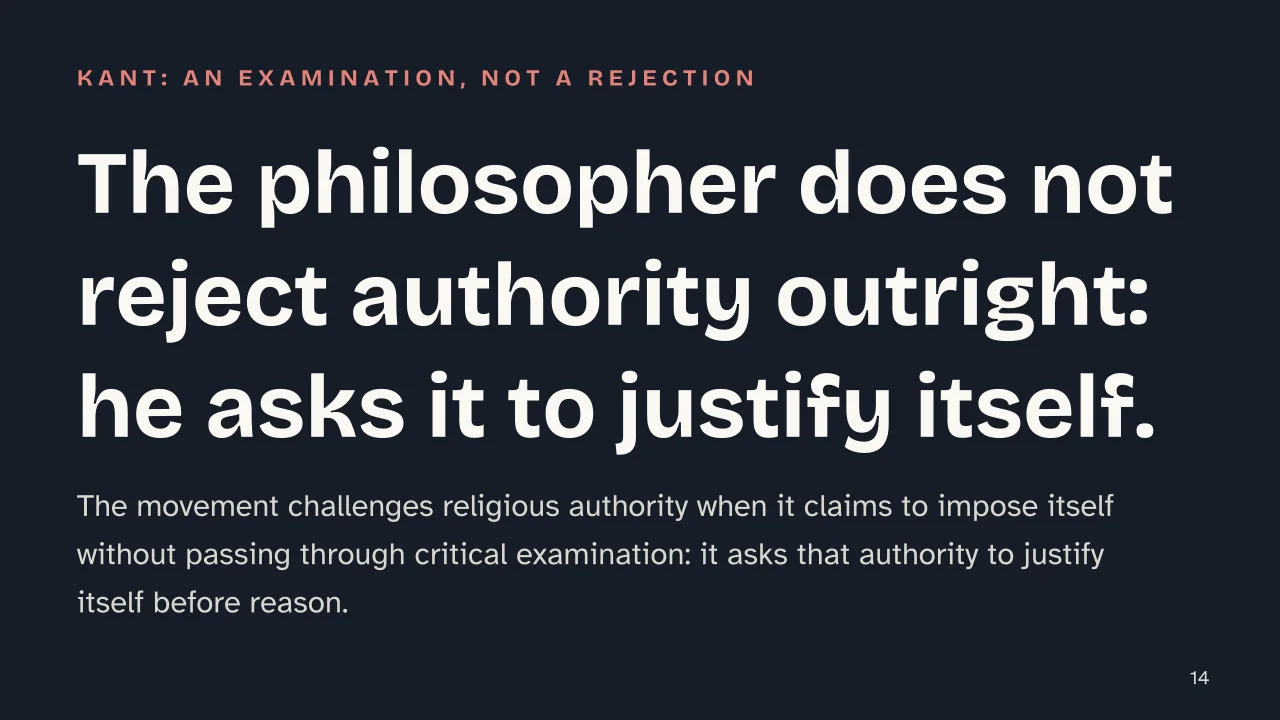 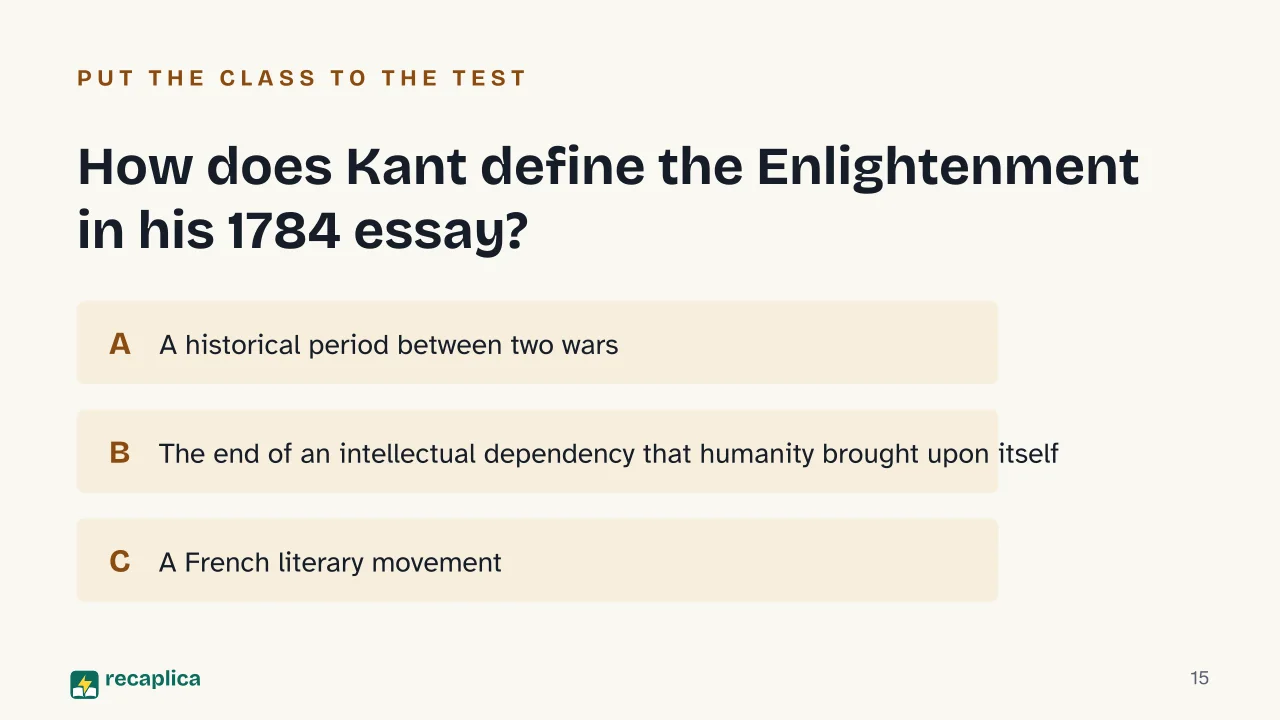  Common myths
Mind mapDrag the background to move around and the nodes to reposition them; use − and + to collapse and expand branches. 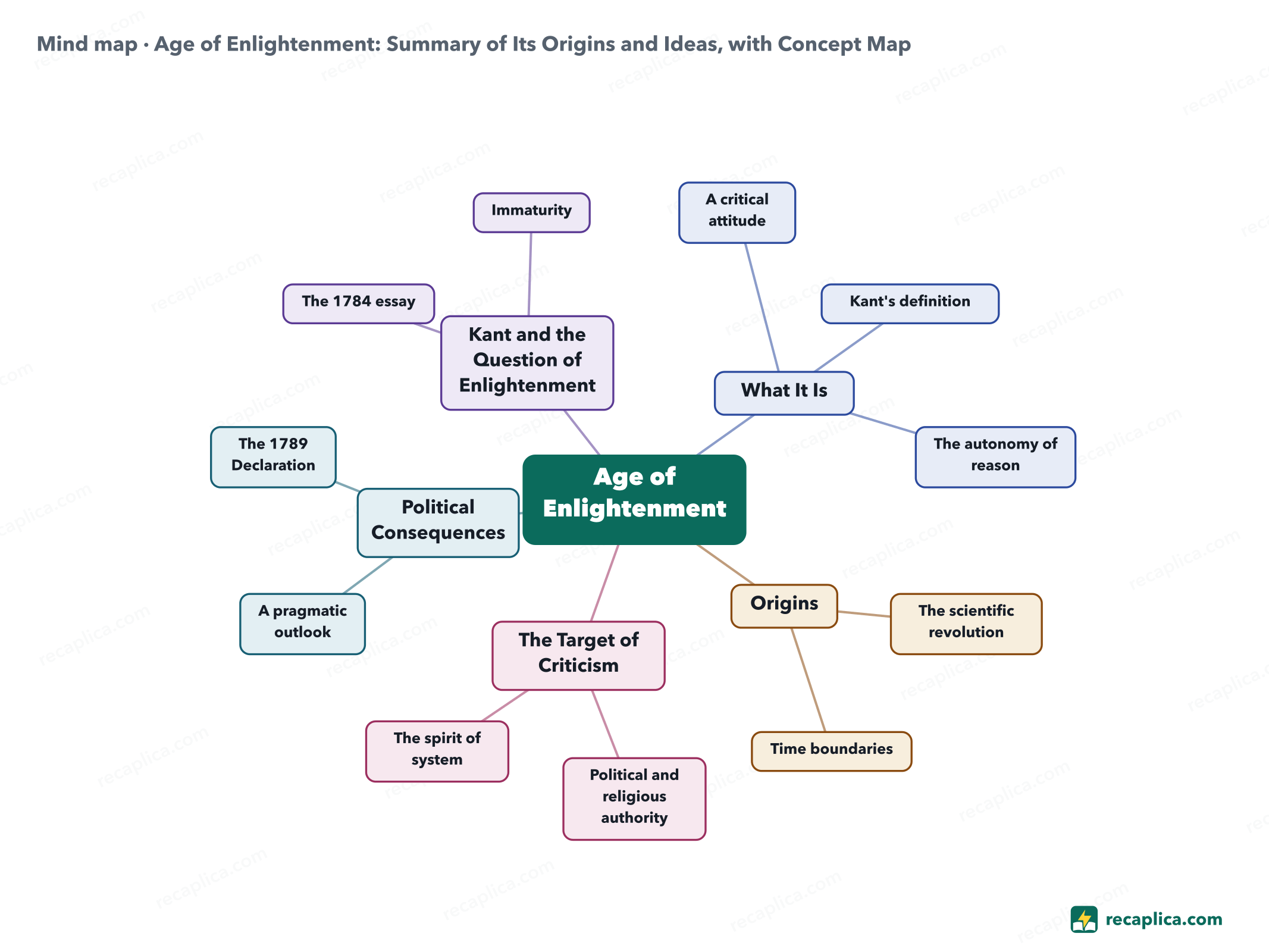
Quiz: test yourselfAnswer the questions to check what you have learned: you get instant feedback and a short explanation. Grade 0/10 0/5
FlashcardsTap the card to flip it and check whether you remember the answer, then move to the next one. 1 / 8 Explain it in your own wordsThe ultimate test: if you can explain it in simple words, you've truly understood it. Write your explanation, then compare it with the Recap. Your explanation is saved only on this device.
Frequently asked questionsWhat is the Age of Enlightenment, in brief?It is the eighteenth-century European movement of thought that sets individual reason as the standard for judging institutions, religion and knowledge, distrusting tradition, superstition and authority whenever they compete with rational examination. What is Kant's answer to the question 'what is Enlightenment'?In his 1784 essay An Answer to the Question: What is Enlightenment?, Kant describes it as leaving behind a state of dependence on someone else's judgment, a dependence the person brought upon themselves. When does the Age of Enlightenment take place?According to Treccani, it begins with the end of the religious wars of the 17th century, or with the English revolution of 1688, and ends with the French Revolution in 1789. What sets the Enlightenment apart from mere erudition?The critical use of reason, rather than the sheer amount of knowledge accumulated: an attitude of suspicion toward any authority, tradition or prejudice that claims to impose itself without passing through individual rational examination. Does the Enlightenment concern only philosophy?No: according to Treccani it also reaches into politics and law, where Enlightenment thinkers replaced reasoning in terms of raison d'État with a concrete reform agenda, up to the 1789 Declaration. Every Recap goes through an independent review before publication. |