|
recaplica
Critique of Pure Reason Summary: What Can We Know? | ||||||||||||
| © 2026 Recaplica · recaplica.com — All rights reserved | ||||||||||||
Critique of Pure Reason Summary: What Can We Know?What to print Page numbers appear when printing with default margins. SlidesChoose a cut Flash10 slidesThe essential thread, to present in classFull14 slidesEvery chapter and the deeper detailBoth come with speaker notes. In 30 seconds quick readThe Critique of Pure Reason, published by Kant in a first edition in 1781 and in an expanded second edition in 1787, asks what the human mind can actually know. Kant calls the object as it appears to a perceiving, thinking subject a phenomenon, and the thing as it is independently of that subject a noumenon: human knowledge covers the phenomenon, while the noumenon stays out of its reach. Space and time, in this picture, are the forms through which our senses organize whatever they perceive. Kant describes his own proposal as a "Copernican" move: knowledge gets explained by starting from the knower. Key Points
Deep DiveThe problem of knowledgeThe Critique of Pure Reason appears in a first edition, marked A, in 1781; an expanded second edition, marked B, follows in 1787. The question Kant poses from the start is easy to state and hard to settle: what can the human mind actually know, and where does that possibility end? The question is not about any single field of study. It is about how knowledge itself works. For Kant, the traditional questions of metaphysics — about the soul, about the world, about whatever lies beyond experience — cannot be answered by the human mind at all: settling that boundary is the central task the Critique of Pure Reason sets for itself. A useful starting point for seeing why Kant reaches this conclusion is a distinction that takes the place of much older questions: already the pre-Socratic philosophers, with their search for the arche, were trying to separate how things seem from how they really are. Phenomenon and noumenon: what we can actually knowKant separates the world we experience, made of appearances, from a world of things as they are in themselves. He names the first the phenomenon, and the second the noumenon. The objects we can know are always things as they appear to us, never things as they are in themselves: that is the conclusion the Critique of Pure Reason reaches. This move stands out by contrast with a much older philosopher. Plato and his theory of forms placed true reality in an eternal realm of ideas, reachable through thought alone. Kant turns this around: he grants that a reality beyond appearance, the noumenon, may exist, but treats it as inaccessible to human knowledge no matter how far thought tries to reach.
Space and time, forms of sensibilityA point that follows directly from this distinction concerns space and time. For Kant, space and time are conditions of how we perceive, supplied by sensibility before any object reaches the understanding. The same holds for time, an a priori and subjective condition of experience just like space: both concern only appearances, phenomena. Sensations, on this picture, are not spatial by themselves: it is the mind that represents them in space, placing them next to one another. Sensibility and understanding: how knowledge arisesKnowing, for Kant, requires two distinct contributions. Sensibility supplies intuitions, the raw material of perception; understanding supplies concepts, through which that material is thought and organized. Kant sums up the idea in one of the most quoted lines of his work: knowledge arises from the meeting of what the senses take in and what thought works out, and neither contribution is enough on its own. Within understanding, Kant identifies twelve categories, arranged in four triads covering quantity, quality, relation and modality. Among the categories of relation are substance, causality and community. In pure thought, Kant notes, the categories are not bound by the conditions of sensibility the way genuine knowledge is: thought can range beyond the limits of possible experience, but knowing beyond those limits is a different matter. The Copernican turnKant describes his own proposal through an analogy that became famous: he calls it a “Copernican” turn. Copernicus, Kant explains, traced the apparent motion of the sun and stars back to the movement of the observer. In the same way, Kant proposes to explain knowledge by starting from the knower: it is the mind that imposes its own forms, space and time, and its own categories on experience. The mind already carries the conditions for receiving the external world, instead of simply recording it. The first edition of the Critique of Pure Reason came out in 1781, in the same decades when Europe was debating enlightened absolutism and moving toward the French Revolution of 1789. The Critique of Pure Reason remains, in this sense, an exercise in reason limiting itself. Before asking what exists, Kant asks reason to examine what it can actually reach — a question that shifts attention from the object known to the knower, and that shift is what transcendental idealism means in practice. Closing off theoretical knowledge this way leaves room for a moral law built on separate grounds: Kant’s categorical imperative. Slide deckSlides ready to download and make your own in PowerPoint or Google Slides, with speaker notes. Pick the Flash cut or the Full one.   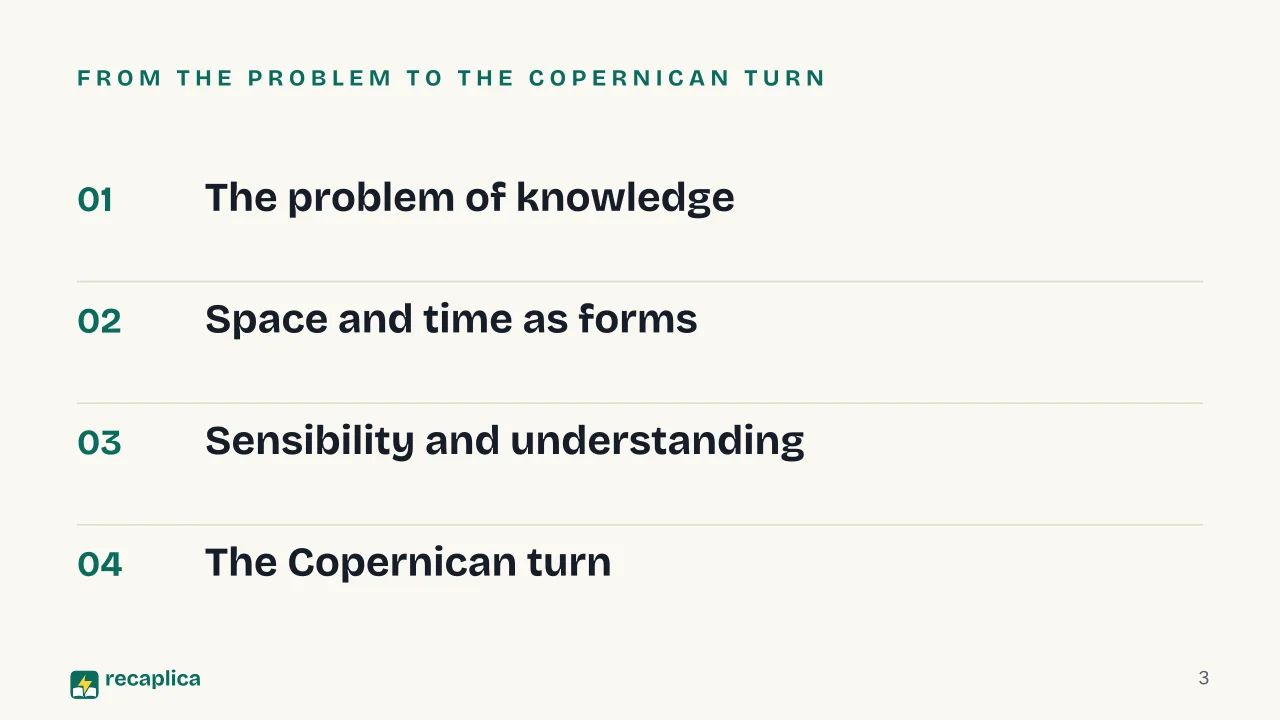  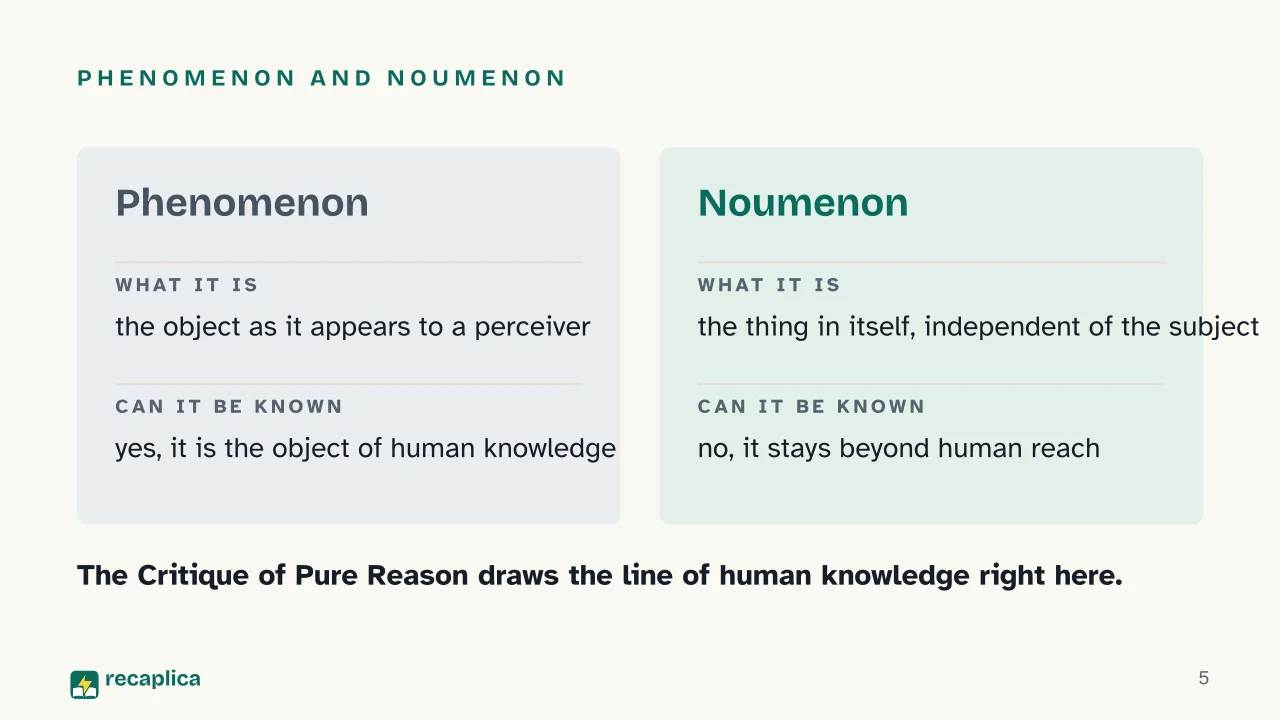  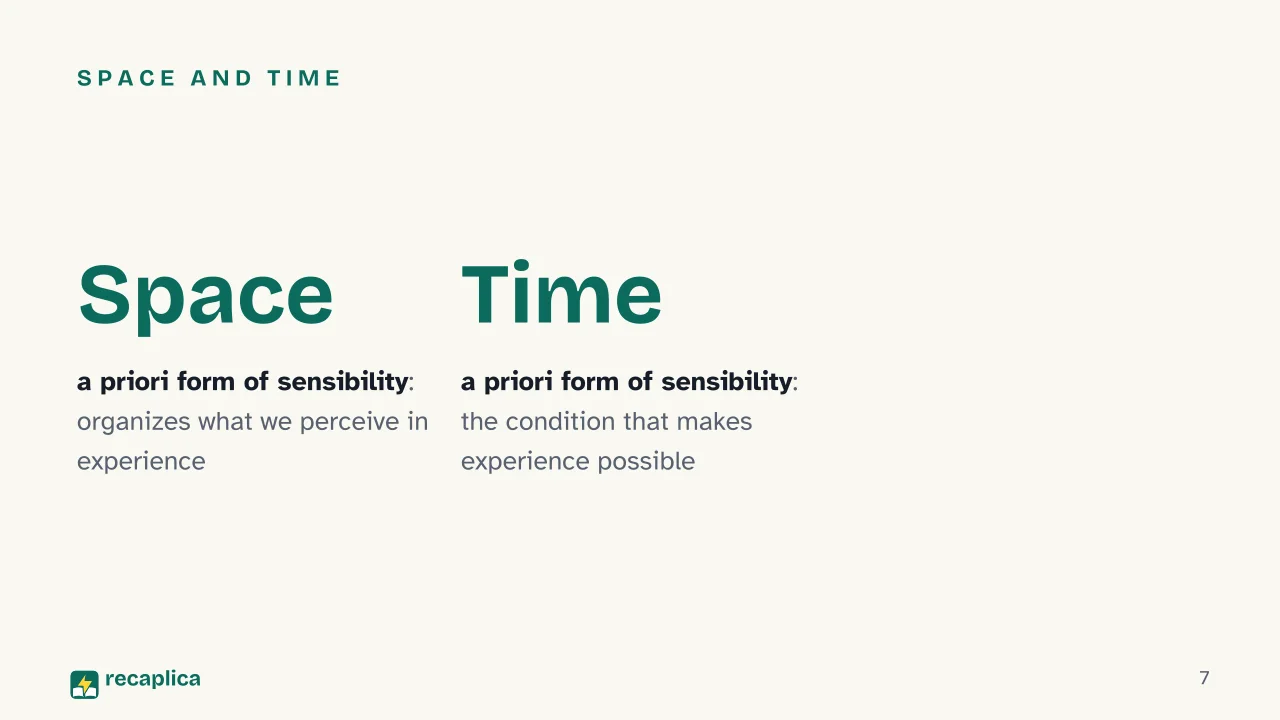  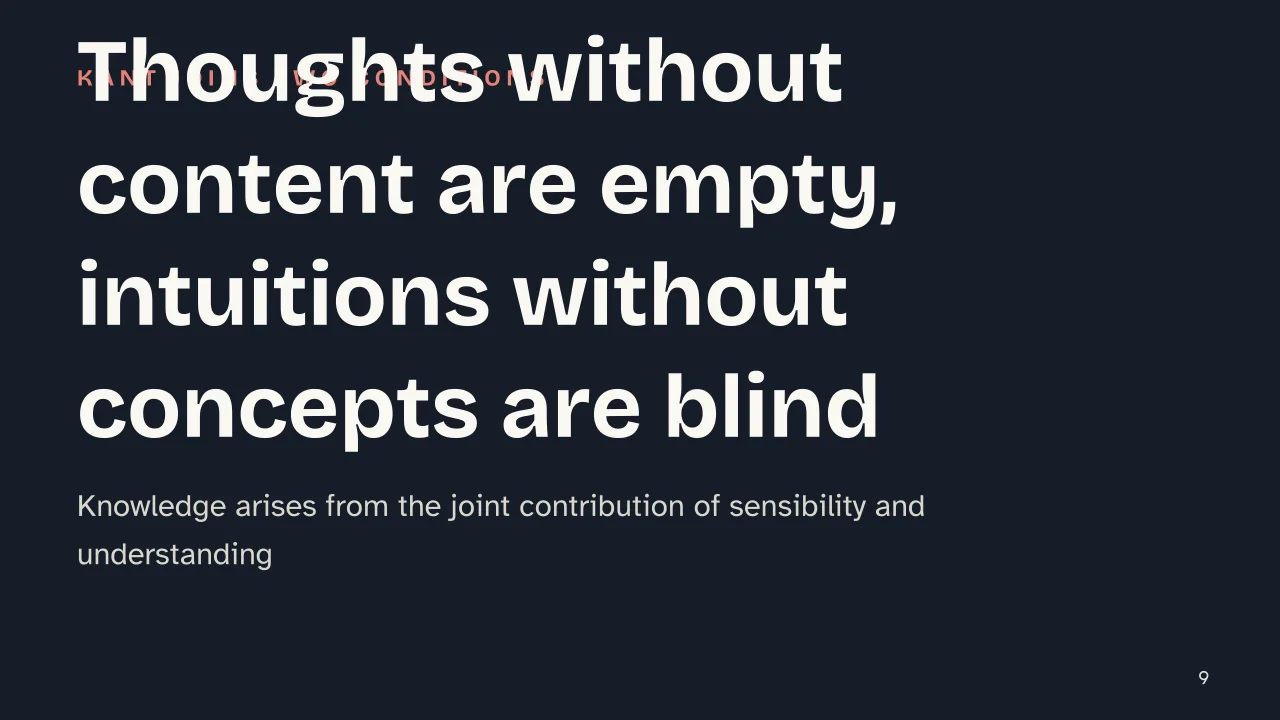  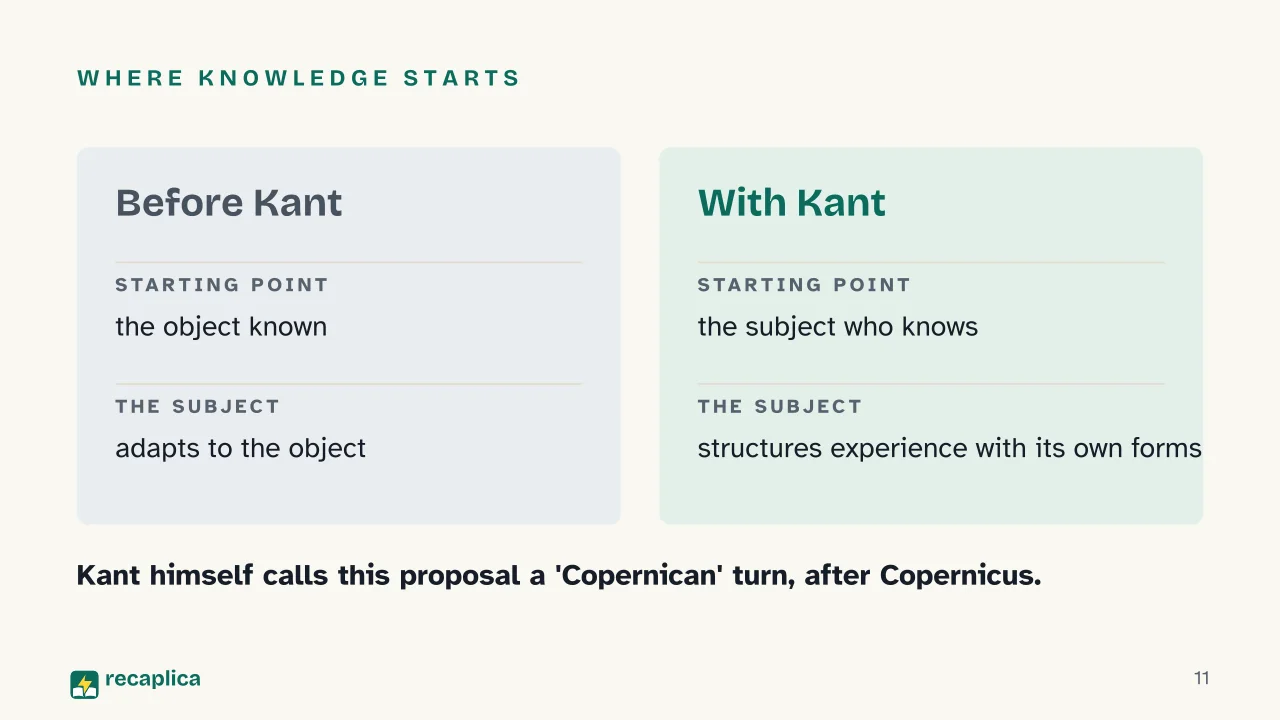 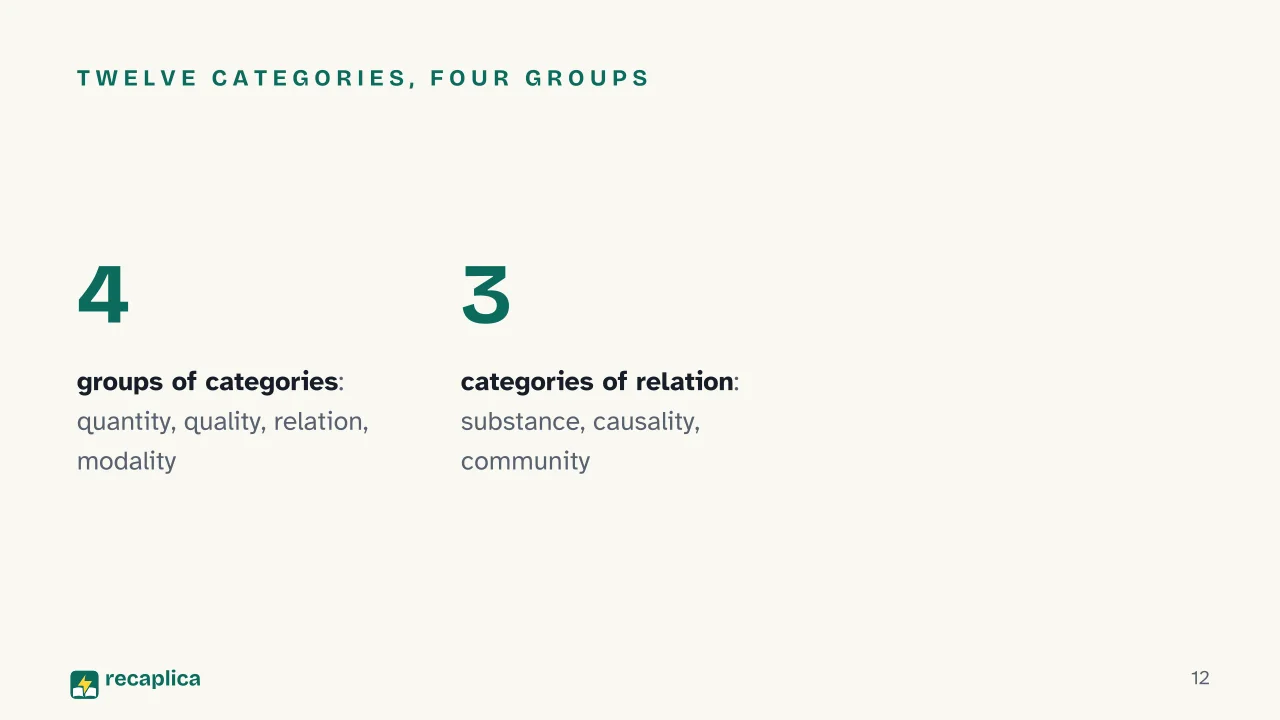 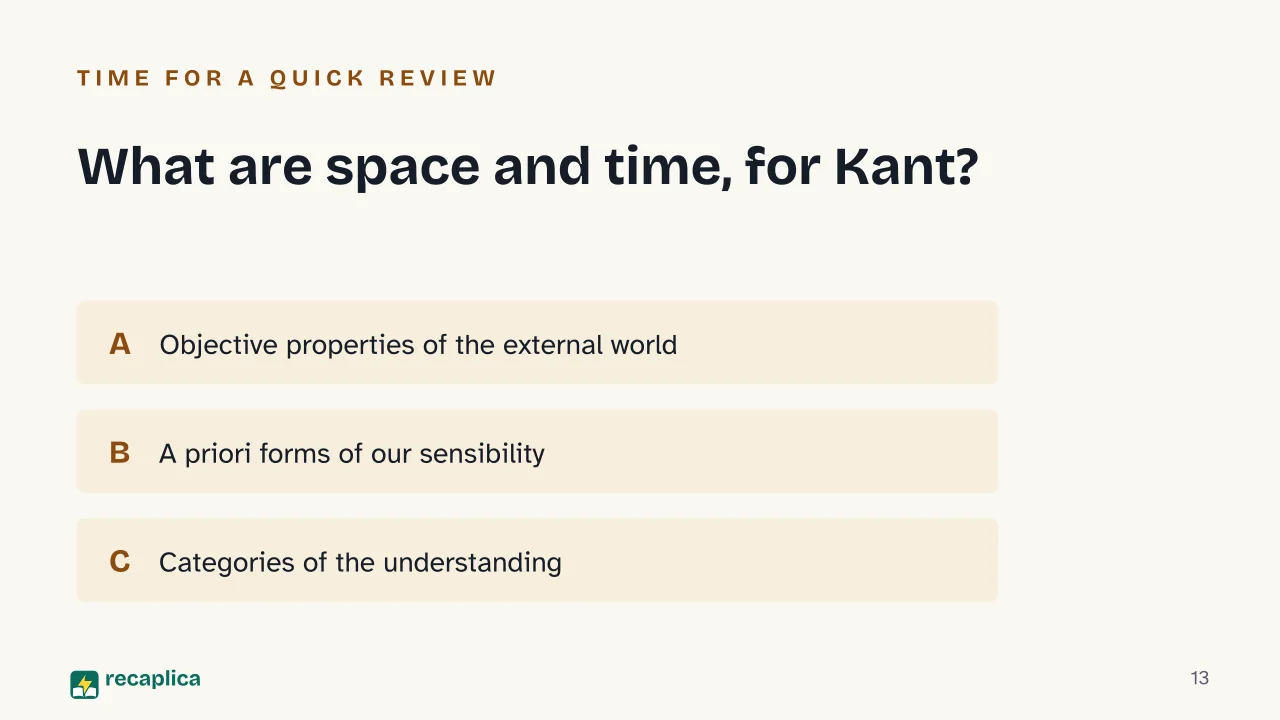  Common myths
Mind mapDrag the background to move around and the nodes to reposition them; use − and + to collapse and expand branches. 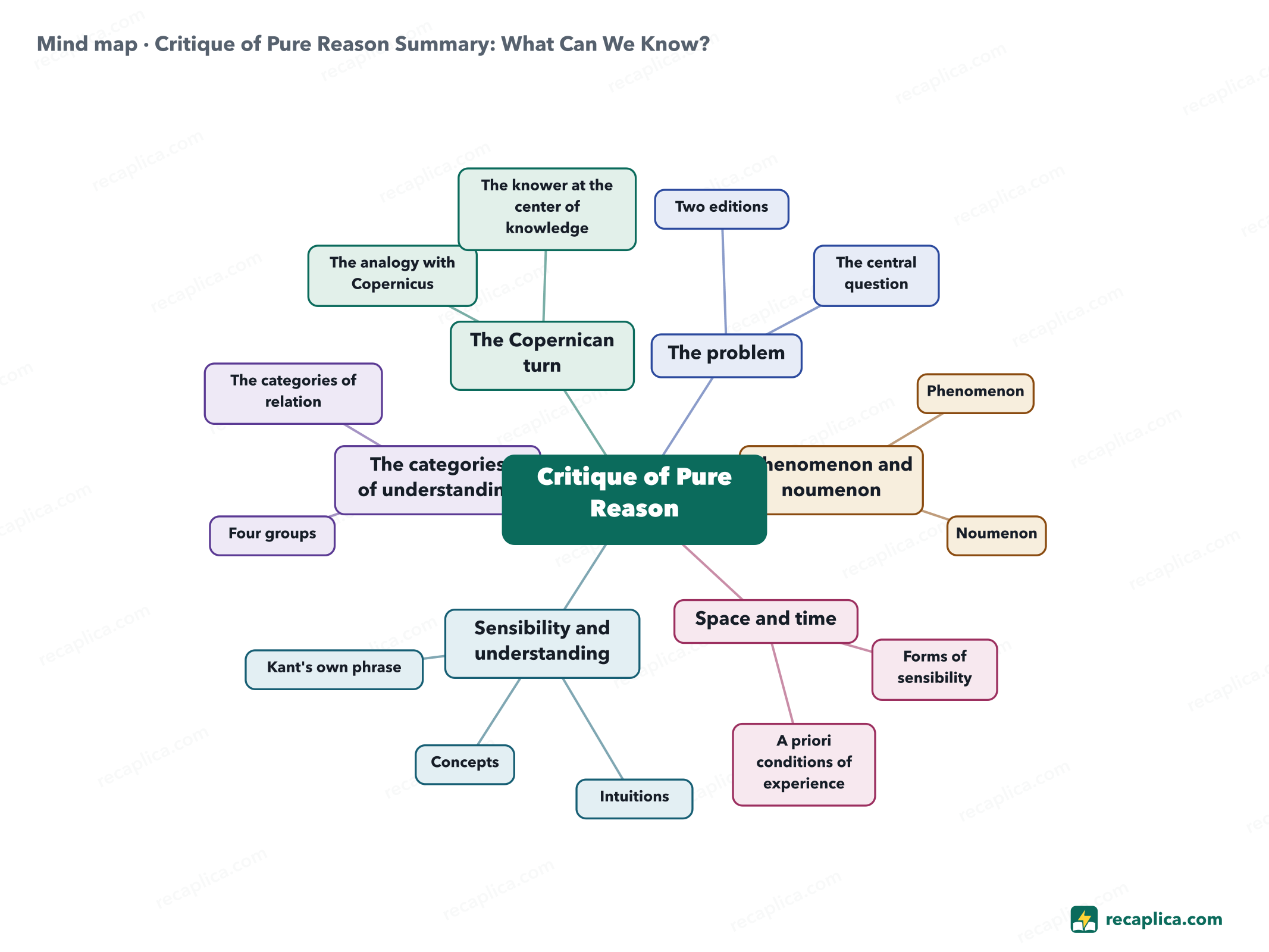
Quiz: test yourselfAnswer the questions to check what you have learned: you get instant feedback and a short explanation. Grade 0/10 0/5
FlashcardsTap the card to flip it and check whether you remember the answer, then move to the next one. 1 / 7 Explain it in your own wordsThe ultimate test: if you can explain it in simple words, you've truly understood it. Write your explanation, then compare it with the Recap. Your explanation is saved only on this device.
Frequently asked questionsWhat does 'phenomenon' mean in Kant's Critique of Pure Reason?The phenomenon is the object as it presents itself to a subject who perceives and thinks it: for Kant, our experience is always made of phenomena. What is the difference between phenomenon and noumenon?The phenomenon is the appearance we can know, shaped by the forms of sensibility (space and time) and by the concepts of understanding. The noumenon is the thing in itself, which for Kant stays beyond the reach of human knowledge. Does Kant deny that an external world exists?No: Kant leaves the existence of things in themselves open. His claim concerns knowledge, which for him stops at the way objects appear to us. Why does Kant speak of a 'Copernican' turn?Copernicus realized that the apparent motion of the stars is explained by the position of the observer. Kant applies this idea to knowledge, putting the knower at the center instead of the object known. In which years was the Critique of Pure Reason published?The first edition (A) appeared in 1781; the expanded second edition (B) appeared in 1787. Every Recap goes through an independent review before publication. |