|
recaplica
What Is Phenomenology? Husserl's Philosophy Explained |
| © 2026 Recaplica · recaplica.com — All rights reserved |
What Is Phenomenology? Husserl's Philosophy ExplainedWhat to print Page numbers appear when printing with default margins. SlidesChoose a cut Flash10 slidesThe essential thread, to present in classFull14 slidesEvery chapter and the deeper detailBoth come with speaker notes. In 30 seconds quick readEdmund Husserl founded phenomenology as a philosophical discipline around 1900-1901, with his Logical Investigations. His method starts from the epoché, a suspension of our everyday, unquestioning stance toward the world, and moves toward phenomenological reduction: studying how things appear to consciousness rather than what they are in themselves. At the center sits intentionality, the idea that every experience is always an experience of something specific, whether hoping, perceiving, or desiring. The method Husserl built carried into the 20th century through Heidegger, Sartre, and Merleau-Ponty, moving from German philosophy into French philosophy along the way. Key Points
Key figures
Deep DiveSay that something “looks” different depending on who is looking, and most people picture a matter of opinion or taste. Edmund Husserl starts from a more radical observation: before asking what things are, we should ask how they present themselves to consciousness. That question, pursued with a rigor Husserl wanted to be scientific, is where phenomenology begins. Who Husserl wasEdmund Husserl was born on April 8, 1859, in Proßnitz, Moravia, and died on April 27, 1938. Between those two dates he wrote the book the Stanford Encyclopedia of Philosophy treats as the turning point of his philosophy: the Logical Investigations, published in 1900-1901. That is where Husserl himself placed his shift toward phenomenology, a method he kept developing for almost four decades, down to his last major work in 1936, on the crisis of the European sciences. The method: epoché and phenomenological reductionAt the heart of Husserl’s method is a move that looks, at first glance, like the doubt practiced by Descartes in his problem of method: set aside settled certainties and start over. The resemblance does not last long. Husserl does not discard or deny the external world; epoché brackets the unquestioned certainty of everyday experience to study how phenomena appear to consciousness. Epoché, the same encyclopedia explains, is the first step toward what Husserl calls phenomenological reduction, a further move toward what he termed transcendental reduction. Husserl returned to this framework in the 1930s, in the Cartesian Meditations of 1931: the title nods to Descartes and his method, but the goal is different. Husserl does not seek an unshakable foundation for deductions; he sets out to describe how phenomena present themselves to consciousness.
The intentionality of consciousnessThe second concept Husserl builds phenomenology around is intentionality. According to the Stanford Encyclopedia of Philosophy, every intentional experience is the experience of a specific kind: hoping is always hoping for something, desiring is always desiring something, perceiving is always perceiving something. There is no “empty” consciousness that later runs into objects; consciousness is always already directed at something, and that direction takes a precise shape depending on the act involved. The Internet Encyclopedia of Philosophy points out that phenomenological analysis turns to very different phenomena, from intentionality to love to the touch of two hands, because the method exists to describe the lived experience of those phenomena, whatever their nature. That is why the same encyclopedia frames phenomenology as a discipline centered on consciousness, closer in ambition to what Aristotle had already attempted with logic than to a natural science such as physics. The major works and the search for essencesHusserl’s first philosophically significant text, according to the Internet Encyclopedia of Philosophy, was “On the Concept of Number,” from 1887. But it is with the Logical Investigations of 1900-1901 that phenomenology emerges as its own philosophical discipline, a point both the Stanford Encyclopedia of Philosophy and its separate entry on the term “phenomenology” agree on. In 1913 Husserl published Ideas for a Pure Phenomenology and Phenomenological Philosophy I, where he worked phenomenological reduction into a fuller system. Anyone familiar with Plato’s theory of forms will recognize a similar ambition in Husserl: the search for stable structures behind the flow of appearances. But Husserl does not posit, as Plato did, a separate realm of perfect forms; the essences Husserl seeks emerge from describing experience with care, not from contemplating another world. The same goes for the word “transcendental,” which Husserl applies to his reduction: the term echoes Kant, but in Husserl’s hands it describes consciousness as the condition for any possible experience, not a moral law. The last work in this sequence dates to 1936, two years before Husserl’s death. The legacy in the 20th centuryPhenomenology did not stay an isolated project. According to the Stanford Encyclopedia of Philosophy, Husserl influenced thinkers such as Martin Heidegger, Edith Stein, Maurice Merleau-Ponty, and Jean-Paul Sartre. Heidegger published Being and Time in 1927, a phenomenological approach that starts from Husserl’s method and then reshapes it; in the 1930s, the same encyclopedia notes, phenomenology moved from Austrian and then German philosophy into French philosophy, where Merleau-Ponty published Phenomenology of Perception in 1945. The Internet Encyclopedia of Philosophy adds further names to this line, Gadamer, Levinas, Derrida, noting that all of them, while contesting aspects of the original project, remain heavily indebted to Husserl. It is a legacy that spans nearly a century of philosophy, from late-19th-century Moravia to postwar Paris. Husserl’s phenomenology should not be confused with the Phenomenology of Spirit, the book Georg Wilhelm Friedrich Hegel wrote a century earlier. They are different authors with different projects: Hegel traces a path consciousness takes toward absolute knowledge, while Husserl offers a descriptive science of consciousness itself. Slide deckSlides ready to download and make your own in PowerPoint or Google Slides, with speaker notes. Pick the Flash cut or the Full one.     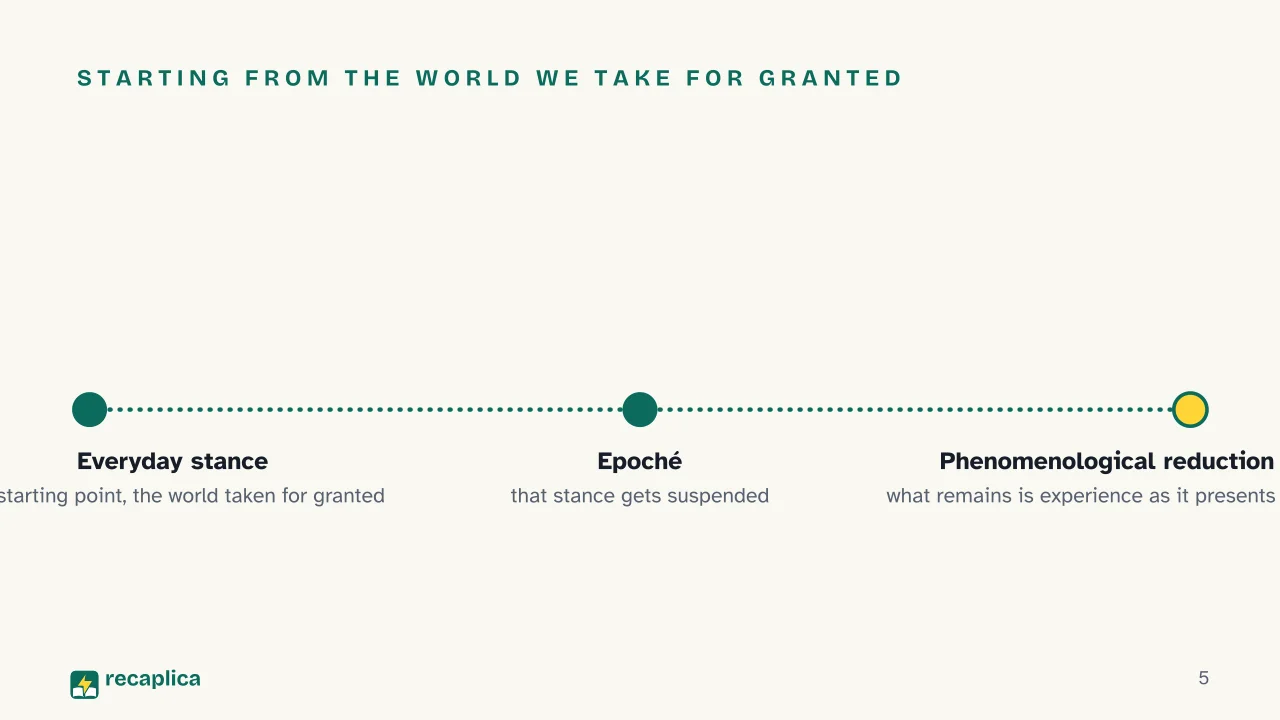  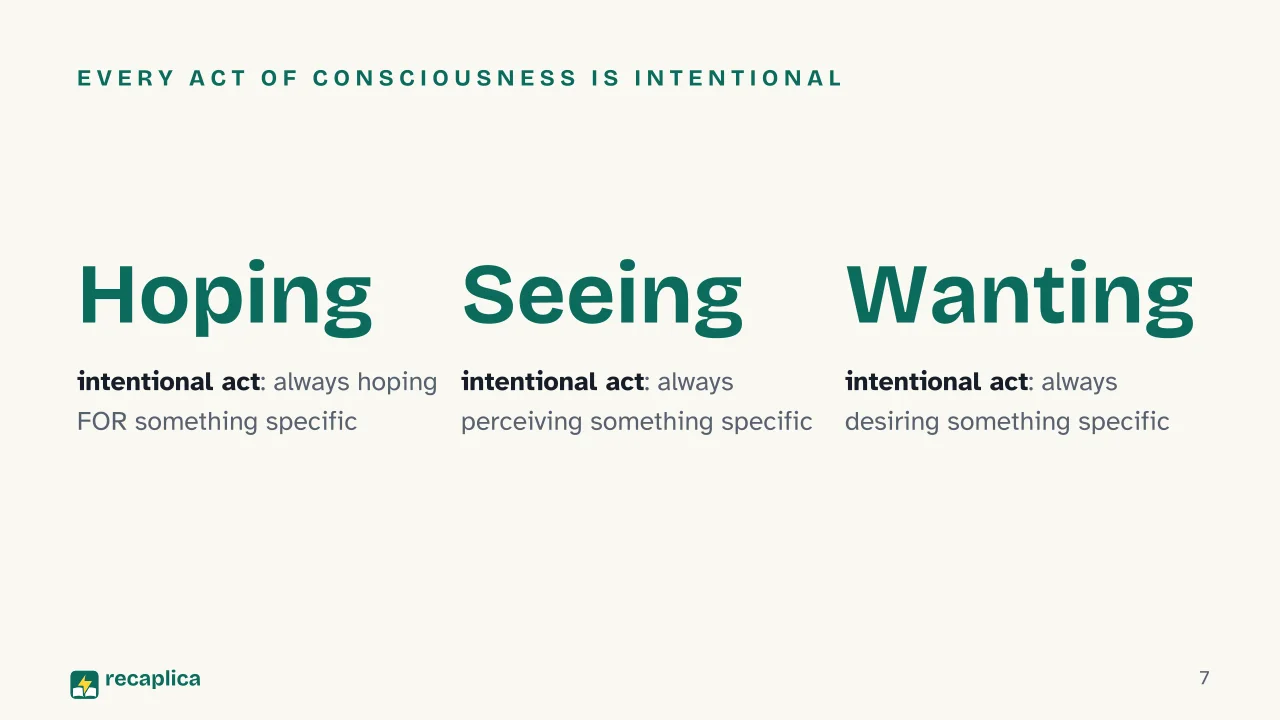  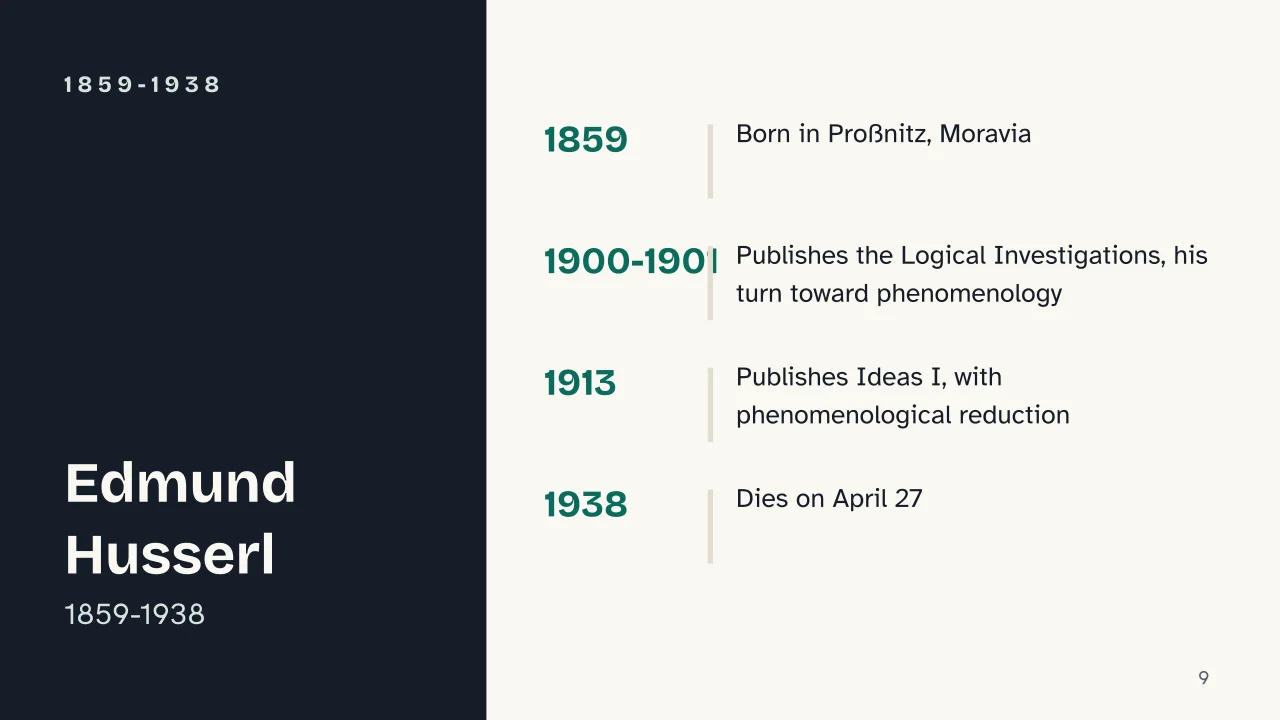 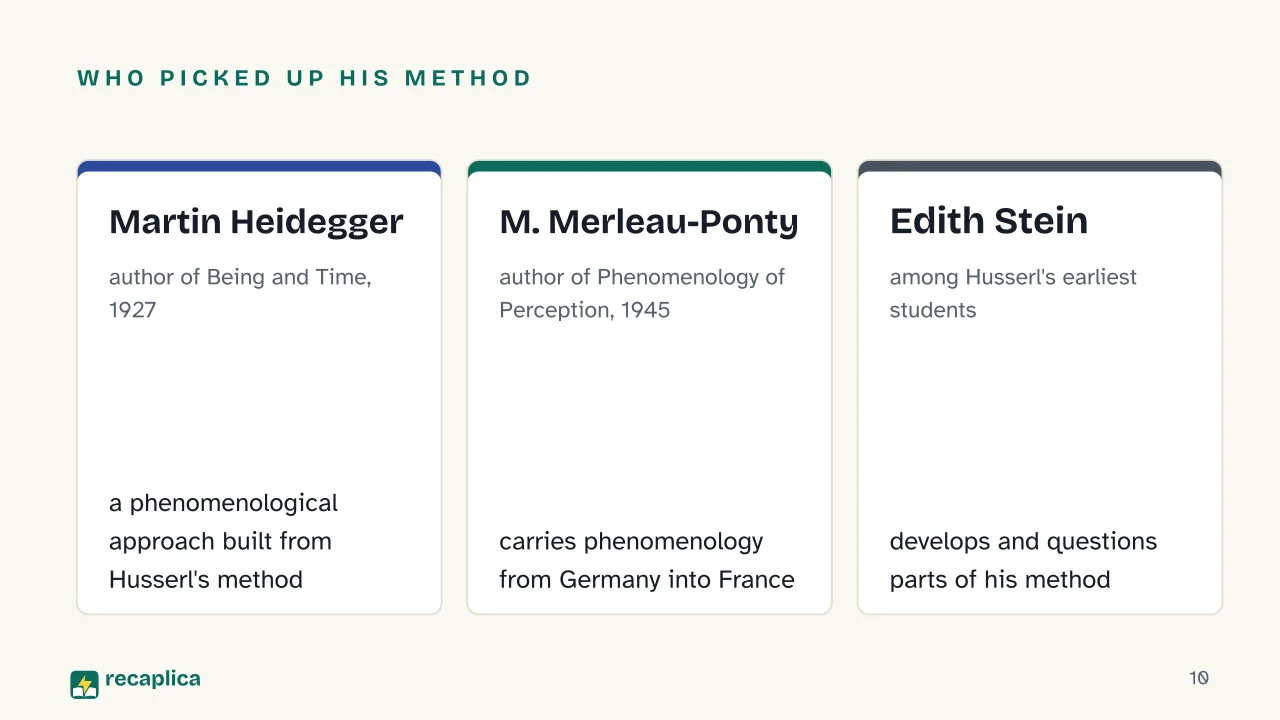 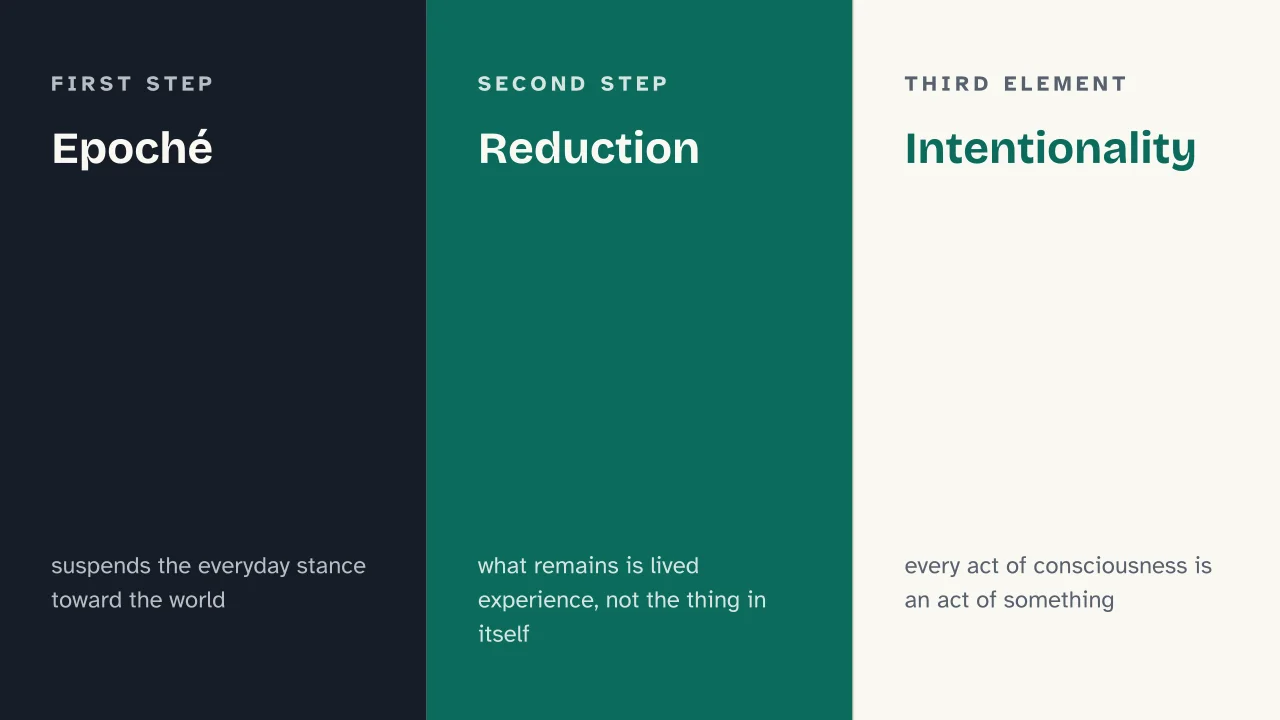  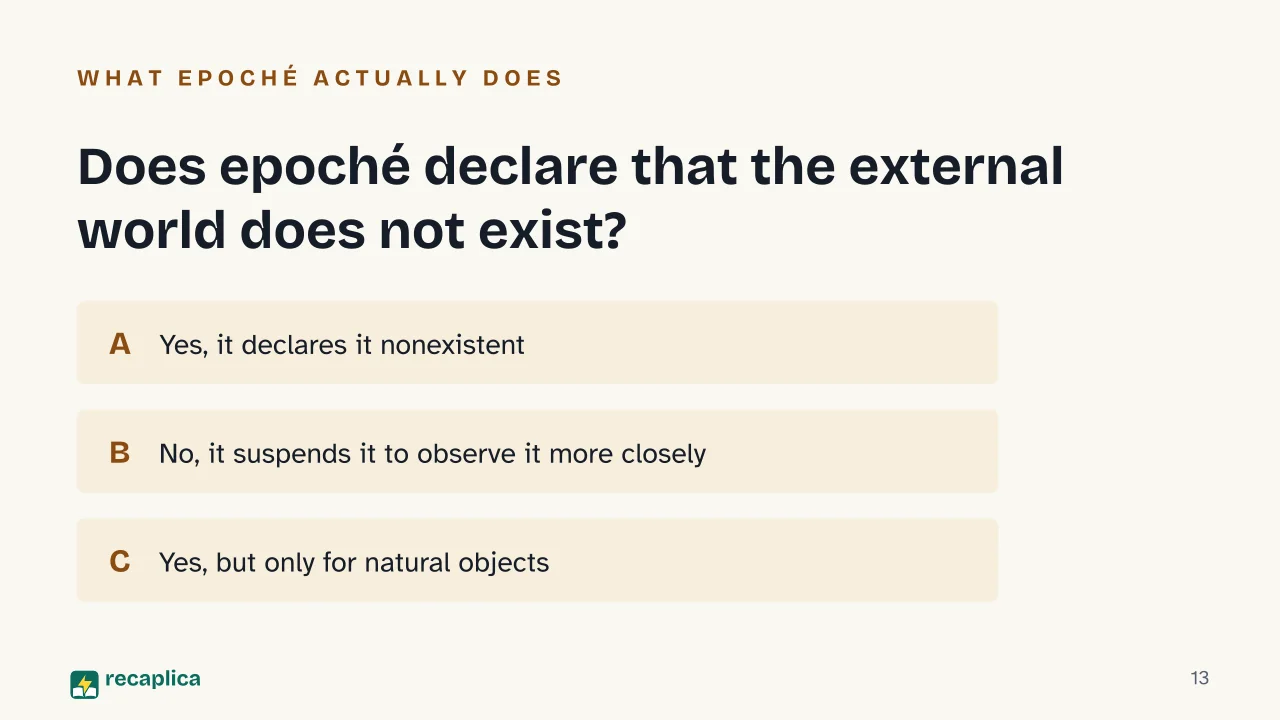  Common myths
Mind mapDrag the background to move around and the nodes to reposition them; use − and + to collapse and expand branches. 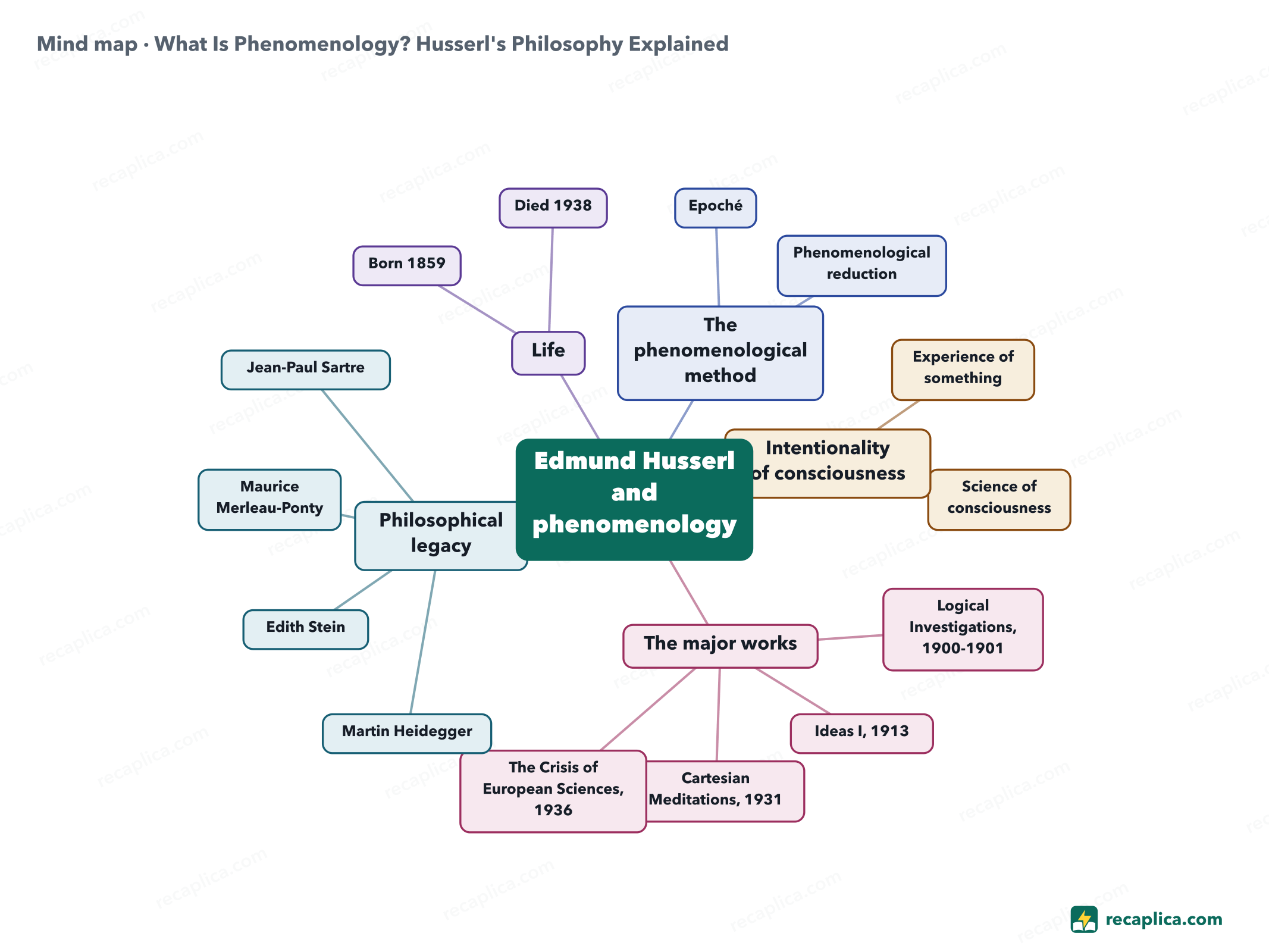
Quiz: test yourselfAnswer the questions to check what you have learned: you get instant feedback and a short explanation. Grade 0/10 0/5
FlashcardsTap the card to flip it and check whether you remember the answer, then move to the next one. 1 / 7 Explain it in your own wordsThe ultimate test: if you can explain it in simple words, you've truly understood it. Write your explanation, then compare it with the Recap. Your explanation is saved only on this device.
Frequently asked questionsWhat is Husserl's phenomenology, in short?According to the Stanford Encyclopedia of Philosophy, it is the study of the structures of consciousness as lived from the first- person point of view. Husserl called it "the science of the essence of consciousness," built around intentionality. What is epoché and what is it for?It is how Husserl suspends the certainties about the world we treat as obvious, not an invitation to doubt or exclude reality. From there follows the step Husserl calls phenomenological reduction, later deepened into transcendental reduction. Are Husserl's phenomenology and Hegel's Phenomenology of Spirit the same thing?No. They are works by different authors with different projects. Husserl launched phenomenology as its own philosophical field with the Logical Investigations of 1900-1901, a century after Hegel's book. Who continued Husserl's work?Martin Heidegger, Edith Stein, Maurice Merleau-Ponty, and Jean-Paul Sartre worked from his method, even while contesting parts of it. In the 1930s phenomenology moved from German philosophy toward French philosophy. What are Husserl's main works?The Logical Investigations (1900-1901), Ideas I (1913), the Cartesian Meditations (1931), and his last work, The Crisis of European Sciences and Transcendental Phenomenology (1936). Every Recap goes through an independent review before publication. |