Skip to content
recaplica

    One moment: security check

    Cloudflare wants to make sure you're not a robot. Tick the box below and your search will continue on its own.

    IT
    recaplica Hegel and German Idealism: What Is His Philosophy?
    © 2026 Recaplica · recaplica.com — All rights reserved
    Home › History

    Hegel and German Idealism: What Is His Philosophy?

    By Recaplica Newsroom · Updated on October 12, 2026

    What to print

    Page numbers appear when printing with default margins.

    Slides

    Choose a cut

    Flash10 slidesThe essential thread, to present in classFull15 slidesEvery chapter and the deeper detail

    Both come with speaker notes.

    Telegram channel
    recaplica Clear in 30 seconds, yours in 10 minutes.
    In 30 seconds Key points Figures Deep dive Slides Myths Mind map Quiz Flashcards FAQ

    In 30 seconds quick read

    Georg Wilhelm Friedrich Hegel was born in Stuttgart in 1770 and died in Berlin in 1831, after a decade of wide recognition as a professor in the Prussian capital. He belongs to German idealism, the movement that pushed Kant's philosophy toward absolute idealism. His method, the dialectic, tracks a concept to its own limits and carries it forward into a richer form of thought, through what Hegel calls aufheben. At the center of his philosophy sits the Geist, or Spirit: a concept that covers both an individual mind and the shared life of an entire people.

    Key Points

    • Hegel (1770-1831) studied in Tübingen, then taught in Heidelberg and finally in Berlin, where he gained a professorship in 1818.
    • German idealism grows out of Kant's philosophy and pushes it further, to the point of denying that an unknowable 'thing in itself' remains.
    • Hegel's dialectic moves through determinate negation: resolving a contradiction always leaves behind a concept with more content than it started with.
    • Aufheben, the key term of Hegel's method, means to negate and to preserve a concept at the same time.
    • The Geist, or Spirit, is not only the individual mind: it also takes in the habits and institutions a community builds together.
    • The formula 'thesis-antithesis-synthesis', often credited to Hegel in textbooks, actually belongs to Fichte's vocabulary.

    Key figures

    • 1807 publication year of the Phenomenology of Spirit, Hegel's first major work, finished in 1806 Source: Stanford Encyclopedia of Philosophy
    • 1818 year Hegel gained the chair of philosophy in Berlin Source: Stanford Encyclopedia of Philosophy

    Deep Dive

    Who Hegel was

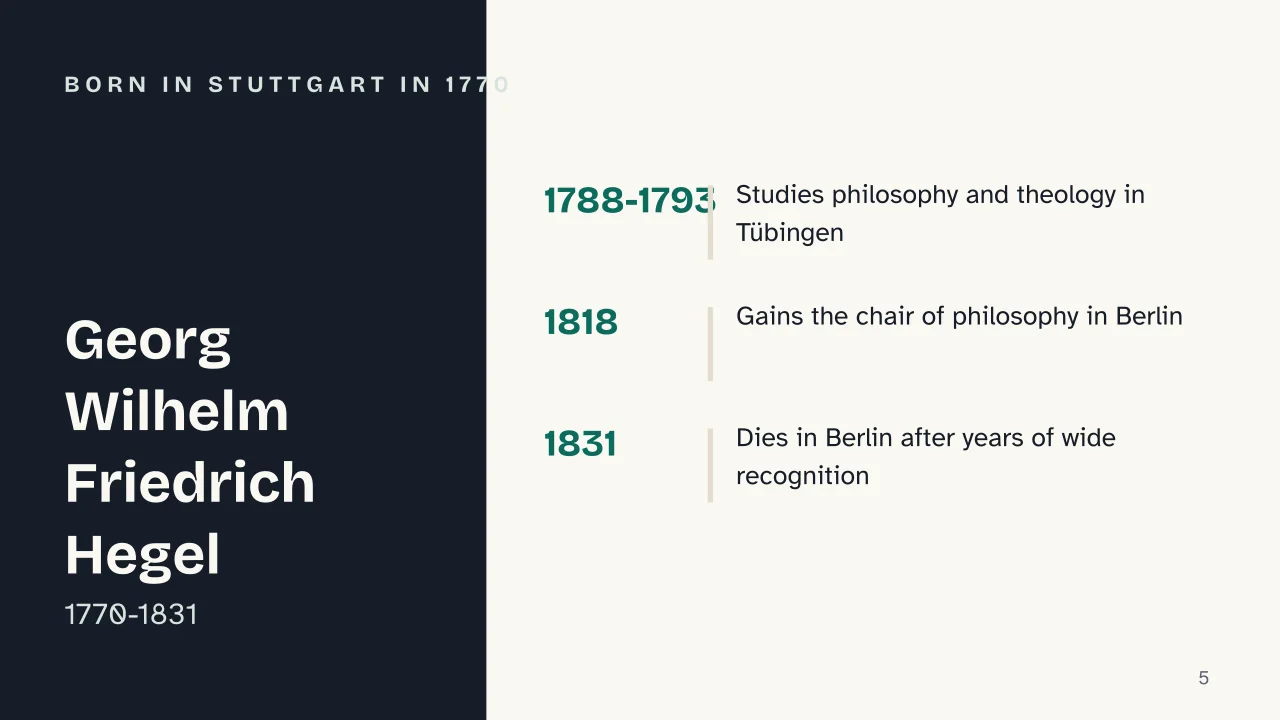
    Georg Wilhelm Friedrich Hegel was born in Stuttgart in 1770. According to the Stanford Encyclopedia of Philosophy, he studied philosophy and then theology in Tübingen between 1788 and 1793, spent years outside academic life, and returned to university in 1816 in Heidelberg; in 1818 he gained the chair of philosophy in Berlin, where he stayed until his death in 1831, the last decade of it marked by wide recognition. The Phenomenology of Spirit, his first major work, was finished in 1806 and published in 1807; the Philosophy of Right, Hegel’s main work on political philosophy, appeared in Berlin in 1821, while the Encyclopedia of Philosophical Sciences condenses the whole system into logic, nature, and spirit. Readers who want to place Hegel within the history of political ideas can start from how Hobbes, Locke and Rousseau thought about the social contract, the ground on which his philosophy of right builds.

    German idealism, after Kant

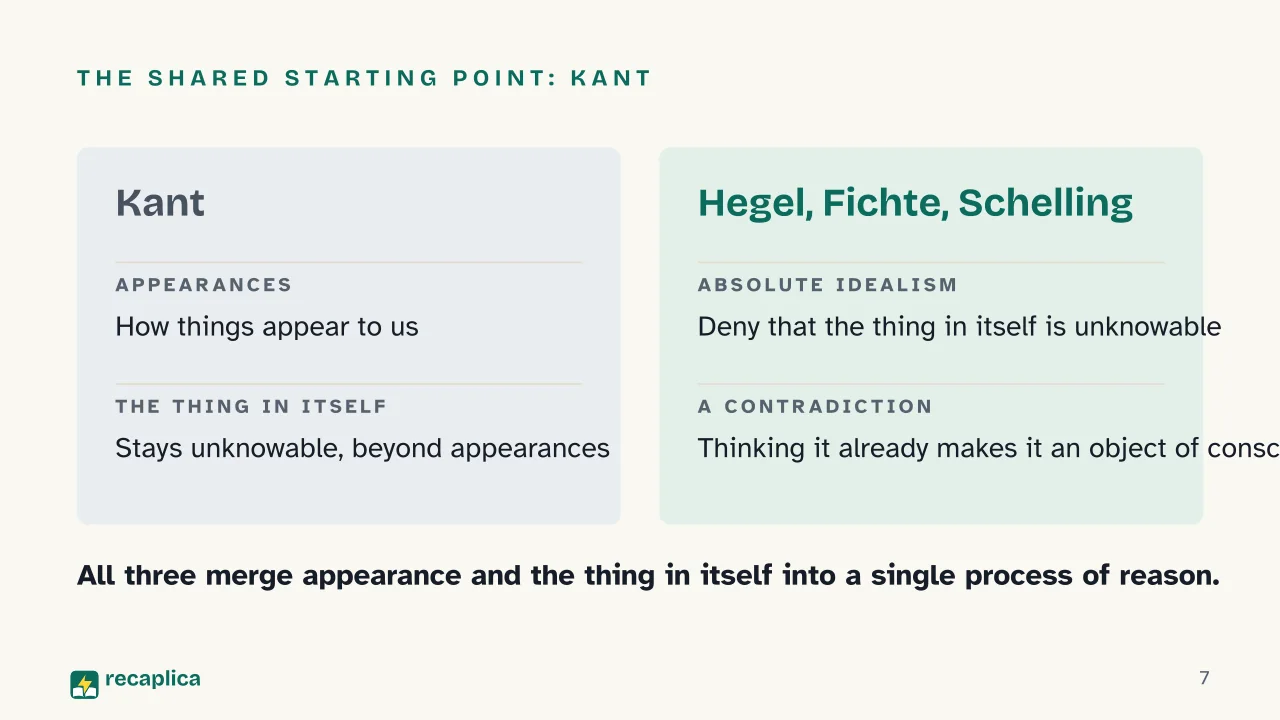
    German idealism is the German philosophical movement running from the 1780s to the 1840s, according to the Internet Encyclopedia of Philosophy. Its starting point is Kant’s transcendental idealism, set out in the Critique of Pure Reason, which drew a careful line between appearances, how things seem to us, and things in themselves.

    Fichte, Schelling and Hegel pushed this position further, turning it into absolute idealism: for them, the very idea of an unknowable thing in itself is self-contradictory. For Fichte, thinking of a thing in itself independent of thought already turns it into an object for consciousness, which is self-contradictory. Within this movement, Hegel assigned Fichte to the subjective side and Schelling to the objective, or absolute, side. Among the German idealists, according to the source, Hegel remains the most read and the most influential.

    German idealism, though, is a different current from Berkeley’s: it doesn’t deny that an outside world exists, but concerns how reason structures our knowledge of reality. Readers familiar with the moral side of Kant’s philosophy, the categorical imperative, will recognize the same question shifted from ethics to knowledge.

    The dialectic: aufheben and determinate negation

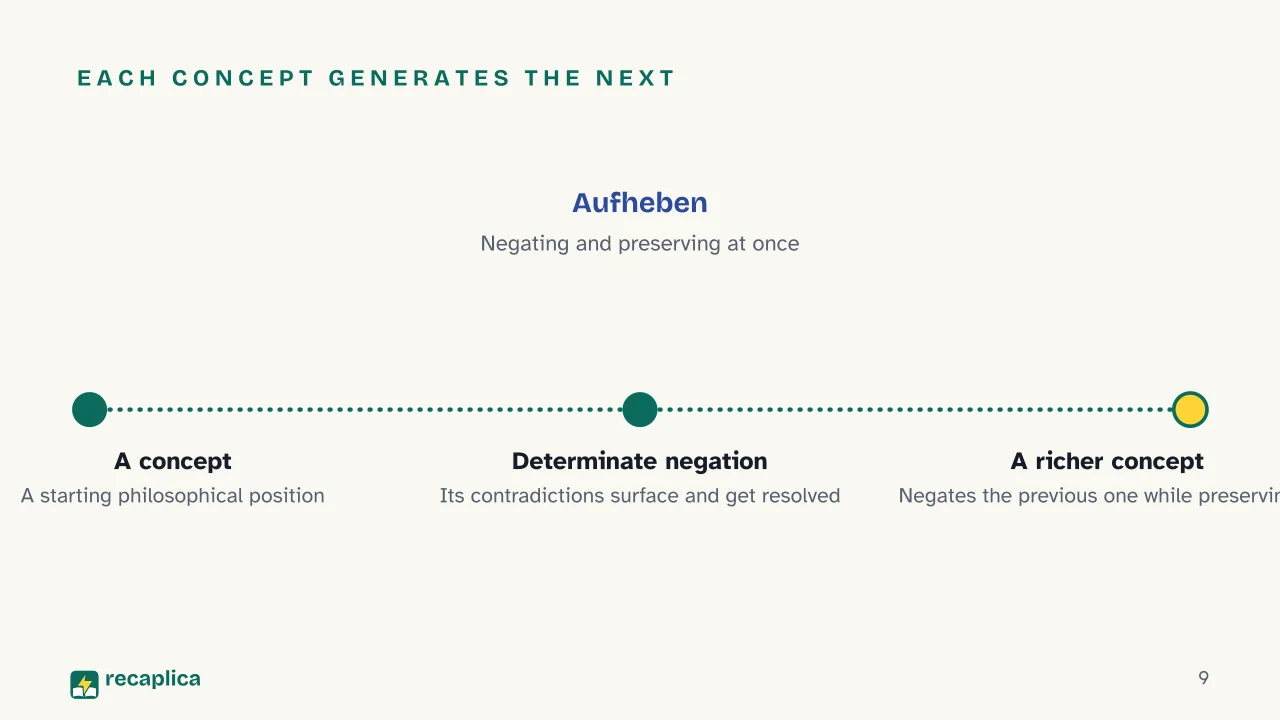
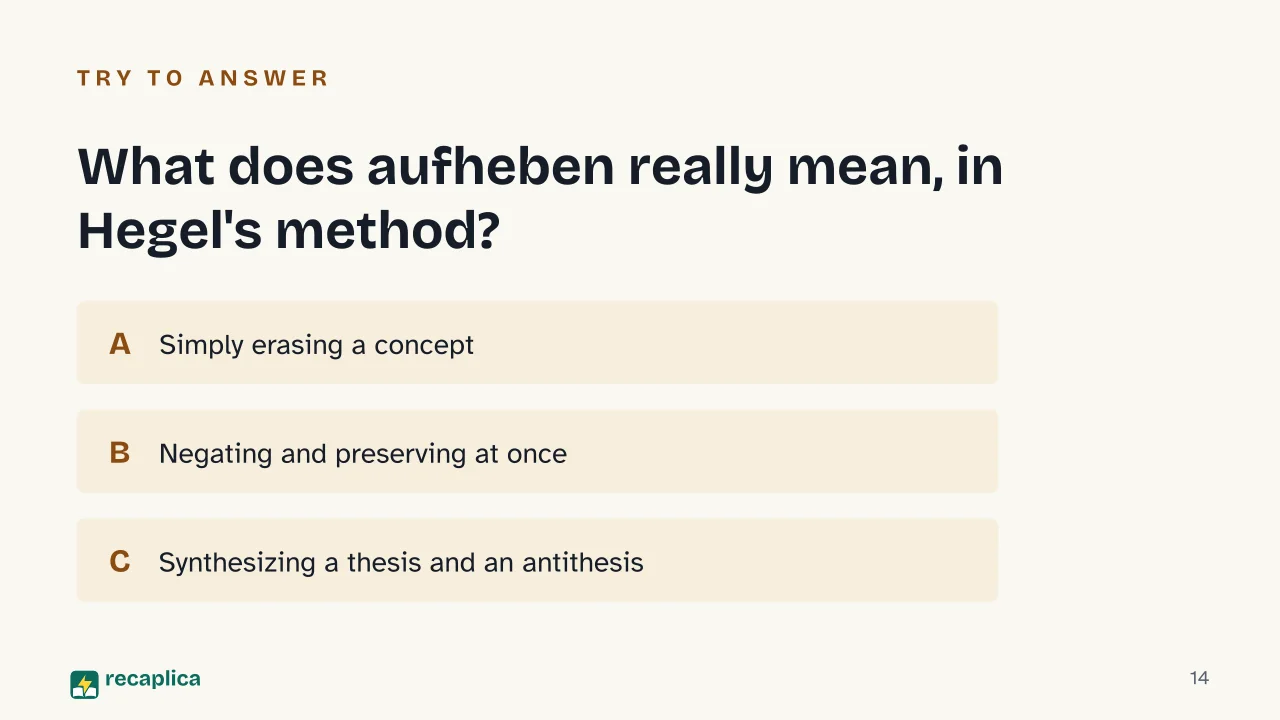
    In Hegel’s method, the dialectic is the process that surfaces a concept’s contradictions and resolves them, carrying thought toward a richer form of consciousness, according to the Internet Encyclopedia of Philosophy. The German verb aufheben, central to this method, carries a double meaning: to negate a concept and to preserve it at the same time.

    Practical example: think of an opinion that looks obvious until you find its limit. You correct it: the new version still holds something of the original idea, in a more precise form. That’s the pattern Hegel calls aufheben.

    In Hegel’s dialectic, negation doesn’t produce absolute nothingness but a determinate negation, one that carries a specific content. Each dialectical step produces a new concept, richer than the one before it, because it both negates and contains it.

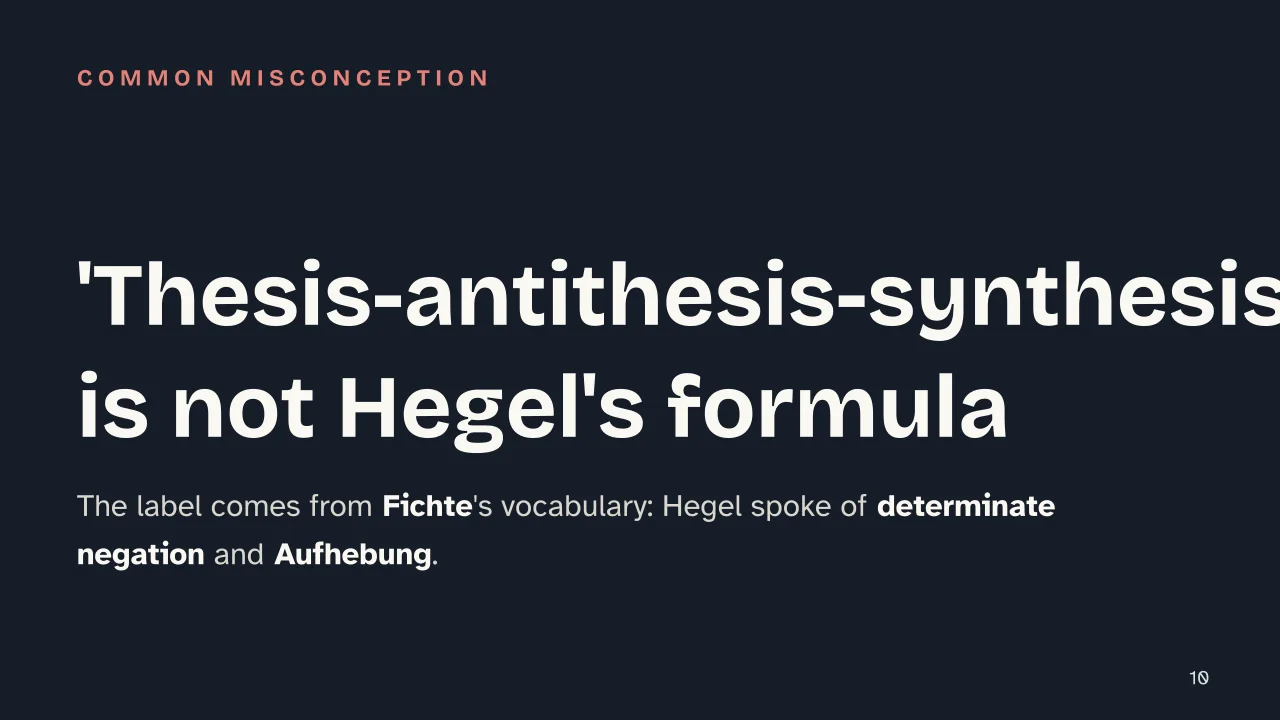
    The well-known formula “thesis-antithesis-synthesis”, often used in textbooks to summarize Hegel’s dialectic, belongs to Fichte’s vocabulary: to describe his own method, Hegel used different terms.

    Geist, or Spirit

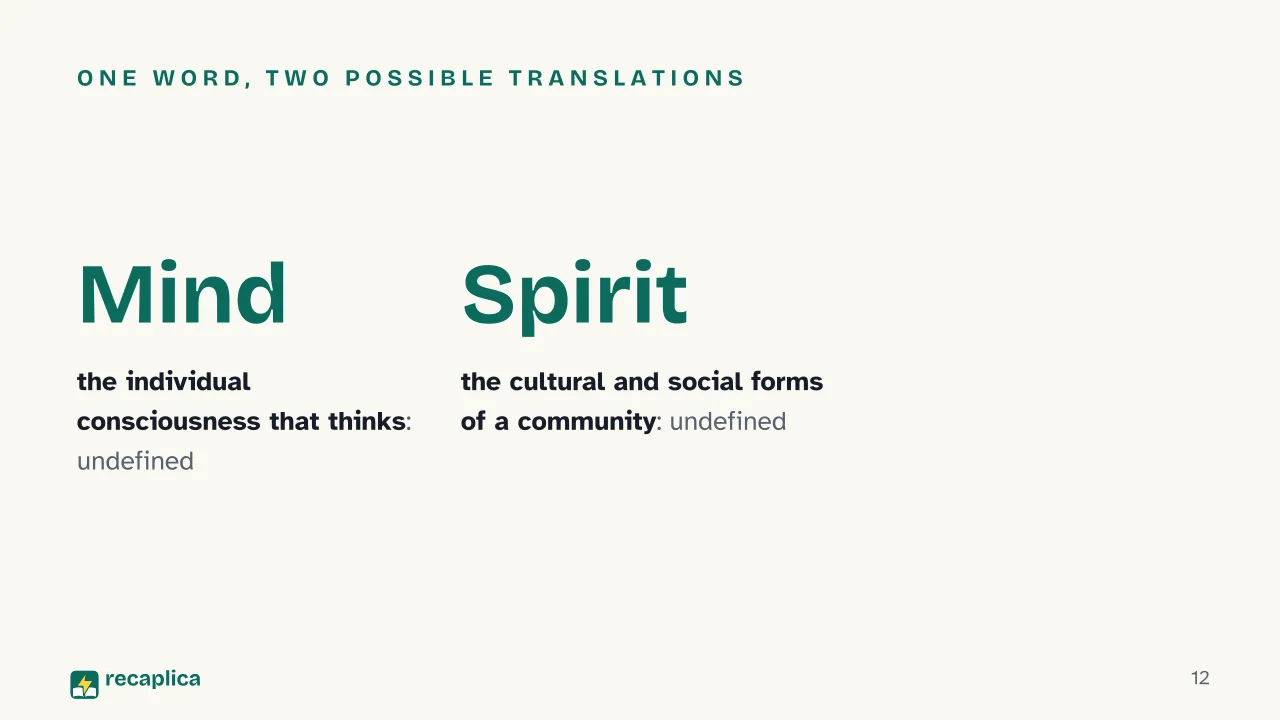
    The German term Geist, central to Hegel’s philosophy, can be translated as either mind or Spirit; the second is preferred because it carries the cultural and collective sense of the concept, according to the Stanford Encyclopedia of Philosophy. In the Phenomenology of Spirit, Hegel moves from the study of individual consciousness to objective spirit, the cultural and social forms shared by a community.

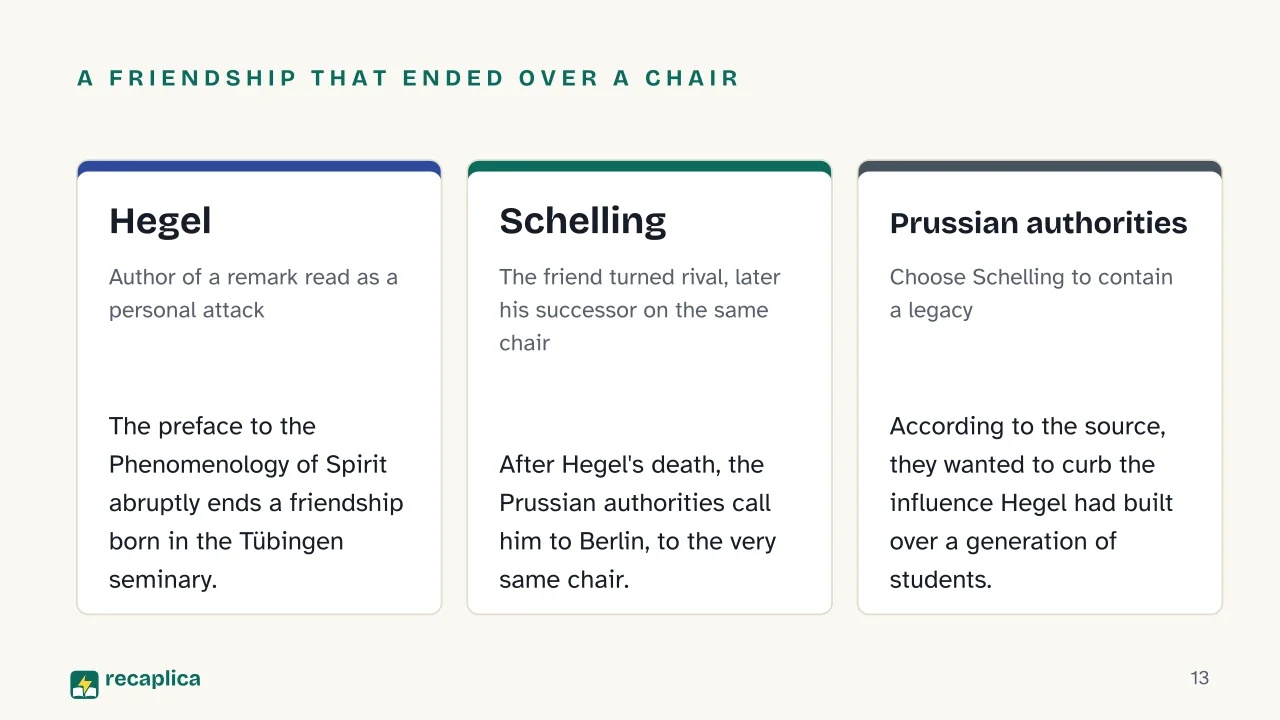
    Hegel lived out his own philosophy in his relationships with colleagues too: he and Schelling had been friends and fellow seminary students in Tübingen. To Schelling, though, a sharp passage in the preface to the Phenomenology of Spirit felt like a direct affront, and the friendship between the two ended on the spot. After Hegel’s death, the Prussian authorities called Schelling to his own chair in Berlin: according to the source, to counter the influence Hegel’s philosophy had built over a generation of students.

    Slide deck

    Slides ready to download and make your own in PowerPoint or Google Slides, with speaker notes. Pick the Flash cut or the Full one.
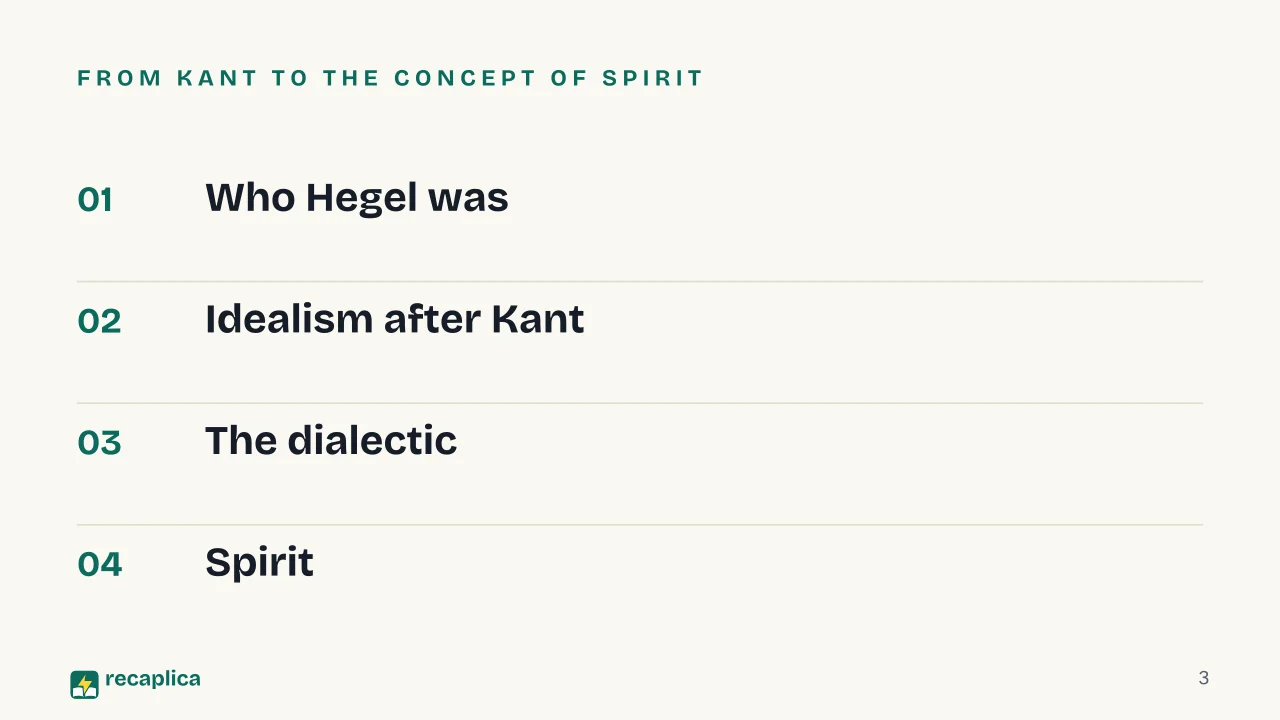
    Slide 1 of the presentation on Hegel and German Idealism: Hegel and German IdealismSlide 2 of the presentation on Hegel and German Idealism: Can we know things as they really are?Slide 3 of the presentation on Hegel and German Idealism: From Kant to the concept of SpiritSlide 4 of the presentation on Hegel and German Idealism: Chapter 01: Who Hegel wasSlide 5 of the presentation on Hegel and German Idealism: Born in Stuttgart in 1770Slide 6 of the presentation on Hegel and German Idealism: Chapter 02: Idealism after KantSlide 7 of the presentation on Hegel and German Idealism: The shared starting point: KantSlide 8 of the presentation on Hegel and German Idealism: Chapter 03: The dialecticSlide 9 of the presentation on Hegel and German Idealism: Each concept generates the nextSlide 10 of the presentation on Hegel and German Idealism: 'Thesis-antithesis-synthesis' is not Hegel's formulaSlide 11 of the presentation on Hegel and German Idealism: Chapter 04: SpiritSlide 12 of the presentation on Hegel and German Idealism: One word, two possible translationsSlide 13 of the presentation on Hegel and German Idealism: A friendship that ended over a chair: Hegel, Schelling, Prussian authoritiesSlide 14 of the presentation on Hegel and German Idealism: What does aufheben really mean, in Hegel's method?Slide 15 of the presentation on Hegel and German Idealism: Now, time to review
    Flash10 slidesThe essential thread, to present in classFull15 slidesEvery chapter and the deeper detail

    Common myths

    • ✗ Myth Hegel's dialectic boils down to the formula thesis-antithesis-synthesis

      ✓ Reality that formula isn't Hegel's: it belongs to Fichte's vocabulary. Hegel described his own method with aufheben and determinate negation, the process that carries a concept toward a richer form.

    • ✗ Myth German idealism denies that the outside world really exists

      ✓ Reality Hegel's idealism, like that of the other German thinkers in this tradition, differs from Berkeley's: the outside world stays in place; what changes is how reason comes to know and structure it.

    • ✗ Myth Geist, in Hegel's philosophy, is something mysterious or religious, almost ghostly

      ✓ Reality the term allows two translations, mind and Spirit: Hegel favored the second because it carries a historical dimension shared by a whole people, far from anything ghostly.

    Mind map

    Drag the background to move around and the nodes to reposition them; use − and + to collapse and expand branches.
    Customize
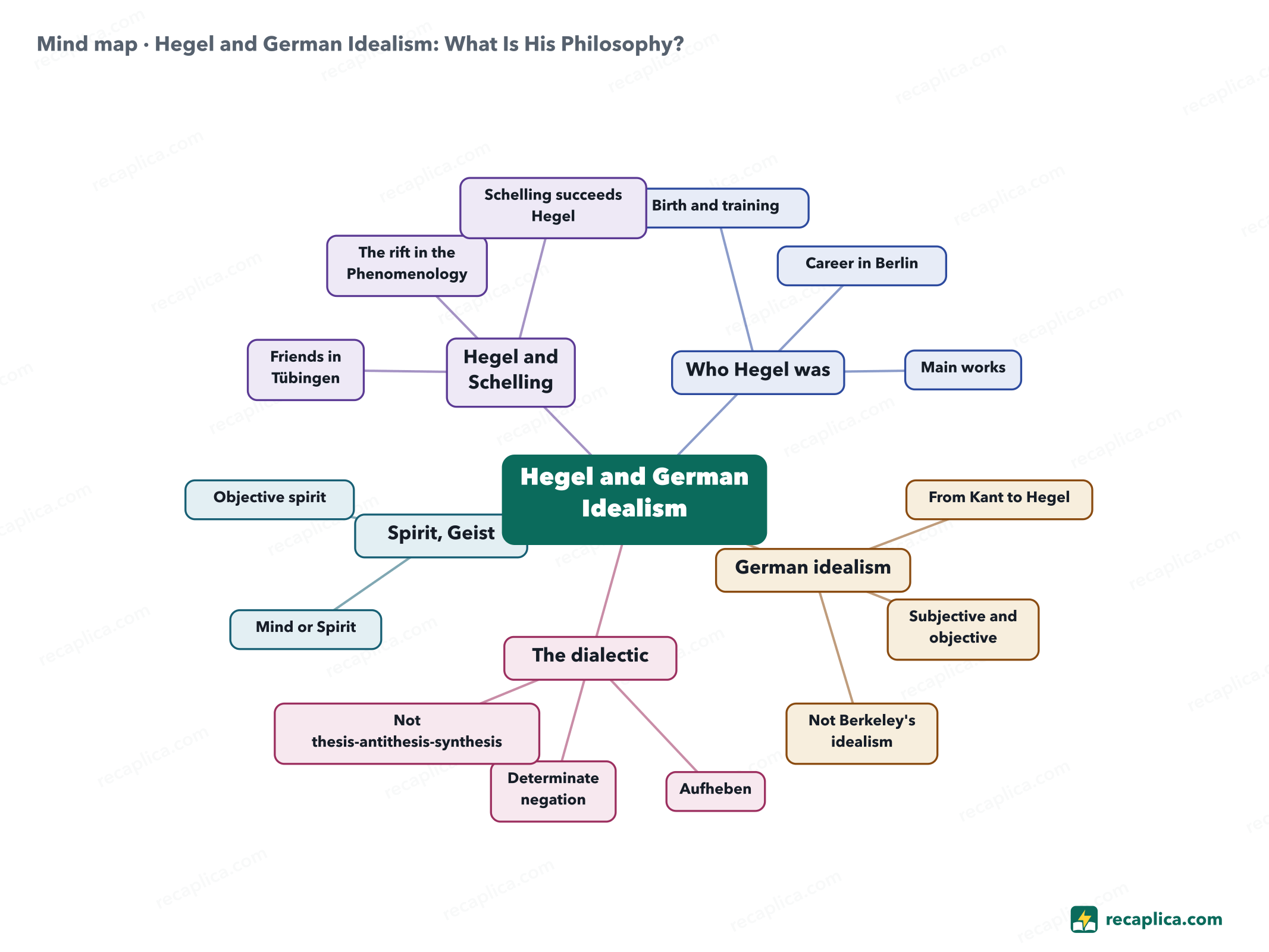
    Mind map: Hegel and German Idealism: What Is His Philosophy?
    • Hegel and German Idealism
      • Who Hegel was
        • Birth and training Born in Stuttgart in 1770, studied philosophy and theology in Tübingen between 1788 and 1793
        • Career in Berlin Chair of philosophy in 1818, died in 1831
        • Main works Phenomenology of Spirit in 1807, Philosophy of Right in 1821
      • German idealism
        • From Kant to Hegel Kant's transcendental idealism, pushed into absolute idealism
        • Subjective and objective Fichte subjective, Schelling objective or absolute
        • Not Berkeley's idealism Doesn't deny the outside world, concerns how reason knows it
      • The dialectic
        • Aufheben To negate and preserve at once, not to erase
        • Determinate negation A resolved contradiction produces a new, richer concept
        • Not thesis-antithesis-synthesis That formula belongs to Fichte's vocabulary
      • Spirit, Geist
        • Mind or Spirit The double meaning of the German word Geist
        • Objective spirit A people's habits and institutions, beyond individual consciousness
      • Hegel and Schelling
        • Friends in Tübingen Fellow seminary students during their formative years
        • The rift in the Phenomenology A critical remark in the preface, read as a personal attack
        • Schelling succeeds Hegel Called to the same chair after Hegel's death

    Quiz: test yourself

    Answer the questions to check what you have learned: you get instant feedback and a short explanation.

    Grade 0/10 0/5
    1 When did Georg Wilhelm Friedrich Hegel live?

    Hegel was born in Stuttgart in 1770 and died in Berlin in 1831, after a decade as a professor in the Prussian capital.

    2 True or false: German idealism denies that a world exists outside the mind.

    False: the German idealists don't follow Berkeley on this point. The world outside the mind remains; what changes is the path reason takes to know it.

    3 How did Hegel, together with Fichte and Schelling, transform Kant's position?

    Fichte, Schelling and Hegel found that position untenable: conceiving of something outside all thought is already thinking it, an operation that contradicts itself.

    4 What does aufheben, the key term of Hegel's method, mean?

    Aufheben carries two moves at once: it negates a concept and preserves it, producing a content that is new and more specific than the starting point.

    5 True or false: the formula thesis-antithesis-synthesis was coined by Hegel himself.

    False: the label belongs to Fichte's vocabulary. The method Hegel actually used is called determinate negation, expressed through the verb aufheben.

    Answers: 1-A · 2-B · 3-B · 4-B · 5-B

    Flashcards

    Tap the card to flip it and check whether you remember the answer, then move to the next one.

    1 / 8

    Explain it in your own words

    The ultimate test: if you can explain it in simple words, you've truly understood it. Write your explanation, then compare it with the Recap.

    Your explanation is saved only on this device.

    Georg Wilhelm Friedrich Hegel was born in Stuttgart in 1770 and died in Berlin in 1831, after a decade of wide recognition as a professor in the Prussian capital. He belongs to German idealism, the movement that pushed Kant's philosophy toward absolute idealism. His method, the dialectic, tracks a concept to its own limits and carries it forward into a richer form of thought, through what Hegel calls aufheben. At the center of his philosophy sits the Geist, or Spirit: a concept that covers both an individual mind and the shared life of an entire people.

    Frequently asked questions

    Who was Hegel?

    Georg Wilhelm Friedrich Hegel (1770-1831) was a German philosopher, among the central figures of German idealism. He studied philosophy and theology in Tübingen between 1788 and 1793, returned to academic life in 1816 in Heidelberg, and by 1818 was teaching philosophy at the university in Berlin, a post he kept until his death in 1831.

    What is German idealism?

    It is the period of German philosophy opened by Kant's distinction between appearances and things in themselves. Fichte, Schelling and Hegel questioned that boundary, arriving at an idealism that brings everything within the reach of reason: absolute idealism.

    What is the difference between Hegel and Kant?

    Kant left the thing in itself outside any possible knowledge. Hegel, together with Fichte and Schelling, removed that boundary: treating a thing in itself as existing apart from thought is already thinking it, an idea that undermines itself.

    What does the word Geist mean in Hegel?

    The German word Geist allows two renderings, mind and Spirit. Hegel points the reader toward the second: in the Phenomenology the path opens with one person's consciousness and widens into objective spirit, the habits and institutions a whole society builds and holds in common.

    Is it true that Hegel's dialectic boils down to thesis-antithesis-synthesis?

    That label isn't Hegel's: it belongs to Fichte's vocabulary. The method Hegel uses is aufheben, the move that negates a concept while preserving its content in a new, richer form.

    Sources

    • Stanford Encyclopedia of Philosophy – Georg Wilhelm Friedrich Hegel
    • Internet Encyclopedia of Philosophy – German Idealism
    • Stanford Encyclopedia of Philosophy – Hegel's Dialectics

    Every Recap goes through an independent review before publication.

    Every evening, the day's new Recaps on our Telegram channel. Join the channel →

    Keep learning

    • History What Is Existentialism? Heidegger, Being and Time, and Dasein Existentialism is a current of twentieth-century philosophy centered on human existence, freedom and the search for meaning. According to the Stanford Encyclopedia of Philosophy, the German philosopher Martin Heidegger (1889-1976) shaped that current more than almost anyone else, even though he never accepted the label. In 1927 he published Being and Time, his major work, where he introduced the concept of Dasein: the human being as the one entity that questions its own existence. That book influenced Jean-Paul Sartre's existentialism, but in 1946, in the Letter on Humanism, Heidegger openly broke with Sartre and refused to be called an existentialist. In 1933 he was elected rector of the University of Freiburg and became a Nazi party member, keeping that membership until the regime fell - an episode Heidegger himself later denied or played down more than once. Read the Recap →
    • History What Is Phenomenology? Husserl's Philosophy Explained Edmund Husserl founded phenomenology as a philosophical discipline around 1900-1901, with his Logical Investigations. His method starts from the epoché, a suspension of our everyday, unquestioning stance toward the world, and moves toward phenomenological reduction: studying how things appear to consciousness rather than what they are in themselves. At the center sits intentionality, the idea that every experience is always an experience of something specific, whether hoping, perceiving, or desiring. The method Husserl built carried into the 20th century through Heidegger, Sartre, and Merleau-Ponty, moving from German philosophy into French philosophy along the way. Read the Recap →
    • History Legal Positivism: What It Is, from Austin to Kelsen and Hart According to the Stanford Encyclopedia of Philosophy, legal positivism measures legal validity against observable social facts, keeping moral judgment on a separate track. Its roots lie in Hobbes and Hume. Jeremy Bentham produced the theory's first full account, which John Austin later took up and spread: for Austin, a rule is law only when a sovereign commands it under threat of punishment. In the twentieth century, Hans Kelsen grounded legal validity in a hierarchy that traces back to a presupposed basic norm, while Herbert Hart located it instead in a rule of recognition actually followed by judges and officials. Natural law theory takes the opposite view: an unjust law is not really a law. Legal positivism disagrees — a law stays valid even when it is morally unjust, as long as it was made the way the system requires. Read the Recap →

    recaplica

    Clear in 30 seconds, yours in 10 minutes.

    Recaps Mind maps Request a Recap Telegram channel Mind map maker Our method About Privacy & cookies Legal notes & terms of use

    © 2026 Recaplica · A project by Curi S.r.l. — VAT IT05472000750

    Statistics, only if you say so

    To learn which Recaps help most we would use Google Analytics, with aggregate, anonymous data. It starts only with your OK, and you can change your mind anytime. Privacy policy