|
recaplica
American Revolution: Timeline and Summary, 1765-1783 | ||||||||||
| © 2026 Recaplica · recaplica.com — All rights reserved | ||||||||||
American Revolution: Timeline and Summary, 1765-1783What to print Page numbers appear when printing with default margins. SlidesChoose a cut Flash10 slidesThe essential thread, to present in classFull16 slidesEvery chapter and the deeper detailBoth come with speaker notes. In 30 seconds quick readThe American Revolution was the process, between 1765 and 1783, through which Britain's Thirteen Colonies in North America broke away from Great Britain and became the United States. It began as a dispute over taxes and political representation, escalated through a decade of protests and harsher laws, and turned into an eight-year war. The Declaration of Independence, adopted on July 4, 1776, marked the political break, but full recognition of independence came gradually from other nations, ending only with the Treaty of Paris in 1783. What emerged was not yet a federal union: the Constitution followed several years later. Key Points
Key figures
Deep DiveIn 1765, Britain’s Thirteen Colonies in North America looked, from London’s vantage point, like a source of revenue to help pay off the debts of empire. Eighteen years later they were a nation recognized by foreign governments, born from a conflict that reshaped how a territory could claim its own sovereignty. In between lie contested taxes, tea dumped into a harbor, a document that became foundational, and a war whose outcome hinged on treaties signed abroad as much as on the fighting itself. The causes: taxes, laws and denied representationTensions between the colonies and the mother country did not spring from a single grievance. The Stamp Act, passed by the British Parliament on March 22, 1765, taxed printed paper and legal documents: a measure designed in London to recover part of the cost of imperial wars, and read in the colonies as a levy imposed by a Parliament in which they had no voice.
Protests dragged on for years, culminating in an episode that became the era’s defining symbol. On the night of December 16, 1773, protesting the Tea Act that favored the East India Company’s monopoly, roughly 150 colonists disguised with Mohawk-inspired dress boarded three ships in Boston harbor and destroyed 342 chests of tea within hours: the Boston Tea Party. Parliament answered in 1774 with the Coercive Acts, which colonists called the Intolerable Acts: Boston’s port was shut down and the city placed under martial law. That harsh response is what pushed the colonies toward joint action. Twelve of the thirteen colonies, all but Georgia, sent delegates to the First Continental Congress, held in Philadelphia from September 5 to October 26, 1774, which approved an organized boycott of British goods. The break: from Congress to armsThe closure of Boston’s port, martial law imposed on an entire city, and Britain’s refusal to grant the colonies real representation in the Parliament taxing them all added to the strain. When negotiation ran out, the conflict moved from paper to weapons: the battles of Lexington and Concord, in Massachusetts, on April 19, 1775, were the war’s first armed clashes. From that point political leadership of the revolt passed to the Second Continental Congress, convened from May 10, 1775. It was this Congress that adopted, on July 4, 1776, the Declaration of Independence: a text drafted by a five-member committee, with Thomas Jefferson as its principal author. The document declared that the thirteen colonies were severing every political tie with Great Britain, and stated, in its most quoted lines, that all men are created equal and endowed with unalienable rights including life, liberty and the pursuit of happiness. According to the U.S. National Archives, which holds the original document, the Declaration carries no binding legal force: its importance lies in having set down the principles on which the new nation’s political identity was built, not in any immediate legal effect. July 4 marks the political break the colonies declared, not the legal end of the conflict nor recognition by other states — that would come later, and gradually. The war: from Saratoga to YorktownThe war lasted eight years, from 1775 to 1783, and was no straight march to an American victory. A turning point came at Saratoga, in New York, where British troops surrendered on October 17, 1777: a defeat that persuaded France, already eager to weaken its British rival, to intervene openly. On February 6, 1778, the United States and France signed a treaty of alliance: the first foreign government to formally recognize American independence, contributing troops, ships and supplies that weighed on the war’s final outcome. The winter the Continental Army spent at Valley Forge, Pennsylvania, in 1777-78, is often told as the war’s darkest moment. The picture is more nuanced: a colder winter hit the same army at Morristown, New Jersey, in 1780. What made Valley Forge decisive was not the cold itself, but the systematic training Baron von Steuben delivered there, turning a loose collection of militiamen into an army able to hold its ground. Major fighting ended on October 19, 1781, when British general Cornwallis surrendered at Yorktown, Virginia. It was not the legal end of the war, but it pushed the government in London toward peace talks that would conclude two years later. One more point keeps the picture from being oversimplified: the colonial population was not solidly united behind independence. About 90% lived in rural areas outside British military control during the 1775-1783 period, but not every one of those colonists supported the break. Roughly 25,000 Loyalists actively fought for the Crown over the course of the war. International recognition: from Morocco to Great BritainJuly 4, 1776 declared the intent to break from Great Britain; recognition from other governments followed later, one country at a time.
The Treaty of Paris, signed on September 3, 1783, formally ended the war, and with it Great Britain officially recognized the United States as a sovereign, independent nation. Only at that point, seven years after the Declaration, did American independence gain its most important legal recognition. After the war: from victory to the ConstitutionHaving won the war and secured British recognition, the United States was not yet the federal nation it would later become. In the years right after 1783, the new country operated as a confederation of states with a weak central government: it took the Constitution, drafted in 1787 and in effect from 1789, to give thirteen former colonies turned sovereign states an institutional structure that could hold them together. That same idea of a written constitution organizing a state’s powers, quite differently shaped and centuries apart, underpins the Italian Constitution. The American Revolution was not an isolated event of its time: a few years later, in 1789, the French Revolution broke out, fueled in part by the same ideas about natural rights that the Declaration of Independence had put into writing. And the long, uneven path that turned thirteen separate colonies into one country echoes, in its own way, what Italy would go through nearly a century later with Italian unification: building one nation out of many rarely happens with a single act or a single date. Slide deckSlides ready to download and make your own in PowerPoint or Google Slides, with speaker notes. Pick the Flash cut or the Full one.     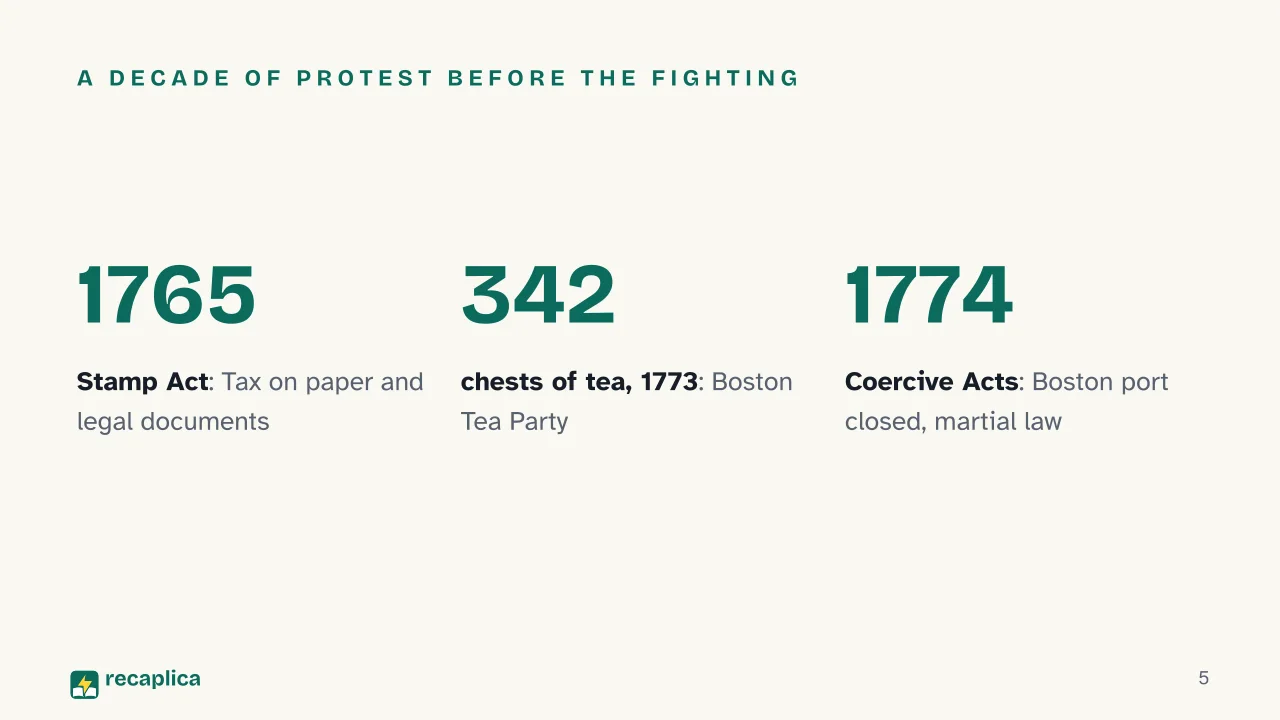  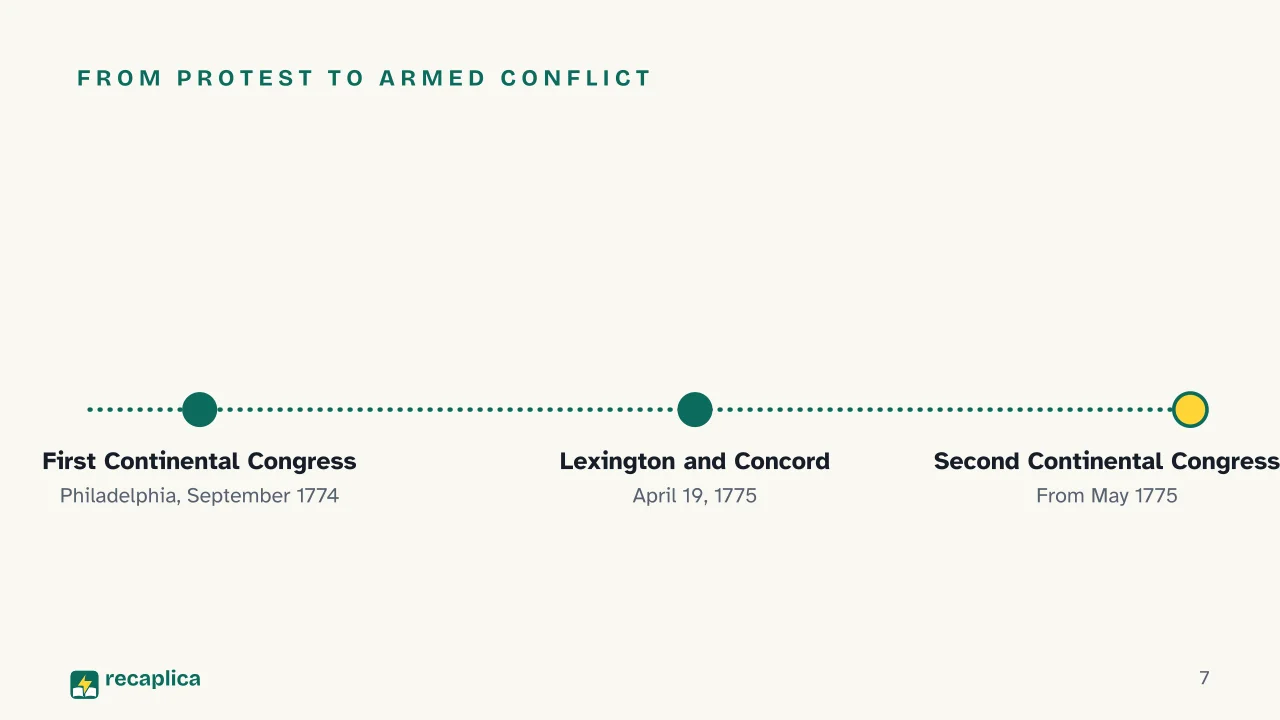 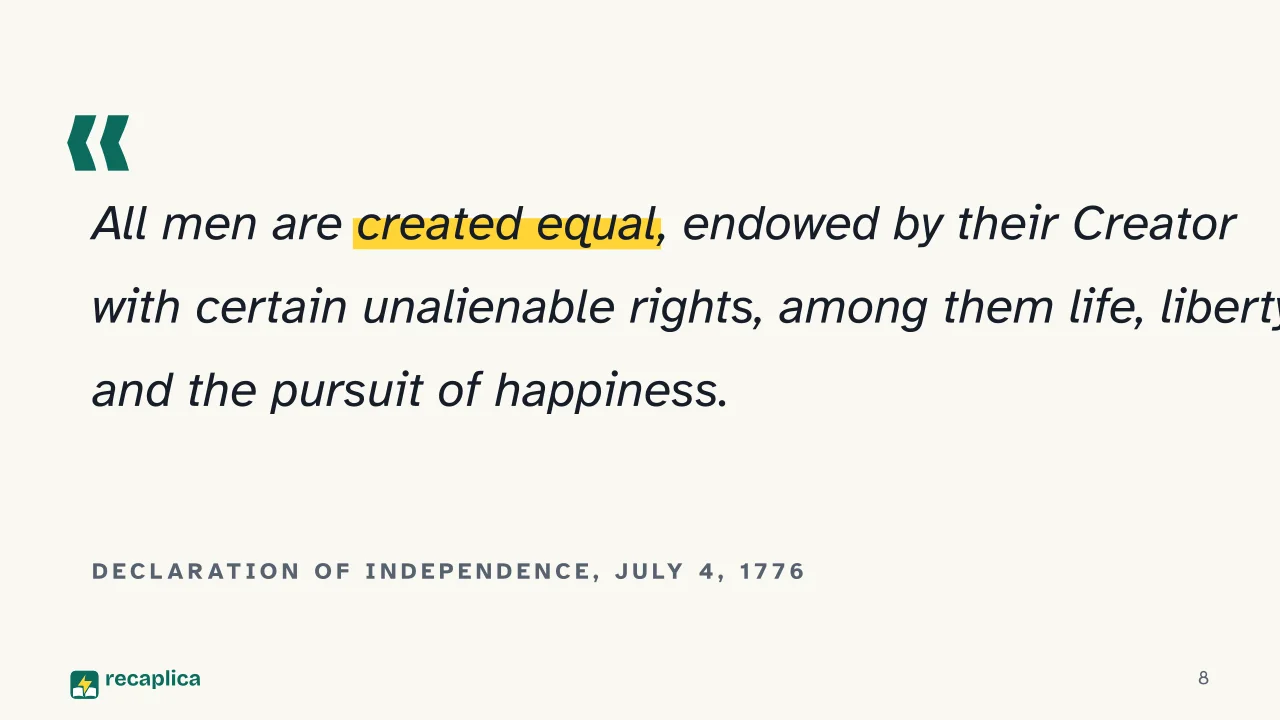 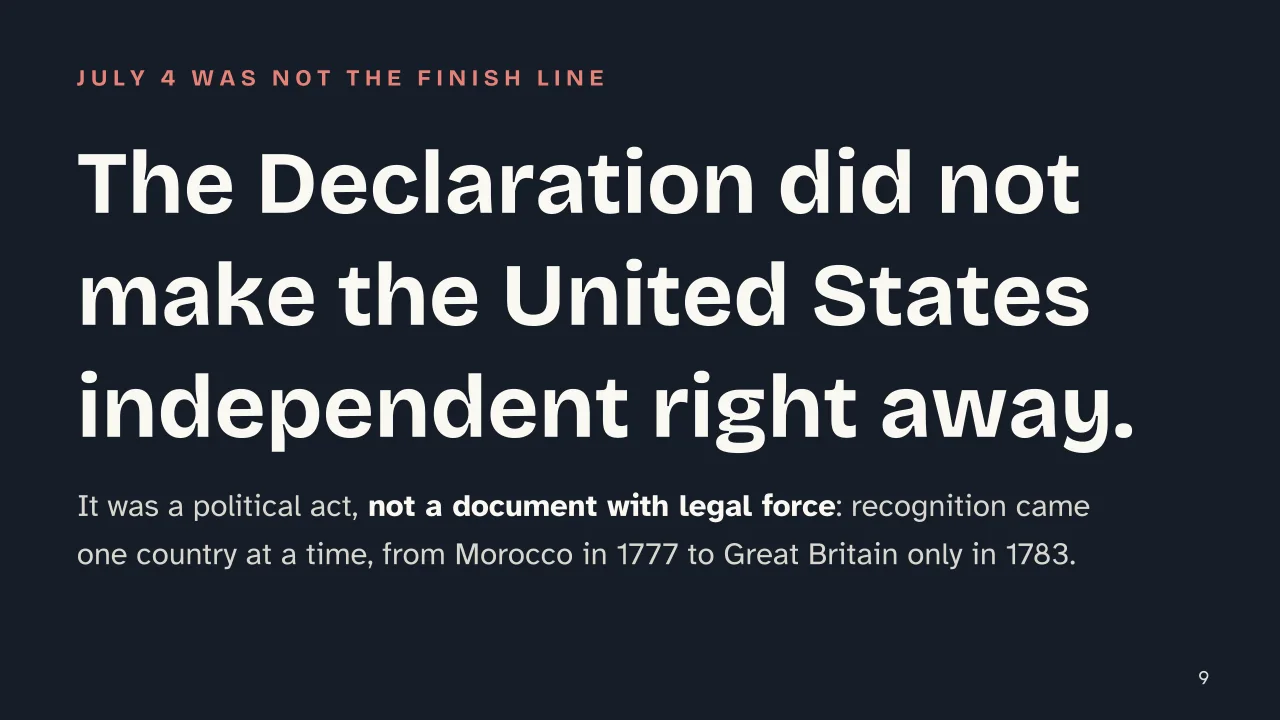  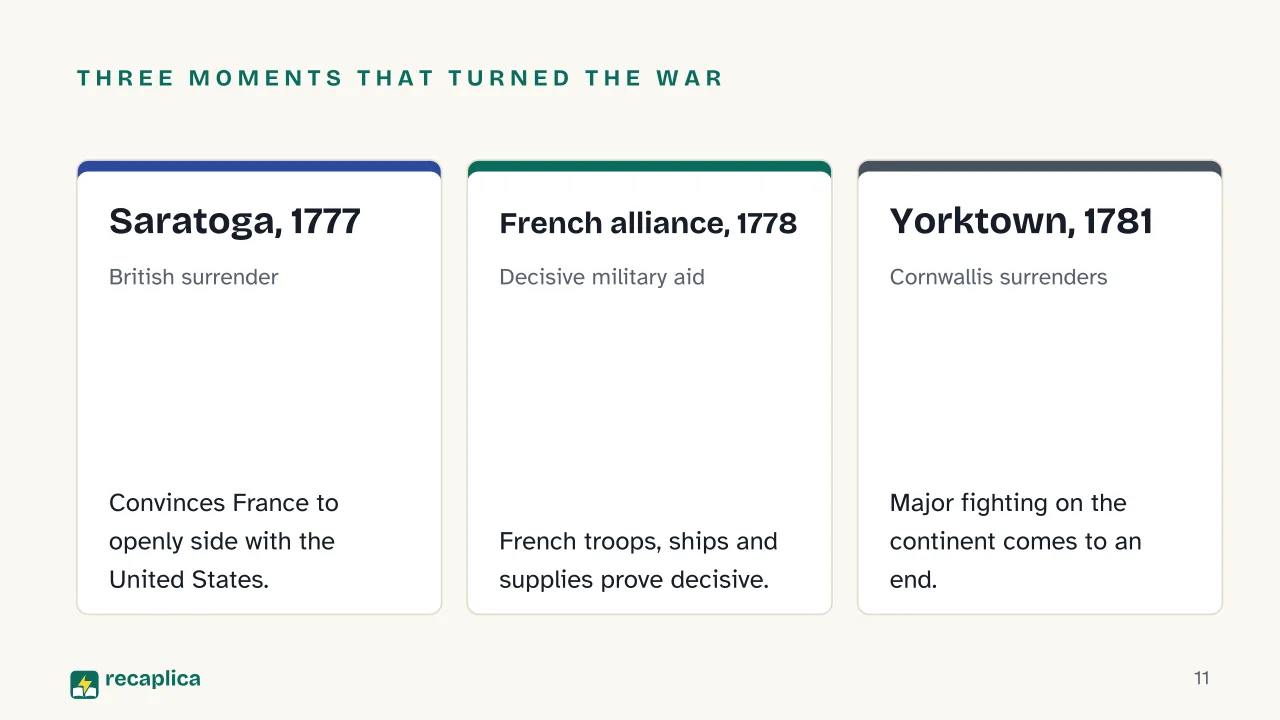 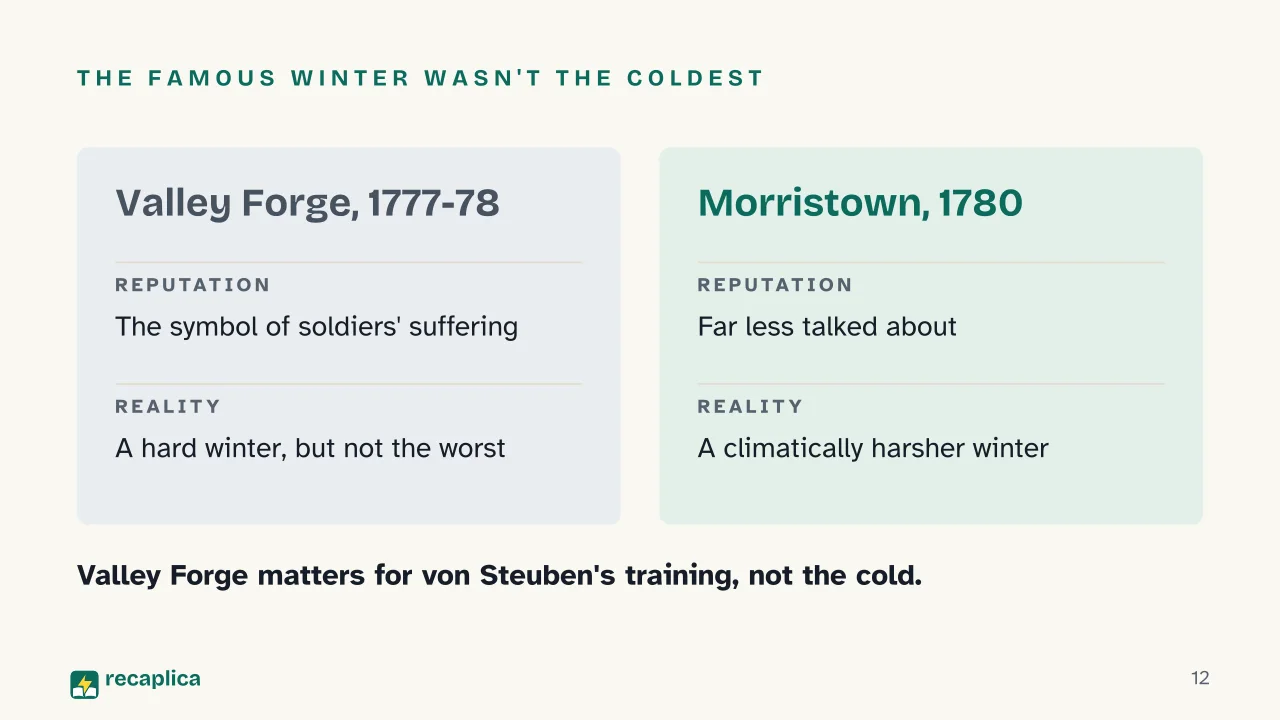  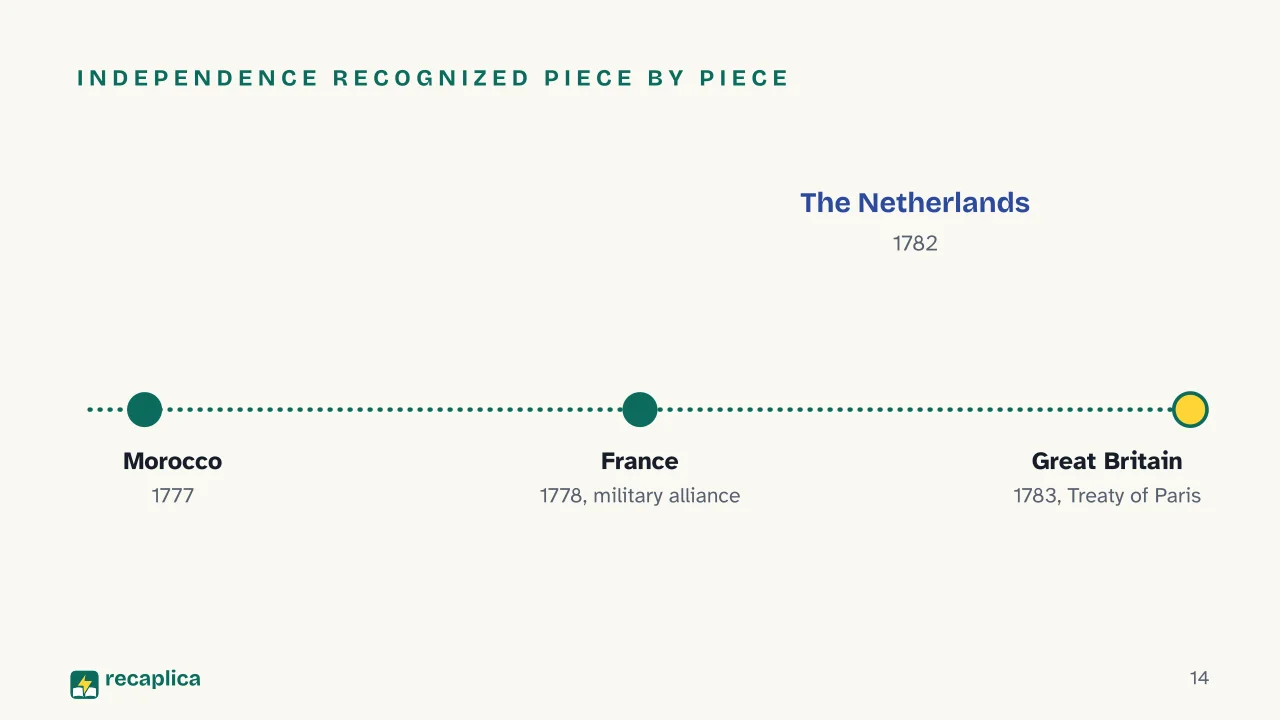 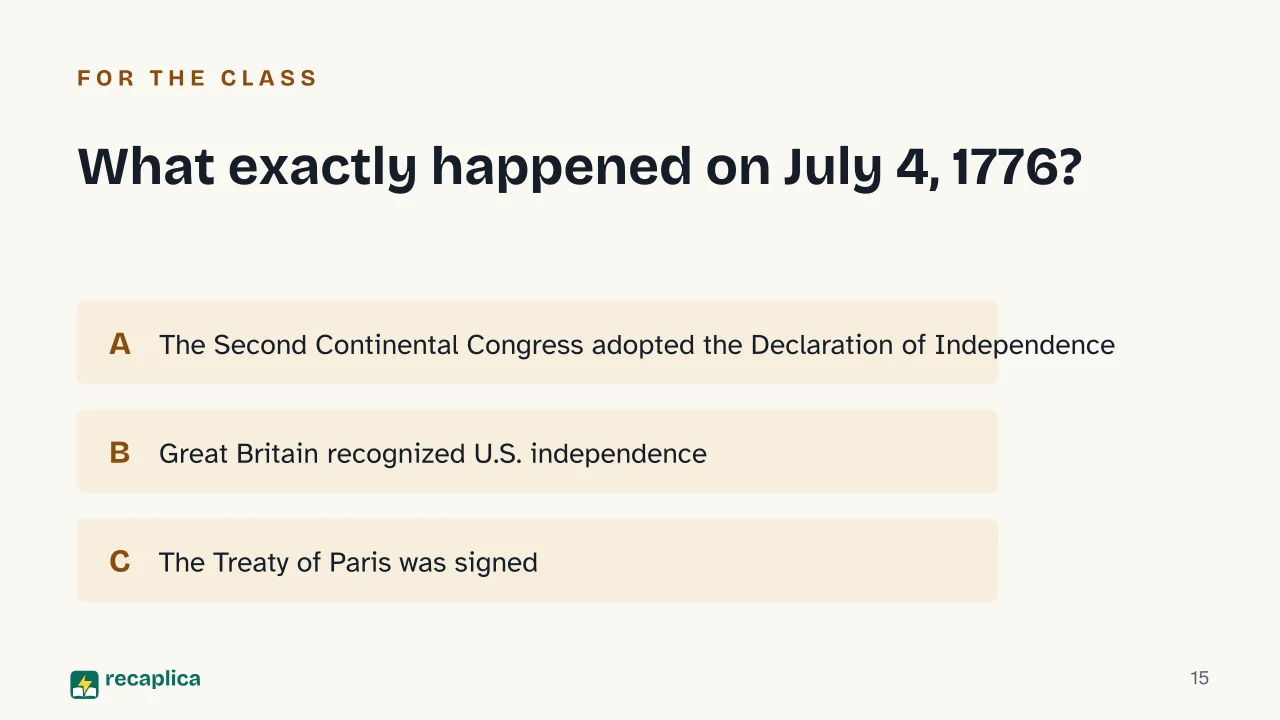  Common myths
Mind mapDrag the background to move around and the nodes to reposition them; use − and + to collapse and expand branches. 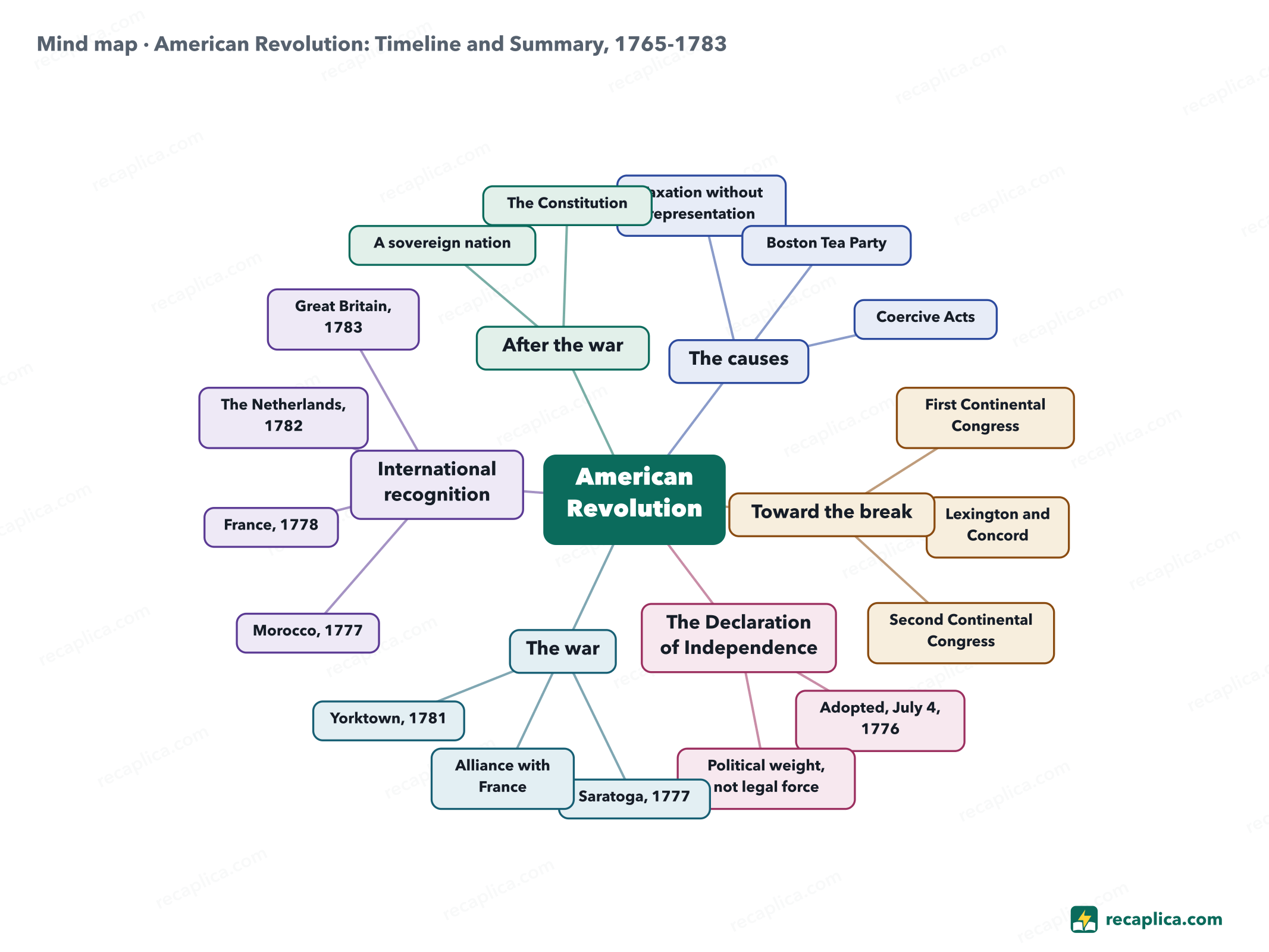
Quiz: test yourselfAnswer the questions to check what you have learned: you get instant feedback and a short explanation. Grade 0/10 0/5
FlashcardsTap the card to flip it and check whether you remember the answer, then move to the next one. 1 / 8 Explain it in your own wordsThe ultimate test: if you can explain it in simple words, you've truly understood it. Write your explanation, then compare it with the Recap. Your explanation is saved only on this device.
Frequently asked questionsWhat was the American Revolution?It was the process, between 1765 and 1783, in which Britain's Thirteen Colonies in North America broke from Great Britain after a decade of disputed taxes and laws, fought an eight-year war, and formed the United States. When did the American Revolutionary War start and end?The first armed clashes were the battles of Lexington and Concord, on April 19, 1775; the war legally ended with the Treaty of Paris, signed on September 3, 1783. Did the Declaration of Independence make the United States free right away?No: it proclaimed the political break from Great Britain on July 4, 1776, but independence was recognized by other countries gradually, and by Great Britain itself only in 1783, with the Treaty of Paris. Who gave the United States military help during the war?France, which signed a decisive military alliance in 1778; the Netherlands also played a role, recognizing American independence in 1782 and offering diplomatic and financial backing. Are the founding of the United States and the U.S. Constitution the same event?No: the war of independence produced a country still organized as a loose confederation; the Constitution, drafted in 1787 and in effect from 1789, came later to give the new nation a federal government. Every Recap goes through an independent review before publication. |