|
recaplica
Social Contract Theory: What Hobbes, Locke, and Rousseau Argued |
| © 2026 Recaplica · recaplica.com — All rights reserved |
Social Contract Theory: What Hobbes, Locke, and Rousseau ArguedWhat to print Page numbers appear when printing with default margins. SlidesChoose a cut Flash10 slidesThe essential thread, to present in classFull18 slidesEvery chapter and the deeper detailBoth come with speaker notes. In 30 seconds quick readSocial contract theory is a thought experiment that explains why individuals accept a shared political authority, starting from how life would look with no government at all. Hobbes describes a universal war that only a sovereign with absolute power can end. Locke starts from a freedom already ordered by reason and limits government to a revocable assignment, with a right of resistance if it betrays that trust. For Rousseau, laws come from the general will of citizens gathered together, with no sovereign standing outside them. The three thinkers share the same reasoning but reach opposite conclusions about freedom and authority. Key Points
Key figures
Deep DiveThe social contract is a philosophical tool for asking why a political authority is legitimate. Hobbes, Locke, and Rousseau answer that question in opposite ways, starting from the same move: imagining how human beings would live with no shared government at all. A war of everyone against everyone: Hobbes’s state of natureAccording to the Stanford Encyclopedia of Philosophy entry on Hobbes, the state of nature described in Leviathan (1651) is a condition of universal war, not occasional clashes. A common power able to enforce rules is entirely absent, and Leviathan itself describes the resulting life as lacking industry, culture, and any stable form of society: every person must fear the violence of others at every moment, because nobody can count on a safe tomorrow.
To leave this condition, individuals institute a sovereignty through a mutual pact of obedience: each person transfers their own right to self-government to a sovereign, who can be one person or an assembly, on condition that everyone else does the same. The Stanford Encyclopedia explains that for Hobbes this power must be absolute, undivided, and unlimited: a partial authority would not be enough to hold back a universal war, which is why, in his reasoning, even a harsh government remains preferable to a return to civil war. A freedom already ordered by reason: Locke’s state of natureAccording to the Stanford Encyclopedia of Philosophy entry on Locke, the state of nature in the Two Treatises of Government (1689), published after the Glorious Revolution, arises from the absence of a common judge with authority, yet reason still governs it. The Internet Encyclopedia of Philosophy describes it as a condition of full freedom; the Stanford Encyclopedia adds that, for Locke, individuals already hold natural rights to life, liberty, and property before any civil society or positive law exists. The pact Locke proposes is therefore far more limited than Hobbes’s. Individuals transfer to government only the executive power needed to punish those who violate the law of nature: a specific, conditional transfer. In the original text of the Two Treatises, Locke writes that when violence is committed even by those who should administer justice, only an appeal to force remains, what he calls an “appeal to heaven”: this is the theoretical basis of the right of resistance. A government that betrays the purpose for which it was instituted can be challenged and replaced, an idea the American founders would later take up in their own revolution (/en/history/american-revolution/). No outside sovereign: Rousseau’s social contractRousseau starts from different premises. In the Discourse on Inequality he argues that the natural goodness of human beings is corrupted by life in society: according to the Internet Encyclopedia of Philosophy, it is the process of socialization that follows, more than any original trait of human nature, that produces inequality and competition. Where Hobbes sees the state of nature as the problem to solve, Rousseau describes it as a peaceful age, free of competition. In The Social Contract (1762), the work that popularized the phrase, Rousseau applies the same pattern as Hobbes and Locke, a state of nature followed by a pact, but arrives, as the Stanford Encyclopedia also reports, at a conclusion of democratic equality. The problem the pact must solve is joining together with others while remaining as free as before: this is why Rousseau rules out any outside sovereign to delegate power to. According to the Internet Encyclopedia of Philosophy, the resulting government rests on the direct assembly of citizens, who deliberate the laws. Legitimate laws come from the general will, aimed at the common good, distinct from the will of all, which is simply the sum of each person’s private interests: the distinction already appears in the first book of The Social Contract. This idea of a sovereignty that stays with the citizens would run through French revolutionary thought (/en/history/french-revolution/) and the 1789 Declaration of the Rights of Man and of the Citizen (/en/history/declaration-rights-of-man/). Three states of nature, the same questionSet side by side, the three states of nature describe opposite starting conditions, and the shape of each pact follows from there. Hobbes imagines a permanent war in which reason alone cannot guarantee safety, so the pact has to create a power able to impose itself on everyone. Locke imagines a freedom already ordered by reason, so the pact can limit itself to delegating a part of that existing order. Rousseau imagines a natural peace spoiled by life in society, so the remedy consists in giving citizens back control of their own laws, instead of delegating it to a third party. This difference also explains why the three authors arrive at incompatible forms of government. For Hobbes, any division of power is a mortal risk. Locke splits power between government and a right of resistance, while Rousseau hands it entirely back to the citizens. No later constitution copies any of the three models whole. The pages on forms of state and government (/en/civics/types-of-government/) describe how these eighteenth-century insights later turned into actual constitutional models. The legacy in revolutions and later theoriesNone of the three philosophers ever witnessed a social contract actually signed: it remains a thought experiment, useful for discussing the legitimacy of power more than for recounting its historical birth. Their ideas still had precise historical consequences. Locke’s natural rights supplied the vocabulary of the American Revolution; Rousseau’s sovereignty of the citizens supplied that of the French Revolution. Hobbes, less directly quoted in revolutionary documents, still remains the starting point of the argument: he is the first to formulate, in modern terms, the problem that Locke and Rousseau would later try to solve in different ways. Slide deckSlides ready to download and make your own in PowerPoint or Google Slides, with speaker notes. Pick the Flash cut or the Full one.   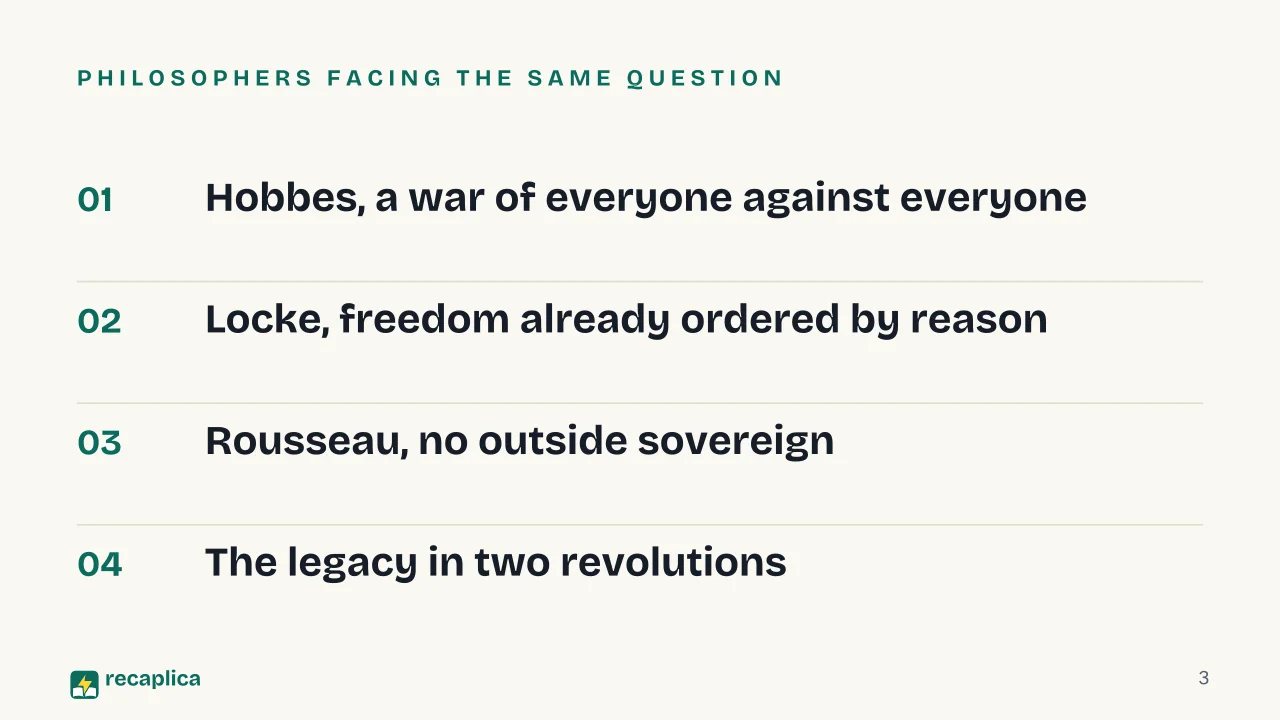  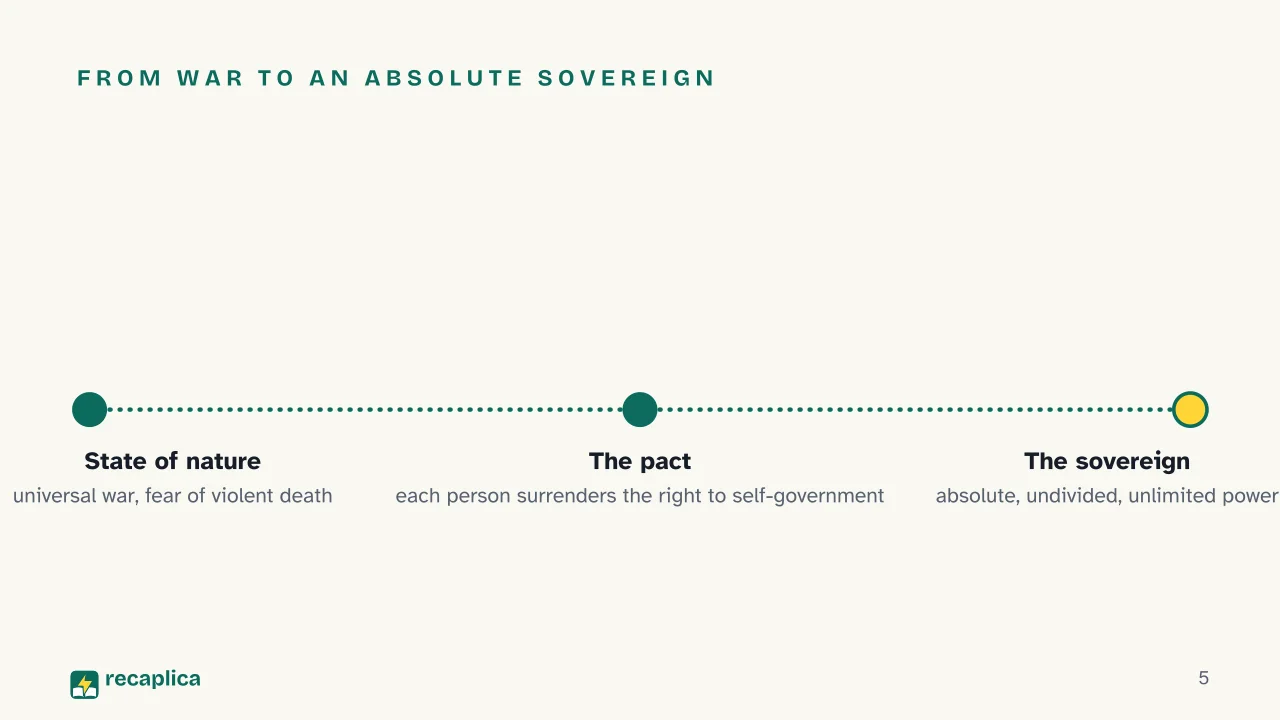  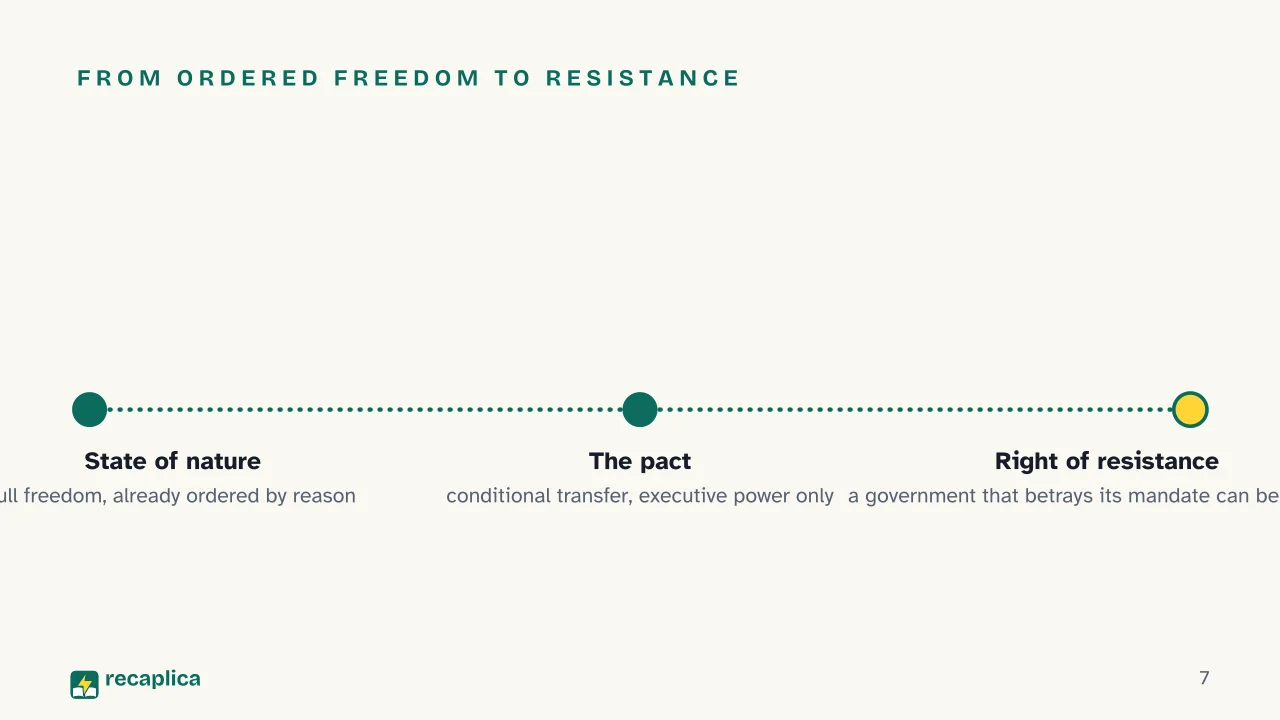  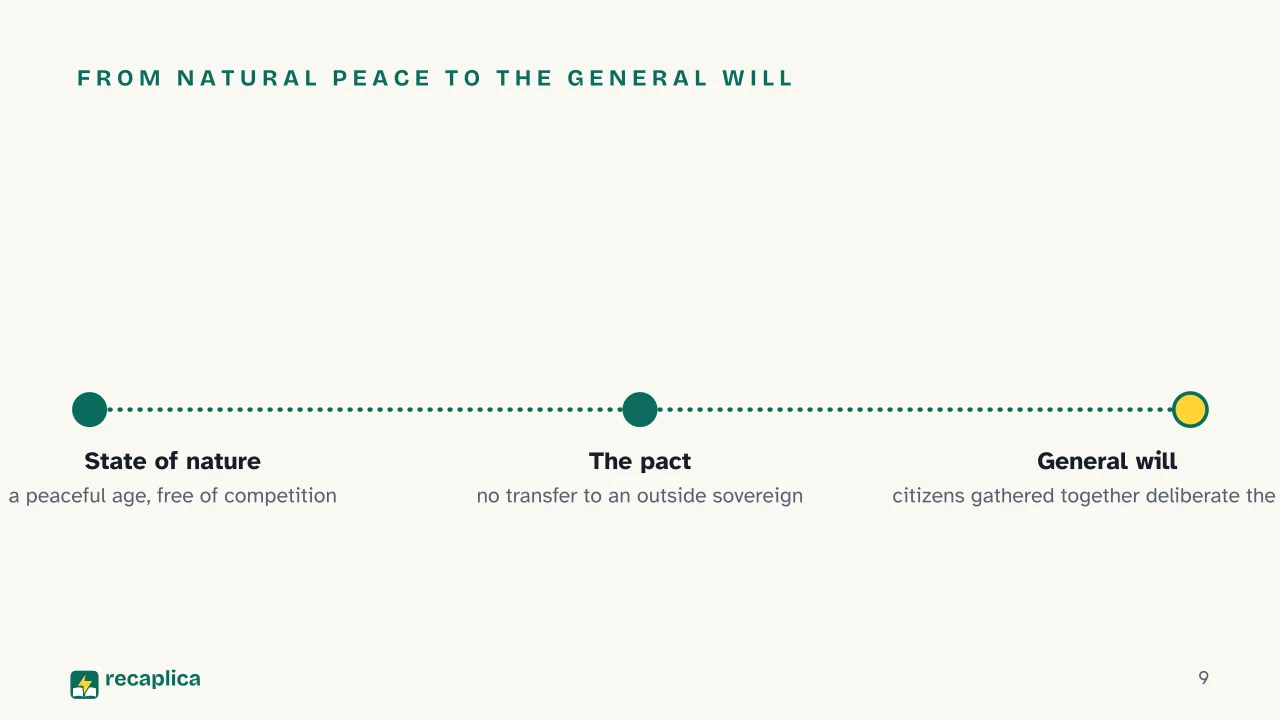 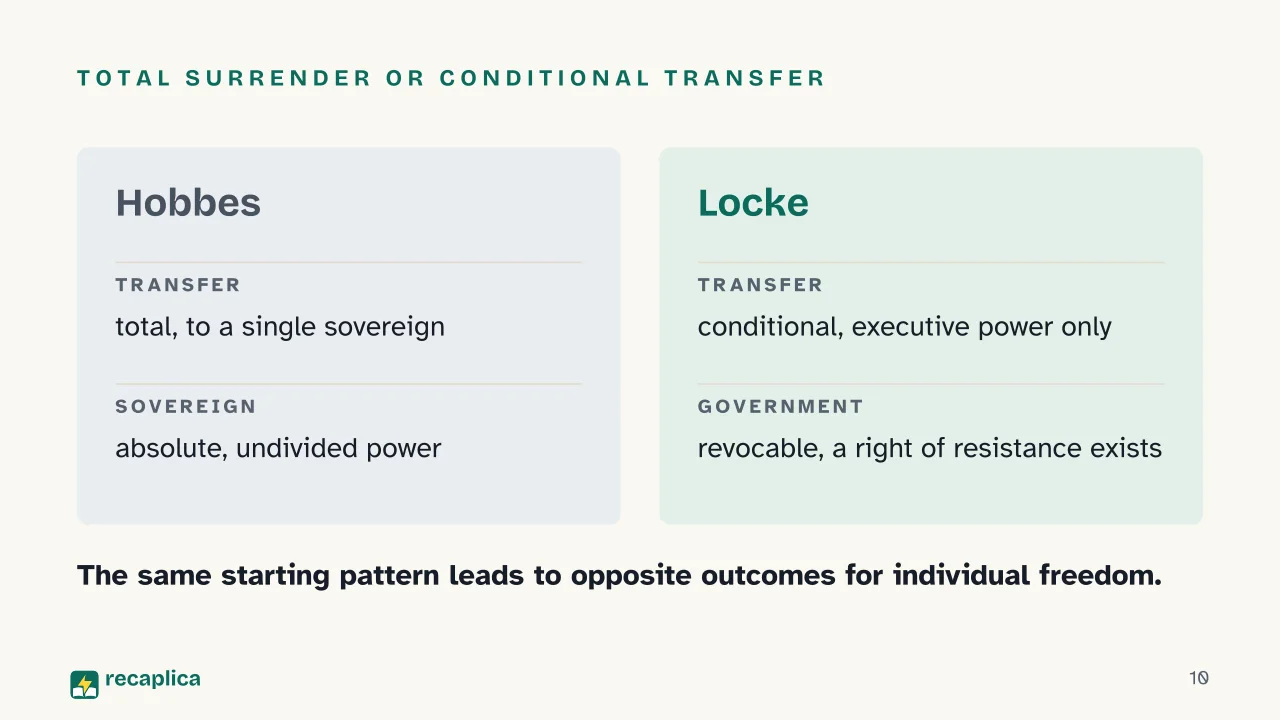 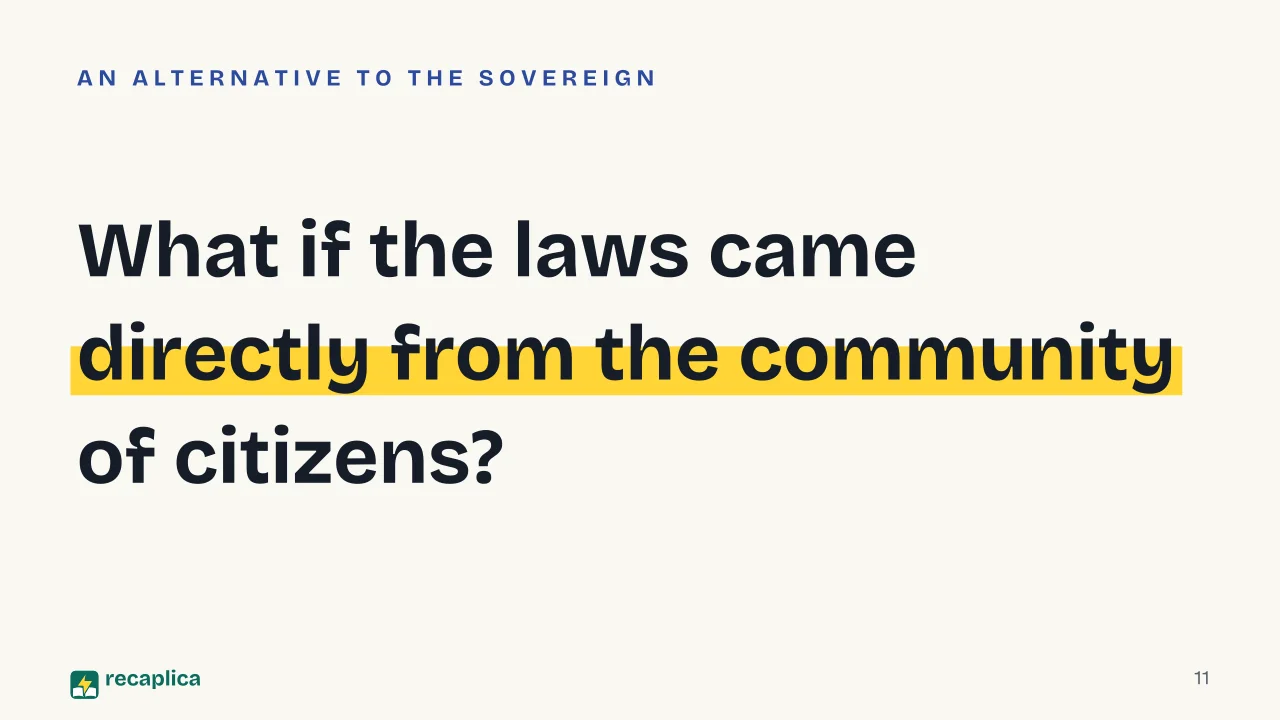 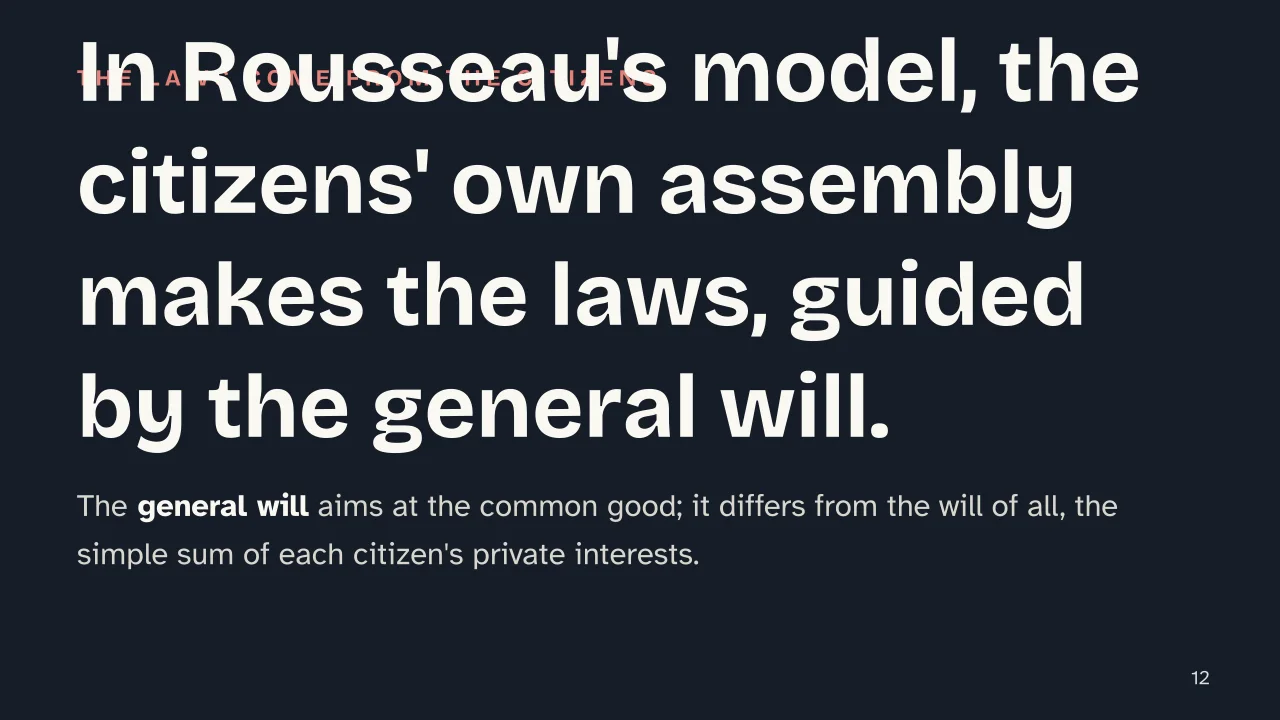 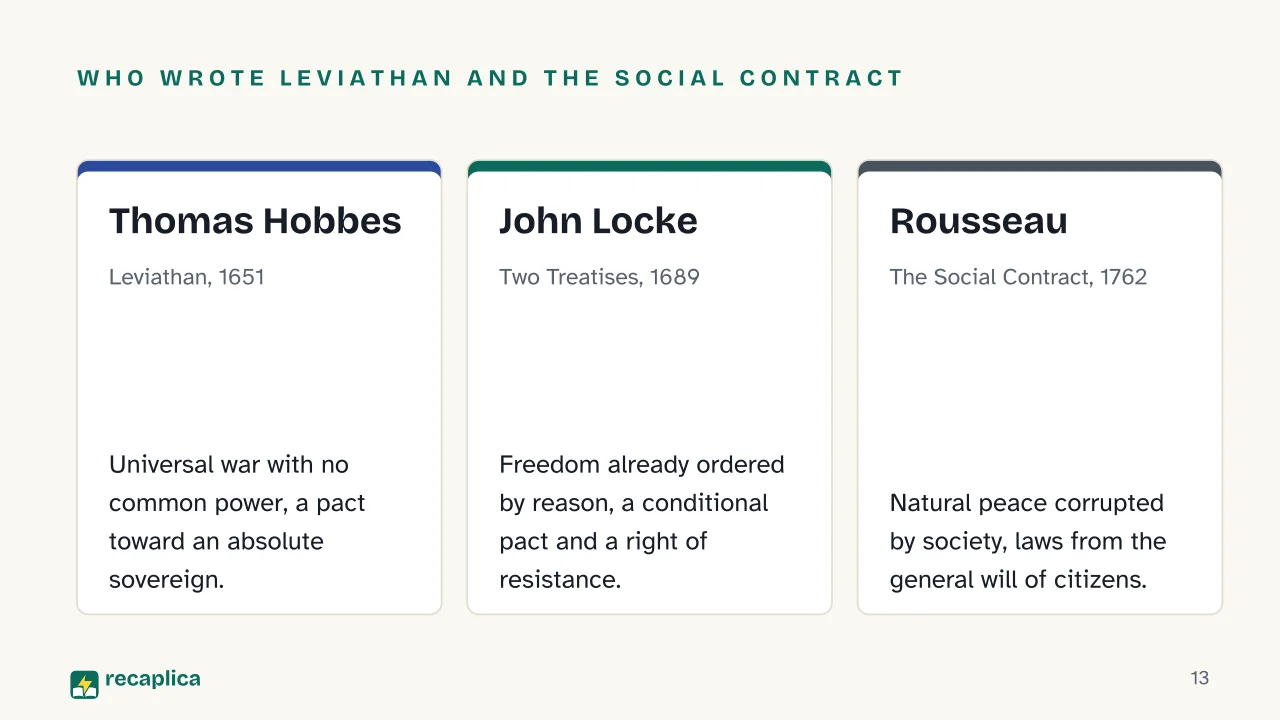 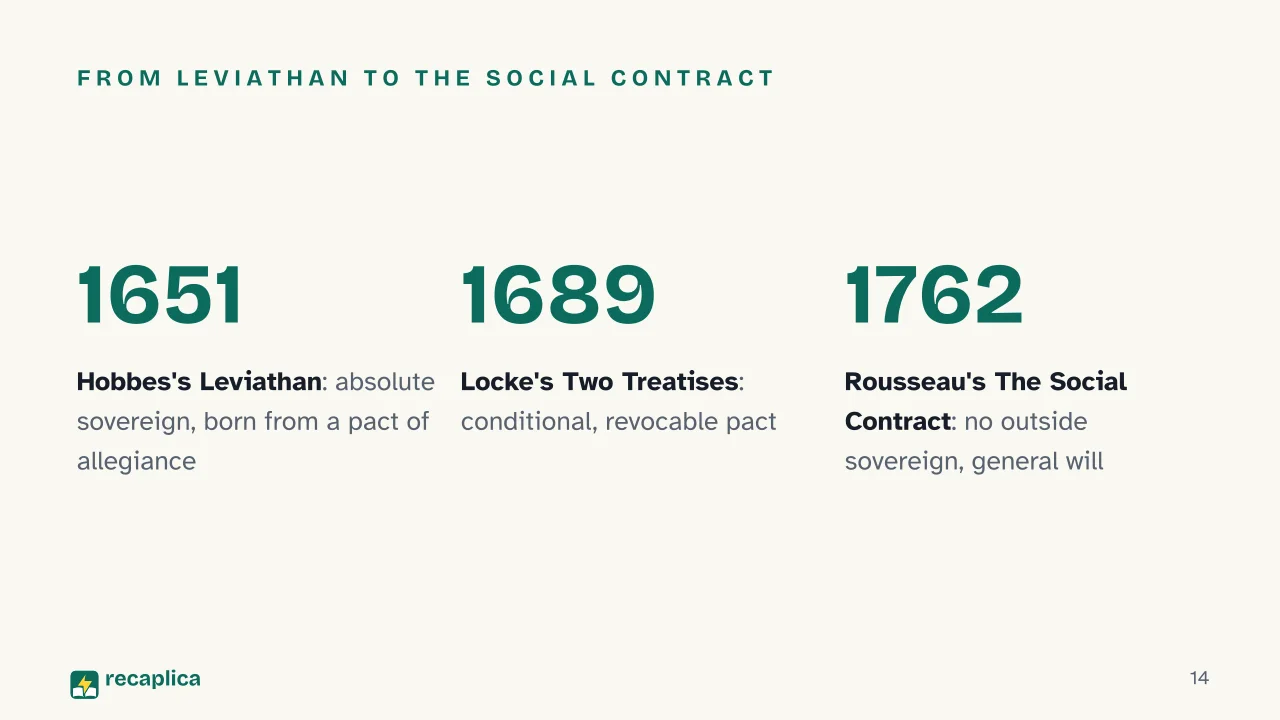  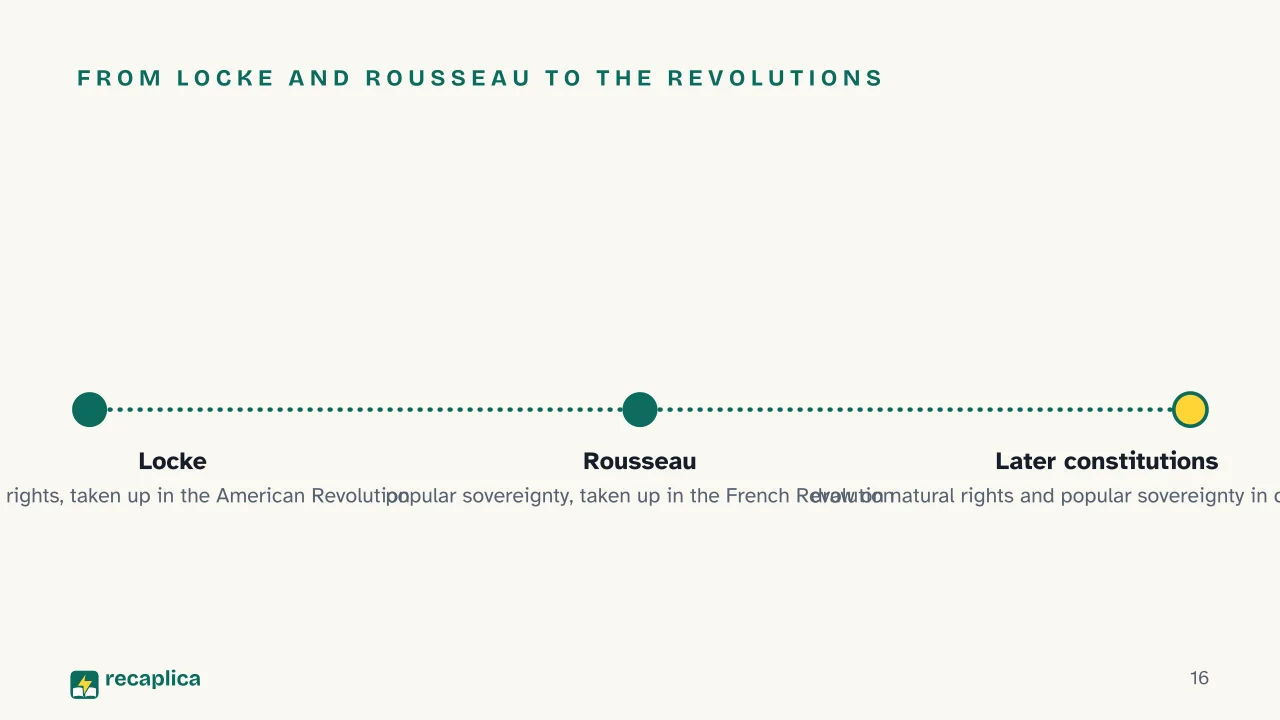 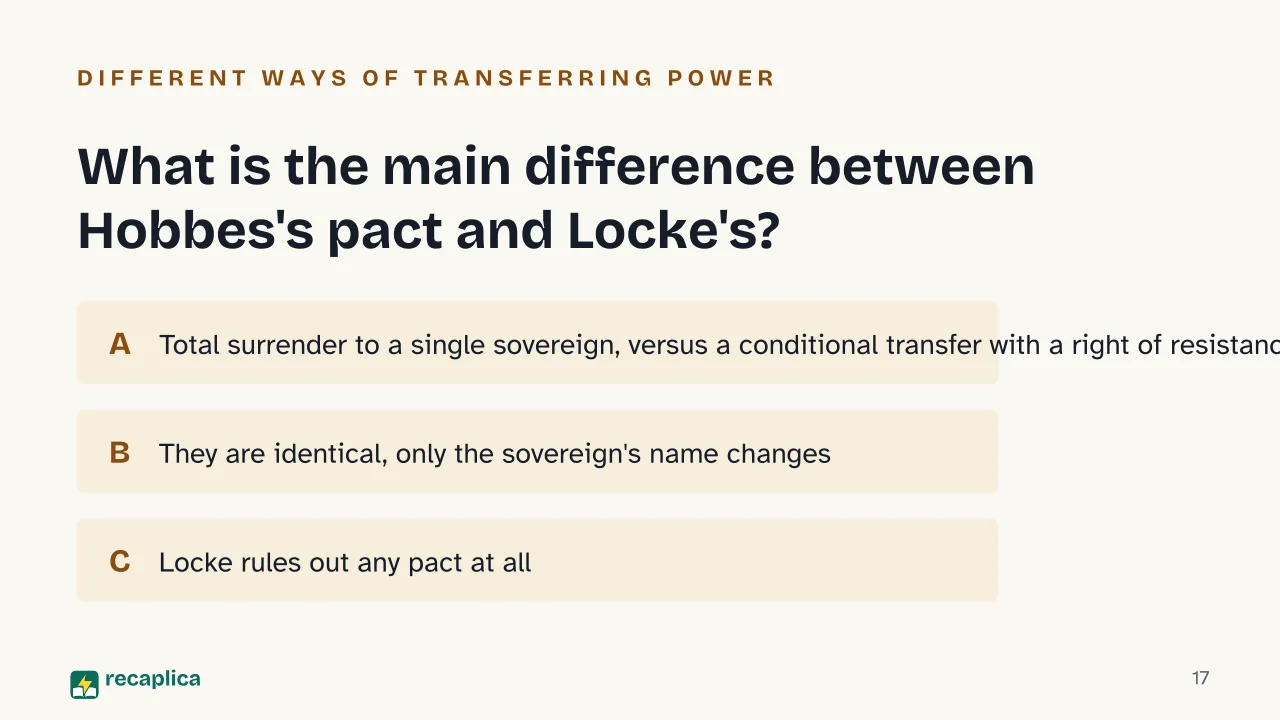  Common myths
Mind mapDrag the background to move around and the nodes to reposition them; use − and + to collapse and expand branches. 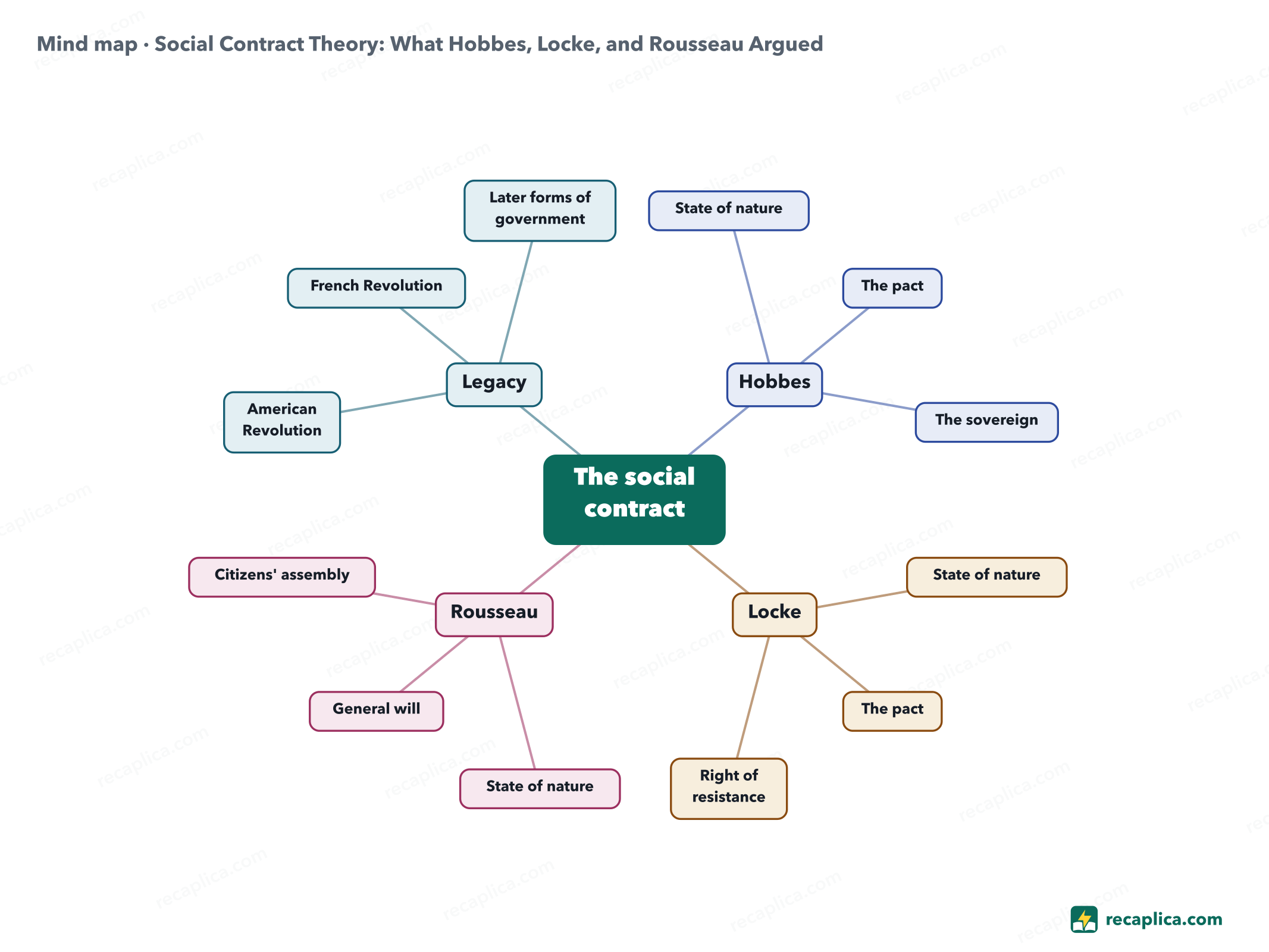
Quiz: test yourselfAnswer the questions to check what you have learned: you get instant feedback and a short explanation. Grade 0/10 0/5
FlashcardsTap the card to flip it and check whether you remember the answer, then move to the next one. 1 / 8 Explain it in your own wordsThe ultimate test: if you can explain it in simple words, you've truly understood it. Write your explanation, then compare it with the Recap. Your explanation is saved only on this device.
Frequently asked questionsWhat is social contract theory?It is a philosophical thought experiment that explains why people accept living under a shared political authority: each person gives up part of their original freedom in exchange for protection or shared rules. What is the difference between Hobbes, Locke, and Rousseau on the social contract?Hobbes hands absolute power to a single sovereign. Locke transfers to government only the power to punish violations and keeps the option of replacing it if it betrays its mandate. Rousseau delegates to no one: laws come from the assembly of citizens themselves. What is the state of nature?It is the condition, imagined by the three philosophers, in which individuals live before any shared political authority. Hobbes describes it as universal war, Locke as freedom already ordered by reason, Rousseau as a peaceful age free of competition. Was the social contract ever actually signed?No. Hobbes, Locke, and Rousseau present it as a tool for philosophical reflection used to justify political authority: none of the three describes an agreement that really took place. What does Rousseau mean by the general will?It is the shared orientation toward the common good that, according to Rousseau, guides the laws of a community: it is distinct from the simple sum of each citizen's personal interests. Every Recap goes through an independent review before publication. |