|
recaplica
David Hume: The Empiricism That Questioned Cause and Effect |
| © 2026 Recaplica · recaplica.com — All rights reserved |
David Hume: The Empiricism That Questioned Cause and EffectWhat to print Page numbers appear when printing with default margins. SlidesChoose a cut Flash10 slidesThe essential thread, to present in classFull15 slidesEvery chapter and the deeper detailBoth come with speaker notes. In 30 seconds quick readDavid Hume was a Scottish philosopher who lived from 1711 to 1776, one of the leading figures of the Scottish Enlightenment. In his empiricism, every idea in the mind traces back to an earlier experience: without sense impressions, there is no raw material to build from. Hume applies the same principle to cause and effect and concludes that we never observe the link itself in the world; we form it out of habit, after watching the same sequence of events repeat many times. His most ambitious book, A Treatise of Human Nature, came out before he turned thirty and drew almost no attention at first; his ideas later shaped the work of Immanuel Kant. Key Points
Key figures
Deep DiveWho David Hume wasDavid Hume was born on 26 April 1711 in Edinburgh, into a reasonably well-off Berwickshire family. His widowed mother raised him until he turned eleven, the age at which he entered the University of Edinburgh, according to the Internet Encyclopedia of Philosophy. He is one of the leading figures of the Scottish Enlightenment, the philosophical and scientific movement that spread across Scotland through the eighteenth century. He died at 65, on 25 August 1776, also in Edinburgh, from an internal illness. The question driving his whole body of work is not new in the history of philosophy: it goes back at least to the pre-Socratic philosophers and their search for the arché, the underlying principle of all things. Hume asks it differently, though: not what the world is made of, but where our knowledge of that world actually comes from. Scottish empiricism: impressions and ideasHume’s empiricism builds on the model set out by John Locke, which gives experience the final word on knowledge. For Hume, all knowledge reduces, in the end, to sense experience alone, as both the Stanford Encyclopedia of Philosophy and Treccani read him. It is a position that has long stood against the rationalist tradition going back to Plato and his theory of Forms: where Plato looks for knowledge reached through reasoning alone, about Forms the mind grasps independently of the senses, Hume starts from the opposite assumption. To explain how this works, Hume splits mental perceptions into two kinds: impressions and ideas. Impressions are the sensations and feelings we experience firsthand; ideas are the thoughts that follow from them. The difference between the two, according to the Stanford Encyclopedia of Philosophy, comes down to force and vivacity: higher in impressions, lower in ideas. Every idea, on this account, traces back to an earlier impression.
Cause and effect, according to HumeThe most debated part of Hume’s thought concerns how we explain relations between events. When one billiard ball strikes another, we say the first caused the second to move. According to Hume, though, what the senses actually register is just a sequence: one event followed by another, never a necessary link we can see between them. The Stanford Encyclopedia of Philosophy describes what takes the place of that link: the mind projects a causal connection onto observed regularities, a connection that is not out there in the world but a tendency of the mind itself. Our inductive inferences, including the bond between cause and effect, come from habit and mental custom rather than from a provable logical foundation. It is habit, built up from repeatedly observing the same sequence, that produces the expectation that event B will follow event A, and that expectation is where the idea of a necessary connection comes from, according to both the Stanford Encyclopedia of Philosophy and the Internet Encyclopedia of Philosophy. This is the source of what is usually called Hume’s best-known skeptical argument, the one about induction: inferring events we have not yet observed from ones we already have. On this reading, Hume concludes that the principle of the uniformity of nature, the assumption that the future will resemble the past, remains without a provable rational foundation.
None of this means Hume denies that fire burns or that a thrown stone falls to the ground: in everyday practice, the habit stays in place and keeps guiding our expectations. What Hume questions is only the claim to an absolute rational guarantee behind those links. A Treatise of Human NatureHume’s most ambitious work carries a full title that is not widely known: A Treatise of Human Nature, an attempt to bring the experimental method into questions of morality. The title itself signals the book’s ambition, close in spirit to the scientific method, here applied to the study of the mind and of morals. The Treatise came out anonymously: the first two books in 1739, the third the following year, before Hume turned thirty. By Hume’s own account, the reception was cold enough that the book “fell dead-born from the press,” failing to stir even its sharpest critics. The Stanford Encyclopedia of Philosophy considers that verdict probably overstated, but the early lack of success remains a fact reported by the author himself. In 1748 Hume returned to the same themes with An Enquiry Concerning Human Understanding, a shorter and more accessible rewrite of the Treatise’s first book. It is through this version that many later readers first encountered the argument about induction and the distinction between impressions and ideas. The legacy: from Kant onwardIn the Prolegomena to Any Future Metaphysics, published in 1783, Immanuel Kant writes that reading Hume is what first “interrupted his dogmatic slumber” and gave his philosophical research a new direction. According to the Stanford Encyclopedia of Philosophy, Hume’s positions were later taken up and challenged by Kant, who grounds his transcendental idealism on them in the Critique of Pure Reason. A reading reported by Treccani adds that Hume’s critique helped, in a negative sense, set the stage for that Kantian transcendentalism, a debt Kant acknowledges openly, in his own words, in the introduction to the Prolegomena. Slide deckSlides ready to download and make your own in PowerPoint or Google Slides, with speaker notes. Pick the Flash cut or the Full one.   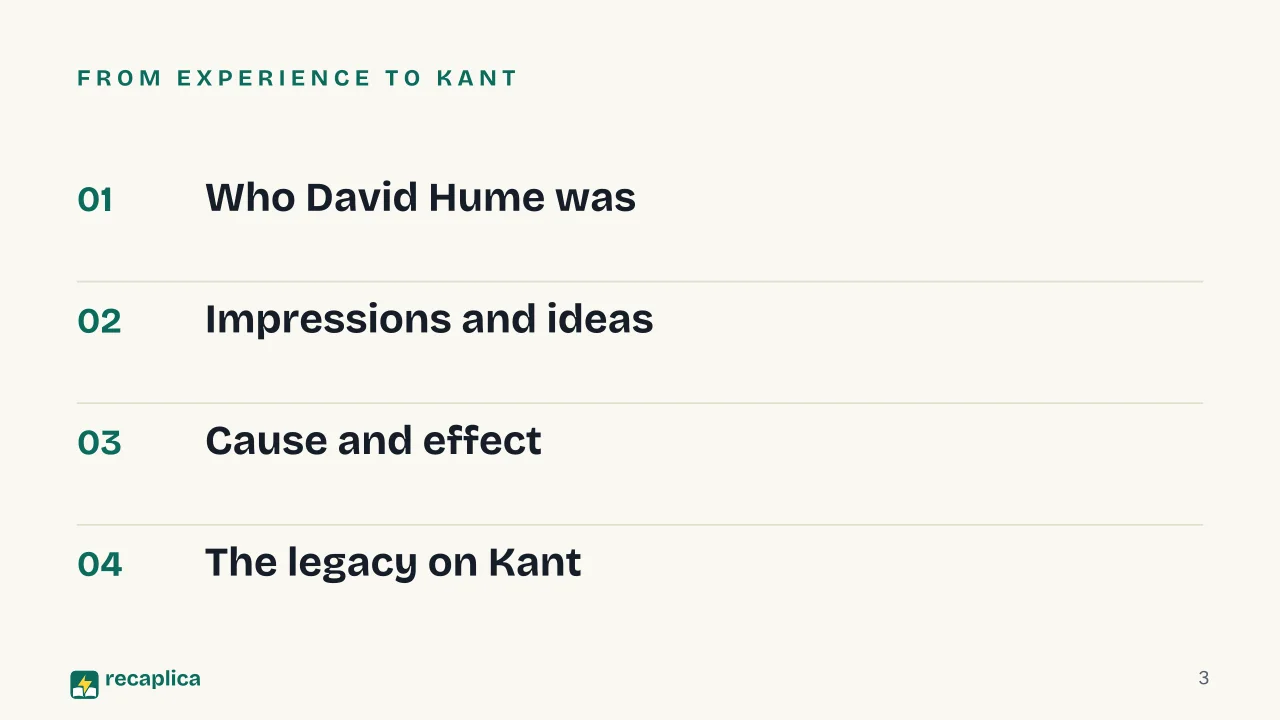  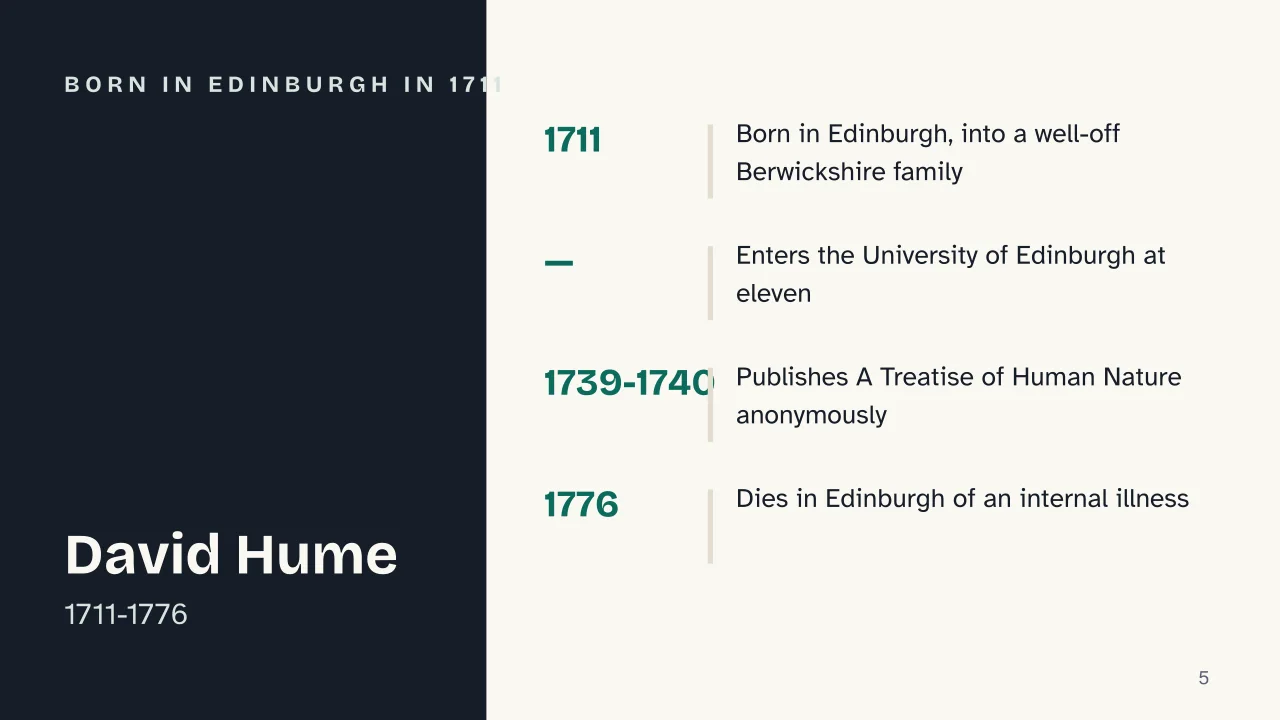  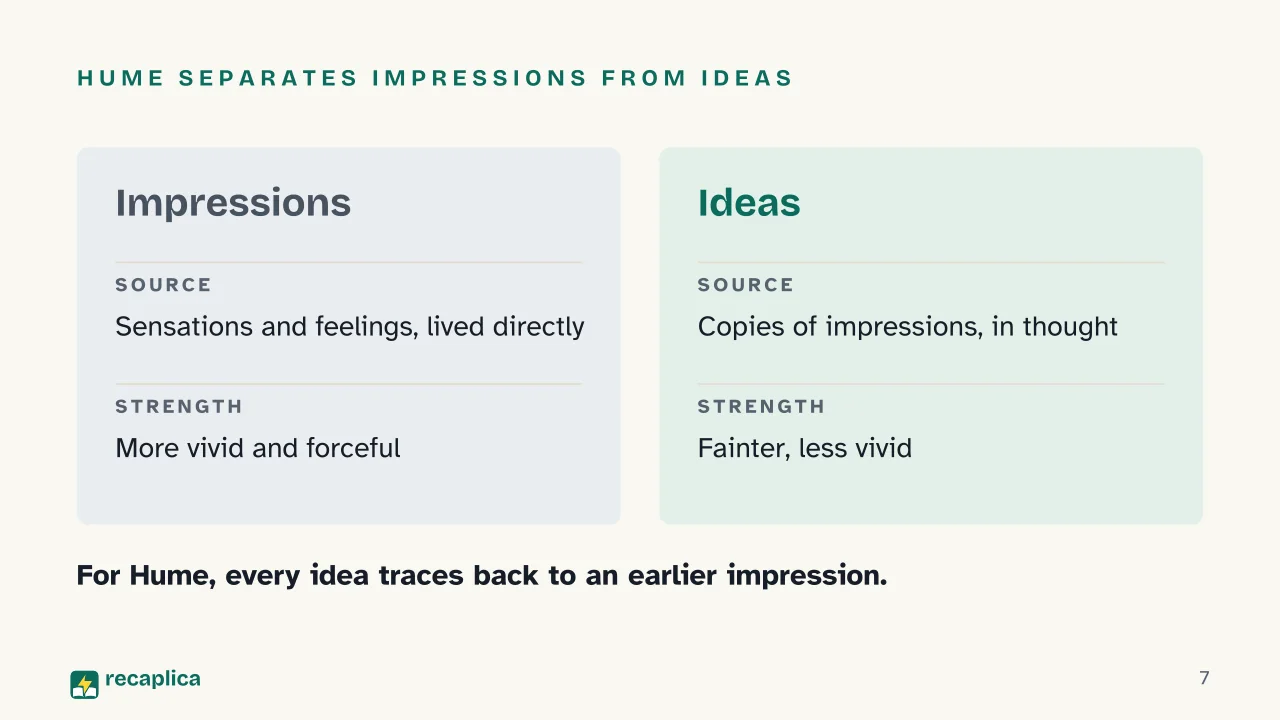  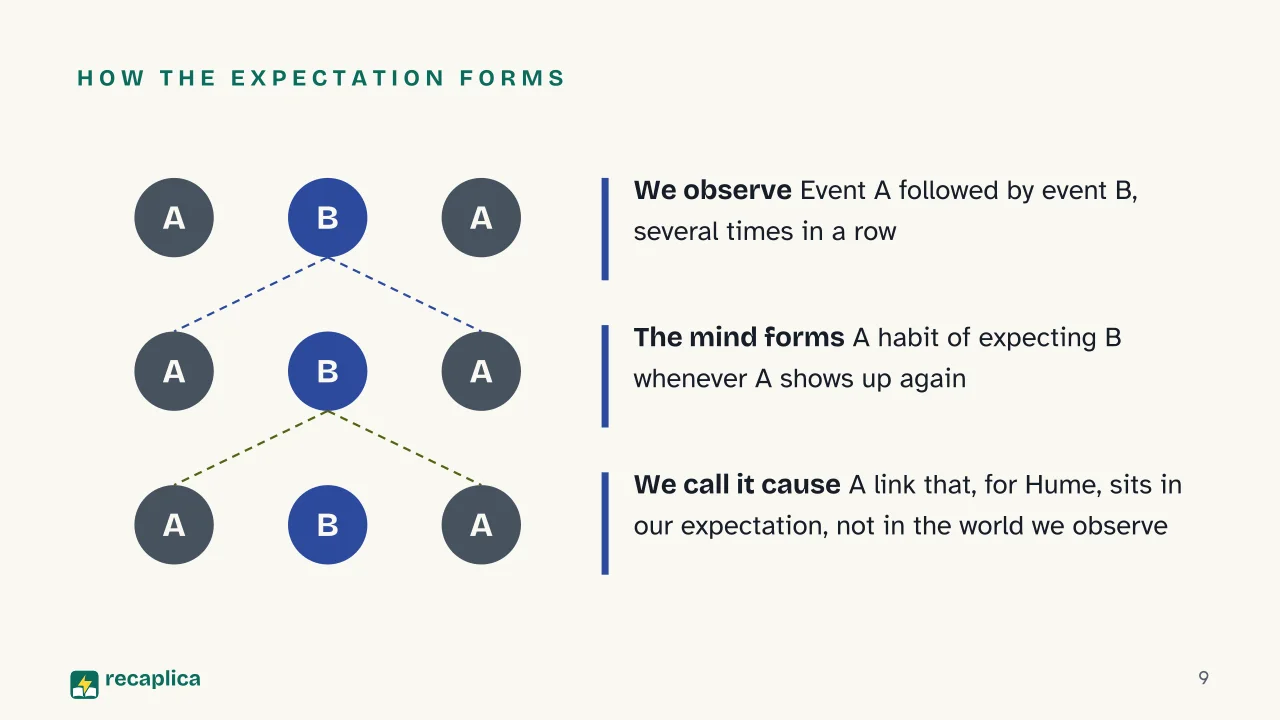 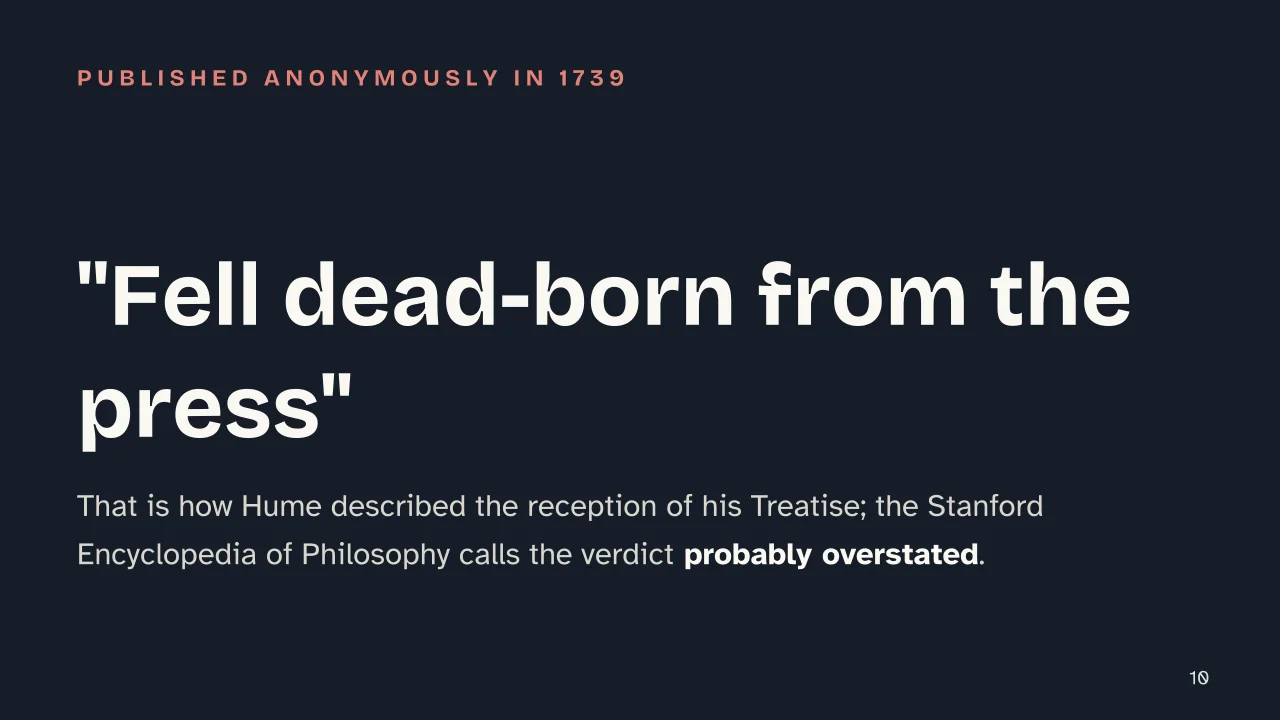  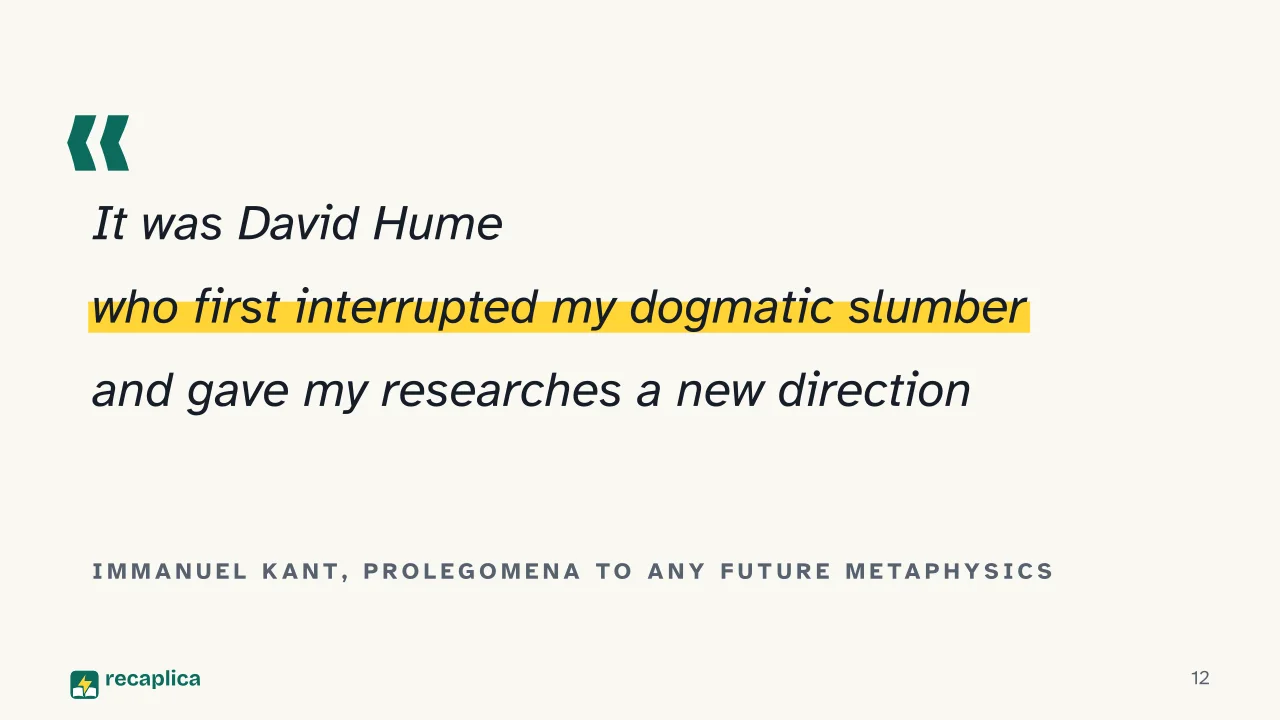 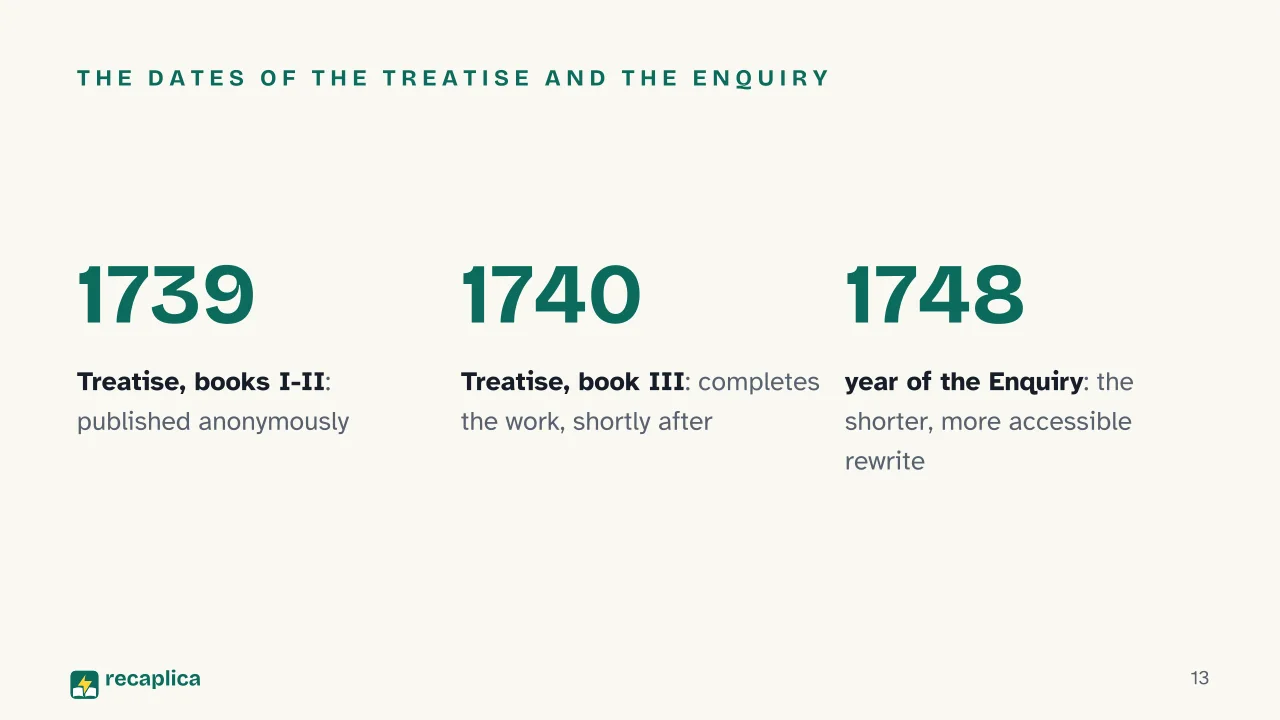 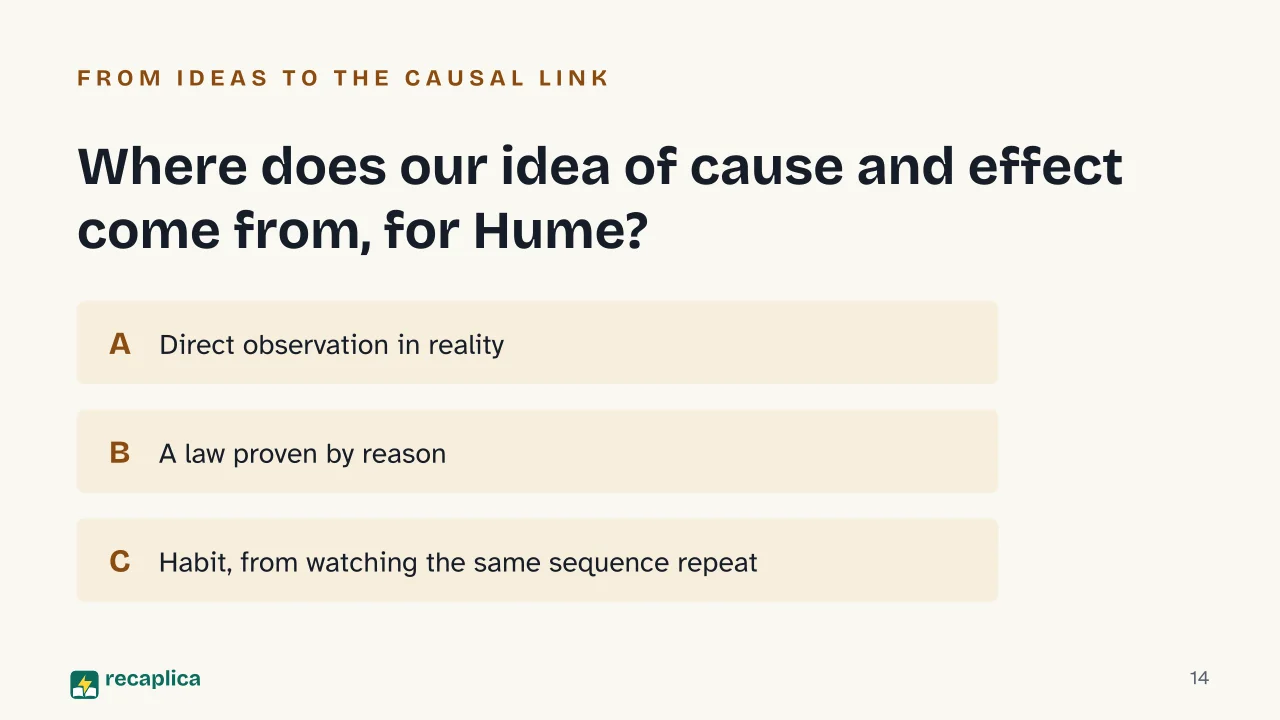  Common myths
Mind mapDrag the background to move around and the nodes to reposition them; use − and + to collapse and expand branches. 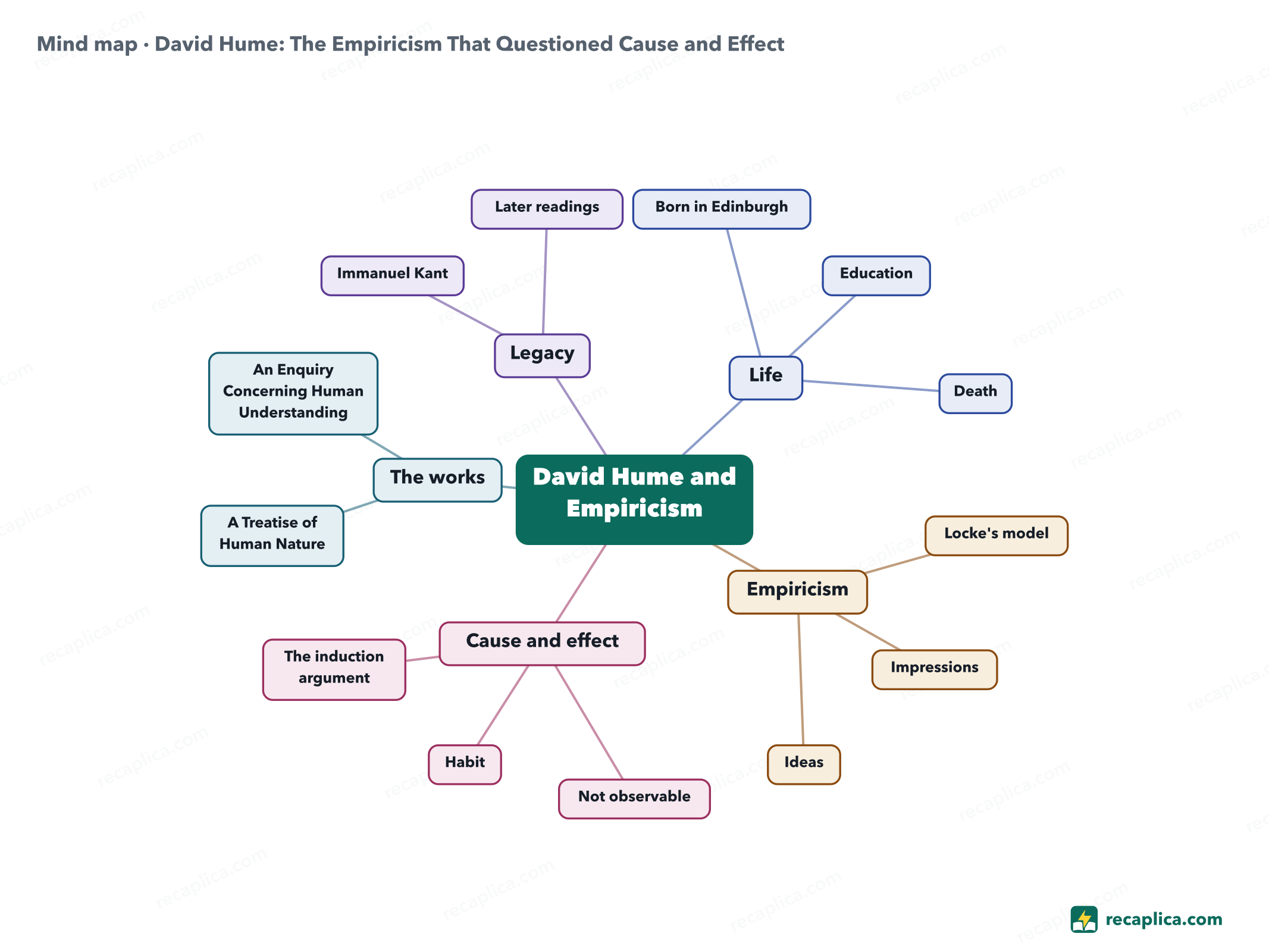
Quiz: test yourselfAnswer the questions to check what you have learned: you get instant feedback and a short explanation. Grade 0/10 0/5
FlashcardsTap the card to flip it and check whether you remember the answer, then move to the next one. 1 / 8 Explain it in your own wordsThe ultimate test: if you can explain it in simple words, you've truly understood it. Write your explanation, then compare it with the Recap. Your explanation is saved only on this device.
Frequently asked questionsWhat is the difference between A Treatise of Human Nature and An Enquiry Concerning Human Understanding?The Treatise (1739-1740) is the larger, earlier work; An Enquiry Concerning Human Understanding (1748) takes up the same themes from its first book in a shorter form, aimed at a wider readership. What is the connection between David Hume and Immanuel Kant?Kant writes in the Prolegomena that reading Hume interrupted his "dogmatic slumber" and redirected his research, eventually leading him to write the Critique of Pure Reason. Did Hume deny that causality exists?No. He questioned only whether cause and effect has a demonstrable rational foundation, not whether one event follows another in everyday practice. What are impressions and ideas in Hume's thought?Impressions are the strongest, most vivid perceptions, such as sensations and feelings; ideas are fainter perceptions, copies of impressions used in thinking and memory. What is empiricism in philosophy?Empiricism holds that knowledge comes from sense experience rather than from reason alone. Hume pushed this view further than Locke, applying it even to cause and effect. Every Recap goes through an independent review before publication. |