|
recaplica
Enlightened Absolutism: What It Was and Who Practiced It |
| © 2026 Recaplica · recaplica.com — All rights reserved |
Enlightened Absolutism: What It Was and Who Practiced ItWhat to print Page numbers appear when printing with default margins. SlidesChoose a cut Flash10 slidesThe essential thread, to present in classFull16 slidesEvery chapter and the deeper detailBoth come with speaker notes. In 30 seconds quick readEnlightened absolutism describes how, in the second half of the 18th century, several European absolute monarchs adopted Enlightenment ideas — religious tolerance, legal reform, administrative modernization — without ever handing power to their own subjects. Frederick II of Prussia, Catherine II of Russia, Joseph II of Austria, Maria Theresa, and, in Spain and Portugal, Charles III with his minister the Marquis of Pombal, all practiced it. Their reforms touched justice, education, church relations, and state administration, but every decision still came from the top, with no form of popular representation. Historians still argue over how much these rulers genuinely believed in Enlightenment ideas and how much they simply used them to strengthen the state. Key Points
Key figures
Deep DiveIn the 18th century several European monarchs governed by a method now known as enlightened absolutism: applying Enlightenment-inspired reforms — rational administration, efficiency, a measure of tolerance — without sharing power with anyone. According to the Encyclopedia of the Early Modern World’s entry on “Enlightened Despotism,” what these monarchs had in mind was simply building monarchies strong enough to impose fairer, more efficient policies, not to give up any sovereignty. Who these rulers wereThe most commonly cited group includes Frederick II of Prussia (1740-1786), Catherine II of Russia (1762-1796), Joseph II of Austria (co-ruler from 1765, sole monarch 1780-1790), and his mother Maria Theresa (1740-1780). In Spain the model was carried out by Charles III (1759-1788), and in Portugal by the Marquis of Pombal, minister to Joseph I from 1750 to 1777. Encyclopedia.com notes that enlightened absolutism flourished most in the three decades following the Seven Years’ War, which ended in 1763. Frederick II summed up the group’s ideology in a phrase that outlived him: he called himself “the first servant of the state.” The monarch’s power stayed intact: its justification, though, moved from divine right to a duty toward public welfare. It’s a similar question about where a ruler’s legitimacy comes from that the entry on types of government tries to sort out. Administrative and economic reforms
Less dramatic but equally concrete reforms took hold elsewhere. Charles III of Spain tried to modernize his empire by weakening the economic power of the Church and its monasteries, promoting university research, and easing trade and agriculture, according to Wikipedia’s entry on enlightened absolutism. Maria Theresa, aided by advisers such as Kaunitz, Haugwitz, and van Swieten, reorganized the finances and administration of the Habsburg lands. Legal and social reformsThe period’s most ambitious legal document is Catherine II’s Nakaz, published in 1767: 22 chapters and 655 articles, more than 400 of them copied almost verbatim from the works of Montesquieu and Beccaria. The text was meant to guide the Legislative Commission convened that same year to write a new law code for the Russian empire. The commission never got there: Wikipedia’s entry on the Nakaz notes the text had little practical value and never circulated outside Moscow and St. Petersburg. Joseph II of Austria went beyond written law. In 1781 he abolished serfdom in his territories and made elementary education compulsory for boys and girls alike. In a confidential directive from August 1783 he further ruled that the death penalty, while remaining formally part of the law, would in practice rarely if ever be carried out. Religious reformsThe clearest clash between these rulers and the Church centered on the Jesuits. On 19 January 1759 the Marquis of Pombal issued a decree seizing the property of the Society of Jesus in Portuguese territory. France followed at the end of 1764 with an edict dissolving the order on its own soil, then Spain under Charles III in 1767, with secret orders sent to every provincial viceroy. In 1773 Pope Clement XIV formally suppressed the Society of Jesus across the entire Catholic Church. Joseph II took a different path from expulsion: in 1781 he signed the Patent of Toleration, granting religious minorities a limited freedom of worship. His mother Maria Theresa, who had modernized schooling and administration, never followed suit: historical sources document openly hostile positions toward the Jewish community, sharply at odds with her son’s choices. Ties to Enlightenment philosophyFrederick II corresponded with Voltaire for years and wrote an essay on “benevolent despotism” to defend his own model of government. Catherine II presents a murkier case: she built the Nakaz on Montesquieu’s work without ever naming him in the text, and admitted doing so for the benefit of her own empire. These rulers’ relationship with Enlightenment philosophy was therefore often a practical one, closer to a matter of image and state efficiency than genuine philosophical commitment. The gap between the theory of power and its practice appears too in Machiavelli’s The Prince, where reason of state guides the ruler’s choices more than abstract ideas about justice. Where the model broke downNone of the reforms described so far touched the central issue: political representation. Subjects remained subjects, with no power to be consulted or to veto the crown’s decisions. Joseph II’s reign is the starkest example of this imbalance: he acted in what he declared to be his subjects’ interest, yet never brought them into the decisions that affected them. Joseph II’s reforms were also the most ambitious, and the first to expose the model’s limits. The speed at which they were imposed, with no social mediation at all, triggered revolts such as the Brabant Revolution of 1789. Shortly before his death in 1790, Joseph II was forced to withdraw many of the reforms he had introduced in Hungary. Enlightened absolutism ran out of road in the very years France was working out a radically different idea of sovereignty: the one that would drive the French Revolution of 1789, with its demand for popular representation that no enlightened ruler had ever granted. A similar demand for political representation surfaced a little earlier in the American colonies: the American Revolution, in the 1770s, answered it by breaking with the ruler instead of reforming him. Slide deckSlides ready to download and make your own in PowerPoint or Google Slides, with speaker notes. Pick the Flash cut or the Full one.     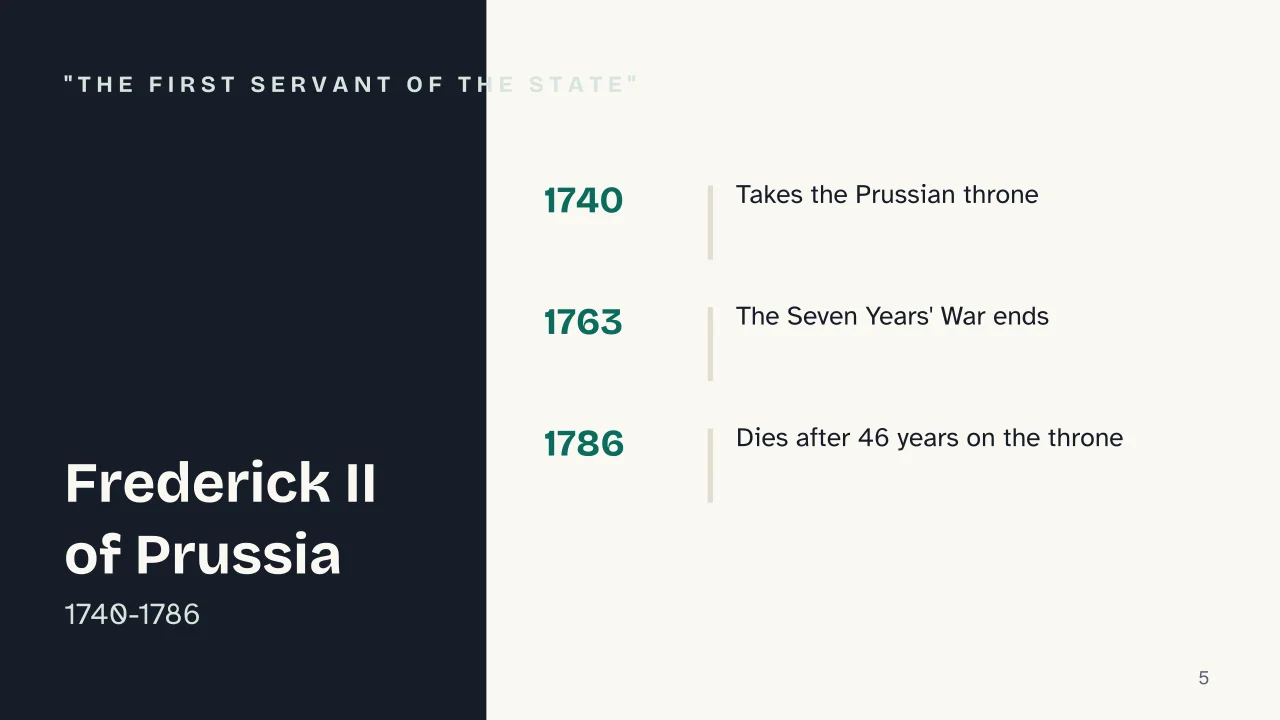 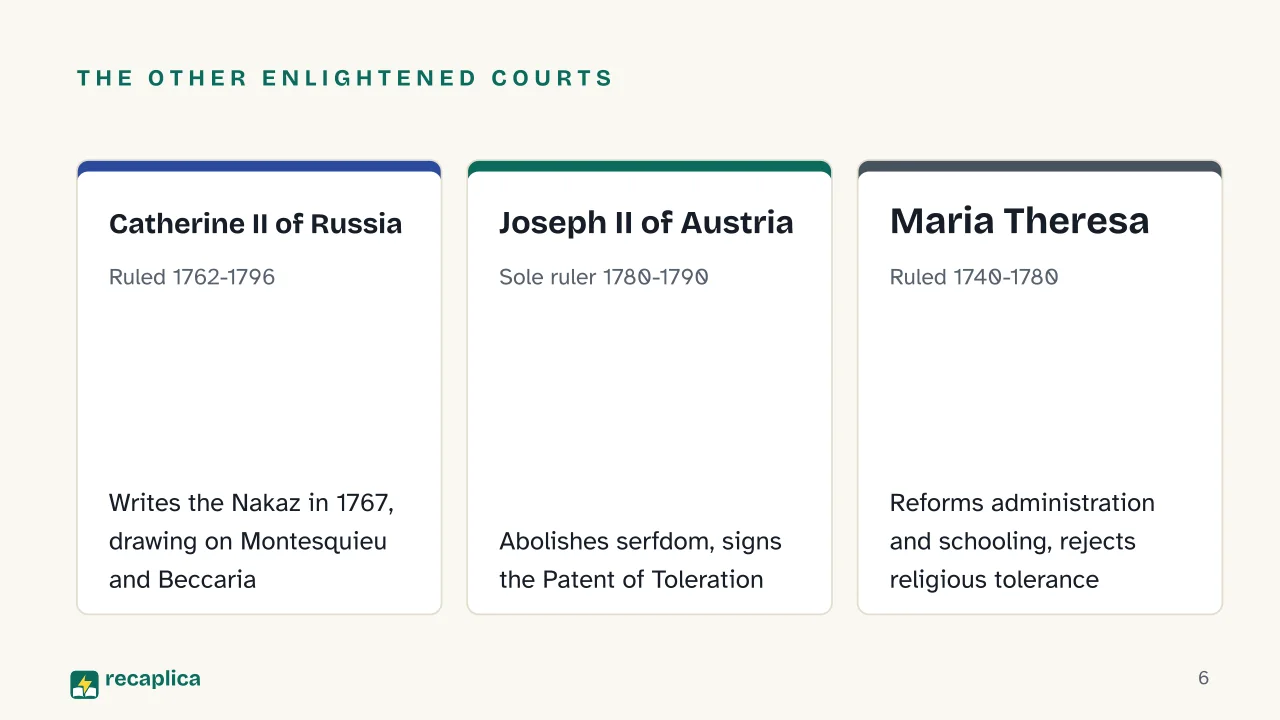  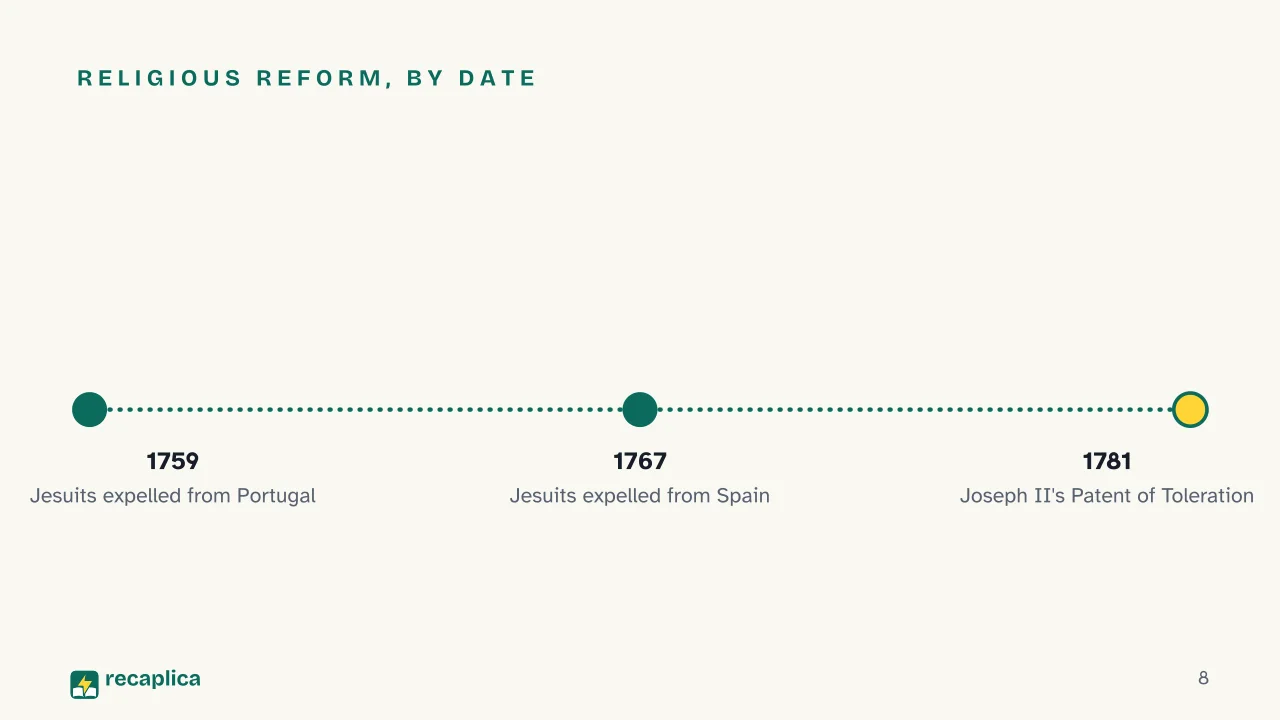 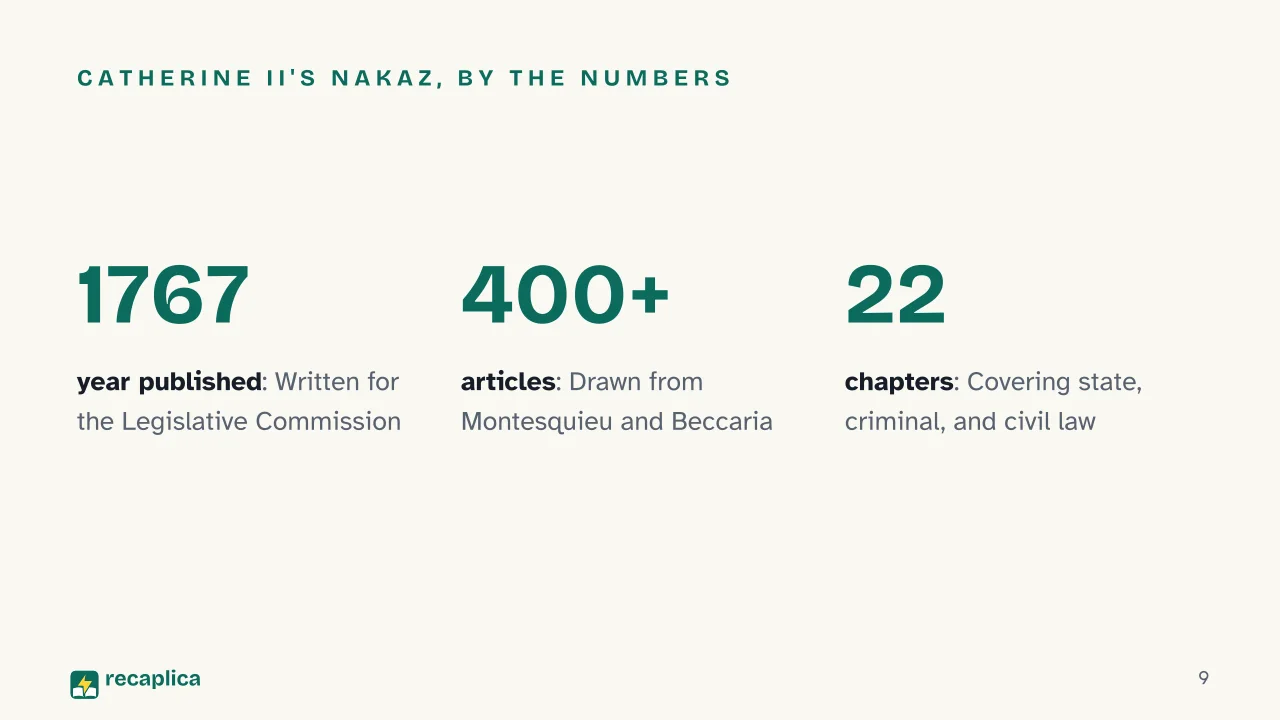  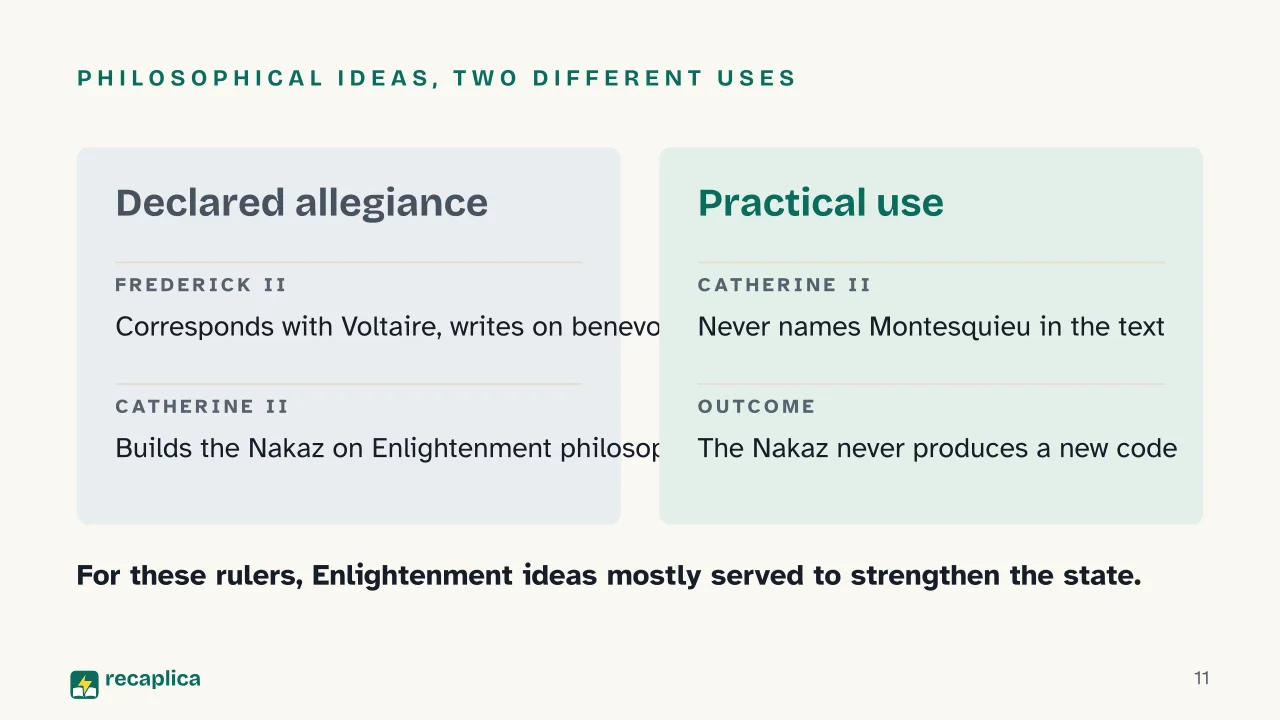   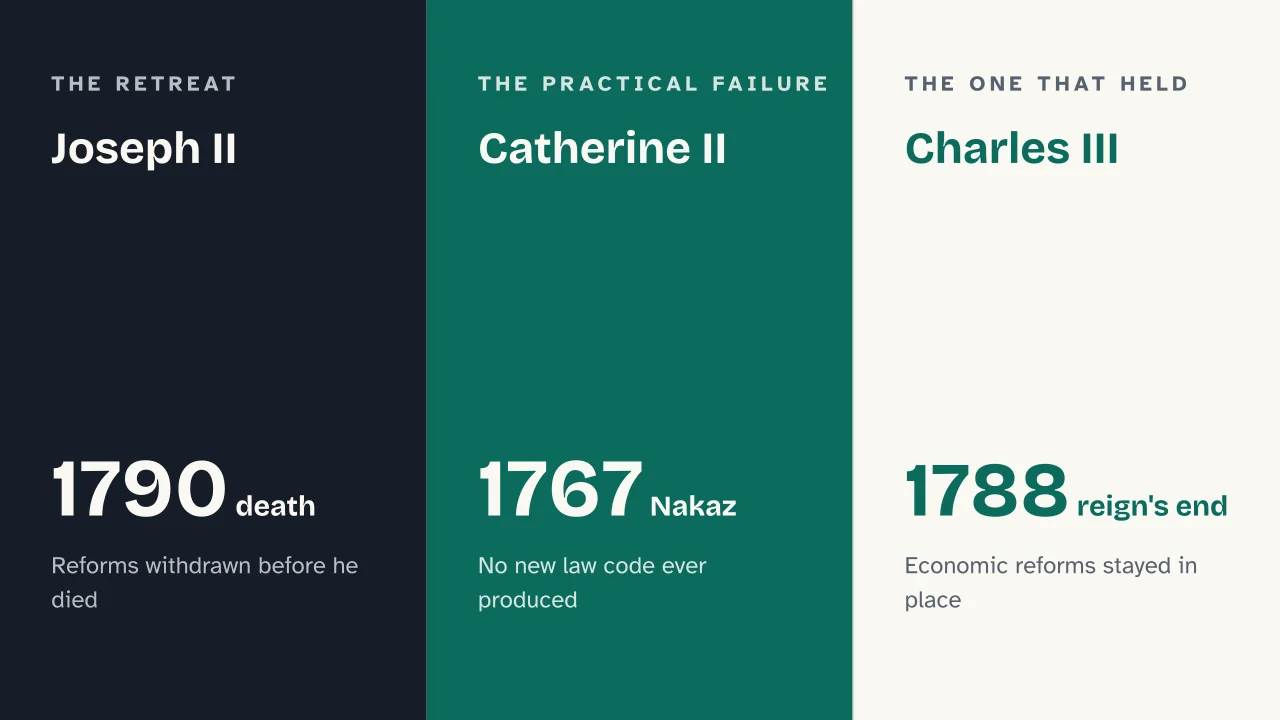 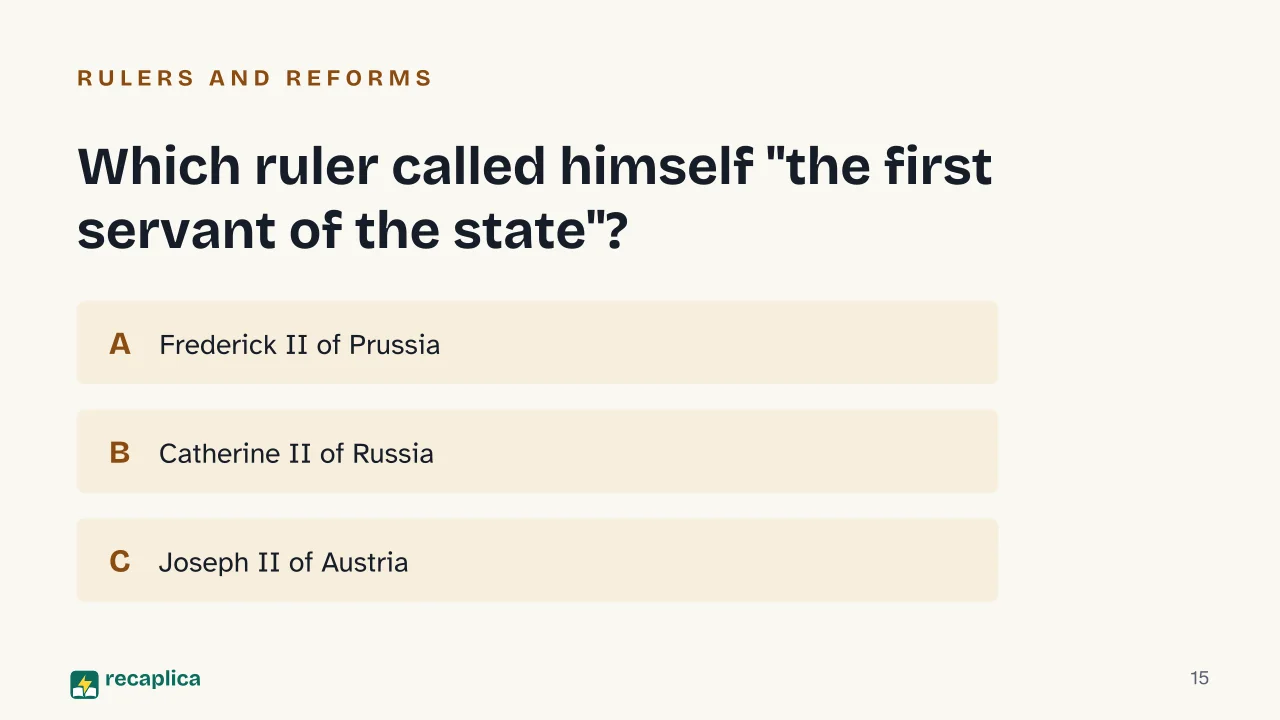  Common myths
Mind mapDrag the background to move around and the nodes to reposition them; use − and + to collapse and expand branches. 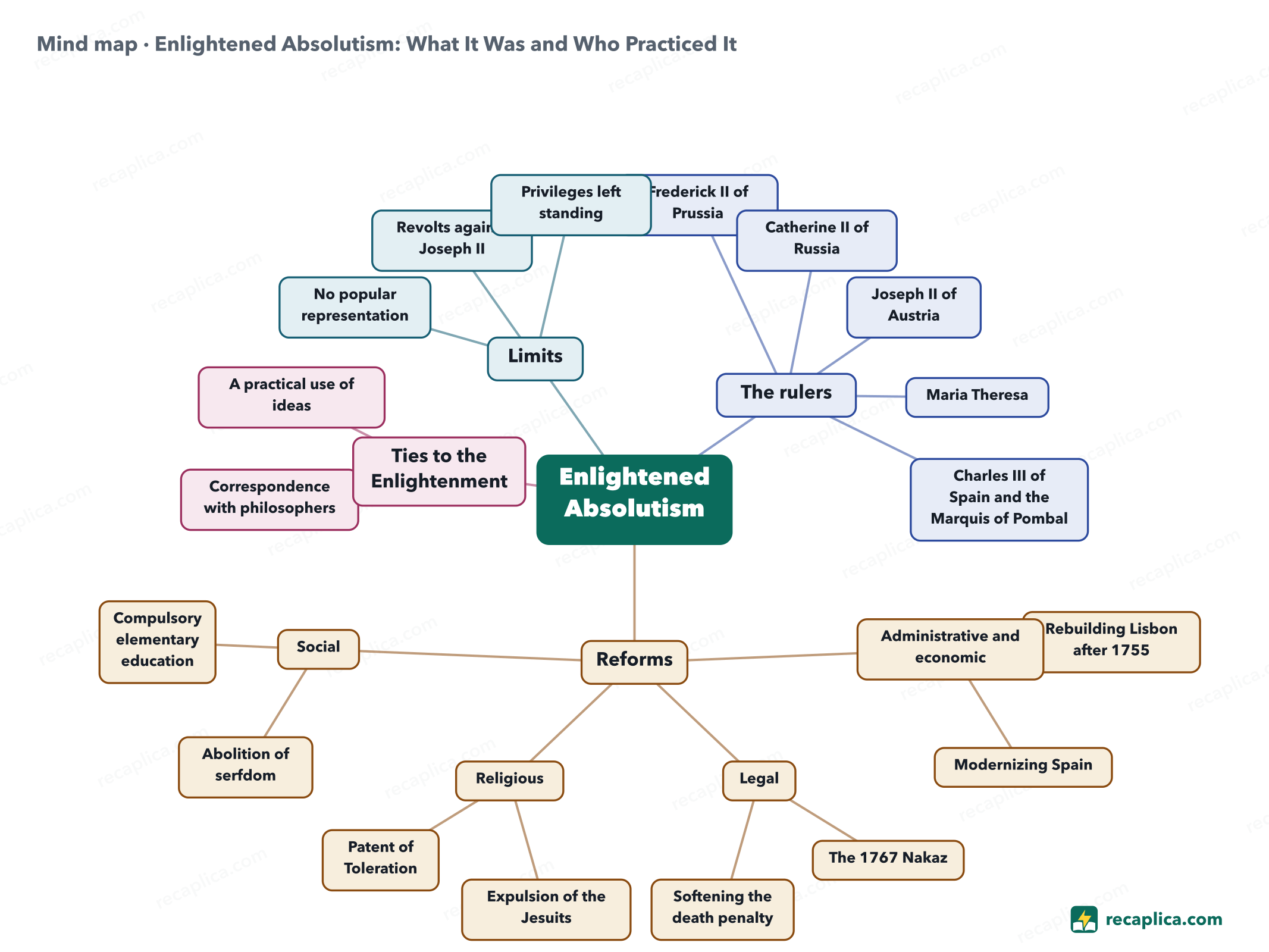
Quiz: test yourselfAnswer the questions to check what you have learned: you get instant feedback and a short explanation. Grade 0/10 0/5
FlashcardsTap the card to flip it and check whether you remember the answer, then move to the next one. 1 / 8 Explain it in your own wordsThe ultimate test: if you can explain it in simple words, you've truly understood it. Write your explanation, then compare it with the Recap. Your explanation is saved only on this device.
Frequently asked questionsWhat is enlightened absolutism?It is the form of government under which, in the second half of the 18th century, several absolute European monarchs adopted Enlightenment ideas — religious tolerance, legal reform, administrative modernization — while keeping all power firmly in their own hands, with no political representation for their subjects. Which rulers practiced enlightened absolutism?The most commonly cited cases are Frederick II of Prussia (1740-1786), Catherine II of Russia (1762-1796), Joseph II of Austria (sole ruler 1780-1790) and his mother Maria Theresa (1740-1780); in Spain, Charles III (1759-1788), and in Portugal, the Marquis of Pombal, minister to Joseph I from 1750 to 1777. How does enlightened absolutism differ from traditional absolutism?Under traditional absolutism the monarch justifies power through divine right; under enlightened absolutism the justification shifts to a duty toward the welfare of the state and its subjects, as in Frederick II's phrase "the first servant of the state." Power itself remains absolute in both cases. Why do historians call these rulers' use of Enlightenment ideas practical rather than ideological?Because in some cases these monarchs borrowed philosophers' ideas without truly sharing their principles: Catherine II admitted she drew on Montesquieu without naming him in the text of the Nakaz, for the benefit of her own empire, not out of genuine philosophical commitment. Did enlightened absolutism lead to real democratic reform?No: none of these rulers granted their subjects political representation. Joseph II's reforms were the most ambitious, but imposing them from above without social consent triggered revolts and forced a partial withdrawal shortly before his death in 1790. Every Recap goes through an independent review before publication. |