|
recaplica
French Revolution Summary: Causes, Phases and Consequences | ||||||||||||
| © 2026 Recaplica · recaplica.com — All rights reserved | ||||||||||||
French Revolution Summary: Causes, Phases and ConsequencesWhat to print Page numbers appear when printing with default margins. SlidesChoose a cut Flash10 slidesThe essential thread, to present in classFull19 slidesEvery chapter and the deeper detailBoth come with speaker notes. In 30 seconds quick readThe French Revolution is the sequence of events that between 1789 and 1799 swept away absolute monarchy in France and rewrote the rules of political life. It grew out of a public finance crisis and a society divided by birth into three estates, in which the nobility was exempt from the main taxes. Within months the Third Estate turned itself into a National Assembly, the Bastille fell and the Declaration of the Rights of Man and of the Citizen was adopted. Then came the Republic, the king's execution, the Terror and finally the coup that brought Napoleon Bonaparte to power. Key Points
Key figures
Deep DiveA state that could no longer balance its booksThe French Revolution did not begin with a crowd in the street but with a budget problem. By the late 1780s the French monarchy was in debt and could not put its revenues back in order. The trouble was not only how much it spent: it was also how taxes were collected. The nobility was exempt from the taille, the main direct tax, from the corvée royale (compulsory labour), from the salt tax and from most other levies. Every attempt to widen the tax base ran into the resistance of the noble orders, who had little appetite for any cut to their privileges.
Out of room to manoeuvre, Louis XVI made the one move left to him: summoning the Estates General, the assembly of the kingdom’s three orders. Three estates, one countrySociety under the ancien régime was divided by birth, and the division had very practical consequences for who paid and who decided.
Out of a population of roughly 26 million, 21 million lived from agriculture. The Third Estate was not one homogeneous class: it held destitute peasants and wealthy merchants, lawyers and artisans. What held them together was a legal status that said nothing about their income.
1789, month by monthThe Estates General opened at Versailles on 5 May 1789. From there events came in quick succession, each one making the previous step irreversible.
Article 1 states that men are born and remain free and equal in rights; article 4 defines liberty as being able to do anything that does not harm others; article 6 holds that the law is the expression of the general will. The monarchy did not fall straight awayHere the chronology surprises almost everyone meeting the Revolution for the first time: in 1791 France adopted a Constitution that kept the king. It was a constitutional monarchy, not a republic. What cracked the arrangement was the flight: on the night of 20-21 June 1791 Louis XVI tried to leave the country and was stopped at Varennes. By fleeing, the king had in effect stopped honouring the constitutional bargain. In 1792 came war against a coalition of European monarchies bent on restoring absolutism, and on 10 August the crowd stormed the Tuileries. On 20 September 1792 the French army won at Valmy. The next day, at its first sitting, the National Convention (749 deputies elected on 2 September by universal male suffrage) unanimously decreed that royalty was abolished. From the following day public acts were dated “year one of the French Republic”; on 25 September the Republic was declared “one and indivisible”. The assembly split into three groups: the Girondins on the right, moderate republicans rooted in the provinces and wary of Parisian radicalism, the Montagnards on the left, who backed a strong central republican power, and the Plaine, the moderates in the centre. On 21 January 1793 Louis XVI was guillotined. The TerrorWith war on the borders and revolts inside the country, the Convention handed government to the Committee of Public Safety and repression to the revolutionary tribunals. This phase is known as the Terror and runs from 5 September 1793 to 27-28 July 1794. Two laws marked its hardening. The Law of Suspects of 17 September 1793 made anyone deemed an enemy of the Republic liable to arrest. The Law of 22 Prairial (10 June 1794) removed the investigation phase of a trial and the right to counsel. The figures, estimates though they remain, give the scale: 16,594 people guillotined across France, 2,625 of them in Paris, roughly 10,000 deaths in prison, and an overall toll estimated between 30,000 and 50,000. The Terror ended when the Convention turned on the man running it: Robespierre was arrested and guillotined on 27-28 July 1794, along with twenty-one supporters. The assignats: the Revolution seen through pricesAn economic story ran alongside the political one. From December 1789 the state issued assignats, paper money backed by national property confiscated from the crown and the Church: a first issue of 400 million livres, decreed in December 1789. The mechanism jammed quickly. By April 1790 the assignat was worth 10% less than metal currency; every new difficulty pushed the authorities to print more, and by 1793 some 3.7 billion livres were in circulation. By 1795 a 1,000-livre assignat had the purchasing power of 80 livres in silver. On 19 February 1796 the Directory stopped the issues. This is inflation in its purest form, two centuries before the word carried its present meaning: more means of payment chasing the same goods, and prices climb. Not to be confused with a recession, which is about output contracting instead: two distinct problems, and revolutionary France was mainly dealing with the first. Thermidor, Directory, BrumaireWith Robespierre gone, the Convention wrote a new Constitution in 1795 and handed executive power to the Directory. These were unstable years, marked by war and by the republican governments set up in Italy between 1797 and 1799. On 18-19 Brumaire 1799 Napoleon Bonaparte’s coup overthrew the Directory. From that point the regime changed its name, but several revolutionary changes stayed in place. Privilege by birth was gone, equality before the law applied, and the subject had become a citizen. What was left behindThe 1789 Declaration is not a filed-away document. The preamble of the Fifth Republic’s Constitution points back to it, and in 1971 the French Constitutional Council granted it constitutional value: a law passed in Paris today can be struck down for conflicting with a text written in 1789. The same principles turn up in the 1948 Universal Declaration of Human Rights, written a century and a half later. Slide deckSlides ready to download and make your own in PowerPoint or Google Slides, with speaker notes. Pick the Flash cut or the Full one.  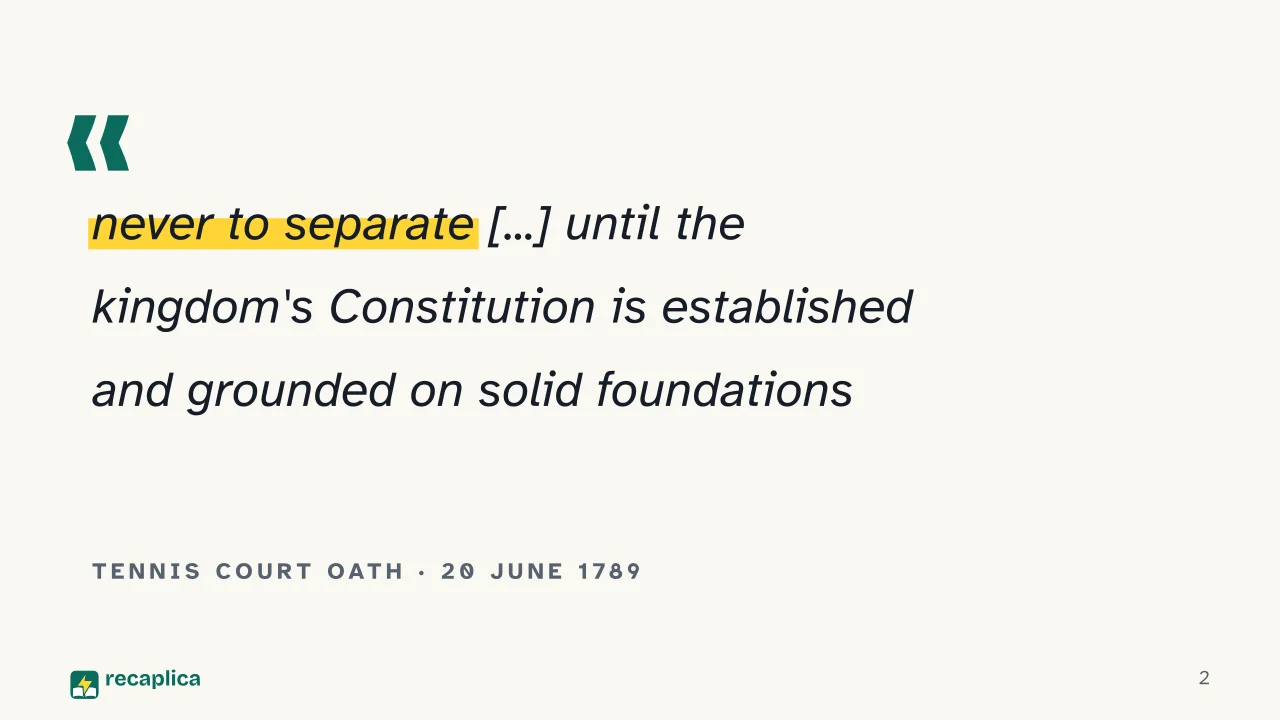   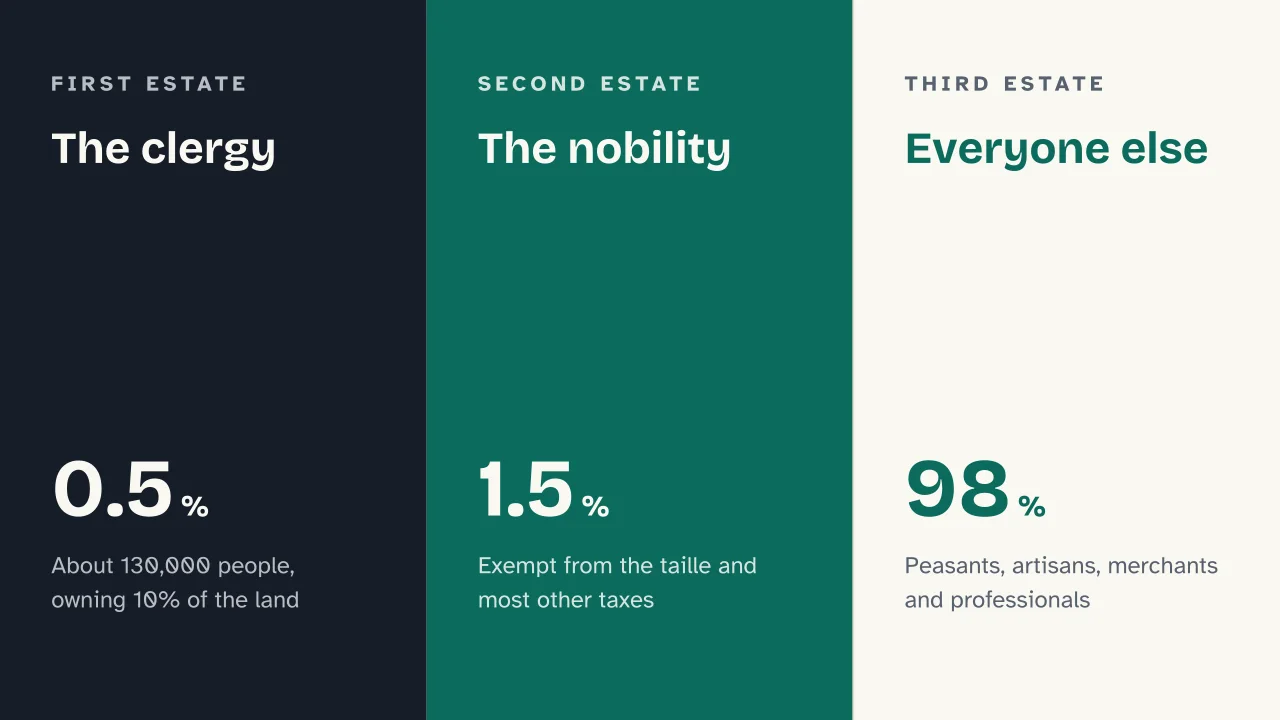   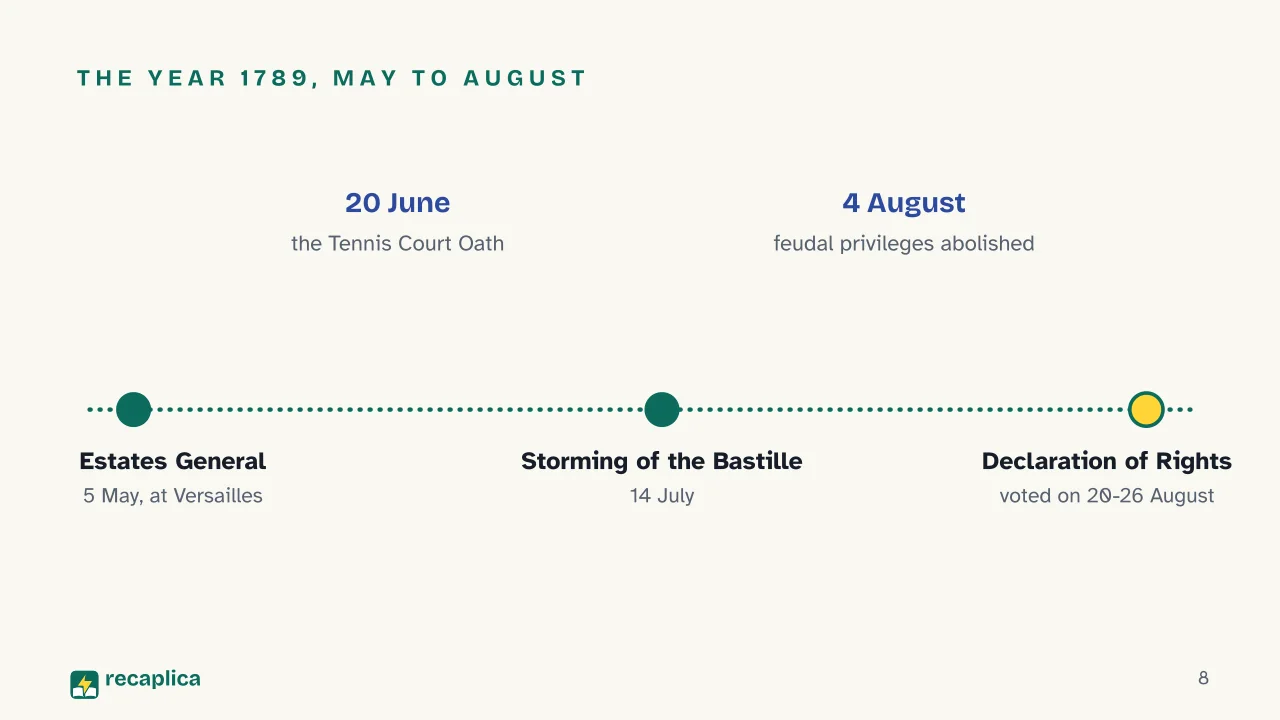 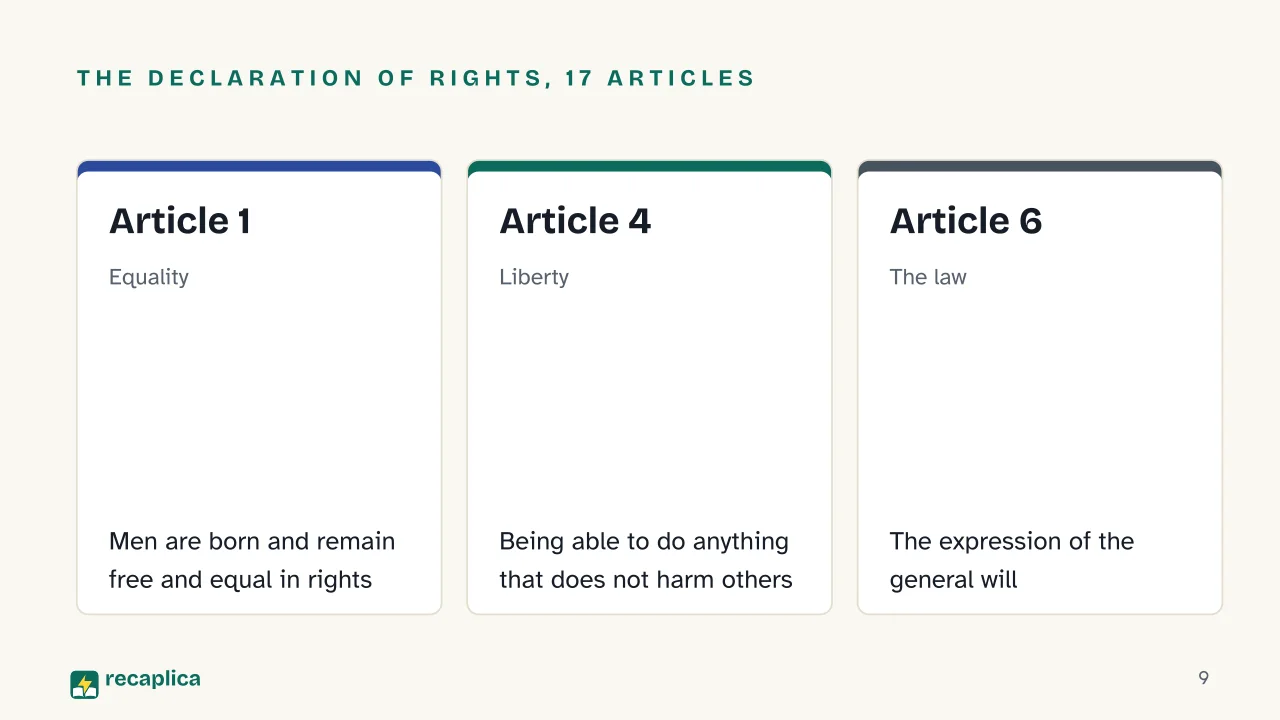  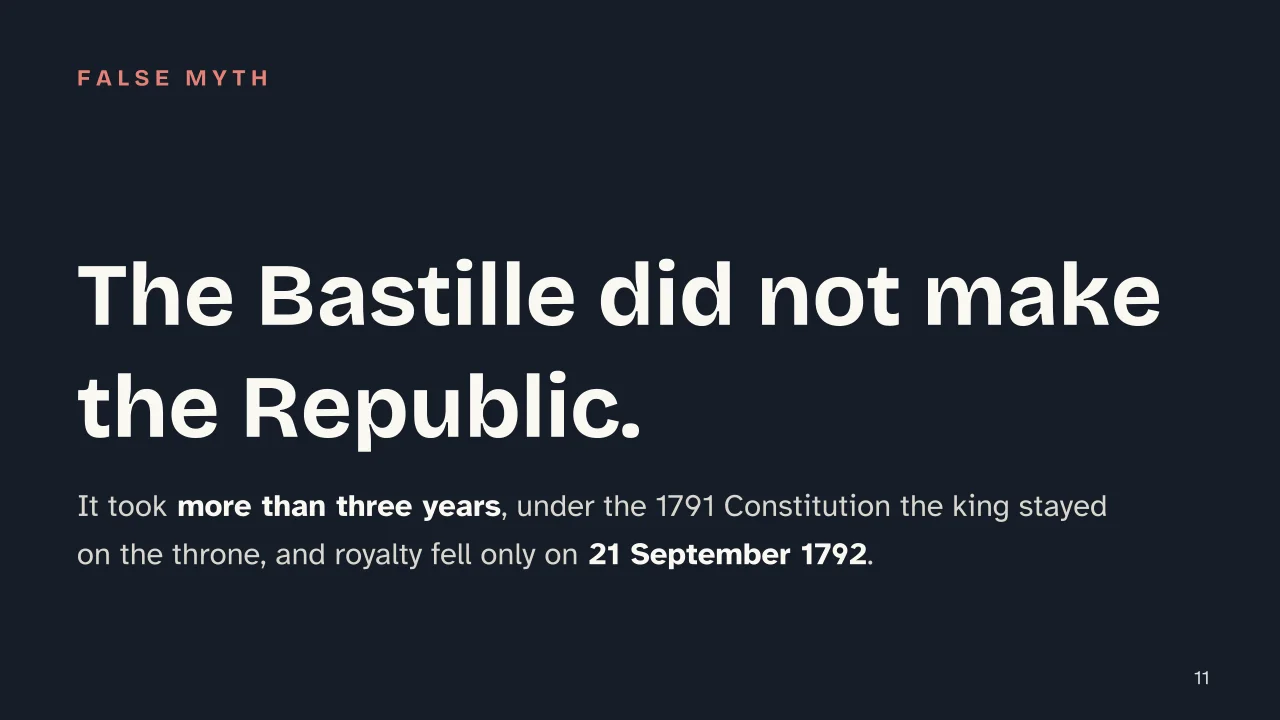 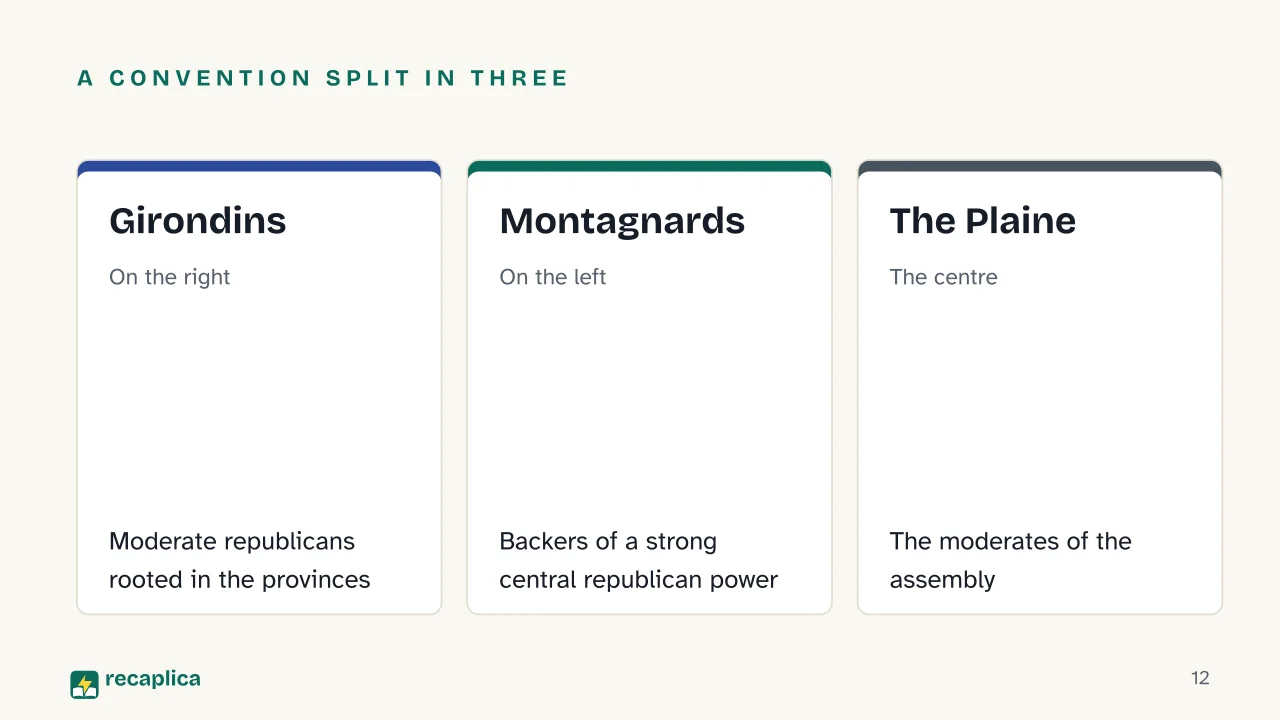 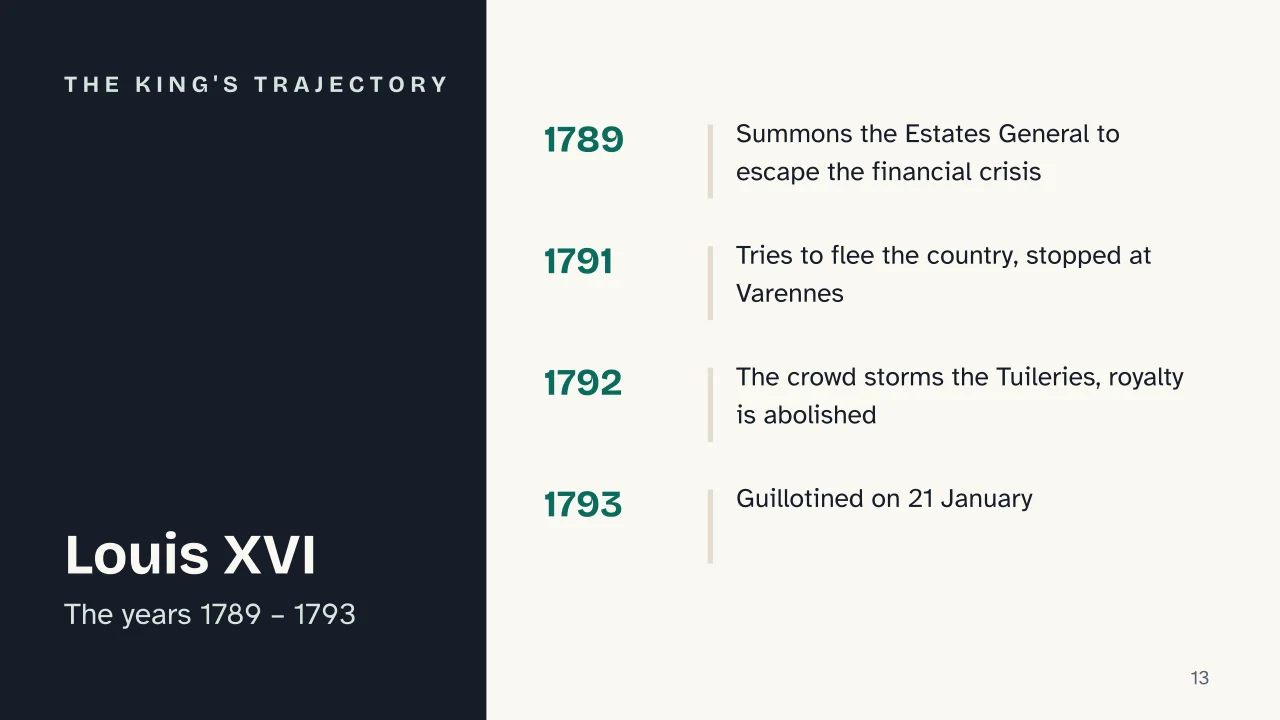 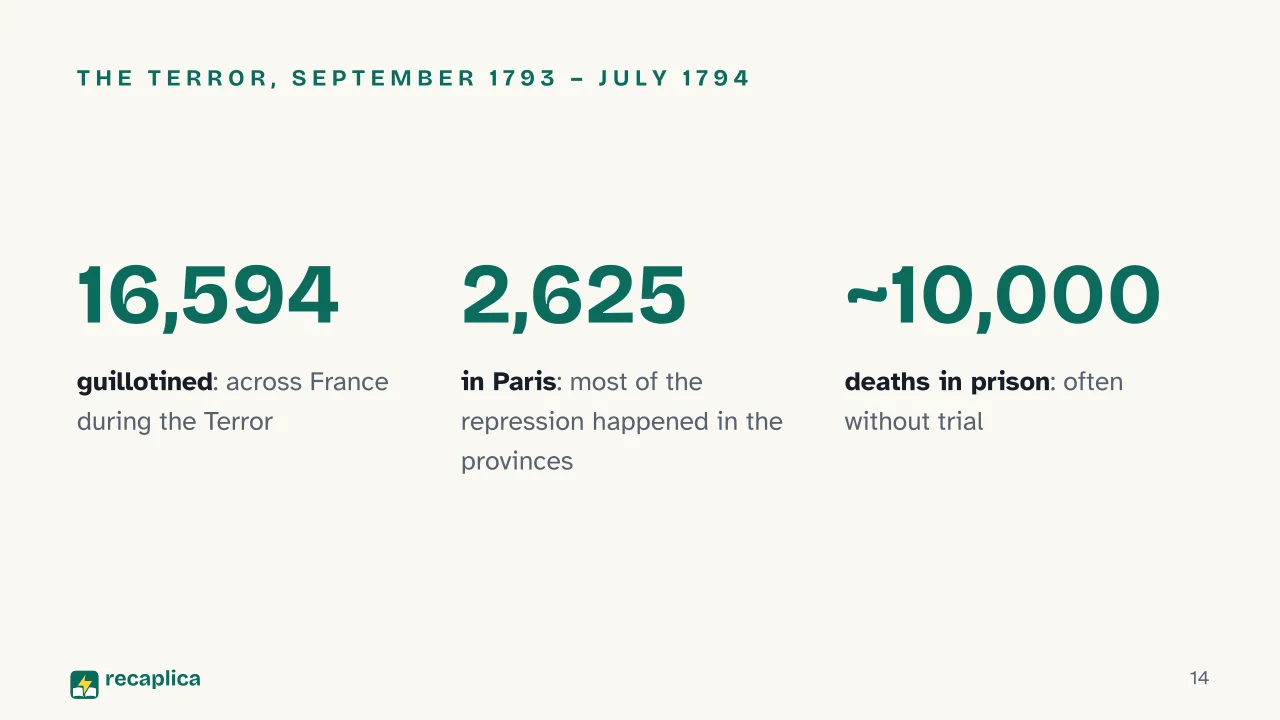  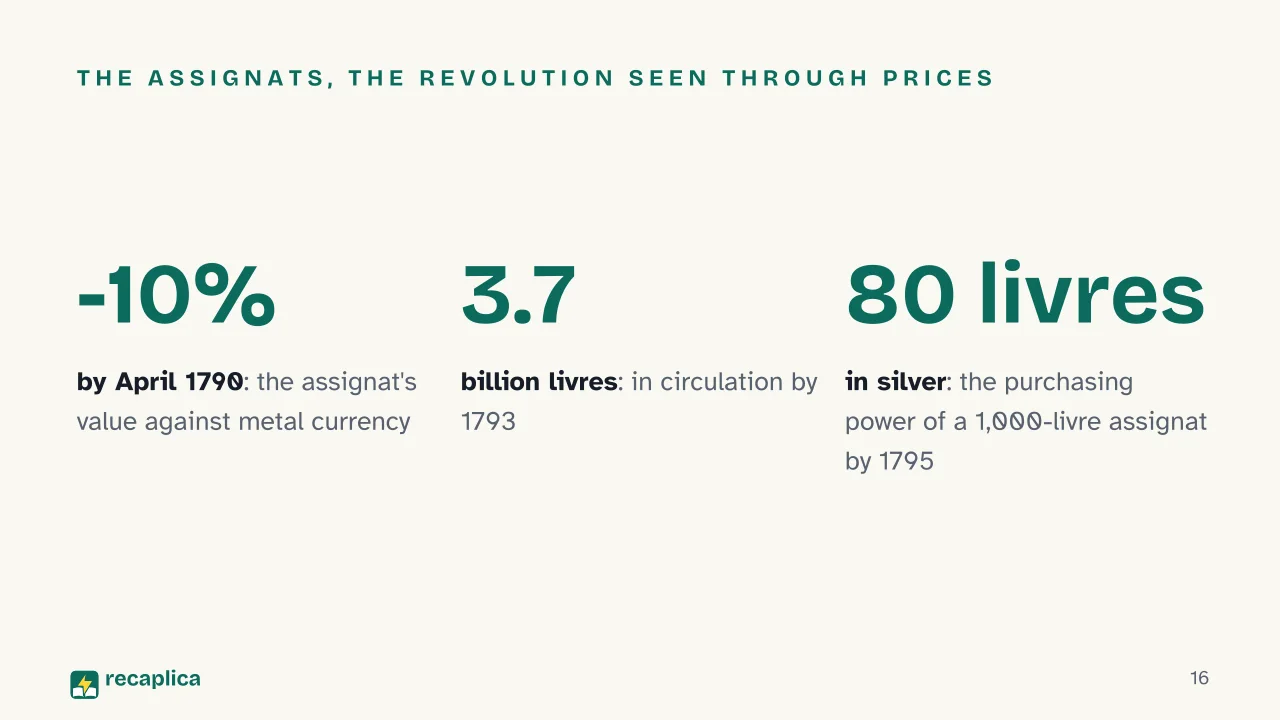 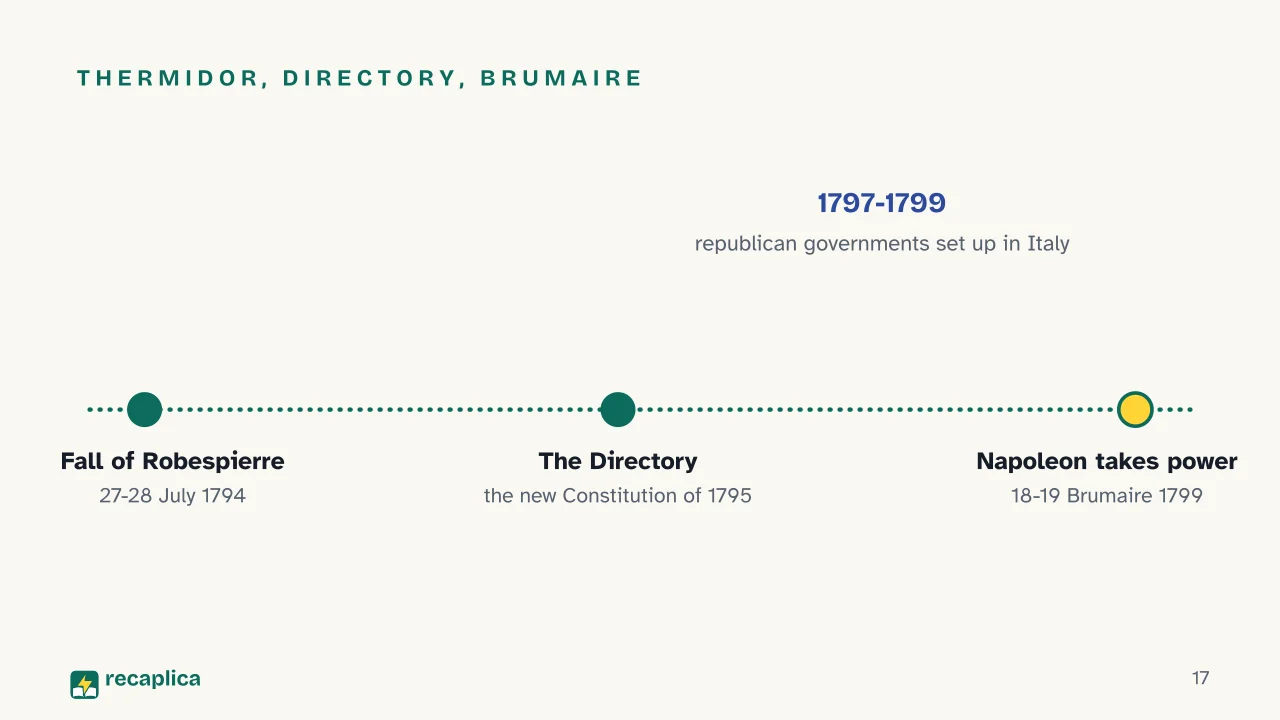 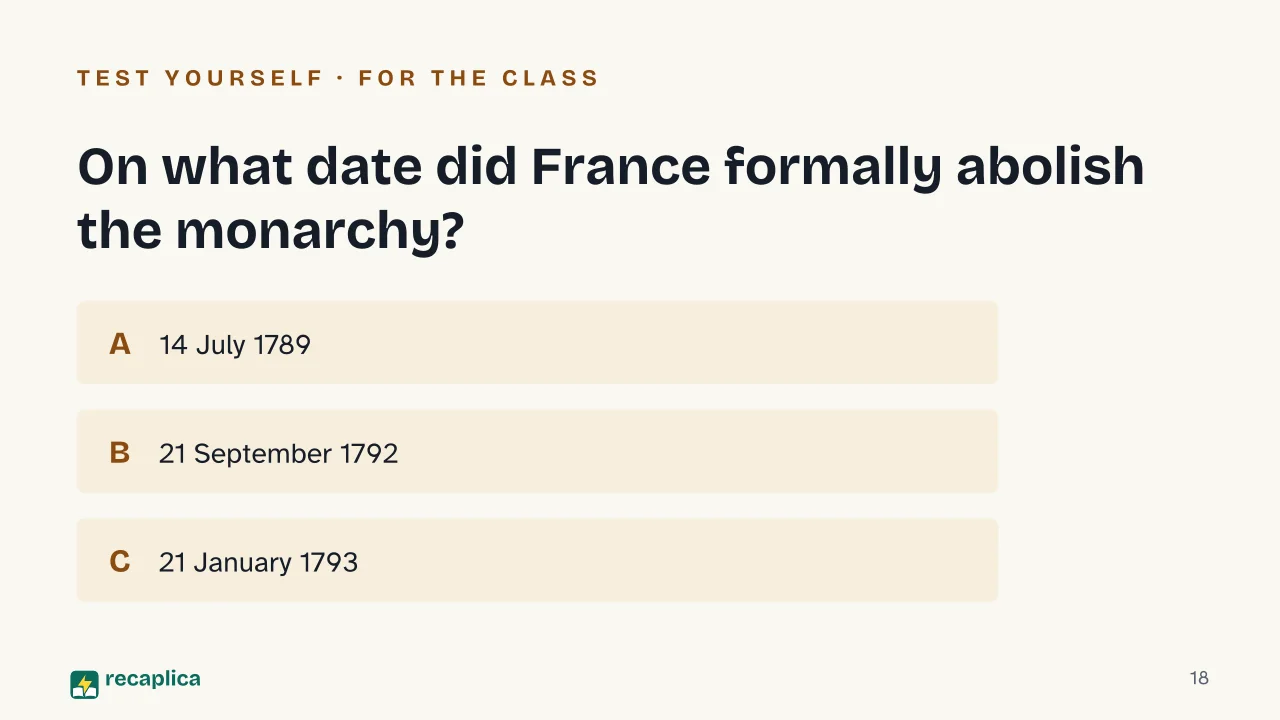  Common myths
Mind mapDrag the background to move around and the nodes to reposition them; use − and + to collapse and expand branches. 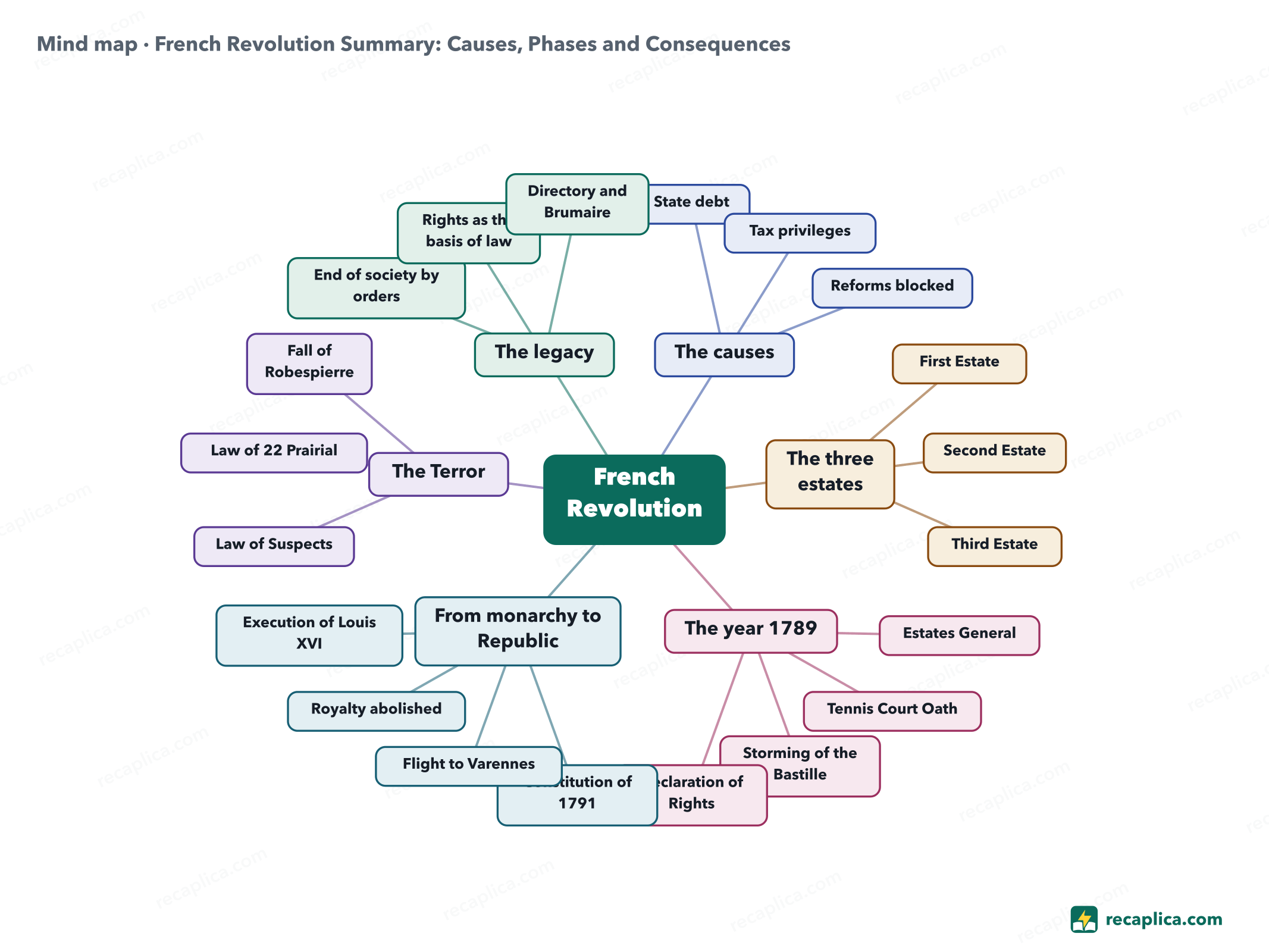
Quiz: test yourselfAnswer the questions to check what you have learned: you get instant feedback and a short explanation. Grade 0/10 0/5
FlashcardsTap the card to flip it and check whether you remember the answer, then move to the next one. 1 / 8 Explain it in your own wordsThe ultimate test: if you can explain it in simple words, you've truly understood it. Write your explanation, then compare it with the Recap. Your explanation is saved only on this device.
Frequently asked questionsWhen did the French Revolution begin and end?It is usually dated from 1789, the year of the Estates General (5 May) and the storming of the Bastille (14 July). The conventional end point is the coup of 18-19 Brumaire 1799, when Napoleon Bonaparte took power and closed the revolutionary decade. Who were the three estates?The First Estate was the clergy (about 130,000 people, owning 10% of the land), the Second the nobility (around 1.5% of the population), the Third everyone else: peasants, artisans, merchants and professionals, that is 98% of the French. The nobility was exempt from the taille, the main direct tax, and from most others. What was the Reign of Terror?The harshest phase of the Revolution, from September 1793 to July 1794, when revolutionary tribunals struck at suspected enemies of the Republic: 16,594 people guillotined across France, roughly 10,000 deaths in prison and an overall estimate of 30,000 to 50,000 victims. It ended with the arrest and guillotining of Robespierre on 27-28 July 1794. Does the 1789 Declaration of Rights still matter?Yes, and it is far from a museum piece. The preamble of the Fifth Republic's Constitution refers to it, and since 1971 the Constitutional Council has granted it constitutional value: a French law can be struck down for conflicting with a text written in 1789. Its principles also shaped the 1948 Universal Declaration of Human Rights. Why was Louis XVI executed?After his flight was stopped at Varennes (20-21 June 1791) and the Tuileries were stormed on 10 August 1792, trust in the king was gone. Once royalty had been abolished, the Convention tried him as an ordinary citizen and had him guillotined on 21 January 1793. Every Recap goes through an independent review before publication. |