|
recaplica
Galileo Galilei: Life, Telescope Discoveries and the Scientific Method | ||||||||||||||||
| © 2026 Recaplica · recaplica.com — All rights reserved | ||||||||||||||||
Galileo Galilei: Life, Telescope Discoveries and the Scientific MethodWhat to print Page numbers appear when printing with default margins. SlidesChoose a cut Flash10 slidesThe essential thread, to present in classFull18 slidesEvery chapter and the deeper detailBoth come with speaker notes. In 30 seconds quick readGalileo Galilei was born in Pisa on February 15, 1564, and taught mathematics first in Pisa and then in Padua. With a telescope he improved in 1609 he observed Jupiter's moons, the mountains of the Moon and the phases of Venus, publishing the findings in the 1610 Sidereus Nuncius. His support for the Copernican system brought him a warning in 1616 and, after he published the Dialogue Concerning the Two Chief World Systems in 1632, a trial that forced him to recant in 1633. He died in Arcetri in 1642: the Stanford Encyclopedia of Philosophy calls him a central figure of the seventeenth-century scientific revolution, for the way he combined observation, experiment and mathematics. Key Points
Key figures
Deep DiveWho Was Galileo Galilei: A BiographyGalileo Galilei was born in Pisa on February 15, 1564, the son of Vincenzo Galilei, a court musician and composer, and Giulia Ammannati. In 1580 he enrolled in medicine at the University of Pisa, but left the course after a short time to pursue the study of mathematics instead. An academic career followed quickly: Galileo held the chair of mathematics at the University of Pisa from 1589 to 1592, then moved to the University of Padua, where he taught starting that same year. The Telescope and the Discoveries That Changed AstronomyHaving learned of a telescope that had just been invented, Galileo built an improved version of it in 1609 and used it for celestial observations regarded as extraordinary. With that instrument he found that Jupiter is accompanied by four moons, known today as the Galilean moons. Watching how sunlight falls on the Moon, he concluded that its surface is mountainous and uneven. In 1610 he also observed that Venus shows phases, a finding that points to the planet orbiting the Sun. Galileo rushed these discoveries into print in March 1610, in the Sidereus Nuncius (the “Starry Messenger” or “Sidereal Messenger”). Galileo’s Scientific MethodAccording to the Stanford Encyclopedia of Philosophy, Galileo had little patience for a style of natural philosophy that relied on books alone, without direct observation. He designed and built experimental devices to test his ideas, among them inclined planes and pendulums.
Galileo described the universe as a book written in the language of mathematics, legible only to those who learn its characters. Historians of science commonly treat “Galilean science” as close to a stand-in for the modern scientific method itself, a reading the Stanford Encyclopedia of Philosophy records as well established among scholars in the field. Support for Copernicanism and the TrialGalileo’s support for the Copernican system built up over several stages.
The Dialogue Concerning the Two Chief World Systems favors Copernican theory without stating it explicitly, according to the Stanford Encyclopedia of Philosophy. In June 1633 Galileo was convicted of “vehement suspicion of heresy”: the prison term set by the sentence became permanent house arrest right away. He was taken to the church of Santa Maria sopra Minerva, in Rome, and ordered to kneel while his sentence was read aloud. Final Years and LegacyAfter the trial, Galileo spent his remaining years in Arcetri, under house arrest. There he completed the Discourses and Mathematical Demonstrations Relating to Two New Sciences, smuggled out of Italy and published in the Netherlands by the Elzevir family in 1638. He died in early 1642 (January 8, according to Museo Galileo); because of his conviction, the location of his grave stayed largely unmarked until he was reinterred in 1737. The Stanford Encyclopedia of Philosophy calls him one of the central figures — if not the central figure — of the seventeenth-century scientific revolution in any history of science: a judgment about his place in that history. Readers who want to follow the thread forward from Galileo can see how Kepler’s laws describe planetary motion around the Sun, how Newton’s laws of motion generalize the physics of motion, what we mean today by the scientific method, how the solar system Galileo observed through his telescope is put together, and the cultural setting of the Renaissance in which he came of age. Slide deckSlides ready to download and make your own in PowerPoint or Google Slides, with speaker notes. Pick the Flash cut or the Full one.     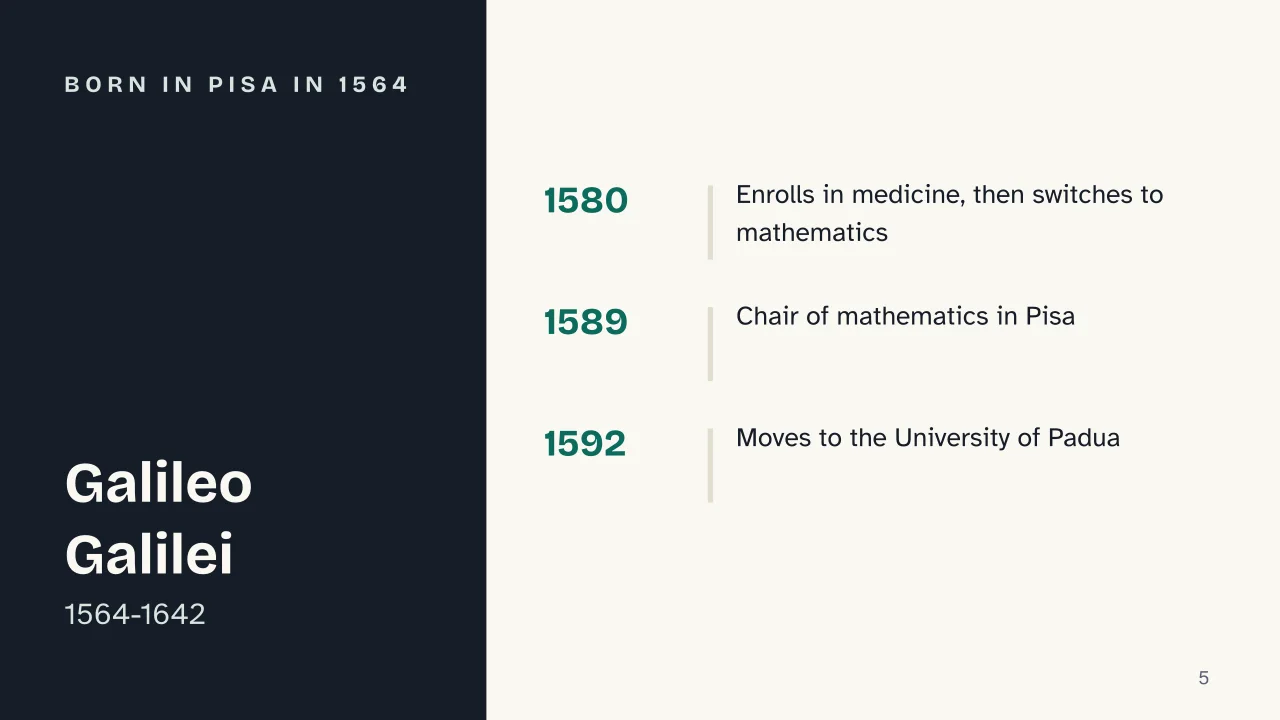 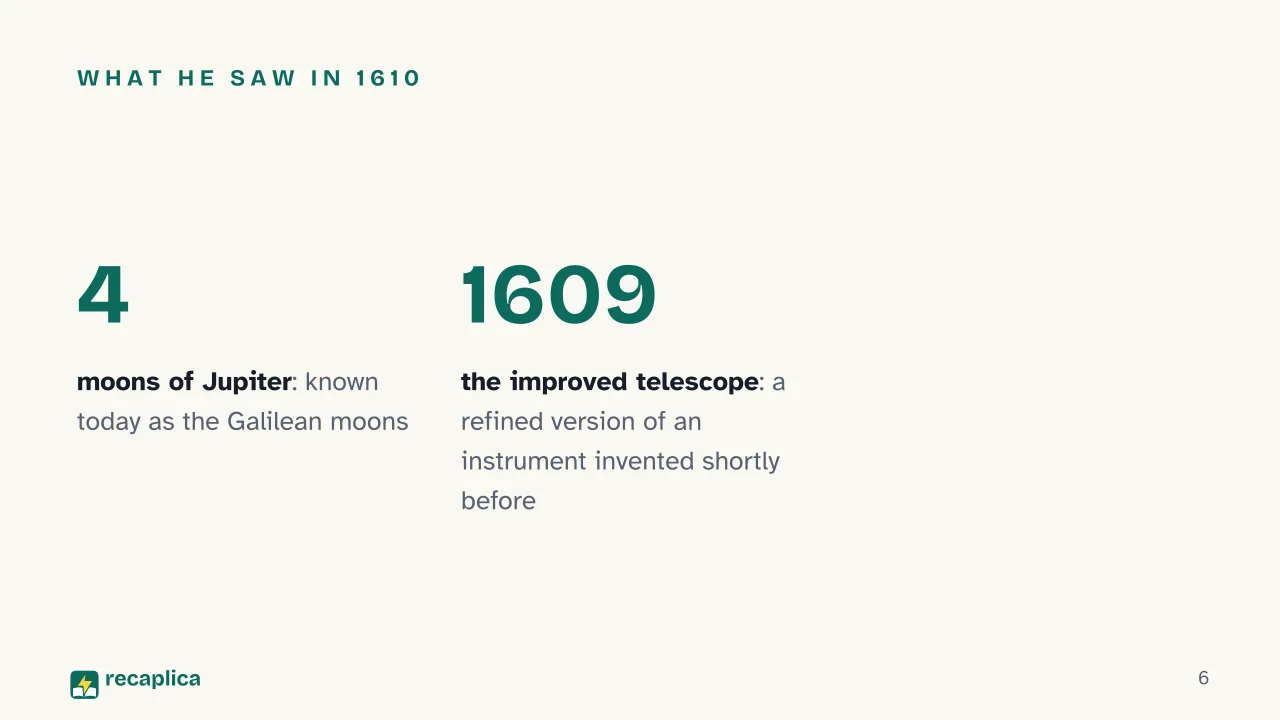  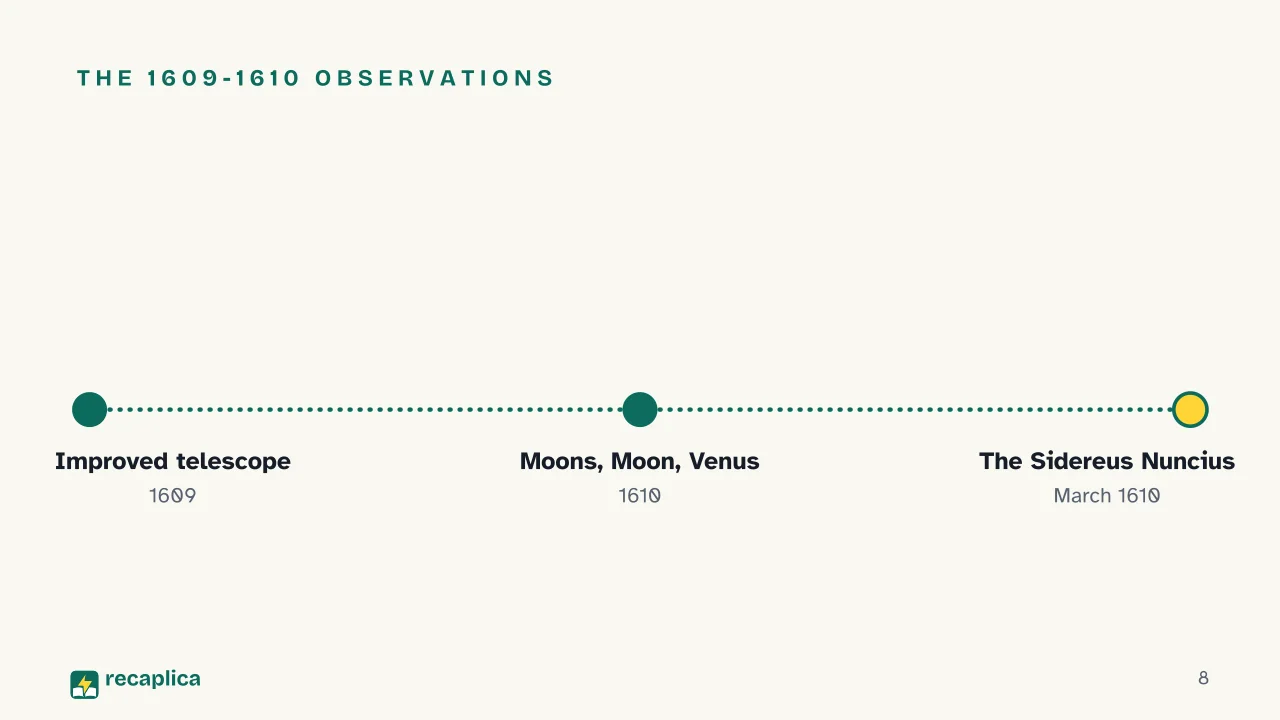   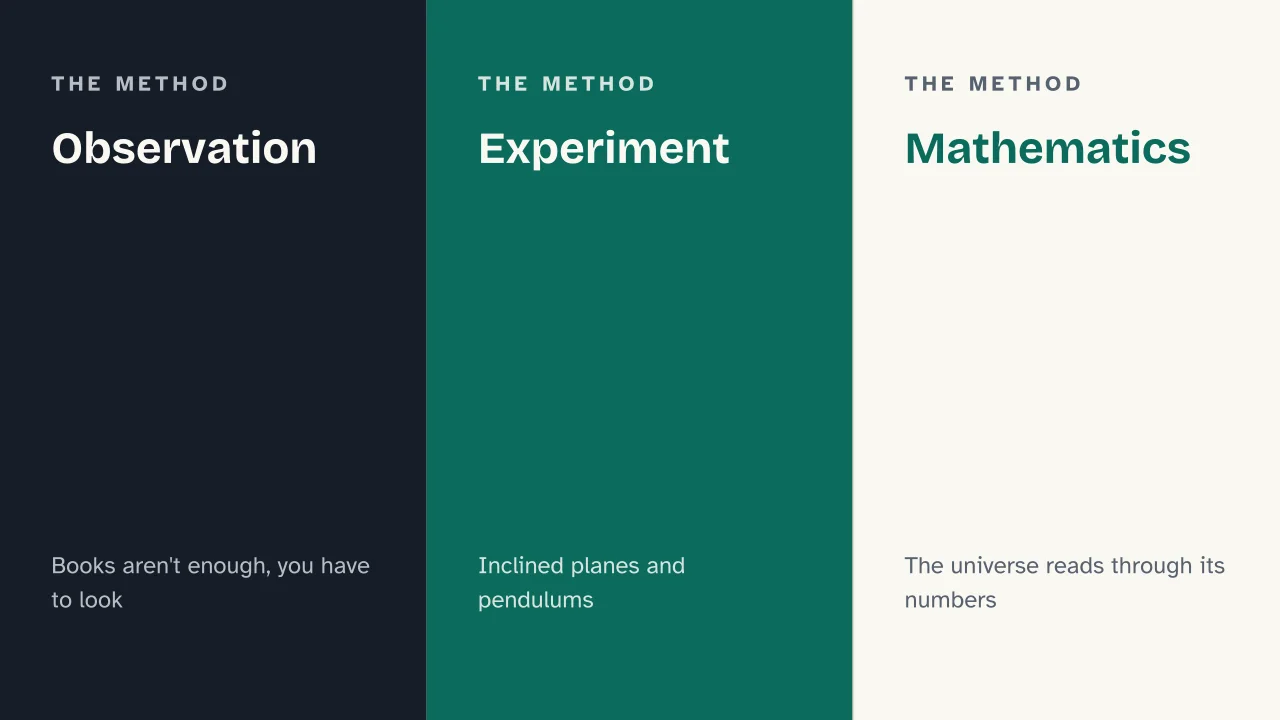 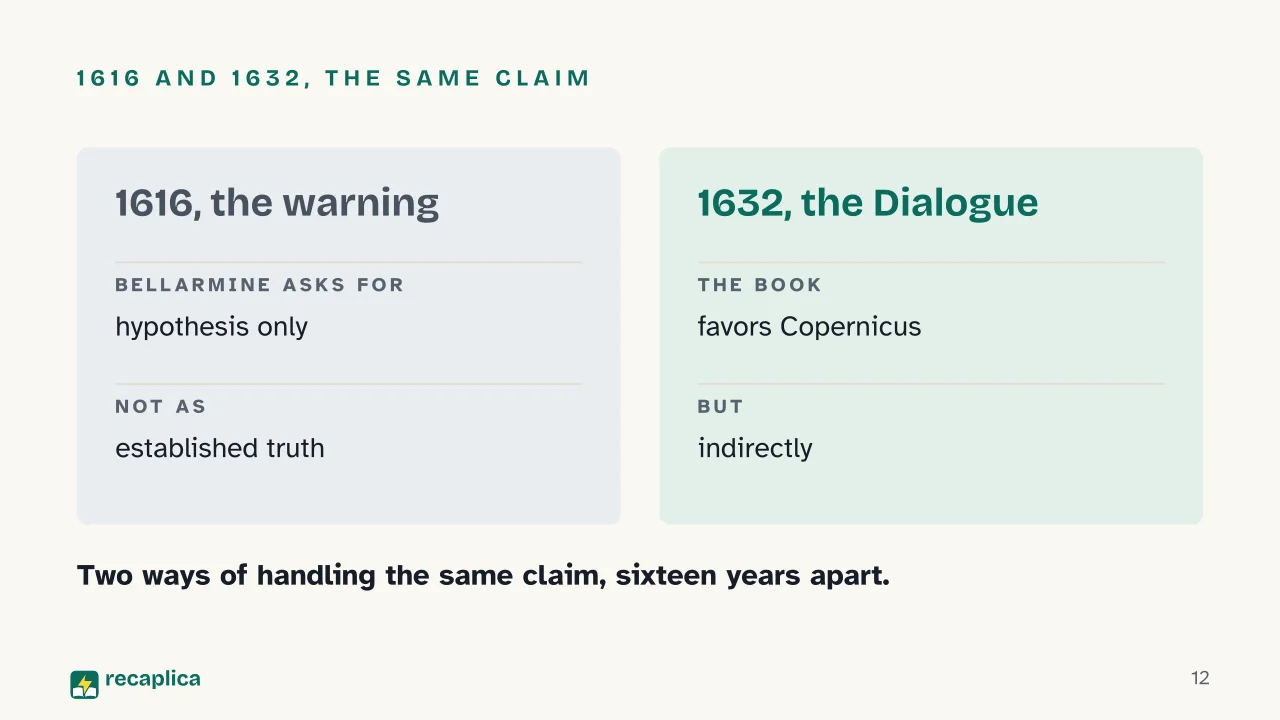  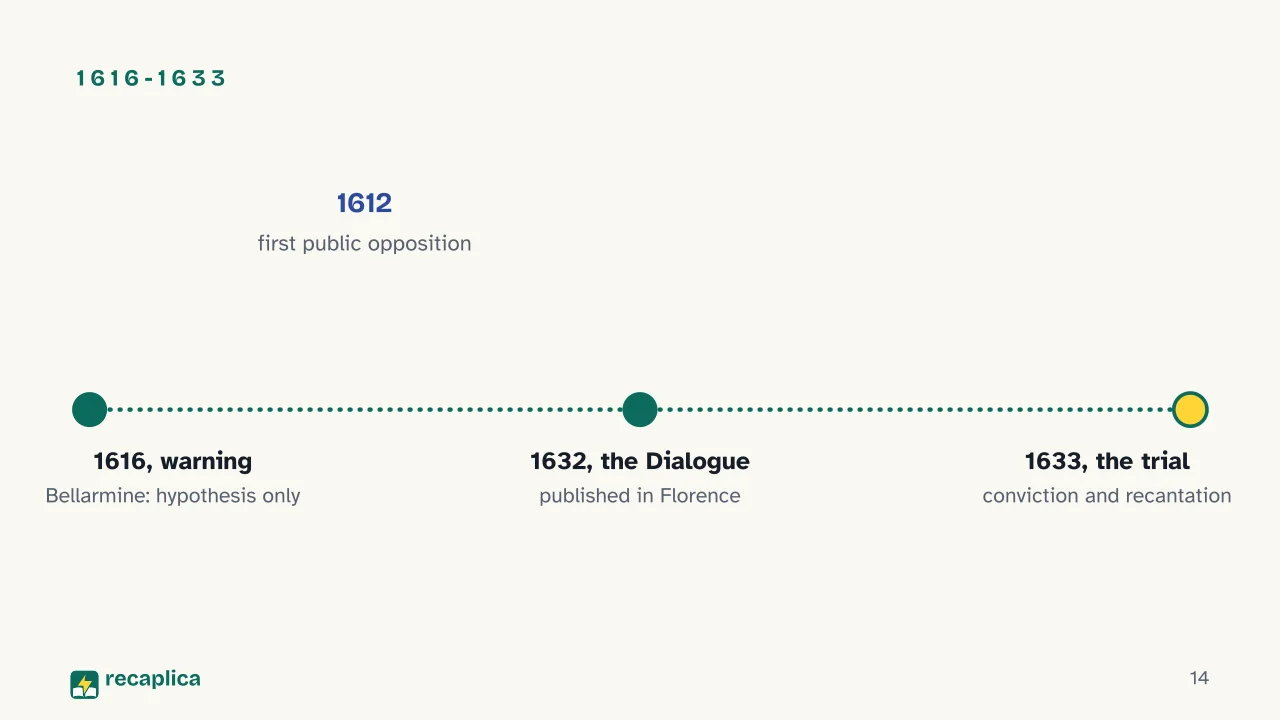  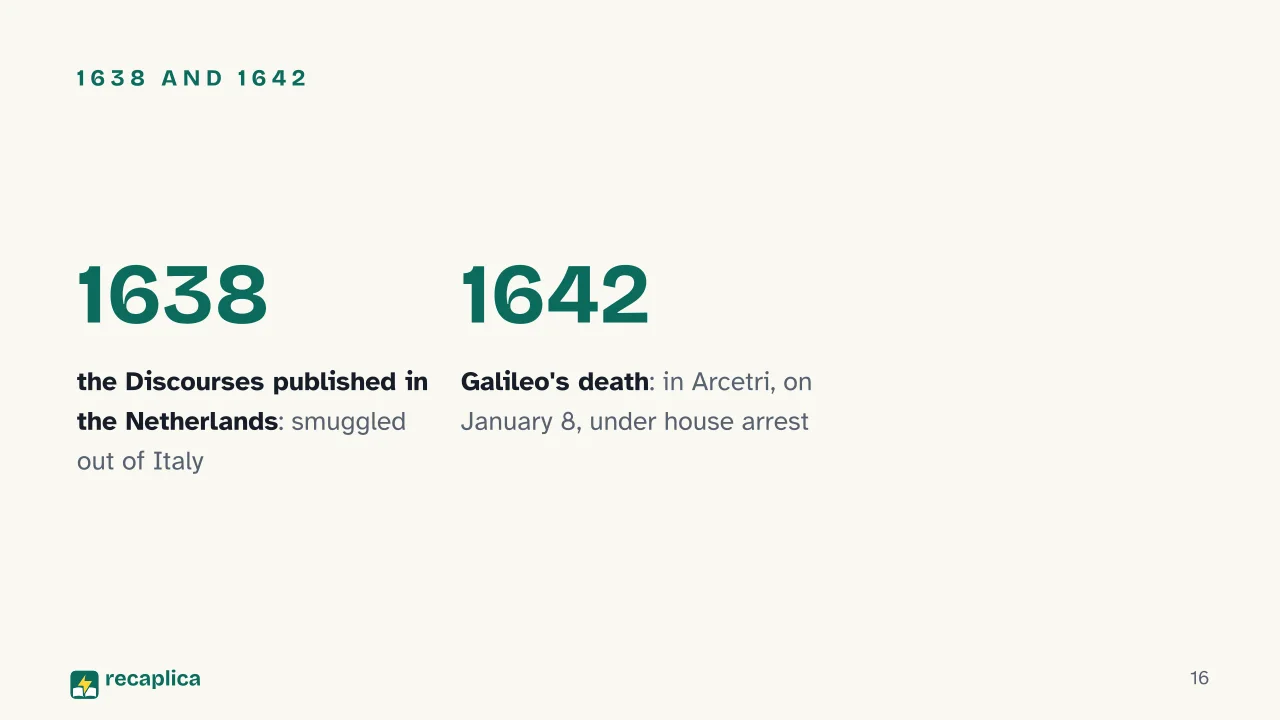   Common myths
Mind mapDrag the background to move around and the nodes to reposition them; use − and + to collapse and expand branches. 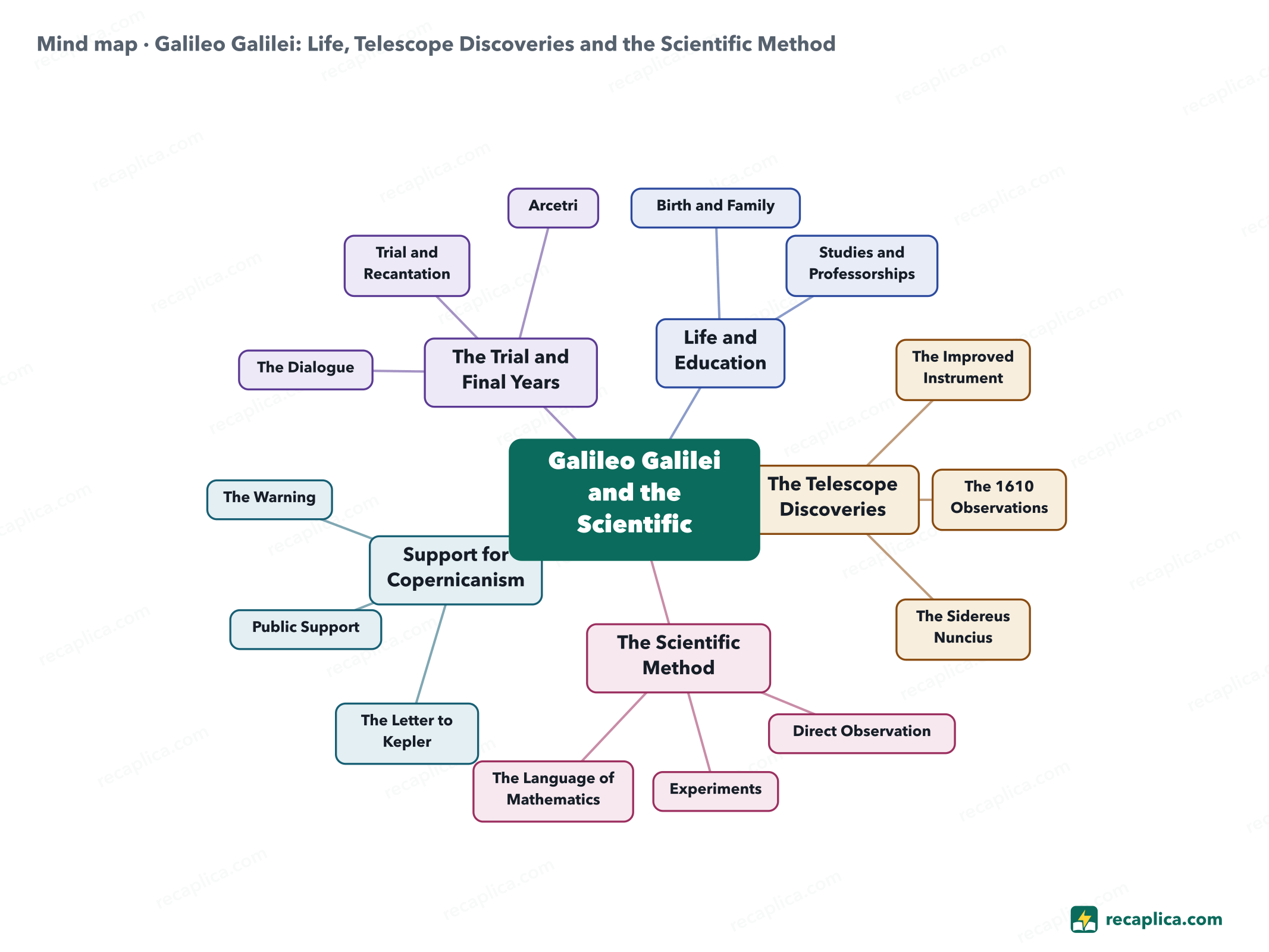
Quiz: test yourselfAnswer the questions to check what you have learned: you get instant feedback and a short explanation. Grade 0/10 0/5
FlashcardsTap the card to flip it and check whether you remember the answer, then move to the next one. 1 / 8 Explain it in your own wordsThe ultimate test: if you can explain it in simple words, you've truly understood it. Write your explanation, then compare it with the Recap. Your explanation is saved only on this device.
Frequently asked questionsWhat was Galileo's scientific method?Galileo combined direct observation of phenomena, experiments built specifically to test them — inclined planes, pendulums — and mathematics as the language for describing them. The phrase "Galilean science" is often used as a synonym for the modern scientific method, according to the Stanford Encyclopedia of Philosophy: a view widely shared among historians of science, not an absolute claim of priority. What is Galileo Galilei's biography in brief?Born in Pisa in 1564, Galileo studied mathematics after abandoning medicine, taught in Pisa and then Padua, used the telescope to discover moons and planetary phases, supported the Copernican system, stood trial in 1633 and died in Arcetri in 1642. Why was Galileo put on trial?For his support of Copernican theory, set out in the 1632 Dialogue Concerning the Two Chief World Systems: in 1633 the Holy Office convicted him of "vehement suspicion of heresy" and forced him to recant, immediately commuting the prison term to permanent house arrest. What did Galileo discover with the telescope?Jupiter's four moons (the Galilean moons), the rugged surface of the Moon, and the phases of Venus, which show that the planet orbits the Sun; he published these findings in the Sidereus Nuncius in 1610. When did Galileo Galilei die?On January 8, 1642, in Arcetri, where he spent his final years under house arrest following the 1633 trial. Every Recap goes through an independent review before publication. |