|
recaplica
Echo Chamber: How Recommendation Algorithms Shape What You See | |||||||||||||||
| © 2026 Recaplica · recaplica.com — All rights reserved | |||||||||||||||
Echo Chamber: How Recommendation Algorithms Shape What You SeeWhat to print Page numbers appear when printing with default margins. SlidesChoose a cut Flash10 slidesThe essential thread, to present in classFull15 slidesEvery chapter and the deeper detailBoth come with speaker notes. In 30 seconds quick readAn echo chamber is an environment, online or offline, where a person mostly encounters opinions that confirm their own. Recommendation algorithms can build a narrower version of this, often called a filter bubble, by quietly deciding what to show someone based on what they've clicked and watched before. The two ideas get mixed up constantly, but they aren't the same phenomenon, and the strongest research available paints a more mixed picture than the popular narrative: algorithms have a measurable but modest effect, and people's own choices matter more. Whether algorithms actually drive political polarization is not something the most rigorous experiments have settled. Key Points
Key figures
Deep DiveAn echo chamber doesn’t need a single algorithm behind it: people have been sorting themselves into like-minded groups since long before recommendation engines existed. What’s changed is that platforms do some of that sorting automatically, quietly narrowing what shows up based on what someone has already watched, liked, or clicked. Eli Pariser gave that narrower, algorithm-built version a name in his 2011 book The Filter Bubble, warning that personalization could wall people off from ideas and information they’d otherwise stumble across. Filter Bubble and Echo Chamber Aren’t the Same ThingThe two terms get used interchangeably, but they describe different mechanisms. A filter bubble comes from an algorithm: a system that, implicitly and without being asked, decides what to show someone based on their past behavior. An echo chamber, by contrast, is a social phenomenon described in academic literature as far back as 2008, when researchers Kathleen Hall Jamieson and Joseph Cappella defined it as a bounded media space capable of amplifying the messages inside it while insulating them from outside rebuttal. The practical difference is this: an echo chamber can form with no algorithm at all, simply because a person chooses to spend time only with sources and people who share their views. A filter bubble, by definition, always has some automated system behind it. How a Recommendation Algorithm Actually WorksThe algorithms behind social media feeds and streaming recommendations typically rely on two techniques, often combined: collaborative filtering, which learns from the behavior of other users with similar tastes, and content-based filtering, which learns from the traits of what a person has already watched or liked. These are machine learning techniques: the system isn’t following hand-written rules, it’s finding patterns in data. A 2016 Google Research paper describes in detail the architecture behind YouTube’s recommendations, one of the largest and most sophisticated systems of this kind in the world. It runs in two separate stages: a “candidate generation” model first narrows an enormous video catalog down to a manageable pool of plausible candidates, using signals like watch history and some demographic data through a neural network; a second, distinct model handles only ranking — deciding the order in which those candidates get shown. The paper is from 2016, and YouTube’s actual architecture has almost certainly evolved since, but the two-stage design remains the standard way to explain how these systems work, including the neural networks that power them.
What the Research Actually Says About PolarizationThe popular claim — “algorithms are polarizing us” — doesn’t hold up cleanly against the most rigorous studies available. A 2015 study in Science by Bakshy, Messing, and Adamic, covering 10.1 million Facebook users who had stated their political affiliation, found that the News Feed algorithm cut the odds of seeing content challenging each user’s views, compared with what their contacts actually shared: by 5% for conservatives and 8% for liberals. The same study measured a partly different effect on the other side: when that content did show up, conservatives clicked on it 17% less often and liberals 6% less often. The authors concluded that, overall, individual choices outweighed algorithmic ranking in limiting exposure to differing views — though broken down by group, the algorithm’s effect for liberals (8%) actually came out slightly larger than their own clicking behavior (6%). Eight years later, a package of four independent studies — run by researchers from universities including Princeton, Dartmouth, and the University of Texas in collaboration with Meta, and published in 2023 in Science and Nature — tested the same question with a real experiment, during the 2020 US presidential election. For 23,377 Facebook users, exposure to content from like-minded sources was artificially reduced for three months: from 53.7% down to 36.2%, a drop of roughly a third. The result showed no measurable effect across eight preregistered attitudinal measures, including affective polarization, ideological extremity, and belief in false claims. A related experiment in the same package, which removed reshared content from the feed for the same period, lowered participants’ news knowledge without meaningfully affecting polarization or other political attitudes. It’s worth being upfront that these studies were carried out in collaboration with Meta, the company that owns the platform being studied — a potential conflict of interest that some academic researchers have raised, and one reason to treat the results as an important piece of evidence rather than the final word on the subject. The picture widens with data from the Digital News Report, analyzed by the Reuters Institute across a comparison of seven countries. In the United Kingdom, in 2020, only about 2% of people lived in a left-leaning echo chamber and about 5% in a right-leaning one: small shares, in a country where most people still get their news from a mix of sources. The United States remains the exception, with a combined share above 10%. The same research flags another finding that pushes back on the idea of ever-tightening isolation: people who use social media for news, especially on platforms like YouTube and Twitter, tend to stumble onto stories they weren’t looking for — an incidental exposure effect that, in some cases, widens a person’s news diet rather than narrowing it. Why the Caution Is Worth KeepingTreating a link the evidence doesn’t clearly support as settled fact leads to two opposite mistakes: underrating the real, if modest, role algorithms play in shaping what people see, or pinning on algorithms a responsibility the data doesn’t back up, which shifts attention away from individual choices and the social context where opinions actually form. Recognizing what artificial intelligence actually does here — selecting and ranking, not deciding on someone’s behalf — is part of the same critical skill needed to spot fake news circulating online. Slide deckSlides ready to download and make your own in PowerPoint or Google Slides, with speaker notes. Pick the Flash cut or the Full one.     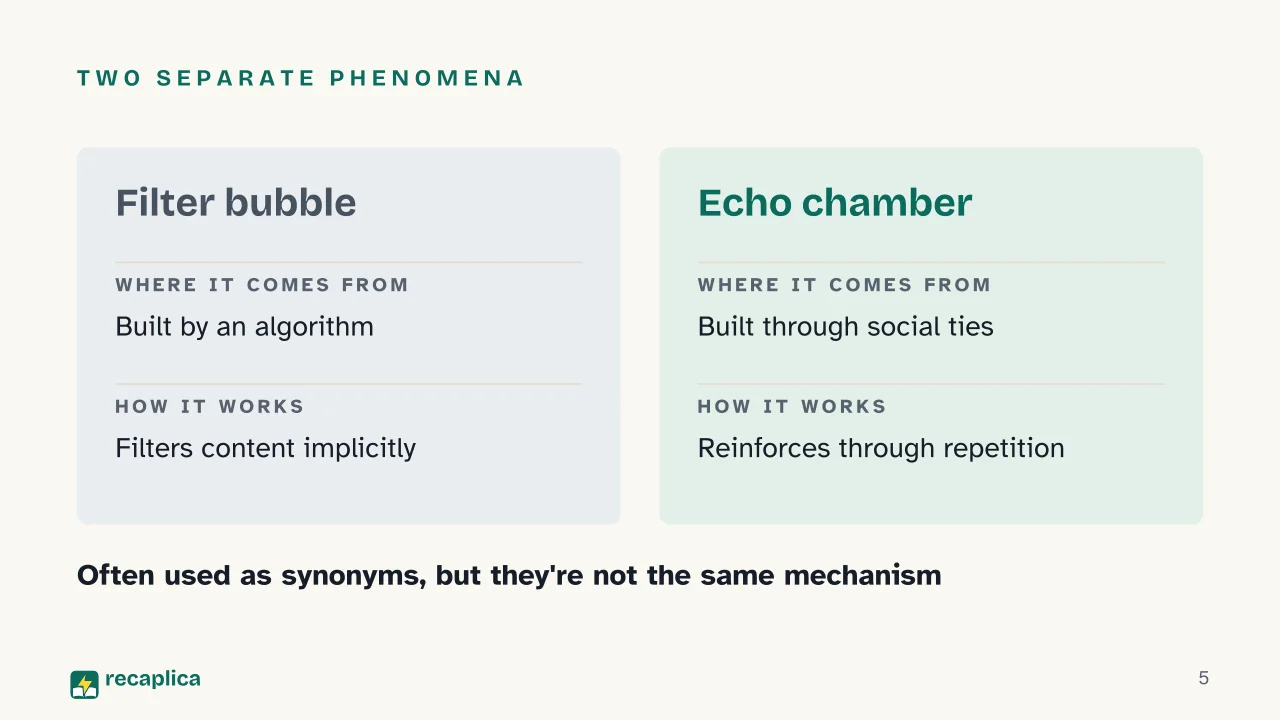  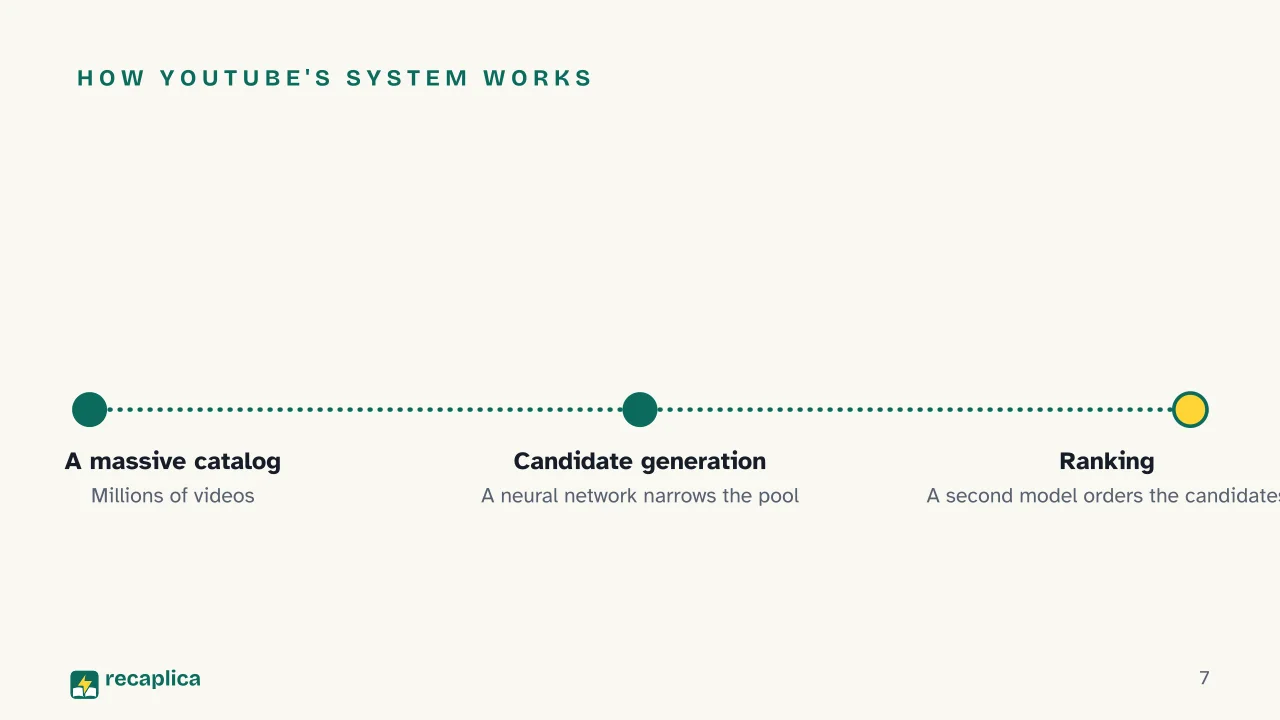 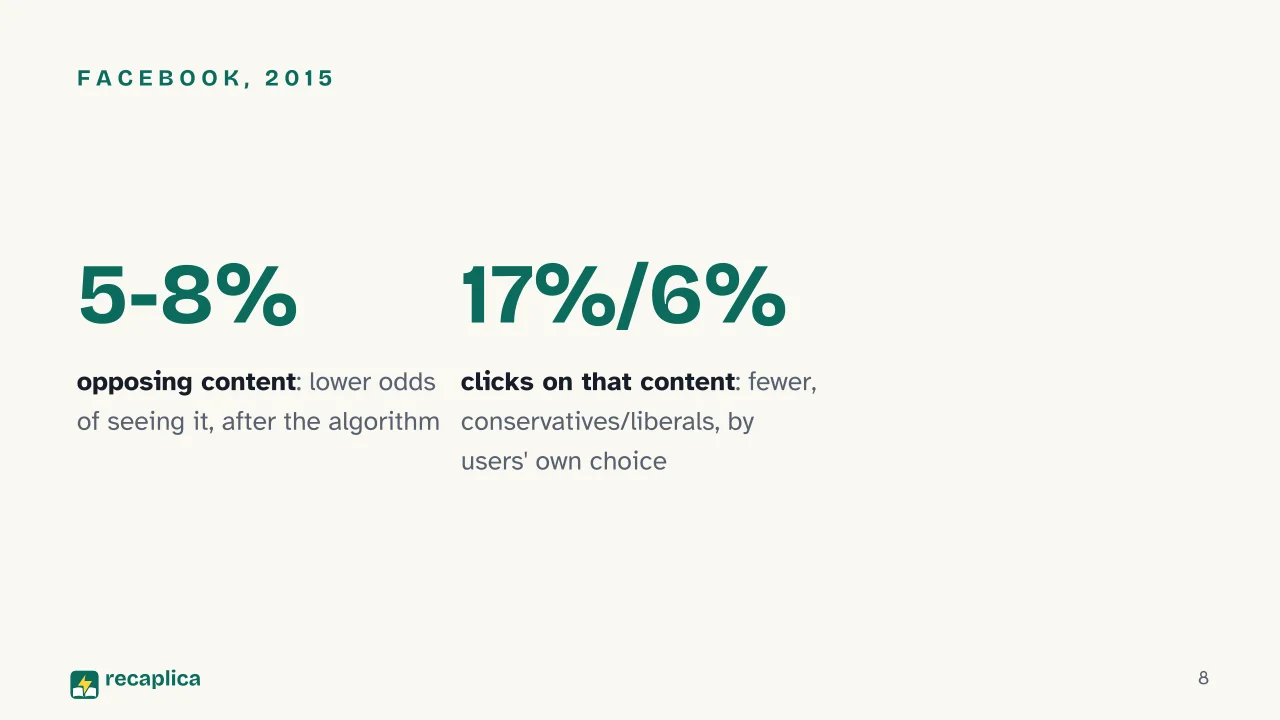  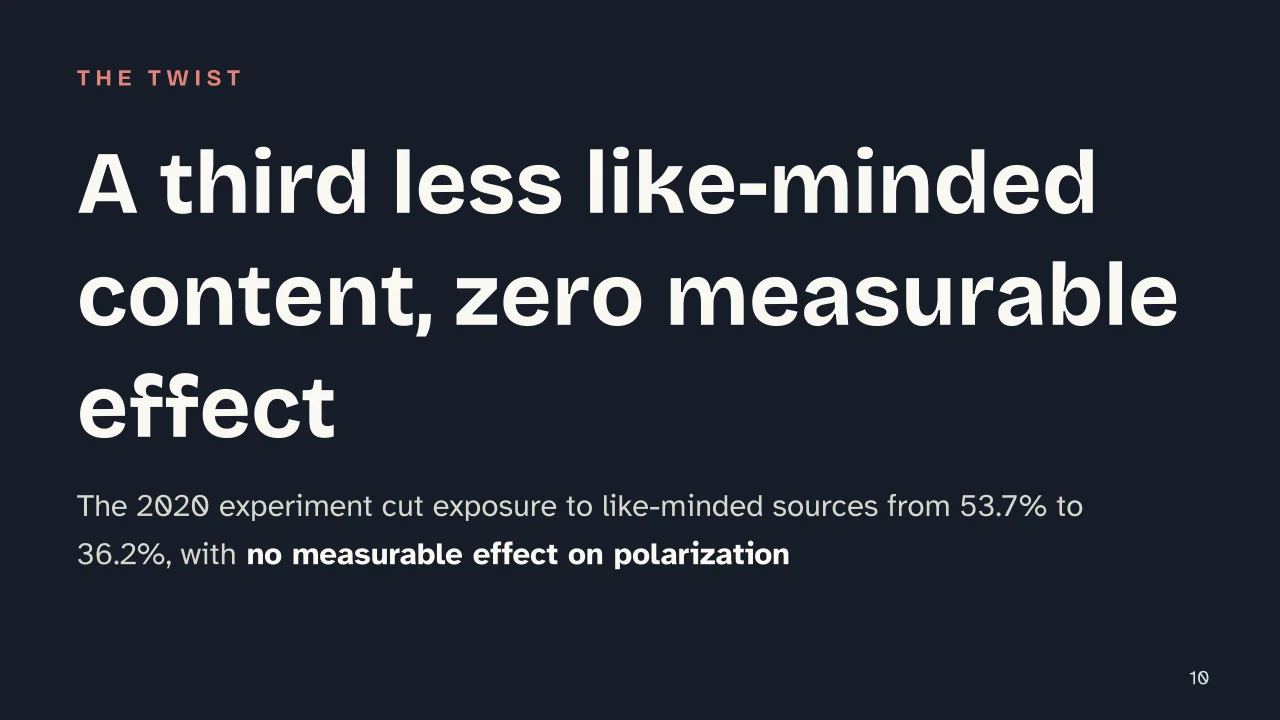 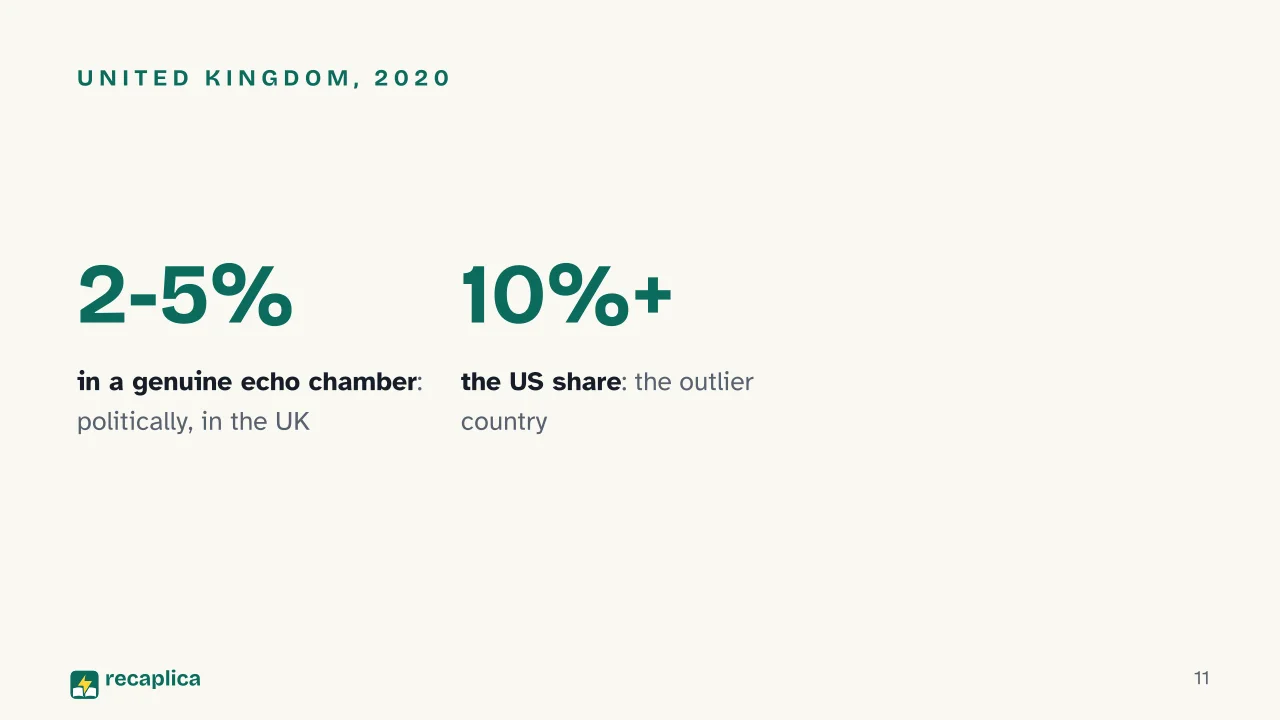  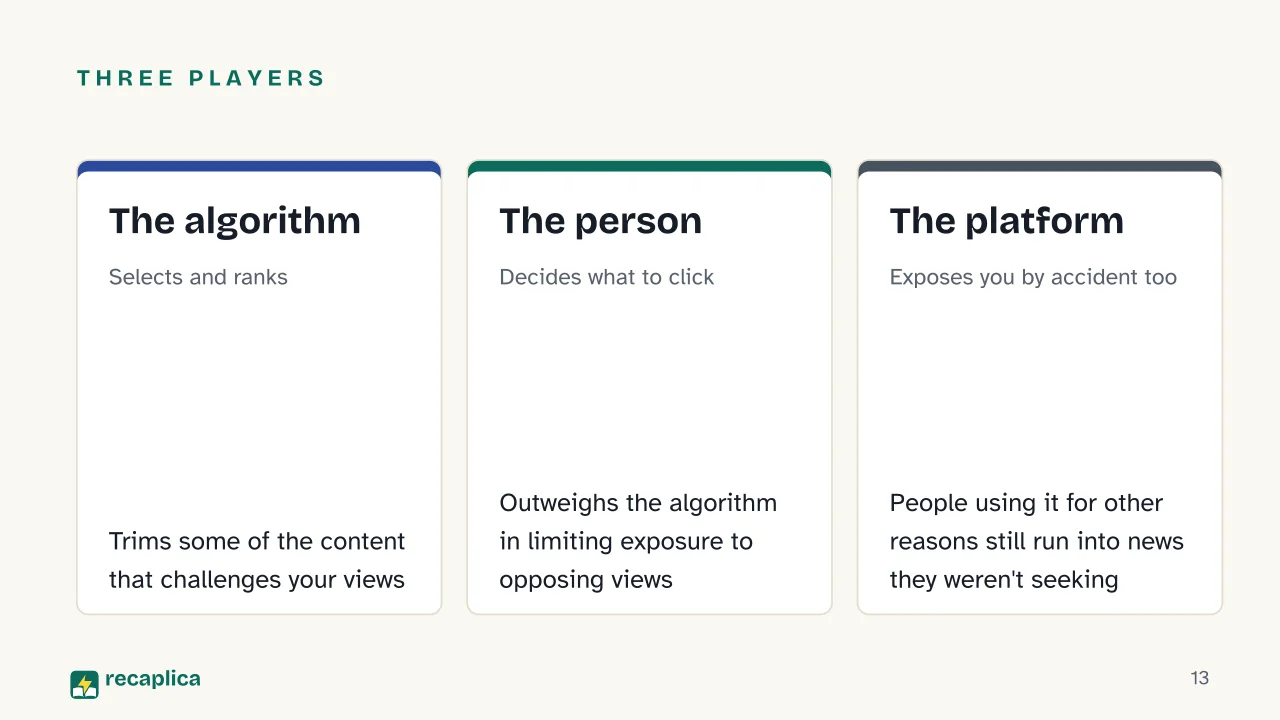   Common myths
Mind mapDrag the background to move around and the nodes to reposition them; use − and + to collapse and expand branches. 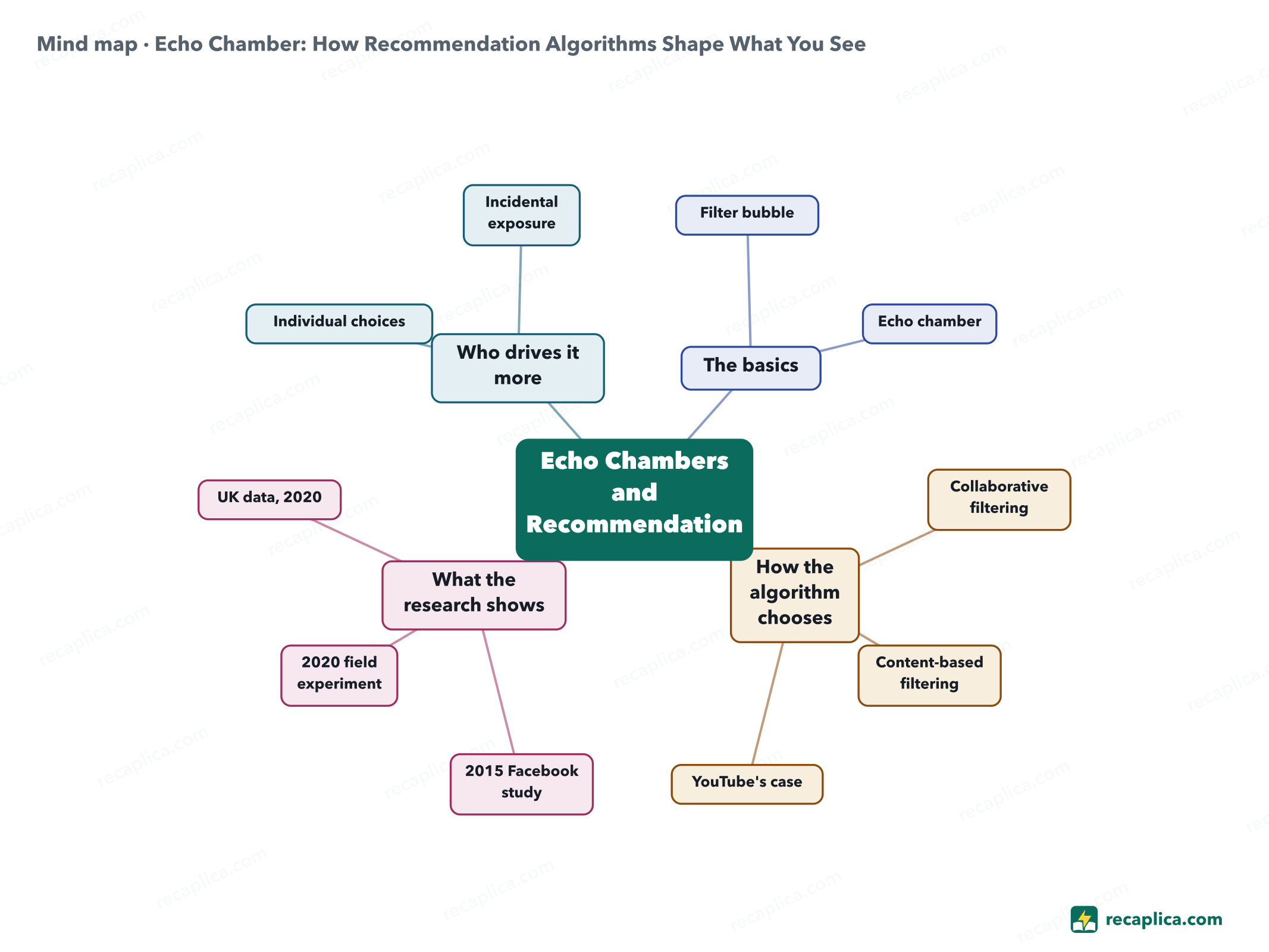
Quiz: test yourselfAnswer the questions to check what you have learned: you get instant feedback and a short explanation. Grade 0/10 0/5
FlashcardsTap the card to flip it and check whether you remember the answer, then move to the next one. 1 / 7 Explain it in your own wordsThe ultimate test: if you can explain it in simple words, you've truly understood it. Write your explanation, then compare it with the Recap. Your explanation is saved only on this device.
Frequently asked questionsWhat is an echo chamber?It's an environment, online or offline, where a person mostly encounters opinions and sources that confirm what they already believe, with outside views largely filtered out or drowned out. The definition used in academic research dates back to 2008, describing it as a bounded media space that amplifies messages inside it and insulates them from rebuttal. Do recommendation algorithms cause political polarization?It isn't settled. A 2015 Facebook study found the algorithm's own effect was modest next to individual choices; a 2020 field experiment, published in 2023 in Nature, cut exposure to like-minded sources by a third and found no measurable effect on polarization. The most rigorous research available doesn't confirm a direct causal link. What's the difference between a filter bubble and an echo chamber?A filter bubble comes from algorithmic personalization: the algorithm implicitly filters what a person sees. An echo chamber is a broader social phenomenon, described in the literature since 2008, tied to the people and sources someone chooses to engage with — it can exist with no algorithm involved. How common is the echo chamber effect, really?Less common than most people assume. In the United Kingdom, in 2020, only 2-5% of the population lived in a genuine political echo chamber. The United States is an outlier, above 10%, but it remains an exception compared with the other countries tracked. How does a recommendation algorithm like YouTube's actually work?In two separate stages, according to a 2016 Google Research paper: a "candidate generation" model first narrows an enormous catalog of videos down to a smaller pool of plausible candidates, using a user's watch history; then a separate ranking model orders those candidates to decide what to surface first. Every Recap goes through an independent review before publication. |