|
recaplica
AI Pop Culture: When Synthetic Content Rewrites History | ||||||||||||
| © 2026 Recaplica · recaplica.com — All rights reserved | ||||||||||||
AI Pop Culture: When Synthetic Content Rewrites HistoryWhat to print Page numbers appear when printing with default margins. SlidesChoose a cut Flash10 slidesThe essential thread, to present in classFull15 slidesEvery chapter and the deeper detailBoth come with speaker notes. In 30 seconds quick readAccording to Lead Stories, a World War Two photo held by the Imperial War Museums circulated in 2026 in an AI-colorized version that a detector rated 99% likely to be artificially generated, even though the original shot was genuine. Cases like this also touch pop culture and current events: text, image and video models produce content that looks historical or iconic without actually being so, or alter real content in details that are hard to spot at a glance. Some tools leave technical clues, such as digital watermarks or video length limits, but no single clue covers every generator on the market. The Reuters Institute reports that in 2026 trust in AI chatbot answers about the news stays low, at 20% against 37% for news overall. Checking whether an image or video is authentic still means comparing it against the original archive that holds it. Key Points
Key figures
Deep DiveUNESCO defines “synthetic content” as any audio, image or video created by an AI system, a definition that covers both something invented from scratch and the colorization of a real photo, that is, an alteration of something genuine. It is this second category that complicates verification, because the starting point is not an invention but an actual document. A case gathered by Lead Stories in August 2026 shows the difference. A black-and-white photo from 1944, held in the archives of the Imperial War Museums, shows children at Fen Ditton Junior School sitting at their desks saying grace before their mid-morning milk. It circulated online in an AI-colorized version, and at first glance it looks like a simple restoration. Once uploaded to Sightengine, though, the image came back as 99% likely to be artificially generated: the cups on the desks, which varied in the original, had all become identical with the rolled edge typical of disposable paper cups; the lighting was uniform in a way that isn’t natural; the faces had been reinvented to the point of resembling other people; the lettering on a classroom poster stayed legible in shape but not in content.
When the fake isn’t even AI-generatedNot all visual disinformation starts with a generative model. Poynter documented a video of a large explosion shared on X as recent proof of the war in Iran in 2026: it was actually footage of a 2015 incident at a chemical warehouse in Tianjin, China. Likewise, a photo attributed to current fighting was in fact a Reuters shot from May 21, 2023, showing a Hezbollah military exercise. The distinction matters because the countermeasures differ. Recycled footage or photos get exposed by tracing them back to the source; content that is truly AI-generated leaves other kinds of clues. Google, for instance, embeds a watermark called SynthID in images produced by some of its own tools, which Gemini can detect; videos made with Veo, again according to Poynter, run for about eight seconds at most, a technical limit that makes a longer “generated” clip suspicious. Each of these clues covers only part of the tools available, so it needs to be paired with other checks.
Why history and pop culture make an easy targetHistorical images and iconic figures give an edge to whoever generates synthetic content: they are already familiar, so a plausible alteration slips by more easily than an invention made from nothing. A photo of English schoolchildren during the Second World War, or a still from a well-known film, arrives with a built-in frame of trust that people rarely question each time it gets shared. The Reuters Institute for the Study of Journalism, in its Digital News Report 2026, records a side effect of this pattern: trust in AI chatbot answers about the news sits at 20% globally, against 37% placed in news overall, dropping to 6% in the UK. The same report notes that concern about fake news rose by at least 4 percentage points over the past year in every Western European market, reaching 9 points in Belgium. The same dynamic has a financial side. UNESCO cites a 2024 Statista survey showing that 46% of surveyed fraud experts had encountered synthetic-identity fraud, 37% voice deepfakes and 29% video deepfakes; in a case documented in January 2024, scammers impersonated a company’s CFO on a deepfake video call, convincing an employee to transfer $25 million. What to do about itVerification remains more of a craft than an automatic process. Organizations such as PolitiFact, Snopes, BBC Verify, Full Fact, Lead Stories and AFP systematically check viral content against original sources. Anyone relying on a chatbot for a quick check should keep in mind a limit the same experts quoted by Poynter point out: the accuracy of these answers depends on the quality and freshness of the data the model was trained on, as well as on how the question is phrased. To understand more about the models behind this kind of content, it can help to look at what generative artificial intelligence is and how to spot fake news more broadly. The topic also touches regulation: the European Union addresses the transparency of synthetic content in the AI Act, while broader questions about the limits of today’s models sit at the center of the debate over artificial superintelligence. Slide deckSlides ready to download and make your own in PowerPoint or Google Slides, with speaker notes. Pick the Flash cut or the Full one.     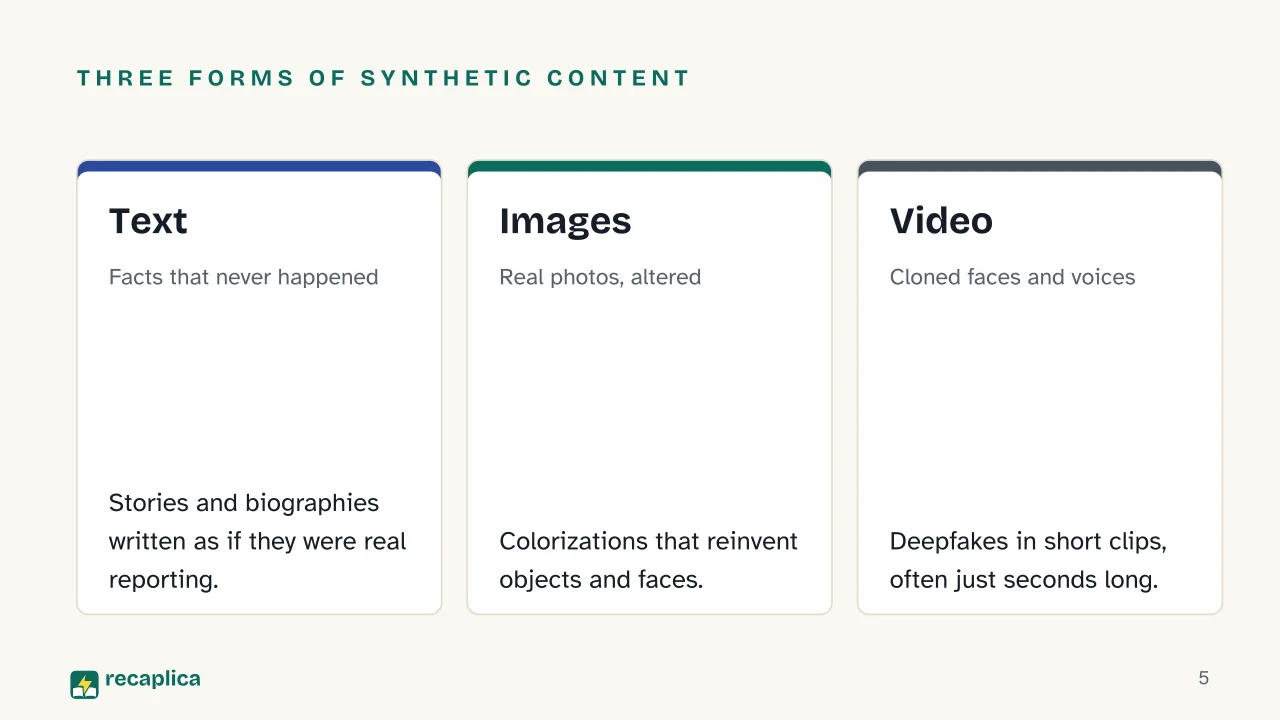  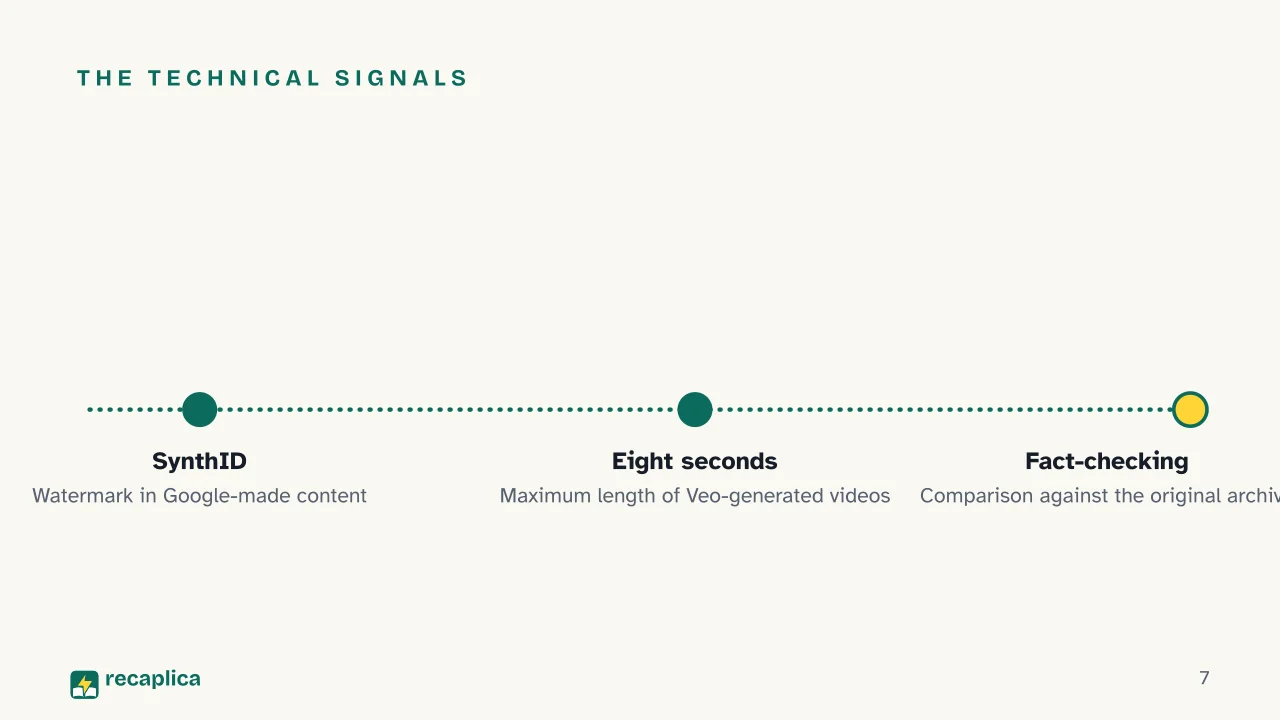  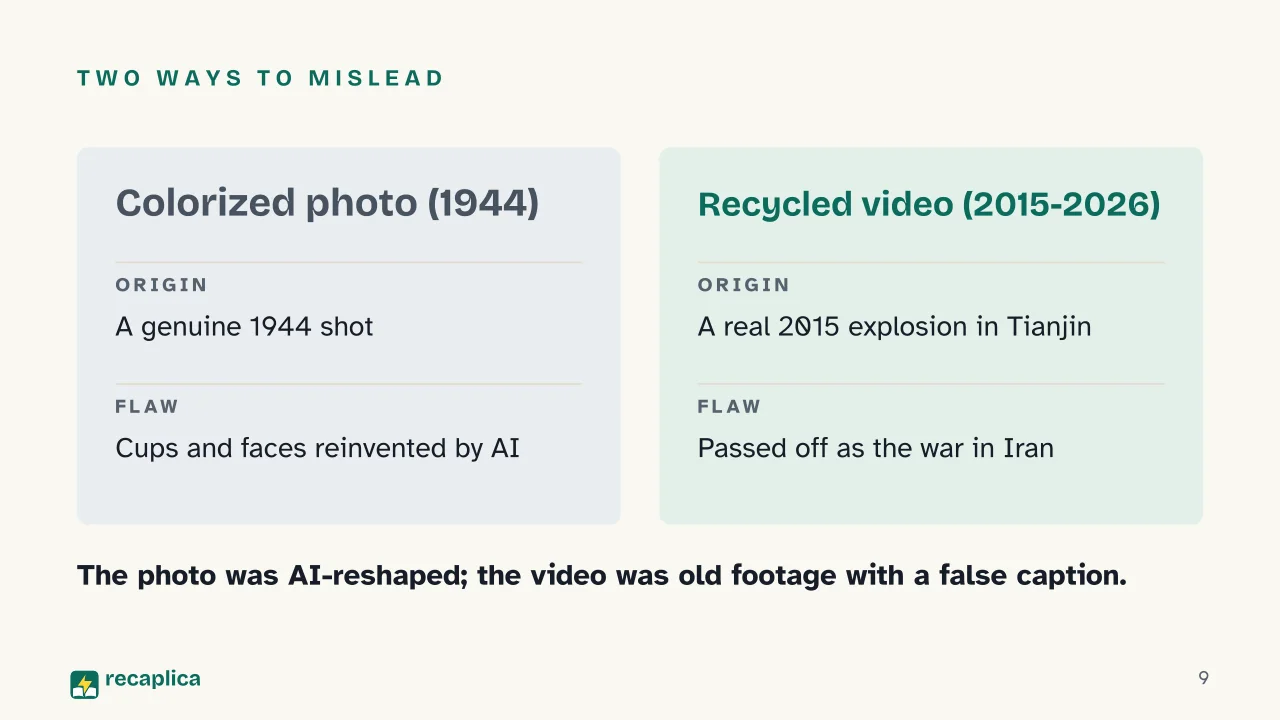  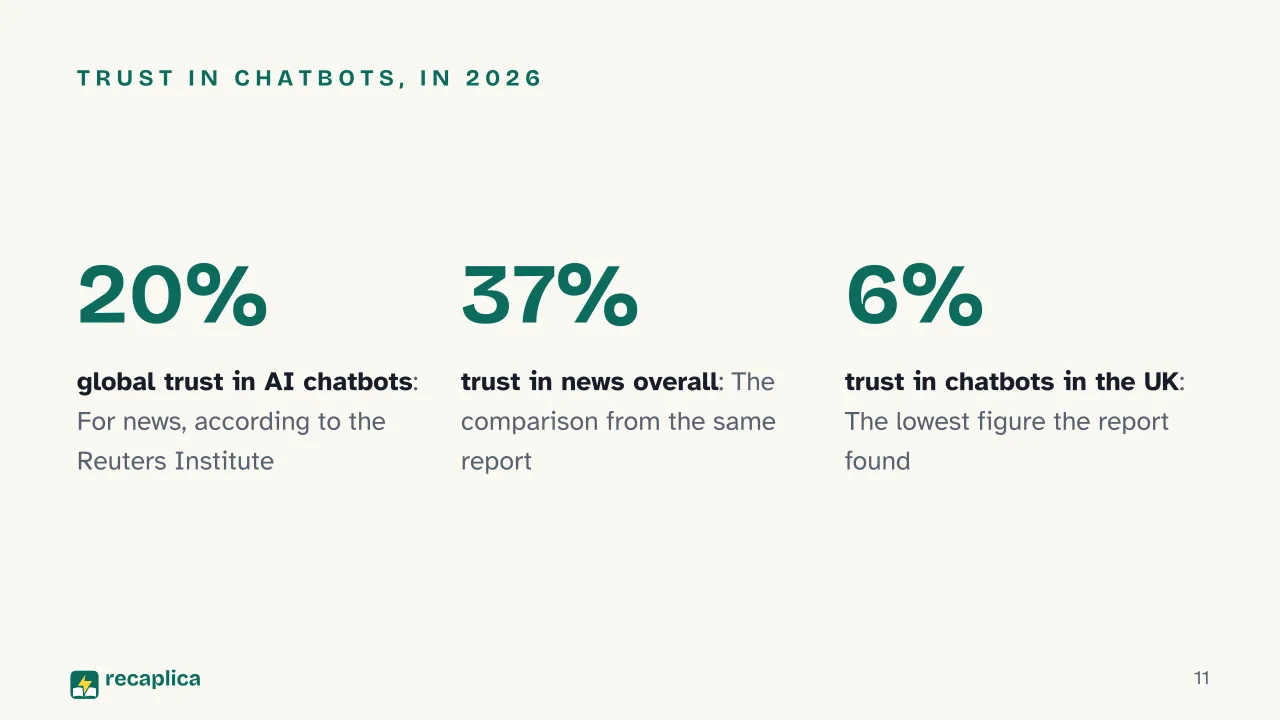 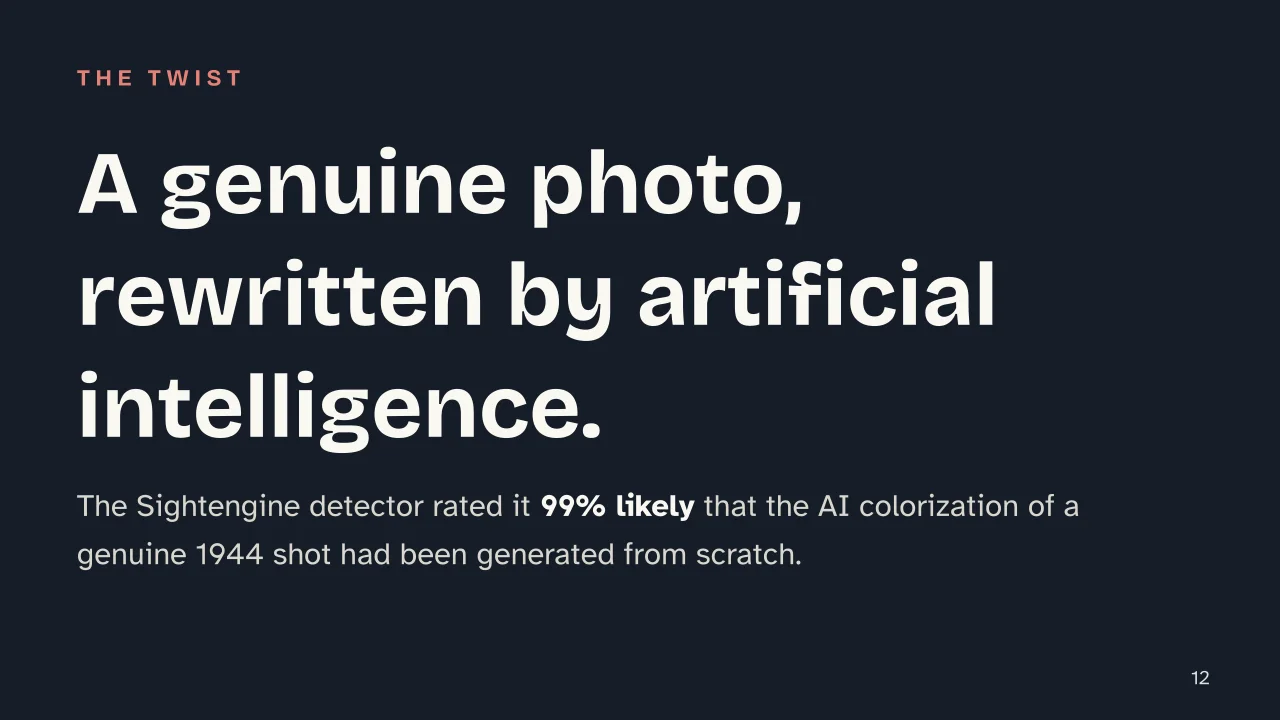    Common myths
Mind mapDrag the background to move around and the nodes to reposition them; use − and + to collapse and expand branches. 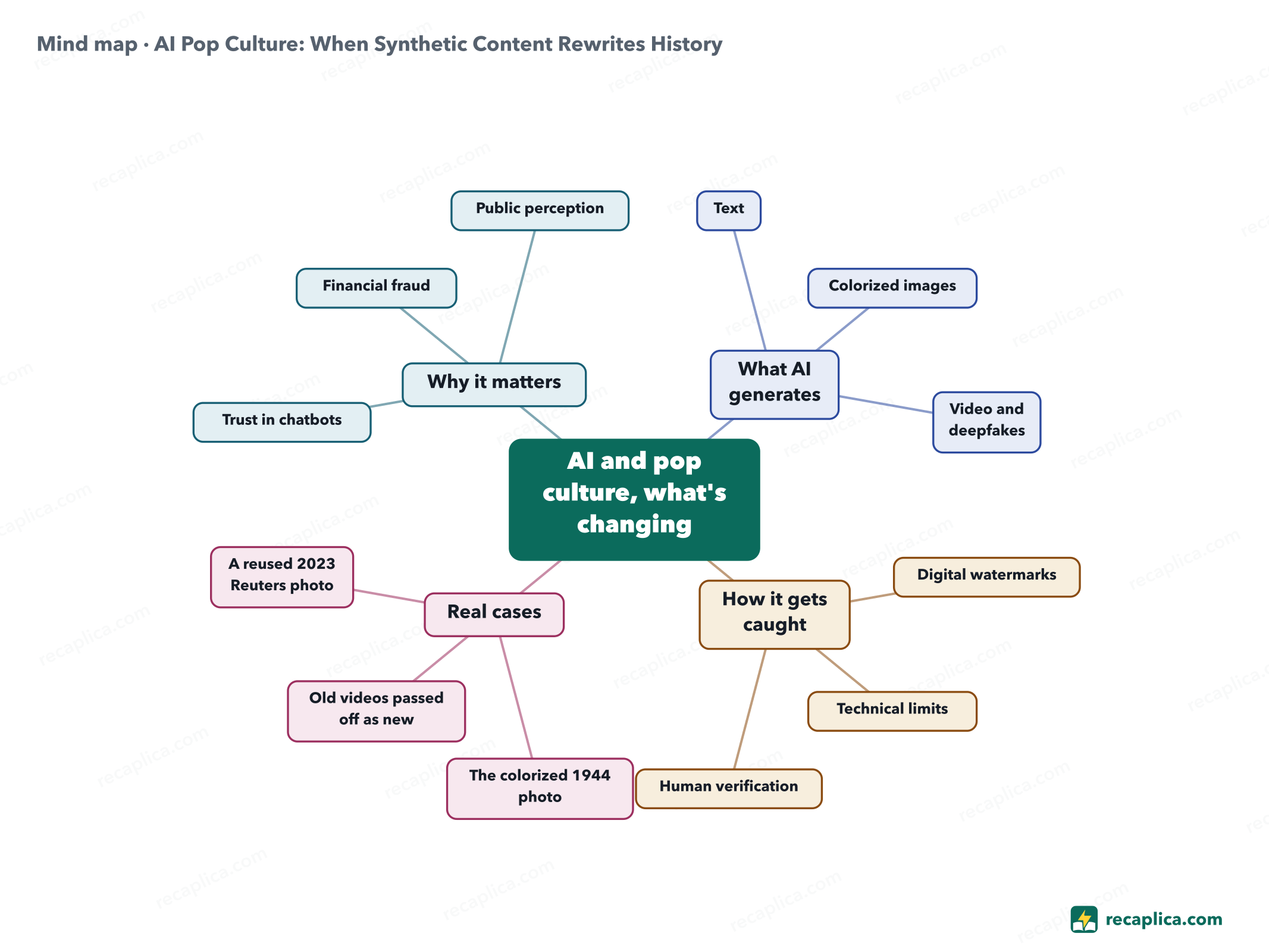
Quiz: test yourselfAnswer the questions to check what you have learned: you get instant feedback and a short explanation. Grade 0/10 0/5
FlashcardsTap the card to flip it and check whether you remember the answer, then move to the next one. 1 / 7 Explain it in your own wordsThe ultimate test: if you can explain it in simple words, you've truly understood it. Write your explanation, then compare it with the Recap. Your explanation is saved only on this device.
Frequently asked questionsHow can you tell if a historical photo has been altered by AI?By comparing its details against the original archive: in the case of the 1944 Imperial War Museums photo, AI colorization had made the cups identical, the lighting unnatural and the faces different from the original, clues that a detector like Sightengine translated into a 99% probability of artificial generation. Are digital watermarks like SynthID enough to expose an AI-generated image?Only partly: SynthID works if the content was made with a tool that embeds it, such as some Google products, but it does not cover every generator on the market: on its own, it cannot settle whether a piece of content is genuine. Why isn't an old video passed off as recent a generative-AI problem?Because in cases like the 2015 Tianjin explosion shared as a current event in the Iran war, the content is real footage recycled with a false caption, not something created by a model: visual disinformation can do without generative AI entirely. Do people trust what AI chatbots say about the news?Not much: according to the Reuters Institute, global trust in chatbots for news sits at 20% in 2026, against 37% placed in news overall, and it drops to 6% in countries such as the UK. How long can AI-generated videos run?It depends on the tool: some generators such as Google Veo, according to Poynter, produce clips up to about eight seconds long, a technical limit useful for judging whether a video circulating as authentic is plausible. Every Recap goes through an independent review before publication. |