|
recaplica
How to Spot Fake News: A Practical Guide | ||||||||||||||||
| © 2026 Recaplica · recaplica.com — All rights reserved | ||||||||||||||||
How to Spot Fake News: A Practical GuideWhat to print Page numbers appear when printing with default margins. SlidesChoose a cut Flash10 slidesThe essential thread, to present in classFull18 slidesEvery chapter and the deeper detailBoth come with speaker notes. In 30 seconds quick readFake news covers false or misleading content that spreads through social media, websites and word of mouth: researchers prefer the term 'information disorder' because much of the problem is not even fabricated, just genuine material used out of context. Three categories matter: misinformation (false content shared without realizing it), disinformation (false content shared knowing it, to cause harm) and malinformation (true content used to hurt someone). False stories tend to travel farther and faster than true ones, partly because they feel newer and stir stronger emotions. The most reliable way to check a claim is not to study the suspicious page itself, but to leave it and see what other independent sources say. Key Points
Key figures
Deep DiveNot one thing: three kinds of toxic information“Fake news” has become the catch-all label for anything unconvincing online, but UNESCO’s handbook for training journalists proposes a more precise term: information disorder, which covers far more than outright falsehoods. Much of the problematic content, explains researcher Claire Wardle (First Draft), isn’t even invented: it’s genuine material used out of context, and that kernel of truth is exactly what makes it more believable and more shareable. Within that disorder, three categories stand apart:
How it spreads: social media, websites and word of mouthThe Reuters Institute’s 2026 survey shows how much this weighs on trust in the news: 62% of people worldwide say they’re concerned about fake news online, four percentage points higher than the year before, with increases above five points in eleven markets (the only exception is Brazil, down three points). 58% worry they can no longer tell what’s real from what’s false when reading news online. On specific channels, the same survey records low trust: only 22% trust news they read on social media and 20% trust answers from an AI chatbot, against an overall average trust level of 37%, the lowest recorded since 2015. Yet in 2026, social media and video platforms overtook both television and news outlets’ own sites and apps as a news source for the first time, on average across the monitored markets: the most-used channel isn’t the one people trust most. AI chatbot use for news remains a minority habit but is growing, from 7% to 10% of users weekly, peaking at 16% among people under 35. Alongside social platforms there are websites: pages that copy the logo and layout of real outlets (what Wardle calls “imposter content”), or stories invented from scratch and published on purpose-built domains (“fabricated content”). Understanding how the internet works and how you land on a site helps spot the details that give away a clone: an address that’s almost, but not quite, identical to the real one, with no verifiable information about who runs it. Then there’s digital word of mouth. Many false stories don’t start with an organized plan — they start with ordinary people sharing an unverified item in good faith, in a family chat or a work group. As it passes from hand to hand, that story can change shape and turn into outright misinformation, even without anyone along the chain ever intending to deceive. Why it goes viral (among the factors that matter)A 2018 MIT study published in Science analyzed roughly 126,000 true and false stories shared on Twitter between 2006 and 2017, adding up to about 4.5 million shares by 3 million people. The result: falsehoods traveled farther, faster and more deeply than the truth, across every category of information tested, with an even stronger effect for political stories compared with terrorism, natural disasters, science, urban legends or financial information. The numbers show the size of the gap: the top 1% of false-news cascades reached between 1,000 and 100,000 people, while true stories rarely crossed 1,000. True stories took six times longer to reach 1,500 people, and twenty times longer to be shared ten times from the original post; overall, a false story was 70% more likely to be retweeted than a true one. Among the factors the authors identified is perceived novelty: false stories came across as more surprising than true ones, which appears to push people toward sharing them precisely because they’re unfamiliar. Emotional response matters too: falsehoods triggered more fear, disgust and surprise, while true stories triggered more anticipation. One finding rules out a convenient explanation, though: bots amplified true and false stories at roughly the same rate, so what mainly explains the faster spread of falsehoods is human behavior, not automation. An even more effective method for spotting itAn IFLA infographic (based on a 2016 FactCheck.org article) lays out eight practical steps, designed for use in libraries: check the source by leaving the page to investigate it, verify the author is a real person, check the publication date, recognize your own biases, read past the headline, check whether the cited links actually support the story, work out whether it’s satire, and, when in doubt, ask a librarian or consult a fact-checking site. Research on professional fact-checkers, conducted by the Stanford History Education Group and covered by Poynter, found an even more effective technique: lateral reading. Instead of staying on the suspicious page and judging it by its appearance — URL, design, functionality — readers open other browser tabs and check what independent sources say about the same site or story. Those “internal” cues, which feel like the most natural things to evaluate, turned out to be unreliable; what matters more is the trail a source leaves elsewhere, in how others have already judged it. Photos and videos made with AI: what to look forAs generative AI has spread, Wardle’s “manipulated content” and “fabricated content” categories gained a new tool: images and videos built from scratch, increasingly hard to tell apart from a real photo. Facta.news, an Italian debunking project, suggests a few practical checks: look for watermarks from major generators (an animated cloud for Sora 2, a four-pointed star for Gemini, a logo for Grok); notice anomalies, such as poorly reproduced brand logos, garbled text, crowds that look too uniform, objects that appear or vanish, or impossible perspectives; and be wary of suspicious “perfection,” such as skin that’s too smooth, teeth that are too even, no background noise, or motion that’s too fluid. One extra trick: people who create disinformation often deliberately lower the resolution of their content, making it harder to spot the details that would give away a composite image or a synthetic video. That’s why the strongest check remains the same one that works for text: trace the content back to its original source (creators of AI-generated material often disclose it openly on their own profile) and compare the event it depicts against what reliable news outlets are reporting. What decides what we see online in the first place isn’t neutral either — the same goes for the algorithms that decide what shows up first on a social feed, one more reason not to stop at the first thing that appears in your timeline. Slide deckSlides ready to download and make your own in PowerPoint or Google Slides, with speaker notes. Pick the Flash cut or the Full one.   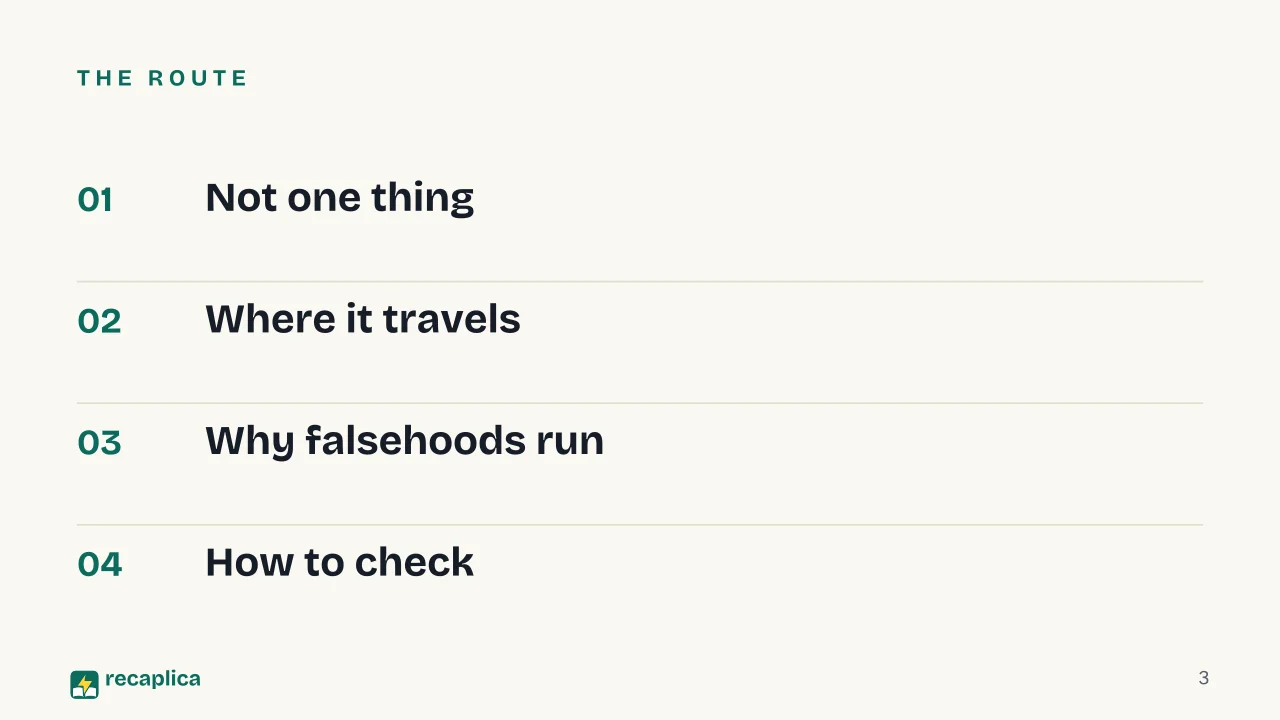  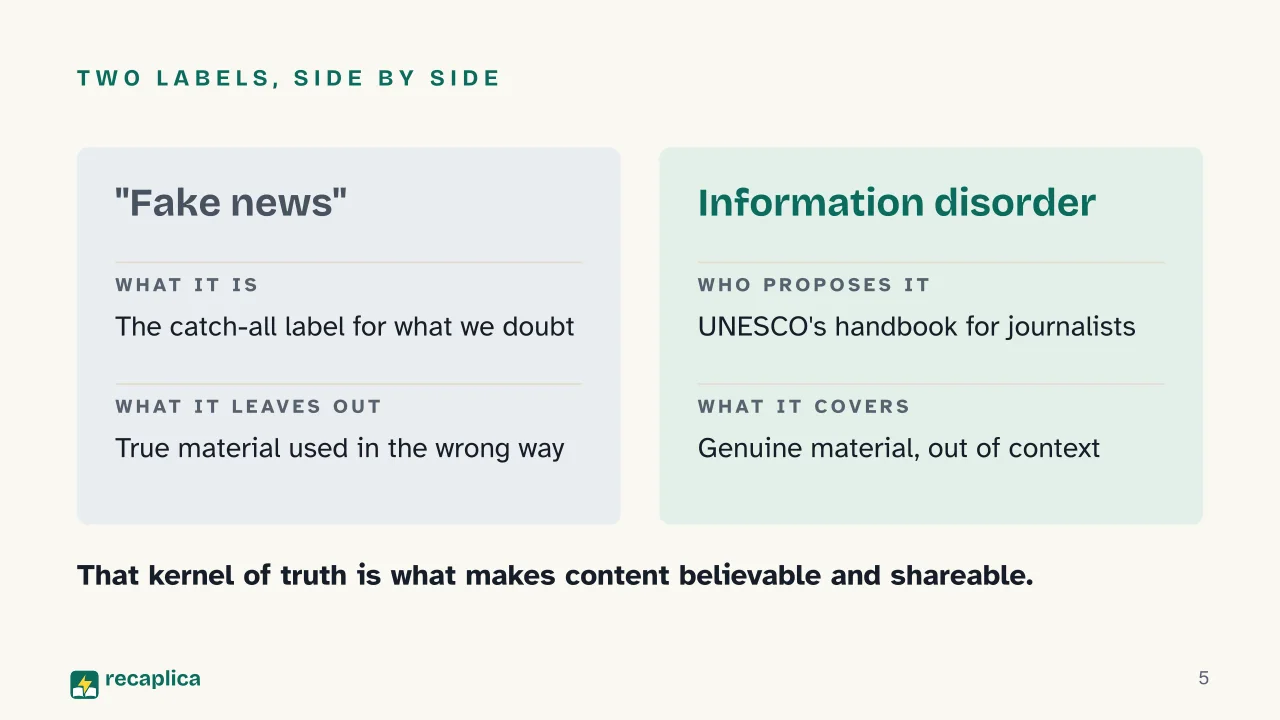 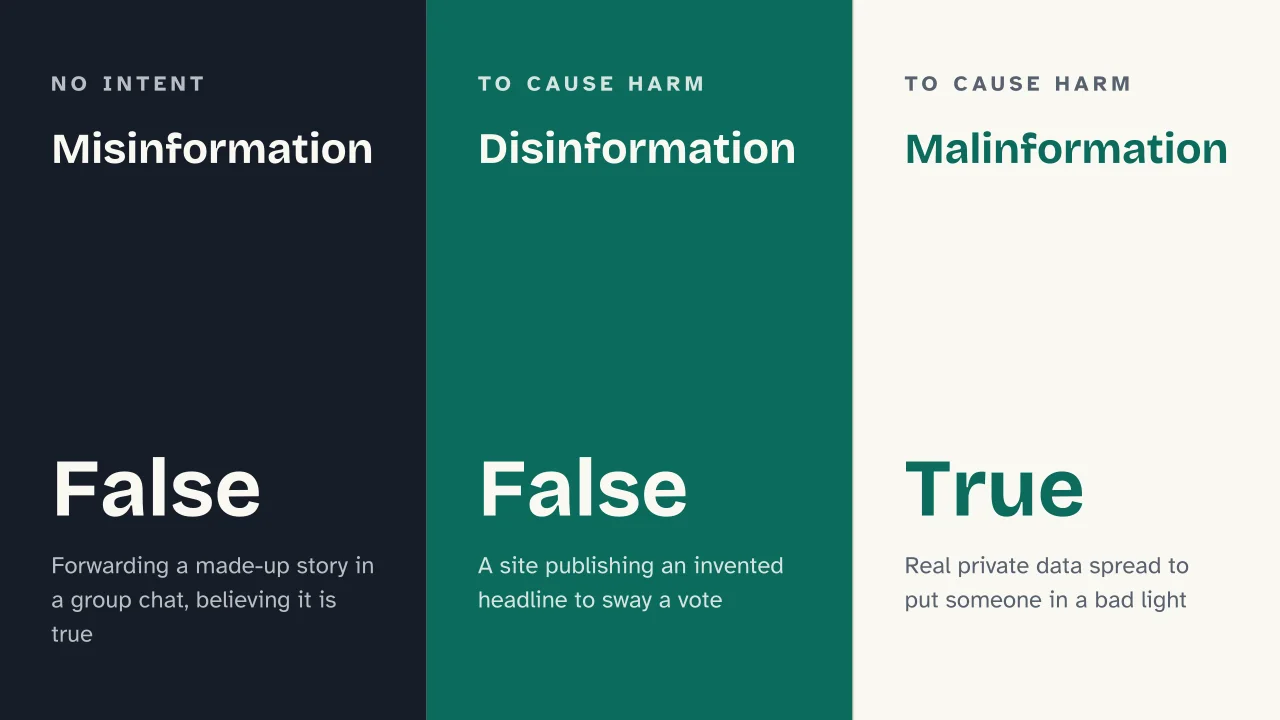  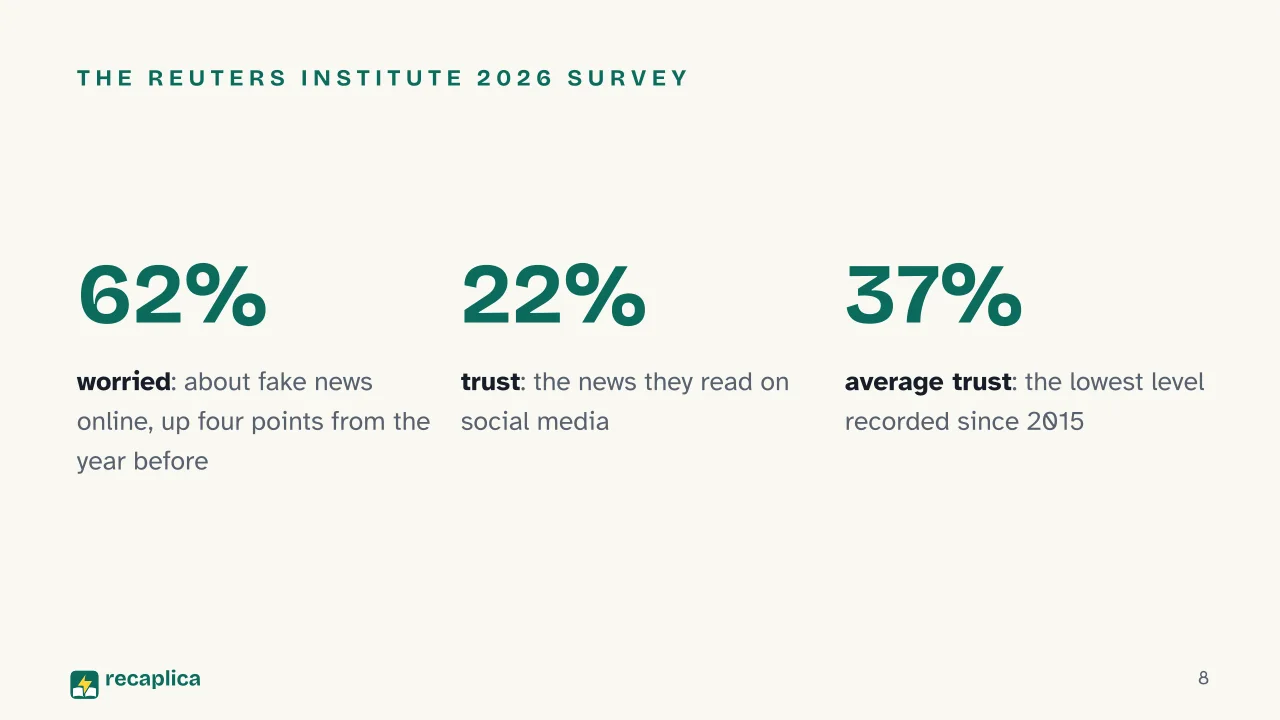 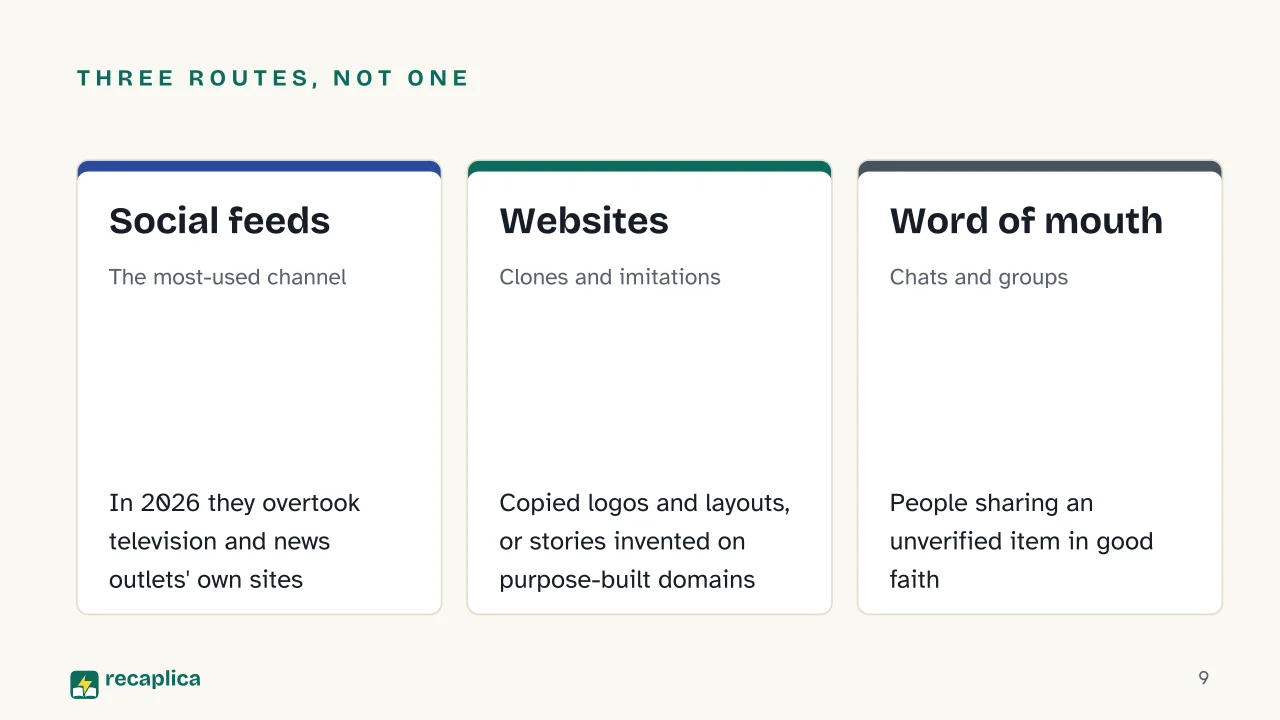  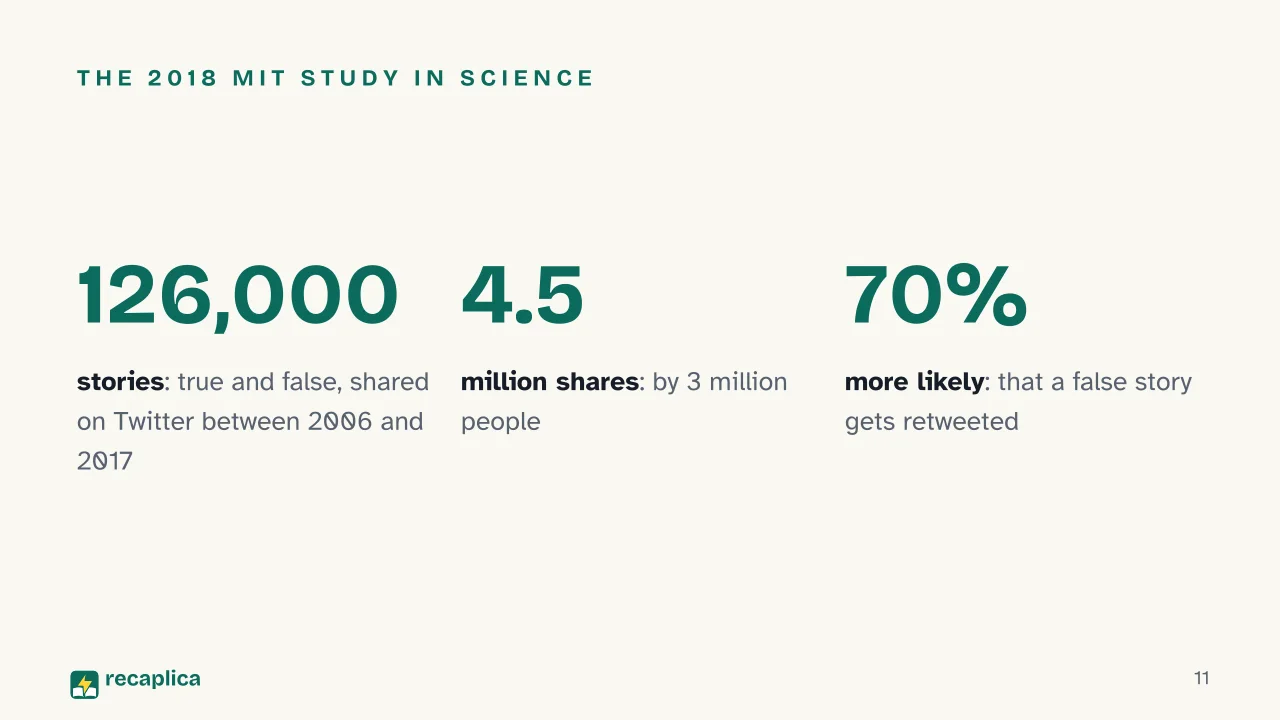  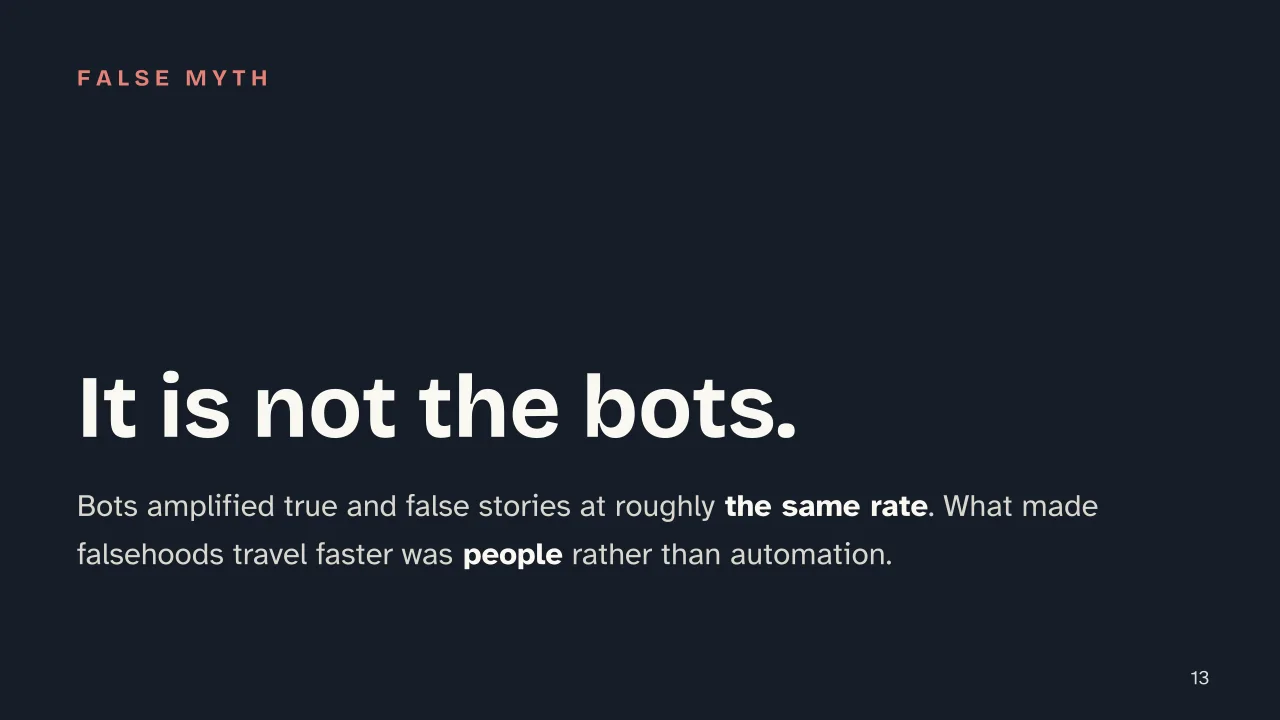  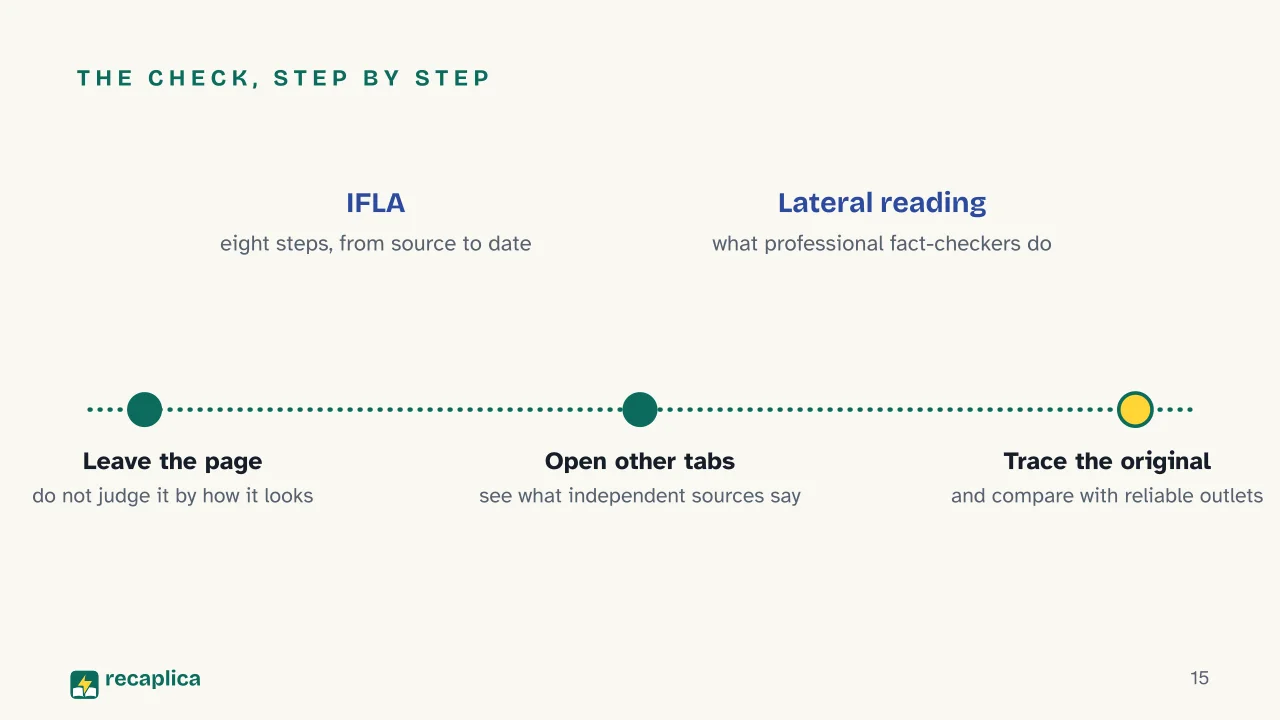 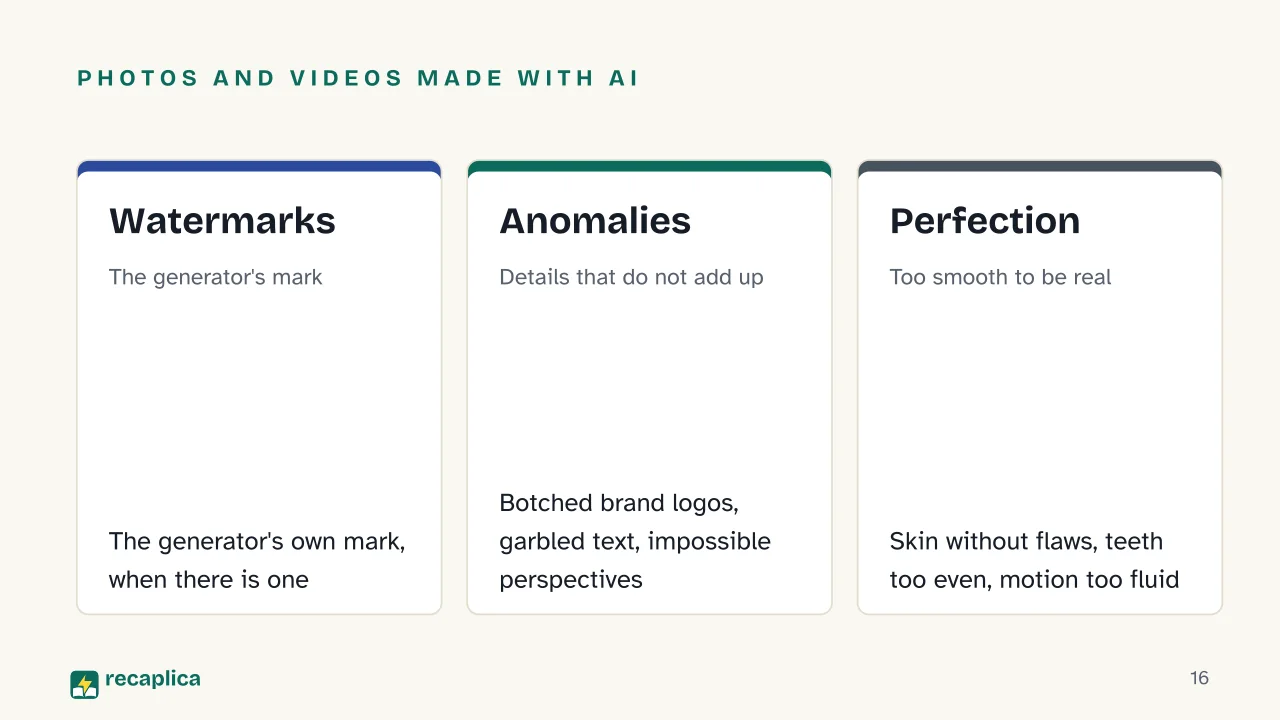 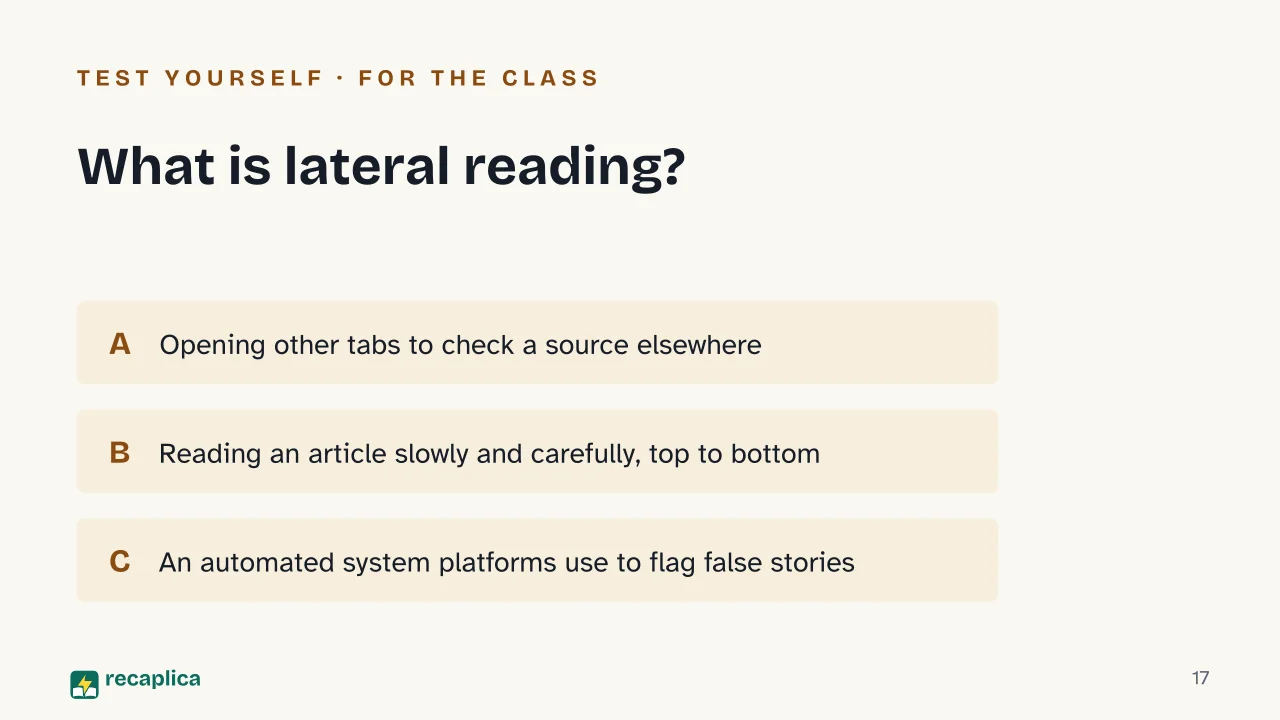  Common myths
Mind mapDrag the background to move around and the nodes to reposition them; use − and + to collapse and expand branches. 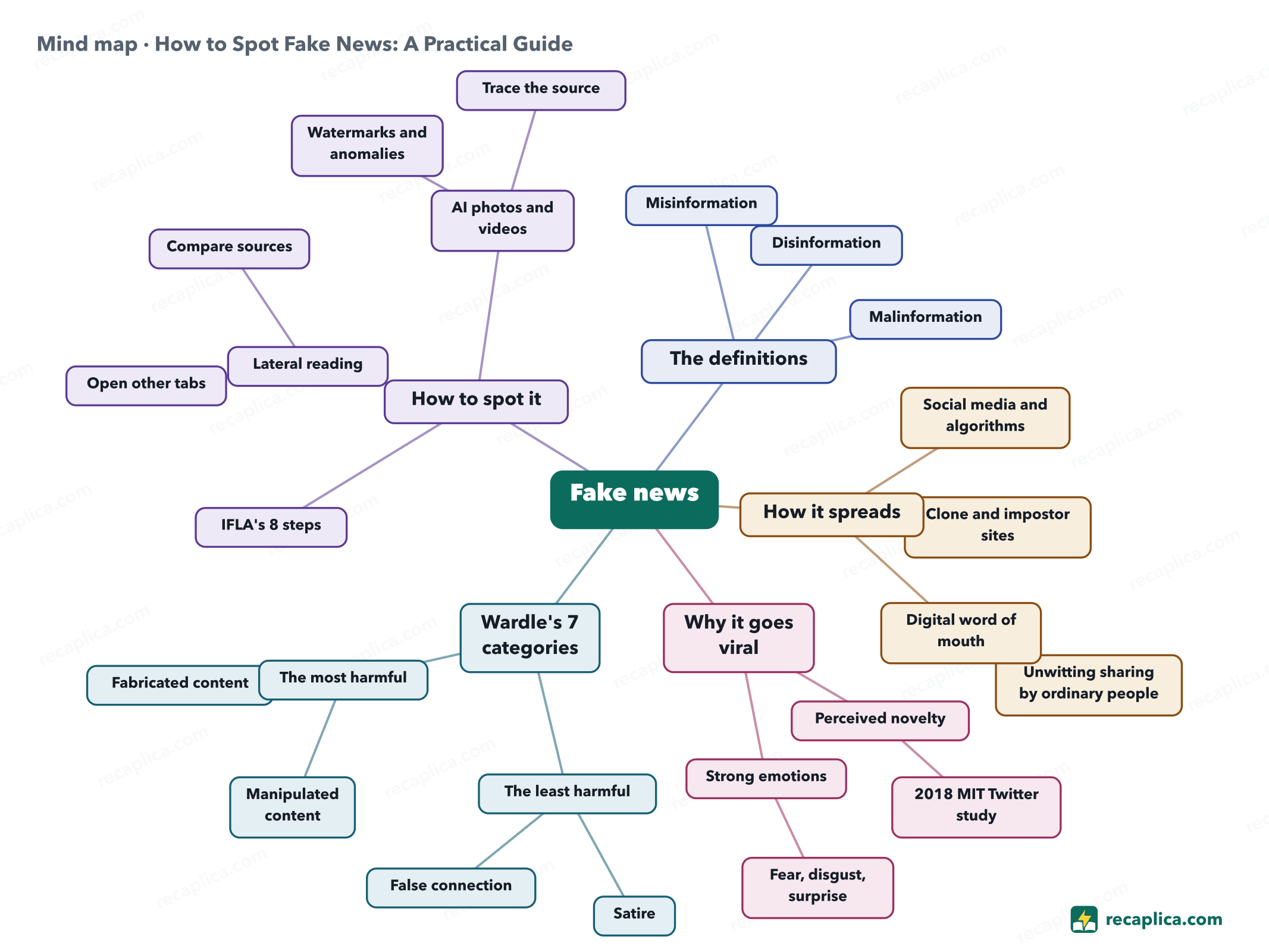
Quiz: test yourselfAnswer the questions to check what you have learned: you get instant feedback and a short explanation. Grade 0/10 0/5
FlashcardsTap the card to flip it and check whether you remember the answer, then move to the next one. 1 / 8 Explain it in your own wordsThe ultimate test: if you can explain it in simple words, you've truly understood it. Write your explanation, then compare it with the Recap. Your explanation is saved only on this device.
Frequently asked questionsWhat is fake news?It's false or misleading content presented as real news, spread through social media, websites or word of mouth. Researchers prefer the broader term 'information disorder' because much of the problematic content isn't even false in itself — it's genuine material used out of context. What's the difference between misinformation and disinformation?Misinformation is false information shared by someone who doesn't know it's false, without intent to deceive. Disinformation is false information created or shared knowing it's false, with the intent to cause harm. There's also malinformation: genuine information used to damage someone. How do you spot fake news on social media?The most effective method, according to research on professional fact-checkers, is lateral reading: instead of only analyzing the page or post itself, you open another tab and check what independent sources say about the story or the site that published it. It also helps to check the source, the author, the date, and whether the linked references actually back up what's claimed. How do you spot an AI-generated image or video?Look for watermarks from the major generators, anomalies like poorly rendered logos, garbled text or impossible perspectives, and a suspicious kind of 'perfection' (skin too smooth, motion too fluid). Tracing the content back to its original source and comparing it against reliable news outlets also helps. Does fake news really spread more than true news?A 2018 MIT study published in Science, covering roughly 126,000 stories shared on Twitter between 2006 and 2017, found that false stories spread farther, faster and more deeply than true ones across every category tested, with an even stronger effect for false political stories. Every Recap goes through an independent review before publication. |