Skip to content
recaplica

    One moment: security check

    Cloudflare wants to make sure you're not a robot. Tick the box below and your search will continue on its own.

    IT
    recaplica SEO, AEO and GEO: What Are They?
    © 2026 Recaplica · recaplica.com — All rights reserved
    Home › Technology

    SEO, AEO and GEO: What Are They?

    By Recaplica Newsroom · Updated on September 18, 2026

    What to print

    Page numbers appear when printing with default margins.

    Slides

    Choose a cut

    Flash10 slidesThe essential thread, to present in classFull14 slidesEvery chapter and the deeper detail

    Both come with speaker notes.

    Telegram channel
    recaplica Clear in 30 seconds, yours in 10 minutes.
    In 30 seconds Key points Figures Deep dive Slides Myths Mind map Quiz Flashcards FAQ

    In 30 seconds quick read

    SEO, AEO and GEO are three acronyms for three different ways of getting found online. SEO, Search Engine Optimization, works to get a page to rank higher in a traditional list of search results. AEO, Answer Engine Optimization, aims at a different target: appearing directly inside an answer, such as a voice reply or an answer box, with no click required. GEO, Generative Engine Optimization, is the newest of the three and covers visibility inside the text an AI system generates when it summarizes a topic. Google itself says the fundamentals of SEO still hold for showing up in its AI-powered search features.

    Key Points

    • SEO optimizes a site for the traditional list of search results, the one built from ranked links.
    • AEO targets a spot inside a direct answer — a box, a voice assistant, a summary — rather than a link a user has to click.
    • GEO is about showing up inside the text an AI system generates when it answers a question.
    • Google Search Central says the fundamentals of classic SEO still apply to appearing in AI Overviews and AI Mode: no new files or markup are needed.
    • The term GEO originated in academia in 2023, in a paper presented at the KDD 2024 conference.
    • Some industry sources treat AEO and GEO as near-synonyms; others, including the academic paper that coined GEO, present them as distinct disciplines with different goals.

    Key figures

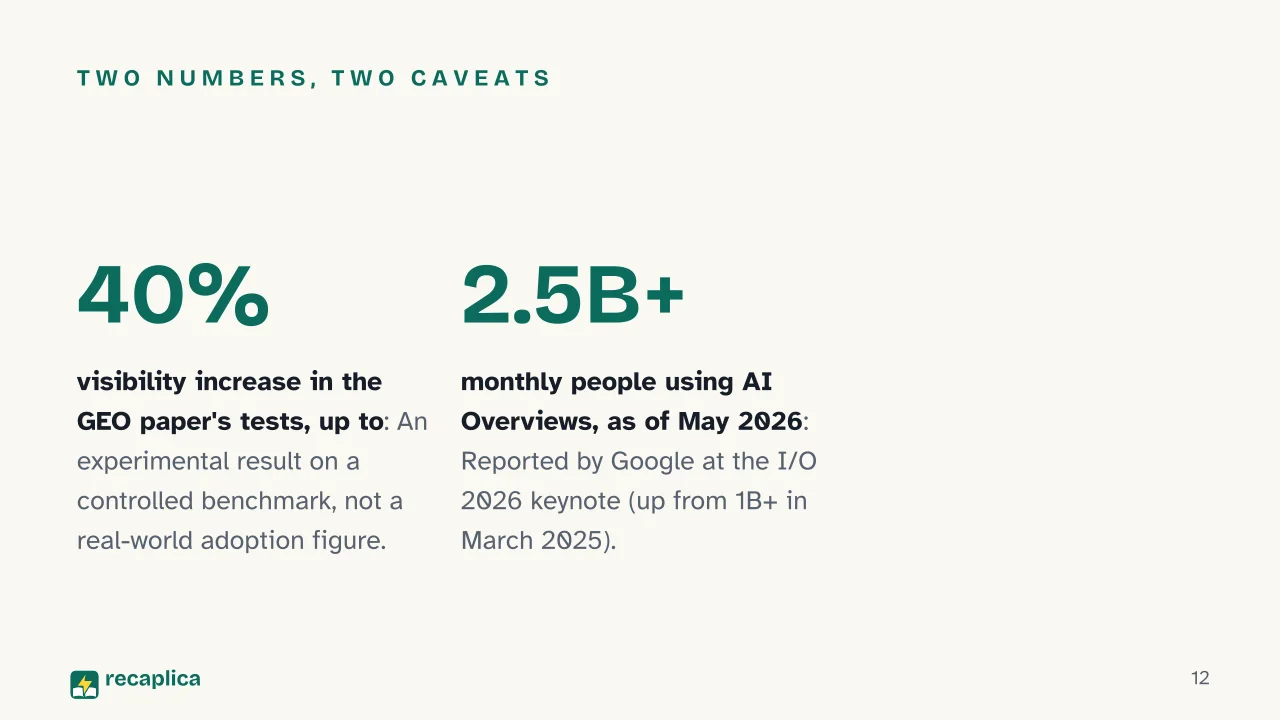
    • over 2.5 billion monthly people who, according to Google, were using AI Overviews as of May 2026 (up from over 1 billion in March 2025, when the company announced AI Mode: the number nearly tripled in just over a year). Source: Sundar Pichai, Google I/O 2026 keynote, May 19, 2026
    • up to 40% the visibility increase the paper's authors measured when applying GEO strategies in their tests, on a controlled benchmark (not a real-world adoption figure). Source: Aggarwal et al., "GEO: Generative Engine Optimization," KDD 2024

    Deep Dive

    The three acronyms point at three different targets within online search. SEO (Search Engine Optimization) works to push a page higher in a search engine’s list of results: carefully chosen keywords, internal and external links, technical factors like page speed. It’s the oldest of the three disciplines and remains the common ground AEO and GEO both build on.

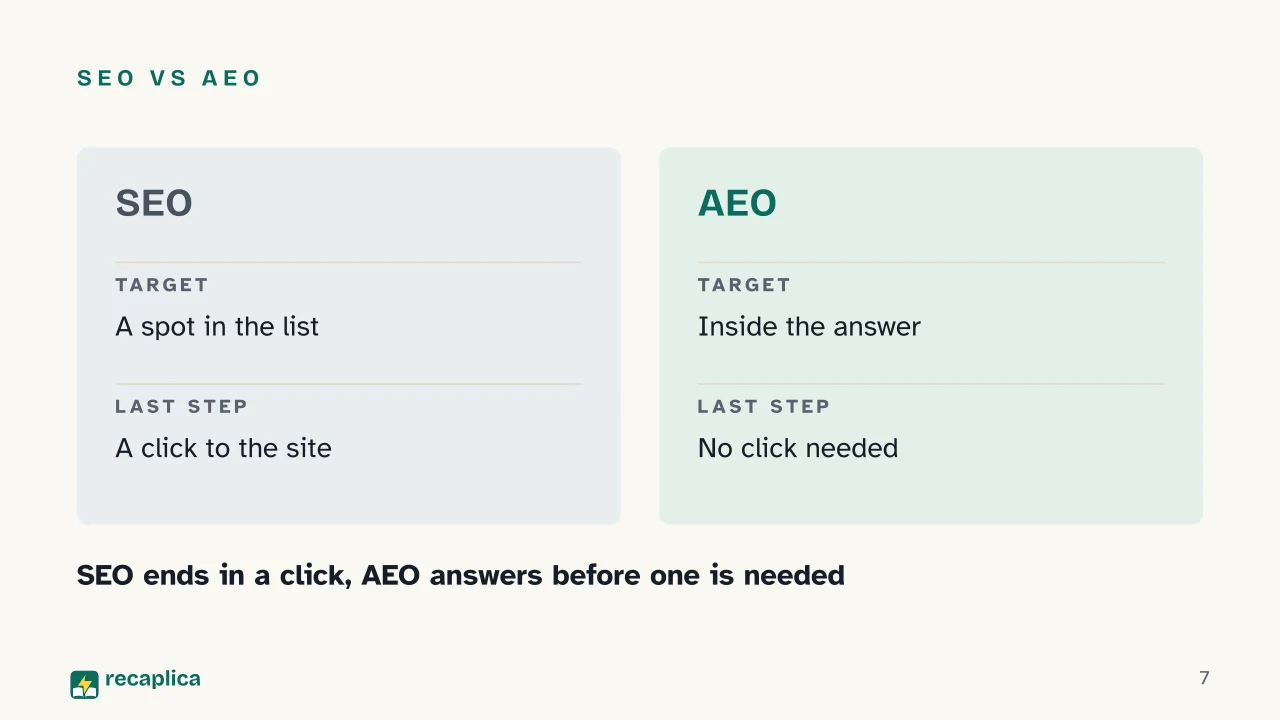
    AEO (Answer Engine Optimization) changes the finish line. Per Seobility’s definition, it aims to place content directly inside a direct answer — a box at the top of the results, a reply read out by a voice assistant — without the user ever clicking a link. Where SEO measures success in rankings and clicks, AEO measures it in presence inside the answer itself.

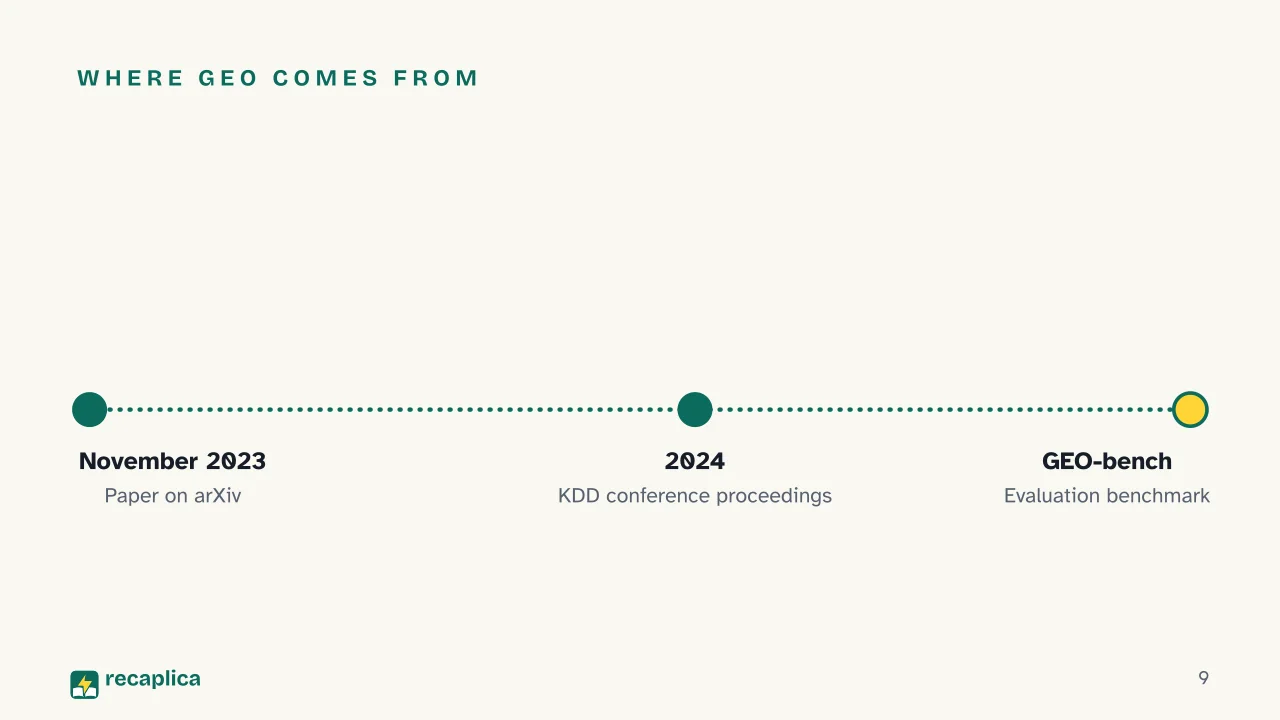
    GEO (Generative Engine Optimization) is the newest of the three. The term comes from an academic paper — “GEO: Generative Engine Optimization,” by Pranjal Aggarwal and colleagues at Princeton, Georgia Tech and the Allen Institute for AI — submitted to arXiv in November 2023 and published in the proceedings of the ACM SIGKDD 2024 conference. The authors describe GEO as the first paradigm built to help content creators improve their visibility inside the responses of a generative engine, a system that uses a language model to gather information from multiple sources and summarize it into a single answer. In their experiments, on a benchmark called GEO-bench, some strategies pushed content visibility up by as much as 40% — a lab result, not a real-world adoption statistic, worth keeping separate when it’s cited.

    Practical example: a school writes a guide on how photosynthesis works. With SEO done well, the guide ranks among the top results when someone searches “how does photosynthesis work.” With AEO done well, the same guide gets read out by a voice assistant as the direct answer to “how does photosynthesis work?” With GEO done well, a chatbot summarizing the topic cites the guide as one of the sources behind its answer.

    Not every source draws the same line between AEO and GEO. Seobility, for instance, treats them almost as synonyms, alongside labels like “AI optimization,” arguing they describe the same underlying practice. The academic paper that coined GEO, on the other hand, treats it as a discipline in its own right, with its own evaluation benchmark and specific experimental goals. In practice AEO and GEO share the same direction — getting noticed by a system that generates an answer instead of simply listing links — but not everyone in the industry treats them as identical.

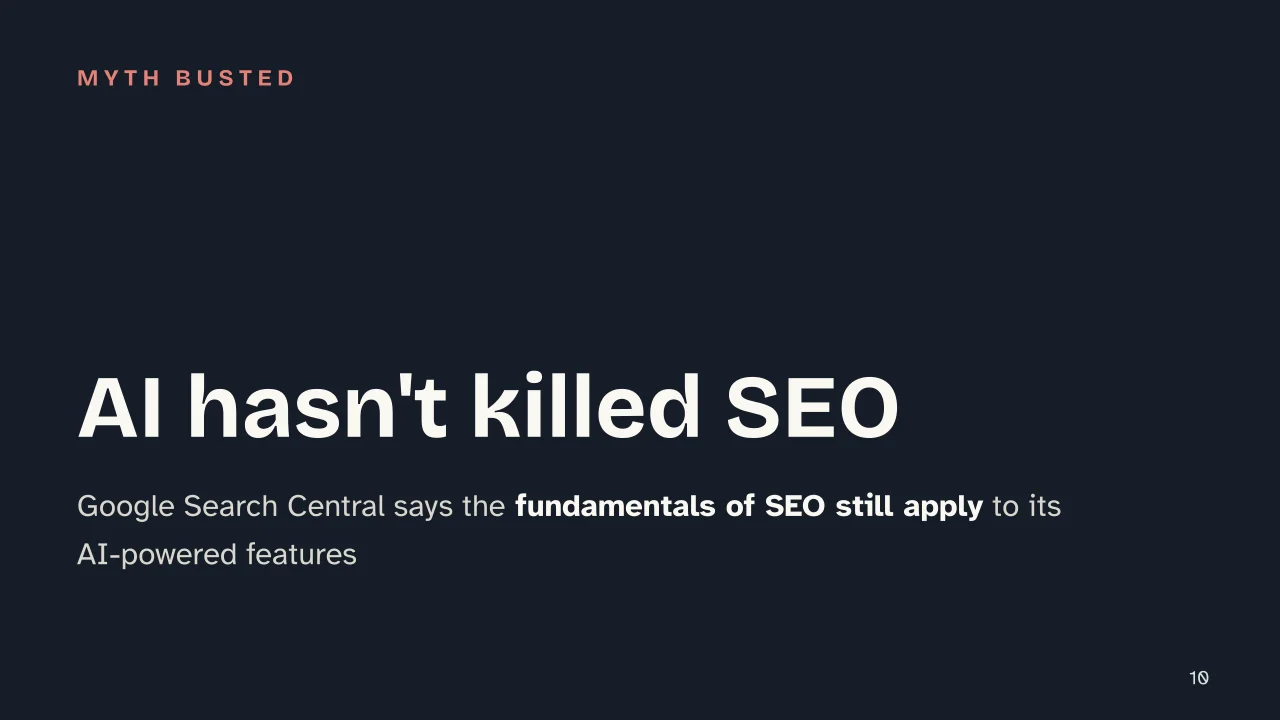
    Google, for its part, has a clear position on how its AI-powered features relate to SEO. According to Google Search Central, there are no extra requirements or special optimizations needed to appear in AI Overviews or AI Mode: no new machine-readable files, no dedicated markup. What’s needed, as a baseline, is a page that’s indexed and eligible to appear in ordinary search results, with a readable snippet. Google adds that every fundamental of existing SEO still applies: robots.txt, internal links, a page’s browsing experience, text content, structured data.

    AspectSEOAEOGEO
    What it optimizesPosition in the results listPresence inside a direct answerPresence inside AI-generated text
    Where it appearsClassic results pageAnswer box, voice assistantChatbot or generative engine reply
    User’s next stepClicks the linkGets the answer, often with no clickReads or hears the generated answer
    Origin of the term1990s-2000s, digital marketingSEO/marketing field, recent evolutionAcademic paper, KDD 2024

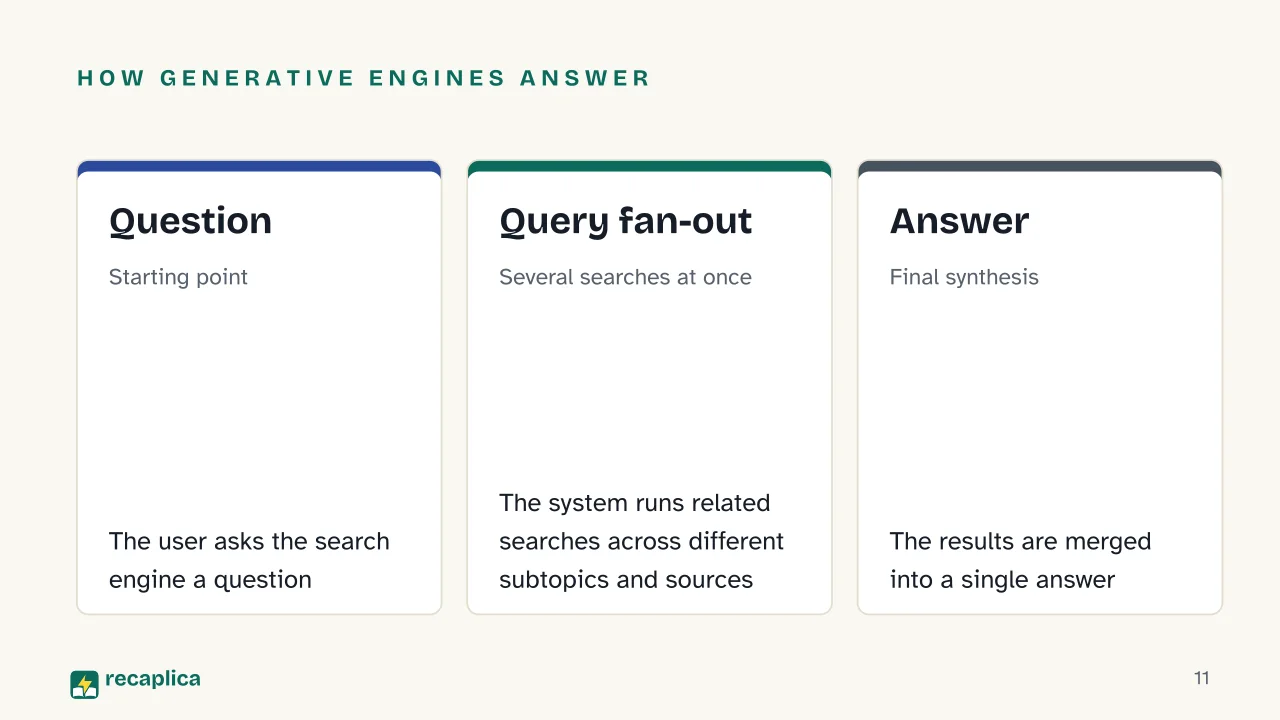
    The mechanism behind AI Overviews and AI Mode helps explain why SEO fundamentals stay useful. According to Google Search Central and the official blog post that announced AI Mode on March 5, 2025, both features rely on a technique called “query fan-out”: the system issues multiple related searches across different subtopics and data sources, then merges the results into a single, easier-to-read answer. To make it into that synthesis, content first has to pass through the ordinary search sieve — the same indexing, the same technical eligibility SEO has always tended to.

    Numbers on AI-driven search adoption keep climbing fast. Google reported, as of March 5, 2025, more than a billion people using AI Overviews; by the Google I/O keynote on May 19, 2026, the reported number had grown to more than 2.5 billion monthly users. Over the same period, a SparkToro study based on Similarweb data measured a rising share of “zero-click” searches: around 68% between January and April 2026, up from about 60% in 2024, a rise SparkToro links directly to the spread of AI Overviews. A third figure often circulates alongside these two — that by 2026 a quarter of organic traffic could shift to chatbots and assistants — and it’s a forecast, not a measurement: Gartner published it on February 19, 2024, and by late 2026 several independent trackers note that Google still holds more than 90% of search market share, a sign the predicted drop hasn’t played out at the scale forecast. It should be read as a forecast that has only partly held up, not as something that has already happened.

    For anyone running a site, three links can help map the ground SEO, AEO and GEO share: how artificial intelligence generates answers in the first place, what sets generative AI apart from other kinds of AI, and how an algorithm — including a search engine’s — decides what to show first.

    Slide deck

    Slides ready to download and make your own in PowerPoint or Google Slides, with speaker notes. Pick the Flash cut or the Full one.

    Slide 1 of the presentation on SEO, AEO and GEO: SEO, AEO, GEOSlide 2 of the presentation on SEO, AEO and GEO: Why isn't a list of links enough anymore?Slide 3 of the presentation on SEO, AEO and GEO: The RouteSlide 4 of the presentation on SEO, AEO and GEO: Chapter 01: SEOSlide 5 of the presentation on SEO, AEO and GEO: SEO, in ShortSlide 6 of the presentation on SEO, AEO and GEO: Chapter 02: AEOSlide 7 of the presentation on SEO, AEO and GEO: SEO vs AEOSlide 8 of the presentation on SEO, AEO and GEO: Chapter 03: GEOSlide 9 of the presentation on SEO, AEO and GEO: Where GEO Comes FromSlide 10 of the presentation on SEO, AEO and GEO: AI hasn't killed SEOSlide 11 of the presentation on SEO, AEO and GEO: How Generative Engines Answer: Question, Query fan-out, AnswerSlide 12 of the presentation on SEO, AEO and GEO: Two Numbers, Two CaveatsSlide 13 of the presentation on SEO, AEO and GEO: What does traditional SEO mainly optimize?Slide 14 of the presentation on SEO, AEO and GEO: Go Further
    Flash10 slidesThe essential thread, to present in classFull14 slidesEvery chapter and the deeper detail

    Common myths

    • ✗ Myth SEO is dead now that AI runs search.

      ✓ Reality Google Search Central states outright that the fundamentals of SEO still apply to showing up in its AI-powered features: robots.txt, internal links, text content and structured data still matter. AEO and GEO build on that foundation; they don't replace it.

    • ✗ Myth Appearing in AI Overviews or AI Mode requires a special file or markup.

      ✓ Reality According to Google Search Central there are no extra requirements or special optimizations: a page just needs to be indexed and eligible to appear in regular search results, with a readable snippet.

    • ✗ Myth AEO and GEO are the exact same thing under two names.

      ✓ Reality Some industry sources treat them as interchangeable, but the paper that coined GEO frames it as a paradigm of its own, built to study how generative engines answer questions, complete with its own evaluation benchmark. AEO, by contrast, developed earlier as a practice around direct-answer boxes and voice assistants. They're related disciplines, not identical in every source.

    Mind map

    Drag the background to move around and the nodes to reposition them; use − and + to collapse and expand branches.
    Customize
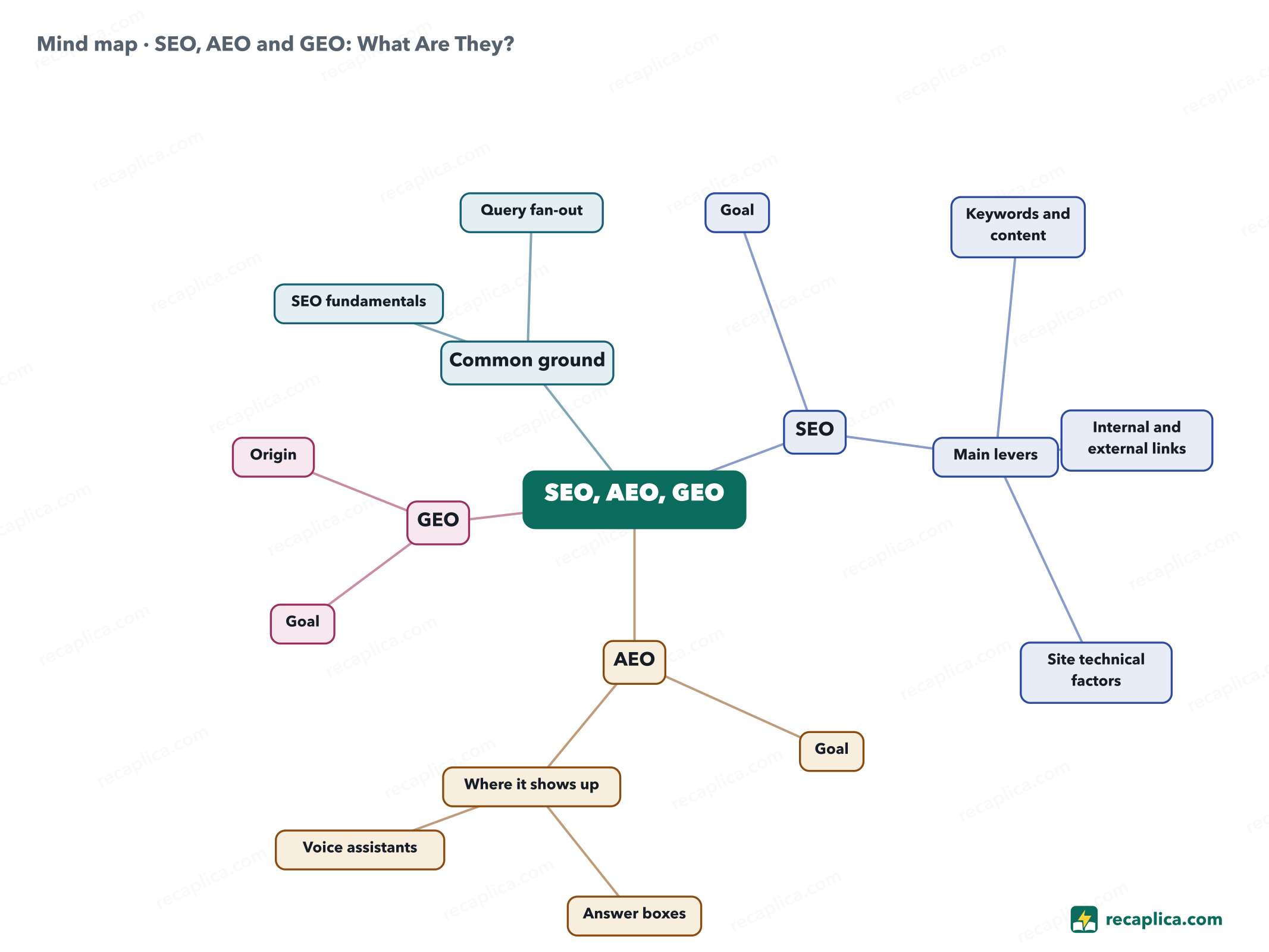
    Mind map: SEO, AEO and GEO: What Are They?
    • SEO, AEO, GEO
      • SEO Search Engine Optimization
        • Goal ranking inside the list of search results
        • Main levers
          • Keywords and content
          • Internal and external links
          • Site technical factors
      • AEO Answer Engine Optimization
        • Goal appearing inside a direct answer, no click needed
        • Where it shows up
          • Answer boxes
          • Voice assistants
      • GEO Generative Engine Optimization
        • Goal getting cited inside an answer written by generative AI
        • Origin academic paper, KDD 2024
      • Common ground
        • SEO fundamentals still apply to AI features, according to Google
        • Query fan-out technique answer engines use to run several related searches

    Quiz: test yourself

    Answer the questions to check what you have learned: you get instant feedback and a short explanation.

    Grade 0/10 0/5
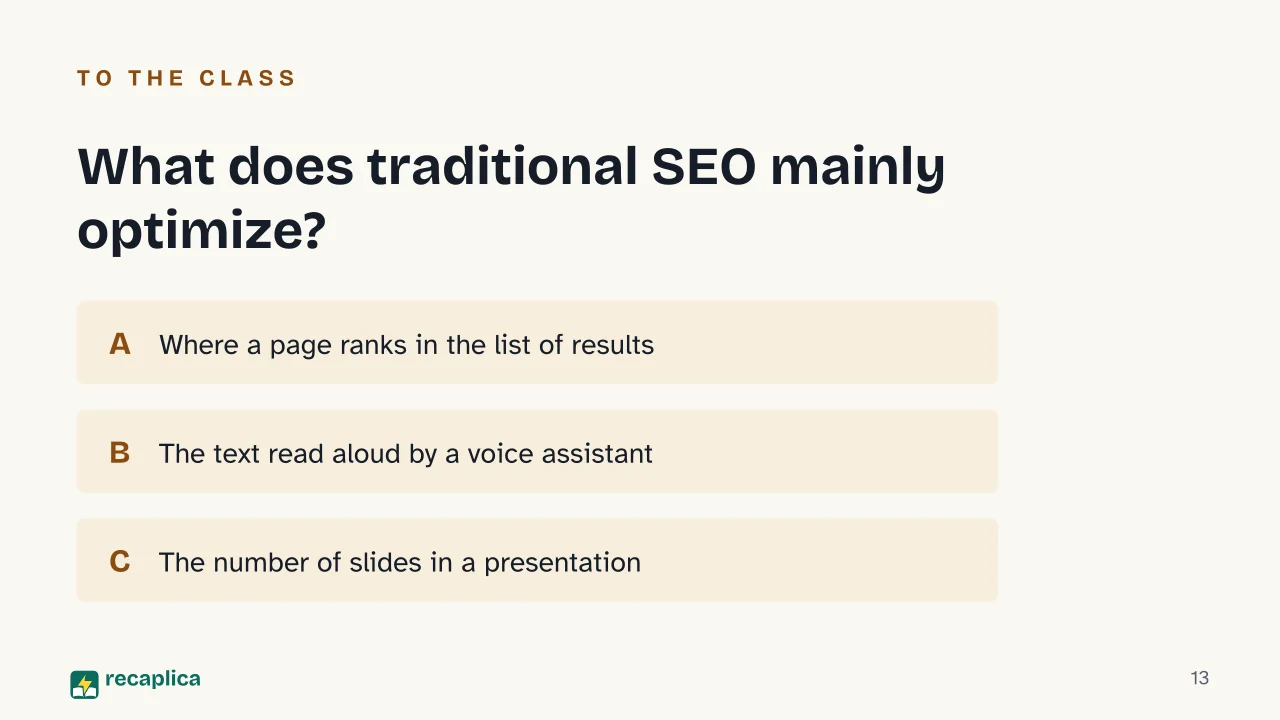
    1 What does traditional SEO mainly optimize?

    SEO (Search Engine Optimization) works on keywords, content, links and technical factors to push a page higher in the classic list of search results.

    2 What is AEO's goal, compared with SEO?

    Per Seobility's definition, AEO aims to place content directly inside answer boxes, voice responses or AI-generated answers, with no click required.

    3 According to Google Search Central, does appearing in AI Overviews and AI Mode require creating new files or dedicated markup?

    Google Search Central states explicitly that no machine-readable files, AI text files or new markup are needed to appear in these features: the existing technical search requirements apply.

    4 Where did the term GEO (Generative Engine Optimization) originate?

    The paper "GEO: Generative Engine Optimization" by Aggarwal and colleagues, submitted to arXiv in 2023 and published in the KDD 2024 proceedings, presents GEO as a new paradigm with its own evaluation benchmark, GEO-bench.

    5 What is the "query fan-out" technique Google describes for AI Overviews and AI Mode?

    Google Search Central describes query fan-out as the mechanism shared by AI Overviews and AI Mode: the system runs multiple related searches on different subtopics and sources, then merges the results into one answer.

    Answers: 1-A · 2-A · 3-B · 4-A · 5-A

    Flashcards

    Tap the card to flip it and check whether you remember the answer, then move to the next one.

    1 / 8

    Explain it in your own words

    The ultimate test: if you can explain it in simple words, you've truly understood it. Write your explanation, then compare it with the Recap.

    Your explanation is saved only on this device.

    SEO, AEO and GEO are three acronyms for three different ways of getting found online. SEO, Search Engine Optimization, works to get a page to rank higher in a traditional list of search results. AEO, Answer Engine Optimization, aims at a different target: appearing directly inside an answer, such as a voice reply or an answer box, with no click required. GEO, Generative Engine Optimization, is the newest of the three and covers visibility inside the text an AI system generates when it summarizes a topic. Google itself says the fundamentals of SEO still hold for showing up in its AI-powered search features.

    Frequently asked questions

    Are SEO, AEO and GEO the same thing?

    No. SEO optimizes for a search engine's list of results, AEO for appearing inside a direct answer (a box, a voice assistant), and GEO for being cited inside an answer written by generative AI. Some industry sources treat AEO and GEO as synonyms, but not all do: the paper that coined GEO presents it as a discipline of its own.

    Do you need to drop SEO to do AEO or GEO?

    No. According to Google Search Central, the fundamentals of classic SEO still apply to appearing in AI-powered search features: robots.txt, internal links, text content and structured data still count.

    Do you need a special file to appear in AI Overviews or AI Mode?

    No. Google Search Central states there are no extra requirements or special optimizations: a page just needs to be indexed and eligible to appear in ordinary search results.

    What is a "zero-click" search?

    A search that ends without the user clicking any site, because the answer is already visible on the results page. According to a SparkToro study based on Similarweb data, around 68% of US Google searches ended this way between January and April 2026, up from about 60% in 2024 — a rise SparkToro links directly to the spread of AI Overviews.

    Where does the term GEO come from?

    From the academic paper "GEO: Generative Engine Optimization" by Aggarwal and colleagues, submitted to arXiv in November 2023 and published in the proceedings of the ACM SIGKDD 2024 conference (KDD '24), which also introduces an evaluation benchmark called GEO-bench.

    Sources

    • AI Features and Your Website | Google Search Central
    • GEO: Generative Engine Optimization (Aggarwal et al., KDD 2024)
    • Answer Engine Optimization (AEO) – Definition & Practical Tips | Seobility
    • Expanding AI Overviews and introducing AI Mode | Google Blog
    • Sundar Pichai, Google I/O 2026 keynote | Google Blog
    • In 2026, Less than One Third of Google Searches Still Send a Click | SparkToro

    Every Recap goes through an independent review before publication.

    Every evening, the day's new Recaps on our Telegram channel. Join the channel →

    Keep learning

    • Technology What is vibe coding? Meaning, origin and security risks Vibe coding is a way of programming where you describe, in speech or writing and in plain language, the result you want, and let an artificial intelligence model write (and often run) the code for you, accepting its output with little or no review. Andrej Karpathy coined the term on 2 February 2025, and it caught on so widely that Collins Dictionary named it Word of the Year 2025. It's distinct from simply using an AI assistant to complete code you already understand: in vibe coding, by the original definition, you stop reading the diffs line by line. Several independent studies report that this way of working raises the risk of security vulnerabilities and leaked credentials in the resulting code. Read the Recap →
    • Technology ASCII Table: What Is It? The ASCII table assigns a fixed number to every letter, digit, punctuation mark, and keyboard control command, so that a computer, which only handles numbers, can represent text. Published in 1963 by the ANSI X3.4 committee and adopted for U.S. federal computers in 1968, it uses 7 bits and covers 128 characters, almost all of them from the English alphabet, according to the IEEE's Engineering and Technology History Wiki. RFC 20 shows how those 7 bits fit neatly inside an 8-bit byte, with the highest bit left unused; putting that extra bit to work opens up more combinations, the basis for the variants known as Extended ASCII. Because it only covers English, though, standard ASCII falls short for languages with accents, ideograms, or other alphabets — a gap Unicode was built to close. Read the Recap →
    • Technology Binary Code: What It Is and How Computers Write Numbers Binary code is how a computer represents numbers using only two digits, 0 and 1. The reason is physical: a computer's circuits reliably tell apart only two electrical states, current off or current on, and we label them 0 and 1 for convenience. Just like the decimal system, each digit's value depends on its position, but here positions are worth powers of two instead of powers of ten: the number 101 works out to (1×4)+(0×2)+(1×1), which is 5. Eight of these digits together form a byte, the unit a computer typically uses to hold one number. Binary alone covers numbers; writing letters needs an extra convention, such as ASCII or Unicode, covered in their own Recaps. Read the Recap →

    recaplica

    Clear in 30 seconds, yours in 10 minutes.

    Recaps Mind maps Request a Recap Telegram channel Mind map maker Our method About Privacy & cookies Legal notes & terms of use

    © 2026 Recaplica · A project by Curi S.r.l. — VAT IT05472000750

    Statistics, only if you say so

    To learn which Recaps help most we would use Google Analytics, with aggregate, anonymous data. It starts only with your OK, and you can change your mind anytime. Privacy policy