|
recaplica
Artificial intelligence: what it is and how it's changing the world | ||||||||||||||||||||
| © 2026 Recaplica · recaplica.com — All rights reserved | ||||||||||||||||||||
Artificial intelligence: what it is and how it's changing the worldWhat to print Page numbers appear when printing with default margins. SlidesChoose a cut Flash10 slidesThe essential thread, to present in classFull17 slidesEvery chapter and the deeper detailBoth come with speaker notes. In 30 seconds quick readArtificial intelligence is, in the OECD's official definition updated in 2023, a system that infers from the data it receives how to generate predictions, content, recommendations or decisions for a given objective - rather than simply carrying out instructions written in advance, the way traditional software does. Very different forms live under this label: hand-coded rule-based systems, machine learning that learns from data, the deep neural networks of deep learning, and generative AI that writes text and creates images. The most recent data - from the 2024 Nobel Prize in Chemistry awarded thanks to AlphaFold to the 2026 Stanford HAI and Pew Research surveys - show a change that's already measurable in work, science, medicine and everyday life, almost never for a single reason. Key Points
Key figures
Deep DiveWhat precisely counts as an artificial intelligence systemIn 2023 the OECD (the Organisation for Economic Co-operation and Development) updated the official definition of an “AI system,” adopted
The key word is “infers.” Traditional software only carries out instructions written in advance by whoever programmed it - what’s known in the trade as an algorithm: a finite, precise sequence of steps. An AI system, by contrast, processes the data it receives and works out on its own, through statistical models, how to reach the result. Its objectives can be hand-coded by a programmer, or acquired by the system itself during training: the example the OECD itself cites is a model like ChatGPT, aligned to desired behavior through a process called reinforcement learning from human feedback (RLHF). Adding “content” to the list of possible outputs, in the 2023 revision, wasn’t an incidental detail: the earlier 2019 definition was built mainly around systems that predict or decide, and didn’t clearly cover systems that create text, images or audio from scratch. Another feature of the definition concerns how a system behaves over time: an AI system can stay fixed after release, or keep adapting, with “varying levels of autonomy and adaptiveness.” The main forms: from who writes the rules to who learns themFor decades, computing solved problems with rule-based (or symbolic) systems: a programmer writes every instruction by hand - if X happens, do Y - and the machine executes it. That works well when the rules can be listed in full, and much less well when the problem is too fuzzy to fit into a list of “if… then” statements. That’s where machine learning comes in: instead of writing the rules, you train a model on large amounts of data and let it find them. A subset of machine learning, deep learning, uses neural networks organized into many layers - loosely inspired, with plenty of simplification, by the structure of the brain - and manages to learn even from raw data, without a human having to prepare and label it example by example. The newest family is generative AI: it uses an architecture called the Transformer, capable of processing entire sequences of data - a whole sentence at once - instead of one word at a time, to create new content (text, images, audio, code) from a request written in natural language. It isn’t replaying an archive: it has learned patterns and relationships from enormous amounts of data and recombines them.
How it’s changing workThe Stanford HAI 2026 report (“The 2026 AI Index Report”) captures already-wide corporate adoption: 88% of organizations surveyed had adopted AI in 2025, and 70% were already using generative AI in at least one business function. Private investment in the sector more than doubled in the same year (+127.5%), coming to account for 60% of all private AI funding; generative AI alone grew by more than 200% and captured nearly half of that money. The United States invests 23 times more private capital in AI than China does. The picture on jobs is more mixed. A third of organizations surveyed expect AI to lead to workforce reductions over the coming year, mostly in customer support operations, supply chain and software engineering - but the report notes that large-scale reductions still aren’t visible in aggregate employment data. The clearest signal so far concerns one specific group: employment among software developers aged 22 to 25 has fallen by nearly 20% compared with 2024, the sharpest drop among the segments linked so far to the change AI is bringing - which remains one factor among several, not the only one these numbers can explain. AI-related skills, meanwhile, already appear in 2.5% of all US job postings, up 297% from a decade earlier. Where AI is used, measured productivity gains vary a great deal from task to task: +14-15% in customer support, +26% in software development, +50% in marketing, with more modest results in tasks that require complex reasoning. The report also flags a possible downside: relying too heavily on AI to work could, according to some evidence, come with a long-term loss of learning for the people who use it. How it’s changing science: the AlphaFold caseOn October 9, 2024, the Nobel Prize in Chemistry was awarded half to David Baker, for computational protein design, and half, jointly, to Demis Hassabis and John Jumper, for using AI to predict protein structure with a system called AlphaFold. It was the first time - and probably not the last - that a discovery made possible by artificial intelligence has won a Nobel Prize. The scale of the change gives a sense of what an impact like this actually means in practice: over roughly 60 years of experimental work, structural biologists had determined the structures of over 190,000 proteins. AlphaFold2, available since 2020, has predicted about 200 million, drawn from over a million different organisms - nearly every protein known to science. The tool’s database has already passed a million users in nearly every country in the world, and thousands of scientific papers cite it, with applications ranging from studying antibiotic resistance to enzymes capable of breaking down plastic. The reason matters too, not just the result. As John Jumper himself put it, “public data were essential to the development of AlphaFold”: the system learned from the protein structures that generations of biologists shared publicly over the decades. How it’s changing medicine: adoption outrunning the rulesA WHO Europe report, published on November 19, 2025, based on a survey conducted between 2024 and 2025 across the 50 member states of the European Region (not just European Union countries), captures a sector adopting AI faster than it’s regulating it: AI-assisted diagnostics are already in use in 64% of member states, and patient-support chatbots in 50%. National strategies dedicated specifically to AI in healthcare remain rare, though: only 8% of states (4 of 50) have one, while 66% have only cross-cutting strategies that mention AI without being built for healthcare specifically. The two barriers states cite most often are legal and regulatory uncertainty (86%, 43 of 50 states) and financial sustainability (78%, 39 of 50); among the factors states consider necessary to clear the way for adoption are clear rules on legal liability (seen as useful by 92%) and guidance on transparency and explainability (90%) - the same ground covered, in Europe, by the EU AI Act. The priorities states name for using AI in healthcare are patient care, reducing the workload on healthcare staff, and system efficiency. How it’s changing everyday lifeIn the United States, the Pew Research Center survey published on June 17, 2026 (fielded between February 17 and 23, 2026) measures rapid growth: 49% of US adults have used an AI chatbot, up from 33% in 2024; ChatGPT alone is used by 44% of adults (34% in 2025). About a quarter of users use it daily. The most common reported uses are looking up information (42%) and, among people who work, getting work tasks done (38%); 10% say they also use it for emotional support. The generational gap is stark: 63% of adults under 50 use it, against 23% of those 65 and older. Alongside chatbots, AI-enhanced “smart” devices are growing too: smartwatches (37%), smart speakers (35%), smart doorbells (18%). One of the most visible everyday uses of generative AI concerns creativity: drafting a piece of writing, generating an illustration, composing a music track are within reach of anyone with a browser. No solid, specific source on just how far this change has gone in creative fields - music, visual art, writing, design - was found, though, which is why we’re limiting ourselves to noting the widespread use, without numbers we couldn’t verify thoroughly. The same Pew survey also measures concerns: 40% of respondents expect a negative impact from AI on society over the next twenty years (48% among under-30s, against 37% of those over 50), 71% fear losing control over their personal data, 63% think AI development is moving faster than society’s ability to adapt, and only 33% trust that government will regulate it effectively. Slide deckSlides ready to download and make your own in PowerPoint or Google Slides, with speaker notes. Pick the Flash cut or the Full one.   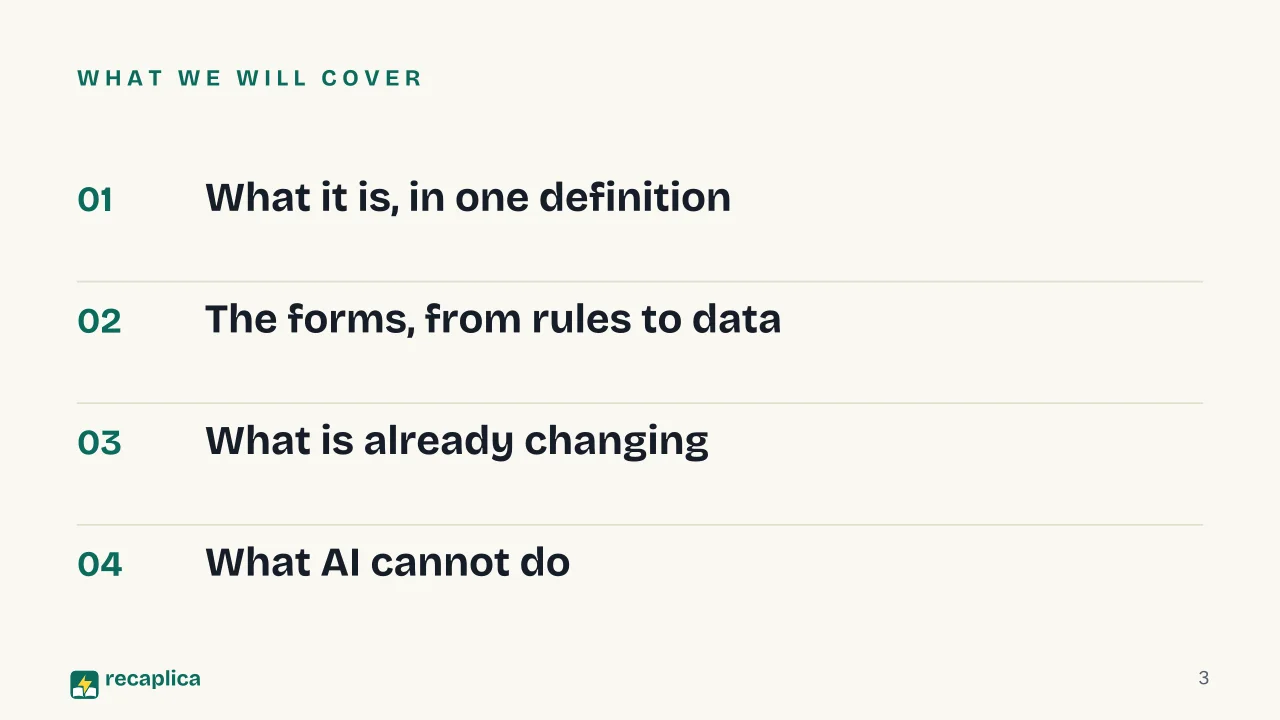 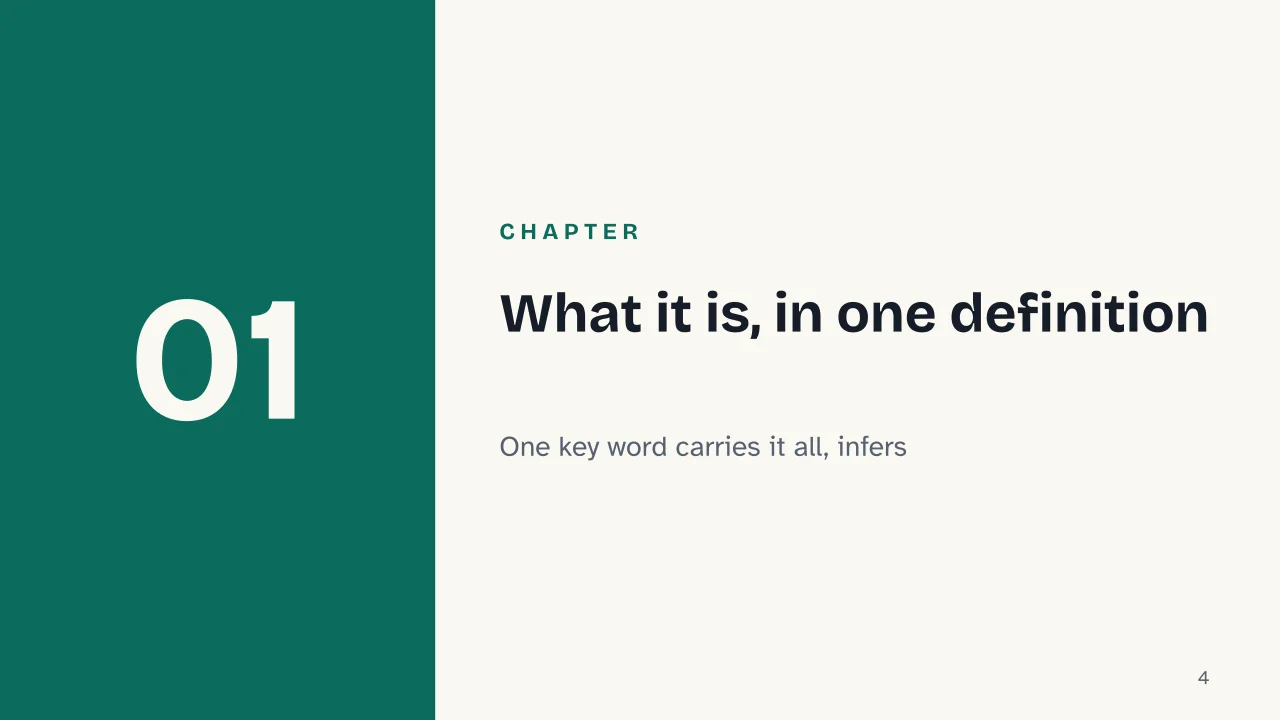 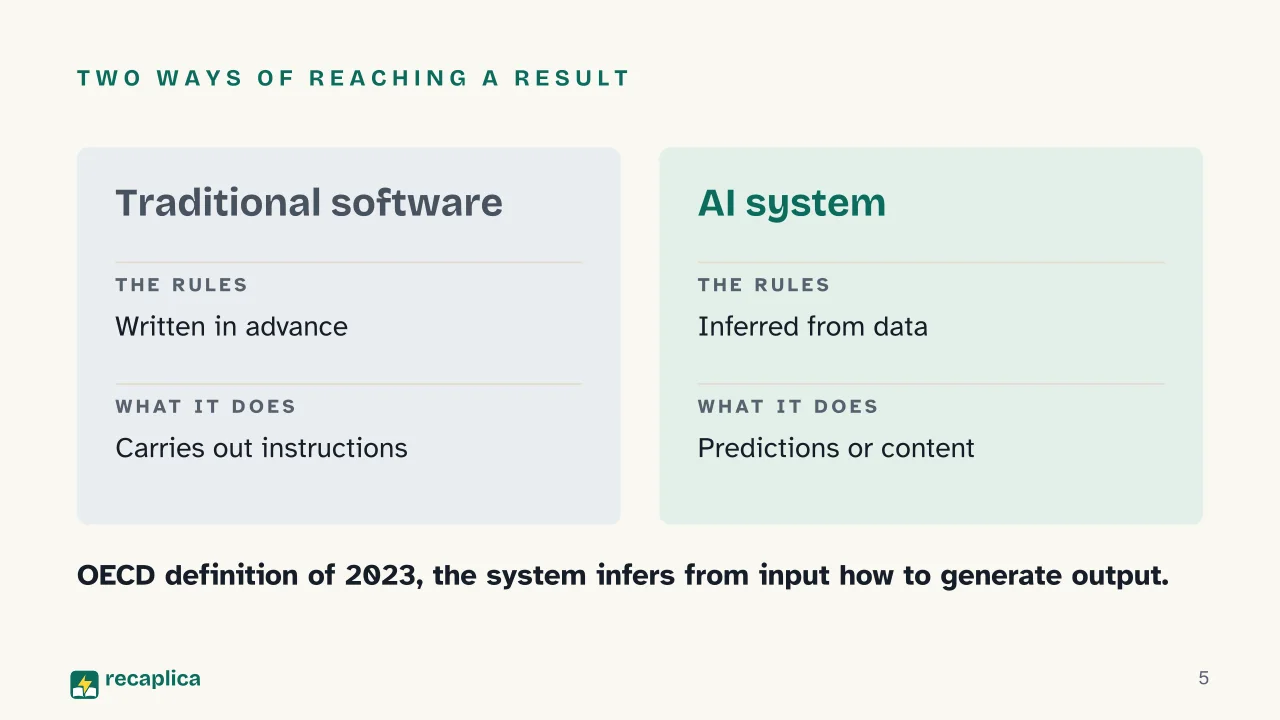  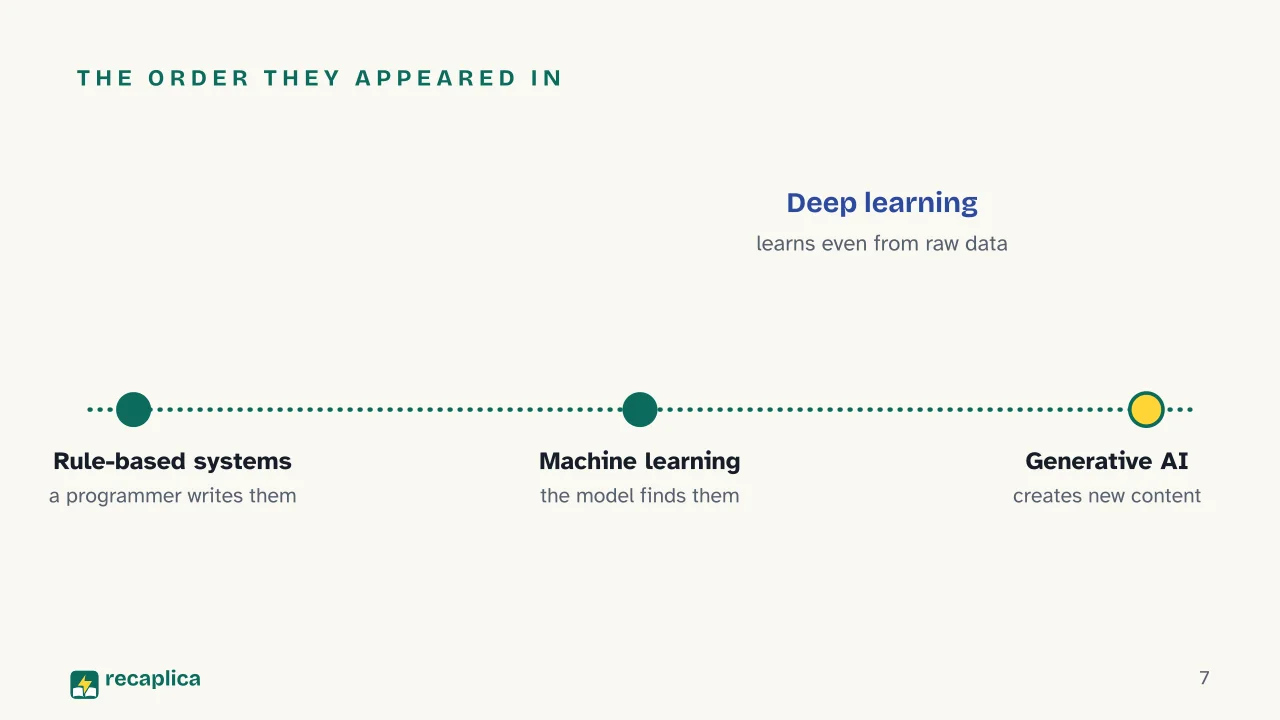 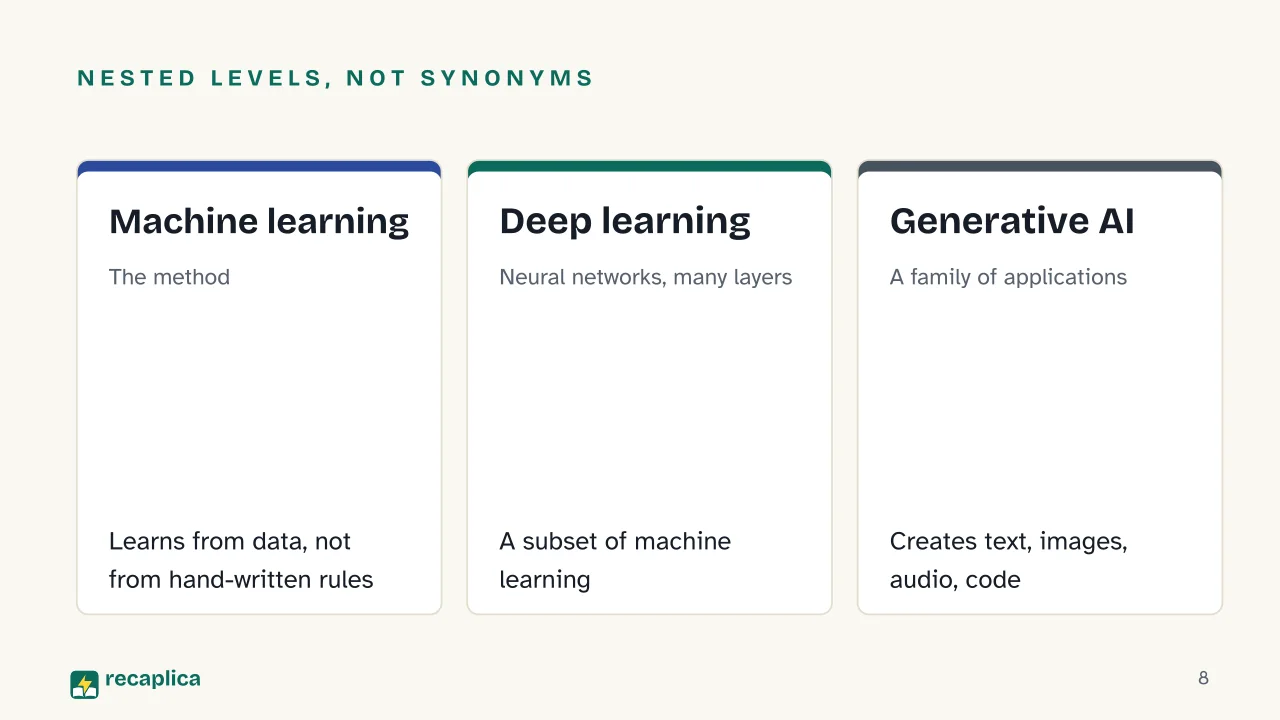   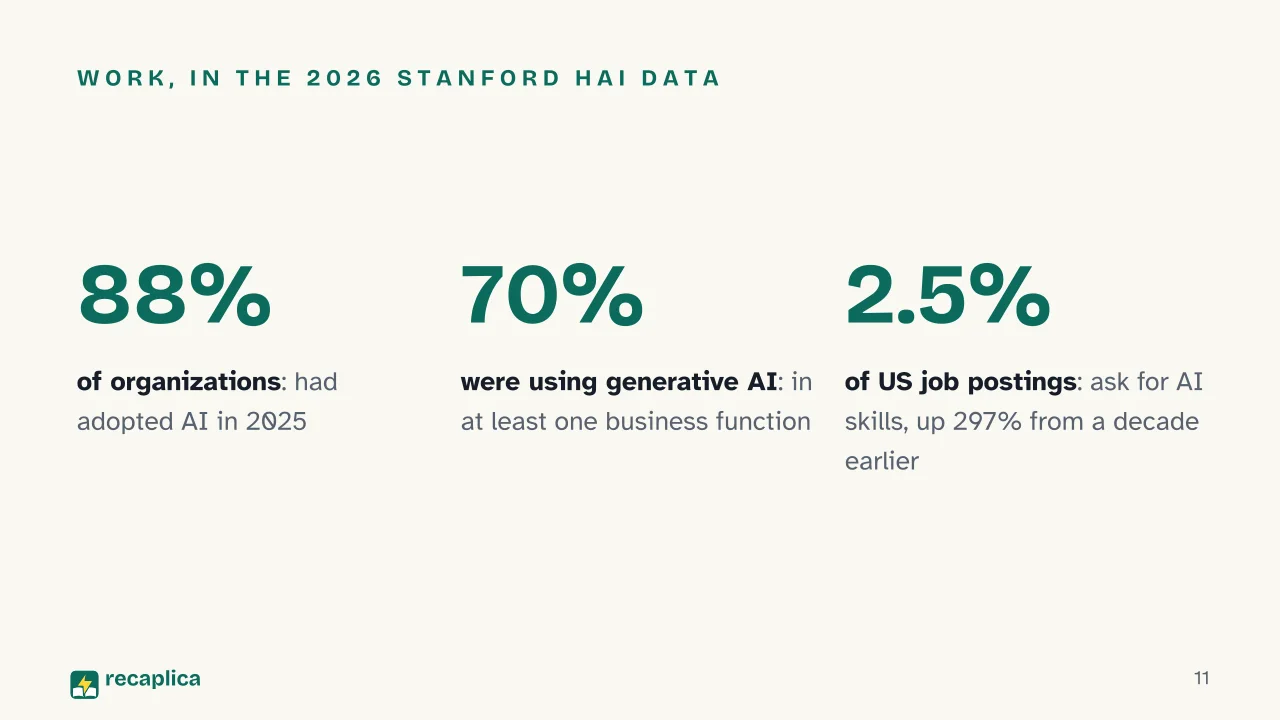 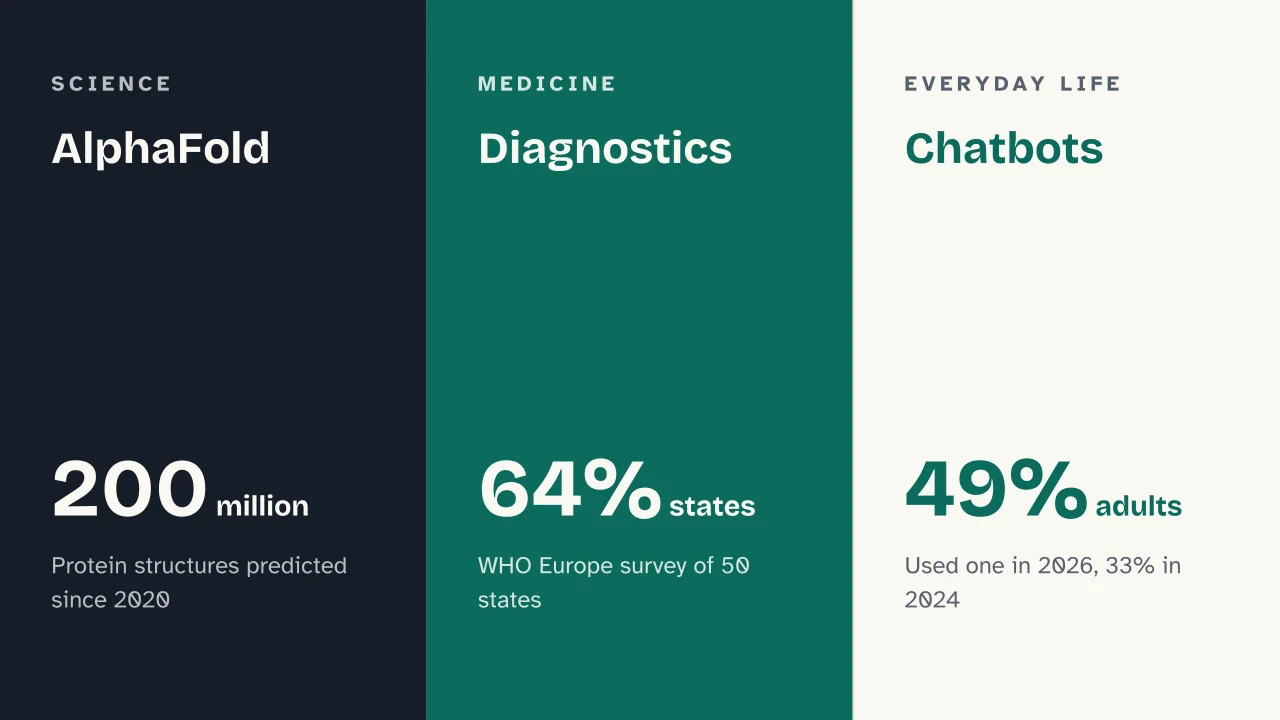 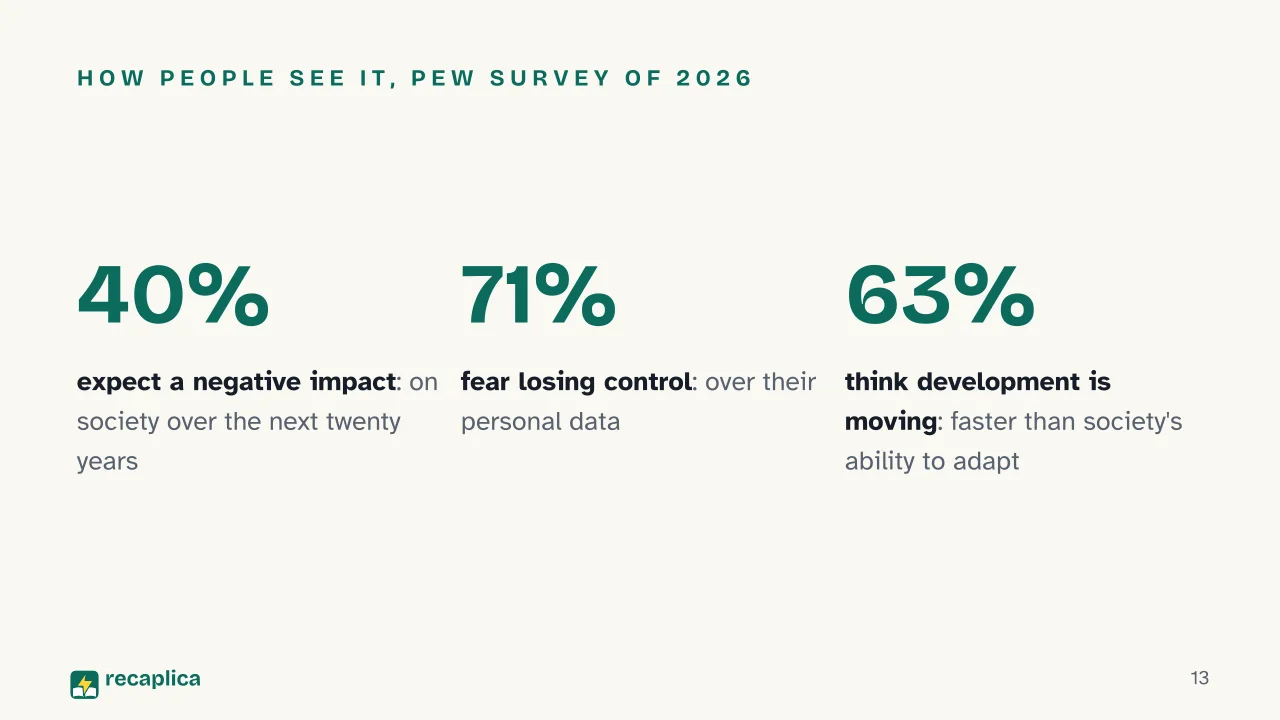  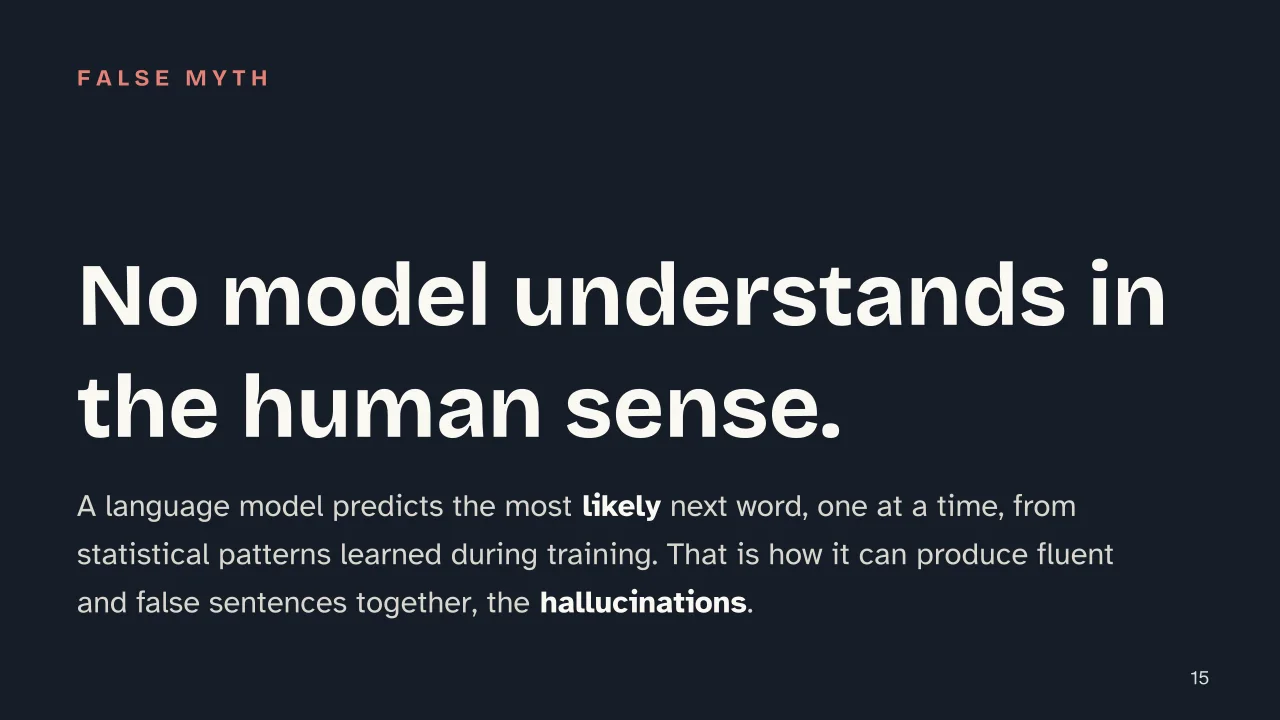 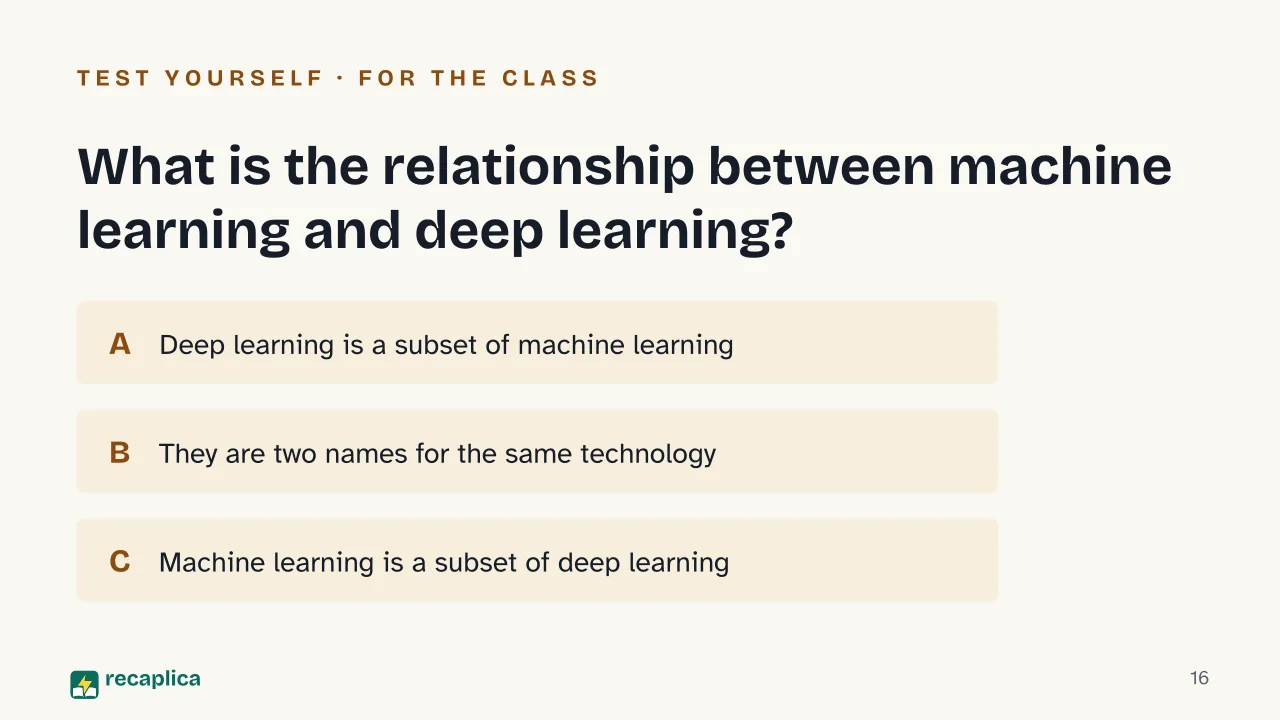  Common myths
Mind mapDrag the background to move around and the nodes to reposition them; use − and + to collapse and expand branches. 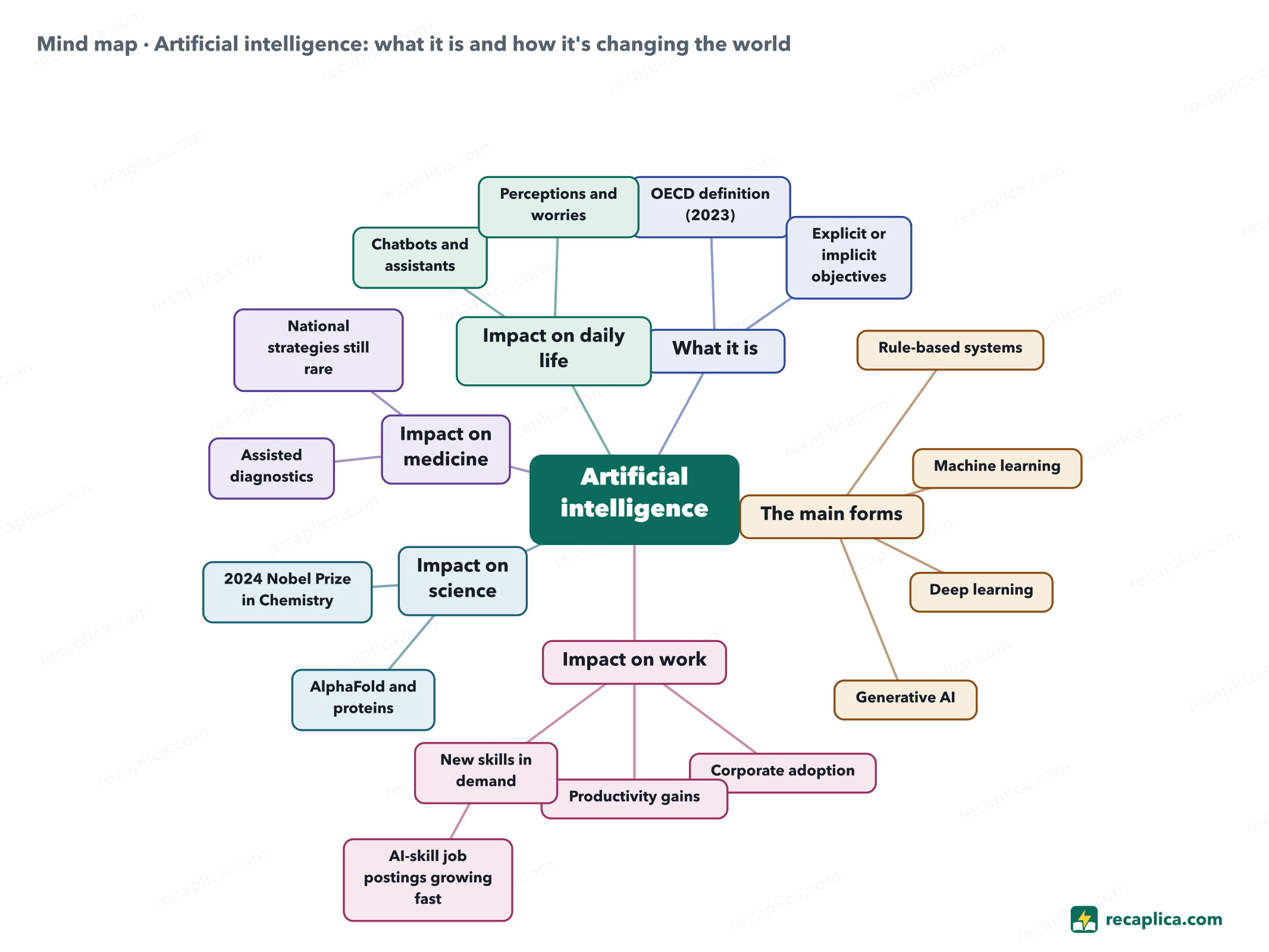
Quiz: test yourselfAnswer the questions to check what you have learned: you get instant feedback and a short explanation. Grade 0/10 0/5
FlashcardsTap the card to flip it and check whether you remember the answer, then move to the next one. 1 / 8 Explain it in your own wordsThe ultimate test: if you can explain it in simple words, you've truly understood it. Write your explanation, then compare it with the Recap. Your explanation is saved only on this device.
Frequently asked questionsWhat's the difference between artificial intelligence and machine learning?Machine learning is a subset of artificial intelligence: the method by which a system learns from data instead of following hand-written rules. AI, as a category, also includes rule-based systems that don't learn at all, while deep learning and generative AI are, in turn, subsets of machine learning. Will artificial intelligence take people's jobs?The 2026 Stanford HAI data paint a mixed picture: a third of organizations surveyed expect workforce reductions over the next year, mostly in customer support, supply chain and software engineering, and employment among young software developers (ages 22-25) has already fallen by nearly 20% compared with 2024. Large-scale reductions, though, still aren't visible in aggregate employment data, and AI remains one factor among several - not the only one these numbers can explain on their own. Does generative AI, like chatbots, actually understand what it writes?No, not in the way a person does. A language model generates text by predicting the most likely next word, one at a time, based on statistical patterns learned during training: that's why it can produce fluent and false sentences alike - the so-called hallucinations - and why its output always needs checking. How widespread is artificial intelligence in healthcare?According to the 2025 WHO Europe survey of 50 member states of the European Region, AI-assisted diagnostics are already in use in 64% of states and patient-support chatbots in 50%. Only 8% of states, though, have a national strategy dedicated specifically to AI in healthcare: most manage it inside broader digital strategies. Where does the definition of artificial intelligence used in this Recap come from?From the OECD (Organisation for Economic Co-operation and Development), which in 2023 updated the official definition of an 'AI system' later adopted, with adaptations, by regulation in the European Union, Japan and the United States. Every Recap goes through an independent review before publication. |