Skip to content
recaplica

    One moment: security check

    Cloudflare wants to make sure you're not a robot. Tick the box below and your search will continue on its own.

    IT
    recaplica Neural networks: how they really work
    © 2026 Recaplica · recaplica.com — All rights reserved
    Home › Technology

    Neural networks: how they really work

    By Recaplica Newsroom · Updated on August 31, 2026

    What to print

    Page numbers appear when printing with default margins.

    Slides

    Choose a cut

    Flash10 slidesThe essential thread, to present in classFull17 slidesEvery chapter and the deeper detail

    Both come with speaker notes.

    Telegram channel
    recaplica Clear in 30 seconds, yours in 10 minutes.
    In 30 seconds Key points Figures Deep dive Slides Myths Mind map Quiz Flashcards FAQ

    In 30 seconds quick read

    A neural network is a system of thousands of simple computing units connected in layers by millions (or billions) of weighted connections, loosely inspired by the brain's neurons. Every connection has an adjustable weight: during training the network tweaks the weights until the examples produce the right answers. With many layers it becomes deep learning, the technology behind image recognition, speech and large language models.

    Key Points

    • The network is made of nodes (artificial neurons) organized in layers: input, hidden layers, output.
    • Each connection has a weight: the node sums its weighted inputs and 'fires' if the total passes a threshold.
    • Weights start out random: training adjusts them little by little on the examples.
    • Deep learning = networks with many layers: each layer detects increasingly abstract features.
    • The idea dates to 1944 (McCullough and Pitts); the first trainable model is the 1957 Perceptron.
    • The modern breakthrough came with GPUs, which made huge networks trainable.

    Key figures

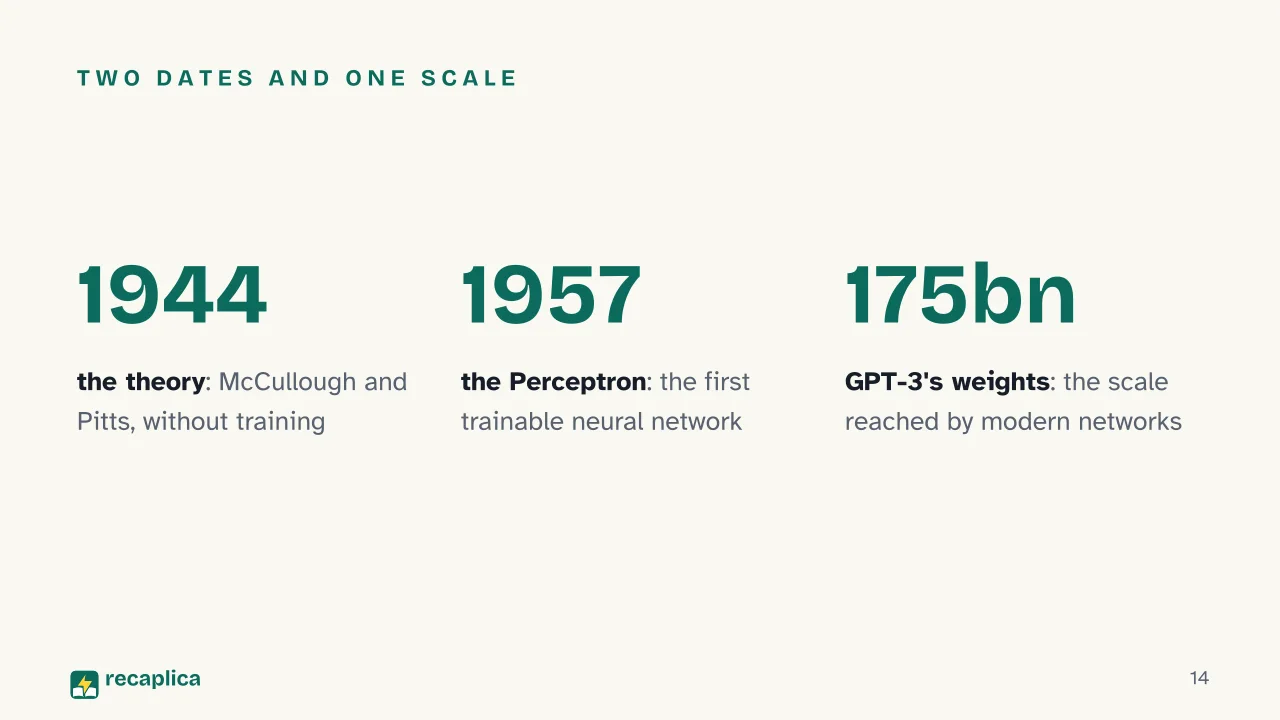
    • 1957 the year of Frank Rosenblatt's Perceptron, the first trainable neural network Source: MIT News
    • 1944 the first theoretical proposal of a neural network, by McCullough and Pitts Source: MIT News
    • 175bn the weights (parameters) of GPT-3: the scale reached by modern networks Source: arXiv, 2020

    Deep Dive

    An orchestra of tiny calculators

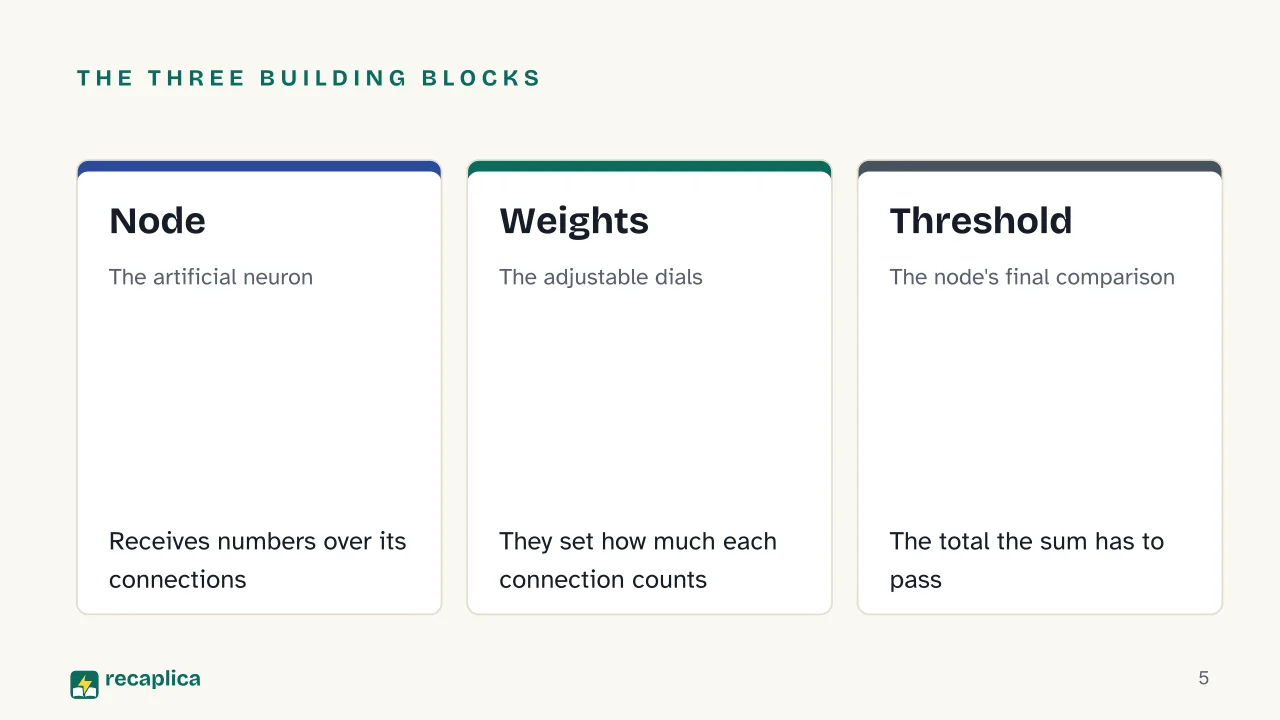
    Forget the electronic brain of the movies. A neural network is something humbler and more surprising: thousands of dead-simple computing units, connected in layers by millions (in modern models, billions) of weighted connections. As MIT explains, each node does one thing: it receives numbers over its incoming connections, multiplies them by their weights, adds everything up and compares the total against a threshold. Above the threshold, the node “fires” and passes the signal to the next layer; below it, silence.

    None of these units knows anything. The intelligence — if we want to call it that — lives entirely in the weights: millions, nowadays billions, of dials deciding how much every connection counts.

    Training: tuning the dials

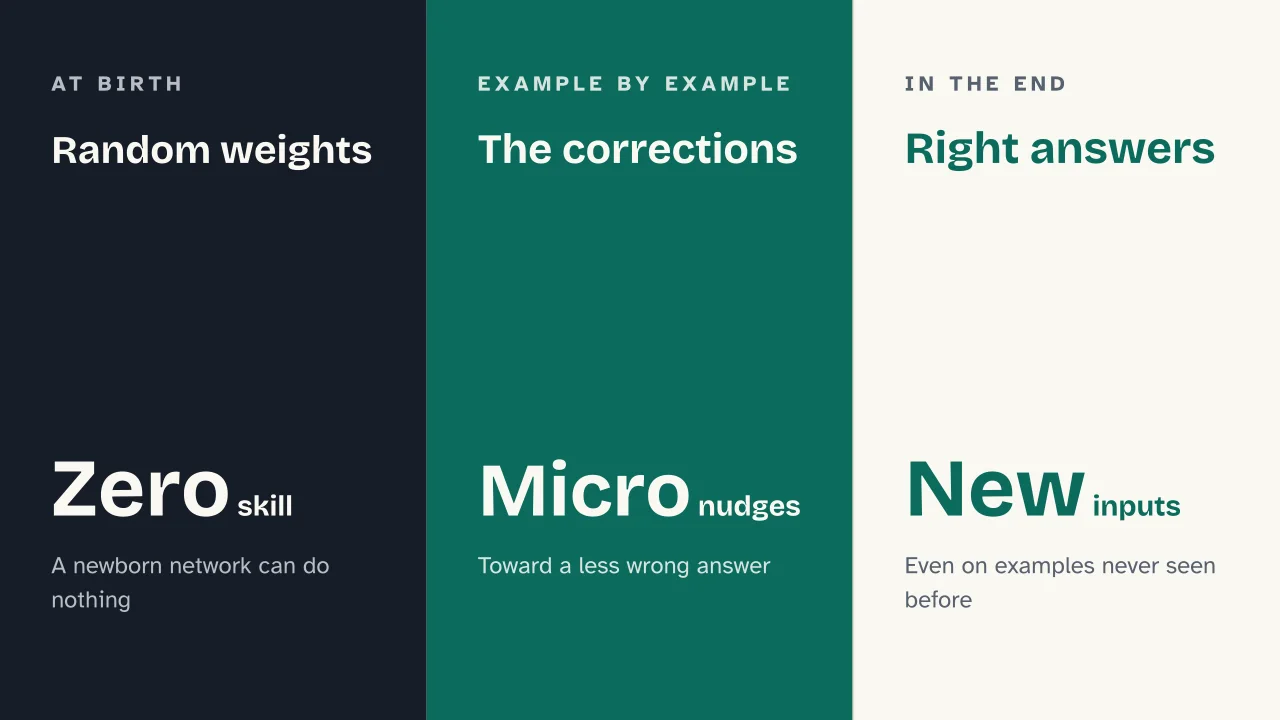
    Here’s the part that surprises everyone who first learns it: at the start, the weights are random numbers. A newborn network can do literally nothing.

    Then the studying begins. It’s shown an example — a photo labeled “cat” — and the output layer’s answer is checked. Wrong? A correction algorithm nudges the weights, ever so slightly, in the direction that would have made the answer less wrong. Repeat with the second example, the thousandth, the millionth. Micro-nudge after micro-nudge, the network comes to give consistently right answers even on inputs it has never seen.

    Practical example: it’s like tuning a thousand-string instrument by ear. You play a test note, hear it’s off, slightly turn the pegs that matter most, try again. After millions of tries the instrument plays in tune — though nobody ever wrote down the tuning score.

    Why “deep”: the power of layers

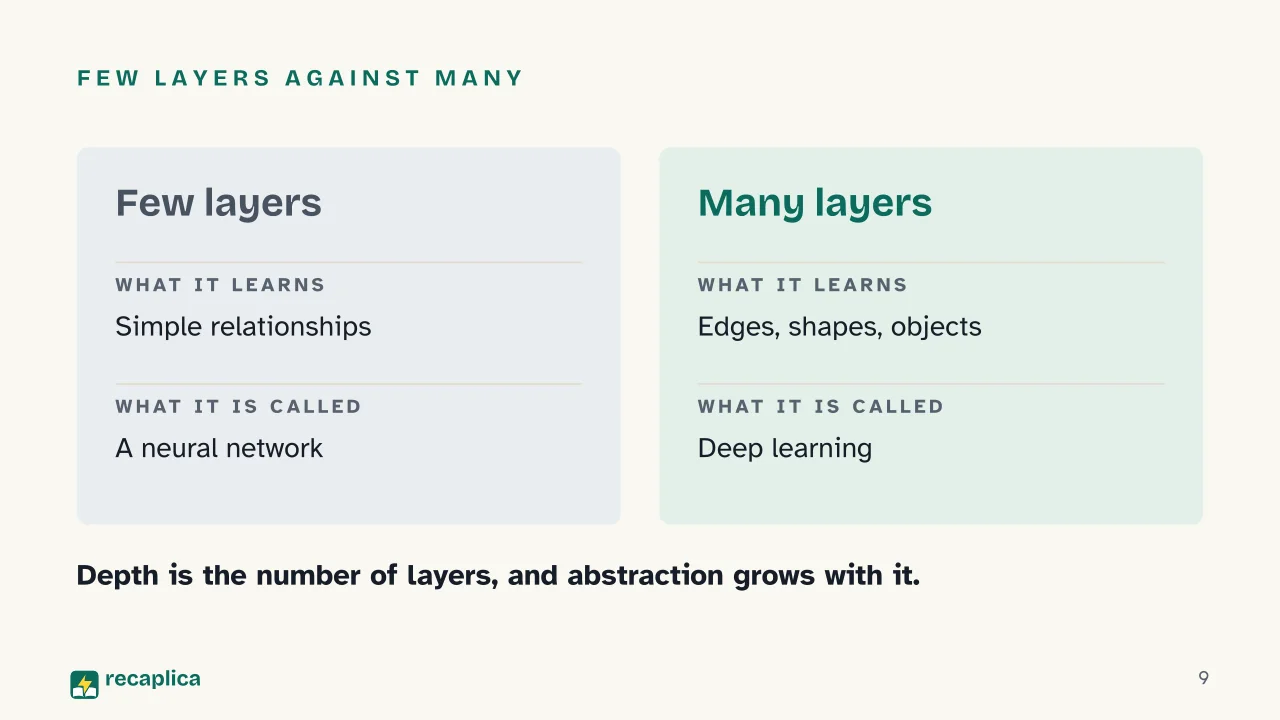
    With few layers a network learns simple relationships. The real leap comes as the layers multiply — that’s the deep in deep learning. In an image network, the early layers learn to catch edges and contrasts; the middle ones combine edges into shapes; the last ones combine shapes into objects. Nobody designs this hierarchy of abstractions: it emerges on its own from training.

    The same principle, applied to text at colossal scale, produces the models behind generative AI: GPT-3 is a network of 175 billion weights. The dials have multiplied beyond counting; the principle is still 1957’s.

    A rollercoaster history

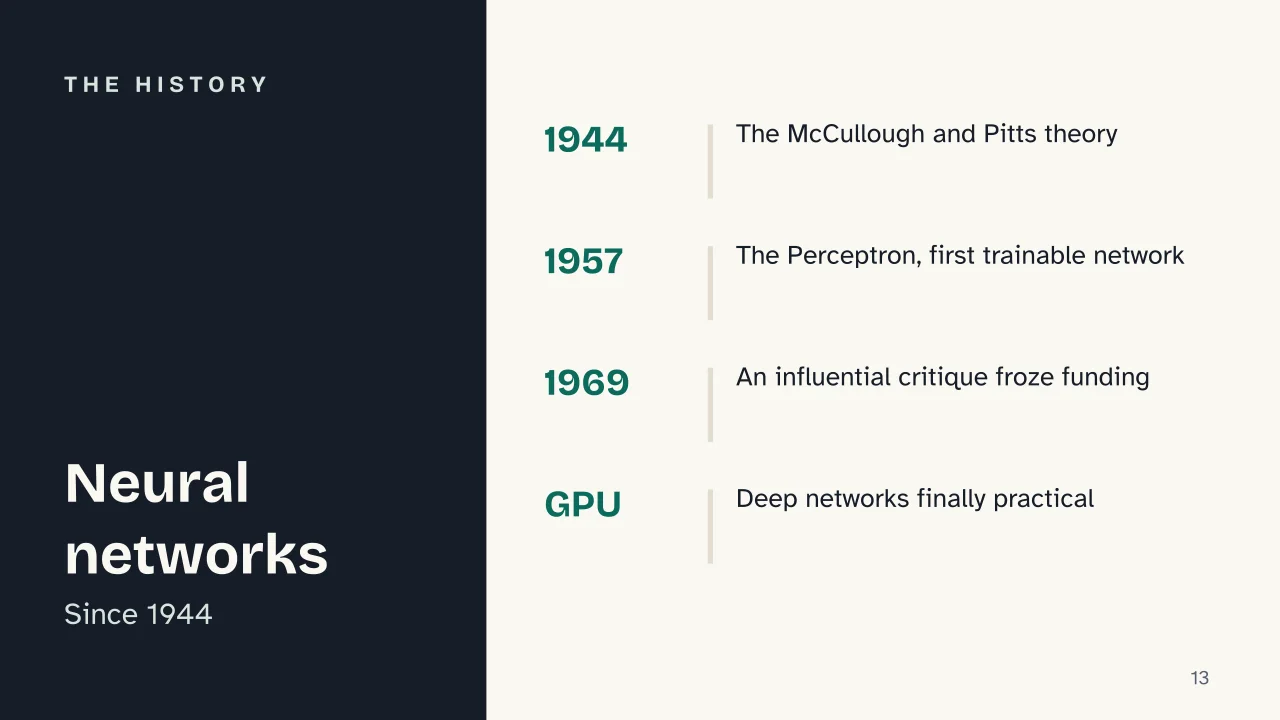
    Yes, 1957: neural networks are anything but new. The theory was born in 1944 with Warren McCullough and Walter Pitts; in 1957 Frank Rosenblatt unveiled the Perceptron, the first trainable network. Then an influential critique (Minsky and Papert, 1969) froze funding for years; the 1980s brought a renaissance, the 2000s another winter as other methods took over.

    The definitive turning point came with GPUs, the graphics cards: built for video games, they turned out to be perfect for the billions of parallel multiplications training requires. From there: networks tens of layers deep, internet-scale data, and deep learning leaving the labs for your phone.

    To place the piece in the puzzle: neural networks are the most powerful engine of machine learning, and what a network executes is still an algorithm, with all its well-defined steps. The network doesn’t know it’s intelligent. It executes, and that’s enough.

    Slide deck

    Slides ready to download and make your own in PowerPoint or Google Slides, with speaker notes. Pick the Flash cut or the Full one.
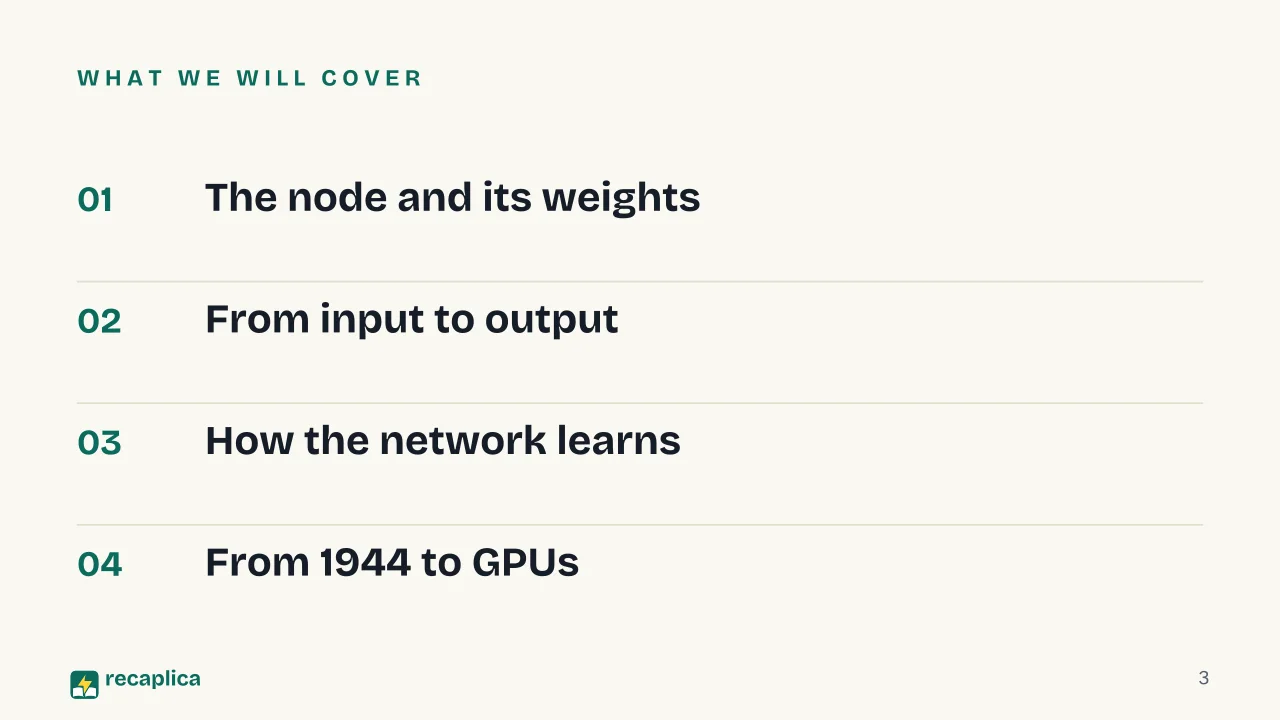
    Slide 1 of the presentation on Neural networks: Neural networksSlide 2 of the presentation on Neural networks: What does a single artificial neuron know?Slide 3 of the presentation on Neural networks: What we will coverSlide 4 of the presentation on Neural networks: Chapter 01: The node and its weightsSlide 5 of the presentation on Neural networks: The three building blocks: Node, Weights, ThresholdSlide 6 of the presentation on Neural networks: And if the sum does not pass the threshold?Slide 7 of the presentation on Neural networks: Chapter 02: From input to outputSlide 8 of the presentation on Neural networks: A data point's journeySlide 9 of the presentation on Neural networks: Few layers against manySlide 10 of the presentation on Neural networks: Chapter 03: How the network learnsSlide 11 of the presentation on Neural networks: Random weights · The corrections · Right answersSlide 12 of the presentation on Neural networks: Chapter 04: From 1944 to GPUsSlide 13 of the presentation on Neural networks: The historySlide 14 of the presentation on Neural networks: Two dates and one scaleSlide 15 of the presentation on Neural networks: They do not work like the human brain.Slide 16 of the presentation on Neural networks: How is a neural network organized?Slide 17 of the presentation on Neural networks: And now, the review
    Flash10 slidesThe essential thread, to present in classFull17 slidesEvery chapter and the deeper detail

    Common myths

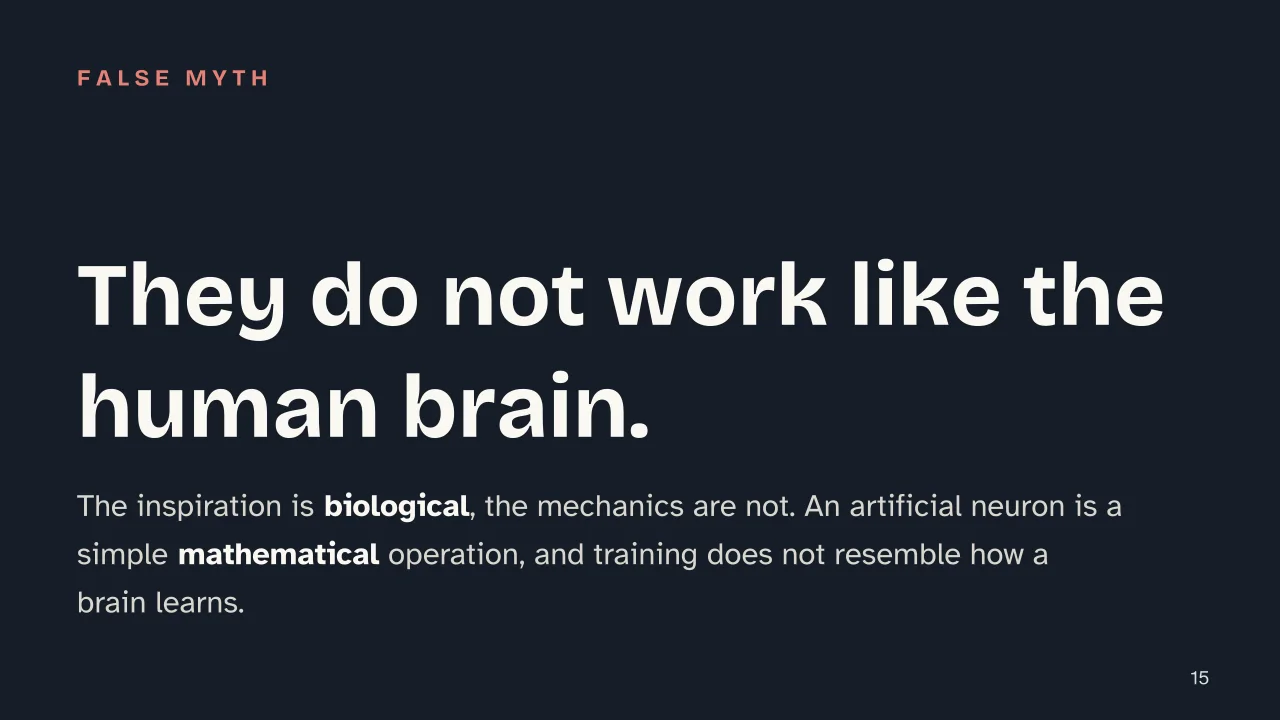
    • ✗ Myth Neural networks work like the human brain.

      ✓ Reality The inspiration is biological, the mechanics aren't: an artificial neuron is a simple mathematical operation, and training doesn't resemble how a brain learns. The metaphor aids intuition, but it's a distant kinship, not a copy.

    • ✗ Myth A neural network understands what it processes.

      ✓ Reality The network turns numbers into numbers through weights tuned on examples. It recognizes a cat without knowing what a cat is: it maps pixel patterns to a label, often with superb accuracy and zero comprehension.

    • ✗ Myth Neural networks are a recent invention.

      ✓ Reality The theory is over eighty years old (1944) and the first trainable model dates to 1957. What's recent is the computing power: GPUs made it feasible to train deep networks on huge data, waking up a field that had repeatedly gone dormant.

    Mind map

    Drag the background to move around and the nodes to reposition them; use − and + to collapse and expand branches.
    Customize
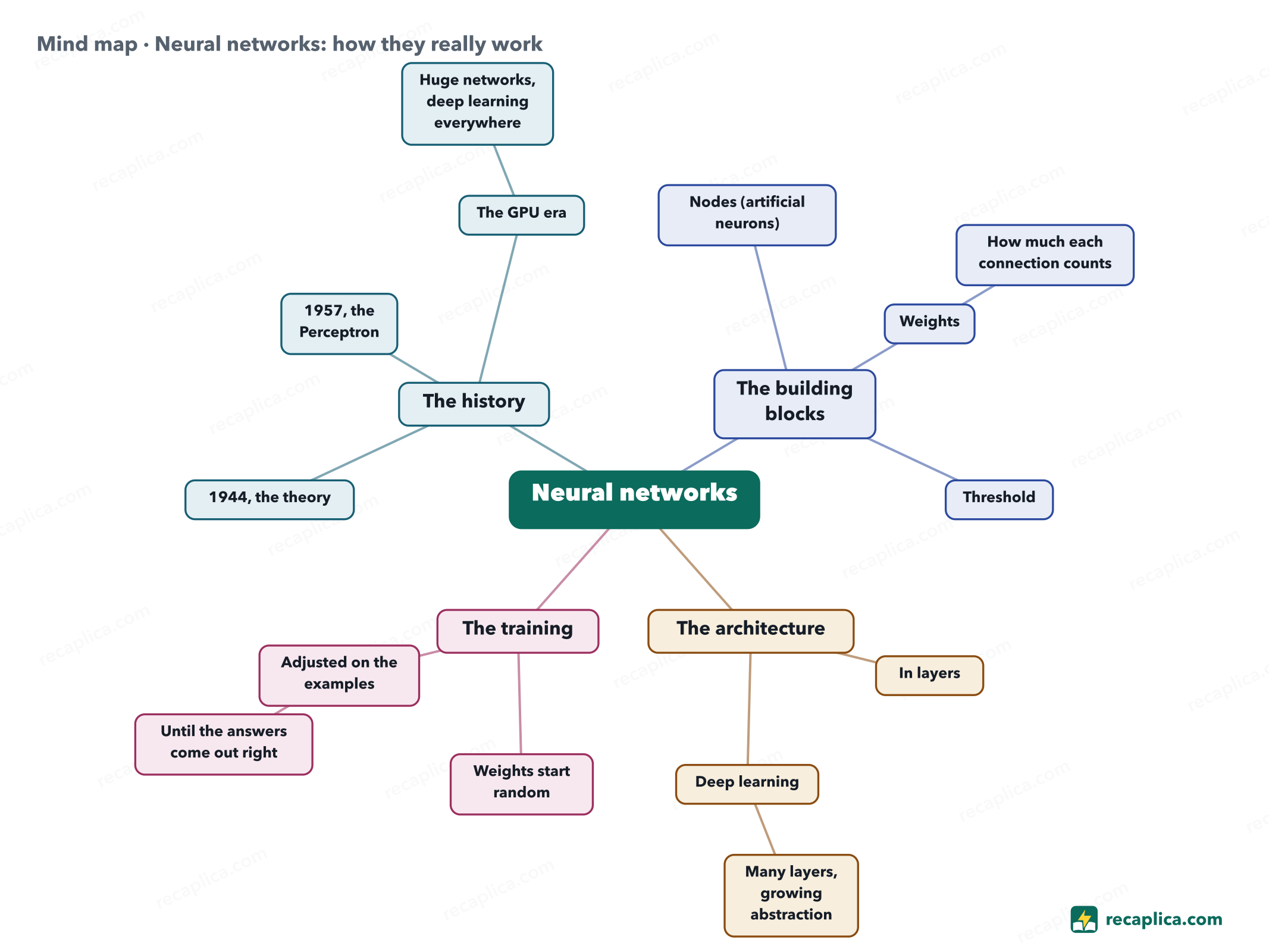
    Mind map: Neural networks: how they really work
    • Neural networks
      • The building blocks
        • Nodes (artificial neurons) Simple computing units.
        • Weights
          • How much each connection counts
        • Threshold The node fires only past it.
      • The architecture
        • In layers Input, hidden layers, output.
        • Deep learning
          • Many layers, growing abstraction
      • The training
        • Weights start random
        • Adjusted on the examples
          • Until the answers come out right
      • The history
        • 1944, the theory McCullough and Pitts.
        • 1957, the Perceptron The first trainable network.
        • The GPU era
          • Huge networks, deep learning everywhere

    Quiz: test yourself

    Answer the questions to check what you have learned: you get instant feedback and a short explanation.

    Grade 0/10 0/5
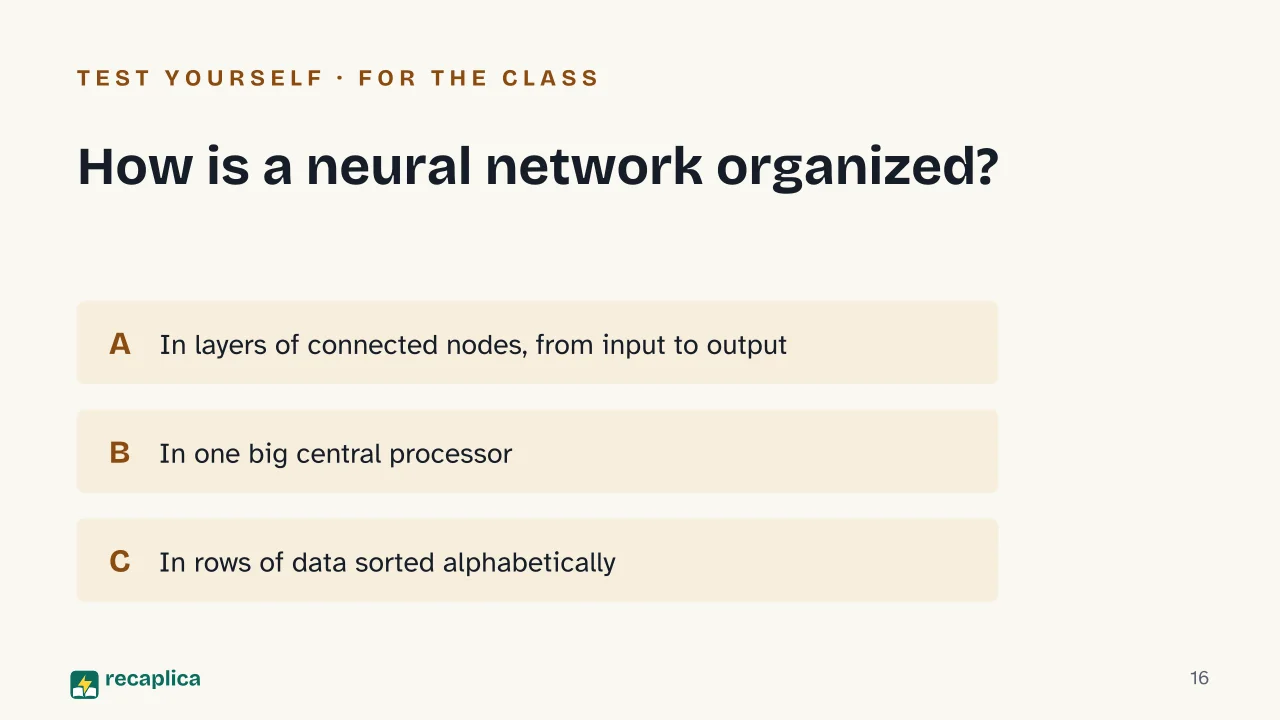
    1 How is a neural network organized?

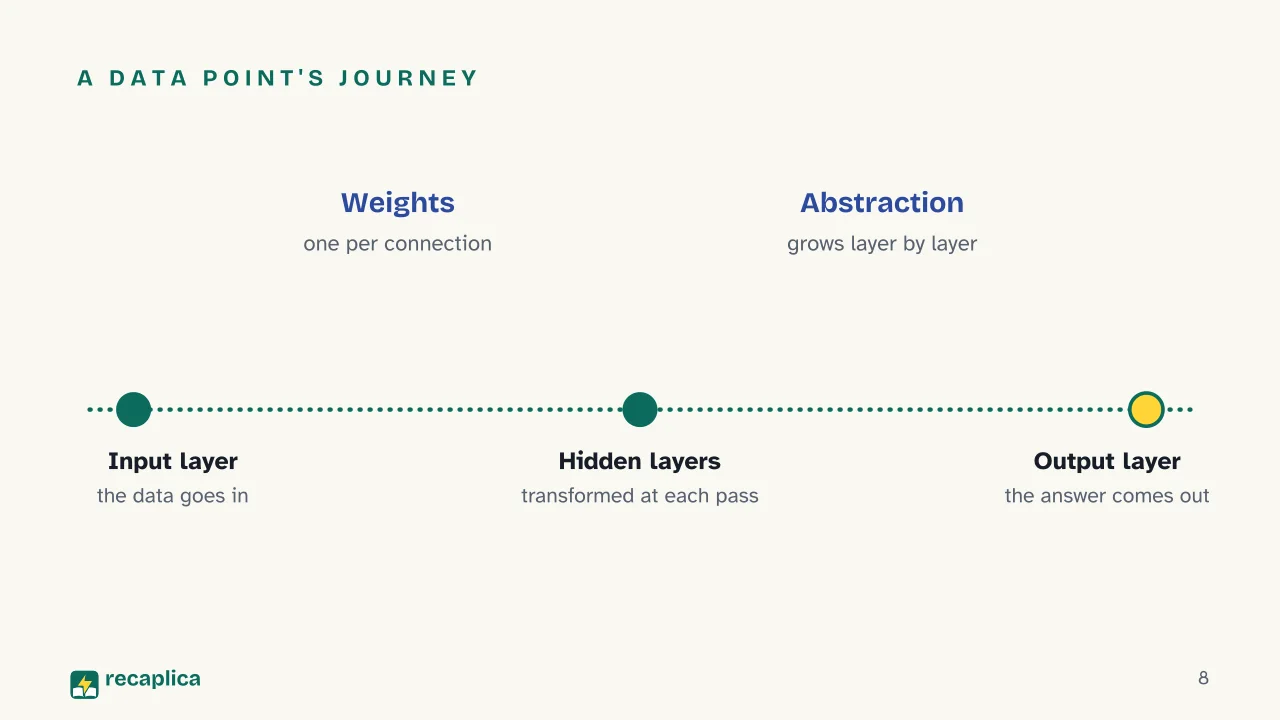
    Nodes are arranged in layers: data enters through the first, crosses the hidden layers being transformed at each pass, and exits the last as the answer.

    2 What are weights?

    Each connection between nodes carries a weight: the node multiplies inputs by weights, sums, and compares with a threshold. Training the network means precisely tuning these values.

    3 How do the weights start out before training?

    It starts from randomness: then, example after example, the weights get adjusted until similar inputs consistently produce the correct answers.

    4 What does 'deep' mean in deep learning?

    Depth = number of layers. With many layers the network builds increasingly abstract representations: from edges to shapes, from shapes to objects.

    5 True or false: the 1957 Perceptron was the first trainable neural network.

    Frank Rosenblatt's Perceptron showed a network could learn from data. The theory had been proposed in 1944 by McCullough and Pitts, but without training.

    Answers: 1-A · 2-A · 3-A · 4-A · 5-A

    Flashcards

    Tap the card to flip it and check whether you remember the answer, then move to the next one.

    1 / 7

    Explain it in your own words

    The ultimate test: if you can explain it in simple words, you've truly understood it. Write your explanation, then compare it with the Recap.

    Your explanation is saved only on this device.

    A neural network is a system of thousands of simple computing units connected in layers by millions (or billions) of weighted connections, loosely inspired by the brain's neurons. Every connection has an adjustable weight: during training the network tweaks the weights until the examples produce the right answers. With many layers it becomes deep learning, the technology behind image recognition, speech and large language models.

    Frequently asked questions

    Why call them 'neural' if they don't work like the brain?

    For the original inspiration: the 1940s pioneers modeled units that activate past a threshold, like biological neurons. The name stuck; the resemblance to the brain stayed superficial.

    What does each layer of a deep network do?

    It detects features at a growing level of abstraction: in an image network, early layers catch edges and contrasts, middle ones shapes and textures, the last ones whole objects. Nobody programs this hierarchy: it emerges from training.

    What's the link between neural networks and ChatGPT?

    Large language models are gigantic neural networks trained on text: GPT-3, for instance, is a network with 175 billion weights. The same basic architecture, at industrial scale.

    Why were GPUs the turning point?

    Training a network takes billions of repetitive multiplications — exactly the kind of math graphics cards were born for. With GPUs it became practical to train networks tens of layers deep on huge datasets: hence the deep learning explosion.

    Sources

    • MIT News — Explained: Neural networks
    • Language Models are Few-Shot Learners (GPT-3, 175bn parameters) — arXiv, 2020

    Every Recap goes through an independent review before publication.

    Every evening, the day's new Recaps on our Telegram channel. Join the channel →

    Keep learning

    • Technology AI Pop Culture: When Synthetic Content Rewrites History According to Lead Stories, a World War Two photo held by the Imperial War Museums circulated in 2026 in an AI-colorized version that a detector rated 99% likely to be artificially generated, even though the original shot was genuine. Cases like this also touch pop culture and current events: text, image and video models produce content that looks historical or iconic without actually being so, or alter real content in details that are hard to spot at a glance. Some tools leave technical clues, such as digital watermarks or video length limits, but no single clue covers every generator on the market. The Reuters Institute reports that in 2026 trust in AI chatbot answers about the news stays low, at 20% against 37% for news overall. Checking whether an image or video is authentic still means comparing it against the original archive that holds it. Read the Recap →
    • Technology Echo Chamber: How Recommendation Algorithms Shape What You See An echo chamber is an environment, online or offline, where a person mostly encounters opinions that confirm their own. Recommendation algorithms can build a narrower version of this, often called a filter bubble, by quietly deciding what to show someone based on what they've clicked and watched before. The two ideas get mixed up constantly, but they aren't the same phenomenon, and the strongest research available paints a more mixed picture than the popular narrative: algorithms have a measurable but modest effect, and people's own choices matter more. Whether algorithms actually drive political polarization is not something the most rigorous experiments have settled. Read the Recap →
    • Technology Virtual influencers: the AI-made creators behind the profiles Virtual influencers are digital characters built by an agency or studio, complete with a face, a voice and a biography, who post on social media the way a real creator would. The phenomenon predates the generative-AI boom: Lil Miquela's account has been live since April 23, 2016, and Shudu Gram first appeared on April 22, 2017. Some of these profiles work with major brands: Miquela has partnered with Calvin Klein and Prada, while the Spanish agency The Clueless built Aitana López after finding human models and influencers too unreliable to manage. In the United States, the Federal Trade Commission updated its advertising rules in 2023 to explicitly cover virtual influencers among the content that must be disclosed as sponsored. Read the Recap →

    recaplica

    Clear in 30 seconds, yours in 10 minutes.

    Recaps Mind maps Request a Recap Telegram channel Mind map maker Our method About Privacy & cookies Legal notes & terms of use

    © 2026 Recaplica · A project by Curi S.r.l. — VAT IT05472000750

    Statistics, only if you say so

    To learn which Recaps help most we would use Google Analytics, with aggregate, anonymous data. It starts only with your OK, and you can change your mind anytime. Privacy policy