|
recaplica
The algorithm: what it really is (and why it's not a dirty word) |
| © 2026 Recaplica · recaplica.com — All rights reserved |
The algorithm: what it really is (and why it's not a dirty word)What to print Page numbers appear when printing with default margins. SlidesChoose a cut Flash10 slidesThe essential thread, to present in classFull18 slidesEvery chapter and the deeper detailBoth come with speaker notes. In 30 seconds quick readAn algorithm is a finite, precise sequence of steps to achieve a result: the definition covers a cooking recipe as much as Google's code. The word comes from the Persian mathematician al-Khwarizmi, who lived more than a thousand years ago. Today "the algorithm" has become the popular name for the systems that rank content on social media — which are algorithms, of a particular kind. Key Points
Key figures
Deep DiveThe most misunderstood word of the decade“The algorithm decided.” In everyday speech the word has become shorthand for the dark power of social media. A pity, because the concept is among the clearest humanity has produced: an algorithm is a finite, precise sequence of steps to achieve a result — in NIST’s formula, “a computable set of steps to achieve a desired result”. That’s all. And you’ve been executing them all your life.
A name with a thousand years of historyNo Silicon Valley here: the word comes from the Persian mathematician al-Khwarizmi, author around 825 A.D. of a treatise on the rules of calculation. The Latinization of his name, century after century, became “algorithm”. When Google was still eleven centuries away, algorithms were already at work: procedures for computing, dividing, solving. Two properties make a procedure an algorithm. Precision: no step may be ambiguous (“add salt to taste” disqualifies a recipe from mathematical rigor). Termination: the steps eventually end and the result arrives. Inside every piece of software, literallyA computer doesn’t understand, interpret or intuit: it executes. Every app you use is a weave of algorithms — for ranking results, searching archives, compressing photos, routing messages — executed billions of times per second, to the letter. An algorithm’s quality is measured above all in efficiency: how many steps it needs as the data grows. On a thousand items any method works; on a billion, the gap between a well-designed algorithm and a naive one is the gap between a second and a week. So what is “the algorithm” on social media?What we call a social network’s “algorithm” is a recommendation system: it observes your behavior — clicks, pauses, shares — and ranks content by predicting what will keep you around longest. Technically, these days it’s largely machine learning: the rules aren’t written by hand but learned from billions of users’ data, often through neural networks. Two things deserve clarity. First: it’s not an autonomous entity — it’s a product designed by people with a business objective, usually maximizing time on the platform. Second: its precision doesn’t make it neutral. An algorithm faithfully executes the choices of whoever built it, and if it learns from data it inherits the data’s distortions. Understanding this is the best antidote to both the fear and the blind trust — and, in the end, the reason this word deserved an article. Slide deckSlides ready to download and make your own in PowerPoint or Google Slides, with speaker notes. Pick the Flash cut or the Full one.  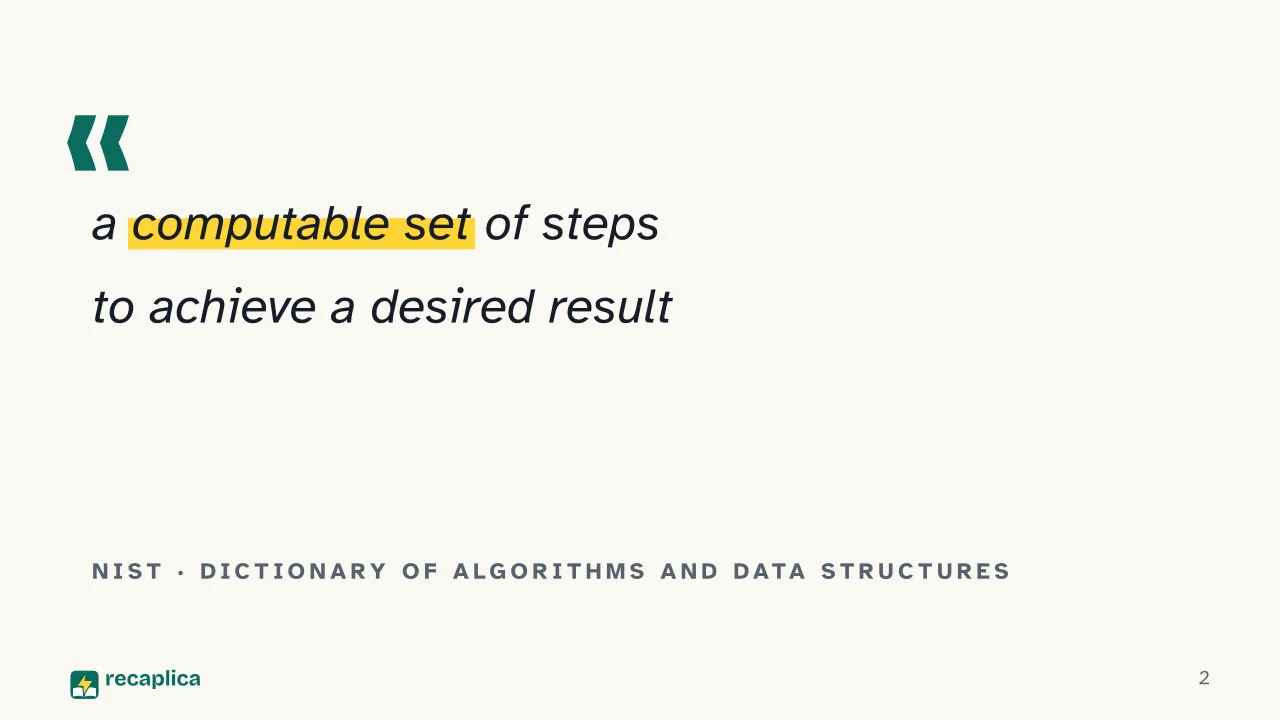 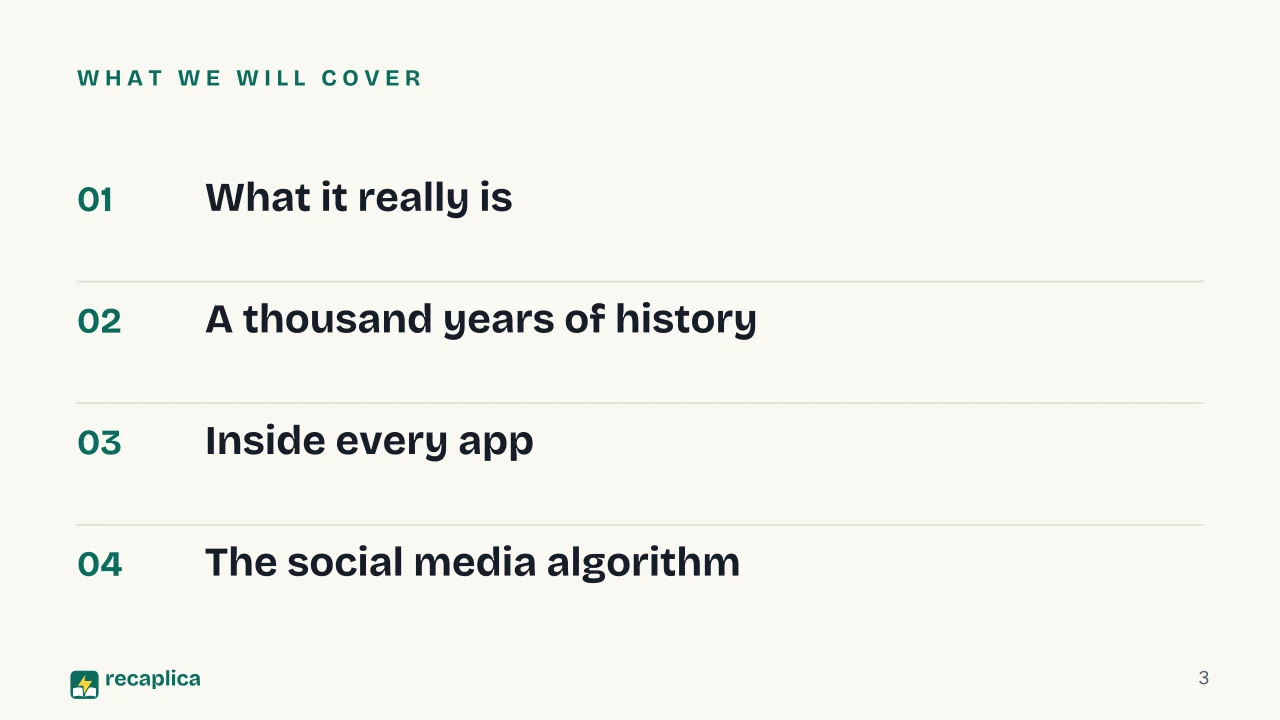  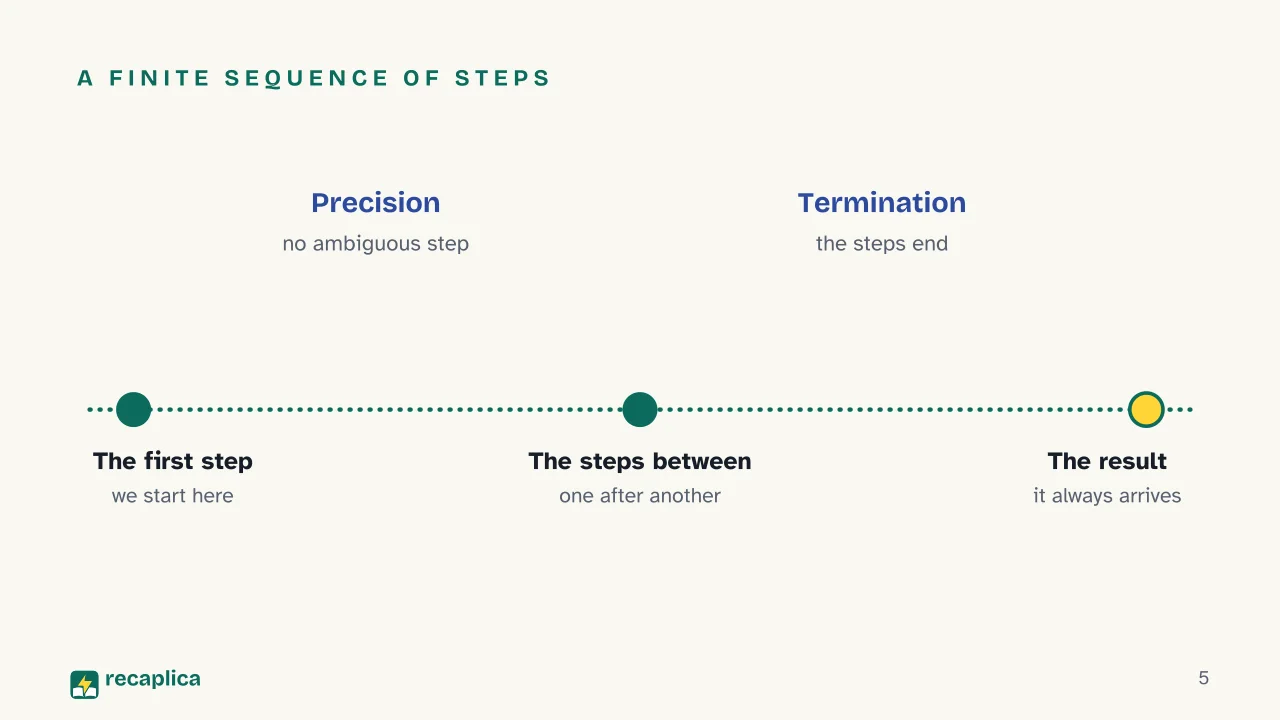  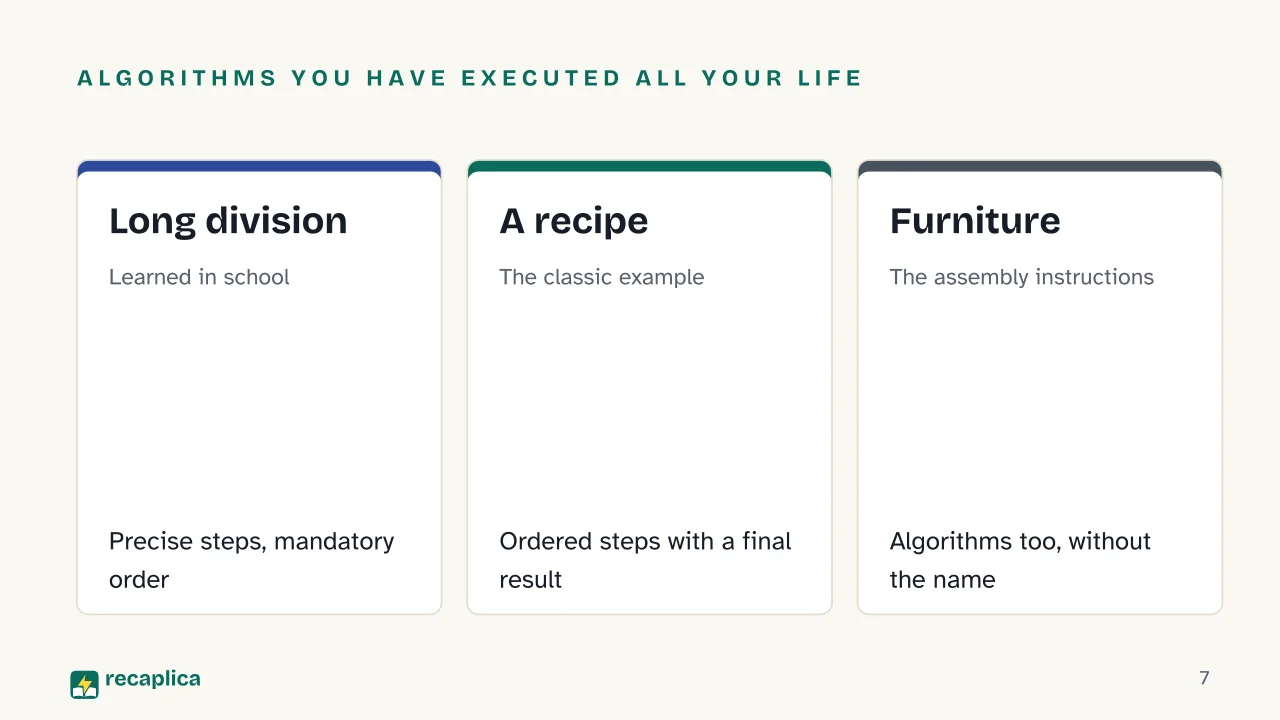  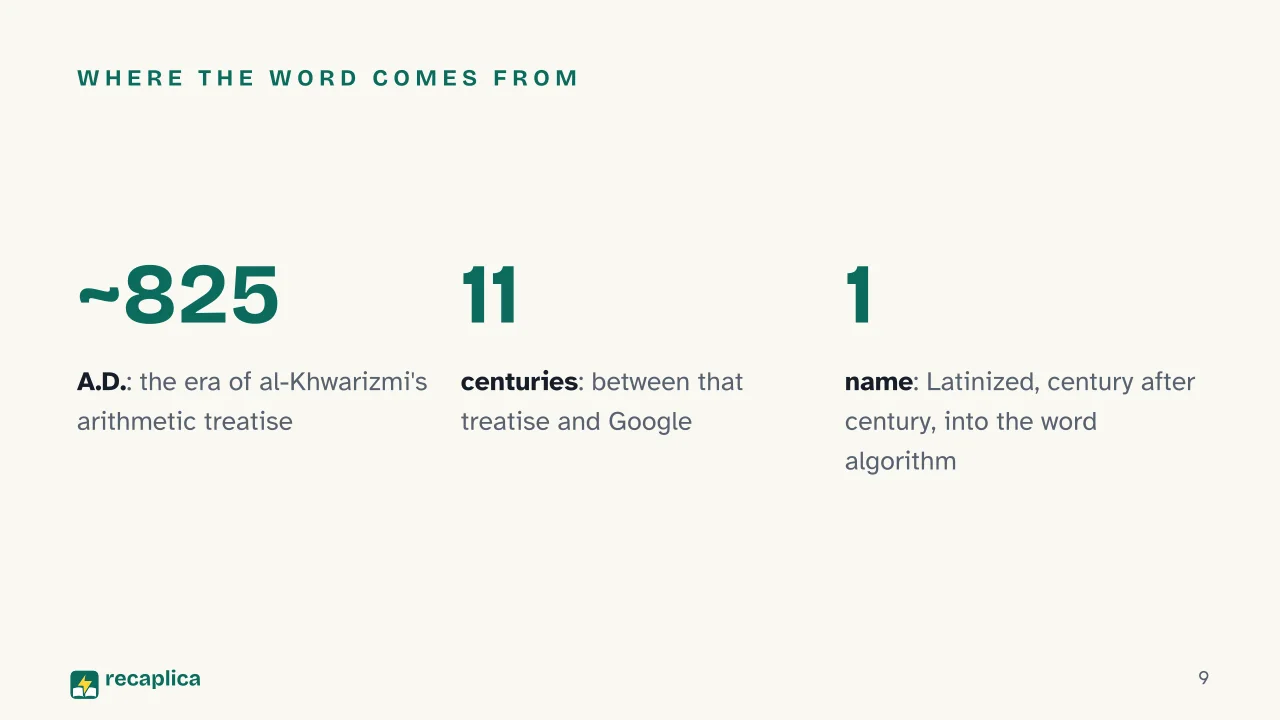  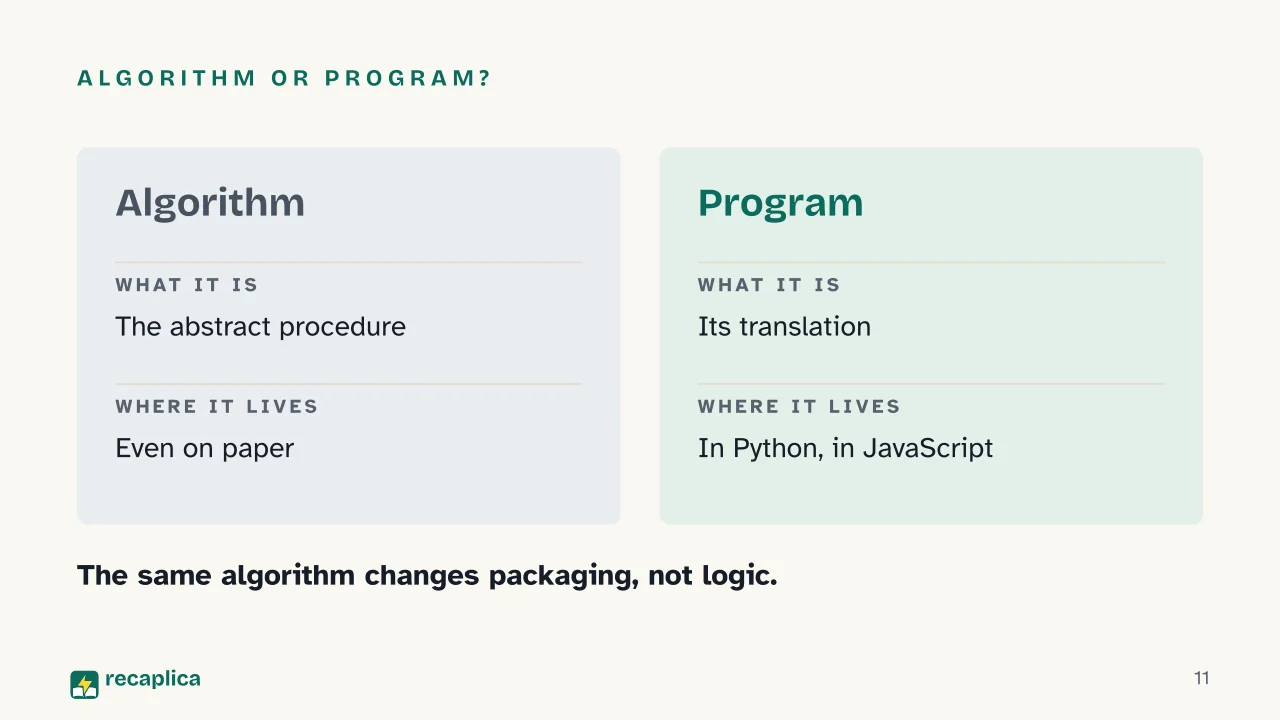 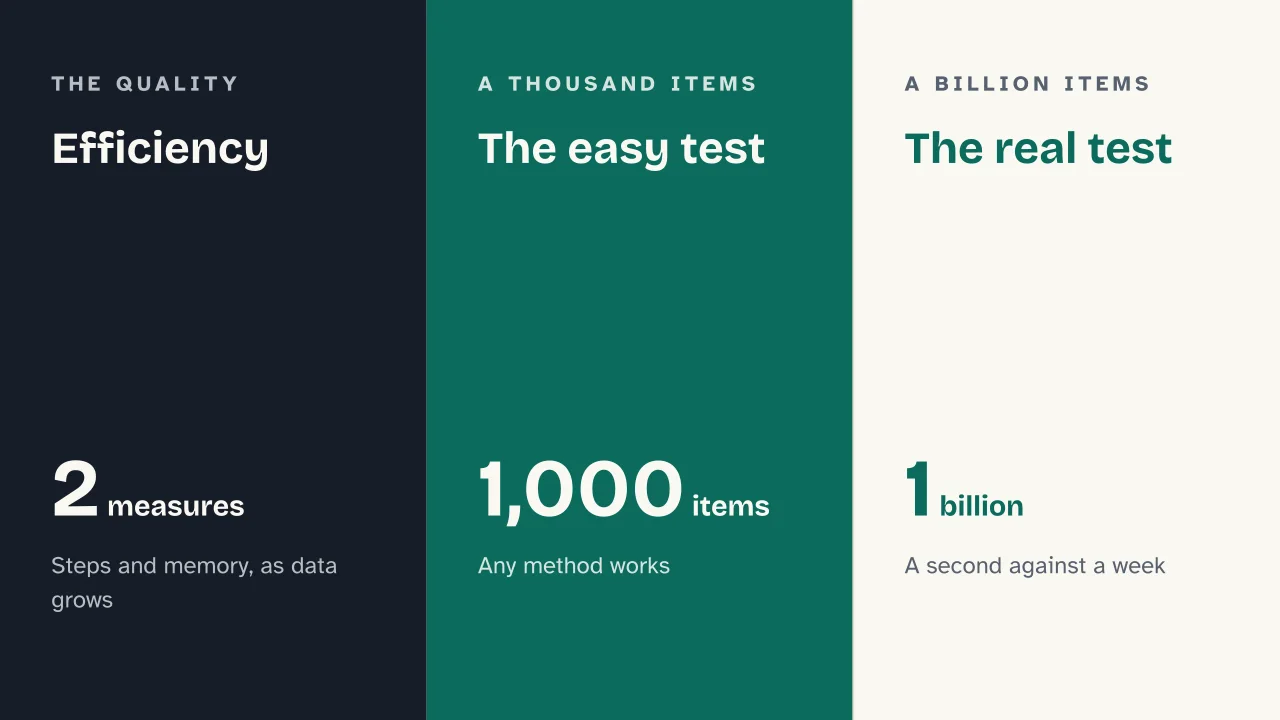   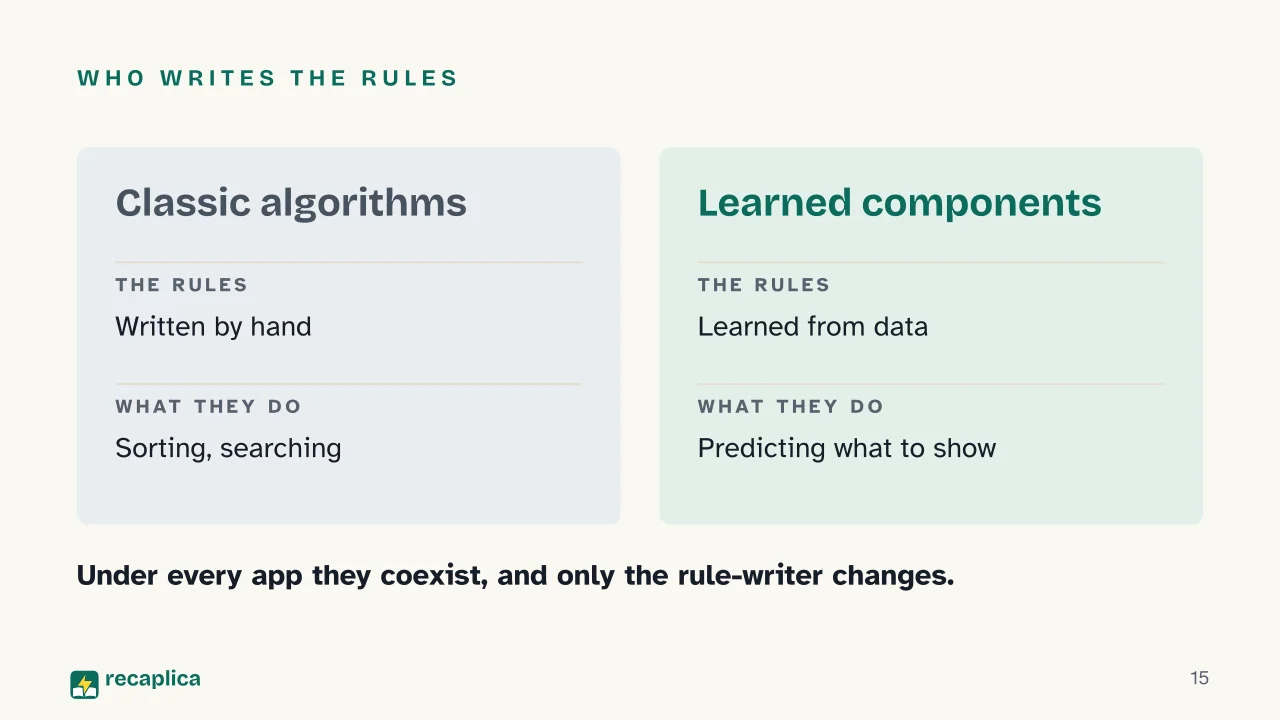 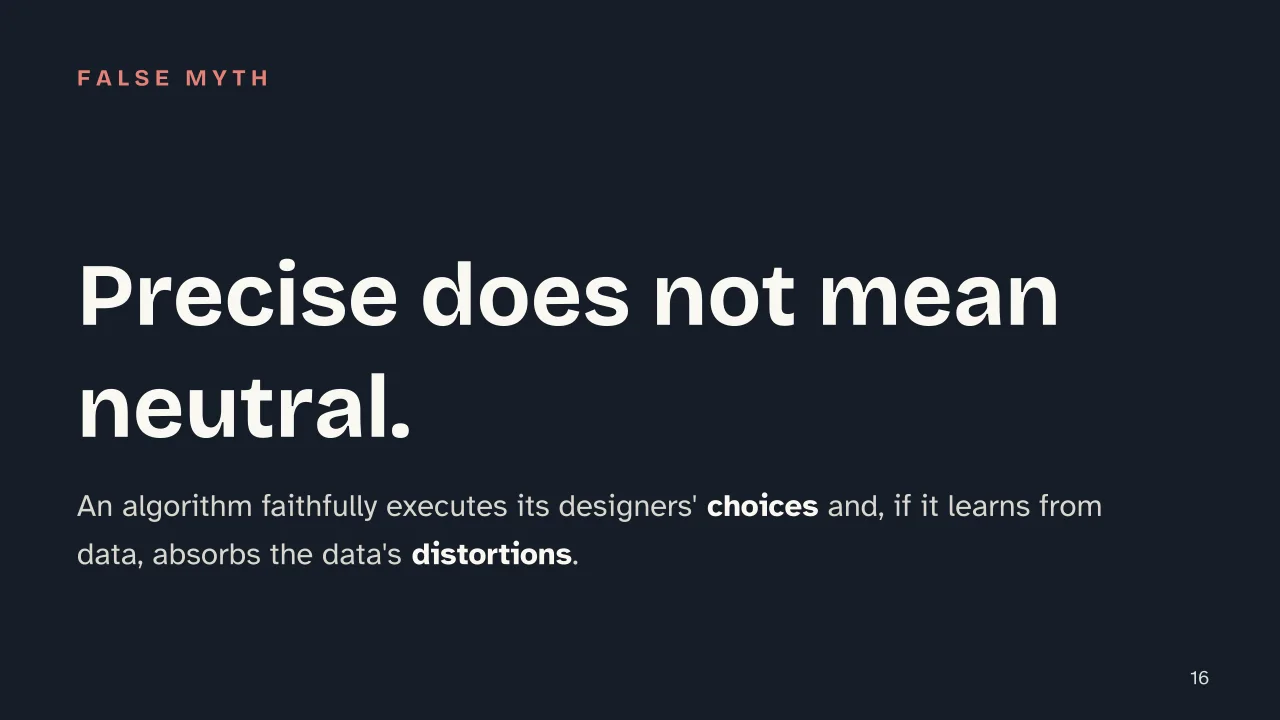 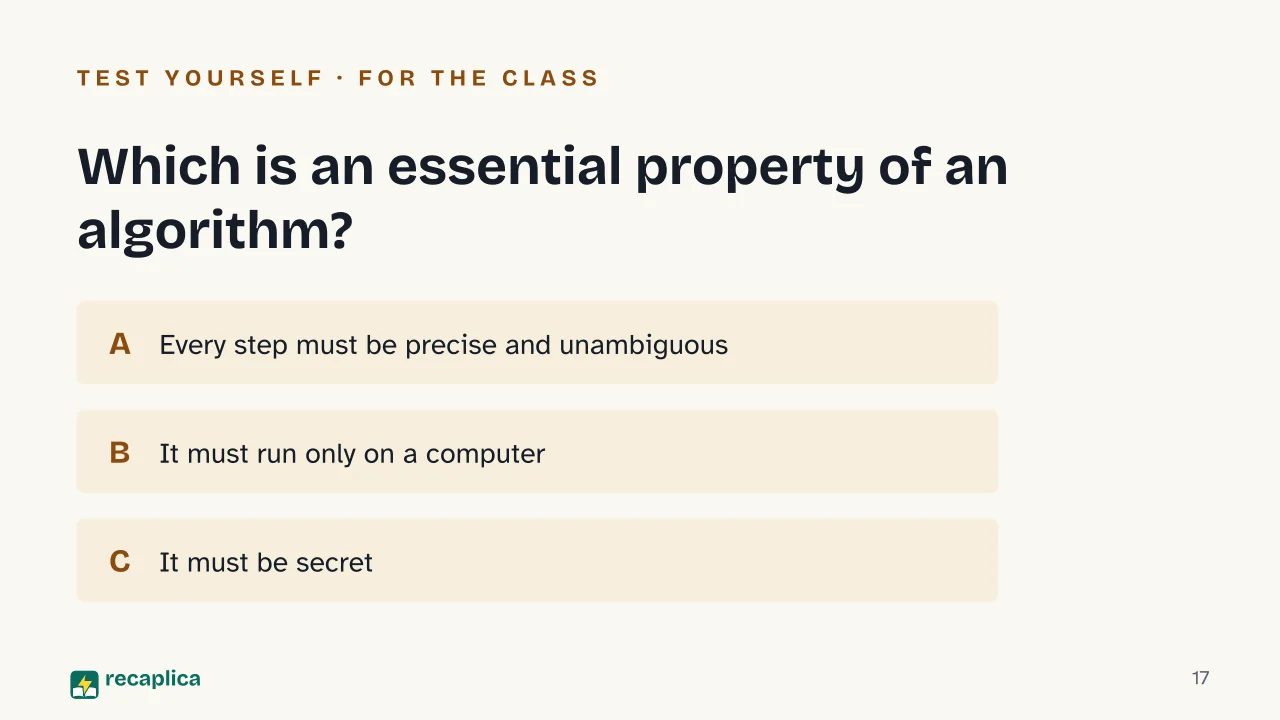  Common myths
Mind mapDrag the background to move around and the nodes to reposition them; use − and + to collapse and expand branches. 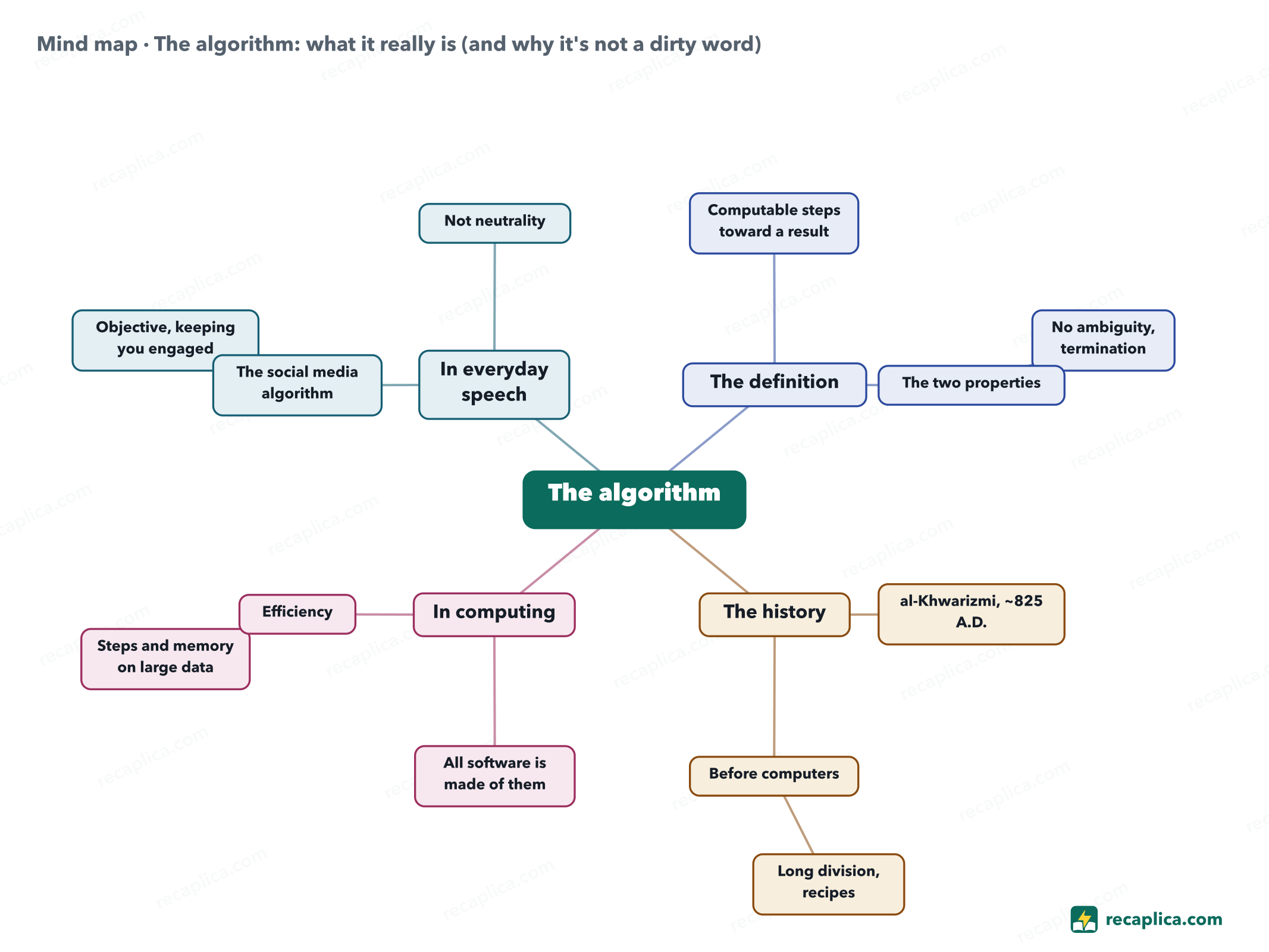
Quiz: test yourselfAnswer the questions to check what you have learned: you get instant feedback and a short explanation. Grade 0/10 0/5
FlashcardsTap the card to flip it and check whether you remember the answer, then move to the next one. 1 / 6 Explain it in your own wordsThe ultimate test: if you can explain it in simple words, you've truly understood it. Write your explanation, then compare it with the Recap. Your explanation is saved only on this device.
Frequently asked questionsWhat's the difference between an algorithm and a program?The algorithm is the abstract procedure; the program is its translation into a language the computer executes. The same sorting algorithm can be written in Python, JavaScript or on paper: the packaging changes, the logic doesn't. What makes one algorithm 'better' than another?For the same result, efficiency: how many steps and how much memory it needs as the data grows. Sorting a thousand numbers is easy with any method; sorting a billion separates well-designed algorithms from naive ones. Can social media algorithms be 'gamed'?Every recommendation system responds to the signals it receives: engaging with certain content brings more of it. It works in reverse too: creators study which signals get rewarded to gain visibility, and platforms keep updating their systems precisely because of that chase. Has AI made traditional algorithms obsolete?No — it joined them: machine learning models are themselves executed by algorithms, and under every app, classic algorithms (sorting, searching, routing) coexist with components learned from data. Who writes the rules changes; the nature of the procedure doesn't. Every Recap goes through an independent review before publication. |