Skip to content
recaplica

    One moment: security check

    Cloudflare wants to make sure you're not a robot. Tick the box below and your search will continue on its own.

    IT
    recaplica Machine learning: what it is and how a machine learns
    © 2026 Recaplica · recaplica.com — All rights reserved
    Home › Technology

    Machine learning: what it is and how a machine learns

    By Recaplica Newsroom · Updated on August 31, 2026

    What to print

    Page numbers appear when printing with default margins.

    Slides

    Choose a cut

    Flash10 slidesThe essential thread, to present in classFull16 slidesEvery chapter and the deeper detail

    Both come with speaker notes.

    Telegram channel
    recaplica Clear in 30 seconds, yours in 10 minutes.
    In 30 seconds Key points Figures Deep dive Slides Myths Mind map Quiz Flashcards FAQ

    In 30 seconds quick read

    Machine learning is the branch of artificial intelligence in which a piece of software, called a model, learns from data instead of following hand-written rules. Show it thousands of examples and it finds the patterns linking question and answer on its own: that's how it spots spam, recommends films, estimates prices. It's the technology behind almost all the AI you use daily.

    Key Points

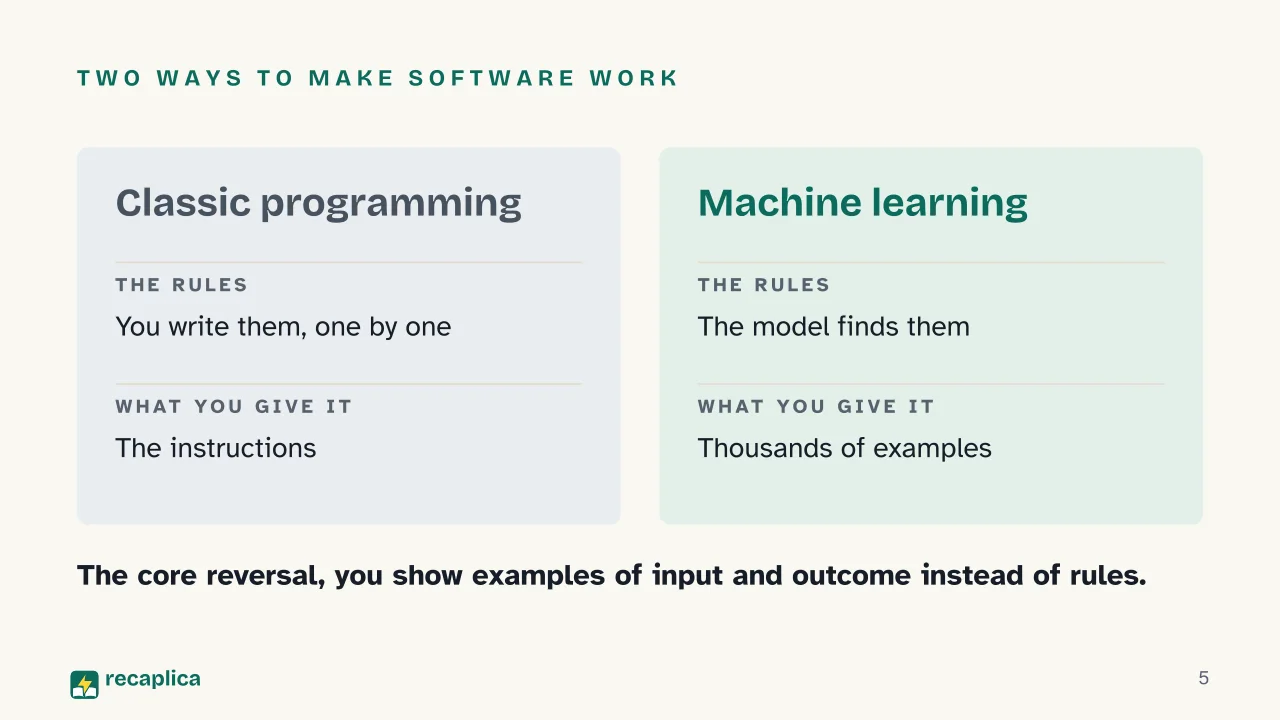
    • Classic programming: you write the rules. Machine learning: you show examples and the model finds the rules.
    • The model is the trained software; training data is its set of study examples.
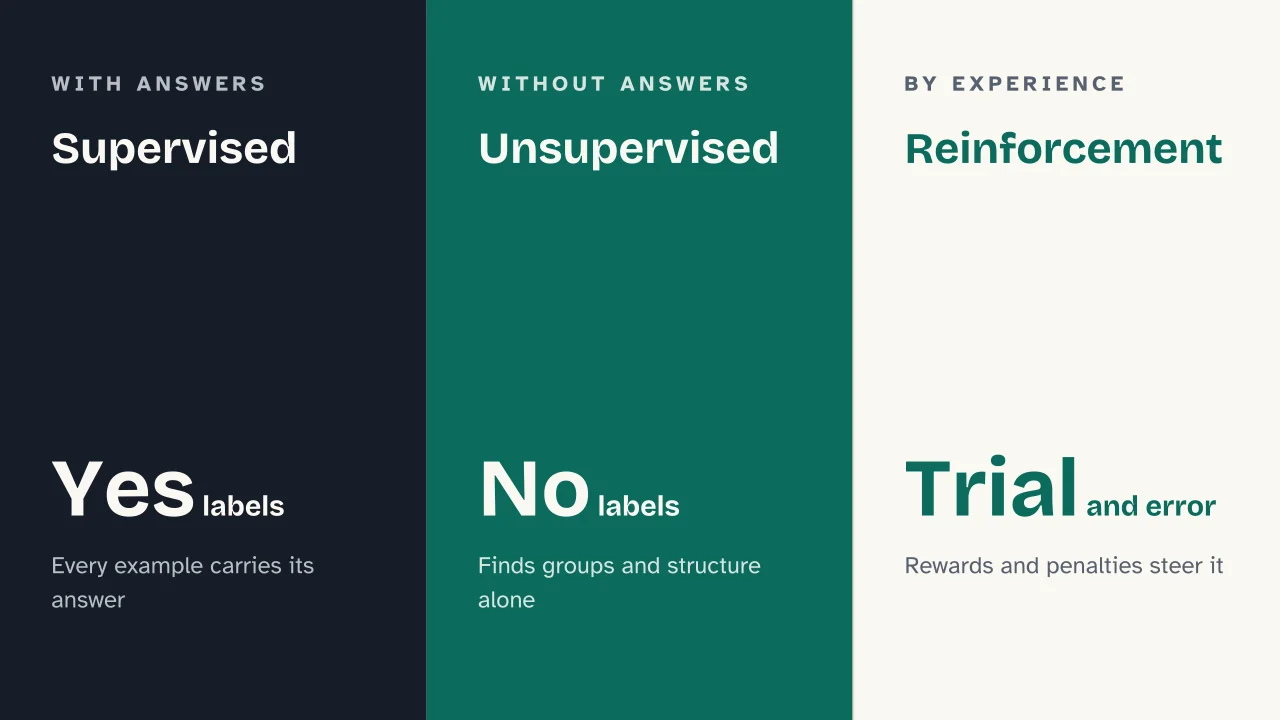
    • Supervised learning: examples with the right answer attached (like studying from old solved exams).
    • Unsupervised learning: the model discovers groups and structure in unlabeled data by itself.
    • Reinforcement learning: learning by trial and error, with rewards and penalties.
    • The term was born in 1959 with Arthur Samuel and his checkers-playing program.

    Key figures

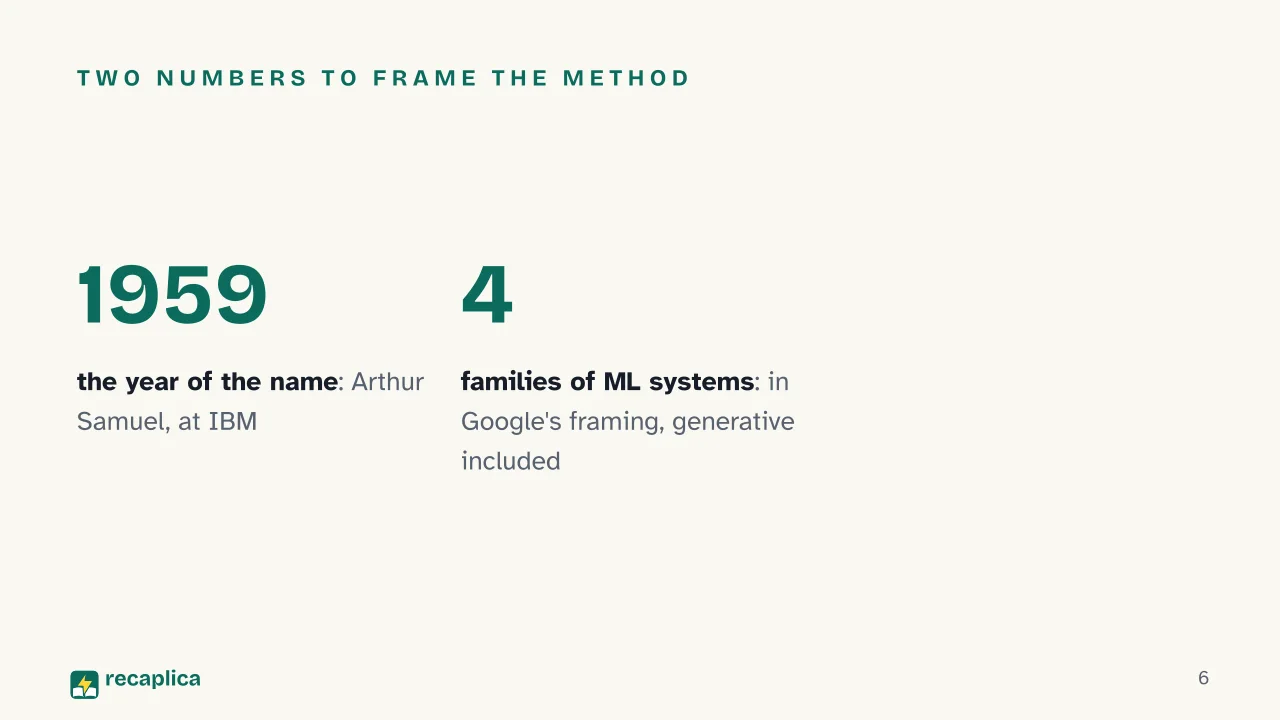
    • 1959 the year Arthur Samuel coined 'machine learning' in IBM's research journal Source: IBM Journal of Research and Development
    • 4 the families of ML systems in Google's framing: supervised, unsupervised, reinforcement, generative Source: Google, Machine Learning Crash Course

    Deep Dive

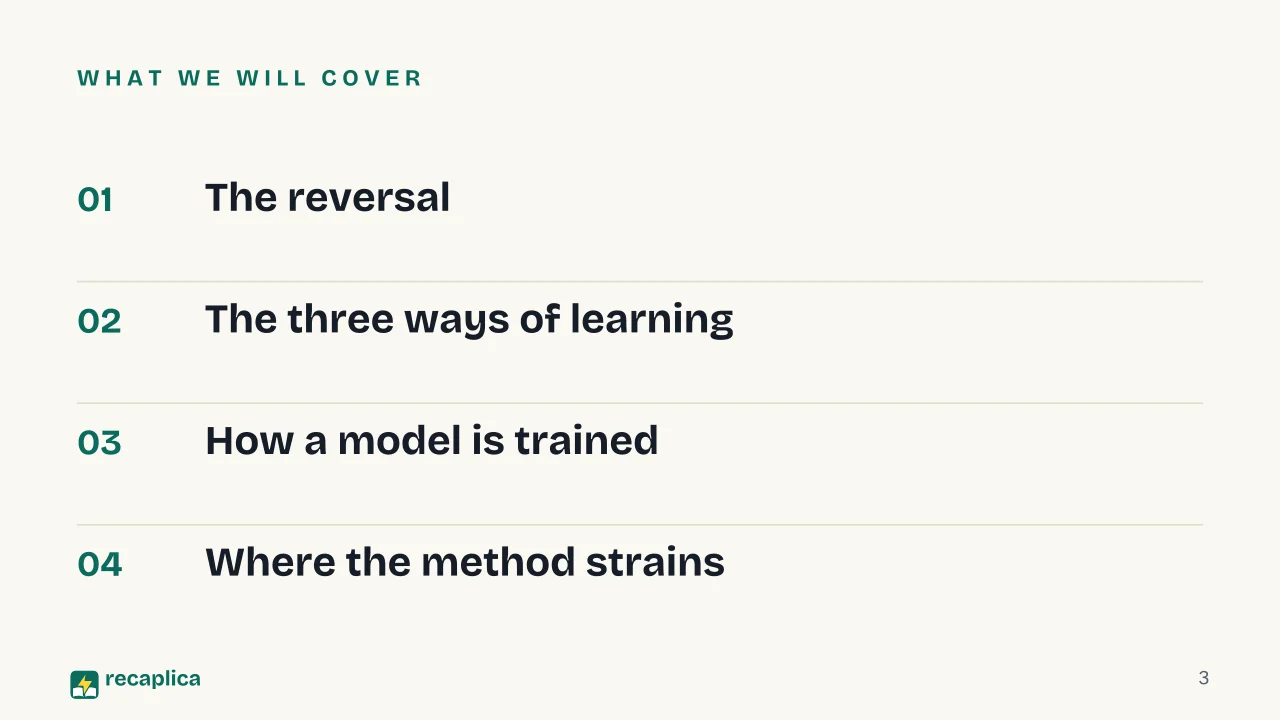
    The reversal: examples instead of rules

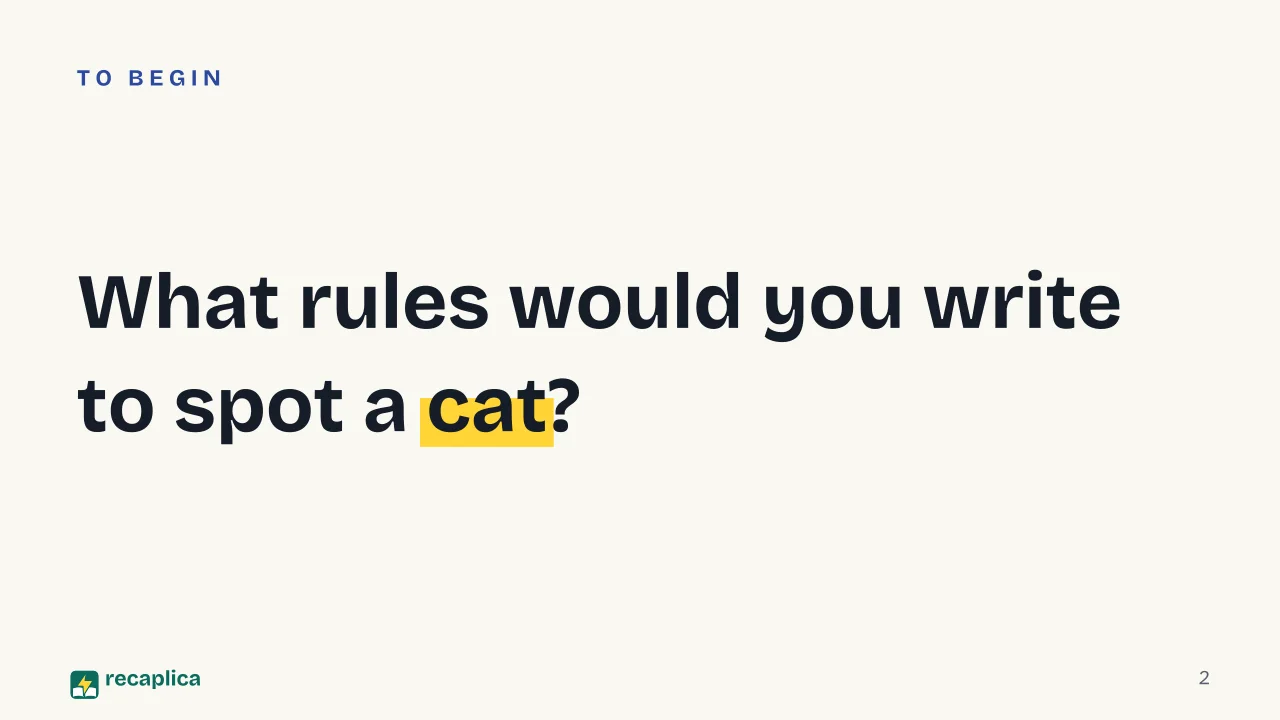
    For decades, programming meant one thing: writing rules. If the email contains this word, flag it as spam; if the customer spends above this amount, apply the discount. It works as long as the rules can be written. But try writing the rules for recognizing a cat in a photo: pointy ears? So do foxes. Fur? Not sphynx cats. You give up fast.

    Machine learning flips the table: instead of writing rules, you show the software thousands of examples (photos labeled “cat” or “not cat”) and let it dig out the patterns. The result of that studying is called a model. As Google puts it, ML is “training a piece of software, called a model, to make useful predictions or generate content from data”.

    The idea has a precise birthday: in 1959 Arthur Samuel, at IBM, coined the term while describing his program that got better at checkers game after game, eventually beating skilled players.

    The three ways of learning (plus one)

    Supervised: studying from solved exams

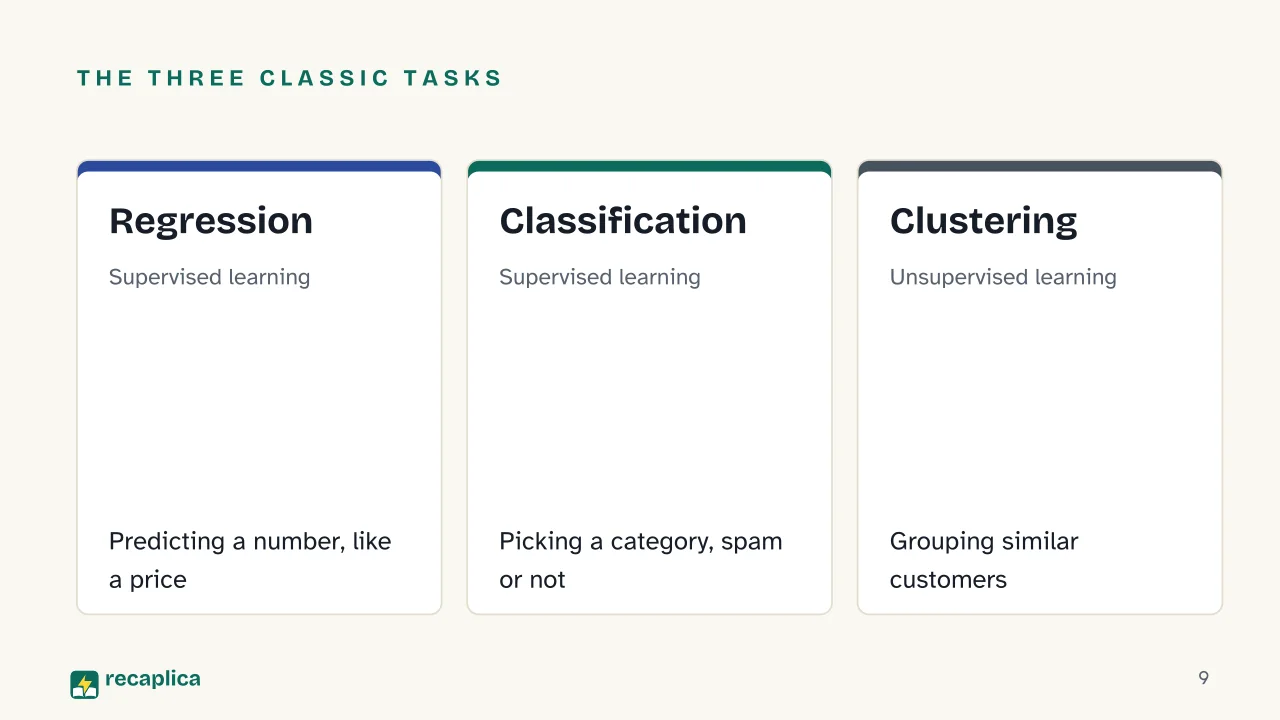
    The most common method: every example comes with the right answer attached. A thousand emails labeled “spam” or “not spam”, ten thousand houses with their sale price. The model learns the relationship between input and answer, like a student preparing from past years’ solved exams. The two classic applications: regression (predicting a number, like a house price) and classification (picking a category, like spam or not).

    Unsupervised: finding order without instructions

    Here the examples carry no labels. The model receives raw data and hunts for structure and similarity on its own: clustering groups customers with similar habits without anyone defining the groups in advance. Making sense of what emerges is then a human job.

    Reinforcement: learning by failing

    The system acts in an environment and collects rewards or penalties: winning move, point; losing move, punishment. Attempt after attempt, it refines its strategy. That’s how AlphaGo learned to beat human Go champions, and how robots get trained.

    And generative?

    Systems that create content — text, images, code — are the newest family: we covered them in the article on generative AI. Under the hood it’s still machine learning, at giant scale.

    Practical example: your streaming service uses supervised learning to estimate how much you’ll like a film (millions of ratings serve as examples), unsupervised learning to discover “types” of viewers similar to you, and blends the results into your “recommended for you” row.

    Where the method shines, and where it strains

    Machine learning excels where rules are impossible to write: recognizing faces and voices, translating, estimating risk. But everything hinges on its raw material: a model is only as good as its data. Skewed or dirty examples produce skewed and dirty predictions, and a bias present in the data gets learned with the same diligence as any other pattern.

    There’s also a more fundamental limit: the model detects correlations, it doesn’t grasp causes. When the world changes (new habits, new spammer tricks), the learned patterns age and predictions decay, until someone retrains it on fresh data.

    How a machine actually “adjusts its parameters” while studying is the story of neural networks — the mathematical engine behind deep learning. And all of it, at bottom, remains what computing has always been: an algorithm grinding through well-defined steps — except this time, the steps were written by the training.

    Slide deck

    Slides ready to download and make your own in PowerPoint or Google Slides, with speaker notes. Pick the Flash cut or the Full one.
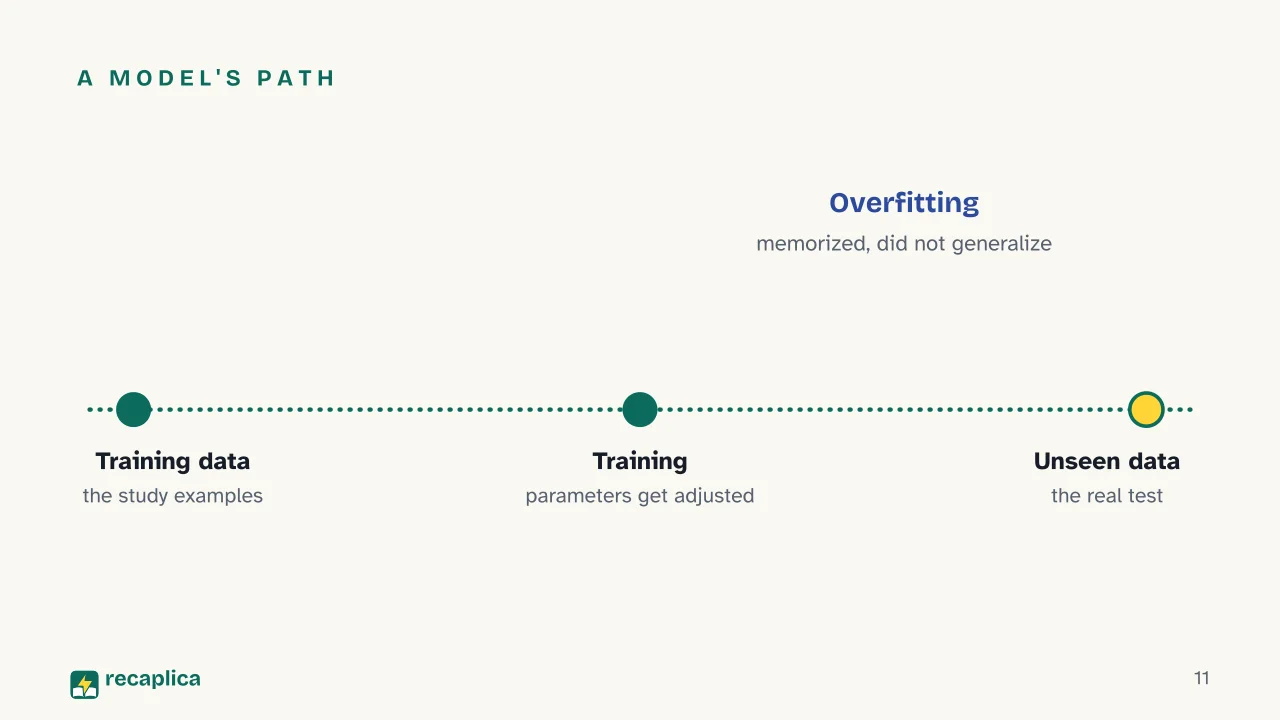
    Slide 1 of the presentation on Machine learning: Machine learningSlide 2 of the presentation on Machine learning: What rules would you write to spot a cat?Slide 3 of the presentation on Machine learning: What we will coverSlide 4 of the presentation on Machine learning: Chapter 01: The reversalSlide 5 of the presentation on Machine learning: Two ways to make software workSlide 6 of the presentation on Machine learning: Two numbers to frame the methodSlide 7 of the presentation on Machine learning: Chapter 02: The three ways of learningSlide 8 of the presentation on Machine learning: Supervised · Unsupervised · ReinforcementSlide 9 of the presentation on Machine learning: The three classic tasks: Regression, Classification, ClusteringSlide 10 of the presentation on Machine learning: Chapter 03: How a model is trainedSlide 11 of the presentation on Machine learning: A model's pathSlide 12 of the presentation on Machine learning: Chapter 04: Where the method strainsSlide 13 of the presentation on Machine learning: Why does a model that worked well start to fail?Slide 14 of the presentation on Machine learning: More data does not mean a better model.Slide 15 of the presentation on Machine learning: A model grouping similar customers without labels is doing...Slide 16 of the presentation on Machine learning: And now, the review
    Flash10 slidesThe essential thread, to present in classFull16 slidesEvery chapter and the deeper detail

    Common myths

    • ✗ Myth Machine learning is an electronic brain that reasons.

      ✓ Reality It's applied statistics at scale: the model finds correlations in data and uses them to make predictions. It doesn't understand the world, it recognizes patterns — and when the patterns change, it fails.

    • ✗ Myth More data always means better results.

      ✓ Reality Quality and representativeness matter, not just quantity: skewed or dirty data produces skewed and dirty models. If the examples contain a bias, the model learns it diligently.

    • ✗ Myth Machine learning and artificial intelligence are the same thing.

      ✓ Reality Machine learning is a subset of AI: the learn-from-data approach. AI includes other approaches too, and deep learning (deep neural networks) is in turn a subset of machine learning.

    Mind map

    Drag the background to move around and the nodes to reposition them; use − and + to collapse and expand branches.
    Customize
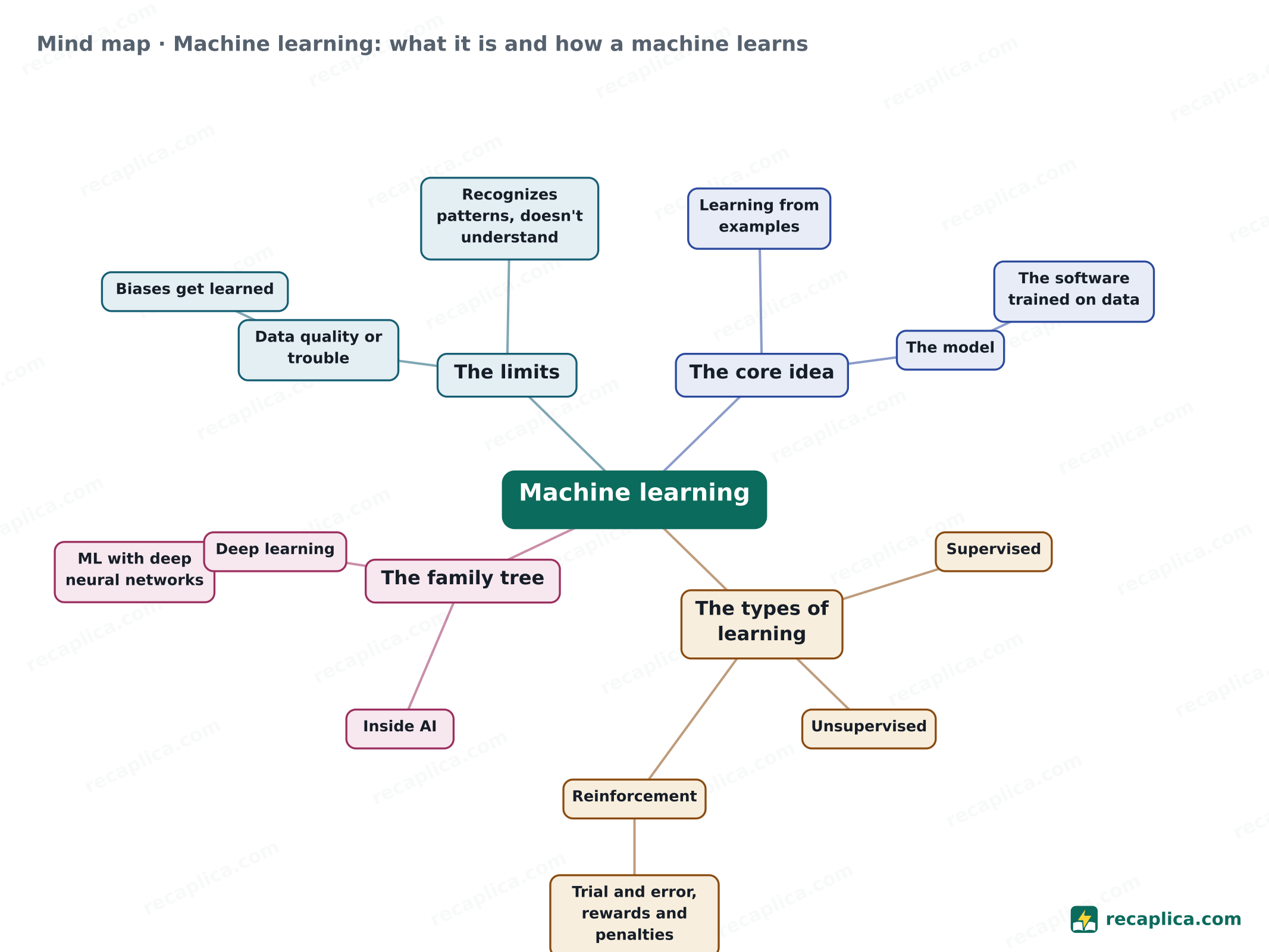
    Mind map: Machine learning: what it is and how a machine learns
    • Machine learning
      • The core idea
        • Learning from examples The model finds the rules, not the programmer.
        • The model
          • The software trained on data
      • The types of learning
        • Supervised Examples with the right answer attached.
        • Unsupervised Discovers groups in unlabeled data.
        • Reinforcement
          • Trial and error, rewards and penalties
      • The family tree
        • Inside AI ML is a subset of artificial intelligence.
        • Deep learning
          • ML with deep neural networks
      • The limits
        • Data quality or trouble
          • Biases get learned
        • Recognizes patterns, doesn't understand

    Quiz: test yourself

    Answer the questions to check what you have learned: you get instant feedback and a short explanation.

    Grade 0/10 0/5
    1 What's the difference between classic programming and machine learning?

    That's the core reversal: instead of telling the machine HOW, you show it thousands of examples of input and outcome, and it finds the relationships itself. And it needs plenty of data.

    2 What is supervised learning?

    Each example carries its solution (this email IS spam, this one isn't): the model learns the input-to-answer relationship, like a student working through past solved exams.

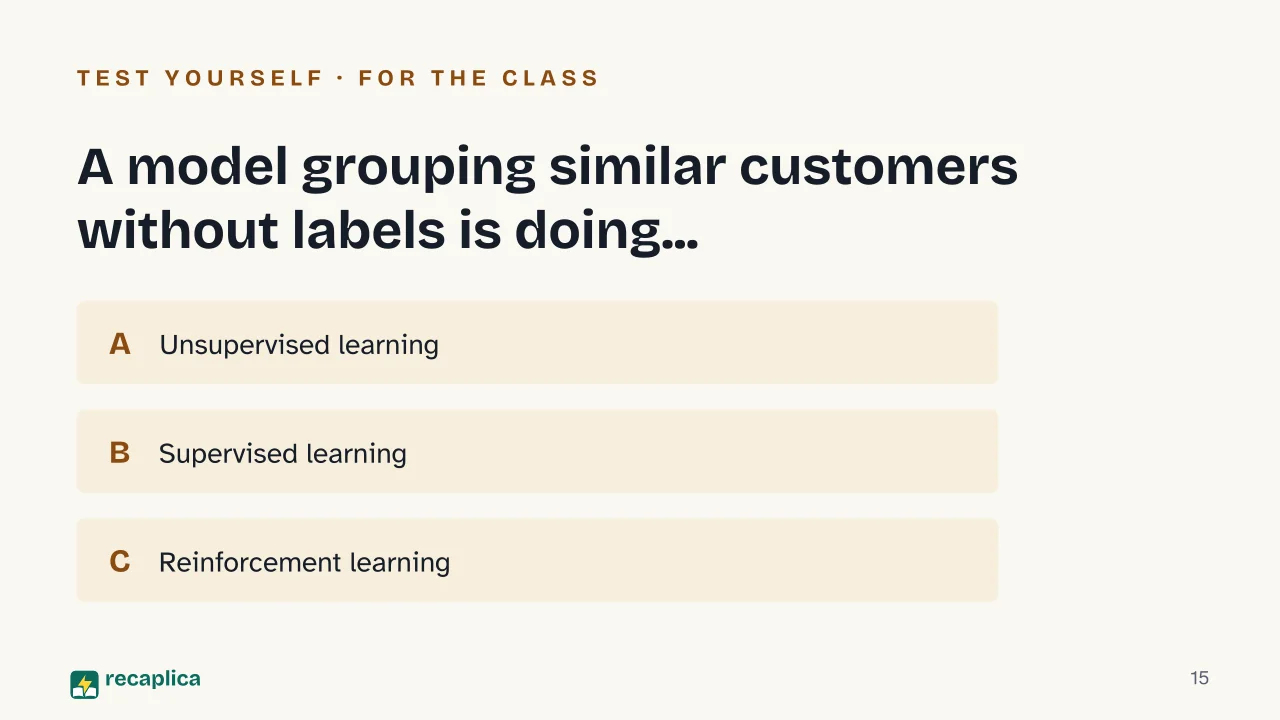
    3 A model grouping similar customers without predefined labels is doing...

    Nobody told it which groups exist: clustering discovers similarities in the data on its own. Interpreting the groups it finds is then a human job.

    4 How does a reinforcement learning system learn?

    It acts in an environment, collects rewards or punishments and adjusts its strategy: the method that taught systems to beat Go champions.

    5 True or false: if the training data contains a bias, the model tends to learn it.

    The model learns everything the examples contain, distortions included. Data quality is machine learning's real bottleneck.

    Answers: 1-A · 2-A · 3-A · 4-A · 5-A

    Flashcards

    Tap the card to flip it and check whether you remember the answer, then move to the next one.

    1 / 7

    Explain it in your own words

    The ultimate test: if you can explain it in simple words, you've truly understood it. Write your explanation, then compare it with the Recap.

    Your explanation is saved only on this device.

    Machine learning is the branch of artificial intelligence in which a piece of software, called a model, learns from data instead of following hand-written rules. Show it thousands of examples and it finds the patterns linking question and answer on its own: that's how it spots spam, recommends films, estimates prices. It's the technology behind almost all the AI you use daily.

    Frequently asked questions

    Where do I meet machine learning every day?

    The spam filter, film and music recommendations, your phone's face recognition, machine translation, the navigation app's traffic predictions, dynamic flight prices. Almost all everyday AI is machine learning at work.

    What's the difference between machine learning and deep learning?

    Deep learning is machine learning done with deep neural networks — many layers: the subfamily that made image recognition, speech and large language models possible. All deep learning is ML, not the other way around.

    What does 'training' a model mean?

    Having it process the examples while gradually adjusting its internal parameters until its predictions get close to the correct answers. Once trained, the model is used on data it has never seen: that's where you find out whether it truly learned.

    Can a model fail after training?

    Absolutely, in two typical ways: if it memorized the examples instead of generalizing (overfitting), or if the real world drifted away from the data it studied. That's why models are evaluated on test data and retrained over time.

    Sources

    • Google — What is Machine Learning? (Machine Learning Crash Course)
    • Sutton & Barto — Samuel's Checkers Player (the 1959 program)

    Every Recap goes through an independent review before publication.

    Every evening, the day's new Recaps on our Telegram channel. Join the channel →

    Keep learning

    • Technology AI Pop Culture: When Synthetic Content Rewrites History According to Lead Stories, a World War Two photo held by the Imperial War Museums circulated in 2026 in an AI-colorized version that a detector rated 99% likely to be artificially generated, even though the original shot was genuine. Cases like this also touch pop culture and current events: text, image and video models produce content that looks historical or iconic without actually being so, or alter real content in details that are hard to spot at a glance. Some tools leave technical clues, such as digital watermarks or video length limits, but no single clue covers every generator on the market. The Reuters Institute reports that in 2026 trust in AI chatbot answers about the news stays low, at 20% against 37% for news overall. Checking whether an image or video is authentic still means comparing it against the original archive that holds it. Read the Recap →
    • Technology Echo Chamber: How Recommendation Algorithms Shape What You See An echo chamber is an environment, online or offline, where a person mostly encounters opinions that confirm their own. Recommendation algorithms can build a narrower version of this, often called a filter bubble, by quietly deciding what to show someone based on what they've clicked and watched before. The two ideas get mixed up constantly, but they aren't the same phenomenon, and the strongest research available paints a more mixed picture than the popular narrative: algorithms have a measurable but modest effect, and people's own choices matter more. Whether algorithms actually drive political polarization is not something the most rigorous experiments have settled. Read the Recap →
    • Technology Virtual influencers: the AI-made creators behind the profiles Virtual influencers are digital characters built by an agency or studio, complete with a face, a voice and a biography, who post on social media the way a real creator would. The phenomenon predates the generative-AI boom: Lil Miquela's account has been live since April 23, 2016, and Shudu Gram first appeared on April 22, 2017. Some of these profiles work with major brands: Miquela has partnered with Calvin Klein and Prada, while the Spanish agency The Clueless built Aitana López after finding human models and influencers too unreliable to manage. In the United States, the Federal Trade Commission updated its advertising rules in 2023 to explicitly cover virtual influencers among the content that must be disclosed as sponsored. Read the Recap →

    recaplica

    Clear in 30 seconds, yours in 10 minutes.

    Recaps Mind maps Request a Recap Telegram channel Mind map maker Our method About Privacy & cookies Legal notes & terms of use

    © 2026 Recaplica · A project by Curi S.r.l. — VAT IT05472000750

    Statistics, only if you say so

    To learn which Recaps help most we would use Google Analytics, with aggregate, anonymous data. It starts only with your OK, and you can change your mind anytime. Privacy policy