Skip to content
recaplica

    One moment: security check

    Cloudflare wants to make sure you're not a robot. Tick the box below and your search will continue on its own.

    IT
    recaplica Zone of Proximal Development: What Is It? Vygotsky's Theory
    © 2026 Recaplica · recaplica.com — All rights reserved
    Home › Science

    Zone of Proximal Development: What Is It? Vygotsky's Theory

    By Recaplica Newsroom · Updated on September 25, 2026

    What to print

    Page numbers appear when printing with default margins.

    Slides

    Choose a cut

    Flash10 slidesThe essential thread, to present in classFull17 slidesEvery chapter and the deeper detail

    Both come with speaker notes.

    Telegram channel
    recaplica Clear in 30 seconds, yours in 10 minutes.
    In 30 seconds Key points Deep dive Slides Myths Mind map Quiz Flashcards FAQ

    In 30 seconds quick read

    Lev Vygotsky (1896-1934) was a Soviet psychologist who developed the zone of proximal development, the gap between what a child can solve alone and what they can achieve with help from an adult or a more capable peer. Vygotsky argued that teaching works best when it targets that in-between space, not what a child has already mastered. He died young of tuberculosis, his work was banned in the Soviet Union for political reasons, and he only reached readers outside the USSR after his writings were translated into English. The term 'scaffolding', often linked to his name today, was coined later by other researchers.

    Key Points

    • The zone of proximal development is the gap between the actual development level (what a child solves alone) and the potential development level (what a child solves with guidance).
    • Vygotsky trained as a lawyer, writing a 1917 thesis on Shakespeare's Hamlet, before moving into psychology in Moscow in 1924.
    • To gauge a child's potential, Vygotsky proposed a two-step test: a task solved alone, then a similar task with an adult's hints and prompts.
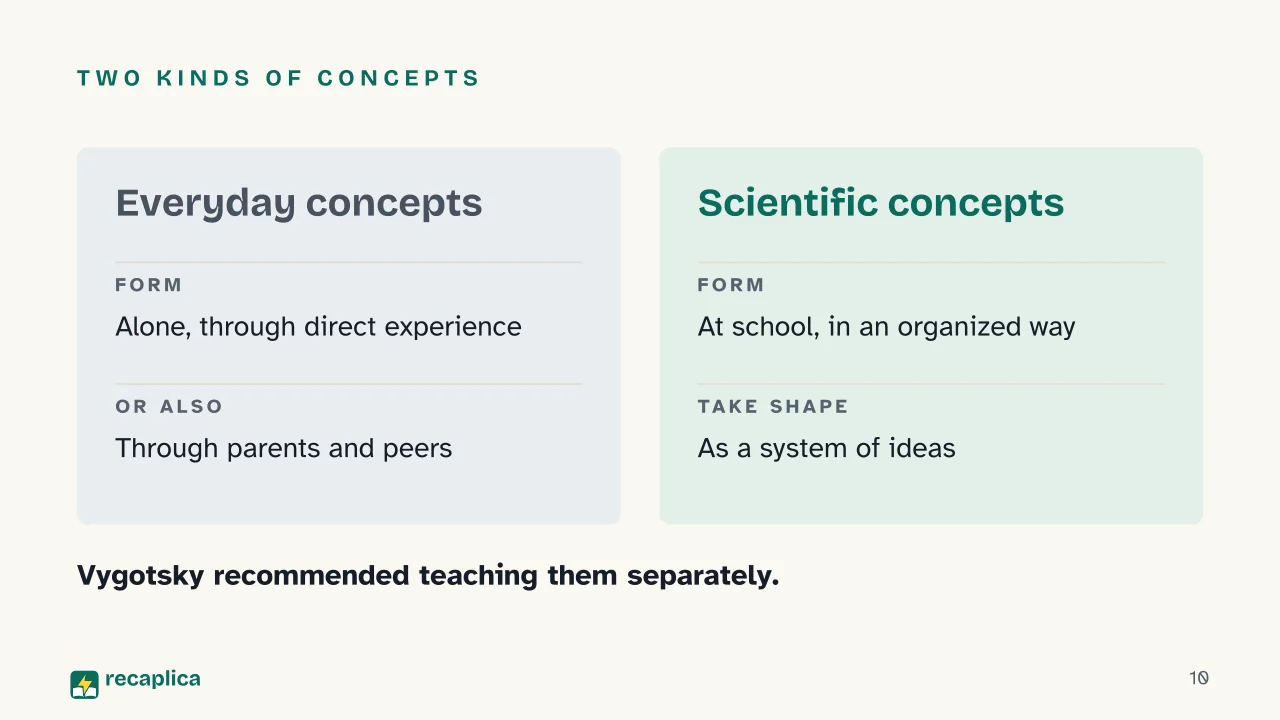
    • Vygotsky separated everyday concepts, picked up through direct experience, from scientific concepts, taught in an organized way at school.
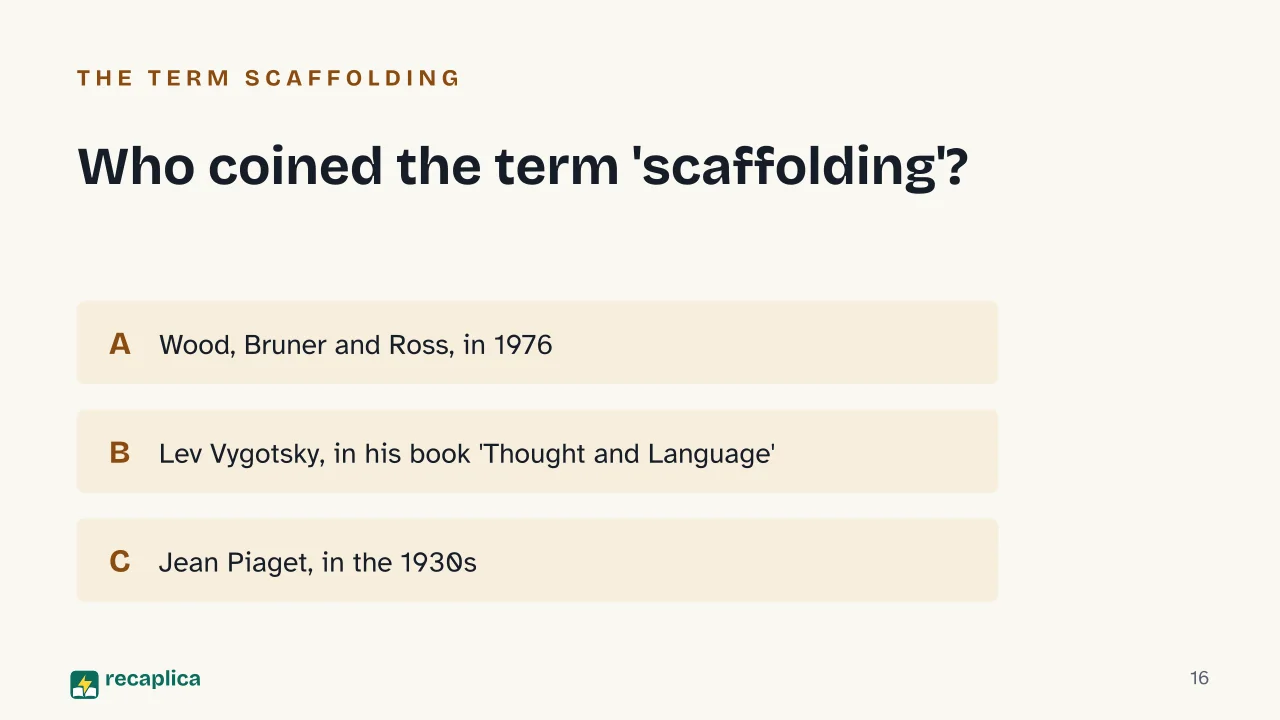
    • The word 'scaffolding' isn't Vygotsky's: Wood, Bruner and Ross coined it in 1976, and other researchers linked it to the zone of proximal development only afterward.
    • Vygotsky's works were banned in the Soviet Union in 1936, two years after his death, and stayed largely unknown outside the USSR until they were translated into English.

    Deep Dive

    Lev Vygotsky was born in Orsha, Russia, on 5 November 1896, and died in Moscow on 11 June 1934. He became a Soviet psychologist, but his first field was law: he earned a law degree in Moscow after attending the gymnasium in Gomel, in Belarus, where he grew up in a Jewish family of eight children. In 1917 he defended a thesis on Shakespeare’s Hamlet, shaped by stage productions he had seen between 1911 and 1914. Only in 1924, after a successful talk at a congress in Leningrad, did he join the Kornilov Institute of experimental psychology in Moscow, where he worked alongside Alexander Luria and Alexei Leontiev to build what became known as cultural-historical theory.

    A short career, a long ban

    Vygotsky’s working life as a psychologist lasted about a decade. In the spring of 1934 he suffered a severe attack of tuberculosis, the illness that had dogged him for years, and died shortly after, leaving a wife and two daughters. His last work, “Thought and Language,” later his most widely read book, was dictated from the sickbed where the disease was consuming him, and published that same year.

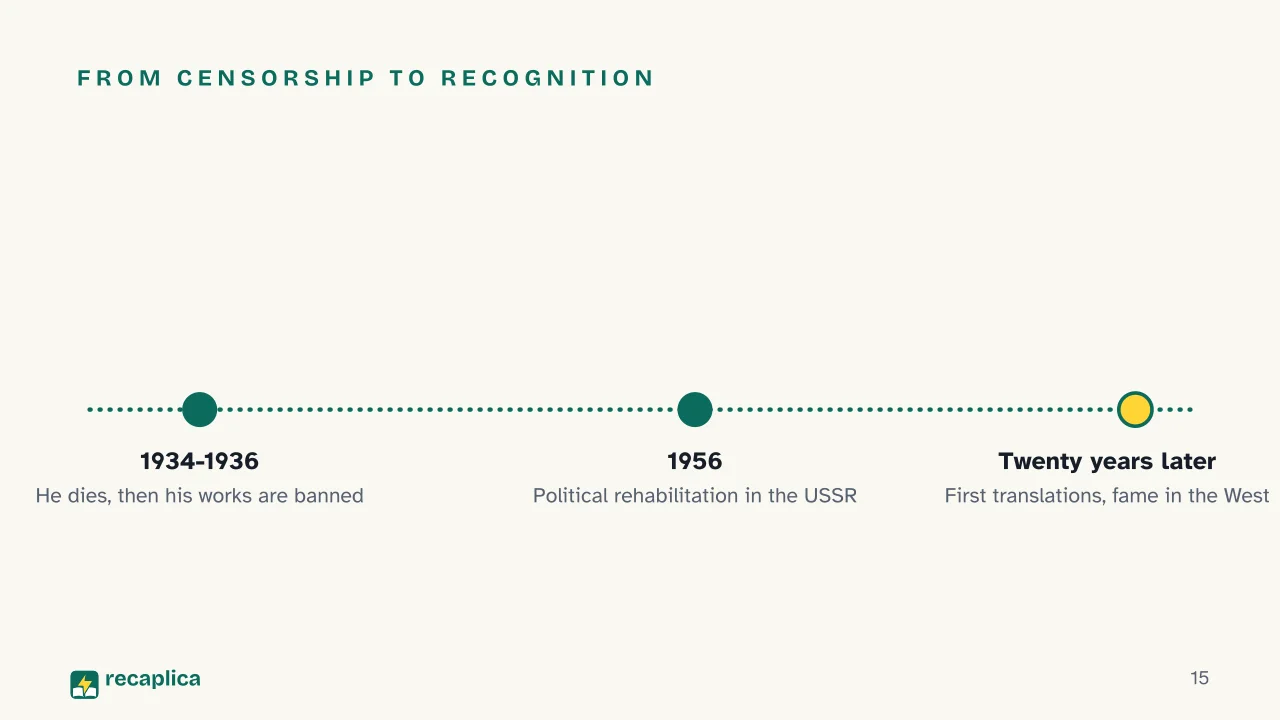
    Two years later, in 1936, his surviving publications were banned in the Soviet Union: for political reasons the sources describe as difficult to explain rationally, it became impossible to cite his writings for decades. Rehabilitation came in 1956, with some texts republished, but nearly twenty years passed before his work reached and was translated in the rest of the world: until the first English translations appeared, Vygotsky remained largely unknown outside Soviet borders. A retrospective ranking from the early 2000s still placed him among the hundred most influential psychologists of the twentieth century, and one Western scholar, in a verdict reported by academic sources, called him the “Mozart of psychology.”

    What the zone of proximal development is

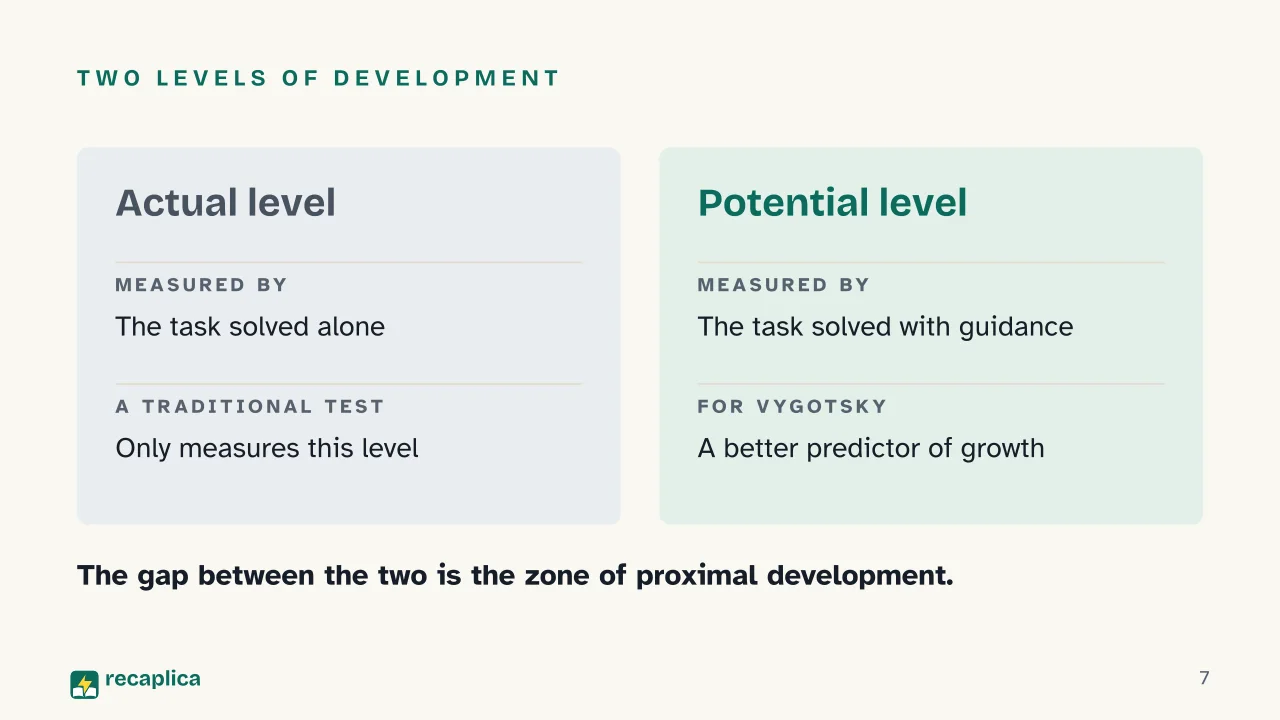
    At the core of Vygotsky’s thinking is a distinction between two levels of development. The first is the actual development level, the one a traditional test measures: the tasks a child can solve entirely on their own. The second is the potential development level, harder to see but, in Vygotsky’s view, more telling: the tasks a child can solve with an adult’s guidance or in collaboration with a more capable peer. The distance between the two levels is the zone of proximal development.

    Vygotsky worked out the definition in “Mind in Society,” published after his death: the zone of proximal development is the space between what a child can already do alone and what they can only do today with assistance, but will be able to do independently tomorrow. With this idea, Vygotsky was pushing back against the psychometric tests used in Russian schools of his time, which he thought captured only what a child had already learned, without saying anything about future growth. The teaching implication was direct: a teacher shouldn’t wait until a child is “ready” for a task by their current level, but should offer problems the child can only tackle together with someone more capable. A task that’s too advanced, one the child couldn’t solve even with help — the example that recurs across the sources is teaching quadratic equations to a ten-year-old — simply falls outside the zone of proximal development, no matter how much support is offered.

    Practical example: Vygotsky often used the example of learning to write a letter. Writing a letter requires the child to spell out information the recipient doesn’t already have, unlike a spoken conversation where shared context lets much go unsaid. It also demands a conscious plan of what to say before writing it down: a task that, Vygotsky argued, a child handles better after first working through it with an adult who helps organize the ideas, before being able to do it alone.

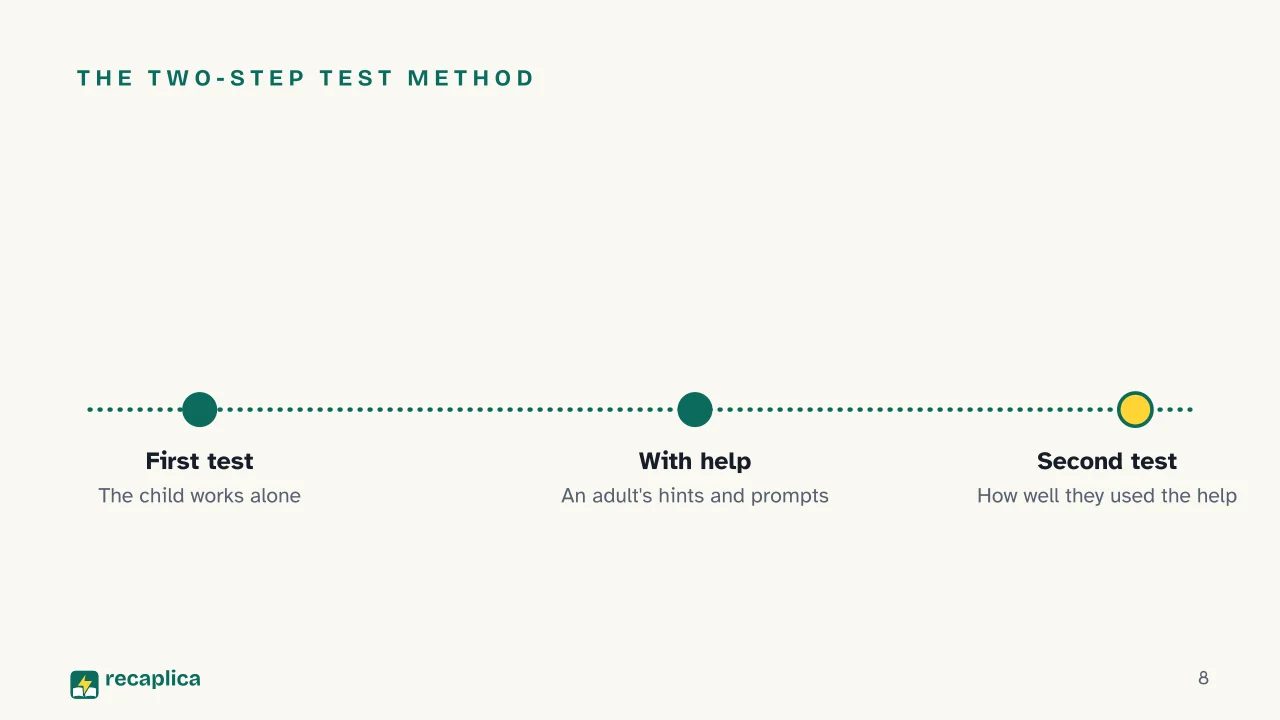
    To measure this potential, Vygotsky proposed a method that today reads as an early form of dynamic assessment: the two-step test. The child is given a task to solve alone, as in a traditional test; then given a similar task again, this time with hints and prompts. How much the child manages to gain from that help, according to the sources that have studied his work, is a more reliable sign of future intellectual development than the score from independent work alone.

    Everyday concepts and scientific concepts

    In secondary school, Vygotsky recommended teaching what he called scientific concepts, to be kept distinct from the everyday concepts a child picks up alone or through spontaneous interaction with parents and peers. Everyday concepts grow from the bottom up, out of direct experience; scientific concepts, as Vygotsky framed them, need the organized structure that only classroom teaching can provide, and take shape within a system of relationships between ideas rather than as isolated facts. This distinction ties the zone of proximal development to a broader view of learning as a social process: that is the core of Vygotsky’s sociocultural theory as a whole, of which the zone of proximal development is just one specific concept.

    Anyone interested in how to study effectively will find in the zone of proximal development a principle still cited today: the difficulty of a task matters less than the kind of support around it. It sits at a distance from behaviorism, which dominated psychology for much of the first half of the twentieth century and reduced learning to observable stimulus-response links, leaving out internal mental processes; and it connects, in its own way, to the questions cognitivism raised later, once those internal processes became its central subject. It also owes something to the method that defines psychological science: Vygotsky’s two-step test is, at bottom, an attempt to make measurable something that might otherwise look like pure teaching intuition.

    A scaffold Vygotsky never called by that name

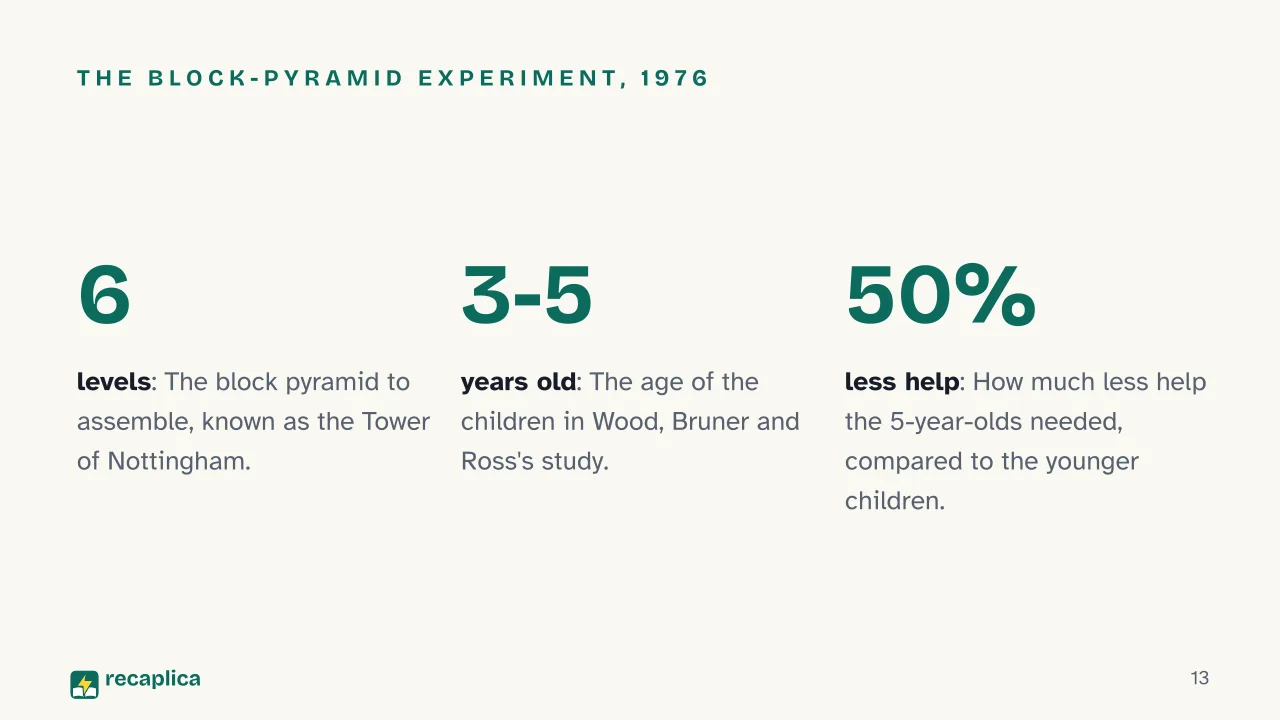
    One point deserves careful handling, since it’s among the most common misunderstandings about Vygotsky’s work: the term “scaffolding,” almost automatically linked to his name today, was never used by him. Wood, Bruner and Ross coined it in 1976, in an experimental paper that didn’t explicitly cite the zone of proximal development. In their experiment, an adult guided children aged 3 to 5 through assembling a six-level pyramid of wooden blocks, a task known as the Tower of Nottingham: the 3- and 4-year-olds needed roughly similar amounts of help, while the 5-year-olds needed about half as much.

    It was only later that various researchers explicitly connected scaffolding to Vygotsky’s zone of proximal development, eventually treating it as the practical, classroom version of that theory. The link isn’t fully settled, though: some scholars have observed that the zone of proximal development describes a two-way collaboration between teacher and learner, while the scaffolding metaphor risks suggesting a process driven mainly by the adult, with the risk — flagged in the literature — of pulling teaching back toward a more directive model than the one Vygotsky had in mind.

    Slide deck

    Slides ready to download and make your own in PowerPoint or Google Slides, with speaker notes. Pick the Flash cut or the Full one.

    Slide 1 of the presentation on Zone of Proximal Development: VygotskySlide 2 of the presentation on Zone of Proximal Development: What can a child do with help, before they can do it alone?Slide 3 of the presentation on Zone of Proximal Development: The path aheadSlide 4 of the presentation on Zone of Proximal Development: Chapter 01: Who Vygotsky WasSlide 5 of the presentation on Zone of Proximal Development: Who he wasSlide 6 of the presentation on Zone of Proximal Development: Chapter 02: The Zone of Proximal DevelopmentSlide 7 of the presentation on Zone of Proximal Development: Two levels of developmentSlide 8 of the presentation on Zone of Proximal Development: The two-step test methodSlide 9 of the presentation on Zone of Proximal Development: Chapter 03: Everyday and Scientific ConceptsSlide 10 of the presentation on Zone of Proximal Development: Two kinds of conceptsSlide 11 of the presentation on Zone of Proximal Development: Chapter 04: Scaffolding, Coined LaterSlide 12 of the presentation on Zone of Proximal Development: Scaffolding isn't one of Vygotsky's words.Slide 13 of the presentation on Zone of Proximal Development: The block-pyramid experiment, 1976Slide 14 of the presentation on Zone of Proximal Development: Chapter 05: LegacySlide 15 of the presentation on Zone of Proximal Development: From censorship to recognitionSlide 16 of the presentation on Zone of Proximal Development: Who coined the term 'scaffolding'?Slide 17 of the presentation on Zone of Proximal Development: Read more
    Flash10 slidesThe essential thread, to present in classFull17 slidesEvery chapter and the deeper detail

    Common myths

    • ✗ Myth Vygotsky himself coined the word 'scaffolding' as part of his theory.

      ✓ Reality Wood, Bruner and Ross introduced it in 1976, more than forty years after Vygotsky's death, to describe how an adult supports a child through a task. Other researchers made the link to the zone of proximal development later on: Wood, Bruner and Ross's original paper never mentions it.

    • ✗ Myth Vygotsky was a well-known, established psychologist during his lifetime.

      ✓ Reality He died at 37 after roughly a decade of work in psychology, and his writings stayed almost unknown outside the Soviet Union for decades — they were even banned there in 1936. He became an international reference only after his political rehabilitation in 1956 and the first English translations, nearly twenty years later.

    • ✗ Myth The zone of proximal development and scaffolding are the same idea under two different names.

      ✓ Reality The literature on the topic notes that exactly how the two connect is still debated: the zone of proximal development frames teaching and learning as a two-way collaboration, while some researchers point out that the scaffolding metaphor risks suggesting a one-way process led mostly by the adult.

    Mind map

    Drag the background to move around and the nodes to reposition them; use − and + to collapse and expand branches.
    Customize
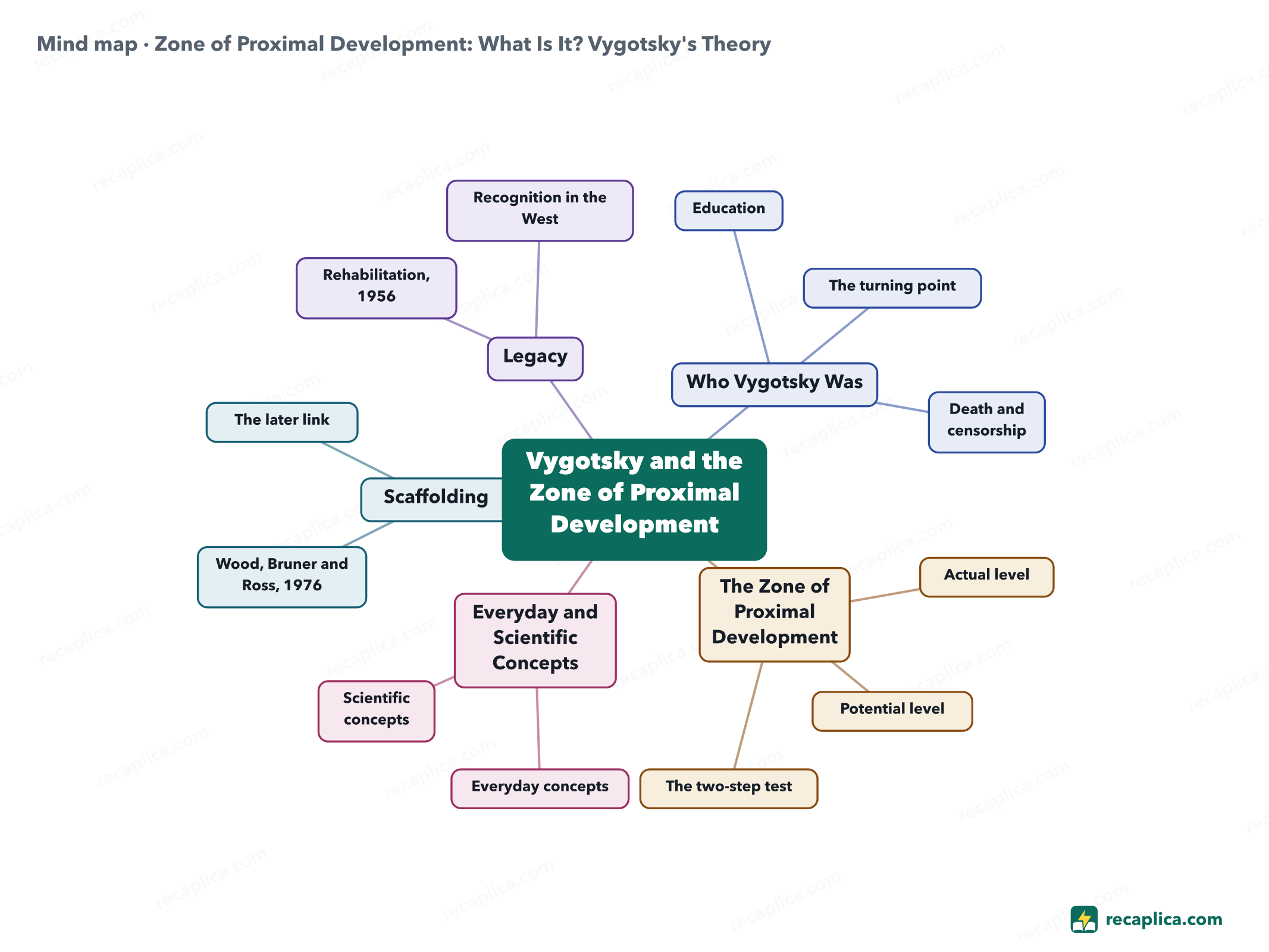
    Mind map: Zone of Proximal Development: What Is It? Vygotsky's Theory
    • Vygotsky and the Zone of Proximal Development
      • Who Vygotsky Was Gomel, Moscow, an early death
        • Education Law degree, 1917 thesis on Hamlet
        • The turning point Moves into psychology in Moscow, 1924
        • Death and censorship Dies of tuberculosis in 1934, works banned in 1936
      • The Zone of Proximal Development
        • Actual level Tasks solved independently
        • Potential level Tasks solved with guidance
        • The two-step test First alone, then with hints
      • Everyday and Scientific Concepts
        • Everyday concepts Picked up alone, through direct experience
        • Scientific concepts Taught at school, in an organized system
      • Scaffolding
        • Wood, Bruner and Ross, 1976 Coin the term, without citing Vygotsky
        • The later link Made by other researchers, after 1976
      • Legacy
        • Rehabilitation, 1956 End of the political ban in the USSR
        • Recognition in the West Through the first English translations

    Quiz: test yourself

    Answer the questions to check what you have learned: you get instant feedback and a short explanation.

    Grade 0/10 0/5
    1 How did Vygotsky define the zone of proximal development?

    This is the definition scholars trace to Vygotsky's 'Mind in Society': the distance between the actual development level and the potential level, reachable with help from someone more skilled.

    2 Who coined the term 'scaffolding'?

    The term first appeared in a 1976 paper by Wood, Bruner and Ross, decades after Vygotsky's death: other researchers made the link to the zone of proximal development later on.

    3 Vygotsky earned his degree in psychology.

    He graduated in law in Moscow, with a 1917 thesis on Shakespeare's Hamlet. He only began working as a psychologist in 1924, after a successful talk at a congress in Leningrad.

    4 What was the point of the two-step test described in connection with Vygotsky?

    The first test measures what the child solves alone; the second, with an adult's hints and prompts, shows how much the child can draw on that help: the gap between the two is the zone of proximal development.

    5 What distinction did Vygotsky draw between everyday concepts and scientific concepts?

    Everyday concepts grow out of spontaneous interaction with the environment and other people; scientific concepts, for Vygotsky, need the organized teaching that school provides.

    Answers: 1-A · 2-A · 3-B · 4-A · 5-A

    Flashcards

    Tap the card to flip it and check whether you remember the answer, then move to the next one.

    1 / 8

    Explain it in your own words

    The ultimate test: if you can explain it in simple words, you've truly understood it. Write your explanation, then compare it with the Recap.

    Your explanation is saved only on this device.

    Lev Vygotsky (1896-1934) was a Soviet psychologist who developed the zone of proximal development, the gap between what a child can solve alone and what they can achieve with help from an adult or a more capable peer. Vygotsky argued that teaching works best when it targets that in-between space, not what a child has already mastered. He died young of tuberculosis, his work was banned in the Soviet Union for political reasons, and he only reached readers outside the USSR after his writings were translated into English. The term 'scaffolding', often linked to his name today, was coined later by other researchers.

    Frequently asked questions

    What is Vygotsky's zone of proximal development?

    It's the gap between what a child can solve alone and what they can solve with help from an adult or a more capable peer: for Vygotsky, teaching pays off most in exactly that in-between space.

    Why shouldn't the term 'scaffolding' be credited directly to Vygotsky?

    Because it was coined by Wood, Bruner and Ross in 1976, more than forty years after Vygotsky died in 1934: the link between scaffolding and the zone of proximal development was made afterward by other researchers, not by the term's original authors.

    Did Vygotsky study psychology at university?

    No: he earned a law degree in Moscow, with a 1917 thesis on Shakespeare's Hamlet. He only entered experimental psychology in Moscow from 1924, after a successful talk at a congress in Leningrad.

    Why did Vygotsky's work become famous only long after his death?

    Because in 1936, two years after he died, his publications were banned in the Soviet Union for political reasons. They were rehabilitated in 1956, but nearly twenty years passed before his work was translated into English and known in the rest of the world.

    What's the difference between everyday and scientific concepts for Vygotsky?

    Everyday concepts form on their own, through direct experience with the environment and other people; scientific concepts, according to Vygotsky, need the organized teaching that only school can provide.

    Sources

    • Vygotsky, Lev Semyonovich — Complete Dictionary of Scientific Biography (Encyclopedia.com)
    • Vygotsky's Zone of Proximal Development: Instructional Implications and Teachers' Professional Development — English Language Teaching, Vol. 3, No. 4 (2010)
    • Scaffolding Made Visible — Design Recommendations for Intelligent Tutoring Systems, Volume 2 (U.S. Army Research Laboratory, 2014)

    Every Recap goes through an independent review before publication.

    Every evening, the day's new Recaps on our Telegram channel. Join the channel →

    Keep learning

    • Science What Is Sociocultural Theory? Vygotsky's Explanation Sociocultural theory explains cognitive development as something that happens between people first, not inside a single child's head alone. The APA defines it as the view that a child's development is guided by interaction with adults, with the surrounding culture shaping how, where and when that interaction takes place. For Vygotsky, language is the main tool a child uses to build knowledge of the world: spoken aloud at first, then folded inward into thought. The theory runs counter to Piaget's, which treats development as an individual, biologically driven process that comes before learning. Read the Recap →
    • Science Cognitive Load Theory: The Definition Behind Sweller's Research Cognitive load is the amount of working memory a task uses up while you learn something new. Psychologist John Sweller first described it in 1988, starting from research on problem solving: a strategy that is too demanding leaves little room to build stable mental structures. Later research distinguishes three types of load, intrinsic, extraneous, and germane, though part of the field treats the third as indistinguishable from the first. Cutting extraneous load, with worked examples or less cluttered materials, frees up mental room for actual learning. Read the Recap →
    • Science Cognitivism: how the mind processes information Cognitivism is the psychological paradigm that treats the mind as a system for processing information, spanning perception, memory, reasoning and language. The shift began around 1956, while behaviorism, championed by Watson and Skinner, still ruled academic psychology and reduced the field to observable stimuli and responses. That same year, George Miller exposed the limits of short-term memory, and Chomsky joined McCarthy, Minsky, Newell and Simon in laying the groundwork for cognitive science. Donald Broadbent's attention model in 1958 and Ulric Neisser's 1967 book, which put the name cognitive psychology into common use, complete the roster of its founding figures. Read the Recap →

    recaplica

    Clear in 30 seconds, yours in 10 minutes.

    Recaps Mind maps Request a Recap Telegram channel Mind map maker Our method About Privacy & cookies Legal notes & terms of use

    © 2026 Recaplica · A project by Curi S.r.l. — VAT IT05472000750

    Statistics, only if you say so

    To learn which Recaps help most we would use Google Analytics, with aggregate, anonymous data. It starts only with your OK, and you can change your mind anytime. Privacy policy