recaplica
Clear in 30 seconds, yours in 10 minutes.
In 30 seconds quick read
In 1923 Johannes Brønsted and Thomas Lowry, working independently, defined an acid as a species that gives away a proton and a base as a species that takes one in. An acid-base reaction is therefore a transfer of a proton, and every transfer produces two conjugate pairs. Water can act as either an acid or a base, and ammonia is a base even though its formula has no OH-. The theory generalizes Arrhenius's, which holds only for water solutions.
Key Points
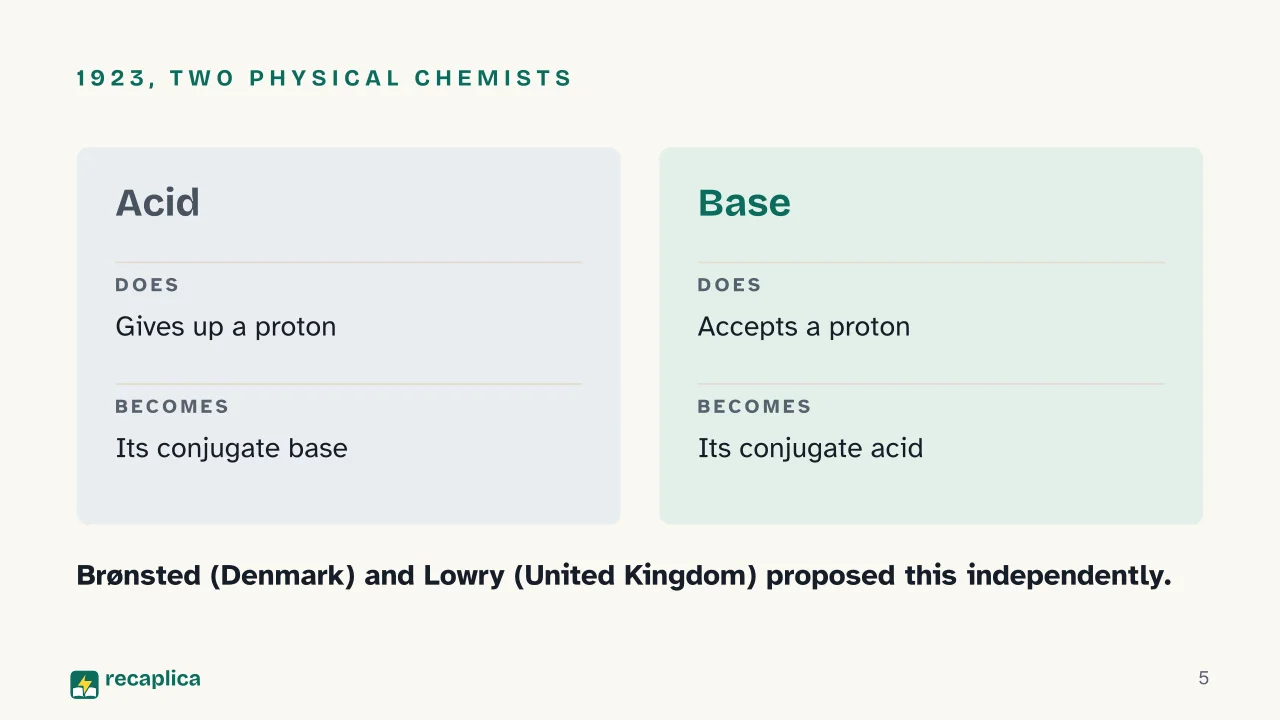
An acid is a proton donor and a base is a proton acceptor. Brønsted and Lowry formulated the definition independently in 1923.
By giving up its proton, an acid becomes its own conjugate base; by taking one in, a base becomes its own conjugate acid.
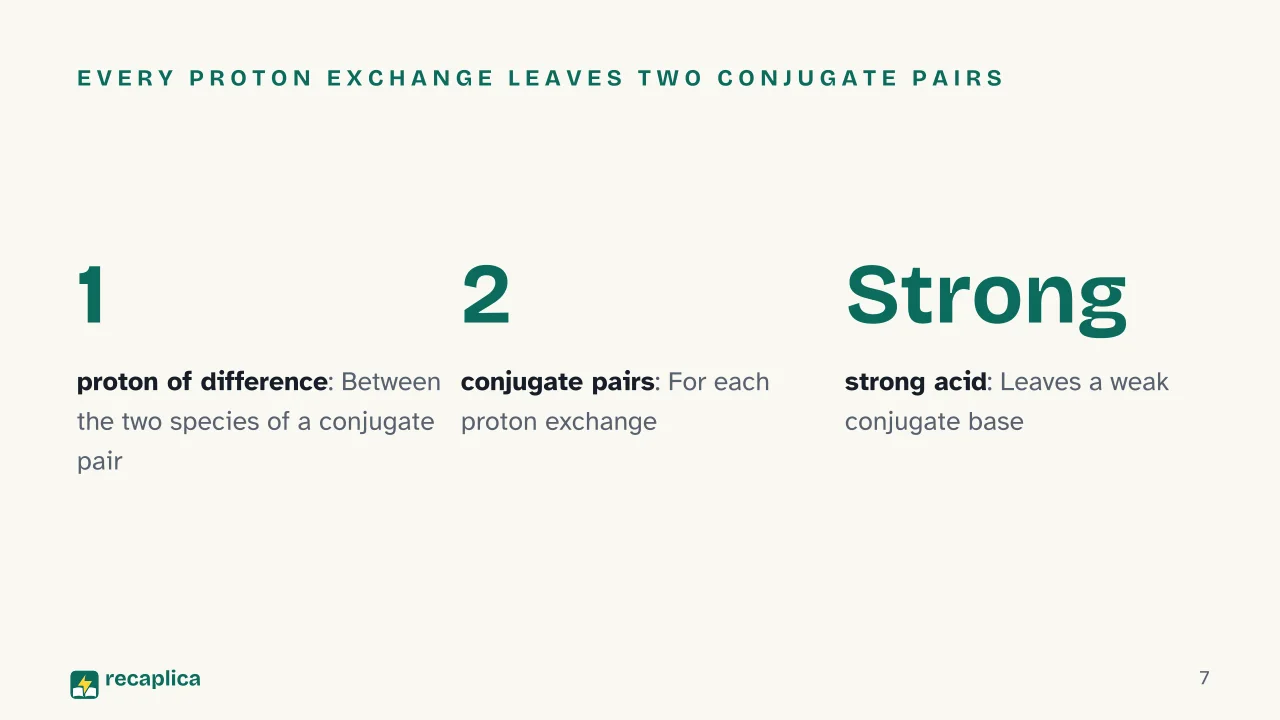
Two species that differ by a single proton form a conjugate pair, and a strong acid has a weak conjugate base.
Water is amphoteric, so its role depends on its partner: facing an acid it takes a proton, facing a base it gives one.
The criterion is the proton changing hands: a substance may contain no H+ or OH-, and the solvent may be something other than water.
Deep Dive
Brønsted-Lowry theory: acids and bases as proton donors and acceptors
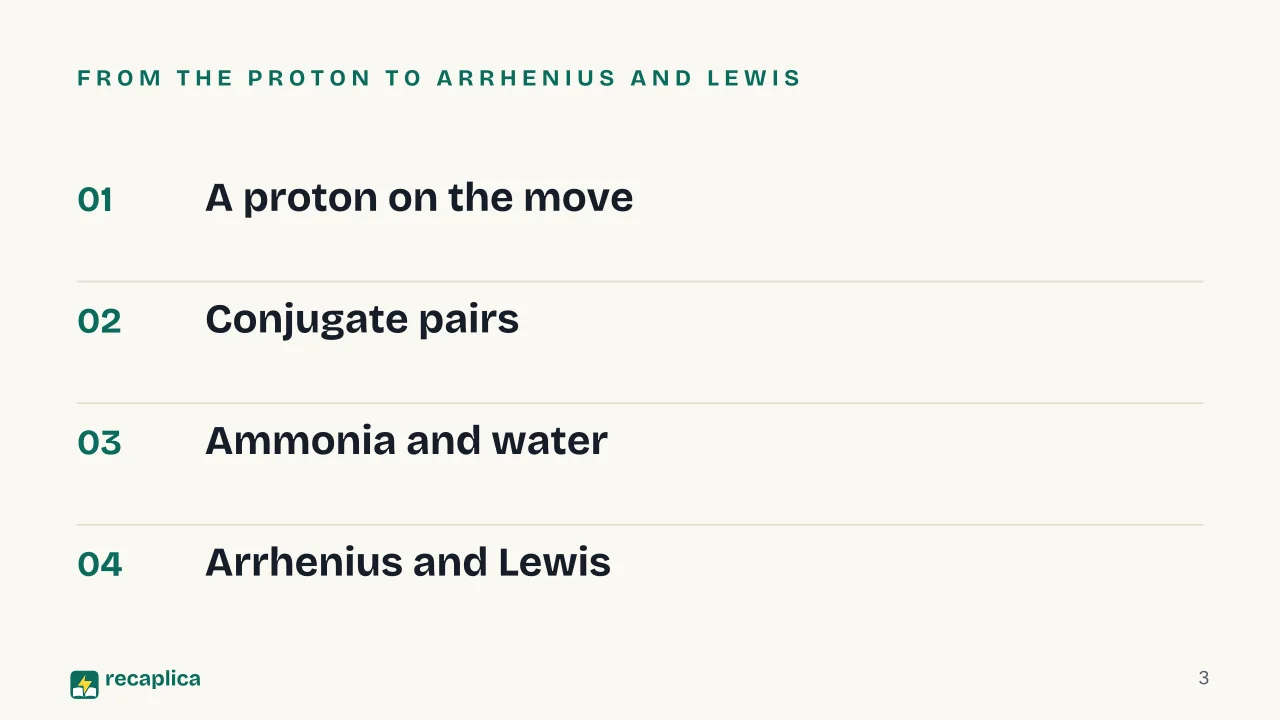
In 1923 two physical chemists, Johannes Nicolaus Brønsted (Denmark) and Thomas Martin Lowry (United Kingdom), reached the same definition independently. An acid is a species that gives up a proton. A base is a species that accepts one. An acid-base reaction is, then, a transfer of a proton from one species to another.
The scale that measures how acidic or basic a solution is gets its own Recap on the pH scale.
Conjugate acid-base pairs
When an acid gives up its proton, it becomes its own conjugate base. When a base accepts a proton, it becomes its own conjugate acid. According to the organic chemistry course of the University of Illinois Springfield, published on LibreTexts, a conjugate acid-base pair consists of two species that differ by a single proton. Each exchange therefore yields two pairs: the acid with its conjugate base, and the base with its conjugate acid. The same course adds that a strong acid leaves behind a very weak conjugate base.
Examples of Brønsted-Lowry acids and bases: ammonia and water
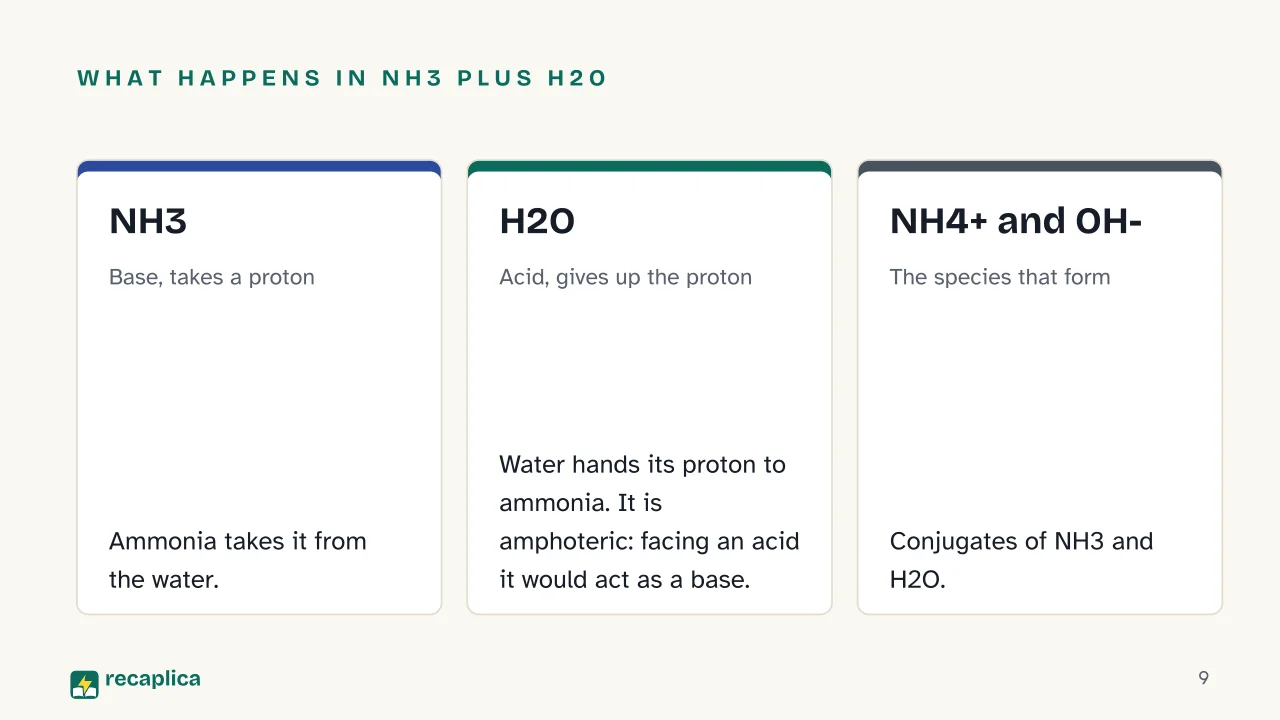
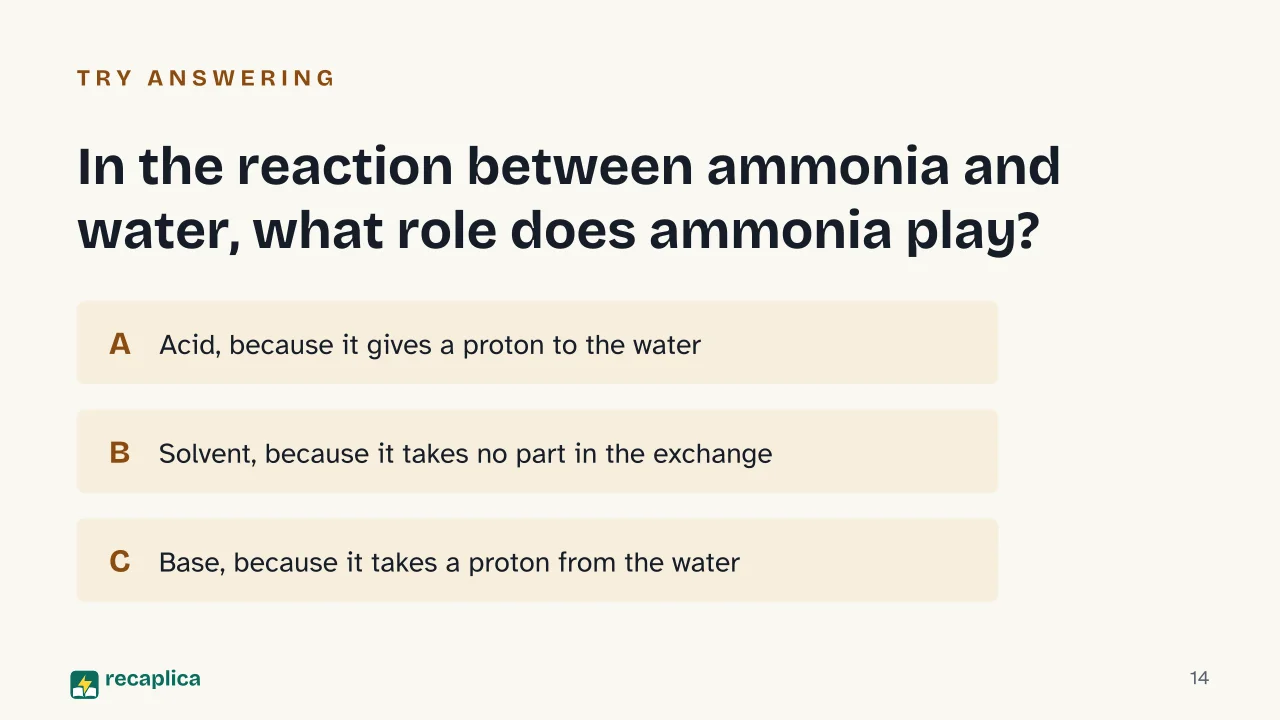
Practical example: in the reaction between ammonia (NH3) and water (H2O), ammonia acts as the base because it takes a proton from the water. The ammonium ion (NH4+) and the hydroxide ion (OH-) result. Water, which gave up the proton, acted as the acid. The two conjugate pairs are NH3 with NH4+, and H2O with OH-.
An ammonia molecule contains no OH- at all. LibreTexts notes that under Brønsted-Lowry theory a substance no longer needs to contain H+ or OH- to be an acid or a base. Wikipedia adds that in dilute water solution ammonia forms only minimal amounts of ammonium ion.
Water as an acid or a base
Water is called amphoteric because its role depends on what it meets: an acid makes it the base, a base makes it the acid. In the ammonia example it is water that gives up the proton, so there it is the acid. Meet it with an acid and the same water becomes the base.
Brønsted-Lowry, Arrhenius and Lewis compared
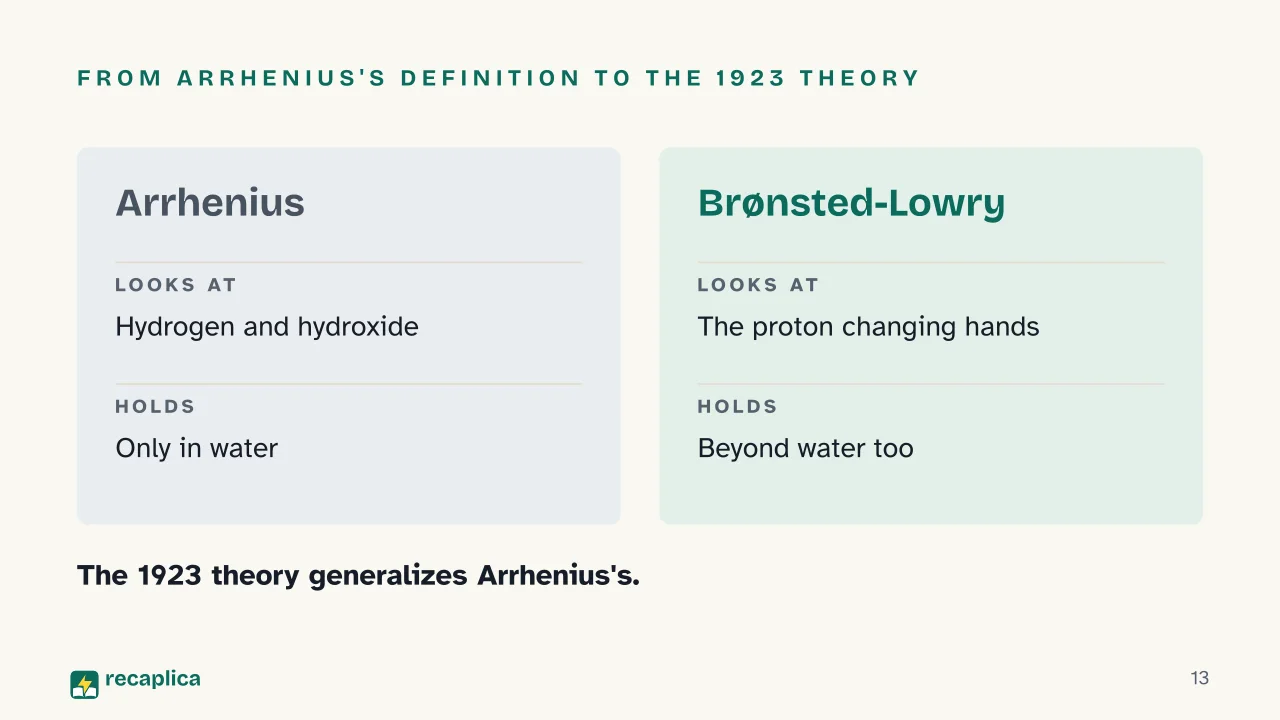
According to Wikipedia, Arrhenius was the first to describe acids and bases in molecular terms with a modern definition. That definition looks at whether a molecule contains hydrogen and hydroxide, and it holds only for water solutions.
Arrhenius
Brønsted-Lowry
What it looks at
Hydrogen and hydroxide in the molecule
A proton changing hands
Where it holds
Water solutions only
In principle, independent of the solvent
Brønsted-Lowry theory generalizes Arrhenius’s. Lewis proposes an alternative definition, which starts from electrons instead of the proton: his base is whatever donates a pair of electrons.
Slide deck
Slides ready to download and make your own in PowerPoint or Google Slides, with speaker notes. Pick the Flash cut or the Full one.
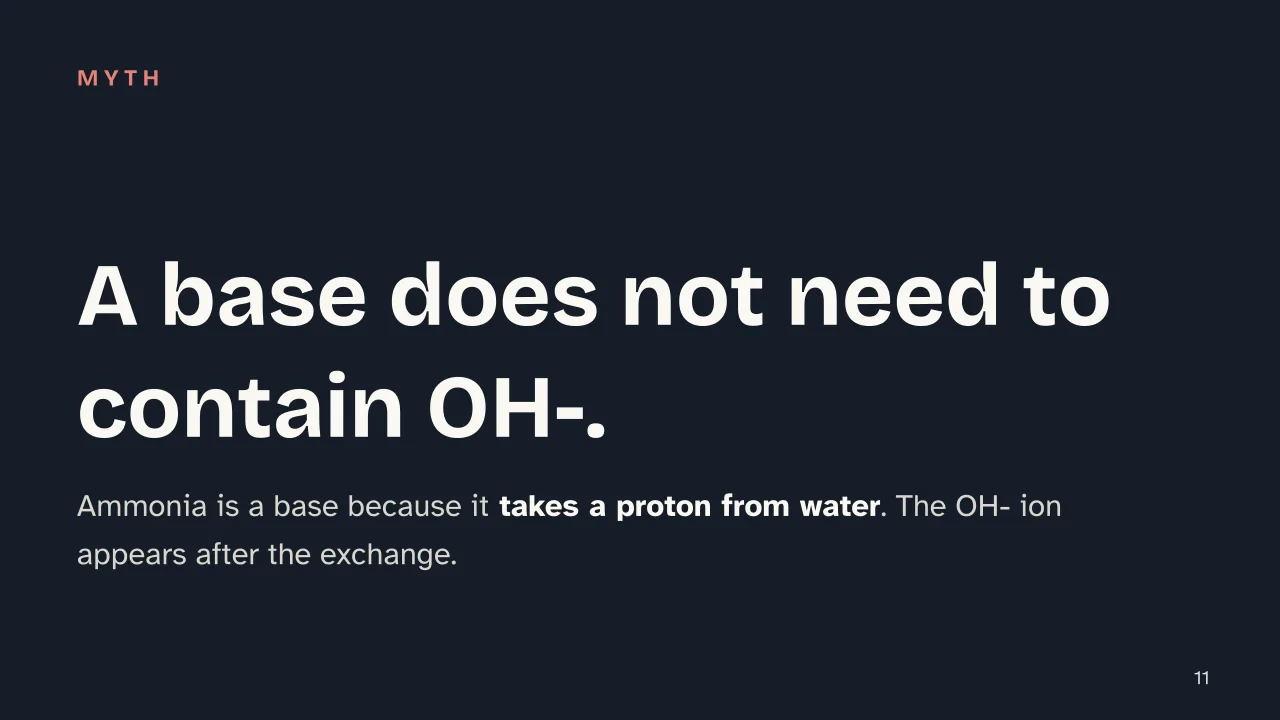
✗ Myth A substance is a base only if it contains OH-.
✓ Reality Ammonia shows otherwise: its molecule has no OH-, yet it takes a proton from water, and that makes it a base.
✗ Myth Acids and bases exist only in water solutions.
✓ Reality That holds for Arrhenius's definitions. Brønsted-Lowry acid-base behavior does not, in principle, depend on the solvent, which does not have to be water.
✗ Myth Water is just the solvent in which the reaction happens.
✓ Reality Water takes part in the proton exchange. In the reaction with ammonia it gives up a proton and acts as an acid. This is amphoteric behavior.
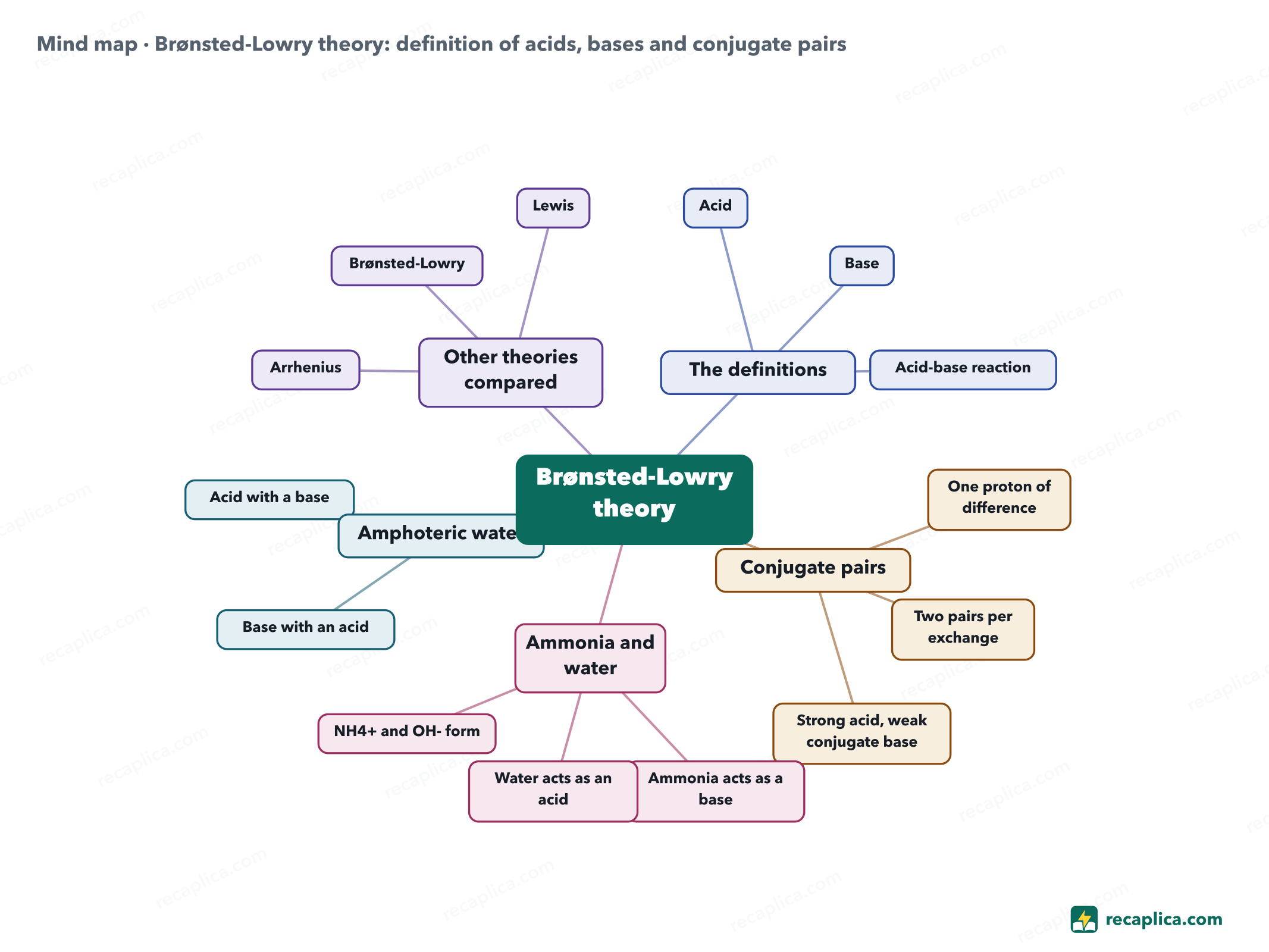
Mind map
Drag the background to move around and the nodes to reposition them; use − and + to collapse and expand branches.
Answer the questions to check what you have learned: you get instant feedback and a short explanation.
Grade0/100/5
Answers: 1-B · 2-A · 3-C · 4-A · 5-D
Flashcards
Tap the card to flip it and check whether you remember the answer, then move to the next one.
1 / 7
Explain it in your own words
The ultimate test: if you can explain it in simple words, you've truly understood it. Write your explanation, then compare it with the Recap.
Your explanation is saved only on this device.
In 1923 Johannes Brønsted and Thomas Lowry, working independently, defined an acid as a species that gives away a proton and a base as a species that takes one in. An acid-base reaction is therefore a transfer of a proton, and every transfer produces two conjugate pairs. Water can act as either an acid or a base, and ammonia is a base even though its formula has no OH-. The theory generalizes Arrhenius's, which holds only for water solutions.
Frequently asked questions
What is Brønsted-Lowry theory?
It is the definition of acids and bases formulated in 1923, independently, by Johannes Nicolaus Brønsted and Thomas Martin Lowry. The acid is the proton donor, the base is the proton acceptor, and an acid-base reaction is a transfer of a proton.
What is a conjugate acid-base pair?
It is a pair of species that differ by one proton. An acid that gives up its proton becomes its conjugate base, and a base that accepts a proton becomes its conjugate acid, so each exchange generates two pairs.
Can a substance without OH- be a base?
Yes. Ammonia (NH3) is a base because it takes a proton from water; the OH- appears only after the exchange.
Is water an acid or a base?
It can be either, which is why it is called amphoteric. Its role depends on the species it reacts with.
Every Recap goes through an independent review before publication.
Statistics, only if you say so
To learn which Recaps help most we would use Google Analytics, with aggregate, anonymous data. It starts only with your OK, and you can change your mind anytime. Privacy policy