|
recaplica
What Is Sociocultural Theory? Vygotsky's Explanation | ||||||||||||||||||
| © 2026 Recaplica · recaplica.com — All rights reserved | ||||||||||||||||||
What Is Sociocultural Theory? Vygotsky's ExplanationWhat to print Page numbers appear when printing with default margins. SlidesChoose a cut Flash10 slidesThe essential thread, to present in classFull16 slidesEvery chapter and the deeper detailBoth come with speaker notes. In 30 seconds quick readSociocultural theory explains cognitive development as something that happens between people first, not inside a single child's head alone. The APA defines it as the view that a child's development is guided by interaction with adults, with the surrounding culture shaping how, where and when that interaction takes place. For Vygotsky, language is the main tool a child uses to build knowledge of the world: spoken aloud at first, then folded inward into thought. The theory runs counter to Piaget's, which treats development as an individual, biologically driven process that comes before learning. Key Points
Deep DiveIn practice: a child who can’t yet stack a tall, stable tower of blocks alone manages it without trouble when a parent points, one block at a time, to where the next one goes. For Vygotsky that’s not a side detail: it shows that cognitive development first passes through interaction with someone more experienced, and only later becomes an ability the child holds on their own. According to the APA Dictionary of Psychology, the sociocultural perspective in developmental psychology holds that cognitive development is guided by interaction between adults and children, with the surrounding culture largely determining how, where and when that interaction takes place. The APA names Lev Vygotsky as one of the major pioneers of this view: his theory describes development as a child’s gradual mastery of their own “natural” cognitive functions, achieved through interaction with more experienced people from the surrounding culture — parents, teachers, older peers. The open-access university textbook Social Sci LibreTexts quotes Vygotsky directly, from his 1978 work Mind in Society: every function in a child’s cultural development appears twice — first on the social plane, between people, and only later on the individual plane, inside the child. The manual adds that it’s only by working with others on a range of tasks that a child picks up shared experience and useful strategies. For Vygotsky, thinking has social origins, and cognitive development can’t be fully understood without the social and historical context it sits inside. The manual from Baylor University Libraries frames Vygotsky as a Russian psychologist whose ideas took shape in reaction to earlier, conflicting approaches in psychology — the kind of rivalry the Recap on psychological science traces back to the field’s own beginnings. It identifies three recurring themes in his theory: the social, historical and cultural origin of development and learning; the use of psychological tools — chief among them language — as mediators of higher mental functions; and learning that happens within the zone of proximal development, the theory’s most specific concept, marking the gap between what a child can do alone and what they can do with help from someone more skilled — the same idea explored, from a learner’s side, in the Recap on studying effectively. Language holds a distinct place in this account. The Baylor manual describes it as the primary tool culture makes available to support the growth of higher-order thought: for Vygotsky, a child engages with the world through the tool of language. As development proceeds, the language a child picks up from their surroundings shapes how they think and behave, and eventually turns inward as thought — cognition, reasoning — which the child then uses to guide their own actions.
Social Sci LibreTexts describes this shift in detail: thinking out loud gradually becomes thought accompanied by inner speech, and talking to oneself turns into something a person does mainly when trying to learn or remember something. It’s the same behavior Jean Piaget read the opposite way, as “egocentric speech” — a practice he tied to a child’s difficulty seeing things from another person’s point of view. Vygotsky, by contrast, held that children talk to themselves precisely to solve problems or clarify their own thinking.
Social Sci LibreTexts sums up the practical consequence of this difference: someone who believes, like Piaget, that development precedes learning will introduce new concepts only once a child already has the capacity to grasp them; someone who believes, like Vygotsky, that learning drives development will instead structure activities to promote interaction from the outset, because development happens as children learn progressively harder concepts together with others. The Baylor manual adds another contrast: while Piaget’s account of cognitive development stresses universal stages progressing toward greater cognitive complexity, Vygotsky’s view is more culturally embedded, with situated, participatory learning driving development. Vygotsky also broke with Piaget on the claim that a person holds not just a set of actual abilities but a set of potential ones too, reachable only with the right guidance from others — the specific principle the zone of proximal development rests on. Piaget and Vygotsky aren’t the only two accounts of how a mind develops: cognitivism and behaviorism answer the same question from different starting points. Slide deckSlides ready to download and make your own in PowerPoint or Google Slides, with speaker notes. Pick the Flash cut or the Full one.     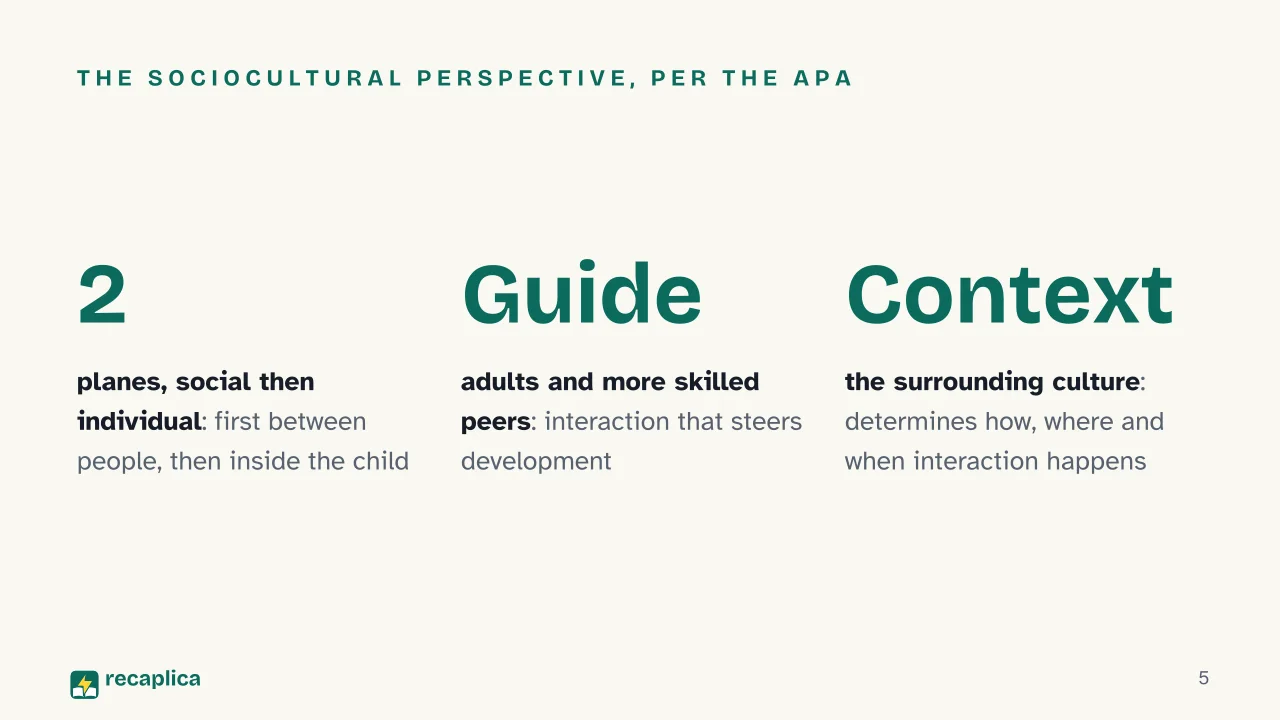 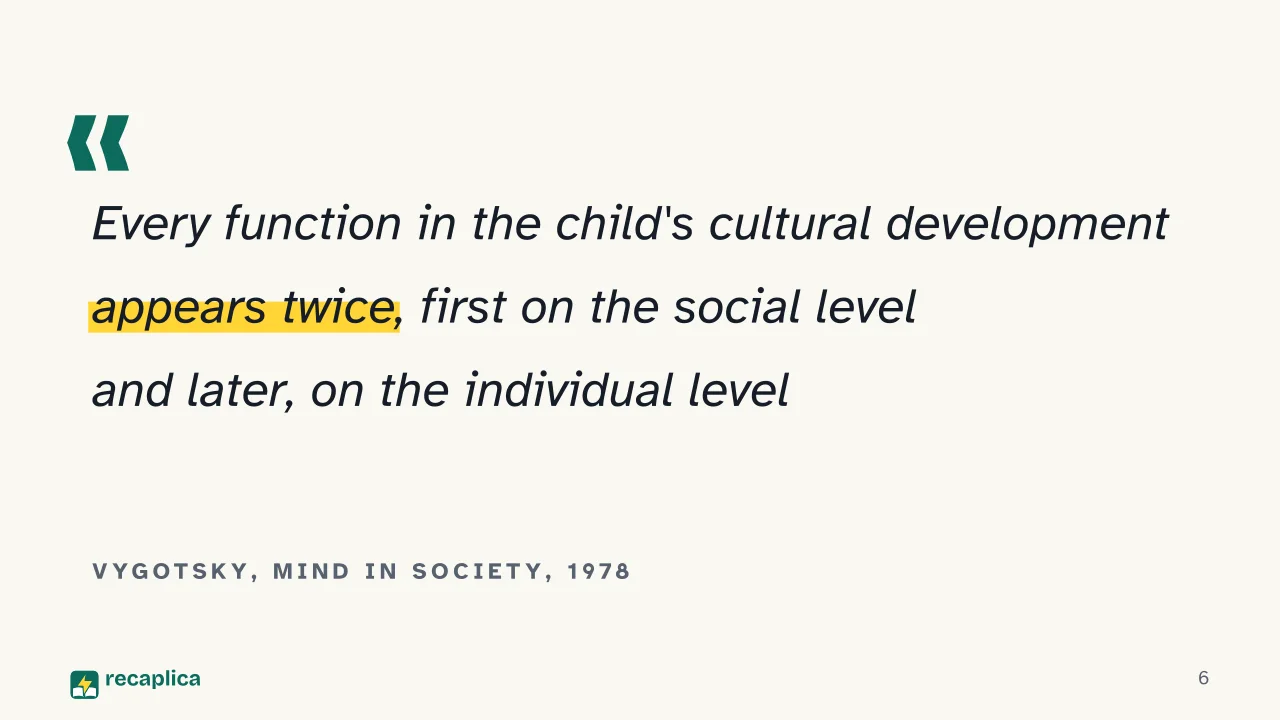  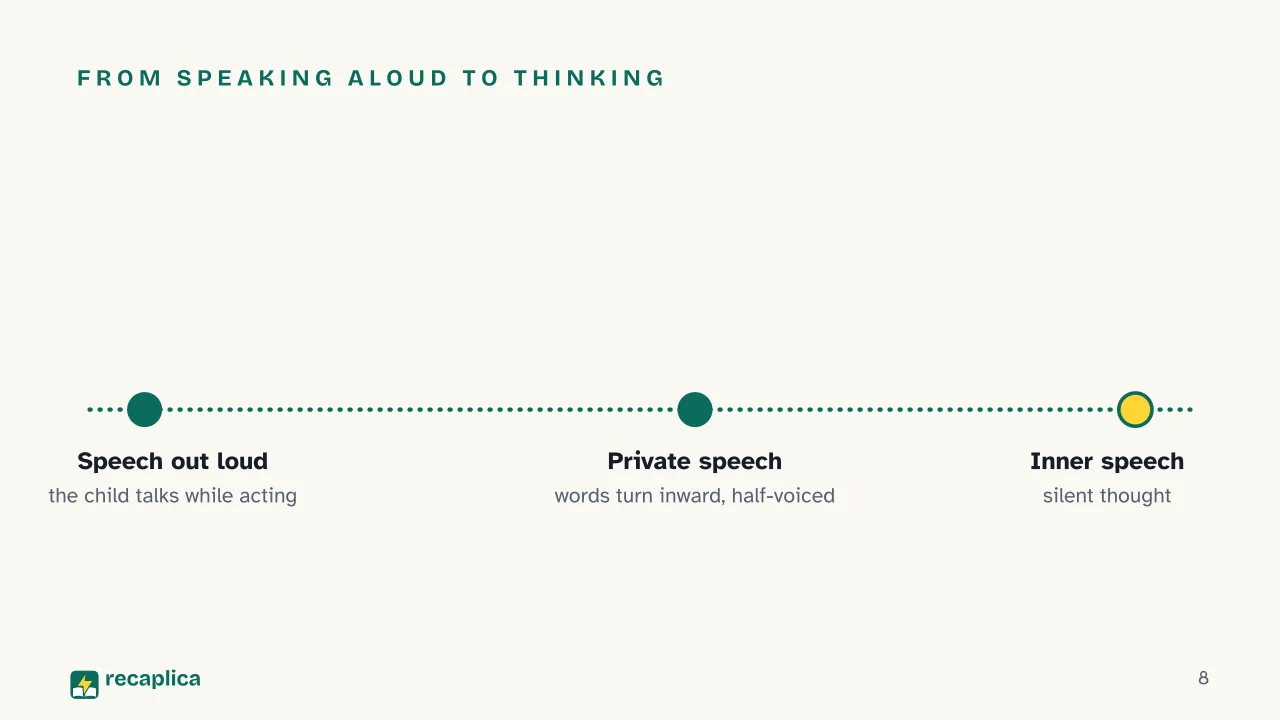 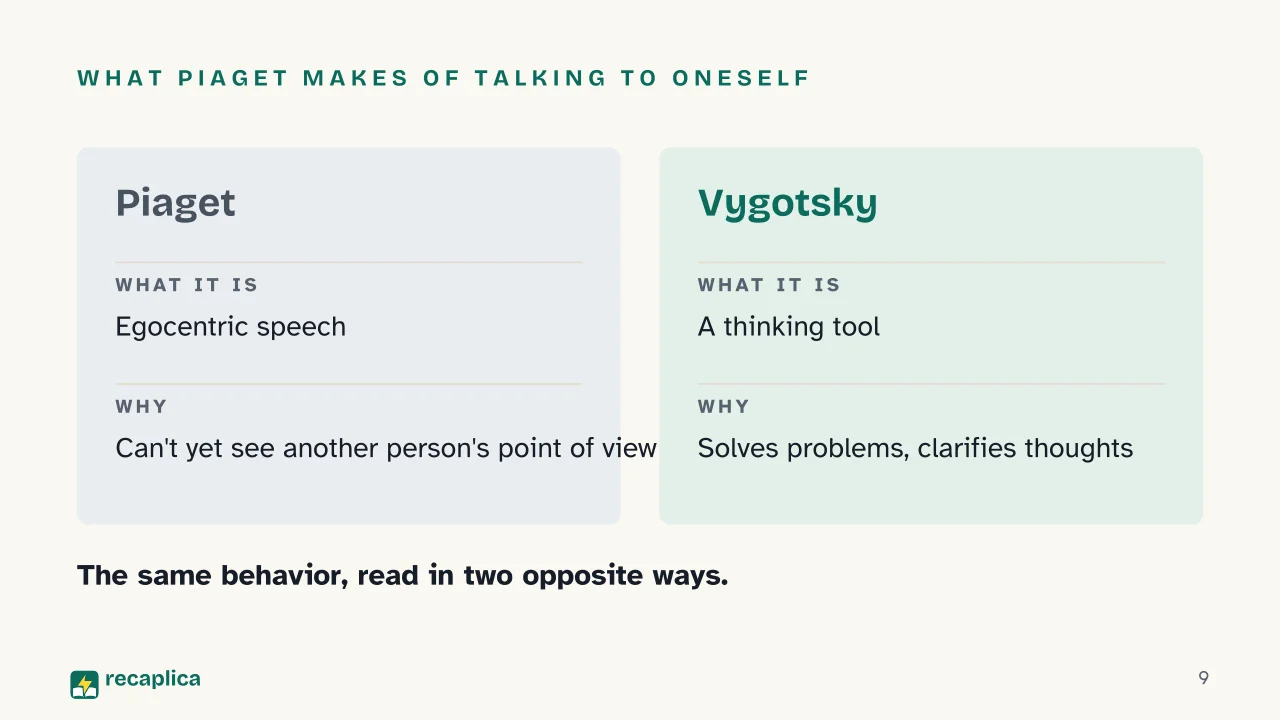  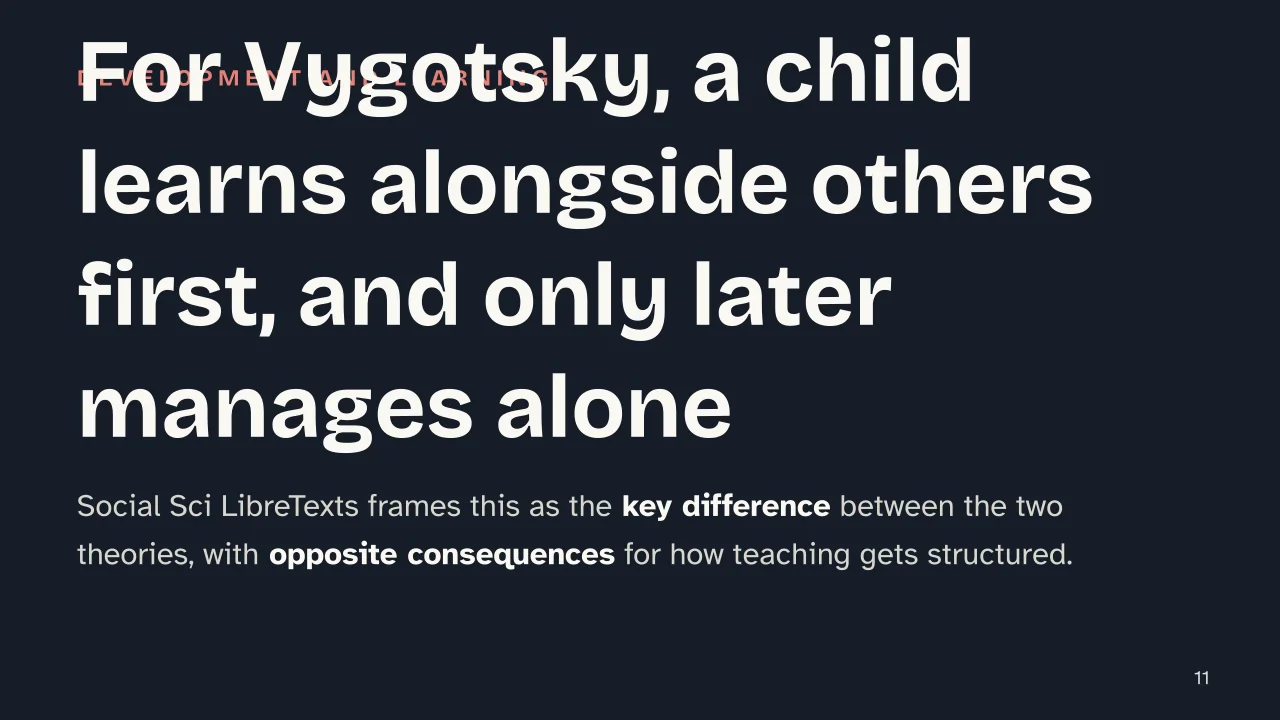 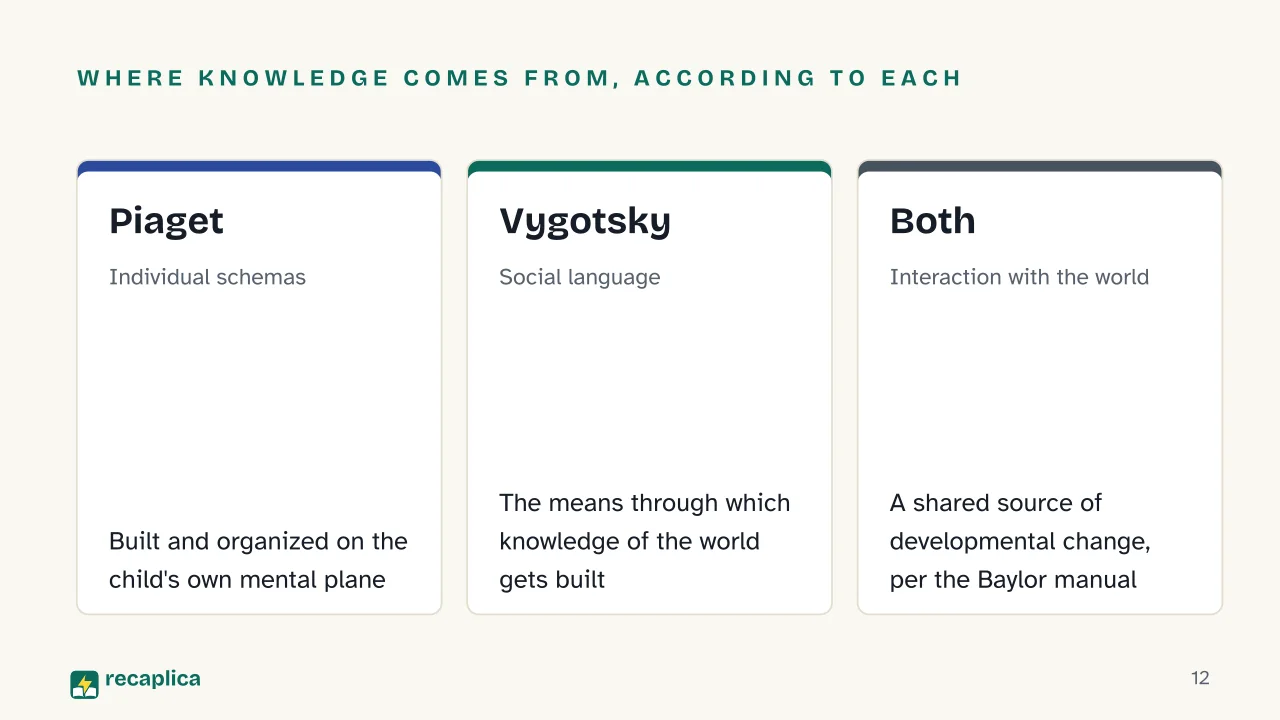   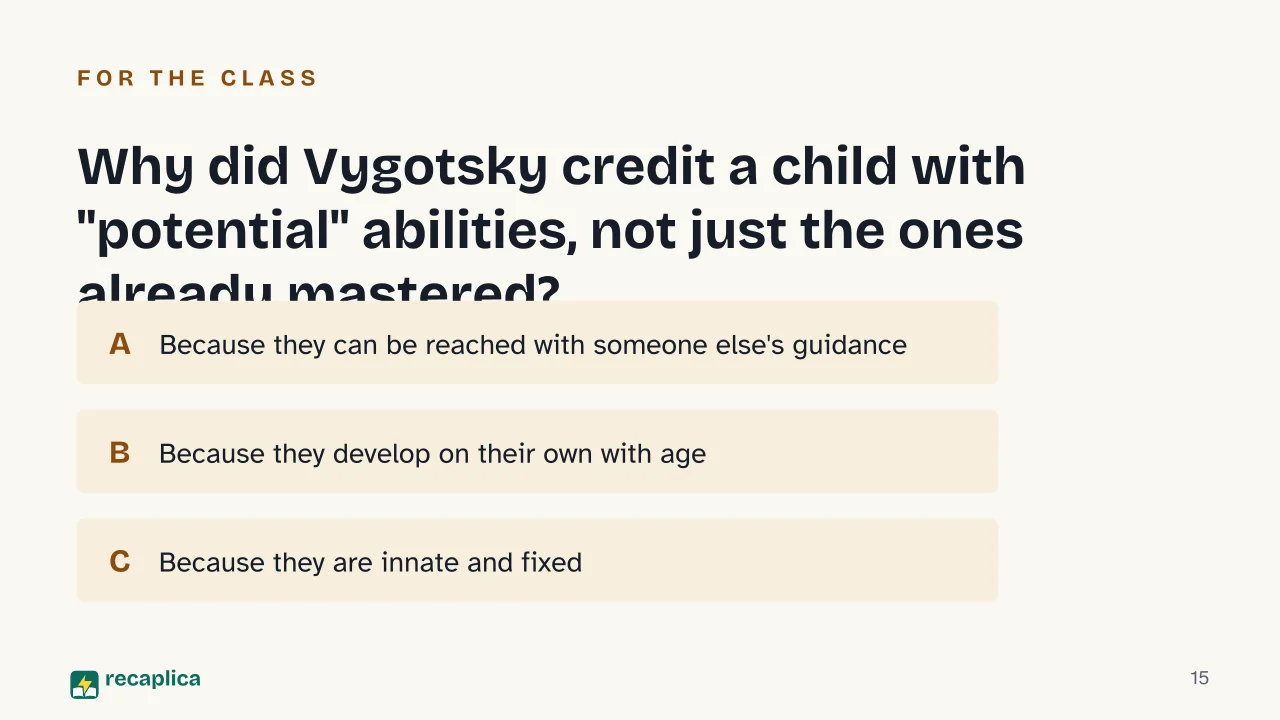  Common myths
Mind mapDrag the background to move around and the nodes to reposition them; use − and + to collapse and expand branches. 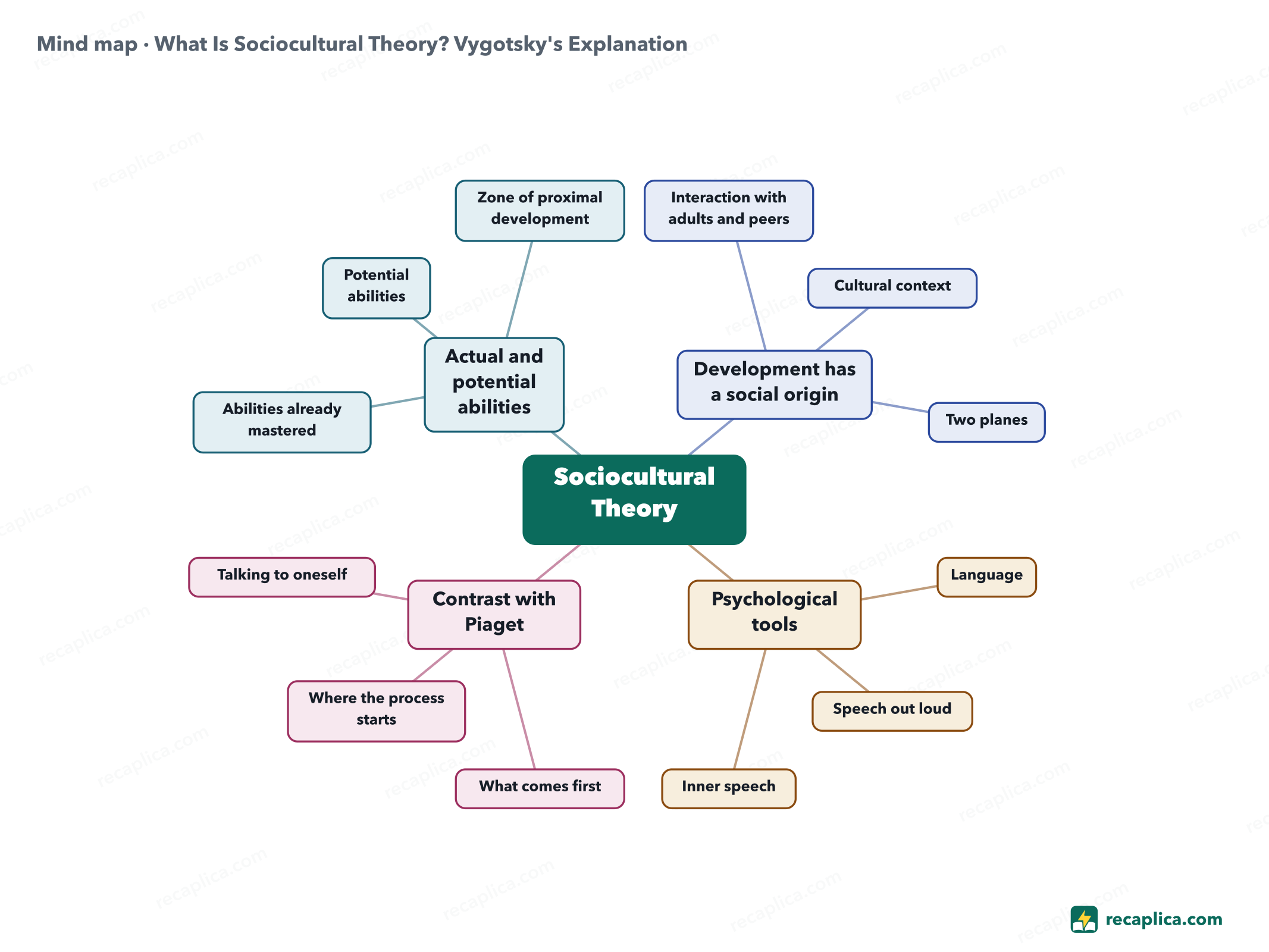
Quiz: test yourselfAnswer the questions to check what you have learned: you get instant feedback and a short explanation. Grade 0/10 0/5
FlashcardsTap the card to flip it and check whether you remember the answer, then move to the next one. 1 / 8 Explain it in your own wordsThe ultimate test: if you can explain it in simple words, you've truly understood it. Write your explanation, then compare it with the Recap. Your explanation is saved only on this device.
Frequently asked questionsWhat is sociocultural theory?It holds that a child's cognitive development grows out of interaction with adults and more skilled peers, inside a specific cultural context, rather than unfolding as an isolated process inside the child's own head (APA). How does Vygotsky's sociocultural theory differ from Piaget's?For Piaget, development is biologically fixed, starts within the individual and precedes learning; for Vygotsky, learning inside social interaction is what drives development, and language — not mental schemas built alone — is the means through which knowledge gets built. What role does language play in sociocultural theory?It is the chief psychological tool a child uses to engage with the world — spoken aloud at first, then internalized as thought (inner speech), according to the Baylor manual. What is the zone of proximal development in Vygotsky's theory?The most specific concept tied to Vygotsky's name, marking the gap between what a child can do alone and what they can do with help from an adult or a more skilled peer. It gets its own dedicated Recap. Who was Lev Vygotsky?A Russian psychologist working in the early twentieth century, credited by the Baylor manual as the source of modern social learning theories, developed in response to earlier, conflicting approaches in psychology. Every Recap goes through an independent review before publication. |