Skip to content
recaplica

    One moment: security check

    Cloudflare wants to make sure you're not a robot. Tick the box below and your search will continue on its own.

    IT
    recaplica Galvanic Cell: What It Is and How It Works
    © 2026 Recaplica · recaplica.com — All rights reserved
    Home › Science

    Galvanic Cell: What It Is and How It Works

    By Recaplica Newsroom · Updated on November 5, 2026

    What to print

    Page numbers appear when printing with default margins.

    Slides

    Choose a cut

    Flash10 slidesThe essential thread, to present in classFull15 slidesEvery chapter and the deeper detail

    Both come with speaker notes.

    Telegram channel
    recaplica Clear in 30 seconds, yours in 10 minutes.
    In 30 seconds Key points Figures Deep dive Slides Myths Mind map Quiz Flashcards FAQ

    In 30 seconds quick read

    A battery makes current because a chemical reaction runs by itself inside it, a type called redox. Alessandro Volta built the first electric battery by stacking different metals with something damp between them. The version taught in school, the galvanic cell, splits that reaction into two half-cells. Oxidation happens at the anode, reduction at the cathode, and the electrons travel through an outside wire. A salt bridge lets ions move between the half-cells, and the voltage you can measure depends on the potentials of the two electrodes.

    Key Points

    • A galvanic cell gets electrical energy from a spontaneous redox reaction carried out in two separate half-cells.
    • The anode is the electrode where oxidation takes place and the cathode is where reduction takes place, in every kind of cell.
    • In the outside circuit, electrons leave the anode and return through the cathode. That flow is the current.
    • The salt bridge connects the half-cells and lets ions move. The ions keep charge balanced, and the solutions stay apart.
    • The electromotive force is the maximum potential difference between the two electrodes. When it is positive, the cell reaction is spontaneous.
    • An electrolytic cell uses current from an outside source to force a non-spontaneous reaction, and the signs of its electrodes are reversed.

    Key figures

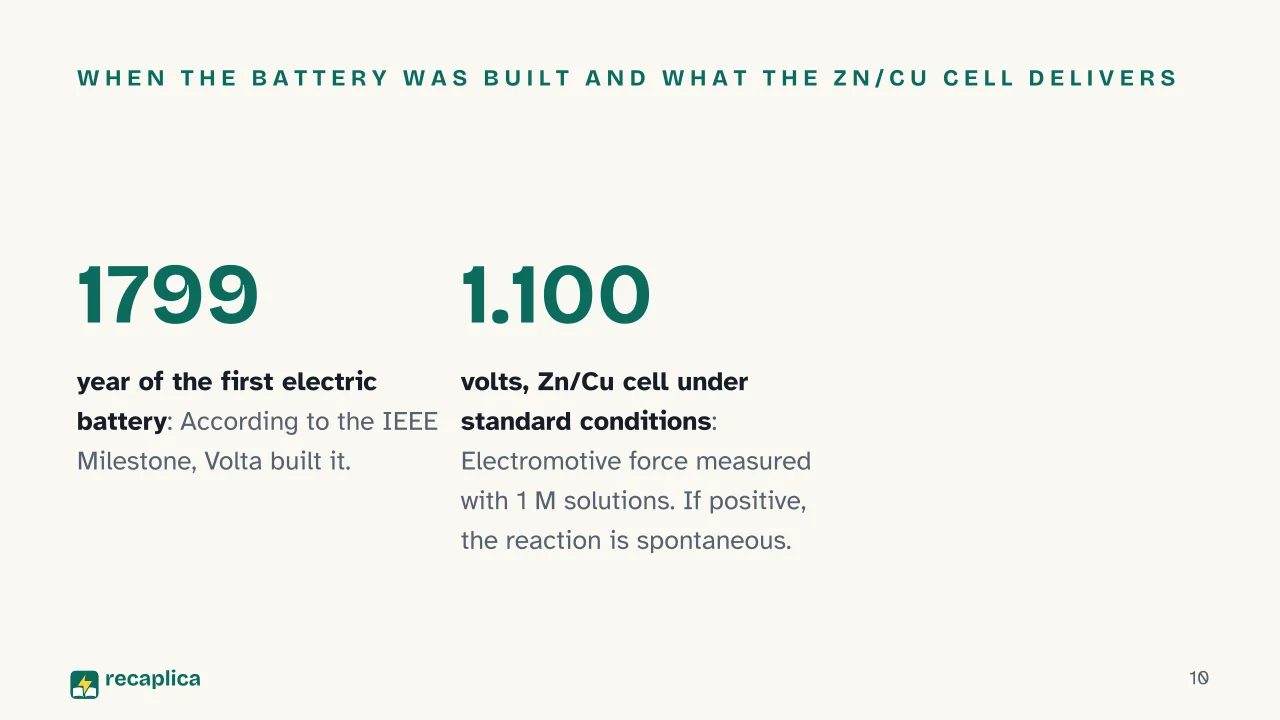
    • 1799 Year Volta built the first electric battery, according to the IEEE Milestone. Source: Engineering and Technology History Wiki (IEEE), Milestones
    • 1.100 V Measured electromotive force of the zinc/copper cell under standard conditions, meaning 1 M solutions. Source: Chemistry LibreTexts, Cell EMF

    Deep Dive

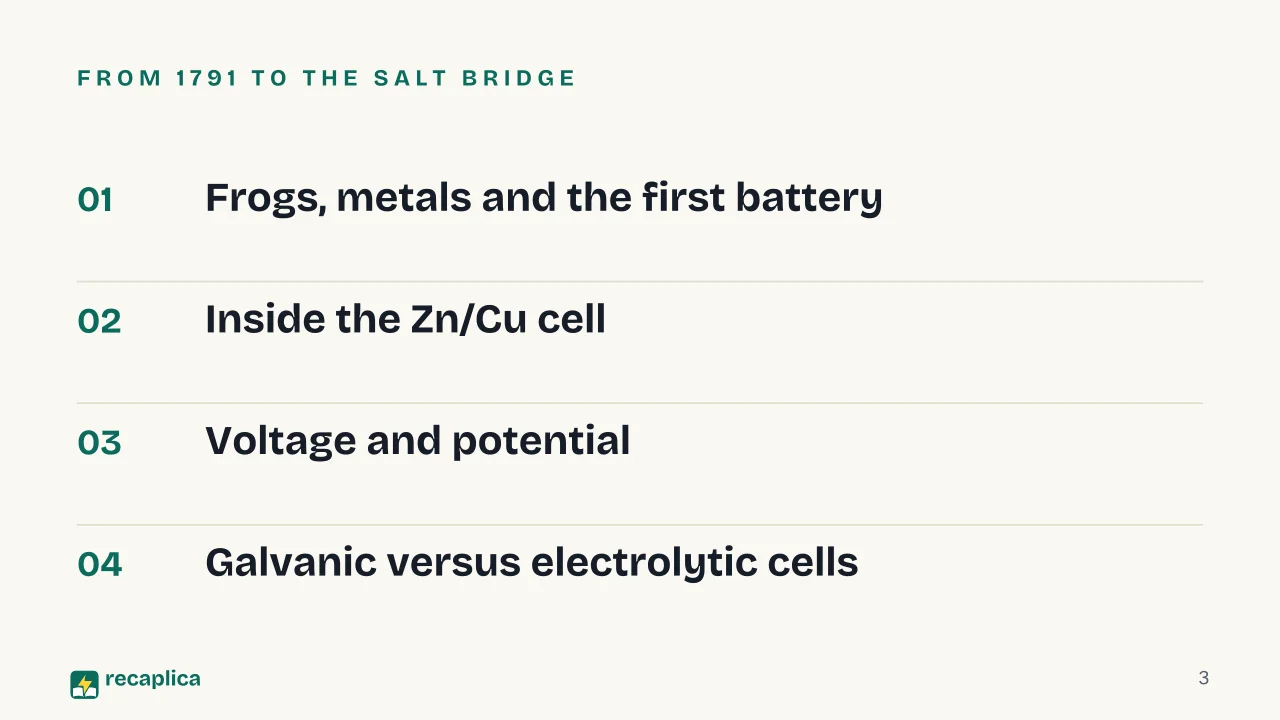
    From Galvani’s frogs to Volta’s pile

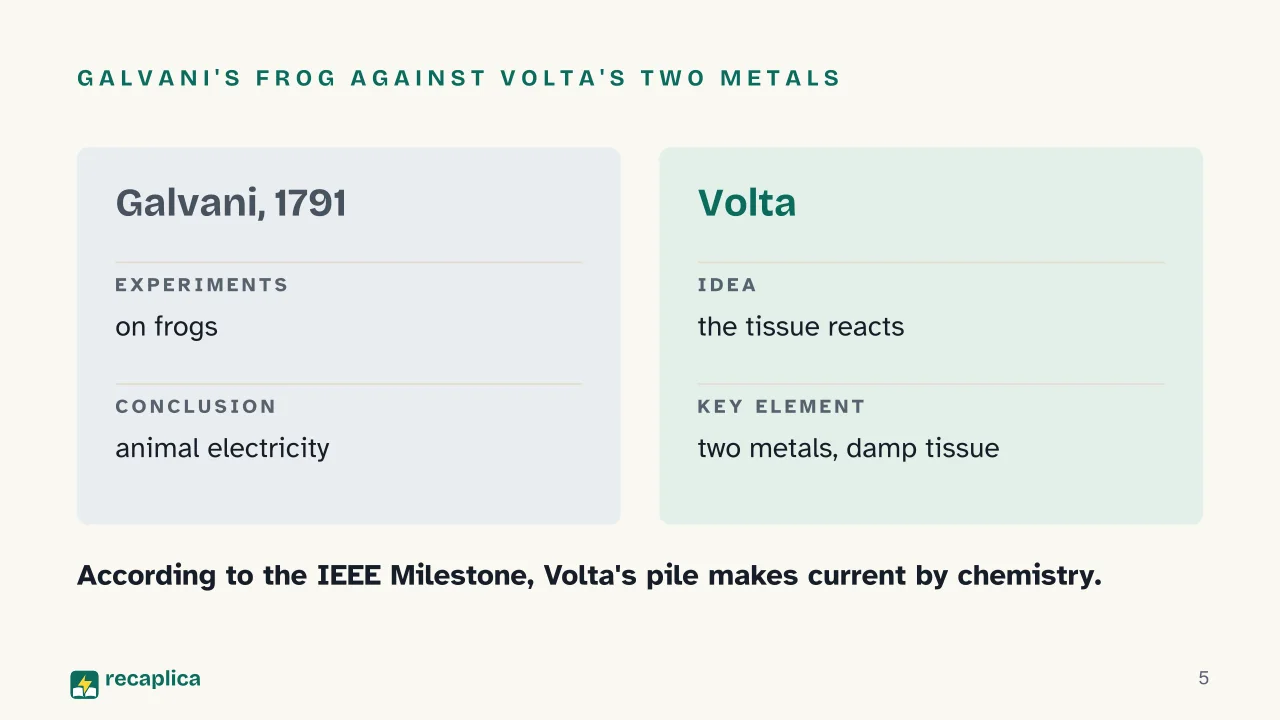
    In 1791 Galvani carried out his experiments on frogs and concluded that he had found a new kind of electricity, the animal kind. Volta, then a professor at Pavia, disagreed. He thought the tissue was reacting to electricity rather than making it, and that what mattered was the two different metals touching moist tissue.

    Volta found that two plates of different metals, such as copper and zinc, separated by a moistened material gave a small current. To multiply the effect he stacked metal discs, each pair separated by damp material, and an appreciable voltage appeared between the top and the bottom of the pile. His paper was read to the Royal Society in London in the spring of 1800 and published almost at once in its Transactions.

    Until then the electrostatic generator was the one reliable supply, and it gave mostly sparks.

    The IEEE Milestone credits Volta with building the first electric battery in 1799. He showed that electricity can be produced chemically and made to flow steadily around a closed circuit, as an electric current. According to the Linda Hall Library, the battery gave a continuous current, quickly and cheaply. The unit of electric potential, the volt, carries his name.

    What a galvanic cell is

    A galvanic cell, also called a voltaic cell (the two names are synonyms), produces electrical energy from a spontaneous redox reaction. The electron transfer takes place in two separate half-cells. Electrons freed by oxidation have to pass through a wire, the outside circuit, before reduction can take them up, and that passage is the current.

    Practical example: put zinc in a copper sulfate solution and within a short time it is coated with reddish-brown copper metal. That shows the reaction between Zn and Cu²⁺ is spontaneous. To get current, though, the zinc must stay away from the copper ions. If they touch, the electrons pass directly and the energy is lost without crossing the wire.

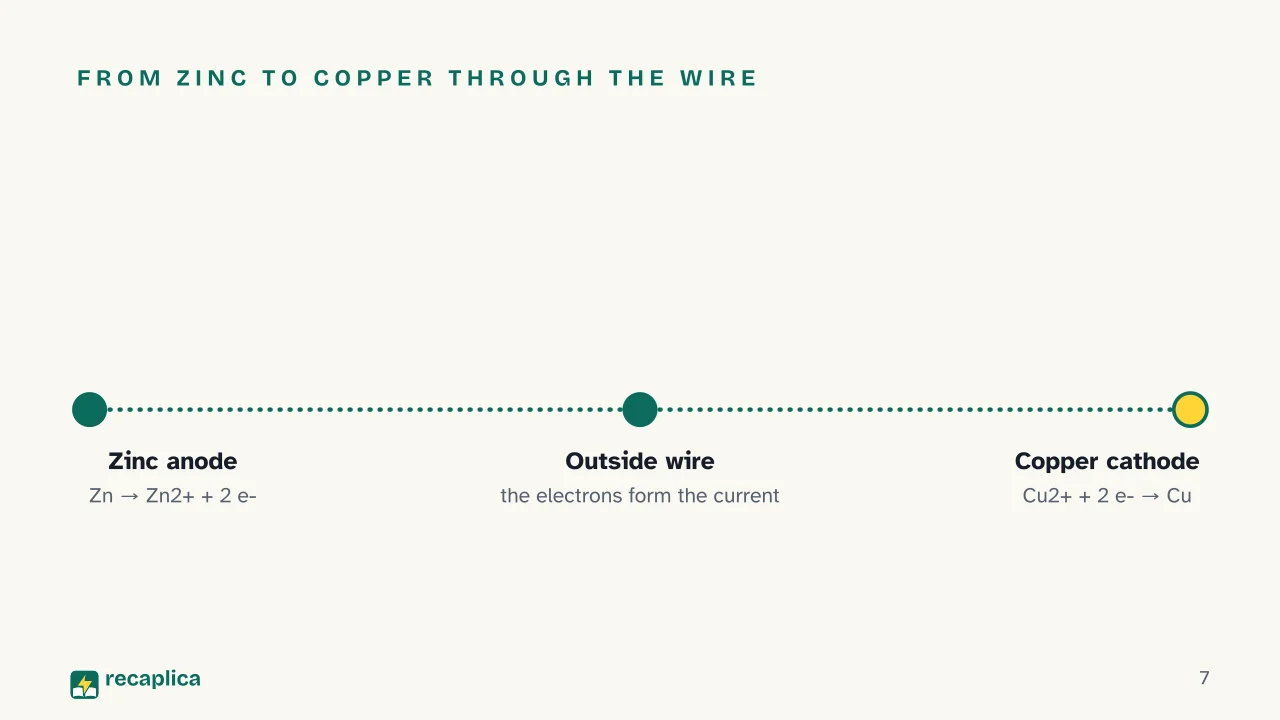
    The copper and zinc galvanic cell, built from two elements of the periodic table, works like this. Zinc is oxidized (Zn → Zn²⁺ + 2 e⁻) and reduction happens at the copper (Cu²⁺ + 2 e⁻ → Cu). For every mole of zinc oxidized, 2 moles of electrons pass to the copper ions, which become copper metal.

    Anode and cathode

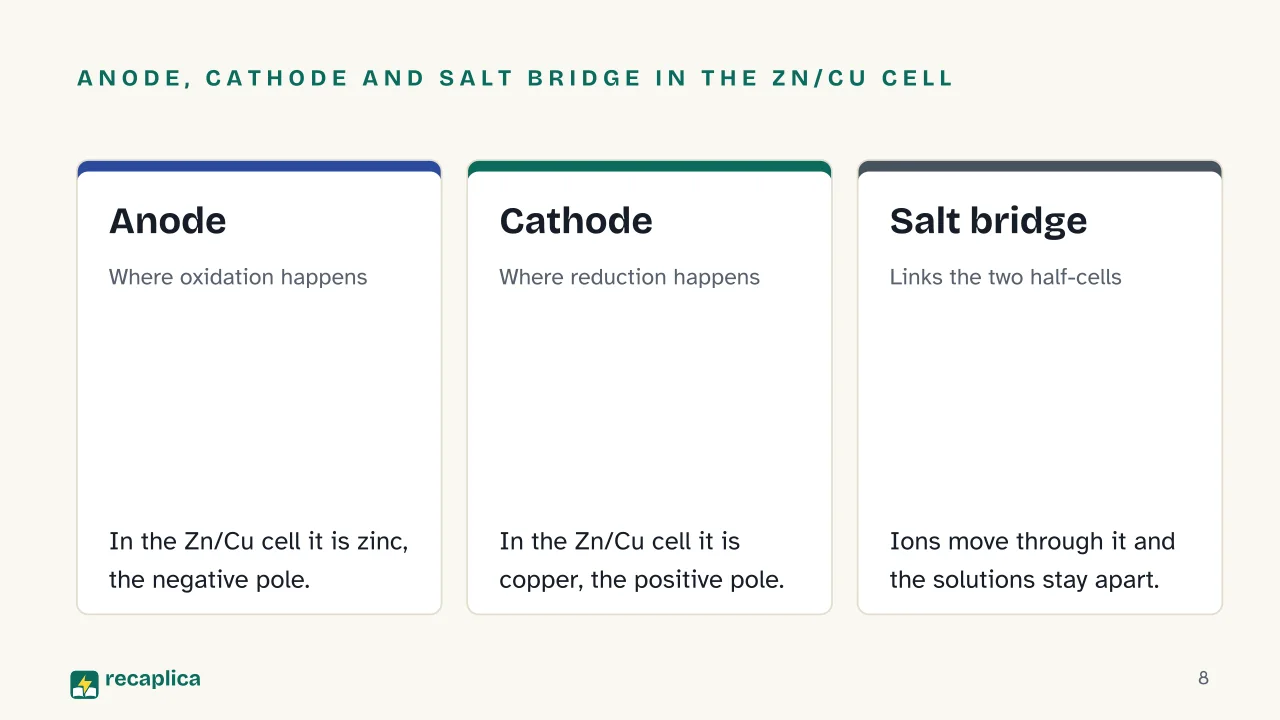
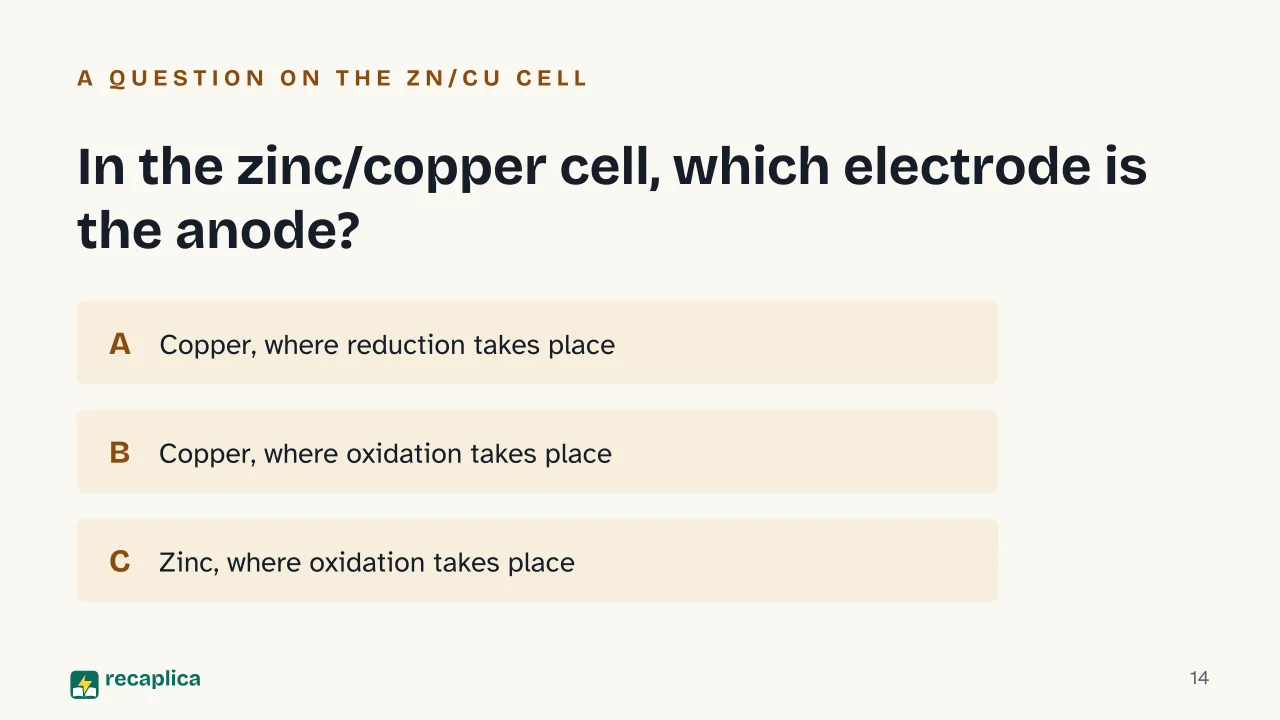
    The zinc electrode, where oxidation happens, is the anode. The copper electrode, where reduction happens, is the cathode. Electrons leave the anode for the outside circuit and come back in through the cathode.

    Both names come from what happens at the electrode. In a spontaneous cell the electrons from the anode make the terminal connected to it negative, so in a galvanic cell the anode is the negative pole and the cathode the positive one.

    Cell notation puts the anode on the left side of the salt bridge and the cathode on the right. In the short form, a double vertical bar stands for the salt bridge.

    The salt bridge

    In the original Daniell cell, a typical galvanic cell used to power telegraphs, the two solutions sit in separate layers: concentrated copper sulfate below, a less concentrated zinc sulfate above. In the laboratory version the two half-cells are joined by a salt bridge holding an electrolyte (KCl): current passes from one half-cell to the other and the contents stay separate.

    A galvanic cell needs this second connection, a salt bridge or a porous barrier, so that ions can move between compartments. It keeps the cell electrically neutral.

    Voltage and cell potential

    Practical example: put a voltmeter between the electrodes and the current is blocked, so a potential difference, a voltage, builds up across them.

    The largest potential difference that can be measured in a cell is called the electromotive force (EMF, symbol E). It is measured when a large resistance stops current from flowing, which is when the voltage is greatest. The Zn/Cu cell under standard conditions, with 1 M solutions, has a measured EMF of 1.100 V.

    EMFs add up. The potentials of single half-cells are tabulated as standard reduction potentials, referenced to the standard hydrogen electrode, whose potential is exactly zero by definition. In the ChemPRIME text, standard conditions are concentrations of 1 mol/dm³ and pressures of 1 atm (101.3 kPa). An oxidation potential is the opposite of the reduction potential.

    The sign of the EMF shows which way the reaction goes. A positive cell potential means a spontaneous reaction, and a negative one means the reverse reaction is the spontaneous one.

    Electrolytic vs galvanic cell

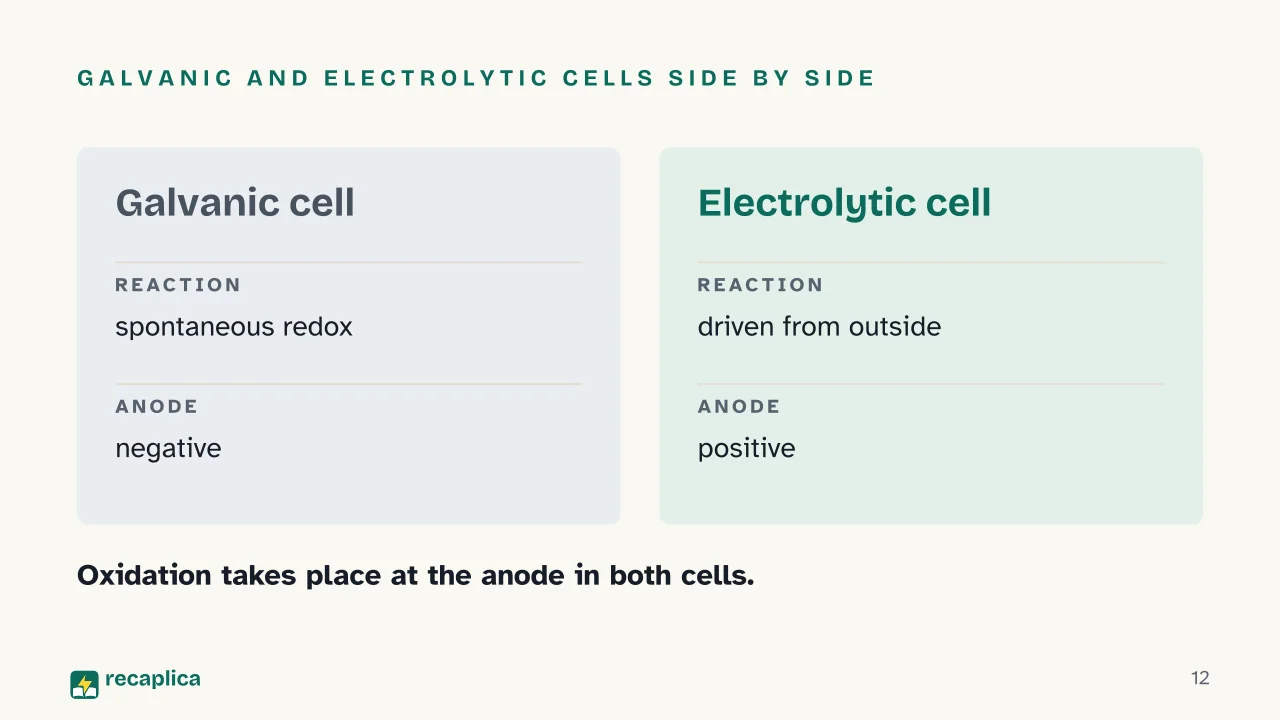
    A voltaic (galvanic) cell runs on a spontaneous chemical reaction, and that reaction sends current around the outside circuit. Electrolytic cells do work on the chemical system by passing current through it: an outside source imposes the potential difference and forces a non-spontaneous reaction, usually in a single compartment, with an outside battery supplying the electrons.

    Galvanic cellElectrolytic cell
    Electrical energyproducedconsumed
    Reactionspontaneous redoxnon-spontaneous, forced
    Electrons supplied byoxidation at the anodeoutside battery
    Anode (oxidation)negative polepositive pole
    Cathode (reduction)positive polenegative pole
    Compartmentstwo, with salt bridge or porous barrierusually one

    Slide deck

    Slides ready to download and make your own in PowerPoint or Google Slides, with speaker notes. Pick the Flash cut or the Full one.

    Slide 1 of the presentation on Galvanic Cell: Galvanic CellSlide 2 of the presentation on Galvanic Cell: How does a chemical reaction turn into current?Slide 3 of the presentation on Galvanic Cell: From 1791 to the salt bridgeSlide 4 of the presentation on Galvanic Cell: Chapter 01: Frogs, metals and the first batterySlide 5 of the presentation on Galvanic Cell: Galvani's frog against Volta's two metalsSlide 6 of the presentation on Galvanic Cell: Chapter 02: Inside the Zn/Cu cellSlide 7 of the presentation on Galvanic Cell: From zinc to copper through the wireSlide 8 of the presentation on Galvanic Cell: Anode, cathode and salt bridge in the Zn/Cu cell: Anode, Cathode, Salt bridgeSlide 9 of the presentation on Galvanic Cell: Chapter 03: Voltage and potentialSlide 10 of the presentation on Galvanic Cell: When the battery was built and what the Zn/Cu cell deliversSlide 11 of the presentation on Galvanic Cell: Chapter 04: Galvanic versus electrolytic cellsSlide 12 of the presentation on Galvanic Cell: Galvanic and electrolytic cells side by sideSlide 13 of the presentation on Galvanic Cell: Electrons travel through the outside wire.Slide 14 of the presentation on Galvanic Cell: In the zinc/copper cell, which electrode is the anode?Slide 15 of the presentation on Galvanic Cell: The full review is online
    Flash10 slidesThe essential thread, to present in classFull15 slidesEvery chapter and the deeper detail

    Common myths

    • ✗ Myth The electricity in a battery comes from living things, as Galvani believed with his frogs.

      ✓ Reality Galvani concluded that he had found animal electricity. Volta suggested that the key element was two different metals touching moist tissue. Volta's pile works with no animal at all, and the IEEE Milestone says its current comes from chemistry.

    • ✗ Myth The cathode is always the positive pole and the anode the negative one.

      ✓ Reality Anode and cathode are defined by the process at each electrode, oxidation at the anode and reduction at the cathode. The charge depends on the type of cell. In a galvanic cell the anode is negative and the cathode positive. In an electrolytic cell the signs swap while the roles stay the same.

    • ✗ Myth Electrons cross the salt bridge to complete the circuit.

      ✓ Reality Electrons travel through the outside wire, from anode to cathode. Ions are what move through the salt bridge, keeping the two half-cells electrically neutral and letting current pass from one to the other while the contents stay separate.

    Mind map

    Drag the background to move around and the nodes to reposition them; use − and + to collapse and expand branches.
    Customize
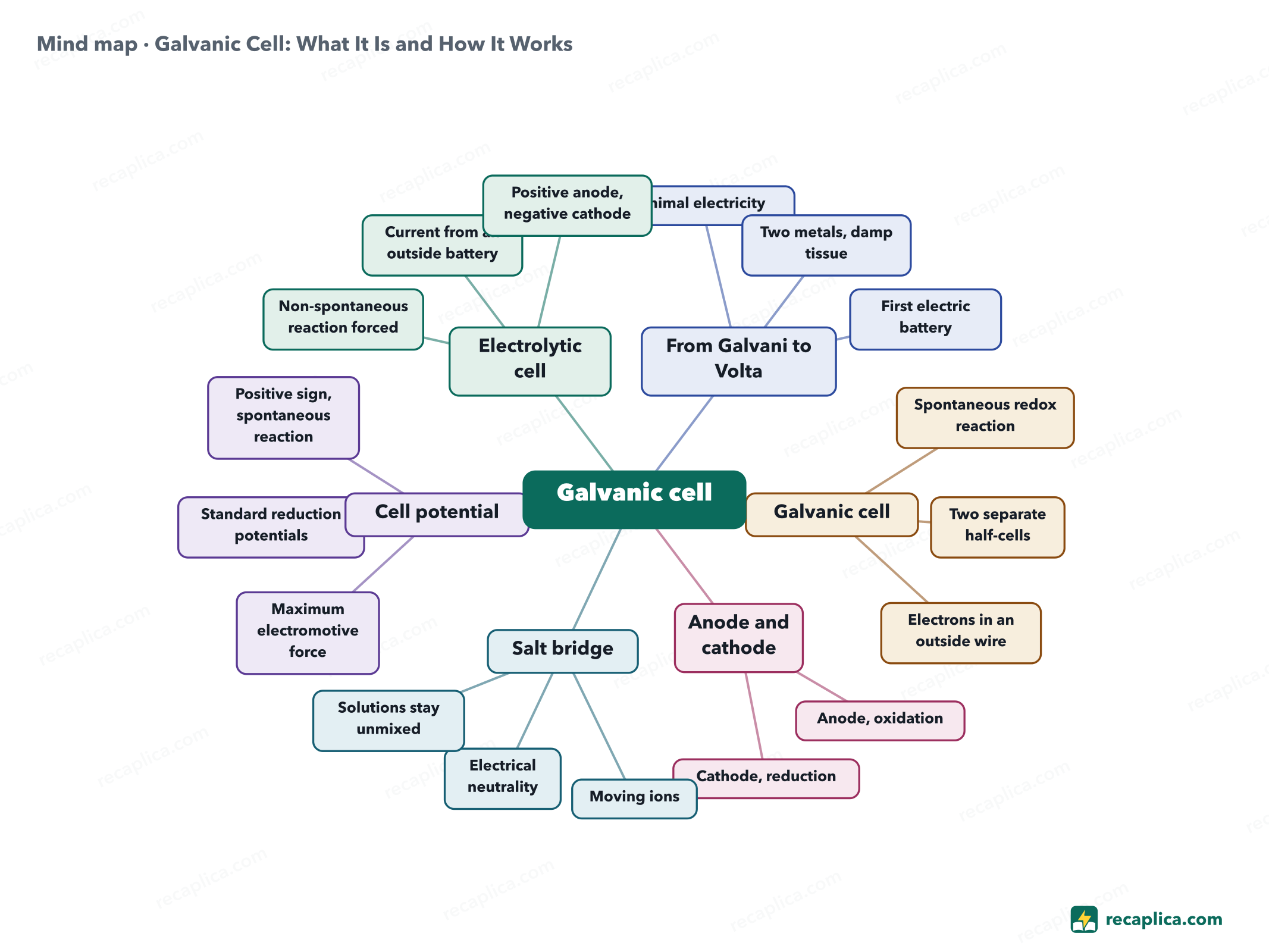
    Mind map: Galvanic Cell: What It Is and How It Works
    • Galvanic cell
      • From Galvani to Volta
        • Animal electricity Galvani, frogs, 1791
        • Two metals, damp tissue Volta's hypothesis
        • First electric battery 1799, per the IEEE
      • Galvanic cell
        • Spontaneous redox reaction
        • Two separate half-cells
        • Electrons in an outside wire That flow is the current
      • Anode and cathode
        • Anode, oxidation Negative in a galvanic cell, zinc in Zn/Cu
        • Cathode, reduction Positive in a galvanic cell, copper in Zn/Cu
      • Salt bridge
        • Moving ions
        • Electrical neutrality
        • Solutions stay unmixed
      • Cell potential
        • Maximum electromotive force Measured with no current flowing
        • Standard reduction potentials Referenced to the hydrogen electrode
        • Positive sign, spontaneous reaction
      • Electrolytic cell
        • Non-spontaneous reaction forced
        • Current from an outside battery
        • Positive anode, negative cathode

    Quiz: test yourself

    Answer the questions to check what you have learned: you get instant feedback and a short explanation.

    Grade 0/10 0/5
    1 What makes a galvanic cell work?

    A galvanic cell uses a reaction that happens on its own and sends the electrons through an outside wire. The outside source belongs to the electrolytic cell, and direct contact between zinc and copper ions would waste the energy.

    2 In the zinc/copper cell, which electrode is the anode?

    Zinc is oxidized (Zn → Zn2+ + 2 e-), so it is the anode. At the copper, Cu2+ ions are reduced to copper metal, which makes copper the cathode.

    3 What is the job of the salt bridge?

    Electrons travel only in the outside circuit. The bridge, or a porous barrier, lets ions pass from one compartment to the other and keeps the cell electrically neutral. The solutions stay separate.

    4 In an electrolytic cell, what sign does the anode have and what happens there?

    Oxidation always happens at the anode, so its role is the same. The charges on the electrodes are reversed, and an outside battery supplies the electrons.

    5 What does a positive electromotive force tell you?

    A positive cell potential goes with a reaction that is spontaneous in the direction it is written. With a negative potential, the reverse reaction is the spontaneous one.

    Answers: 1-A · 2-C · 3-C · 4-B · 5-B

    Flashcards

    Tap the card to flip it and check whether you remember the answer, then move to the next one.

    1 / 7

    Explain it in your own words

    The ultimate test: if you can explain it in simple words, you've truly understood it. Write your explanation, then compare it with the Recap.

    Your explanation is saved only on this device.

    A battery makes current because a chemical reaction runs by itself inside it, a type called redox. Alessandro Volta built the first electric battery by stacking different metals with something damp between them. The version taught in school, the galvanic cell, splits that reaction into two half-cells. Oxidation happens at the anode, reduction at the cathode, and the electrons travel through an outside wire. A salt bridge lets ions move between the half-cells, and the voltage you can measure depends on the potentials of the two electrodes.

    Frequently asked questions

    How does Volta's pile work?

    The pile is a stack of discs of different metals, such as copper and zinc, with something moistened between one pair and the next. Volta found that two different metals separated by a damp material give a small current, and stacking many pairs produced a usable voltage between the top and the bottom.

    What is the difference between a galvanic cell and an electrolytic cell?

    A galvanic cell produces current from a spontaneous reaction. An electrolytic cell uses current to force a reaction that would not happen alone. The electrode roles hold in both. The signs differ, with a negative anode in the galvanic cell and a positive one in the electrolytic cell, and an electrolytic cell usually has a single compartment.

    What is a copper and zinc galvanic cell?

    It is the standard example. Zinc is oxidized at the anode (Zn → Zn2+ + 2 e-) and Cu2+ is reduced at the copper cathode (Cu2+ + 2 e- → Cu). With 1 M solutions under standard conditions its measured electromotive force is 1.100 V. The Daniell cell is a typical version of this zinc/copper design.

    What does the salt bridge do?

    It connects the two half-cells and lets ions move between them, so electrical neutrality is kept. It holds an electrolyte, often potassium chloride (KCl) in laboratory versions, and lets current pass; the solutions stay separate.

    Are a galvanic cell and a voltaic cell the same thing?

    Yes, the two names are synonyms for a cell in which a spontaneous reaction drives the current in the outside circuit.

    Sources

    • ChemPRIME (Moore et al.), 17.8 Galvanic Cells, Chemistry LibreTexts
    • ChemPRIME (Moore et al.), 17.9 Cell Notation and Conventions, Chemistry LibreTexts
    • ChemPRIME (Moore et al.), 17.10 Electromotive Force of Galvanic Cells, Chemistry LibreTexts
    • Cell EMF, Chemistry LibreTexts (Analytical Chemistry, Basics of Electrochemistry)
    • Electrolytic Cells, Chemistry LibreTexts (Analytical Chemistry, Electrochemistry)
    • Milestones, Volta's Electrical Battery Invention, 1799, Engineering and Technology History Wiki (IEEE)
    • Scientist of the Day, Alessandro Volta, Linda Hall Library

    Every Recap goes through an independent review before publication.

    Every evening, the day's new Recaps on our Telegram channel. Join the channel →

    Keep learning

    • Science Balancing Redox Reactions: Half-Reaction and Oxidation Number Methods A redox reaction is balanced when every element has the same number of atoms on both sides and the total charge is the same too. There are two routes. With the half-reaction method you write oxidation and reduction separately, add water, H⁺ and electrons, and then add the two halves together. With the oxidation number method you look at how much each element's number rises and falls, and pick coefficients that make the total rise equal the total fall. In basic solution you start as in acid, and at the end the H⁺ ions are turned into water with OH⁻. Read the Recap →
    • Science Brønsted-Lowry theory: definition of acids, bases and conjugate pairs In 1923 Johannes Brønsted and Thomas Lowry, working independently, defined an acid as a species that gives away a proton and a base as a species that takes one in. An acid-base reaction is therefore a transfer of a proton, and every transfer produces two conjugate pairs. Water can act as either an acid or a base, and ammonia is a base even though its formula has no OH-. The theory generalizes Arrhenius's, which holds only for water solutions. Read the Recap →
    • Science Chemical Equilibrium: Definition, the Constant K and the Reaction Quotient Q A reversible reaction can run in either direction, and in a closed system it reaches a point where the amounts of reactants and products stop changing. At that point the forward and reverse reactions keep going at the same rate. The equilibrium constant K depends on temperature. Comparing the reaction quotient Q with K shows which way the reaction is heading. An ICE table handles the calculations. Read the Recap →

    recaplica

    Clear in 30 seconds, yours in 10 minutes.

    Recaps Mind maps Request a Recap Telegram channel Mind map maker Our method About Privacy & cookies Legal notes & terms of use

    © 2026 Recaplica · A project by Curi S.r.l. — VAT IT05472000750

    Statistics, only if you say so

    To learn which Recaps help most we would use Google Analytics, with aggregate, anonymous data. It starts only with your OK, and you can change your mind anytime. Privacy policy