|
recaplica
How to Study Effectively: What Cognitive Science Says Really Works | ||||||||||||||||||||||||||||||
| © 2026 Recaplica · recaplica.com — All rights reserved | ||||||||||||||||||||||||||||||
How to Study Effectively: What Cognitive Science Says Really WorksWhat to print Page numbers appear when printing with default margins. SlidesChoose a cut Flash10 slidesThe essential thread, to present in classFull14 slidesEvery chapter and the deeper detailBoth come with speaker notes. In 30 seconds quick readNot every study method works equally well. A widely cited review of the research compared ten common study techniques and found huge gaps between them. Active recall, testing yourself instead of rereading, and spaced repetition, spreading study sessions out over time, come out with the strongest evidence behind them. Highlighting, rereading and summarizing without training remain the habits most students actually use, but the ones the evidence supports the least. Knowing the difference means studying smarter, not longer. Key Points
Key figures
Deep DiveMany students never really choose a study method: they just repeat whatever they’ve always done, usually rereading notes or a textbook, maybe with a few lines highlighted along the way. The problem is that the most common techniques aren’t the ones the evidence favors. A review of the research on learning compared ten common study techniques, rating each one by the strength of the experimental evidence behind it, and the result is a clear hierarchy: two techniques outperform everything else, while several widely used habits deliver less than they seem to. According to figures reported by the review’s author, roughly 84 out of 100 students say they study by rereading their notes or textbook: it’s the most popular technique, but not the one with the best evidence. Active recall: the technique with the strongest evidenceActive recall (also called retrieval practice) means trying to pull a piece of information out of memory, for example by answering a question about material you just studied, instead of reading it over again. The first experimental evidence for it dates back to 1909, when a doctoral student at the University of Illinois showed that practice tests improve student performance. Research has kept confirming it since then, including among college students who report using practice tests to prepare for exams. The proposed mechanism is straightforward: correctly retrieving an answer from memory can strengthen that memory. Simply being exposed to information again, the way rereading does, isn’t enough; the retrieval itself has to take effort. Human memory doesn’t behave like a storage drawer that returns the same thing every time you open it: it gets stronger precisely when it’s put under strain, which is a different mechanism from how an artificial intelligence system processes and returns the information it has been given. Spaced repetition: the same hours, arranged betterSpaced repetition (distributed practice) means scheduling study sessions across time instead of packing them all in right before a deadline. This technique is also rated high utility in the review, with benefits observed across students of different ages and levels.
The mechanism behind this gap is almost counterintuitive: learning that comes easily is also easy to lose. Reviewing material that’s still fresh takes little effort, and that’s exactly why it leaves a weak trace; returning to the same topic once it has started to fade forces a harder retrieval, and a harder retrieval sticks longer. There’s no fixed “optimal” gap to aim for; the most common practical advice is simply to leave enough time that the material isn’t still fresh when you come back to it, even a few minutes for very simple content. Interleaved practice and self-explanation: moderate evidence, real gainsInterleaved practice means mixing different topics or problem types within the same session instead of sticking with one for a long stretch: mixing geometry and algebra problems, say, or switching between verb tenses in a foreign language instead of running through dozens of identical drills in a row. Anyone preparing for a university entrance exam finds a natural ally here: mixing subjects within a session reproduces the real conditions of a test, where questions don’t arrive sorted by topic the way they do in a workbook. Self-explanation, on the other hand, is the habit of explaining, in your own words, how a new piece of information connects to what you already know, or the steps you took to solve a problem, instead of just reading through an explanation already written in a book or given in class. In one experiment cited by the review, students who explained the steps to themselves scored around 90 percent on a final test, against under 30 percent for students who hadn’t; a stark gap, though the source consulted for this Recap doesn’t report the exact number of participants or the year of that specific study. A related technique, elaborative interrogation, simply asks you to wonder why a fact is true and try to answer it yourself: it works best when you already have some background knowledge on the topic, while starting from zero makes it hard to build a sensible explanation. Highlighting, rereading, summarizing: popular, but underwhelmingHighlighting and underlining text while reading is probably the most deeply ingrained habit among students, yet the review rates it low utility: in some experiments, students who highlighted scored worse on comprehension tests than students who read the same material without marking anything. Rereading notes or a textbook, as already noted, doesn’t guarantee deeper understanding, and whatever benefit it offers doesn’t last. Summarizing a text can work, but only with substantial training: in one study Dunlosky cites, teachers received 90 minutes of instruction on how to teach the technique, and in another, students themselves went through five roughly 50-minute coaching sessions; without that groundwork, a summary risks becoming more of a transcription exercise than an act of understanding. Image-based mnemonics, finally, pair words with mental images: they give a real boost, but often a short-lived one, and they struggle on school material that isn’t naturally visual.
What to change todayThe first, almost obvious takeaway from this hierarchy is to swap rereading for self-testing wherever you can. Closing the book and trying to answer questions about what you just read, even questions you wrote yourself, sets active recall in motion. The second is building a calendar that breaks studying into several spaced-out sessions instead of one long push the night before a test. One practical point that’s often overlooked concerns interruptions during the study session itself. Every notification that breaks an attempt at active recall forces you to start over almost from scratch, because the thread of reasoning you were trying to rebuild from memory gets lost. Does the best study method change at university?The techniques stay the same in high school and at university: the review behind this Recap measured active recall and spaced repetition across students of very different ages and fields, from high schoolers to college students. What changes is mostly the sheer volume of material to cover in a semester, which makes planning reviews weeks in advance even more valuable than cramming them into the days right before an exam. The school calendar itself isn’t the same everywhere: anyone comparing when the school year starts across European countries will notice the opening dates and breaks differ, but not the study techniques that work once classes are underway. A structured summary as a practical applicationThe two techniques with the strongest evidence, active recall and spaced repetition, map neatly onto one simple tool: a summary structured around key points, followed by a self-test quiz and a few flashcards, revisited a few days later rather than once, right after reading. The quiz forces you to retrieve information from memory instead of rereading it, the flashcards do the same in a faster, more repeatable format, and simply reopening the same material after a few days, instead of the same evening, adds exactly the kind of time gap the research links to a sturdier memory. Slide deckSlides ready to download and make your own in PowerPoint or Google Slides, with speaker notes. Pick the Flash cut or the Full one.     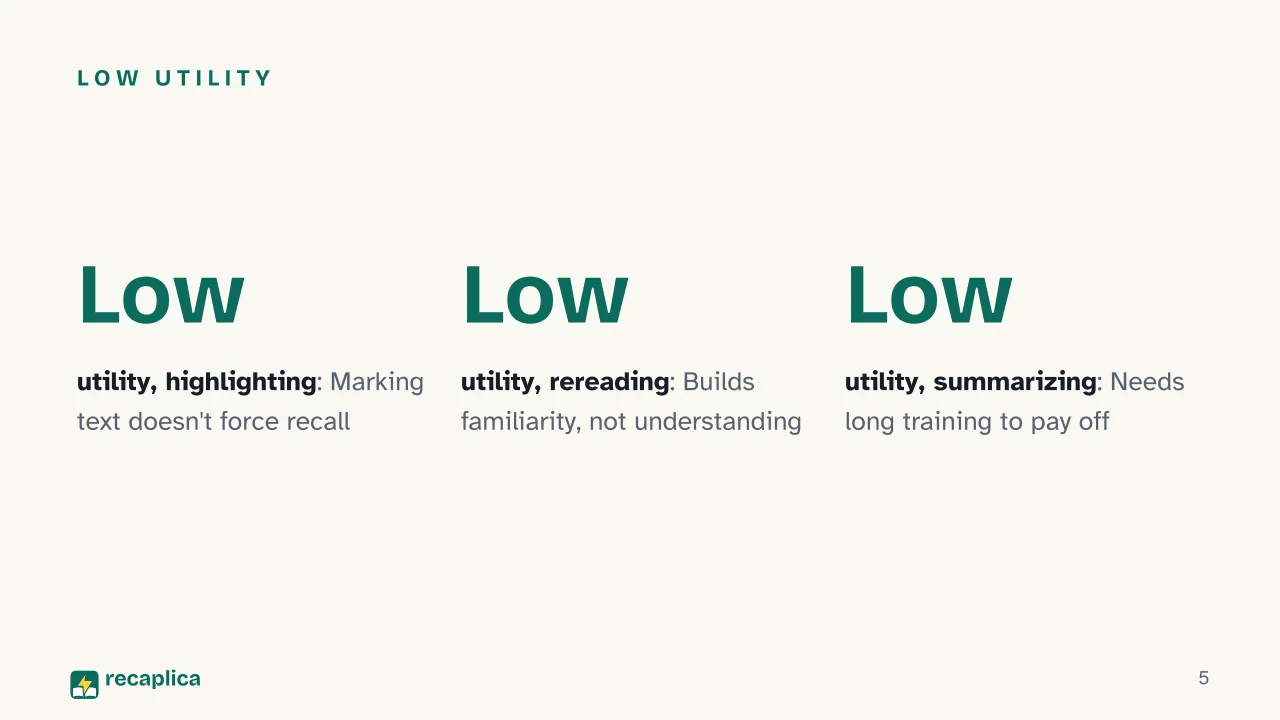  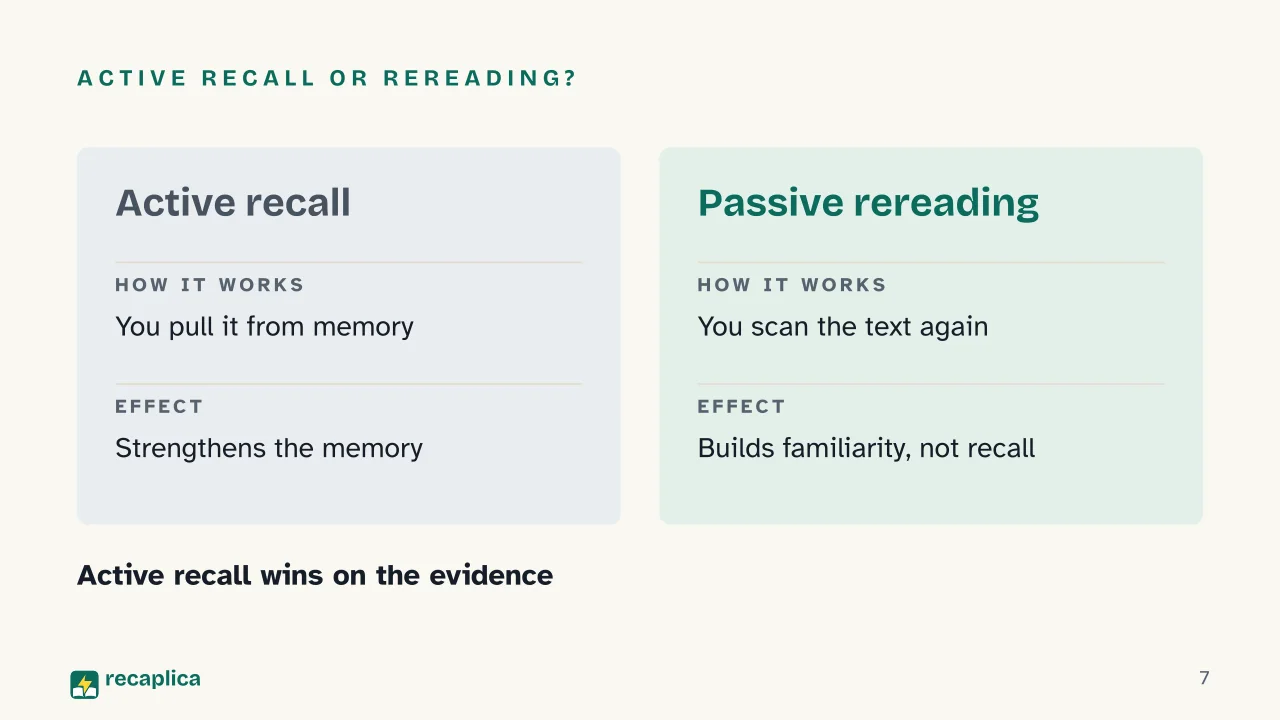  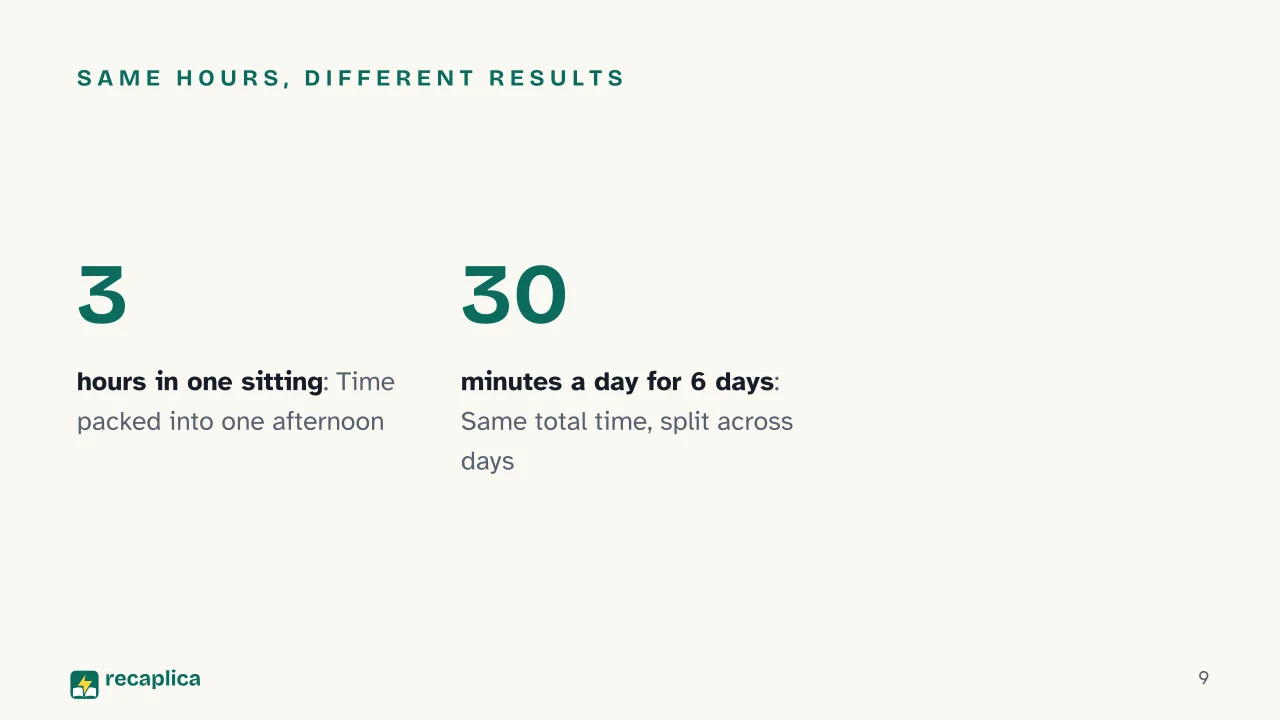   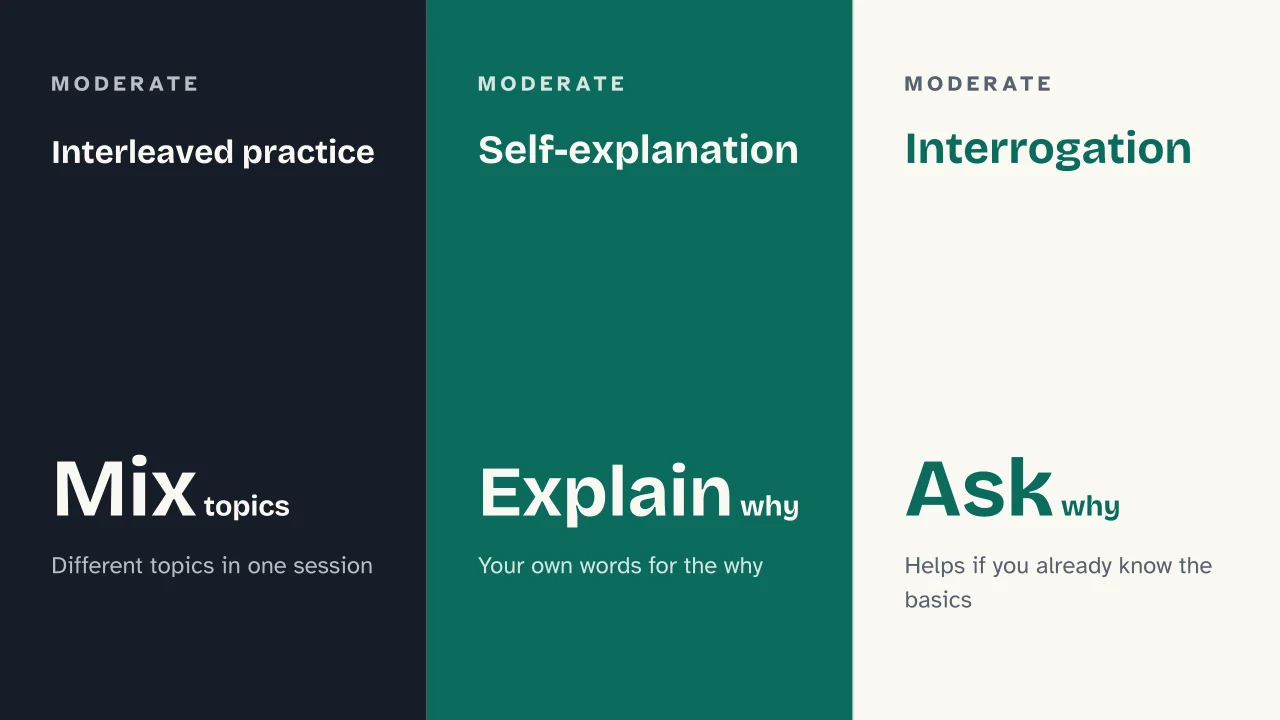 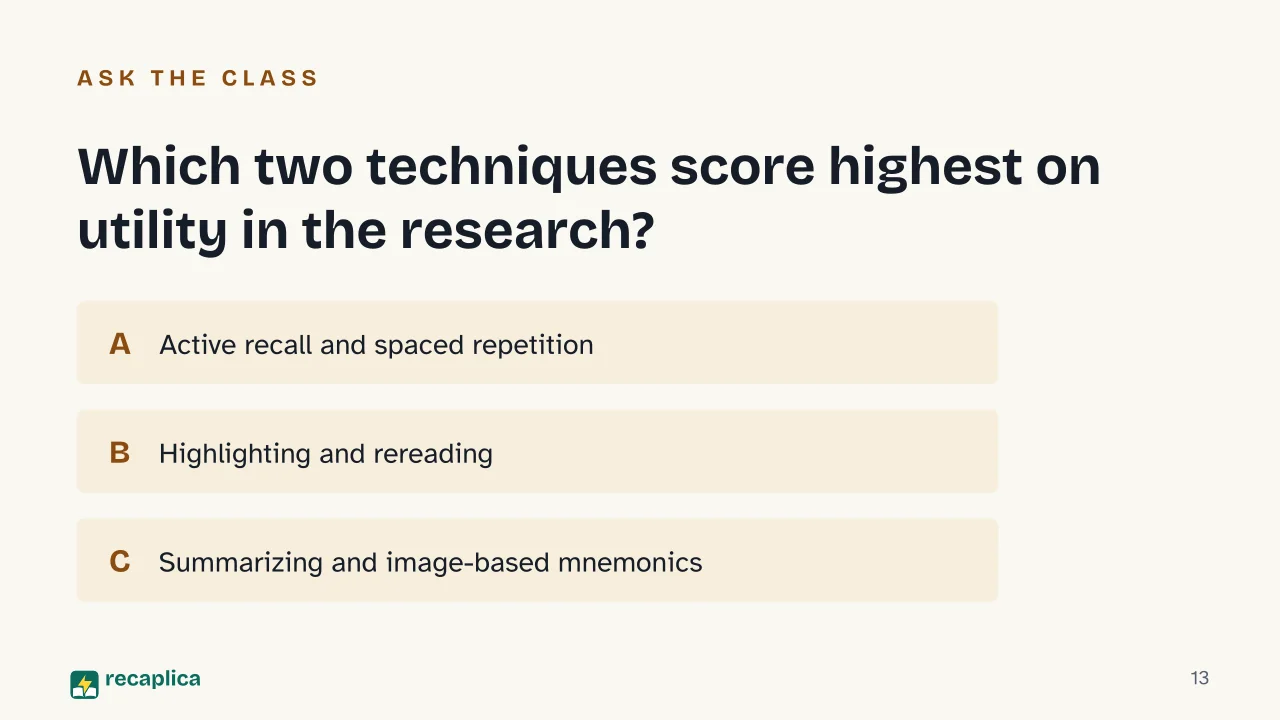  Common myths
Mind mapDrag the background to move around and the nodes to reposition them; use − and + to collapse and expand branches. 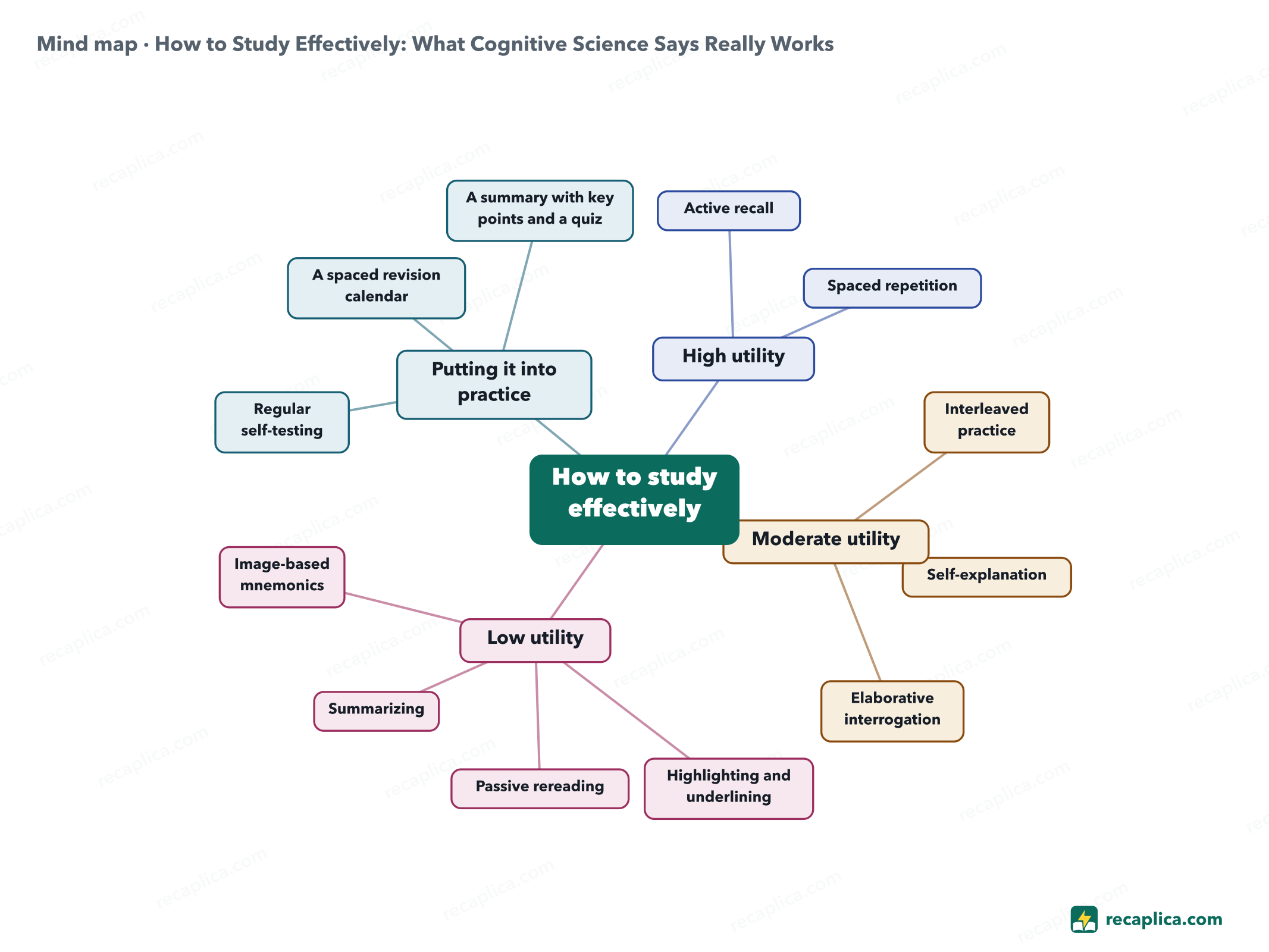
Quiz: test yourselfAnswer the questions to check what you have learned: you get instant feedback and a short explanation. Grade 0/10 0/5
FlashcardsTap the card to flip it and check whether you remember the answer, then move to the next one. 1 / 8 Explain it in your own wordsThe ultimate test: if you can explain it in simple words, you've truly understood it. Write your explanation, then compare it with the Recap. Your explanation is saved only on this device.
Frequently asked questionsWhat are the most effective study methods according to research?The two techniques with the strongest experimental support are active recall, testing yourself instead of rereading, and spaced repetition, studying across several days instead of one long sitting. Interleaved practice and self-explanation follow with moderate evidence behind them. How do I study effectively beyond just the basics?Beyond active recall and spaced repetition, it helps to mix different topics within a session (interleaved practice) and to explain steps of a problem in your own words (self-explanation). Highlighting, underlining and summarizing without training remain popular but underwhelming choices, even though most students rely on them. Is the best study method different at university than in high school?The techniques stay the same: active recall and spaced repetition work regardless of level, and the review behind this Recap measured them across students of different ages and fields. What changes is the sheer amount of material to cover, which makes spreading sessions out over time even more valuable than cramming everything before an exam. Why does rereading notes feel like it works, even when the memory doesn't stick?Rereading creates a sense of familiarity with the text that's easy to mistake for understanding. The experiments Dunlosky cites show that any benefit from rereading, when it exists, doesn't last: the material feels familiar, but it was never actually retrieved from memory. Every Recap goes through an independent review before publication. |