recaplica
Clear in 30 seconds, yours in 10 minutes.
In 30 seconds quick read
A redox reaction is balanced when every element has the same number of atoms on both sides and the total charge is the same too. There are two routes. With the half-reaction method you write oxidation and reduction separately, add water, H⁺ and electrons, and then add the two halves together. With the oxidation number method you look at how much each element's number rises and falls, and pick coefficients that make the total rise equal the total fall. In basic solution you start as in acid, and at the end the H⁺ ions are turned into water with OH⁻.
Key Points
The balance is complete when each element appears equally often on the two sides and the charge is equal too.
The half-reaction method splits the equation into one oxidation and one reduction, each balanced on its own.
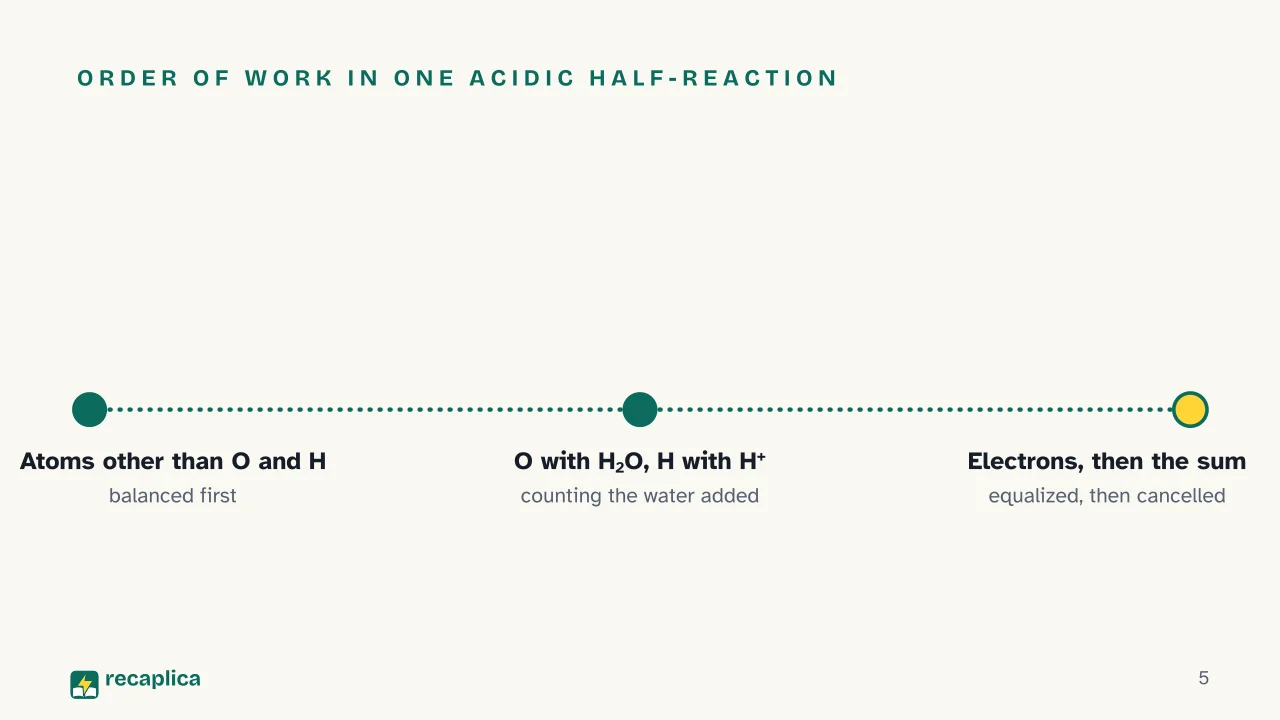
Inside each half-reaction the order is: every atom except O and H, then oxygen with H₂O, then hydrogen with H⁺, then charge with electrons.
The two half-reactions must involve the same number of electrons before they are added, so each is multiplied by a suitable whole number, and the electrons then cancel.
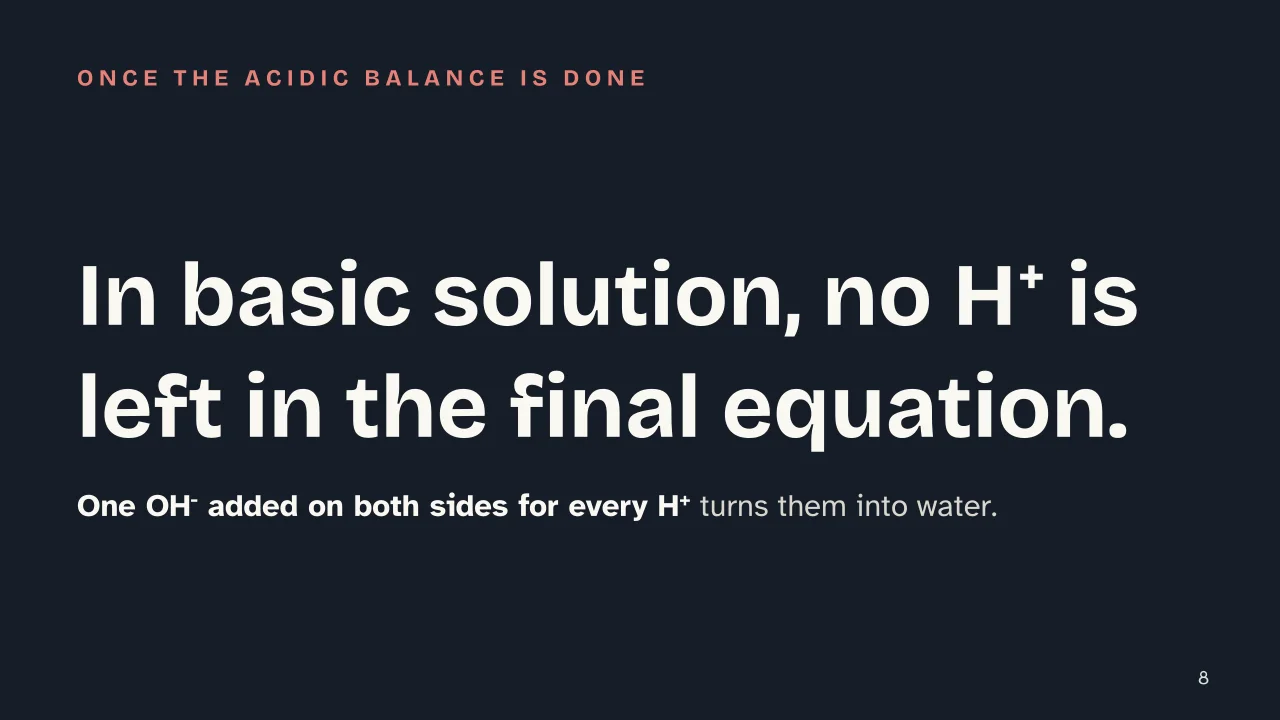
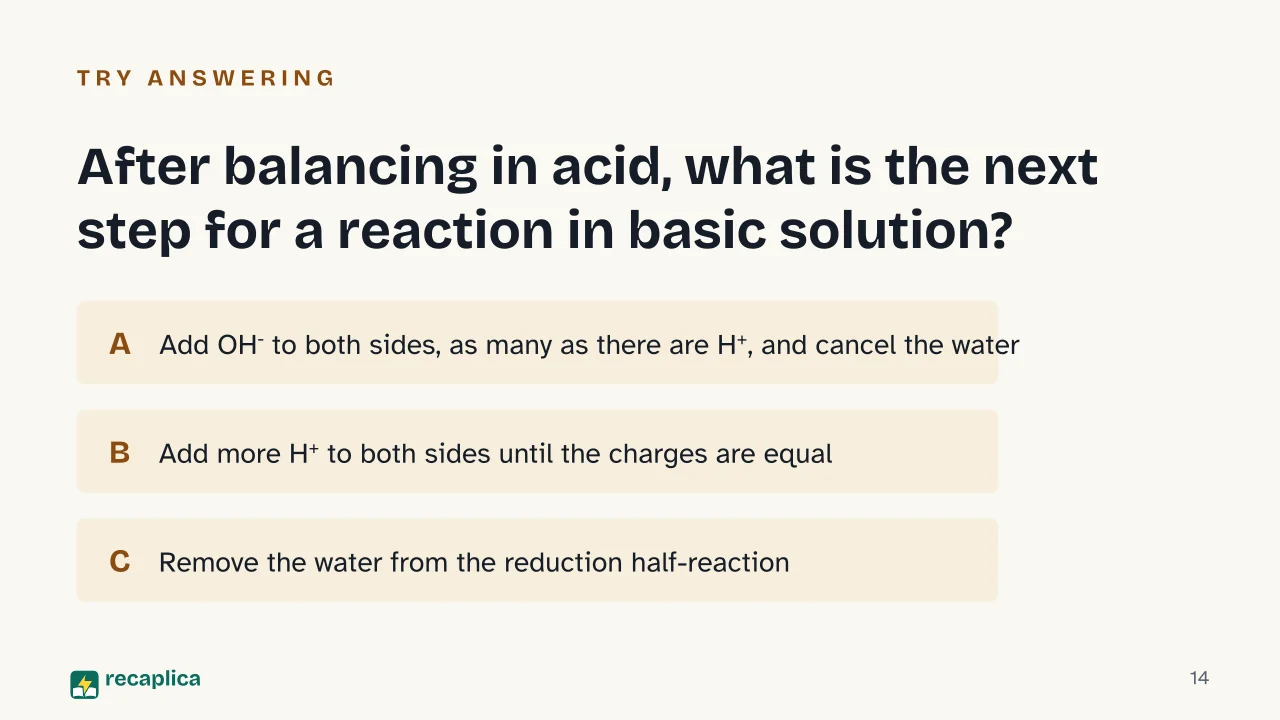
In basic solution you balance as in acid, then add as many OH⁻ as there are H⁺ on both sides, so that each H⁺ + OH⁻ pair becomes H₂O.
In the oxidation number method the coefficients are chosen so that the total increase equals the total decrease.
Deep Dive
Balancing a redox equation means making two counts come out right: each element must appear equally often on the left and on the right, and so must the total charge. The definitions of oxidation and reduction are in the Recap on redox reactions: who gives up and who takes electrons.
What the reducing agent loses, the oxidizing agent gains, in exactly the same number of electrons.
Half-reaction method: the steps in acidic solution
The half-reaction method breaks the equation into two pieces and balances them separately. The steps are:
Separate the equation into an oxidation half-reaction and a reduction half-reaction.
In each, balance every atom except oxygen and hydrogen first.
Balance oxygen by adding water molecules to the side that needs them.
Balance hydrogen with H⁺ ions, counting the hydrogen that arrived with the water.
Compare the total charge on the two sides and add electrons to the more positive one until they match.
Once the two half-reactions are ready, they must involve the same number of electrons. If they do not, multiply each by a whole number that makes them match. Then add the half-reactions, the electrons cancel and the balanced equation is left. If the electrons still differ, the sum does not simplify and a multiplication is missing.
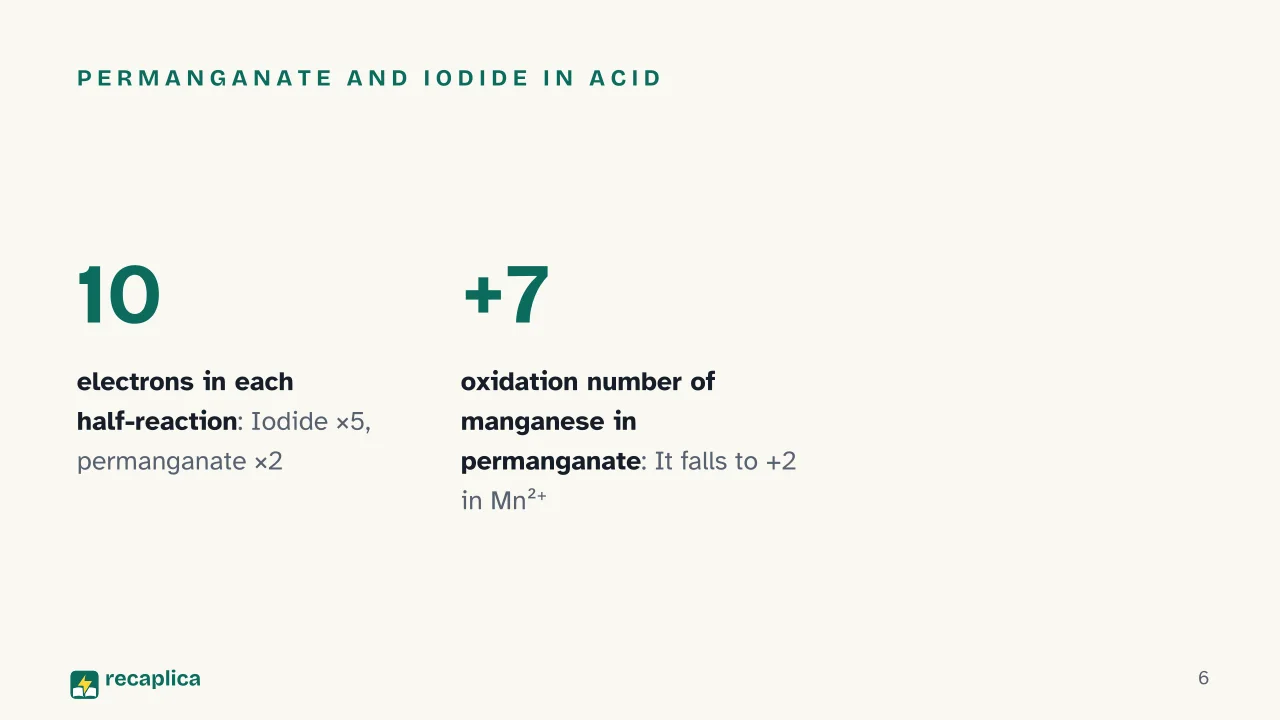
Practical example: permanganate and iodide in acid, giving iodine and Mn²⁺. Iodide is oxidized: 2 I⁻ → I₂ + 2 e⁻. Permanganate is reduced: MnO₄⁻ + 8 H⁺ + 5 e⁻ → Mn²⁺ + 4 H₂O, and manganese goes from +7 to +2. Multiply the first by 5 and the second by 2, so each half-reaction carries 10 electrons. The sum is 10 I⁻ + 16 H⁺ + 2 MnO₄⁻ → 5 I₂ + 2 Mn²⁺ + 8 H₂O.
A second case is our own construction, with iron(II) in place of iodide. Permanganate is still reduced (MnO₄⁻ + 8 H⁺ + 5 e⁻ → Mn²⁺ + 4 H₂O) and iron is oxidized: Fe²⁺ → Fe³⁺ + e⁻. Iron gives up only one electron, so its half-reaction has to be multiplied by 5. Five iron ions then give up the five electrons that one permanganate ion takes.
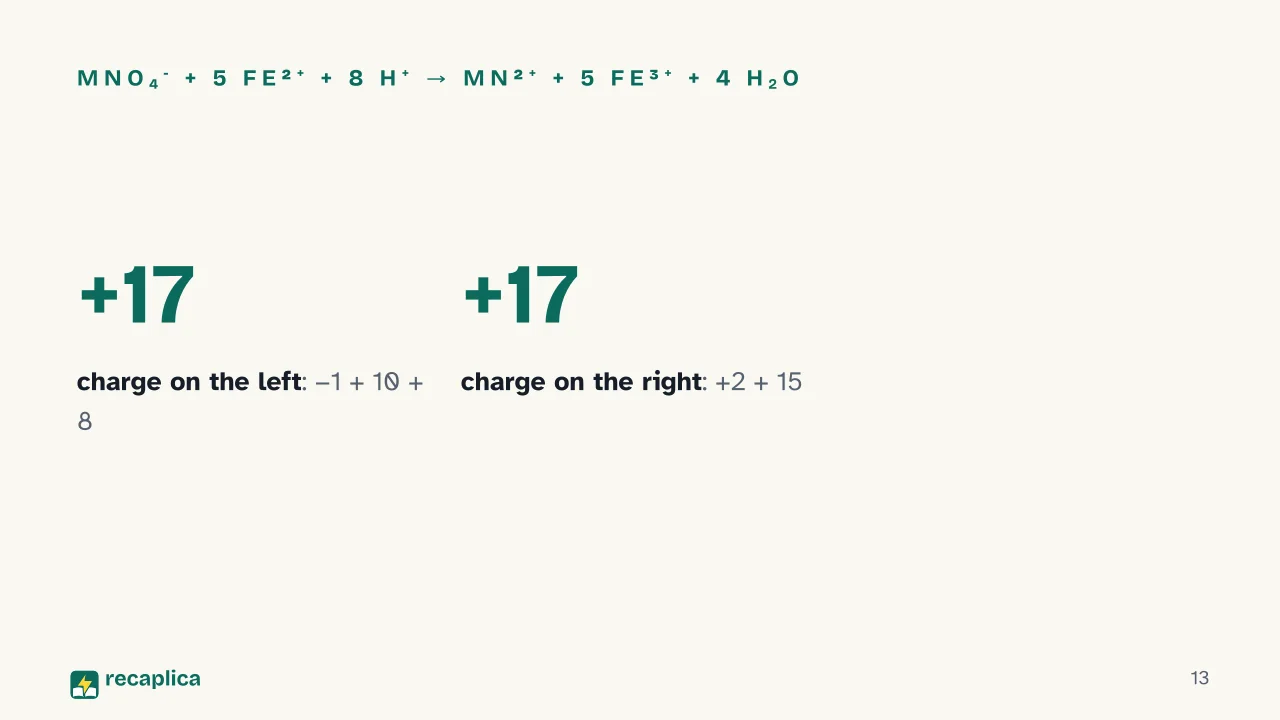
Practical example: MnO₄⁻ + Fe²⁺ in acid. Sum of the two half-reactions: MnO₄⁻ + 5 Fe²⁺ + 8 H⁺ → Mn²⁺ + 5 Fe³⁺ + 4 H₂O. Atoms: 1 Mn, 5 Fe, 4 O and 8 H on both sides. Charge: −1 + 10 + 8 = +17 on the left, +2 + 15 = +17 on the right.
The same scheme fits another pair. In the reduction of nitrate to ammonium in acid, NO₃⁻ + 10 H⁺ + 8 e⁻ → NH₄⁺ + 3 H₂O, zinc is oxidized (Zn → Zn²⁺ + 2 e⁻) and has to be multiplied by 4. The balance is 4 Zn + NO₃⁻ + 10 H⁺ → NH₄⁺ + 3 H₂O + 4 Zn²⁺.
Balancing redox reactions in basic solution
Whether a solution is acidic or basic is measured by its pH. In basic solution the final equation must not contain H⁺. You balance first as in acid. Then every H⁺ left gets an OH⁻ beside it, on both sides, and the pair becomes H₂O. Water that is the same on both sides cancels.
Practical example: an exercise we built ourselves, permanganate and iodide with MnO₂ and I₂ as products. In acid the reduction is MnO₄⁻ + 4 H⁺ + 3 e⁻ → MnO₂ + 2 H₂O and the oxidation is 2 I⁻ → I₂ + 2 e⁻. The lowest common multiple of the electrons is 6: reduction ×2, oxidation ×3. The sum in acid is 2 MnO₄⁻ + 8 H⁺ + 6 I⁻ → 2 MnO₂ + 4 H₂O + 3 I₂. Add 8 OH⁻ to both sides: the 8 H⁺ become 8 H₂O on the left and, after cancelling 4 H₂O, what remains is 2 MnO₄⁻ + 4 H₂O + 6 I⁻ → 2 MnO₂ + 3 I₂ + 8 OH⁻. Check: 2 Mn, 6 I, 12 O and 8 H on both sides; charge −8 on the left and −8 on the right.
Aluminium in strongly basic solution, which releases hydrogen, closes the same way: 2 Al + 2 OH⁻ + 6 H₂O → 2 [Al(OH)₄]⁻ + 3 H₂.
Oxidation number method
The oxidation number method does not split the equation. You assign each element its number, find the ones that change, and choose coefficients so that the sum of the increases equals the sum of the decreases. Then you balance the rest and check atoms and charge.
A few rules assign the numbers:
Situation
Oxidation number
Free element
0
Monatomic ion
Equal to its charge
Hydrogen in compounds
Usually +1, except −1 in metal hydrides
Oxygen in compounds
Usually −2, except −1 in peroxides
Neutral compound
The numbers add up to zero
Polyatomic ion
The numbers add up to the ion’s charge
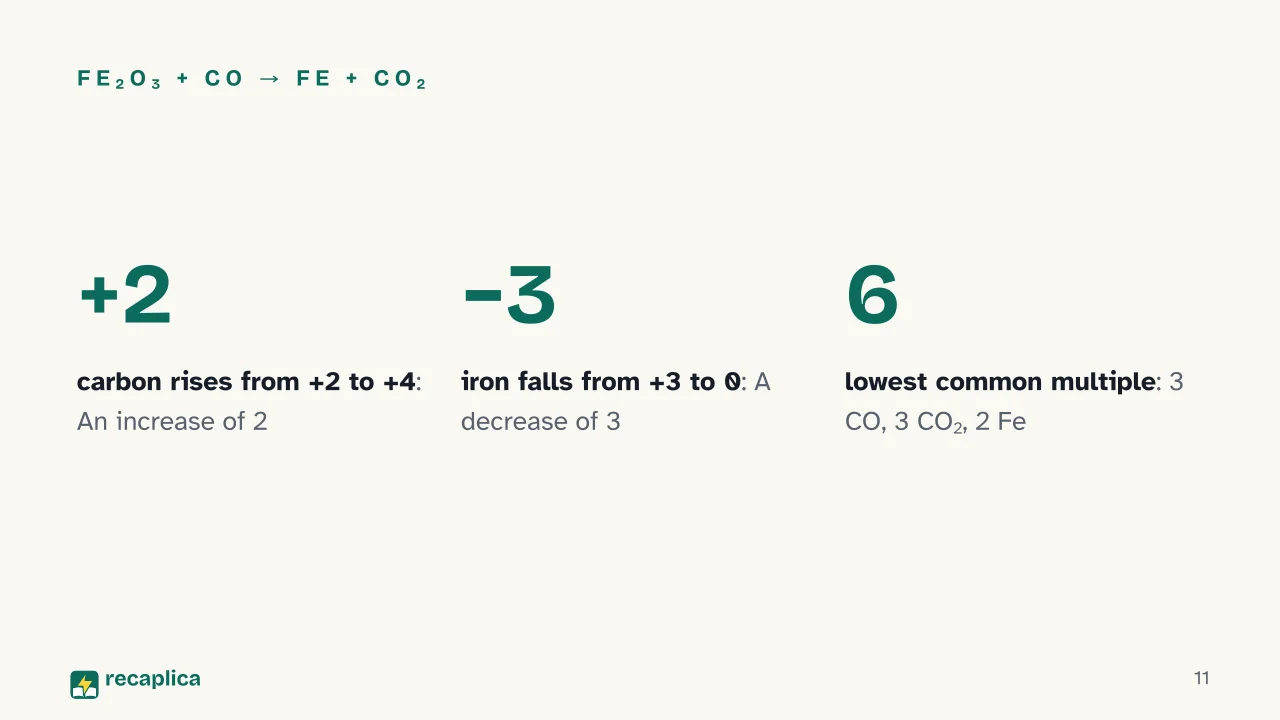
Practical example: Fe₂O₃ + CO → Fe + CO₂. Carbon rises by 2, from +2 to +4. Iron falls by 3, from +3 to 0. The lowest common multiple of 2 and 3 is 6, which gives 3 CO and 3 CO₂ in front of the carbon species and 2 Fe: Fe₂O₃ + 3 CO → 2 Fe + 3 CO₂.
A second case, also our own, uses formulas with higher charges: dichromate and iron(II) in acid. Chromium goes from +6 to +3, with two atoms in dichromate and a total decrease of 6. Iron goes from +2 to +3, an increase of 1 per atom. To equalize 6 and 1 you need 6 Fe²⁺ for every Cr₂O₇²⁻. The rest is balanced with H₂O for oxygen and H⁺ for hydrogen.
Practical example: Cr₂O₇²⁻ + 6 Fe²⁺ + 14 H⁺ → 2 Cr³⁺ + 6 Fe³⁺ + 7 H₂O. Atoms: 2 Cr, 6 Fe, 7 O, 14 H on both sides. Charge: −2 + 12 + 14 = +24 on the left, 6 + 18 = +24 on the right.
The two methods side by side
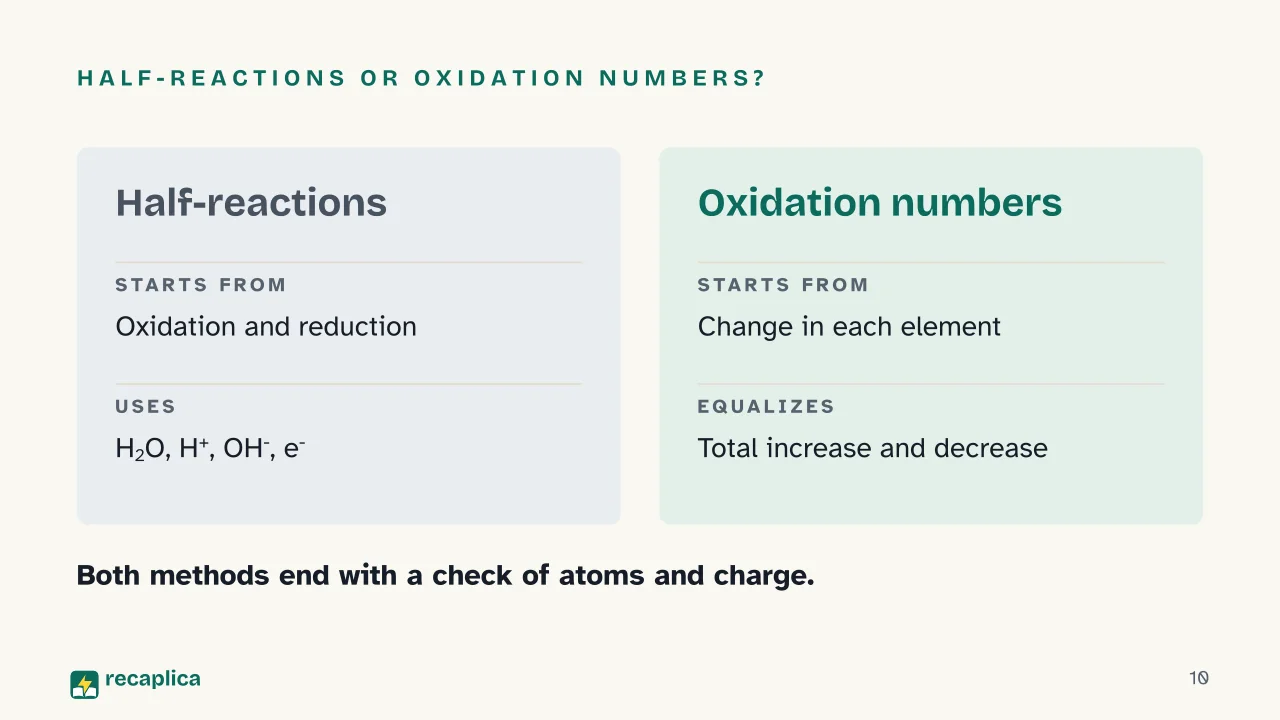
Half-reactions
Oxidation numbers
Starting point
Oxidation and reduction written apart
Change in each element’s number
What is equalized
Electrons of the two half-reactions
Total increase and decrease
What handles the rest
H₂O, H⁺, and in basic solution OH⁻
The balance of atoms and charge
Worked here
MnO₄⁻ with I⁻ and with Fe²⁺
Fe₂O₃ with CO, Cr₂O₇²⁻ with Fe²⁺
Redox practice: the final check
The last step is always the same: count the atoms of each element and add up the charges on each side. If the charge differs, say +4 on the left and +8 on the right, the balance is incomplete even when the atoms match. In basic solution, an equation that still contains H⁺ has not finished the OH⁻ step.
For practice, take the examples above, cover the solution and redo the work, then compare atoms and charge.
Slide deck
Slides ready to download and make your own in PowerPoint or Google Slides, with speaker notes. Pick the Flash cut or the Full one.
✗ Myth As long as the atoms match, the charge takes care of itself.
✓ Reality In a redox reaction electrons move from one species to another, so total charge has to match on both sides just as atoms do. An equation with the right atoms and different charges still needs fixing, for instance with coefficients that do not equalize the electrons given up and the electrons taken. This is why the final check always looks at both.
✗ Myth Basic solution needs a different method with its own rules.
✓ Reality The route is the same as in acid, up to the last line. At the end each leftover H⁺ gets an OH⁻ added next to it, and together they form water. That step is the only difference.
✗ Myth An element's oxidation number is whatever the periodic table says.
✓ Reality The oxidation number depends on the compound the element sits in. A free element is 0, a monatomic ion equals its charge, hydrogen is usually +1 and oxygen usually −2, with some exceptions, such as metal hydrides and peroxides. Manganese, for one, goes from +7 in permanganate to +2 in Mn²⁺.
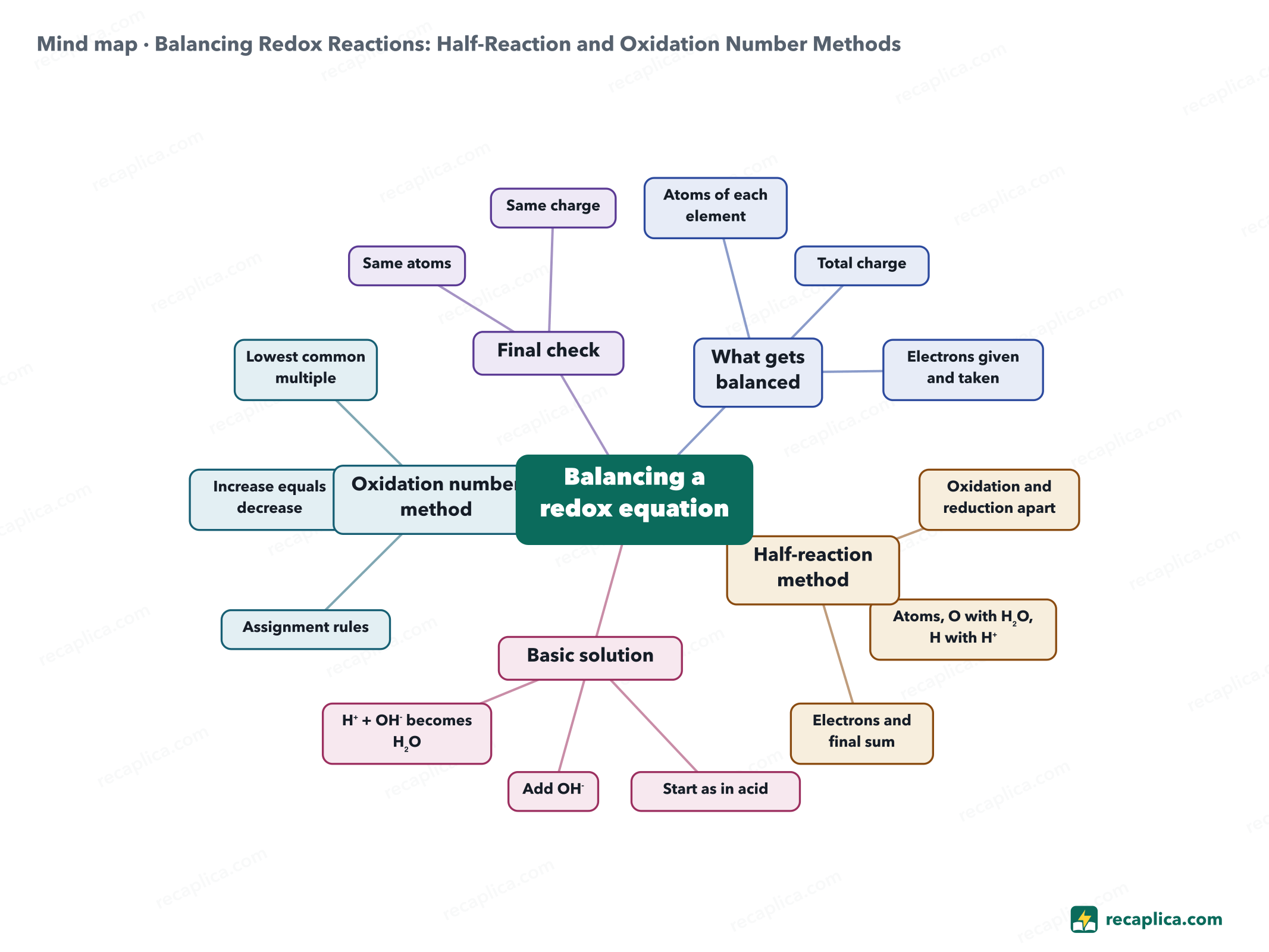
Mind map
Drag the background to move around and the nodes to reposition them; use − and + to collapse and expand branches.
Answer the questions to check what you have learned: you get instant feedback and a short explanation.
Grade0/100/5
Answers: 1-C · 2-B · 3-D · 4-C · 5-B
Flashcards
Tap the card to flip it and check whether you remember the answer, then move to the next one.
1 / 8
Explain it in your own words
The ultimate test: if you can explain it in simple words, you've truly understood it. Write your explanation, then compare it with the Recap.
Your explanation is saved only on this device.
A redox reaction is balanced when every element has the same number of atoms on both sides and the total charge is the same too. There are two routes. With the half-reaction method you write oxidation and reduction separately, add water, H⁺ and electrons, and then add the two halves together. With the oxidation number method you look at how much each element's number rises and falls, and pick coefficients that make the total rise equal the total fall. In basic solution you start as in acid, and at the end the H⁺ ions are turned into water with OH⁻.
Frequently asked questions
What are the steps in balancing a redox reaction?
With half-reactions you separate oxidation and reduction, balance the atoms (O with H₂O, H with H⁺), add electrons to the more positive side, equalize the electrons of the two half-reactions and add them. With oxidation numbers you find the changes in the elements that change, pick the coefficients that make the increase equal the decrease, and balance the rest. Either way, the last step checks atoms and charge.
How do you balance a redox equation in basic solution?
Balance it as in acidic solution first. Then, for every H⁺ left, add one OH⁻ to each side: each pair turns into H₂O, and the water that shows up on both sides is cancelled. The example with MnO₄⁻ and I⁻ ends up as 2 MnO₄⁻ + 4 H₂O + 6 I⁻ → 2 MnO₂ + 3 I₂ + 8 OH⁻.
Where can I find redox balancing practice with worked solutions?
This page has five solved examples, from permanganate oxidizing iodide in acid to iron reacting with dichromate. You can redo them yourself by covering the solution, then compare atoms and charge at the end. The final check tells you at once whether the balance holds.
Which is better, the half-reaction method or the oxidation number method?
The half-reaction method works on charges and electrons and handles water, H⁺ and OH⁻. The oxidation number method starts from how much the elements' numbers change and picks the main coefficients from there, as in the scheme Fe₂O₃ + CO → Fe + CO₂.
How do you work out an oxidation number?
An element on its own is 0, and a single-atom ion has the number of its charge. Hydrogen is usually +1 and oxygen usually −2. In a neutral compound the numbers add up to zero, and in a polyatomic ion they add up to the charge of the ion.
Every Recap goes through an independent review before publication.
Statistics, only if you say so
To learn which Recaps help most we would use Google Analytics, with aggregate, anonymous data. It starts only with your OK, and you can change your mind anytime. Privacy policy