|
recaplica
E = mc²: What Einstein's Special Relativity Really Says |
| © 2026 Recaplica · recaplica.com — All rights reserved |
E = mc²: What Einstein's Special Relativity Really SaysWhat to print Page numbers appear when printing with default margins. SlidesChoose a cut Flash10 slidesThe essential thread, to present in classFull15 slidesEvery chapter and the deeper detailBoth come with speaker notes. In 30 seconds quick readSpecial relativity is the theory Albert Einstein published in 1905 to explain how space and time change for two observers moving relative to each other at very high speed. It starts from a fact that sounds impossible: the speed of light in a vacuum is the same for every observer, no matter how they themselves are moving. From that single starting point come very concrete effects: a moving clock runs slow to someone who stays still, and a moving object shrinks along its direction of travel. The same theory also leads to physics' most famous equation, E = mc², which ties an object's mass to its energy. Gravity sits outside this picture entirely — that arrives later, with the separate theory of general relativity. Key Points
Key figures
Deep DiveEinstein and special relativity: where the theory comes fromIn 1905 Albert Einstein published the theory of special relativity. He started from a principle that sounded almost obvious: the laws of physics stay the same in every reference frame moving at constant speed. To that he added a far less obvious fact — light in a vacuum always travels at the same speed for any observer, regardless of their own motion. It is a universal constant, identical everywhere in space. The trouble starts right away. Put together, these two facts don’t fit inside Galileo’s physics, where speeds always add up. In everyday life, if a train travels at 100 km/h and someone on board throws a ball forward at 10 km/h, an observer standing on the platform measures the ball at 110 km/h: speeds add. Light never adds to anything else, for any observer. To hold both facts together, Einstein gave up the idea of a fixed, universal space and time: measurements of space and time depend on how the person taking them is moving.
Why time and length change: dilation and contractionThe best-known consequence concerns time. To an observer, the lengths of a moving object appear to contract and its clocks appear to slow down as its speed approaches that of light. The root cause is relative simultaneity: two reference frames in relative motion can only agree on the speed of light by accepting that they disagree on which events happen at the same time. How much a moving clock slows down depends only on its speed relative to whoever is watching it: there is no clock that counts as fixed by definition, against which every other clock gets measured. Muons created by cosmic rays high in the atmosphere, observed by a detector on the ground, survive far longer than their average lifetime at rest would predict. If time flowed for them at the same rate as a clock on the ground, almost none should reach the surface before decaying; yet a measurable number do, because their internal clock slows down the closer they get to the speed of light. The same principle underlies the Lorentz transformations, the math that links the space and time measurements taken by different observers. The speed of light stays fixed while the lengths and intervals each observer measures do not: that is how both time dilation and length contraction arise, the second being the apparent shortening of a moving object along its direction of travel. GPS satellite navigation systems experience the same effect on a tiny scale: they have to correct their own calculations to account for special relativity to stay accurate, because their orbiting clocks run at a slightly different rate from a clock on the ground. A thought experiment makes the idea concrete: two twins, one sets off on a trip at very high speed, the other stays on Earth. In the U.S. Department of Energy’s teaching example, at the hypothetical travel speed used, the traveling twin experiences time passing roughly 40 times more slowly than the twin who stayed behind. It is a classroom figure, meant to make visible an effect that, at the much lower speeds of ordinary travel, stays vanishingly small in reality. The E = mc² formula: where it comes fromThe same theory that rewrites time and space also arrives at one of physics’ best-known equations. Einstein showed that mass and energy are two faces of the same quantity: the formula E = mc² sums that up, stating that a body’s energy equals its mass multiplied by the speed of light squared. CERN offers a concrete example of how significant this link becomes at extreme speed. A proton at rest, translated into energy via E = mc², weighs in at 938.3 MeV/c²; accelerated to 99.9999991% of the speed of light inside the Large Hadron Collider, it reaches a design energy of 7 TeV per beam — thousands of times more than it would carry at rest. In everyday life this link stays negligible instead: no object with mass can reach or exceed the speed of light, and meaningful conversions between mass and energy only show up inside a particle accelerator or during a nuclear reaction. Special relativity and general relativity: two theories, not oneSpecial relativity is about space and time. It extends the same reasoning to mass and energy, but it leaves gravity out entirely: that arrives with general relativity, a theory Einstein developed afterward, describing gravity as an effect of the curvature of spacetime produced by the mass of objects. Einstein wrote both theories. The special theory explains how time, length and energy change for observers in relative motion, with no need for gravity. The general theory adds gravity itself, describing it as the geometry of space rather than a force acting at a distance. GPS satellites, too, have to correct their calculations by accounting for both theories to stay accurate. For anyone who wants to keep following the thread of time through physics, it’s worth reading Time Travel: Is It Possible? What Physics Really Says, which picks up time dilation from another angle. Readers who want to start from the basics of motion before tackling relativity can read Kinematics: What It Is and the Equations of Motion. Einstein’s postulate on the constancy of light connects to the behavior of light itself, covered in Electromagnetic Spectrum: What Is It? From Radio Waves to Gamma Rays, while for the force special relativity leaves out — gravity — a good starting point is Newton’s Law of Universal Gravitation: From Kepler’s Laws to the Formula. Slide deckSlides ready to download and make your own in PowerPoint or Google Slides, with speaker notes. Pick the Flash cut or the Full one.     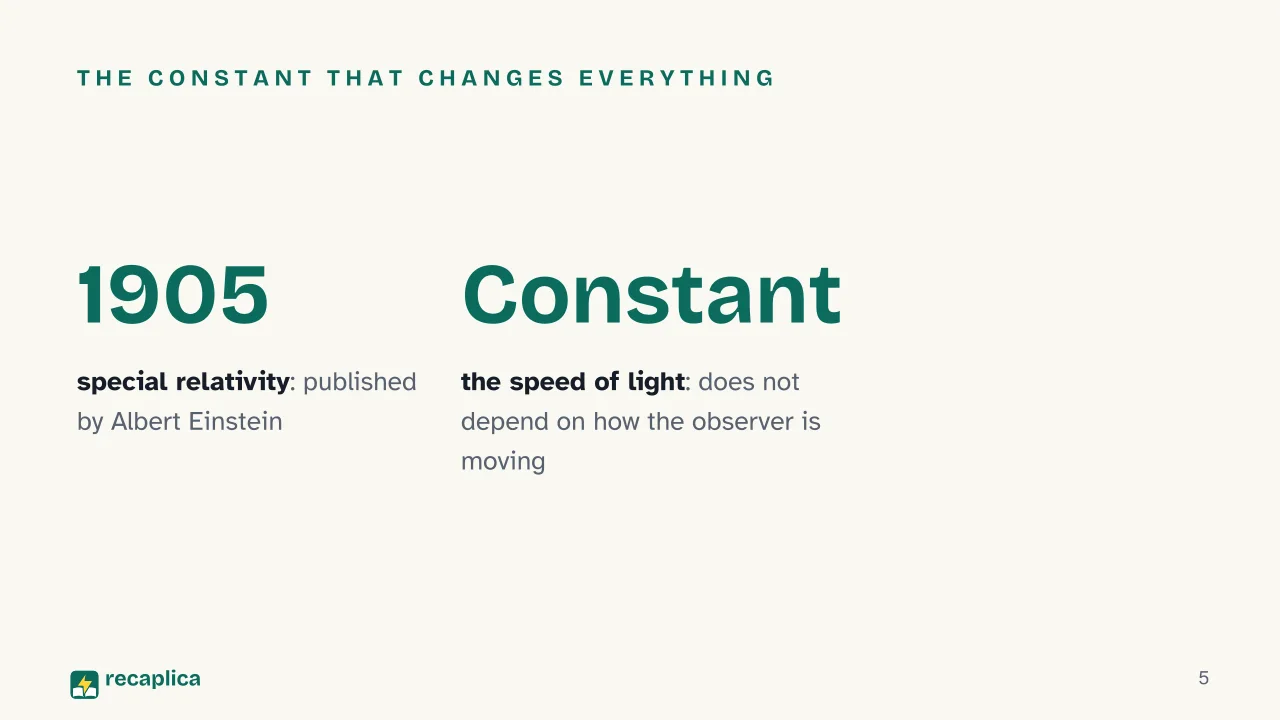  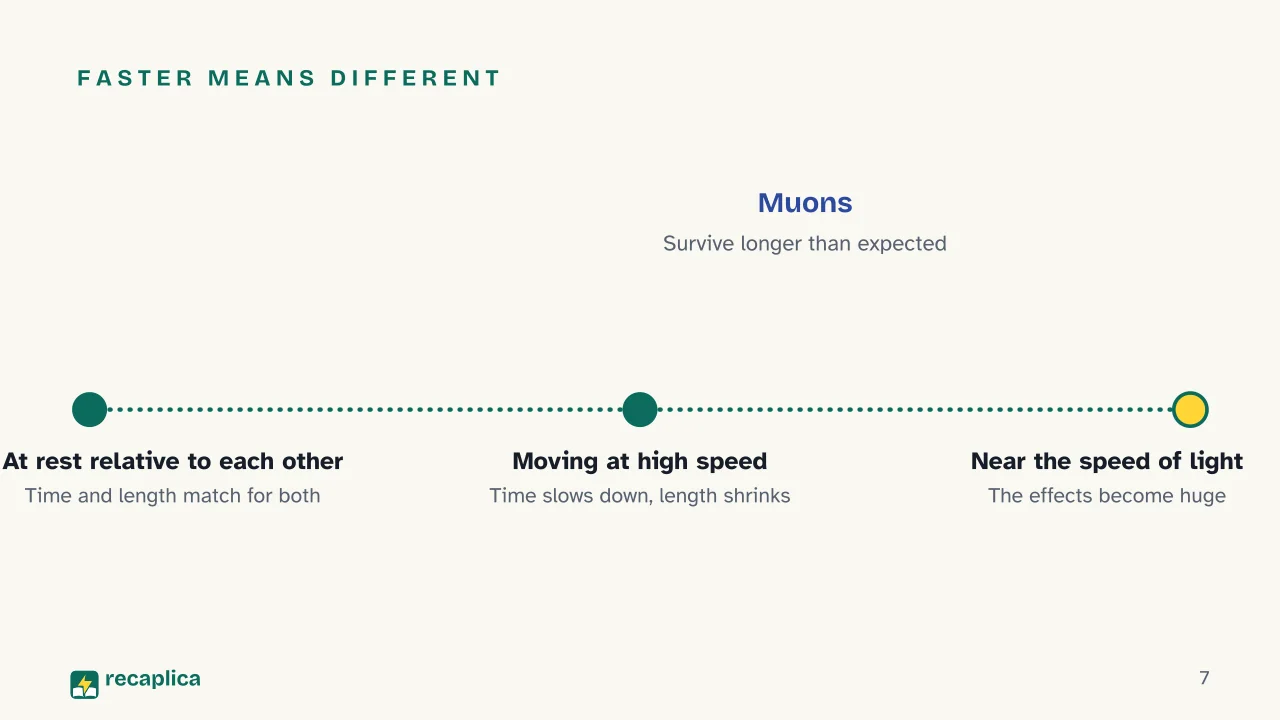 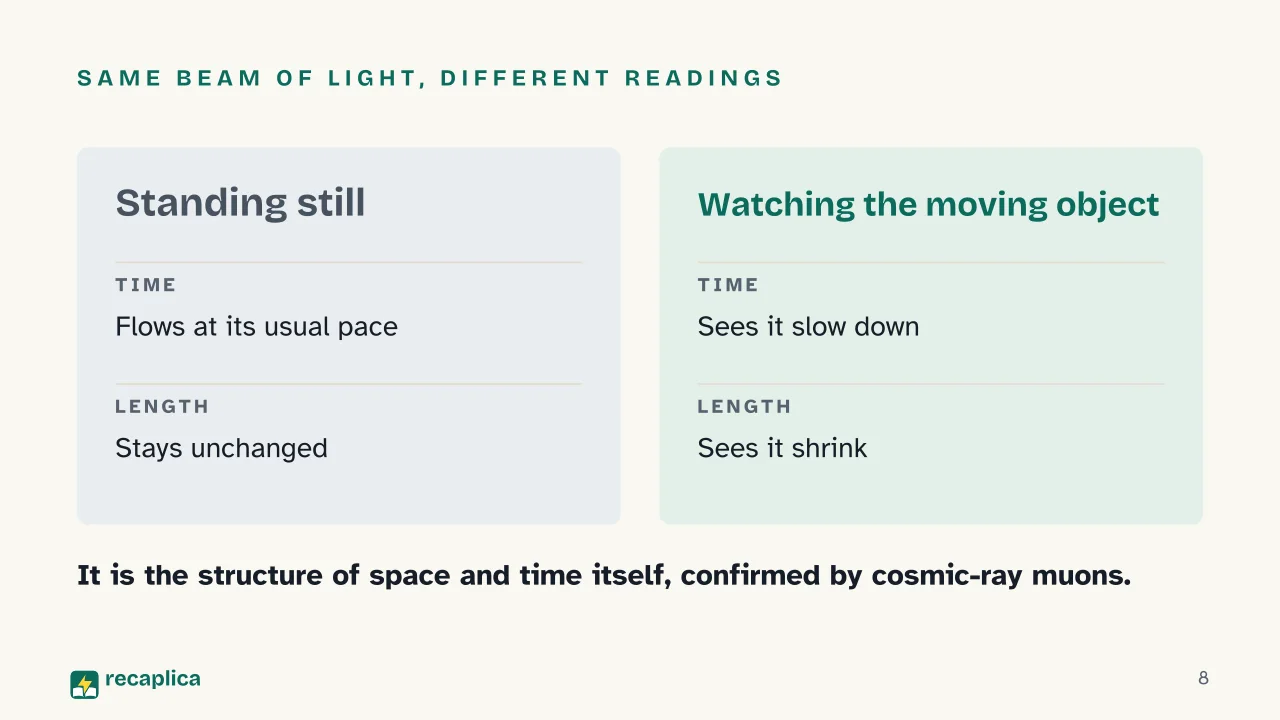  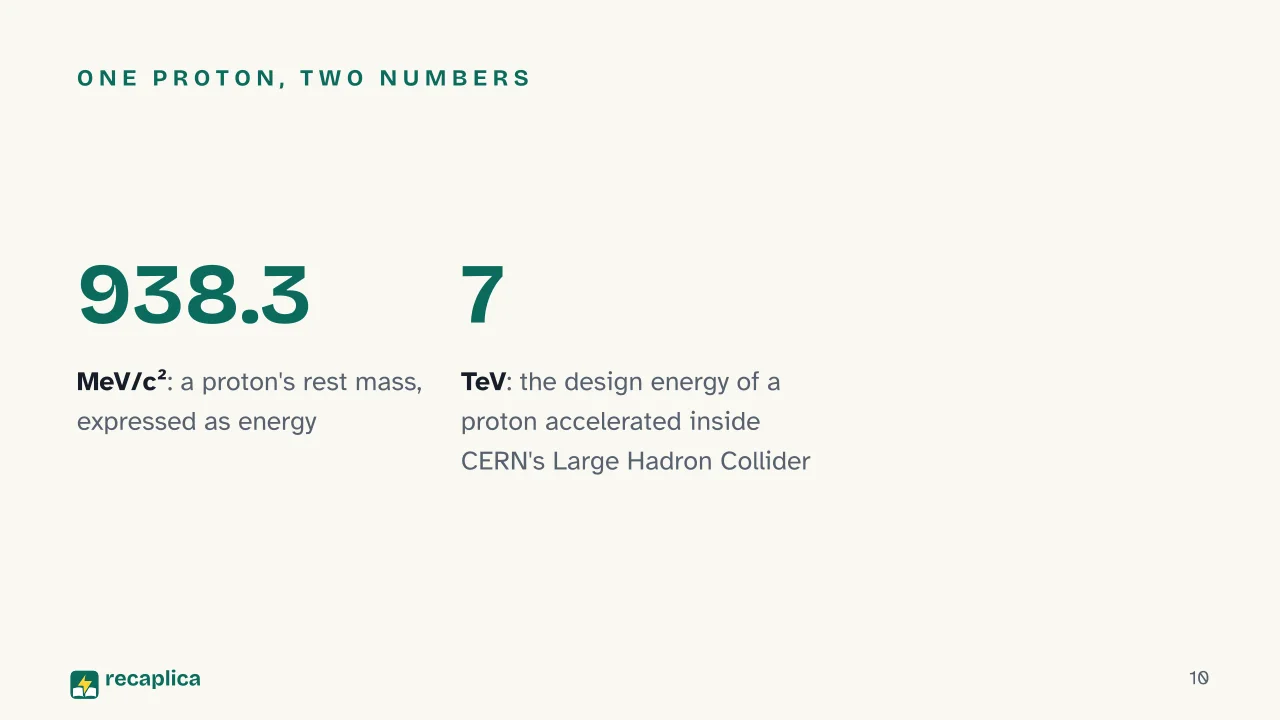 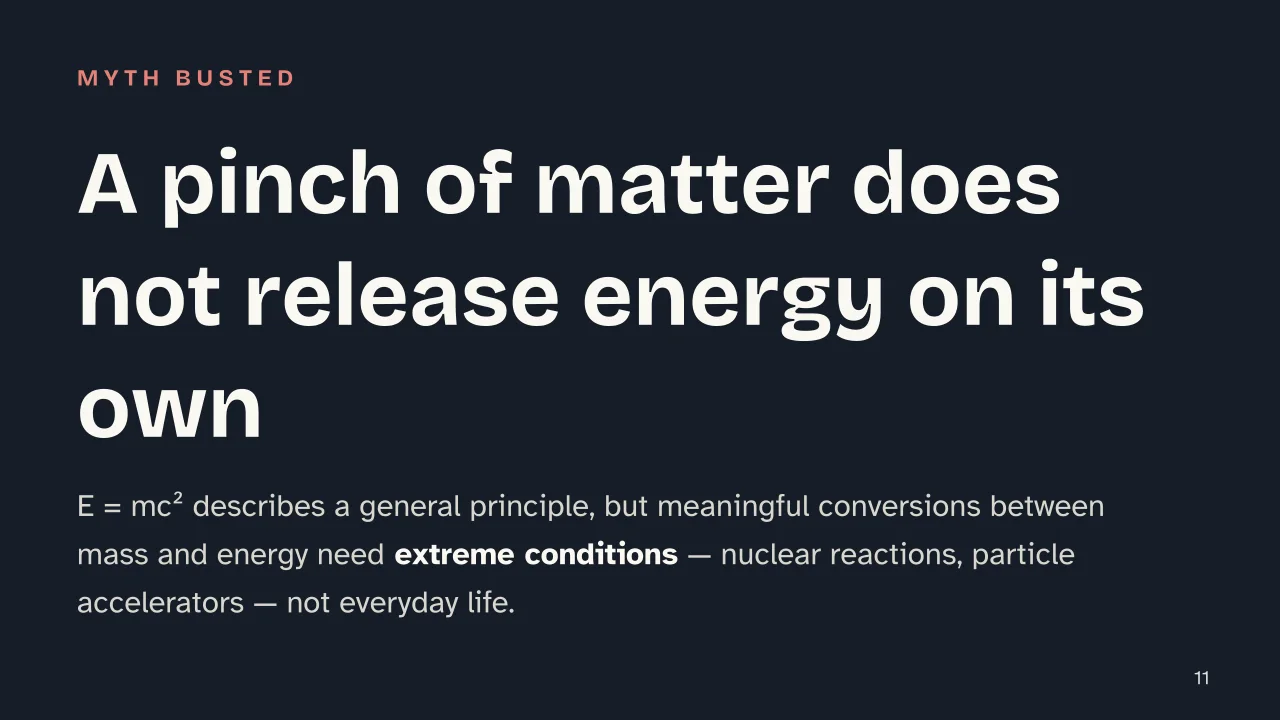  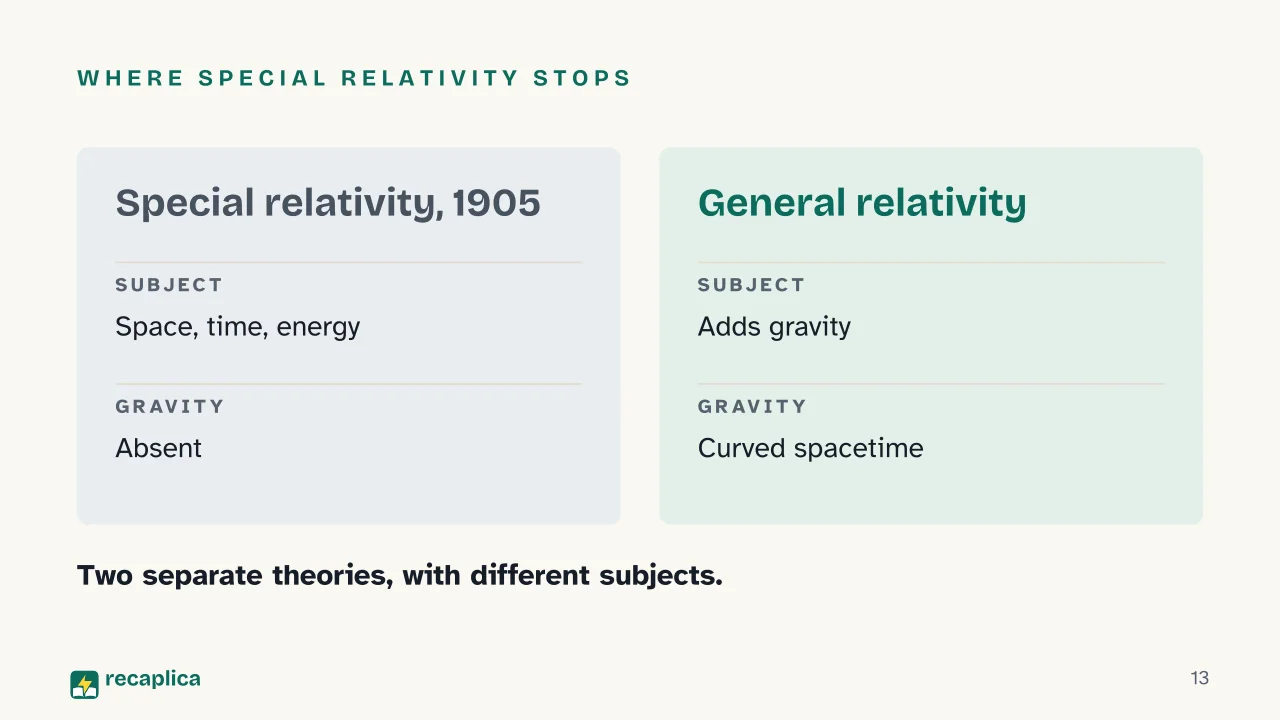 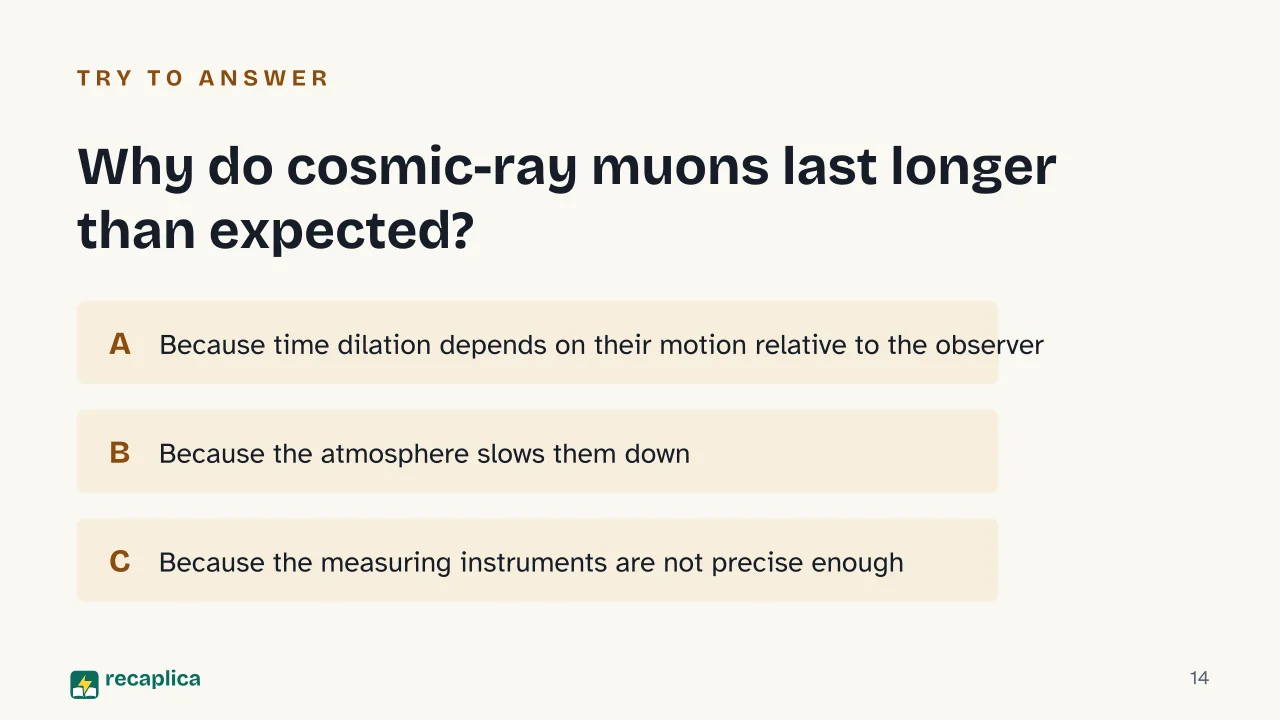  Common myths
Mind mapDrag the background to move around and the nodes to reposition them; use − and + to collapse and expand branches. 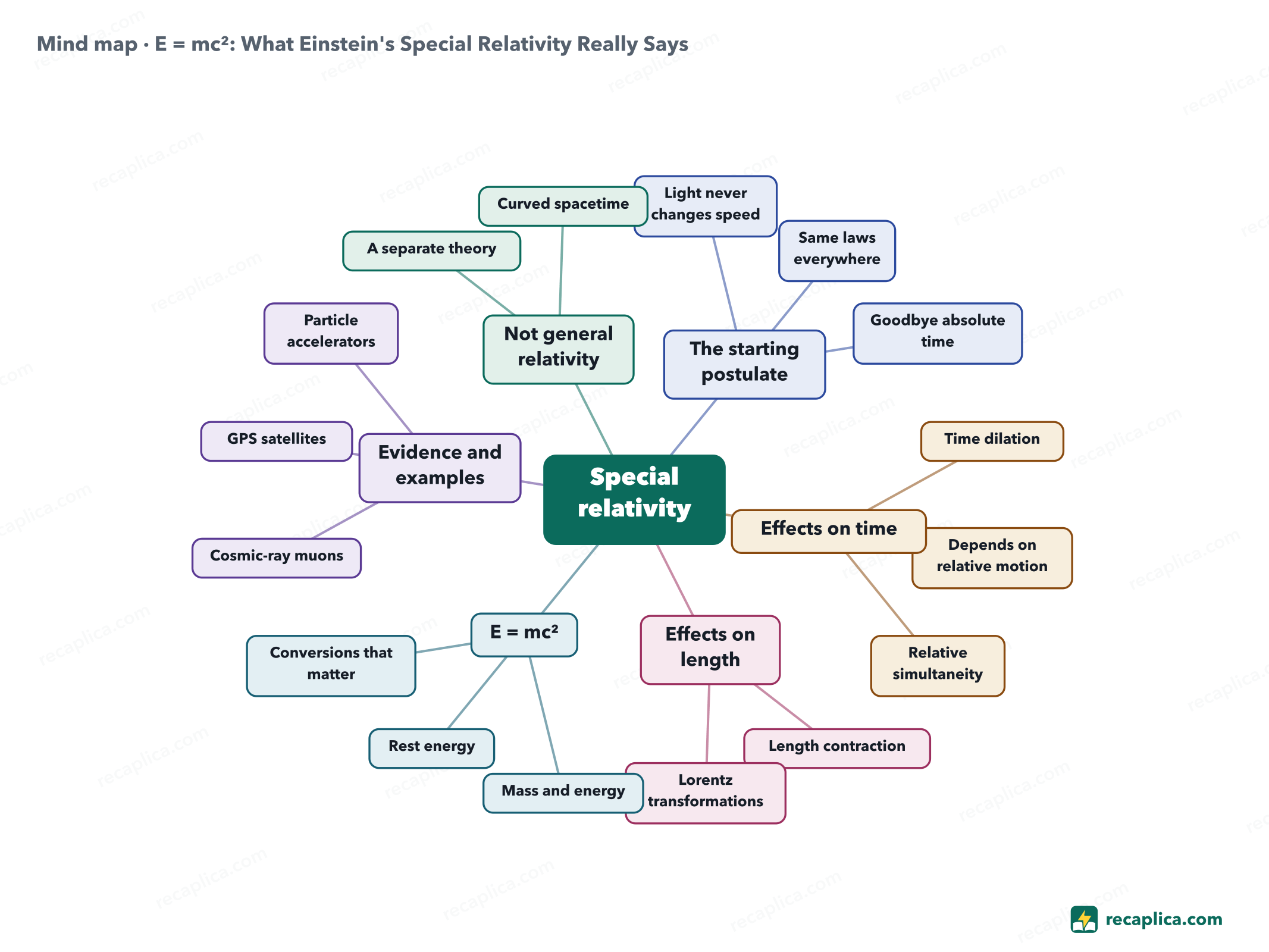
Quiz: test yourselfAnswer the questions to check what you have learned: you get instant feedback and a short explanation. Grade 0/10 0/5
FlashcardsTap the card to flip it and check whether you remember the answer, then move to the next one. 1 / 8 Explain it in your own wordsThe ultimate test: if you can explain it in simple words, you've truly understood it. Write your explanation, then compare it with the Recap. Your explanation is saved only on this device.
Frequently asked questionsCan special relativity be explained without the math?Partly, yes. The core idea is that the speed of light is the same for every observer, and from that single fact follow consequences for time and length that make sense without any calculation; the exact formulas, the Lorentz transformations, are needed only to get precise numbers. Did Einstein also come up with general relativity?Yes, but it is a separate, later theory: the 1905 special relativity does not include gravity, which Einstein described afterward with general relativity, as the curvature of spacetime produced by mass. Does special relativity only apply at extremely high speeds?Its effects exist at every speed, but they only become measurable close to the speed of light: in everyday life they are so small they go unnoticed. What is the Lorentz factor?It is the number that measures how far time, length and mass drift from what we would normally expect at a given speed relative to the speed of light: the closer that speed gets to light speed, the larger it grows. What is E = mc² actually used for, in practice?In everyday life, for nothing visible: it only becomes useful under extreme conditions, inside a particle accelerator or a nuclear reaction, where the energy involved is enormous. CERN's Large Hadron Collider uses it to work out the energy of its particles from their mass. Every Recap goes through an independent review before publication. |