|
recaplica
Newton's Law of Universal Gravitation: From Kepler's Laws to the Formula | ||||||||||
| © 2026 Recaplica · recaplica.com — All rights reserved | ||||||||||
Newton's Law of Universal Gravitation: From Kepler's Laws to the FormulaWhat to print Page numbers appear when printing with default margins. SlidesChoose a cut Flash10 slidesThe essential thread, to present in classFull16 slidesEvery chapter and the deeper detailBoth come with speaker notes. In 30 seconds quick readNewton's law of universal gravitation describes the force with which any two bodies anywhere in the universe attract each other simply because they have mass. Newton published it in 1687, in the "Philosophiae Naturalis Principia Mathematica," building on the three laws Kepler had worked out from the motion of the planets and on Galileo's observations of falling bodies. The formula reads F = G·m₁·m₂/r²: the force grows with the two masses and drops off sharply with the distance between their centers. According to NASA GSFC, Newton's insight was that a falling object and the orbiting Moon answer to the same force. Key Points
Key figures
Deep DiveBetween 1609 and 1619, Johannes Kepler published three laws that described, with precision, how the planets move around the Sun: elliptical orbits, equal areas swept in equal times, a fixed ratio between orbital period and distance from the Sun. He had worked them out from data gathered by the Danish astronomer Tycho Brahe, whose assistant he had been in Prague. These were empirical laws: they worked, but they said nothing about why the planets moved that way. Almost seventy years later, Isaac Newton found the answer. According to Encyclopedia.com, Newton built the law of universal gravitation out of Kepler’s planetary laws, the notion that bodies can pull on each other across empty space, and his own laws of motion; he also leaned on Galileo’s observations of falling bodies, extending gravity’s reach to every piece of matter, not just the heavens. He published the result in 1687, in the Philosophiae Naturalis Principia Mathematica. How Isaac Newton Discovered Gravity, from Kepler’s LawsKepler’s three laws lay out the planets’ paths, the steadiness of the areas they sweep, and the link between orbital period and distance from the Sun. They are descriptive laws, drawn from observational data: the physical cause of that motion falls outside their scope. Readers who want the full breakdown of the three laws can find it in the Recap on Kepler’s laws. Newton started there and added an ingredient Kepler never had: his own laws of motion, already worked out for bodies on Earth (the same framework is covered in the Recap on Newton’s laws of motion). By combining them with the planetary laws and with the idea of action at a distance — two bodies pulling on each other without any physical contact — he reached a broader conclusion: the force that keeps a planet in orbit and the force that pulls an object down on Earth are one and the same force.
According to NASA GSFC, Newton was the first to recognize that a falling apple, the Moon’s orbit, and the orbits of the planets all follow the same principle, F = ma. That is the unification that makes the law “universal”: it holds for any two bodies with mass, anywhere in space: a stone and the Earth, the Earth and the Moon, or the Sun and the planets described in the Recap on the solar system. The Formula, Piece by PieceThe law of universal gravitation is written like this: F = G · m₁ · m₂ / r²
The force grows as the masses grow, and it falls off sharply with distance, because r is squared and sits in the denominator: double the distance between two bodies and the force drops to a quarter. G is the number that fixes how strong that force is for given masses and a given distance: per NIST, the value recommended by CODATA 2022 is 6.674 30 × 10⁻¹¹ m³ kg⁻¹ s⁻², with a relative uncertainty of 2.2 × 10⁻⁵. Where the Law Still Holds Up, as of 2026According to NASA Science, as of 2026 scientists still rely on Kepler’s laws — in the version Newton generalized — to plan spacecraft trajectories and to measure the masses of distant moons and planets. Kepler’s third law, recast by Newton in terms of mass and the constant G, is the basis for most measurements of celestial masses calculated as of 2026: more than three centuries after the Principia was published, it remains the tool for weighing celestial bodies no one can touch. The Apple Story, with CautionMany people who know the law of universal gravitation associate it with an apple falling on Newton’s head. According to the Royal Society, the only account of this episode is a manuscript written by William Stukeley, a friend and contemporary of Newton, in 1752 — decades after the fact. It is, in short, a secondhand account, passed along by a friend of Newton’s long after the fact. NASA GSFC credits Newton with the insight while setting aside the more colorful versions of the tale, the ones where the fruit actually strikes his head. It still works as a memorable way to hold onto the core of the law: the same force that pulls down a piece of fruit keeps the Moon in orbit. Slide deckSlides ready to download and make your own in PowerPoint or Google Slides, with speaker notes. Pick the Flash cut or the Full one.    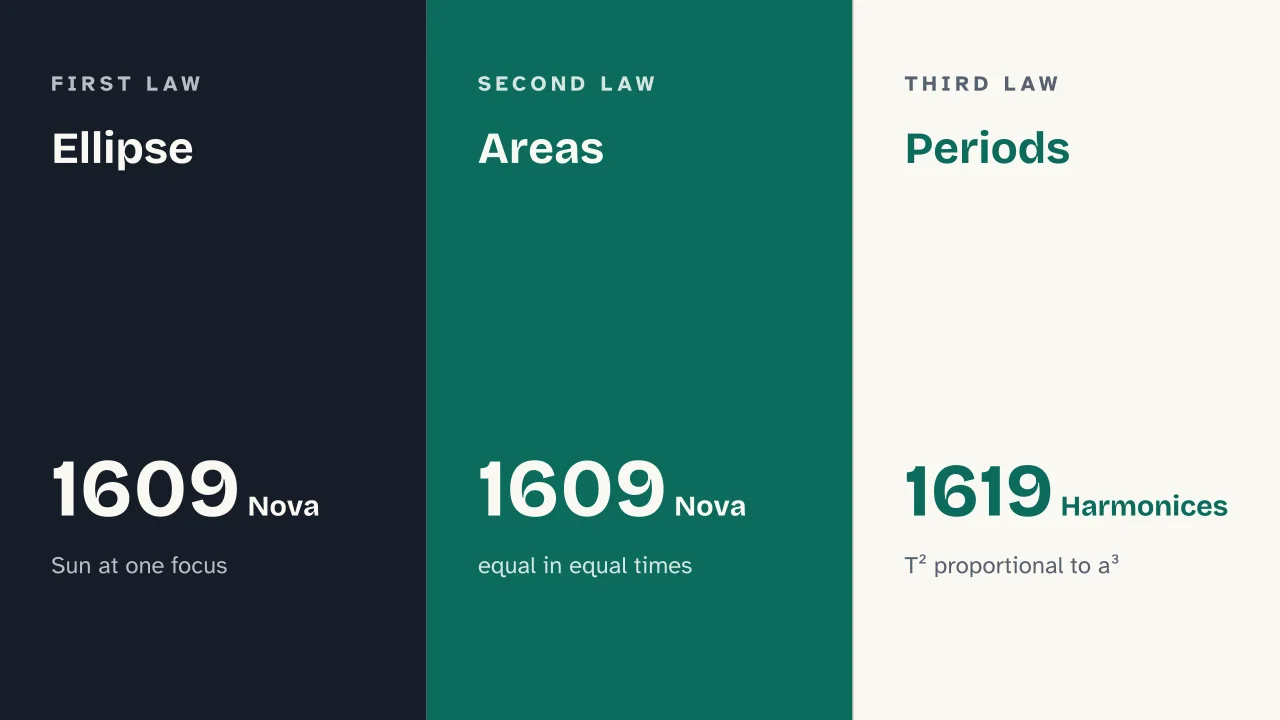 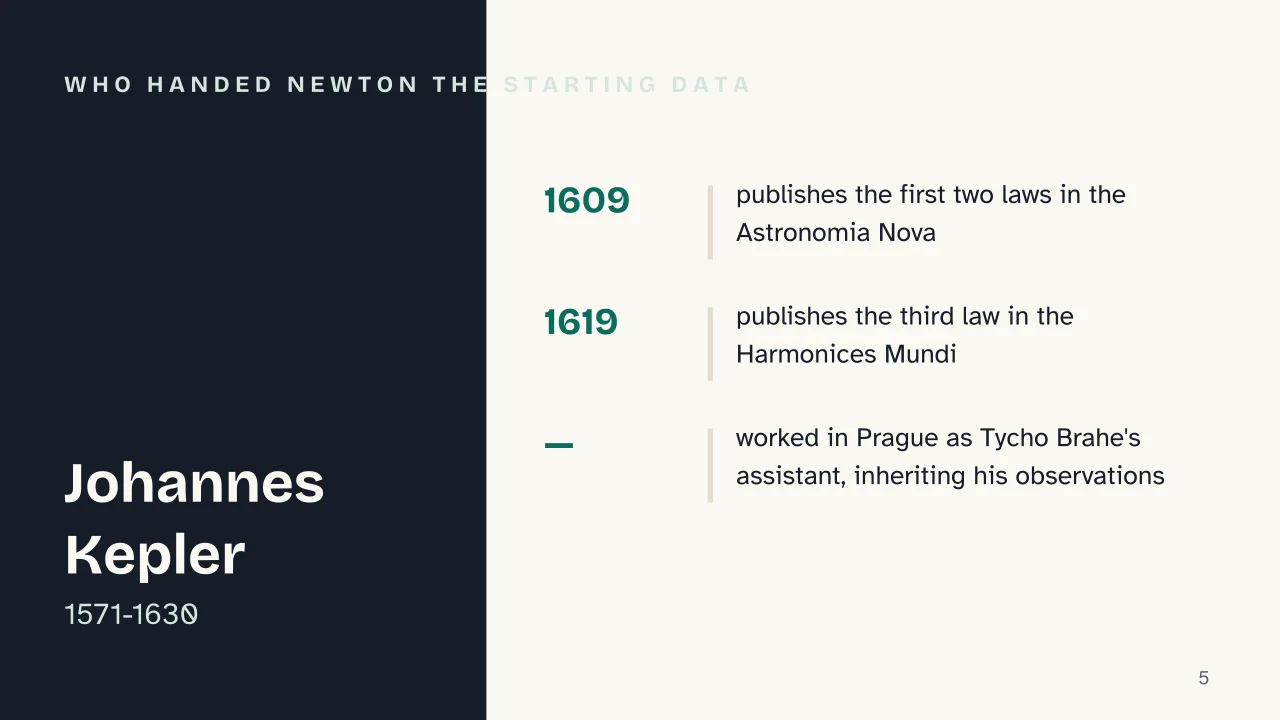 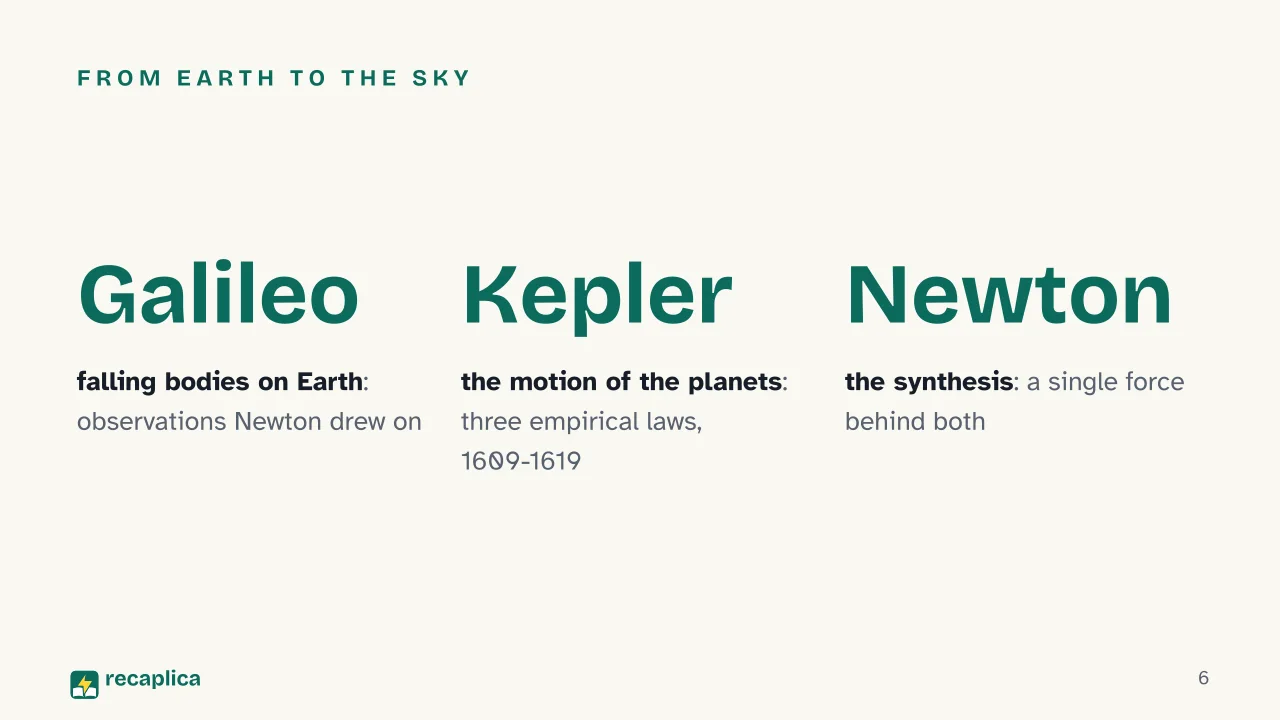 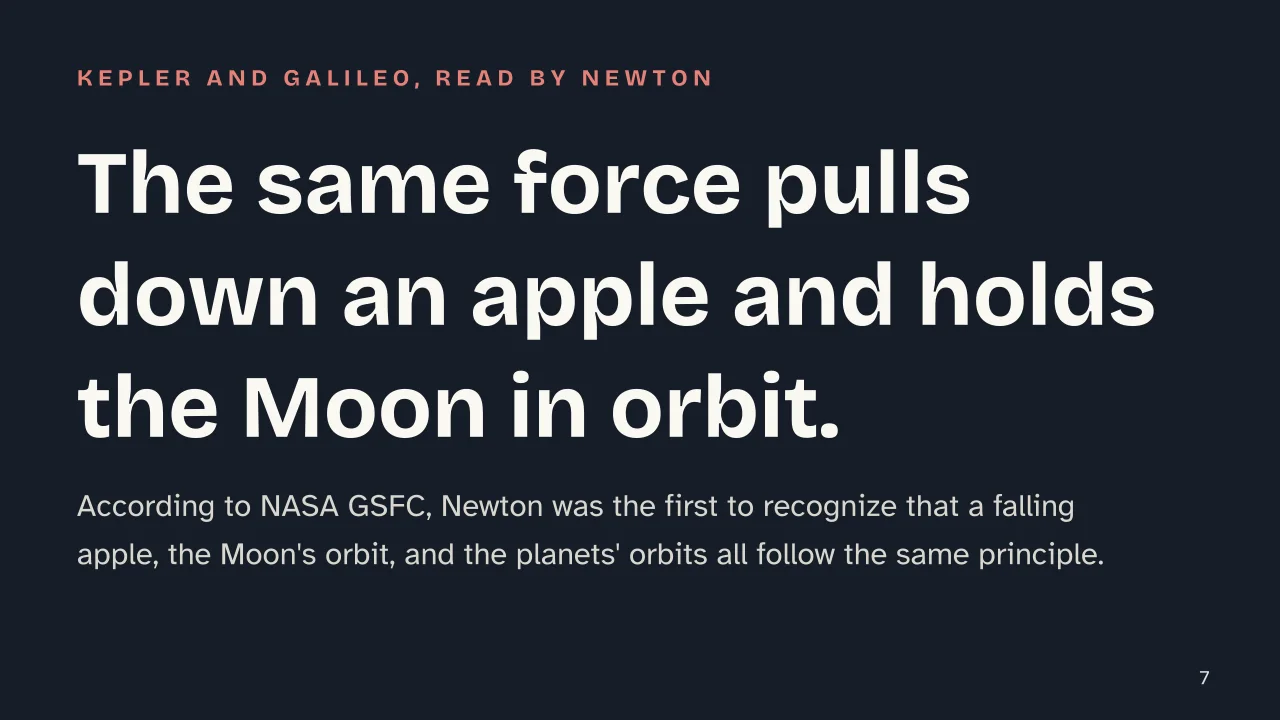 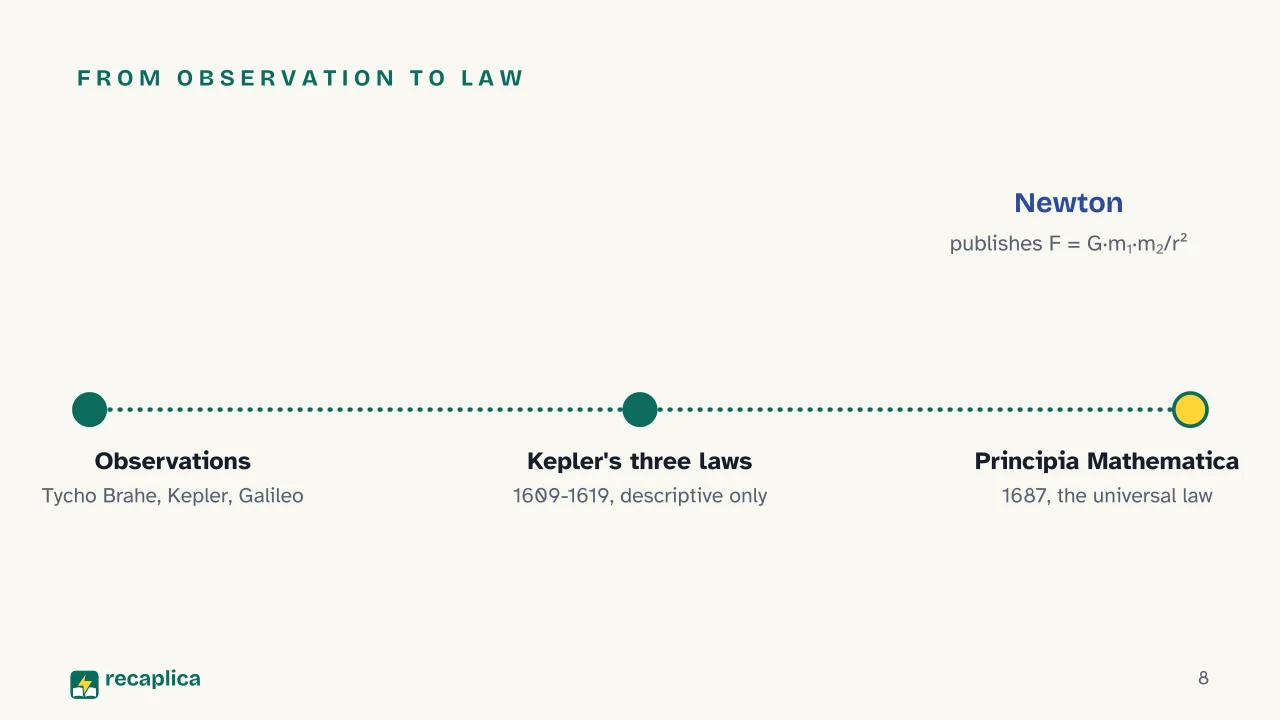 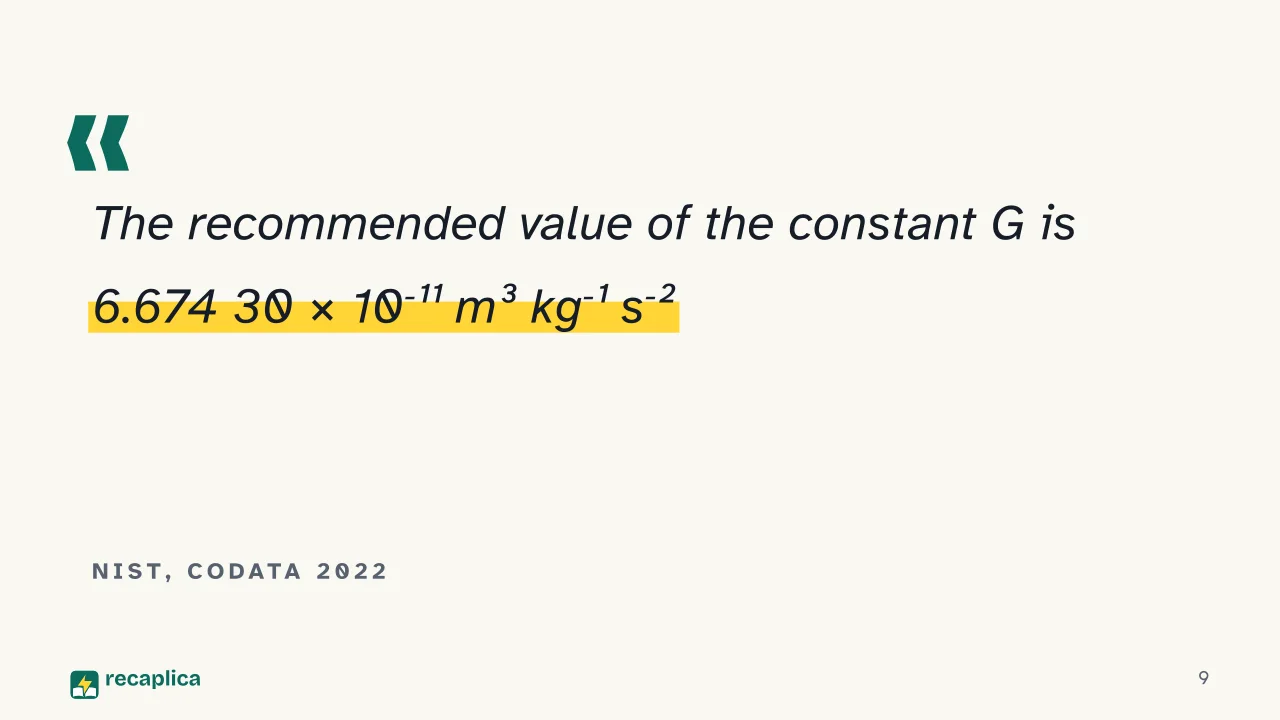 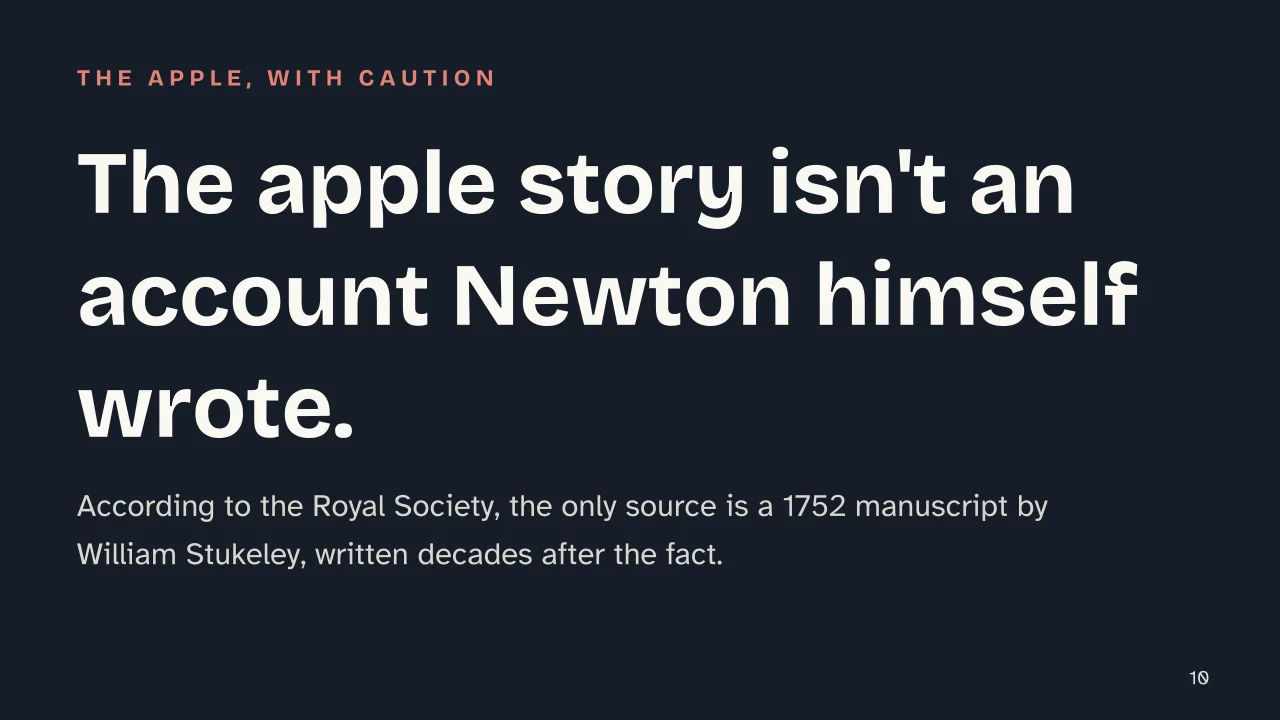 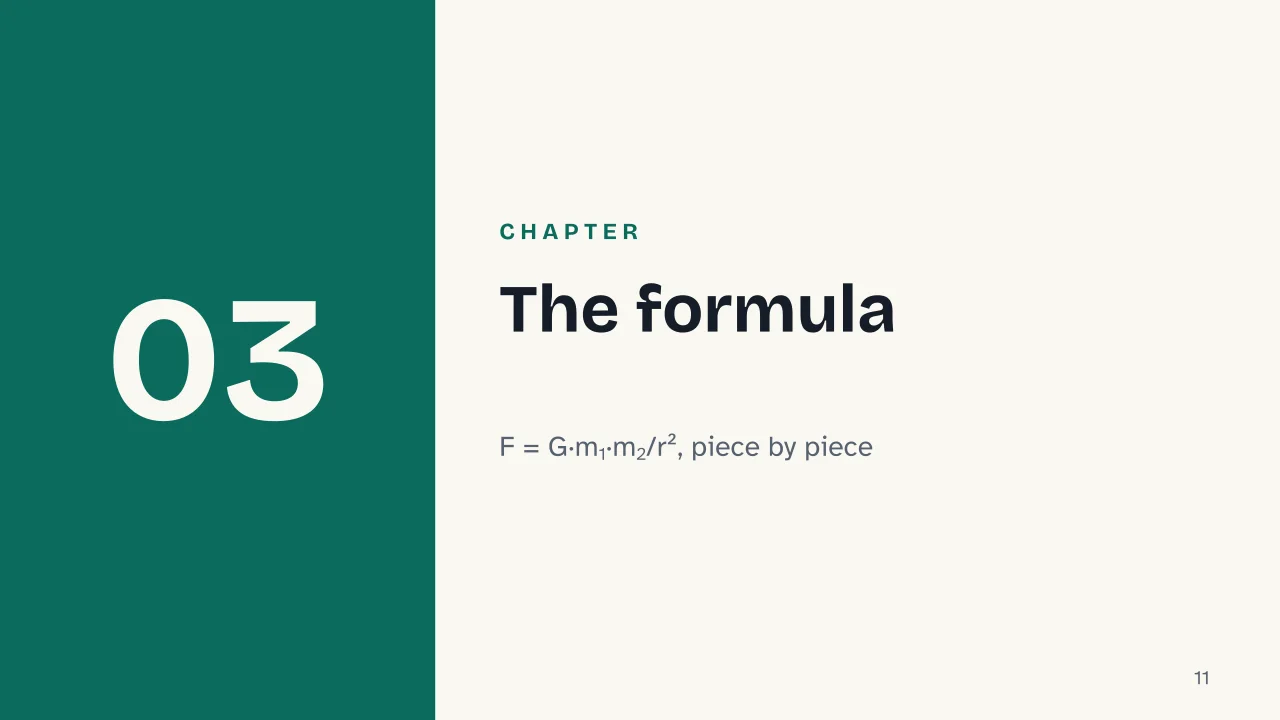 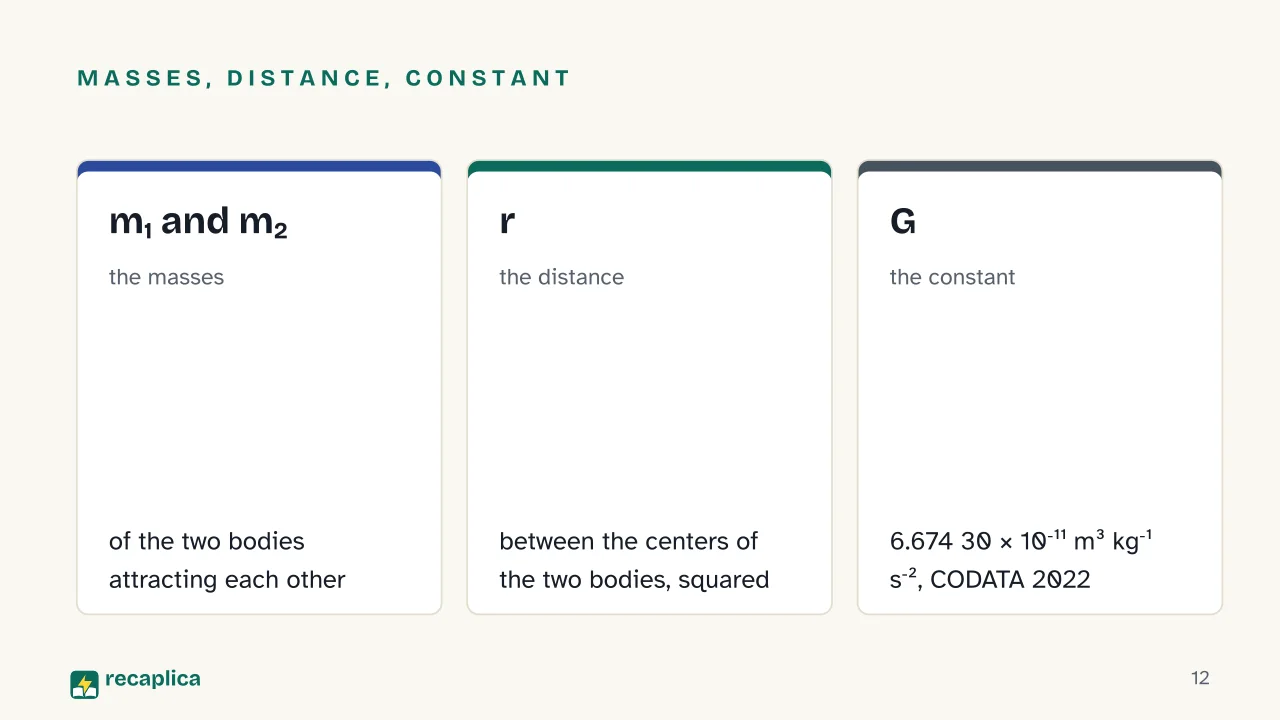  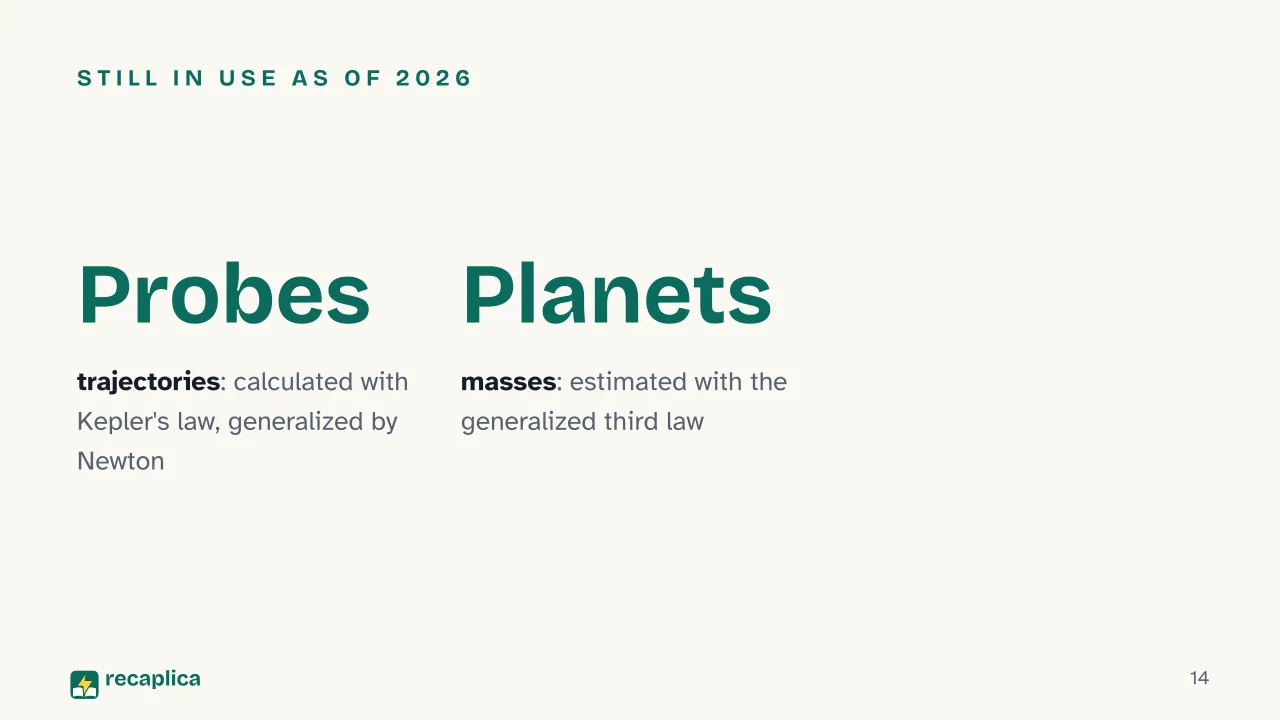   Common myths
Mind mapDrag the background to move around and the nodes to reposition them; use − and + to collapse and expand branches. 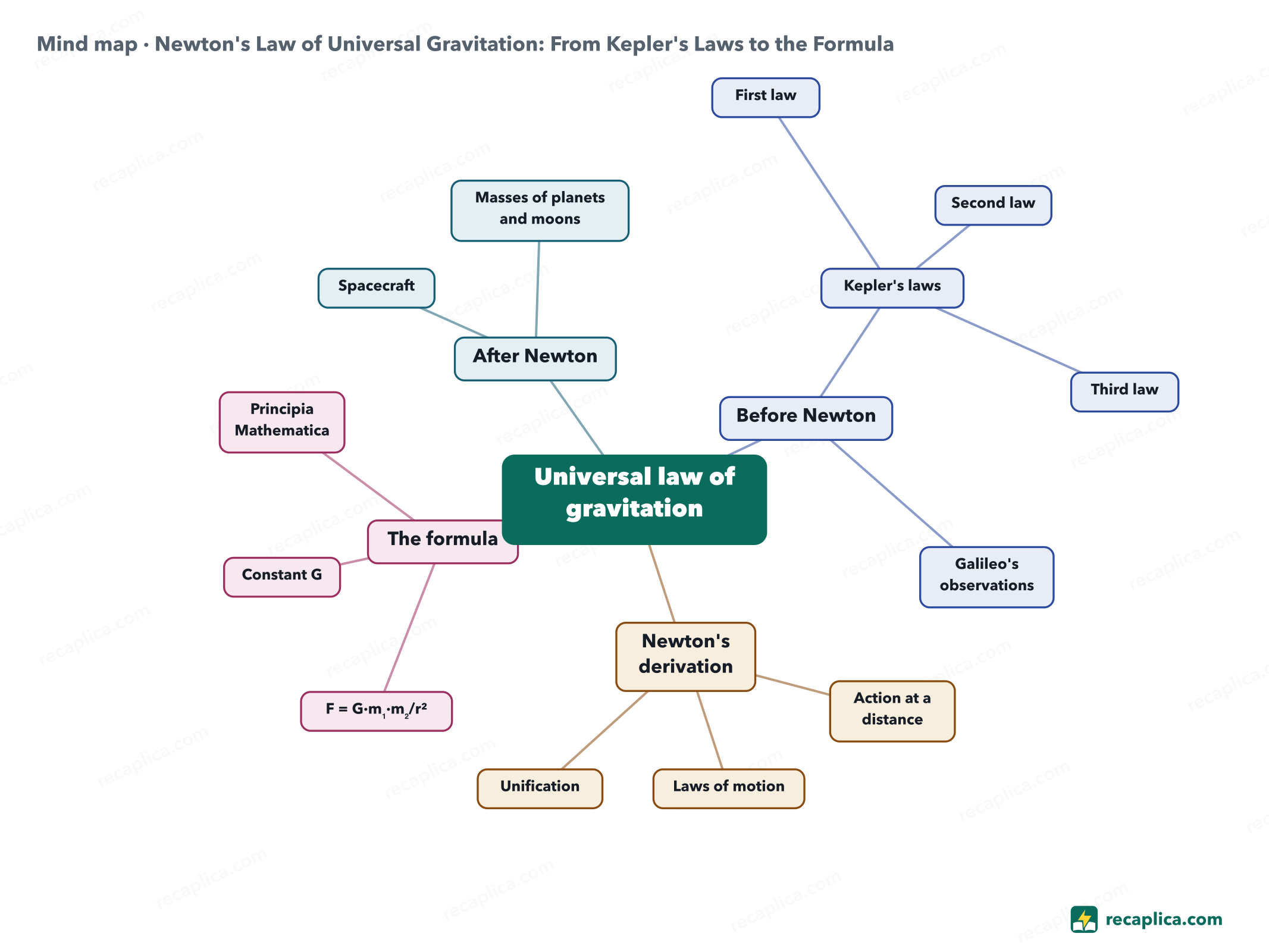
Quiz: test yourselfAnswer the questions to check what you have learned: you get instant feedback and a short explanation. Grade 0/10 0/5
FlashcardsTap the card to flip it and check whether you remember the answer, then move to the next one. 1 / 8 Explain it in your own wordsThe ultimate test: if you can explain it in simple words, you've truly understood it. Write your explanation, then compare it with the Recap. Your explanation is saved only on this device.
Frequently asked questionsHow did Isaac Newton discover gravity, starting from Kepler's laws?He started from what was already known: the three laws Kepler had worked out, between 1609 and 1619, for the motion of the planets, plus what Galileo had observed about falling bodies. Encyclopedia.com describes Newton folding in the possibility that bodies pull on each other without touching, together with his own laws of motion, to reach a law valid everywhere. What is the exact statement of the universal law of gravitation?Every pair of bodies in the universe pulls on each other with a force that grows with the product of their masses and shrinks with the square of the distance between their centers: F = G·m₁·m₂/r². What is G, and what does 6.674 30 × 10⁻¹¹ m³ kg⁻¹ s⁻² mean?G is the number that fixes, in the formula, how strong the gravitational force is for given masses and distance. NIST's CODATA 2022 puts the recommended value at 6.674 30 × 10⁻¹¹ m³ kg⁻¹ s⁻²; the associated relative uncertainty is 2.2 × 10⁻⁵. Is it true that an apple falling on Newton's head gave him the idea?It's a well-known story, but one to take with caution: the Royal Society traces it to a single source, a manuscript William Stukeley wrote in 1752, decades after Newton's actual insight and not penned by Newton at all. According to NASA GSFC, the apple did not actually hit Newton: what is credited to him is the insight that the same force making an apple fall also keeps the Moon in orbit. Is the universal law of gravitation the same thing as Kepler's laws?No. Kepler's laws describe how the planets move around the Sun — the shape of the orbit, equal areas in equal times, the ratio between period and distance — but leave the cause open. The universal law of gravitation supplies it: the same force that keeps a planet in orbit also makes an object fall on Earth. Every Recap goes through an independent review before publication. |