recaplica
Clear in 30 seconds, yours in 10 minutes.
In 30 seconds quick read
General relativity is the theory Albert Einstein finished in 1915 to explain gravity as a result of the curvature that massive bodies create in spacetime. A mass warps the spacetime around it, and other bodies move along geodesics, the straightest paths available in that curved geometry. The first confirmation came in 1919, when observations of a solar eclipse showed the Sun bending starlight by an amount that matched the theory. The effects are not confined to physics textbooks: GPS satellites also have to adjust their onboard clocks because of them. Special relativity, which Einstein had published a decade earlier, remains a separate theory, valid only far from any source of gravity.
Key Points
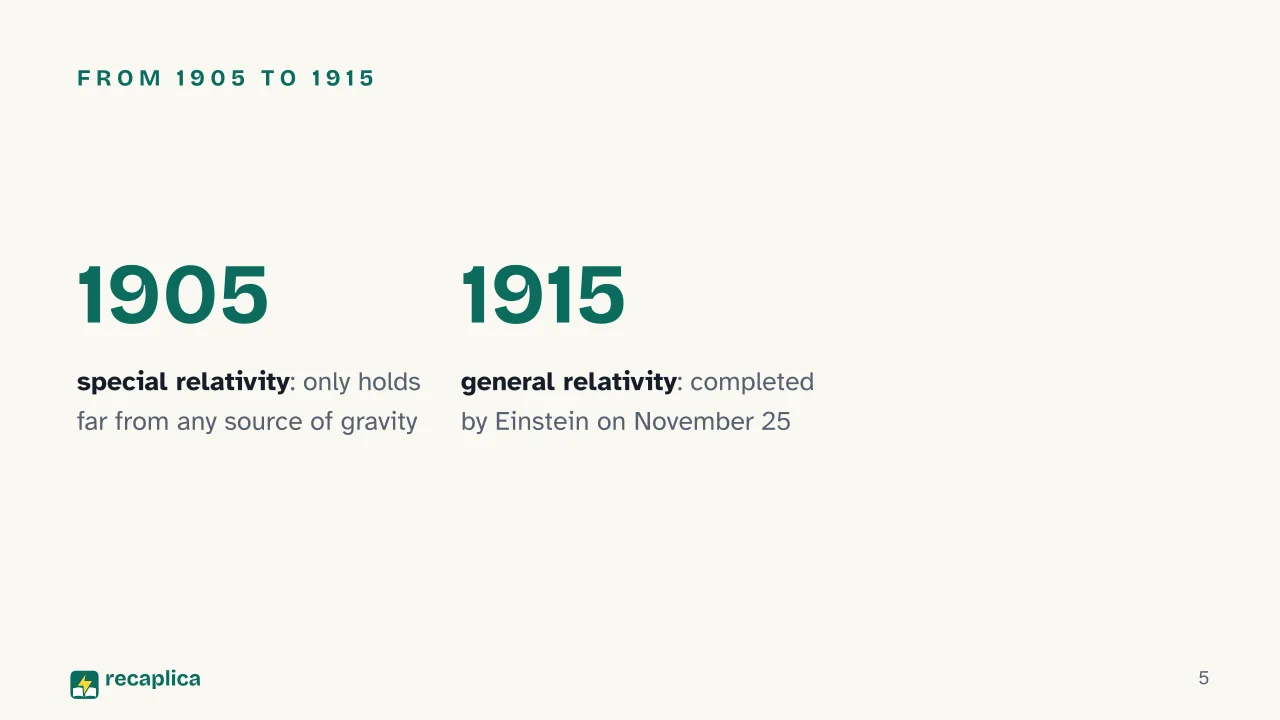
Einstein finished general relativity at the end of 1915, publishing the field equations on November 25 of that year.
A massive body curves the spacetime around it, and in this theory that curvature is what produces gravity.
A body moving through curved spacetime follows a geodesic, the straightest path that curvature allows.
A solar eclipse in 1919 gave astronomers their first look at whether the Sun actually bent passing starlight, and the shift they measured lined up with the theory.
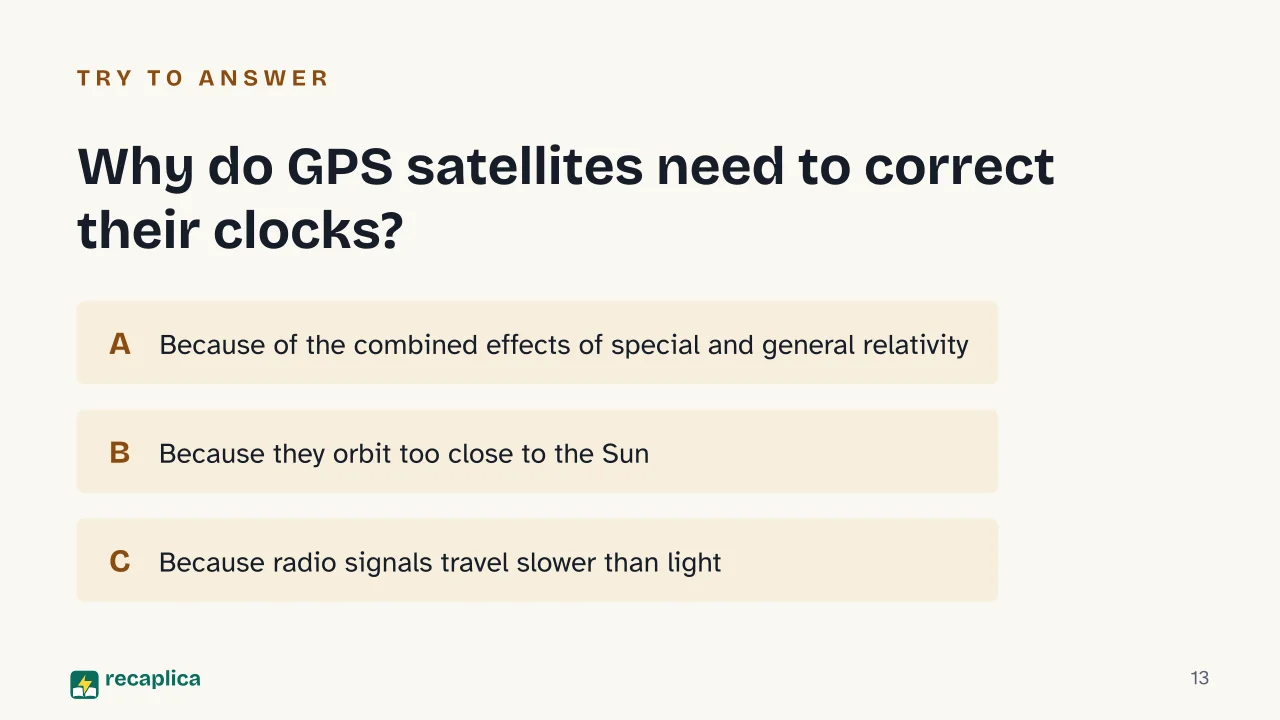
GPS satellites correct their onboard clocks to account for the combined effects of special and general relativity.
Special relativity, published in 1905, stays separate: its effects apply only where no mass nearby is curving spacetime.
Key figures
1915 Year Einstein published the field equations of general relativity, on November 25. Source: NASA Goddard Space Flight Center
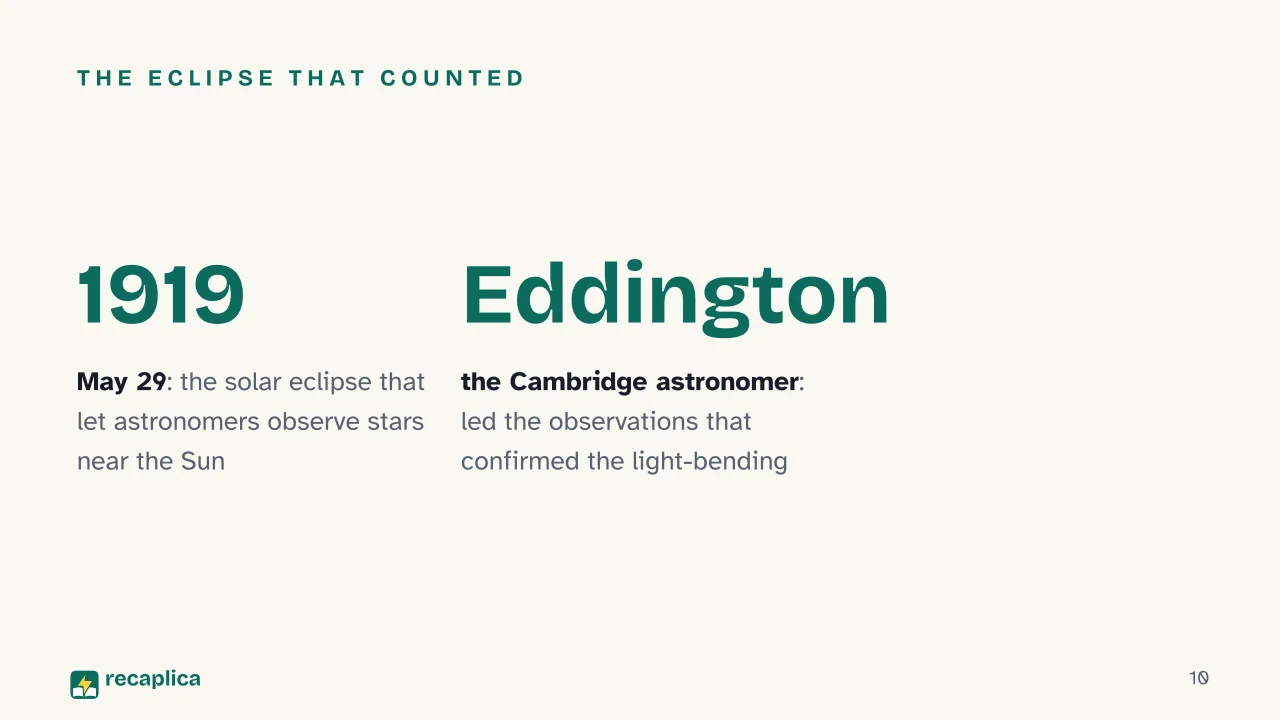
1919 Year of the solar eclipse whose observations, led by Arthur Eddington, confirmed the light-bending predicted by the theory. Source: ESA
Deep Dive
From special relativity to gravity
In 1905 Einstein had published special relativity, the theory linking space and time for observers in relative motion. That theory only holds for an observer far from any source of gravity: it is the limit that E = mc²: What Einstein’s Special Relativity Really Says cannot cross, and it took Einstein another ten years to get past it.
By late 1915, Einstein wrote that he had finally managed to complete the theory.
Gravity as the curvature of spacetime
General relativity hands gravity over to the curvature that massive bodies create in the spacetime around them. A mass placed in a region of space distorts the surrounding geometry, and other bodies move by following that distortion.
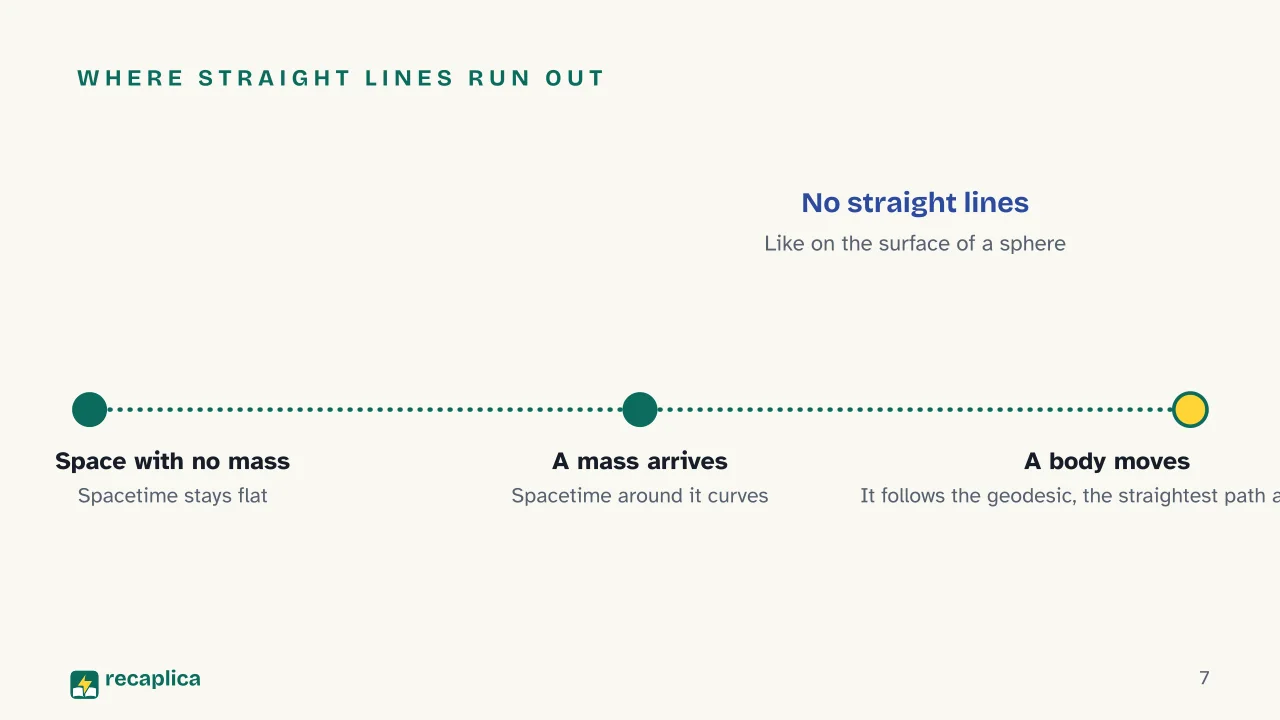
Where mass is present, spacetime is curved. Curved spacetime has no straight lines, just as the surface of a sphere has none: bodies follow geodesics, the straightest lines available in that geometry. Gravity, in this picture, does not deflect bodies from a straight path they would otherwise take; it redefines what moving “straight” even means once space itself is curved.
Practical example: picture a bowling ball resting on a stretched rubber sheet: the sheet dips under its weight, and a marble rolled near the ball follows the shape of that dip instead of rolling straight. It is the image NASA’s Gravity Probe B mission uses to make visible how a mass deforms spacetime, though it remains a teaching analogy, not a physical fact in itself. Physicist John Wheeler summed up the mechanism this way: mass shapes the geometry of spacetime, and that geometry in turn guides how mass moves.
The 1919 test: an eclipse puts the theory on trial
The theory predicted that the Sun would bend the light of stars passing close to it. Testing that required a solar eclipse, the only moment when stars very near the solar disk can be observed without the Sun’s own light hiding them.
Element
Detail
Date
May 29, 1919
Phenomenon observed
Total solar eclipse
Prediction
The Sun bends the light of nearby stars
Outcome
Bending consistent with general relativity
Key figure
Arthur Eddington, Cambridge astronomer
According to ESA, that eclipse ranks among the most important in the history of science: it was the moment Einstein’s theory, published only a few years before, moved from paper to the sky. ESA traces this idea about gravity back to 1915, from the same mind that had rewritten the concept of time in special relativity only years earlier. Arthur Eddington, of Cambridge University, was one of the few people who grasped the meaning of the freshly published theory almost on his own, and the measurements he led returned a bending of starlight near the Sun matching what the theory had calculated in advance. The effects of curved spacetime, pushed to their most extreme, also describe objects like Black Holes, What They Are and How They Form: a separate deep dive that starts from the same geometry covered here.
Effects measured today: from GPS to frame-dragging
General relativity has not stayed a chapter of science history. GPS satellites orbit at a different altitude and speed than a clock on the ground, and the combined effect of special and general relativity makes their clocks gain about 38 microseconds a day compared with a clock on Earth’s surface. That sounds tiny, but left uncorrected, the resulting position error would grow by about 10 km a day.
The Gravity Probe B mission, run by NASA together with Stanford University, was designed to detect another effect the theory predicts: spacetime being slightly dragged into rotation by a planet like Earth, a phenomenon called frame-dragging. Anyone interested in following the thread of time, including how orbiting clocks measure it differently from clocks on the ground, finds another angle on the same subject in Time Travel: Is It Possible? What Physics Really Says.
Slide deck
Slides ready to download and make your own in PowerPoint or Google Slides, with speaker notes. Pick the Flash cut or the Full one.
✗ Myth Gravity is a force like the other forces of nature.
✓ Reality In Einstein's theory gravity is not a force acting at a distance: it depends on how masses curve space and time around them, and other bodies simply follow that shape.
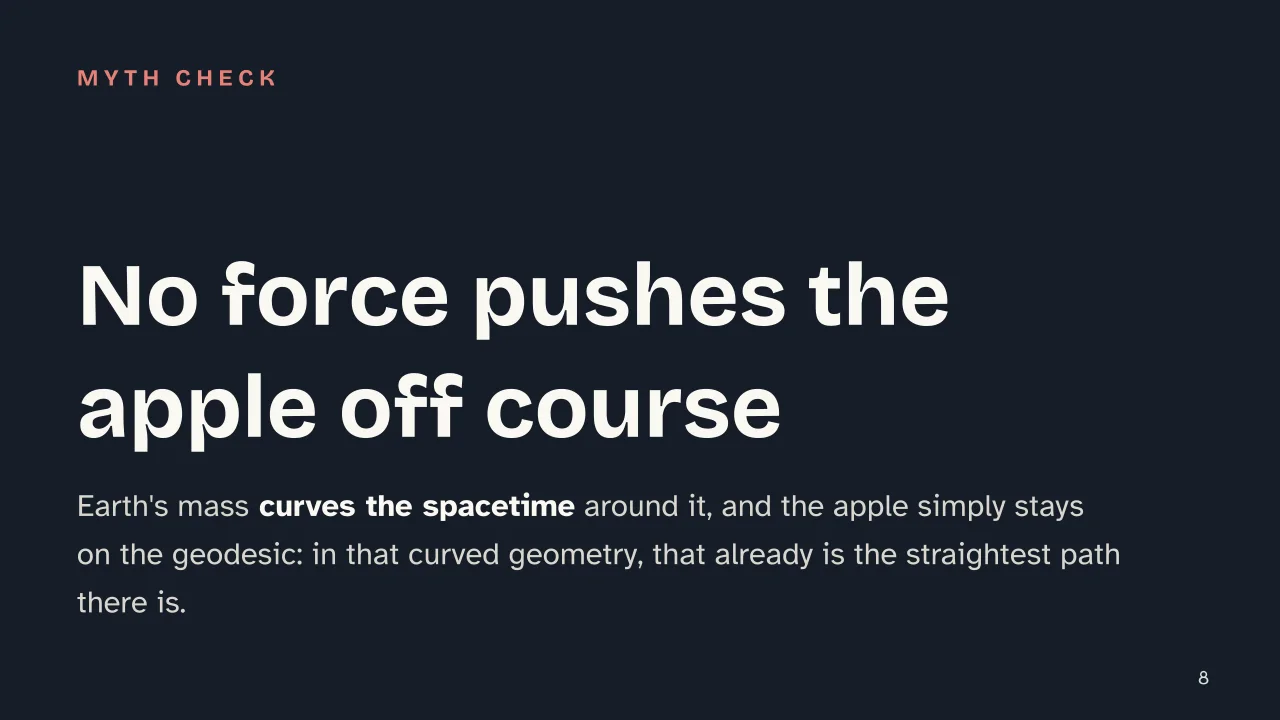
✗ Myth Curved spacetime pushes bodies off a straight path they would otherwise take.
✓ Reality According to the Max Planck Institute for Gravitational Physics, a moving body always follows the geodesic: the straightest route that the local curvature of spacetime allows.
✗ Myth General relativity only matters for extreme objects, far removed from everyday life.
✓ Reality Any mass curves the spacetime around it, in proportion to its own amount. The most familiar case is GPS satellites, which correct their onboard clocks to stay accurate.
Mind map
Drag the background to move around and the nodes to reposition them; use − and + to collapse and expand branches.
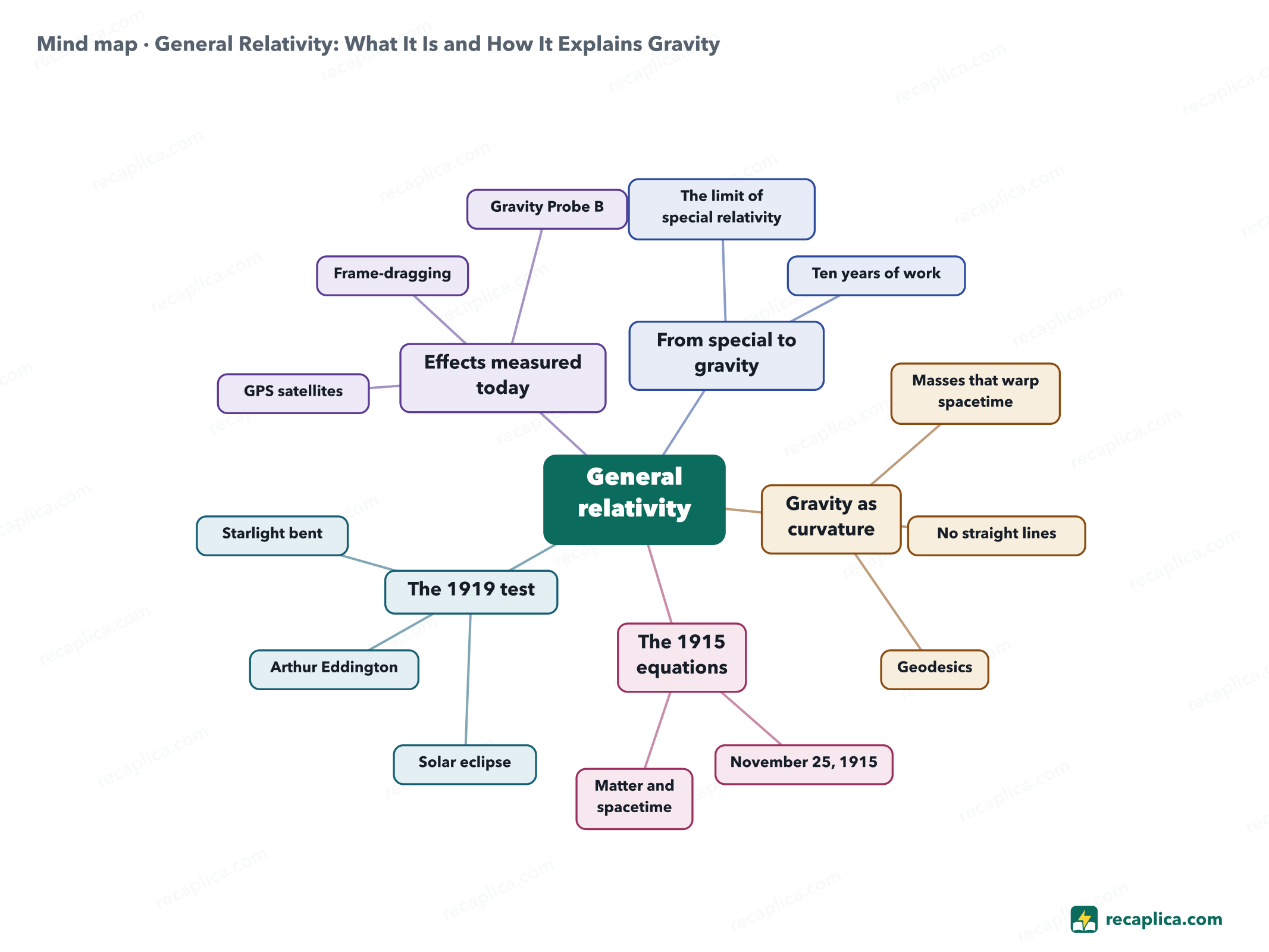
From special to gravityWhy Einstein went back to work after 1905
The limit of special relativityOnly valid far from any source of gravity
Ten years of workFrom 1905 to the 1915 completion
Gravity as curvature
Masses that warp spacetimeA mass curves the geometry around it
No straight linesLike on the surface of a sphere
GeodesicsThe straightest paths possible in curved space
The 1915 equations
November 25, 1915Publication of the field equations
Matter and spacetimeMatter tells spacetime how to curve, and vice versa
The 1919 test
Solar eclipseLets astronomers observe stars near the Sun
Arthur EddingtonLed the observations from Cambridge
Starlight bentBy an amount matching the theory
Effects measured today
GPS satellitesClocks that need correcting to stay accurate
Frame-draggingA rotating body drags spacetime around it
Gravity Probe BNASA mission that measured it
Quiz: test yourself
Answer the questions to check what you have learned: you get instant feedback and a short explanation.
Grade0/100/5
Answers: 1-B · 2-A · 3-A · 4-B · 5-B
Flashcards
Tap the card to flip it and check whether you remember the answer, then move to the next one.
1 / 8
Explain it in your own words
The ultimate test: if you can explain it in simple words, you've truly understood it. Write your explanation, then compare it with the Recap.
Your explanation is saved only on this device.
General relativity is the theory Albert Einstein finished in 1915 to explain gravity as a result of the curvature that massive bodies create in spacetime. A mass warps the spacetime around it, and other bodies move along geodesics, the straightest paths available in that curved geometry. The first confirmation came in 1919, when observations of a solar eclipse showed the Sun bending starlight by an amount that matched the theory. The effects are not confined to physics textbooks: GPS satellites also have to adjust their onboard clocks because of them. Special relativity, which Einstein had published a decade earlier, remains a separate theory, valid only far from any source of gravity.
Frequently asked questions
Are special relativity and general relativity the same theory?
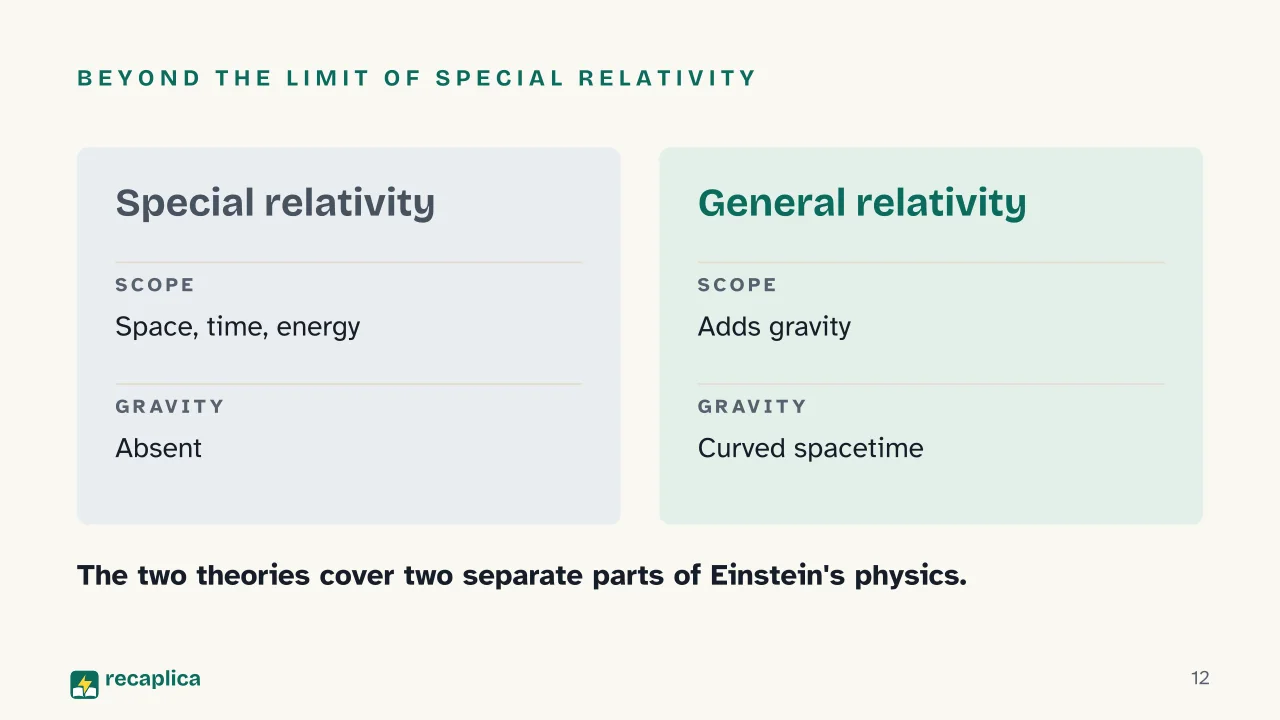
No, they are two separate theories by Einstein. Special relativity, from 1905, covers space, time, mass and energy when gravity is absent from the picture; general relativity, completed in 1915, adds gravity, described as curved spacetime.
How can general relativity be explained without the math?
The core idea is that a body with mass changes the shape of the space and time around it, and everything else moves taking that new shape into account: it is the difference between moving on a flat plane and moving on a curved surface, where straight lines do not exist.
What evidence shows that general relativity describes reality well?
In 1919 an eclipse made it possible to photograph stars very close to the Sun, and their apparent position turned out to be shifted by an amount consistent with what the theory, published in 1915, had predicted. Another piece of evidence, closer to everyday life, is the correction GPS satellites apply to their own clocks.
Does general relativity only matter for space?
No: any body with mass curves the spacetime around it, even by a tiny amount. The most concrete everyday case is GPS, whose satellites correct their own clocks to stay accurate.
Who first confirmed general relativity?
Cambridge astronomer Arthur Eddington was among the few experts who grasped Einstein's theory right away, and he led the 1919 solar eclipse observations that put it to the test.
Every Recap goes through an independent review before publication.
Statistics, only if you say so
To learn which Recaps help most we would use Google Analytics, with aggregate, anonymous data. It starts only with your OK, and you can change your mind anytime. Privacy policy