Skip to content
recaplica

    One moment: security check

    Cloudflare wants to make sure you're not a robot. Tick the box below and your search will continue on its own.

    IT
    recaplica Chemical Equilibrium: Definition, the Constant K and the Reaction Quotient Q
    © 2026 Recaplica · recaplica.com — All rights reserved
    Home › Science

    Chemical Equilibrium: Definition, the Constant K and the Reaction Quotient Q

    By Recaplica Newsroom · Updated on October 24, 2026

    What to print

    Page numbers appear when printing with default margins.

    Slides

    Choose a cut

    Flash10 slidesThe essential thread, to present in classFull15 slidesEvery chapter and the deeper detail

    Both come with speaker notes.

    Telegram channel
    recaplica Clear in 30 seconds, yours in 10 minutes.
    In 30 seconds Key points Figures Deep dive Slides Myths Mind map Quiz Flashcards FAQ

    In 30 seconds quick read

    A reversible reaction can run in either direction, and in a closed system it reaches a point where the amounts of reactants and products stop changing. At that point the forward and reverse reactions keep going at the same rate. The equilibrium constant K depends on temperature. Comparing the reaction quotient Q with K shows which way the reaction is heading. An ICE table handles the calculations.

    Key Points

    • Chemical equilibrium is the state in which the composition of a reacting mixture stops changing.
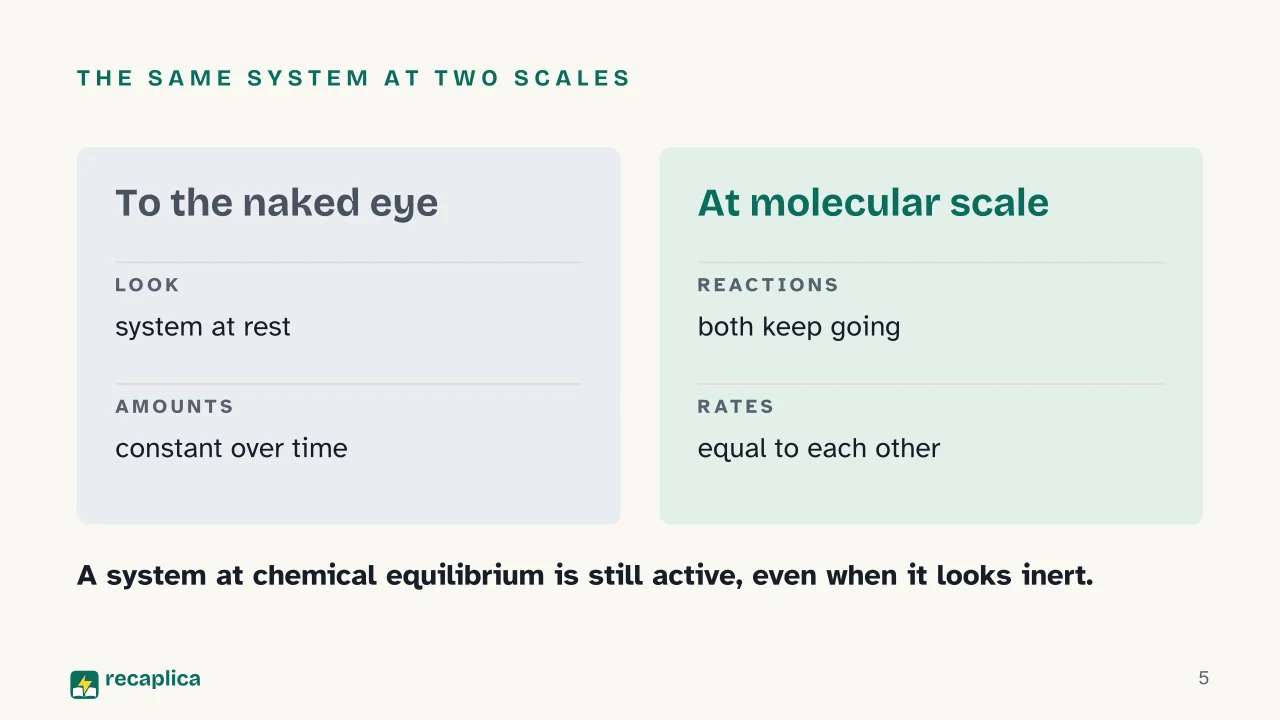
    • It is a dynamic equilibrium: the two opposite reactions go on at equal rates, so the net change is zero.
    • It is reached in a closed system, where no substance enters or leaves.
    • K is the value Q takes at equilibrium, and comparing Q with K shows whether the net reaction runs toward reactants or toward products.
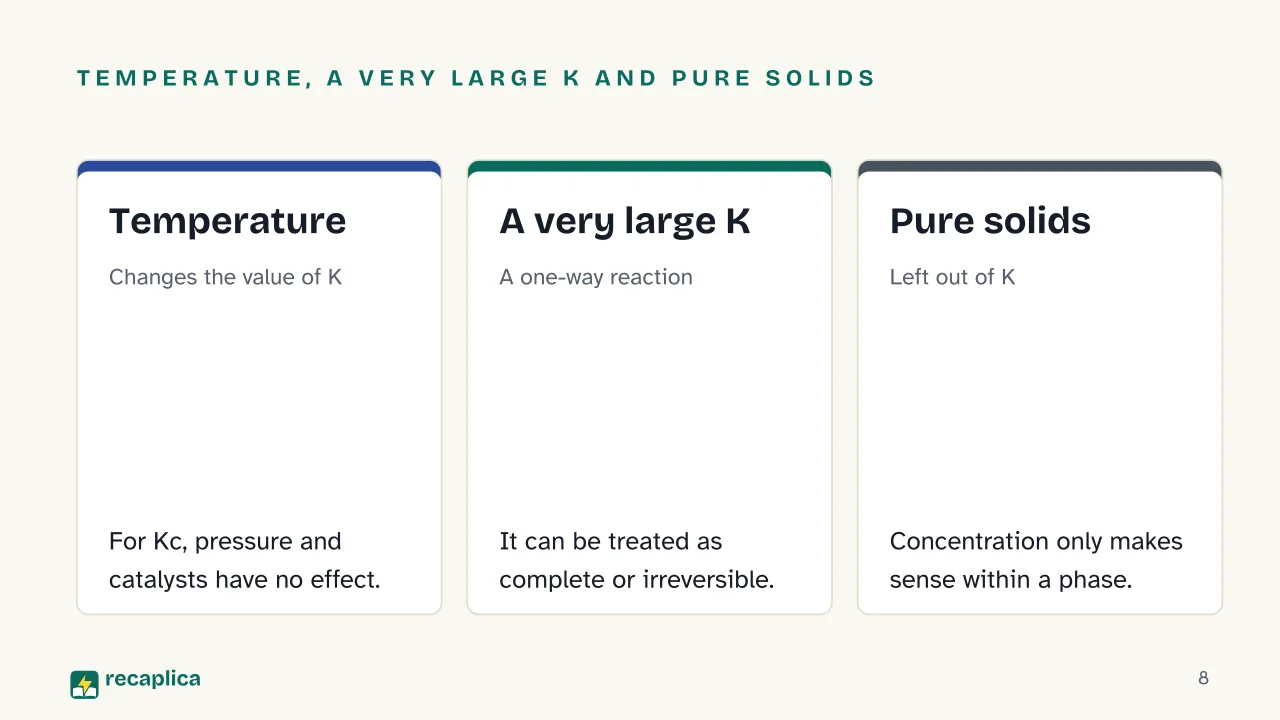
    • At a given temperature K has one fixed value. Temperature changes it; for Kc, pressure and catalysts have no effect.
    • In the K expression for heterogeneous equilibria, pure solids are left out.

    Key figures

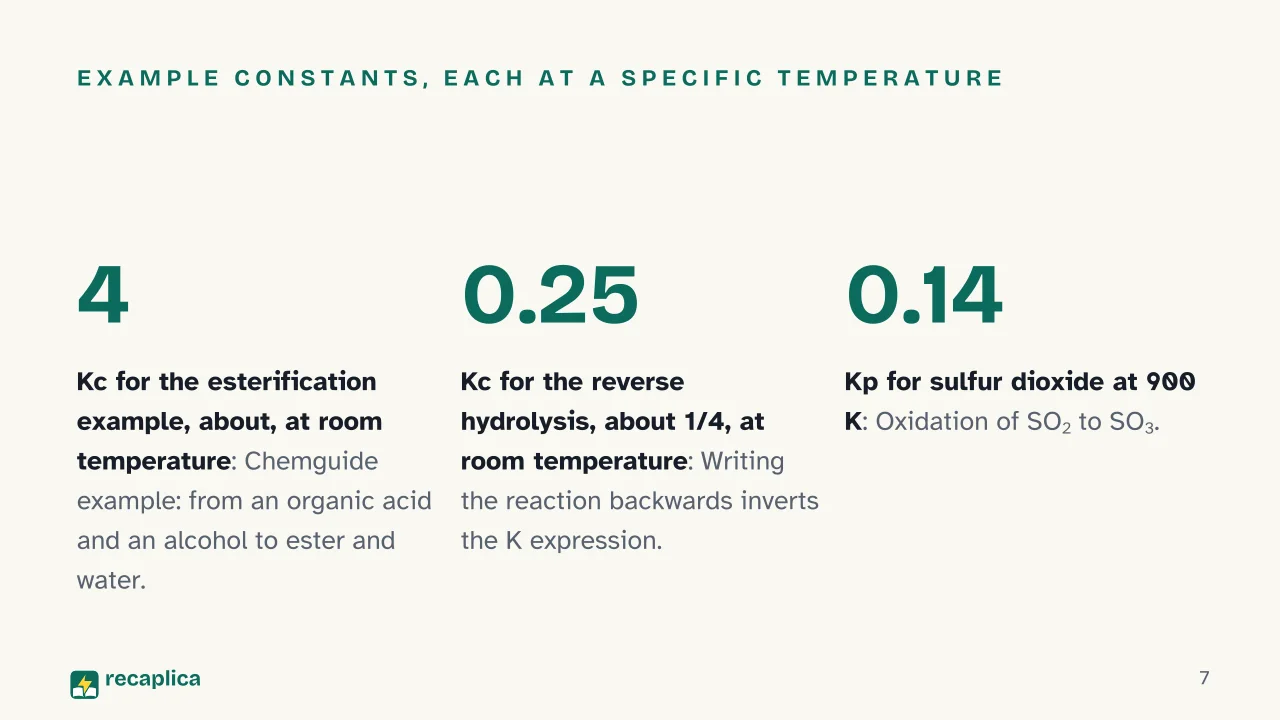
    • Kc ≈ 4 Equilibrium constant in Chemguide's esterification example (an organic acid and an alcohol forming ester and water) at room temperature. For the reverse reaction, hydrolysis, it is about 1/4 (0.25). Source: Chemguide (Jim Clark), equilibrium constants - Kc
    • Kp = 0.14 Value given in a Chem1 exercise for the oxidation of sulfur dioxide (2SO₂ + O₂ ⇌ 2SO₃) at 900 K. Source: Chem1 (Stephen Lower), 11.3 Reaction Quotient

    Deep Dive

    What is chemical equilibrium? A definition

    A reaction is at equilibrium when nothing pushes the amounts of reactants and products to shift any further. According to Chem1, the general chemistry textbook by Stephen Lower, the system looks still to the naked eye, while at the molecular level the forward and reverse reactions are both under way at the same rate, so no net change remains. Chemguide, Jim Clark’s site, names the starting point: a reversible reaction in a closed system, where matter neither comes in nor goes out. Given time, the two reactions end up running at equal rates, and every substance in the mixture holds a constant amount while both reactions carry on. What sets the speed of each of the two is covered in the Recap on reaction rate.

    Practical example: for H₂ + I₂ ⇌ 2HI, Chem1’s composition curves show that the equilibrium mixture is the same whether you start from the reactants or from HI.

    Reversible reactions and irreversible reactions

    In a reversible reaction the direction depends on the conditions: it can run from reactants to products or back again. Once it reaches equilibrium, the vessel still contains an appreciable amount of each, reactants and products alike.

    The opposite case exists too. Chem1 observes that when K is very large, the reaction can be regarded as one-way, complete or irreversible.

    The chemical equilibrium constant K: Kc and Kp

    K is simply the value of the reaction quotient Q once the system has reached equilibrium. It can be written with concentrations (Kc) or with pressures (Kp), and the two numbers generally differ. A value of K always comes with its temperature: In an exercise Chem1 gives Kp = 0.14 at 900 K for the oxidation of sulfur dioxide (2SO₂ + O₂ ⇌ 2SO₃).

    According to Chemguide, at a given temperature Kc always has the same value.

    FactorEffect on Kc
    Temperaturechanges the value
    Pressureno effect
    Catalystno effect

    Writing the reaction backwards inverts the K expression (Chem1), as the esterification example from Chemguide shows.

    Practical example: in Chemguide’s esterification example (an organic acid and an alcohol forming ester and water) Kc is about 4 at room temperature. For the reverse hydrolysis it is about 1/4, that is 0.25.

    Homogeneous and heterogeneous equilibria

    A homogeneous equilibrium involves a single phase, a heterogeneous one involves substances in more than one phase.

    HomogeneousHeterogeneous
    Phasesjust onemore than one

    In K expressions pure solids are left out, because concentration only makes sense within a phase (Chem1). For a hydrate losing water, in a solid-vapor equilibrium, K equals the partial pressure of the water vapor.

    The reaction quotient Q: which way the reaction goes

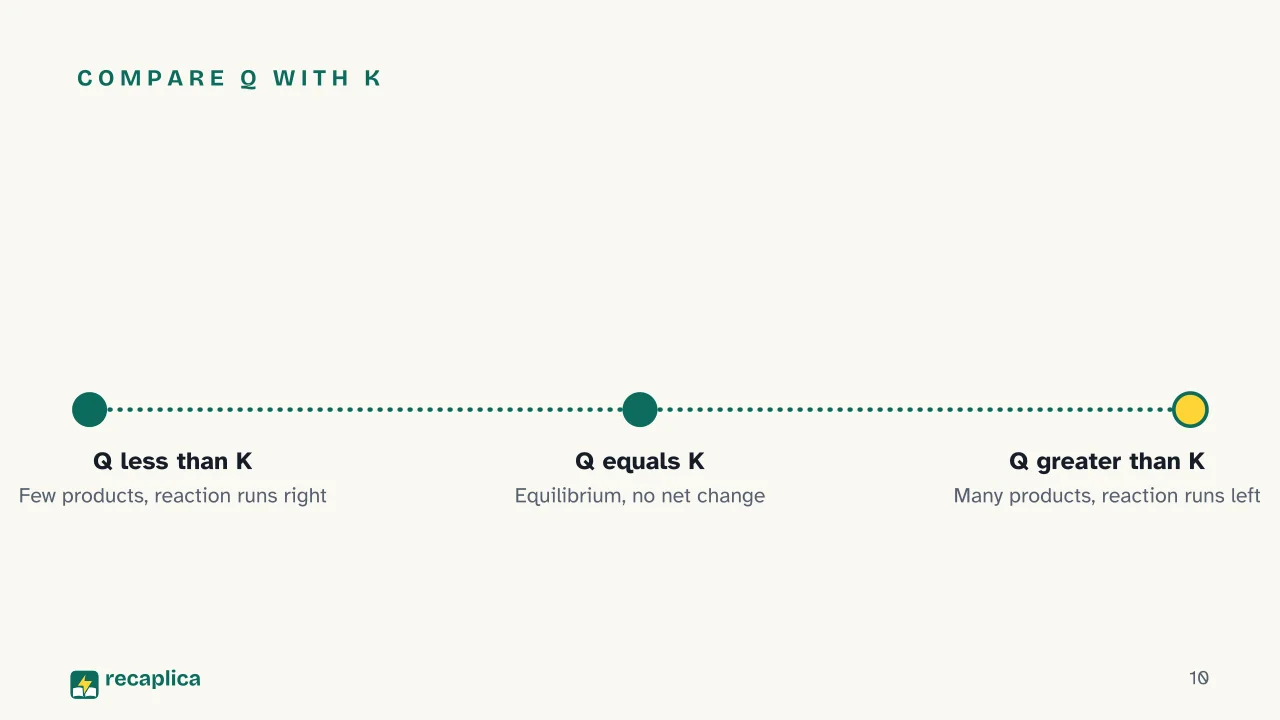
    Q is calculated from the amounts present at a given moment, and comparing it with K shows the direction of the net reaction. If Q equals K the system is at equilibrium and the composition no longer changes in a net way. How an equilibrium shifts when concentration, pressure or temperature change is the subject of Le Chatelier’s principle.

    ComparisonSituationNet reaction
    Q = Kequilibriumno change
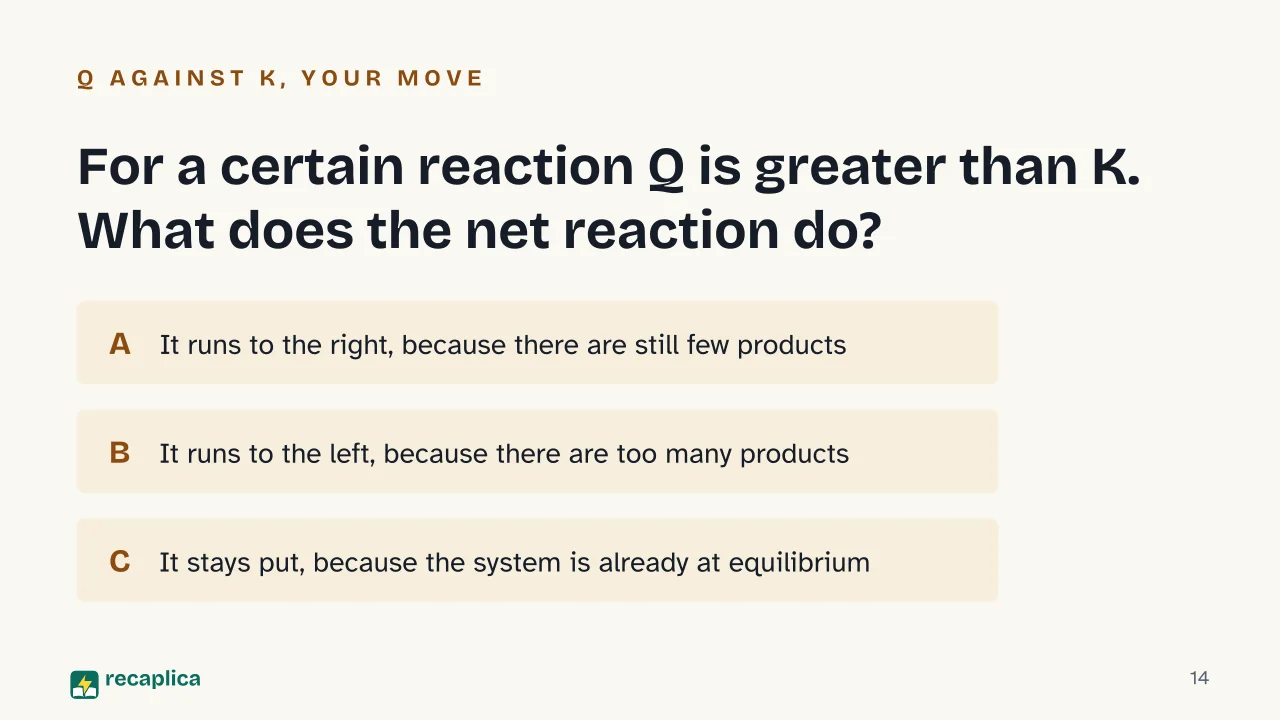
    Q > Ktoo many productsto the left, toward reactants
    Q < Ktoo few productsto the right, toward products

    Calculating equilibrium with an ICE table

    Chem1’s calculation method starts from a table with three rows: initial, change and equilibrium, the so-called ICE table. It is used to find the composition at equilibrium from K and the starting conditions.

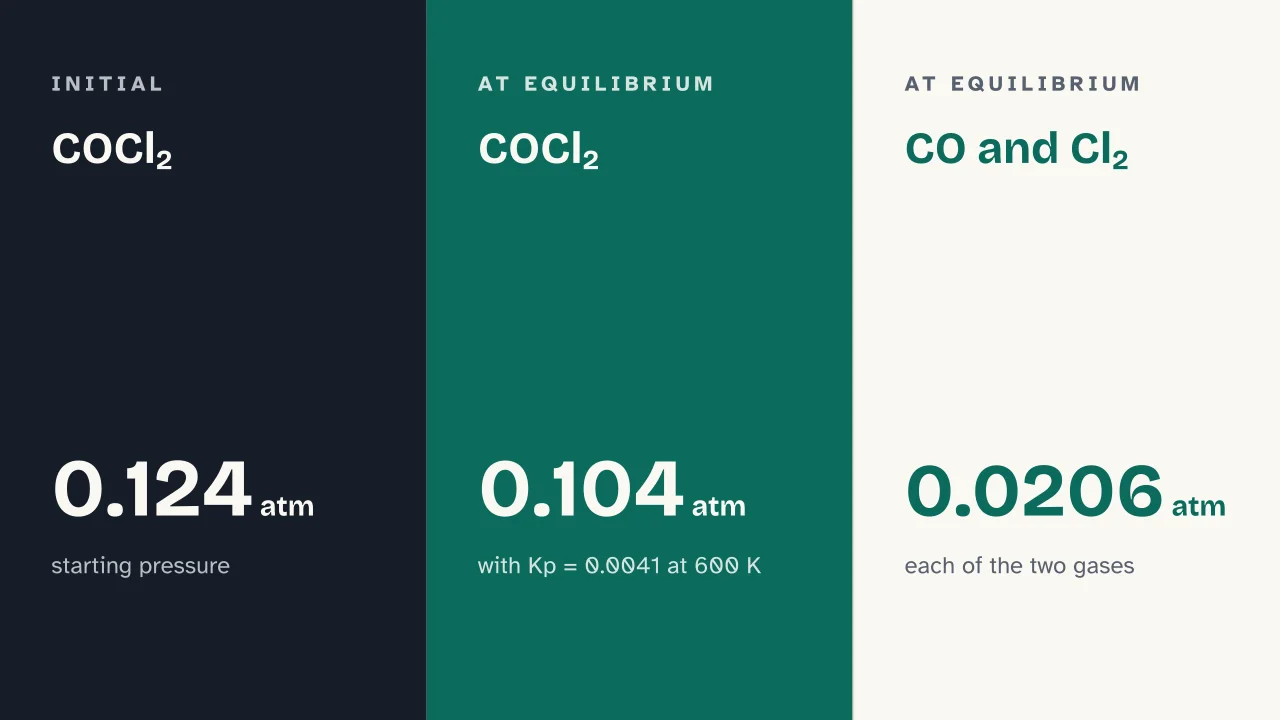
    Practical example: for phosgene (COCl₂ ⇌ CO + Cl₂) the page starts from 0.124 atm of COCl₂, with Kp = 0.0041 at 600 K. Because K is small, the change x is small compared with the starting pressure, and the approximate solution is very close to the exact one. The final pressures are 0.104 atm of COCl₂ and 0.0206 atm each of CO and Cl₂, all at 600 K.

    Slide deck

    Slides ready to download and make your own in PowerPoint or Google Slides, with speaker notes. Pick the Flash cut or the Full one.
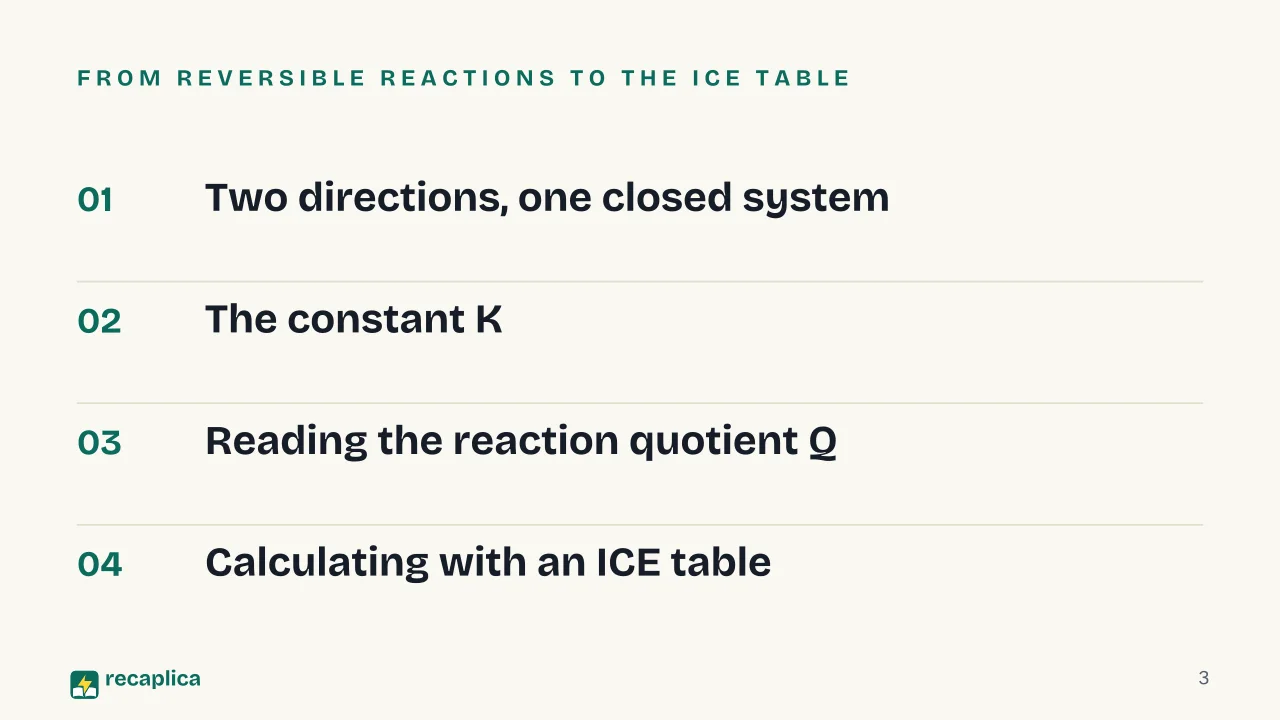
    Slide 1 of the presentation on Chemical Equilibrium: Chemical equilibriumSlide 2 of the presentation on Chemical Equilibrium: When the amounts stop changing, has the reaction stopped?Slide 3 of the presentation on Chemical Equilibrium: From reversible reactions to the ICE tableSlide 4 of the presentation on Chemical Equilibrium: Chapter 01: Two directions, one closed systemSlide 5 of the presentation on Chemical Equilibrium: The same system at two scalesSlide 6 of the presentation on Chemical Equilibrium: Chapter 02: The constant KSlide 7 of the presentation on Chemical Equilibrium: Example constants, each at a specific temperatureSlide 8 of the presentation on Chemical Equilibrium: Temperature, a very large K and pure solids: Temperature, A very large K, Pure solidsSlide 9 of the presentation on Chemical Equilibrium: Chapter 03: Reading the reaction quotient QSlide 10 of the presentation on Chemical Equilibrium: Compare Q with KSlide 11 of the presentation on Chemical Equilibrium: Chapter 04: Calculating with an ICE tableSlide 12 of the presentation on Chemical Equilibrium: COCl₂ · COCl₂ · CO and Cl₂Slide 13 of the presentation on Chemical Equilibrium: At equilibrium the reactions carry on.Slide 14 of the presentation on Chemical Equilibrium: For a certain reaction Q is greater than K. What does the net reaction do?Slide 15 of the presentation on Chemical Equilibrium: Recap ready to review
    Flash10 slidesThe essential thread, to present in classFull15 slidesEvery chapter and the deeper detail

    Common myths

    • ✗ Myth At equilibrium, the reactions stop.

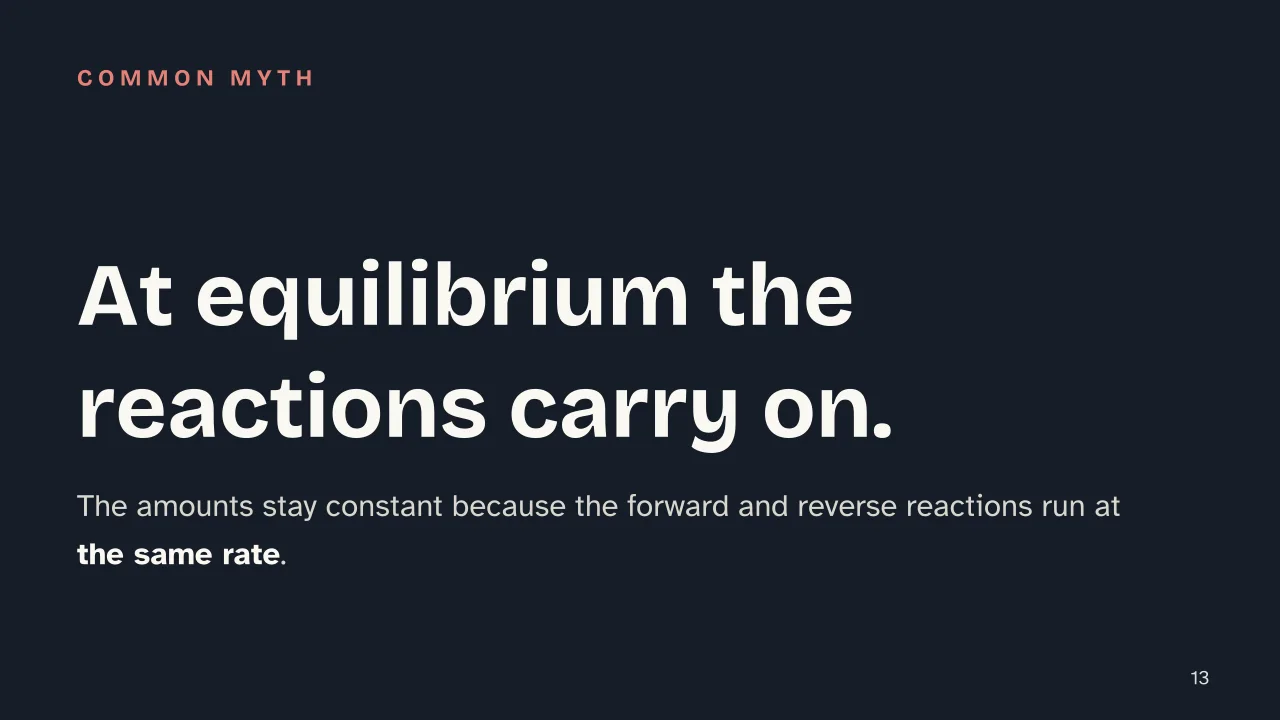
      ✓ Reality Take a mixture of H₂ and I₂ forming HI. After a while the amounts stop changing and the flask looks inert. At the molecular level, though, the forward and reverse reactions both carry on at identical rates, and that match is what erases any net change. Chemguide confirms that every substance keeps a constant amount while the reactions continue.

    • ✗ Myth At equilibrium, reactants and products are present in equal amounts.

      ✓ Reality Equilibrium fixes constant amounts, not equal ones. In Chemguide's esterification example Kc is about 4 at room temperature, a value different from 1.

    • ✗ Myth The equilibrium constant changes if you alter the pressure or add a catalyst.

      ✓ Reality According to Chemguide, once the temperature is fixed, Kc depends on neither pressure nor a catalyst. Chem1 states that the constant varies with temperature.

    Mind map

    Drag the background to move around and the nodes to reposition them; use − and + to collapse and expand branches.
    Customize
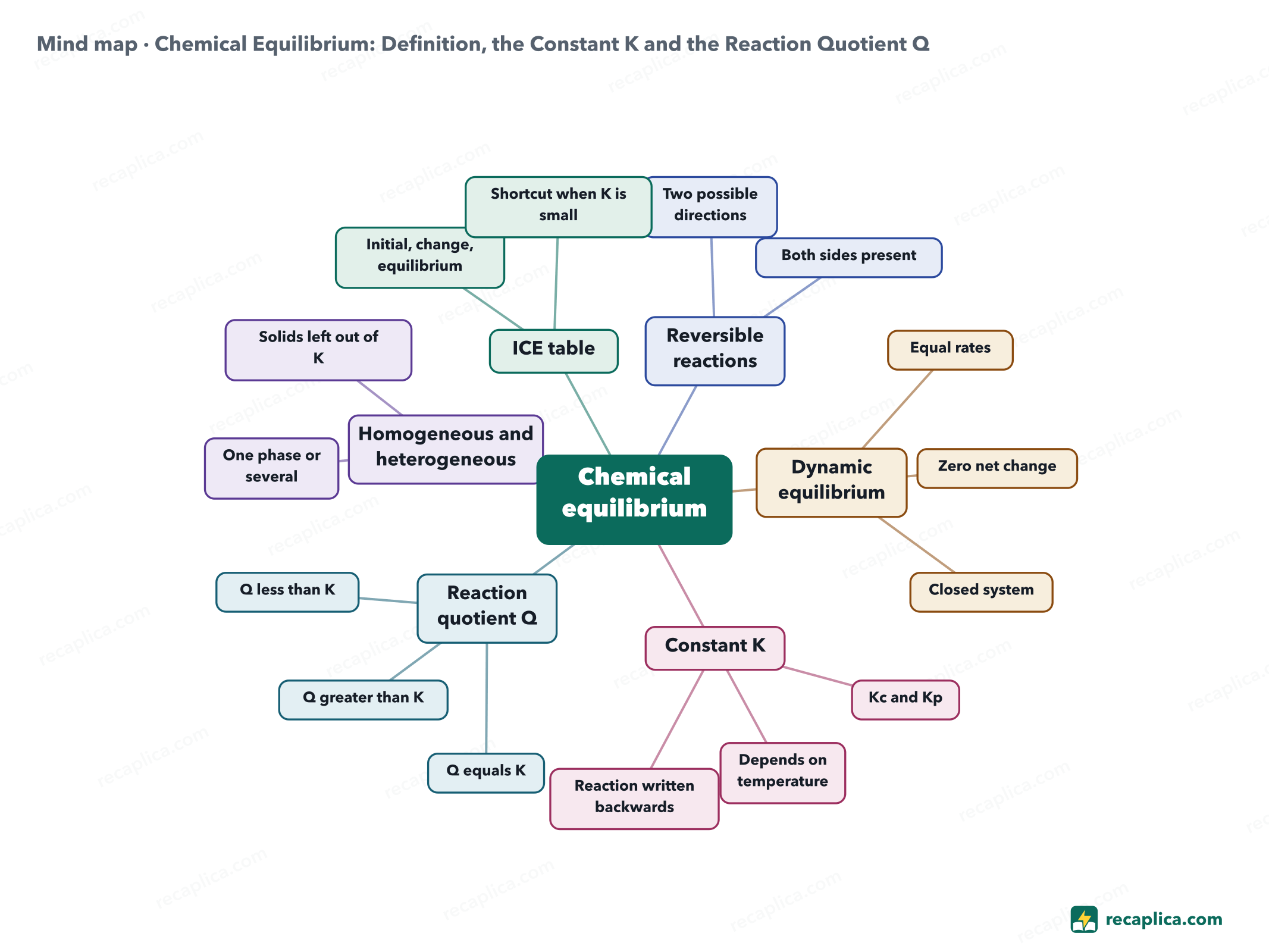
    Mind map: Chemical Equilibrium: Definition, the Constant K and the Reaction Quotient Q
    • Chemical equilibrium
      • Reversible reactions
        • Two possible directions
        • Both sides present
      • Dynamic equilibrium
        • Equal rates
        • Zero net change
        • Closed system
      • Constant K
        • Kc and Kp
        • Depends on temperature
        • Reaction written backwards
      • Reaction quotient Q
        • Q equals K
        • Q greater than K
        • Q less than K
      • Homogeneous and heterogeneous
        • One phase or several
        • Solids left out of K
      • ICE table
        • Initial, change, equilibrium
        • Shortcut when K is small

    Quiz: test yourself

    Answer the questions to check what you have learned: you get instant feedback and a short explanation.

    Grade 0/10 0/5
    1 For a certain reaction, Q is measured and turns out greater than K. What does the net reaction do?

    With Q greater than K there are too many products compared with equilibrium, so the net reaction heads left, back to the reactants. If Q were less than K, products would be scarce and the reaction would run to the right.

    2 Which of these factors changes the value of the equilibrium constant?

    According to Chem1, the equilibrium constant varies with temperature. Chemguide adds that Kc does not change with pressure or with a catalyst.

    3 True or false? When a reversible reaction reaches equilibrium, the forward and reverse reactions stop.

    At equilibrium both reactions continue at equal rates. Because the rates are equal, the amounts of all substances stay constant.

    4 How are pure solids treated in the K expression of a heterogeneous equilibrium?

    Chem1 explains that pure solids do not enter the K expression. For a hydrate losing water, for example, K reduces to the water vapor's partial pressure.

    5 What can be said about a reaction with a very large K?

    Chem1 notes that with a very large K a reaction can be treated as complete.

    Answers: 1-B · 2-C · 3-B · 4-A · 5-C

    Flashcards

    Tap the card to flip it and check whether you remember the answer, then move to the next one.

    1 / 8

    Explain it in your own words

    The ultimate test: if you can explain it in simple words, you've truly understood it. Write your explanation, then compare it with the Recap.

    Your explanation is saved only on this device.

    A reversible reaction can run in either direction, and in a closed system it reaches a point where the amounts of reactants and products stop changing. At that point the forward and reverse reactions keep going at the same rate. The equilibrium constant K depends on temperature. Comparing the reaction quotient Q with K shows which way the reaction is heading. An ICE table handles the calculations.

    Frequently asked questions

    What is chemical equilibrium in simple terms?

    It is the situation in which, for a reversible reaction in a closed system, the amounts of reactants and products stop changing. The reactions keep running in both directions at the same rate, which is why it is called a dynamic equilibrium.

    What is the difference between Kc and Kp?

    Kc is written with concentrations and Kp with pressures. They describe the same equilibrium, but the two numbers are generally not equal, and both must be read with the temperature at which they were measured.

    How do you use Q to tell whether a reaction is at equilibrium?

    Calculate Q from the amounts present at that moment and compare it with K. If they are equal, the system is at equilibrium. If Q is greater than K the net reaction runs toward the reactants, and if it is smaller it runs toward the products.

    What is an ICE table and what is it for?

    It is a calculation method built on a table with rows for initial, change and equilibrium, used to find the amounts present at equilibrium when K and the starting conditions are known. Chem1 uses it, for example, for phosgene at 600 K.

    Does a truly irreversible reaction exist?

    According to Chem1, a very large K lets you treat a reaction as one-way, meaning complete or irreversible.

    Sources

    • Chem1 (Stephen Lower), 11.1 Introduction to Chemical Equilibrium
    • Chem1 (Stephen Lower), 11.3 Reaction Quotient
    • Chem1 (Stephen Lower), 11.4 Equilibrium Expressions
    • Chem1 (Stephen Lower), 11.5 Equilibrium Calculations
    • Chemguide (Jim Clark), an introduction to chemical equilibria
    • Chemguide (Jim Clark), equilibrium constants - Kc

    Every Recap goes through an independent review before publication.

    Every evening, the day's new Recaps on our Telegram channel. Join the channel →

    Keep learning

    • Science Balancing Redox Reactions: Half-Reaction and Oxidation Number Methods A redox reaction is balanced when every element has the same number of atoms on both sides and the total charge is the same too. There are two routes. With the half-reaction method you write oxidation and reduction separately, add water, H⁺ and electrons, and then add the two halves together. With the oxidation number method you look at how much each element's number rises and falls, and pick coefficients that make the total rise equal the total fall. In basic solution you start as in acid, and at the end the H⁺ ions are turned into water with OH⁻. Read the Recap →
    • Science Brønsted-Lowry theory: definition of acids, bases and conjugate pairs In 1923 Johannes Brønsted and Thomas Lowry, working independently, defined an acid as a species that gives away a proton and a base as a species that takes one in. An acid-base reaction is therefore a transfer of a proton, and every transfer produces two conjugate pairs. Water can act as either an acid or a base, and ammonia is a base even though its formula has no OH-. The theory generalizes Arrhenius's, which holds only for water solutions. Read the Recap →
    • Science Le Chatelier's Principle: Definition and Examples Le Chatelier's principle says that when something changes in a system at chemical equilibrium, the equilibrium moves in the direction that works against the change. It helps predict which way a reaction shifts after a change in concentration, pressure or temperature. A catalyst is outside the rule: it gets the system to equilibrium sooner and leaves the position where it was. Read the Recap →

    recaplica

    Clear in 30 seconds, yours in 10 minutes.

    Recaps Mind maps Request a Recap Telegram channel Mind map maker Our method About Privacy & cookies Legal notes & terms of use

    © 2026 Recaplica · A project by Curi S.r.l. — VAT IT05472000750

    Statistics, only if you say so

    To learn which Recaps help most we would use Google Analytics, with aggregate, anonymous data. It starts only with your OK, and you can change your mind anytime. Privacy policy