Skip to content
recaplica

    One moment: security check

    Cloudflare wants to make sure you're not a robot. Tick the box below and your search will continue on its own.

    IT
    recaplica Electromagnetic Spectrum: What Is It? From Radio Waves to Gamma Rays
    © 2026 Recaplica · recaplica.com — All rights reserved
    Home › Science

    Electromagnetic Spectrum: What Is It? From Radio Waves to Gamma Rays

    By Recaplica Newsroom · Updated on October 19, 2026

    What to print

    Page numbers appear when printing with default margins.

    Slides

    Choose a cut

    Flash10 slidesThe essential thread, to present in classFull16 slidesEvery chapter and the deeper detail

    Both come with speaker notes.

    Telegram channel
    recaplica Clear in 30 seconds, yours in 10 minutes.
    In 30 seconds Key points Figures Deep dive Slides Myths Mind map Quiz Flashcards FAQ

    In 30 seconds quick read

    The electromagnetic spectrum is the full range of electromagnetic radiation that exists, from radio waves to gamma rays. Every band is set apart from the others by its wavelength, its frequency and the energy of the photons that carry it, three quantities tied to one another. At the two ends, energy rises from radio waves, the weakest band, up to gamma rays, the most energetic radiation in the whole spectrum. In between sit microwaves, infrared, visible light, ultraviolet and X-rays, each with its own documented uses and risks.

    Key Points

    • The electromagnetic spectrum covers every known form of electromagnetic radiation, described equally well as waves or as photons, massless particles that move at the speed of light.
    • The bands, in order of rising photon energy, are radio waves, microwaves, infrared, visible light, ultraviolet, X-rays and finally gamma rays.
    • The shorter a radiation's wavelength, the higher its photon's energy, the rule NASA uses to order the entire spectrum from radio waves to gamma rays.
    • Gamma rays, X-rays and part of the ultraviolet range carry enough energy to strip electrons from atoms, the threshold NASA calls ionizing radiation.
    • Every band has its own documented uses; microwaves heat food in an oven, infrared drives remote controls, and X-rays pass through body tissue in medical imaging.
    • According to NASA, radio waves travel at exactly the speed of light, an experimental confirmation of Maxwell's theory of electromagnetism.

    Key figures

    • 95% the share of UV-B radiation absorbed by Earth's atmospheric ozone, according to NASA Science's pages on ultraviolet light, updated in 2023 Source: NASA Science
    • 0.03–3 nm the wavelength range of X-rays, according to NASA Science's page on X-rays, updated in 2023 Source: NASA Science
    • 299,792,458 m/s the speed of light in a vacuum, the constant NASA and the Goddard Space Flight Center use to describe the electromagnetic spectrum, on a page updated in 2014 Source: NASA / Goddard Space Flight Center

    Deep Dive

    What the electromagnetic spectrum is

    NASA and the Goddard Space Flight Center use the term for the complete run of electromagnetic radiation that exists. It is not one single thing but a family: it reaches from radio waves up through microwaves, infrared, visible light and ultraviolet, all the way to X-rays and gamma rays. All of these forms of radiation travel as a stream of photons, tiny massless carriers that move at light speed and that, per the same source, behave partly as waves and partly as particles.

    Every photon carries a specific amount of energy, and it is precisely the different amounts of energy that set the different types of radiation apart. Low-energy photons, such as those in radio waves, behave more like waves; high-energy photons, such as those in X-rays, behave more like particles. Electromagnetic radiation originates in electric and magnetic phenomena, the same underlying principle that drives electric current in a circuit.

    Frequency, wavelength and the speed of light

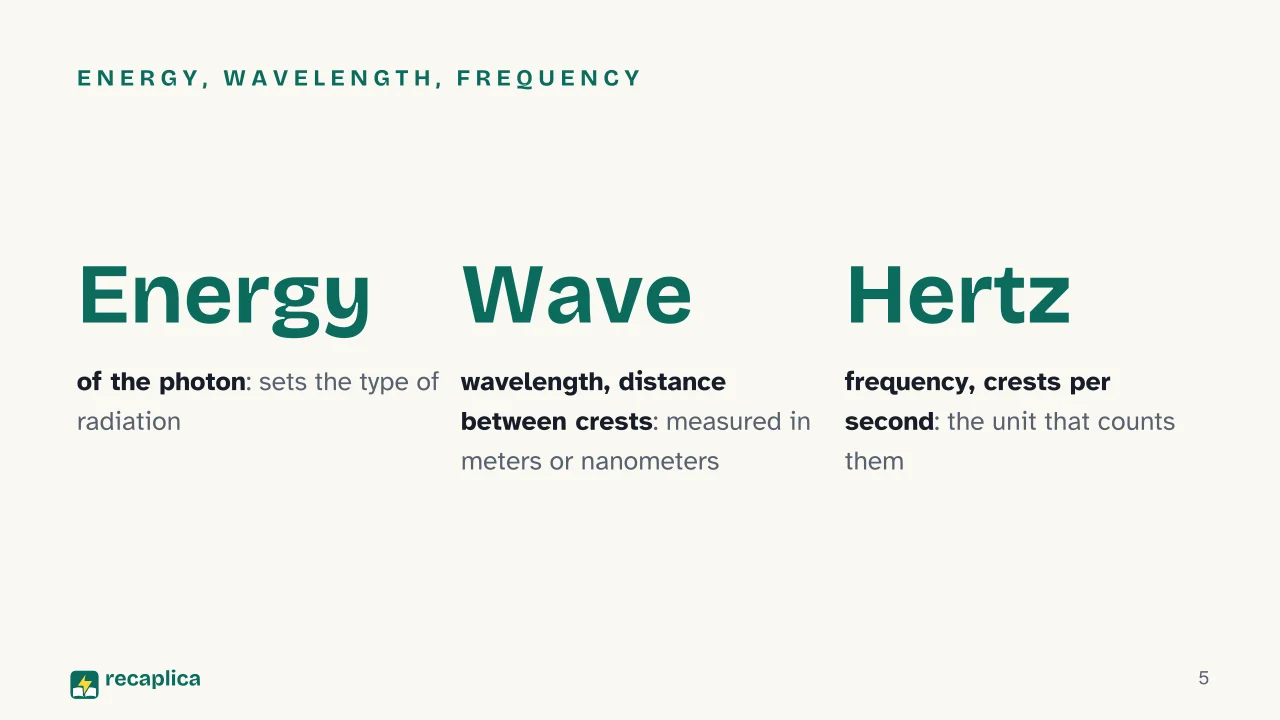
    Three quantities describe the same radiation from different angles, energy, wavelength and frequency. Wavelength is the distance between two successive wave crests; frequency is the number of crests that pass a fixed point in one second. They are tied together by a precise mathematical relationship, so knowing any one of the three is enough to work out the other two.

    In a vacuum, radio waves move exactly as fast as light does, 299,792,458 meters per second, according to NASA and the Goddard Space Flight Center. That detail backs up, experimentally, the theory of electromagnetism James Clerk Maxwell put forward in the nineteenth century, when he first predicted that such waves should exist.

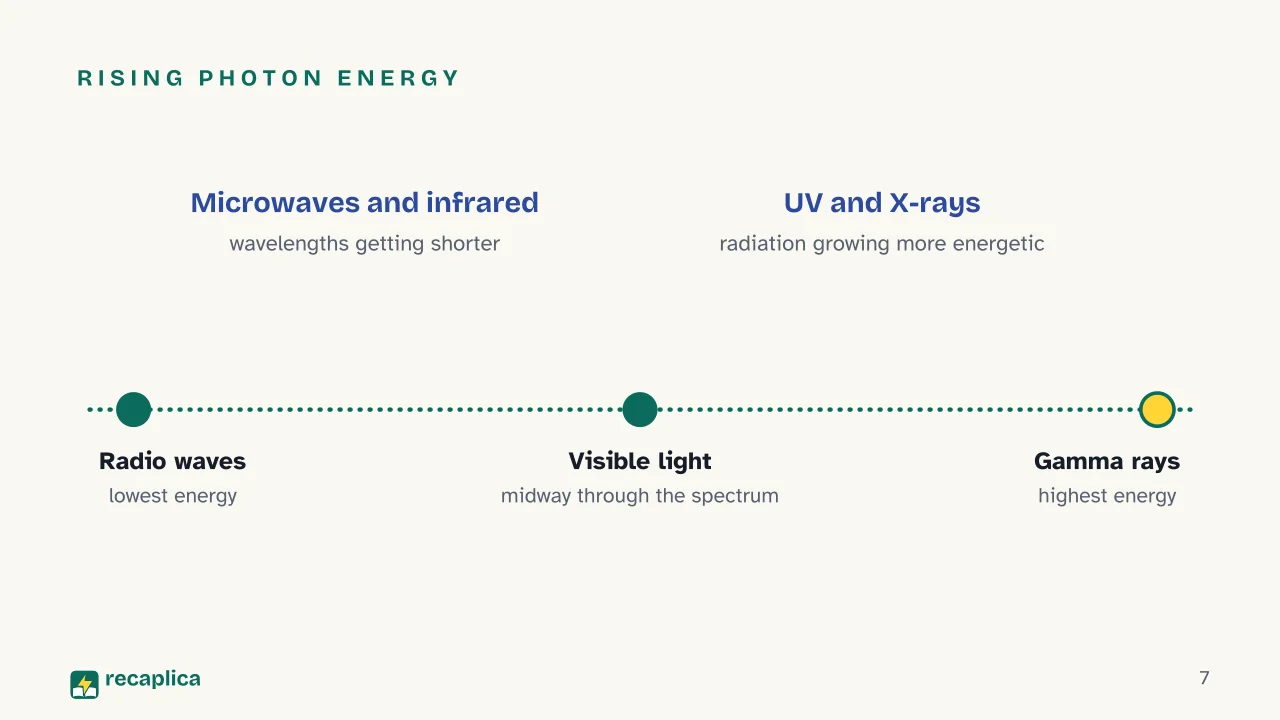
    All else being equal, a radiation’s energy rises as its wavelength gets shorter, which means its frequency rises too. That rule orders the whole spectrum: radio waves, with the longest wavelengths, carry the lowest energy; gamma rays, with the shortest wavelengths, carry the highest.

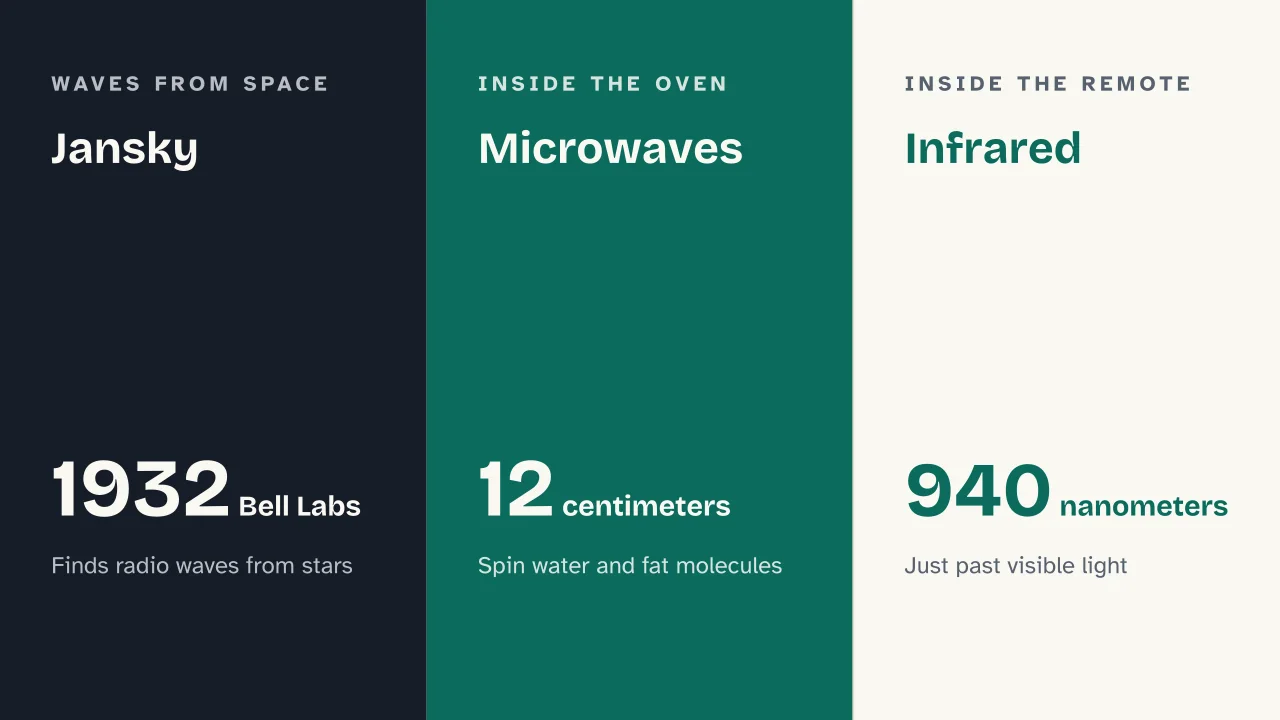
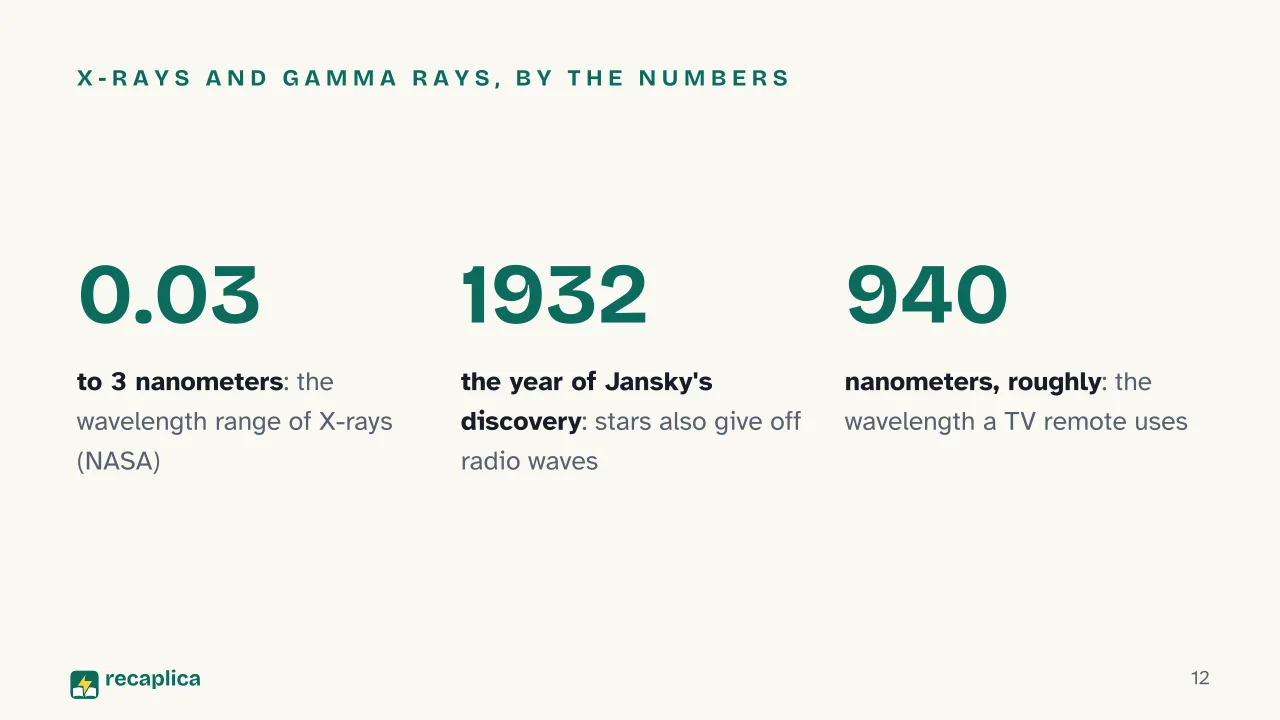
    Practical example: a TV remote gives off infrared at around 940 nanometers, just past what the human eye can register. That is why no light is visible when a button is pressed, yet the television still picks up the signal: a phone camera, less selective than the eye, can sometimes catch a faint glow from it.

    From radio waves to gamma rays: the seven bands

    The bands of the spectrum line up by rising photon energy: first radio waves, then microwaves, infrared, visible light and ultraviolet, with X-rays and, at the very top, gamma rays.

    No part of the spectrum stretches as far as radio, wavelengths run from a few meters, about the length of a football field according to NASA, up to sizes larger than planet Earth. Tuning a radio to a specific wavelength lets someone listen to a broadcast, and observatories rely on that same principle to pick up signals coming from planets, comets, interstellar dust and whole galaxies. In 1932, Karl Jansky, at Bell Labs, discovered that stars and other objects in space give off radio waves, launching the field of radio astronomy.

    Microwaves have shorter wavelengths. A microwave oven uses microwaves about 12 centimeters long to spin the water and fat molecules in food, heating it; the Doppler radar images used in weather forecasts, and most telecommunications satellites, which rely on the C, X and Ku bands, run on the same kind of radiation.

    Infrared picks up where the radio-microwave range ends and reaches up to the edge of visible light. The slice between 8 and 15 micrometers is what scientists call “thermal infrared”; remote controls use it to change a TV channel, while night-vision goggles and thermal cameras pick up the infrared given off by warm bodies, making thermography possible.

    Visible light is the most familiar band, and also the smallest, the human eye typically picks up wavelengths between 380 and 700 nanometers. Within that range, violet has the shortest wavelength, around 380 nanometers, and red the longest, around 700.

    BandWavelengthRelative energyA use
    Radio wavesFrom a few meters to larger than EarthLowest in the spectrumTelecommunications, radio telescopes
    MicrowavesTens of centimetersLowMicrowave ovens, weather radar
    Infrared8-15 micrometers (thermal)Low-to-mediumRemote controls, thermal cameras
    Visible light380-700 nanometersMediumHuman vision
    UltravioletBeyond visible light, partly blocked by ozoneMedium-to-highStudying star formation
    X-rays0.03-3 nanometersHighMedical radiography, space telescopes
    Gamma raysShortest in the spectrumHighest of allRadioactive decay, astrophysics

    Ultraviolet: the band that marks a boundary

    Very different effects coexist within the ultraviolet band. UV-B rays cause sunburn, and exposure to them raises the risk of damage to DNA and to the cells of living organisms, the same kind of damage that makes the genetic material described in the Recap on DNA so delicate; about 95% of UV-B, however, is absorbed by Earth’s atmospheric ozone before it reaches the ground. Anyone curious how skin reacts to this radiation can read the Recap on how tanning works, which traces the mechanism in detail.

    UV-C rays are the most harmful part of the ultraviolet range, but Earth’s atmosphere absorbs nearly all of them, which is why they almost never reach the ground by natural means. Ultraviolet is not merely a risk to manage: scientists also use it to study how stars form, because young stars give off most of their light at these wavelengths.

    X-rays and gamma rays: the most energetic bands

    X-rays pack far more energy into a much shorter wavelength than ultraviolet light does, ranging from 0.03 to 3 nanometers. In medical radiography, technicians position film sensitive to X-rays against one side of the body; the rays pass through the tissue, and the denser bone blocks more of them than skin does, so a pale outline of the skeleton appears on the film. The same principle, on a cosmic scale, powers space-based X-ray telescopes, which collect photons from regions of the sky and help astronomers work out how hot, dense or chemically rich a faraway object is.

    Gamma rays close out the spectrum with the smallest wavelengths and the highest energy of any electromagnetic radiation. In space, gamma rays are produced by some of the universe’s hottest, most energetic objects, including neutron stars, pulsars, supernova explosions and regions near black holes; NASA ranks gamma-ray bursts as the brightest, most powerful flashes of electromagnetic energy recorded since the Big Bang. On Earth, by contrast, gamma rays most often come from radioactive decay, along with nuclear explosions and lightning. Scientists also use them to detect chemical elements on other planets, as in the MESSENGER and Mars Odyssey missions NASA describes.

    Where ionizing radiation begins

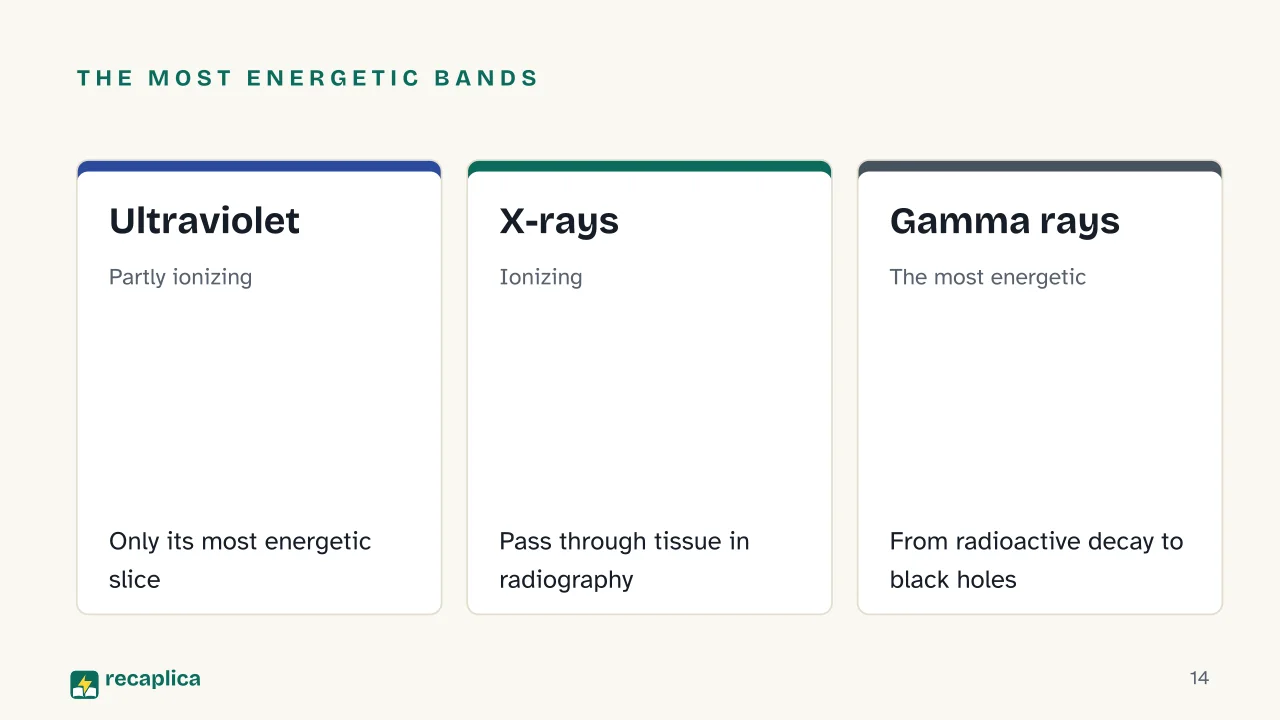
    Not every part of the electromagnetic spectrum carries the same kind of risk. Gamma rays, X-rays and part of the ultraviolet range are “ionizing” radiation, according to NASA they carry enough energy to strip electrons from atoms, a process that can damage the molecules inside living cells. Radio waves, microwaves, infrared and visible light stay below that energy threshold and do not produce this effect.

    The distinction matters more than the name of the band. Calling a radiation “ultraviolet” is not enough to know whether it is ionizing, because very different components coexist within that one band, knowing the wavelength and the photon’s energy is what settles the question, not the label of the band on its own.

    Slide deck

    Slides ready to download and make your own in PowerPoint or Google Slides, with speaker notes. Pick the Flash cut or the Full one.
    Slide 1 of the presentation on Electromagnetic Spectrum: The Electromagnetic SpectrumSlide 2 of the presentation on Electromagnetic Spectrum: What does a TV remote have in common with a star?Slide 3 of the presentation on Electromagnetic Spectrum: What this coversSlide 4 of the presentation on Electromagnetic Spectrum: Chapter 01: The electromagnetic spectrumSlide 5 of the presentation on Electromagnetic Spectrum: Energy, wavelength, frequencySlide 6 of the presentation on Electromagnetic Spectrum: Chapter 02: Energy, frequency, wavelengthSlide 7 of the presentation on Electromagnetic Spectrum: Rising photon energySlide 8 of the presentation on Electromagnetic Spectrum: Radio waves, the longest in the spectrum, carry the lowest energy.Slide 9 of the presentation on Electromagnetic Spectrum: Chapter 03: The seven bands of the spectrumSlide 10 of the presentation on Electromagnetic Spectrum: Jansky · Microwaves · InfraredSlide 11 of the presentation on Electromagnetic Spectrum: UV-B against UV-CSlide 12 of the presentation on Electromagnetic Spectrum: X-rays and gamma rays, by the numbersSlide 13 of the presentation on Electromagnetic Spectrum: Chapter 04: Ionizing radiationSlide 14 of the presentation on Electromagnetic Spectrum: The most energetic bands: Ultraviolet, X-rays, Gamma raysSlide 15 of the presentation on Electromagnetic Spectrum: Which band of the spectrum carries the highest energy?Slide 16 of the presentation on Electromagnetic Spectrum: Time to review
    Flash10 slidesThe essential thread, to present in classFull16 slidesEvery chapter and the deeper detail

    Common myths

    • ✗ Myth Radio waves and visible light are completely different phenomena.

      ✓ Reality Both are electromagnetic radiation. According to NASA and the Goddard Space Flight Center, the bands of the spectrum differ only in wavelength, frequency and photon energy; all of them travel at the same speed in a vacuum.

    • ✗ Myth The longer an electromagnetic wave is, the more energy it carries.

      ✓ Reality It is the reverse of what many assume. NASA explains that a more energetic photon corresponds to a shorter wavelength. Radio waves, the longest in the spectrum, remain the least energetic, while gamma rays, the shortest, are the most energetic of all.

    • ✗ Myth Every type of electromagnetic radiation is harmful to health.

      ✓ Reality Only part of it is. The energy needed to knock electrons loose from atoms, NASA's definition of ionizing radiation, belongs only to gamma rays, X-rays and the sharpest edge of the ultraviolet band. The other bands, radio, microwave, infrared and visible light, stay below that threshold.

    Mind map

    Drag the background to move around and the nodes to reposition them; use − and + to collapse and expand branches.
    Customize
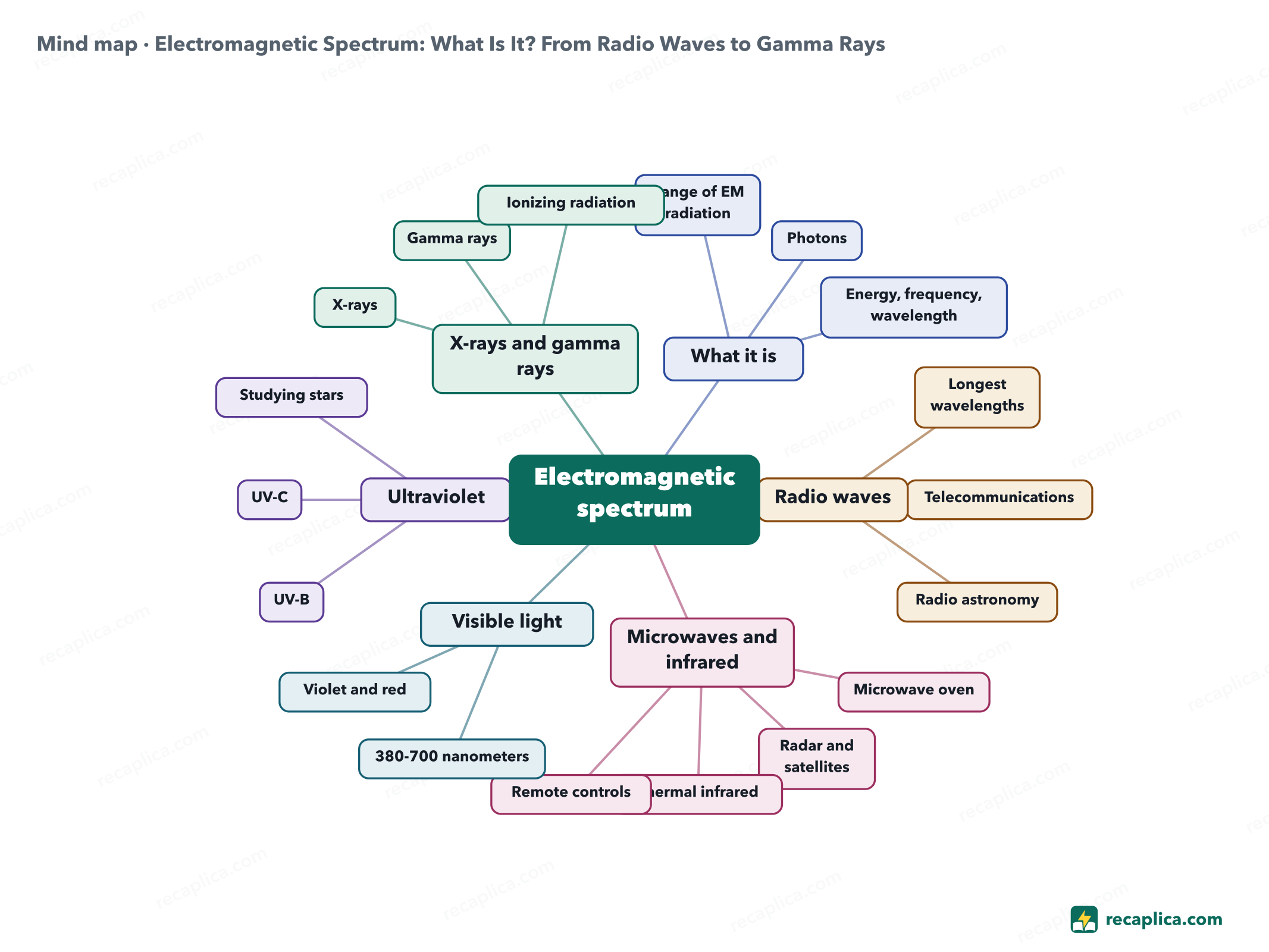
    Mind map: Electromagnetic Spectrum: What Is It? From Radio Waves to Gamma Rays
    • Electromagnetic spectrum
      • What it is
        • Range of EM radiation From NASA and the Goddard Space Flight Center
        • Photons Massless particles, wave-like behavior
        • Energy, frequency, wavelength Three quantities tied together
      • Radio waves
        • Longest wavelengths From a few meters to larger than Earth
        • Telecommunications Tuning in to a frequency to pick up a signal
        • Radio astronomy Radio telescopes, Jansky's 1932 discovery
      • Microwaves and infrared
        • Microwave oven 12 cm, heats water and fat
        • Radar and satellites Weather forecasts, C, X, Ku bands
        • Thermal infrared 8-15 micrometers
        • Remote controls About 940 nanometers
      • Visible light
        • 380-700 nanometers The range the human eye perceives
        • Violet and red Shortest and longest wavelengths of the visible range
      • Ultraviolet
        • UV-B Sunburn, DNA damage
        • UV-C The most harmful, absorbed by the atmosphere
        • Studying stars Young stars emit mostly in UV
      • X-rays and gamma rays
        • X-rays 0.03-3 nm, medical radiography
        • Gamma rays Highest energy, radioactive decay
        • Ionizing radiation Gamma, X-rays and part of UV strip electrons

    Quiz: test yourself

    Answer the questions to check what you have learned: you get instant feedback and a short explanation.

    Grade 0/10 0/5
    1 What is the electromagnetic spectrum?

    NASA describes the spectrum as the complete family of electromagnetic radiation, from radio waves to gamma rays. Energy, wavelength and frequency are three equivalent ways to describe it, and visible light accounts for only a small slice of it.

    2 What happens to a radiation's energy when its wavelength gets shorter?

    The rule runs opposite to the wavelength. NASA states that, all else being equal, a photon becomes more energetic as its wavelength shortens. That is why gamma rays, the shortest waves in the spectrum, are also the most energetic.

    3 True or false: radio waves travel more slowly than visible light.

    False. NASA confirms that radio waves travel at the same speed as light, a result that experimentally backs up Maxwell's theory of electromagnetism.

    4 Which band of the electromagnetic spectrum carries the highest energy?

    Among all the bands, gamma rays have the most energetic photons and the shortest wavelength, according to NASA and the Goddard Space Flight Center, and they come from the hottest, most energetic objects in the universe.

    5 According to NASA, what makes a medical X-ray image possible?

    NASA describes the principle behind medical X-ray imaging this way, a film sensitive to X-rays is placed on one side of the body and X-rays pass through the tissue; bones, being denser, absorb more of them than skin does, leaving a shadow on the film.

    Answers: 1-A · 2-B · 3-B · 4-D · 5-A

    Flashcards

    Tap the card to flip it and check whether you remember the answer, then move to the next one.

    1 / 8

    Explain it in your own words

    The ultimate test: if you can explain it in simple words, you've truly understood it. Write your explanation, then compare it with the Recap.

    Your explanation is saved only on this device.

    The electromagnetic spectrum is the full range of electromagnetic radiation that exists, from radio waves to gamma rays. Every band is set apart from the others by its wavelength, its frequency and the energy of the photons that carry it, three quantities tied to one another. At the two ends, energy rises from radio waves, the weakest band, up to gamma rays, the most energetic radiation in the whole spectrum. In between sit microwaves, infrared, visible light, ultraviolet and X-rays, each with its own documented uses and risks.

    Frequently asked questions

    What does electromagnetic spectrum mean?

    It means the complete range of electromagnetic radiation that exists in nature, from the longest radio waves to the shortest gamma rays. According to NASA and the Goddard Space Flight Center, every type of radiation in that range can be described in three equivalent ways, by its energy, its wavelength or its frequency, and visible light is just one narrow slice of it.

    What are electromagnetic waves?

    They are the form in which electromagnetic energy travels: according to NASA and the Goddard Space Flight Center, they can be described as a stream of photons, massless entities that cross space at the speed of light while behaving partly like waves. From radio waves to gamma rays, through microwaves, infrared, visible light and ultraviolet, they all belong to the same family of radiation: only the wavelength, the frequency and the photon's energy change.

    What is the difference between wavelength and frequency?

    They are two different ways of looking at the same wave. According to NASA, wavelength measures the distance between one crest and the next, while frequency counts how many crests pass a fixed point every second. The two quantities are inversely related, and together they set the photon's energy, the shorter the wavelength, the higher the frequency and the energy.

    Why are gamma rays considered more dangerous than radio waves?

    Because their energy is far higher than that of the other bands. NASA groups gamma rays with X-rays and the sharpest slice of ultraviolet as ionizing radiation, strong enough to strip electrons from atoms. Below that threshold sit radio waves, microwaves, infrared and visible light.

    Do microwaves only heat food?

    No. Besides the microwave oven, NASA notes that the Doppler radar images used in weather forecasts rely on microwaves, and most telecommunications satellites use the C, X and Ku microwave bands to send signals down to ground stations.

    Why do UV-C rays almost never reach the ground?

    Because Earth's atmosphere absorbs nearly all of them, according to NASA. Most UV-B, about 95%, is also stopped by atmospheric ozone; the ultraviolet that reaches the surface in the largest amount is mainly UV-A.

    Sources

    • NASA Science — Electromagnetic Spectrum (series)
    • NASA / Goddard Space Flight Center, Imagine the Universe! — The Electromagnetic Spectrum

    Every Recap goes through an independent review before publication.

    Every evening, the day's new Recaps on our Telegram channel. Join the channel →

    Keep learning

    • Science Balancing Redox Reactions: Half-Reaction and Oxidation Number Methods A redox reaction is balanced when every element has the same number of atoms on both sides and the total charge is the same too. There are two routes. With the half-reaction method you write oxidation and reduction separately, add water, H⁺ and electrons, and then add the two halves together. With the oxidation number method you look at how much each element's number rises and falls, and pick coefficients that make the total rise equal the total fall. In basic solution you start as in acid, and at the end the H⁺ ions are turned into water with OH⁻. Read the Recap →
    • Science Brønsted-Lowry theory: definition of acids, bases and conjugate pairs In 1923 Johannes Brønsted and Thomas Lowry, working independently, defined an acid as a species that gives away a proton and a base as a species that takes one in. An acid-base reaction is therefore a transfer of a proton, and every transfer produces two conjugate pairs. Water can act as either an acid or a base, and ammonia is a base even though its formula has no OH-. The theory generalizes Arrhenius's, which holds only for water solutions. Read the Recap →
    • Science Chemical Equilibrium: Definition, the Constant K and the Reaction Quotient Q A reversible reaction can run in either direction, and in a closed system it reaches a point where the amounts of reactants and products stop changing. At that point the forward and reverse reactions keep going at the same rate. The equilibrium constant K depends on temperature. Comparing the reaction quotient Q with K shows which way the reaction is heading. An ICE table handles the calculations. Read the Recap →

    recaplica

    Clear in 30 seconds, yours in 10 minutes.

    Recaps Mind maps Request a Recap Telegram channel Mind map maker Our method About Privacy & cookies Legal notes & terms of use

    © 2026 Recaplica · A project by Curi S.r.l. — VAT IT05472000750

    Statistics, only if you say so

    To learn which Recaps help most we would use Google Analytics, with aggregate, anonymous data. It starts only with your OK, and you can change your mind anytime. Privacy policy