recaplica
Clear in 30 seconds, yours in 10 minutes.
In 30 seconds quick read
Kinematics is the branch of physics that tracks how a body moves: its position, velocity, and acceleration over time. The forces that explain why it moves belong to dynamics instead. Pinning down where an object is at a given instant always needs a fixed frame of reference, a set of measuring axes. Position-time and velocity-time graphs show the same motion as a line, with the slope telling velocity in one graph and acceleration in the other. Free fall and uniform circular motion are the two examples students meet first.
Key Points
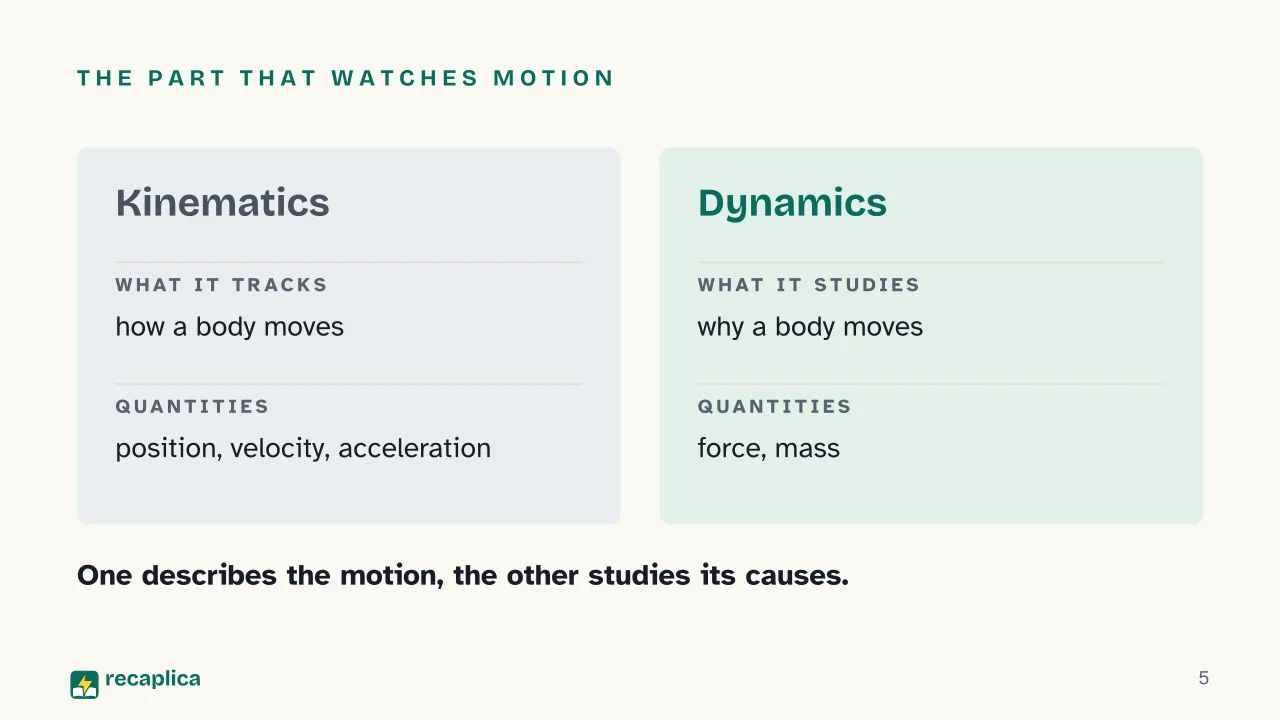
Position, velocity, and acceleration describe how a body moves over time; the forces that explain the motion are the job of dynamics.
Fixing a body's position always needs a frame of reference, a set of measuring axes; the Treccani Encyclopedia adds that a body only moves relative to another body taken as a reference point.
Dividing displacement by the time it takes gives average velocity; shrinking that time interval toward zero gives instantaneous velocity.
Slopes tell the story on motion graphs: on a position-time graph the slope is velocity, on a velocity-time graph the slope is acceleration.
In free fall, acceleration stays at an average of 9.8 m/s² on Earth: as time passes, velocity grows in a straight line and distance traveled grows as a parabola.
In uniform circular motion the speed stays fixed in magnitude; only its direction keeps turning, and that alone produces an acceleration pointed toward the center.
Deep Dive
What kinematics studies
According to OpenStax’s University Physics Volume 1, kinematics is the branch of physics that tracks motion through four quantities — position, time, velocity, and acceleration — while the forces that produce that motion belong to dynamics, the natural counterpart covered in the Recap on Newton’s three laws of motion. The textbook starts with the simplest case, motion along a straight line, before moving on to motion in two or three dimensions.
The Treccani Encyclopedia defines kinematics as the part of mechanics that tracks over time how the geometric features of moving bodies change. For the encyclopedia, motion is a relative concept: saying a body moves only makes sense when comparing it with another body taken as a reference.
Position and frame of reference
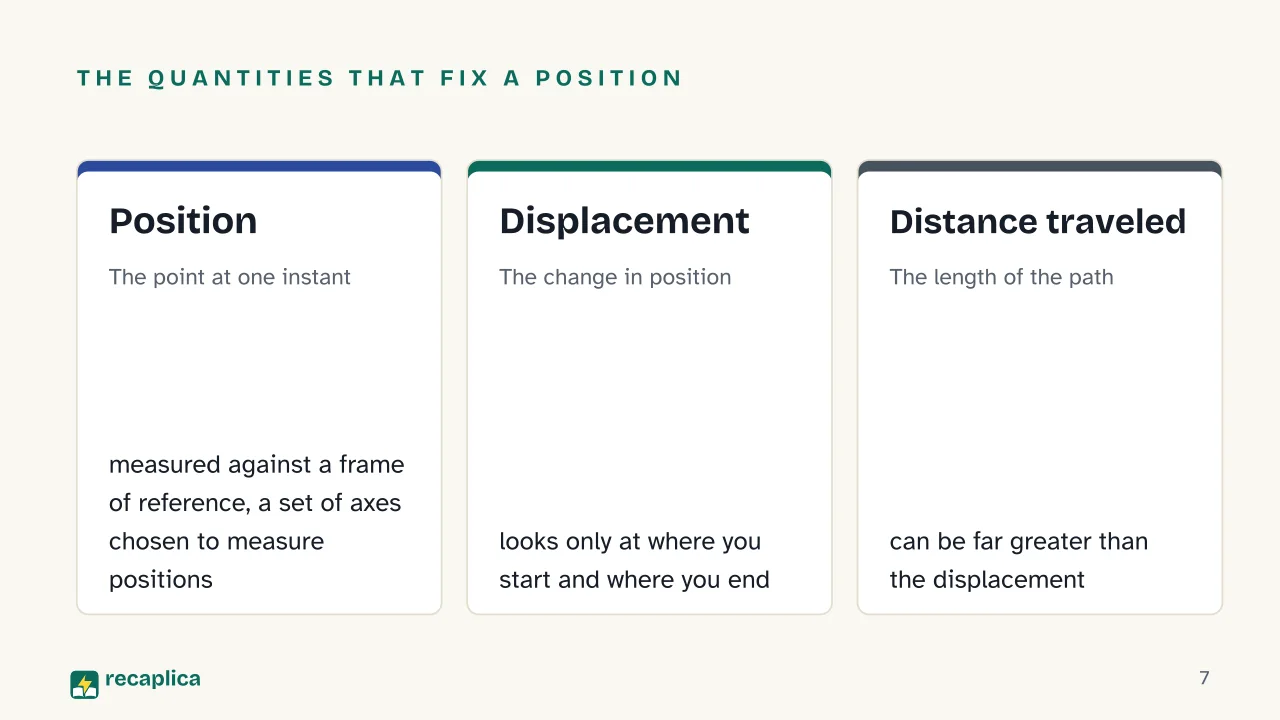
The position of an object is the point where it is at one precise instant. Fixing it means choosing a frame of reference: a set of measuring axes, the same coordinate language used by the coordinate plane. Displacement looks only at the difference between two positions; distance traveled instead adds up the length of the entire path, and the two quantities match only when the path is a straight segment in one direction.
The curve a moving point traces as it travels is its trajectory, in the Treccani Encyclopedia’s definition.
Average velocity, instantaneous velocity, and types of motion
Average velocity is the ratio between total displacement and the time it took to cover it. Instantaneous velocity is that same ratio calculated over a time interval that keeps shrinking, nearly to zero. In uniform motion, says the Treccani Encyclopedia, the ratio between distance covered and time taken stays constant: that constant is the velocity of the uniform motion (a future Recap on uniform rectilinear motion will cover the formula and worked problems for this case). In non-uniform motion, instead, the velocity at an instant equals the derivative of distance with respect to time at that same instant — a more technical way of writing the same idea of instantaneous velocity that OpenStax explains in words.
Reading motion on a graph
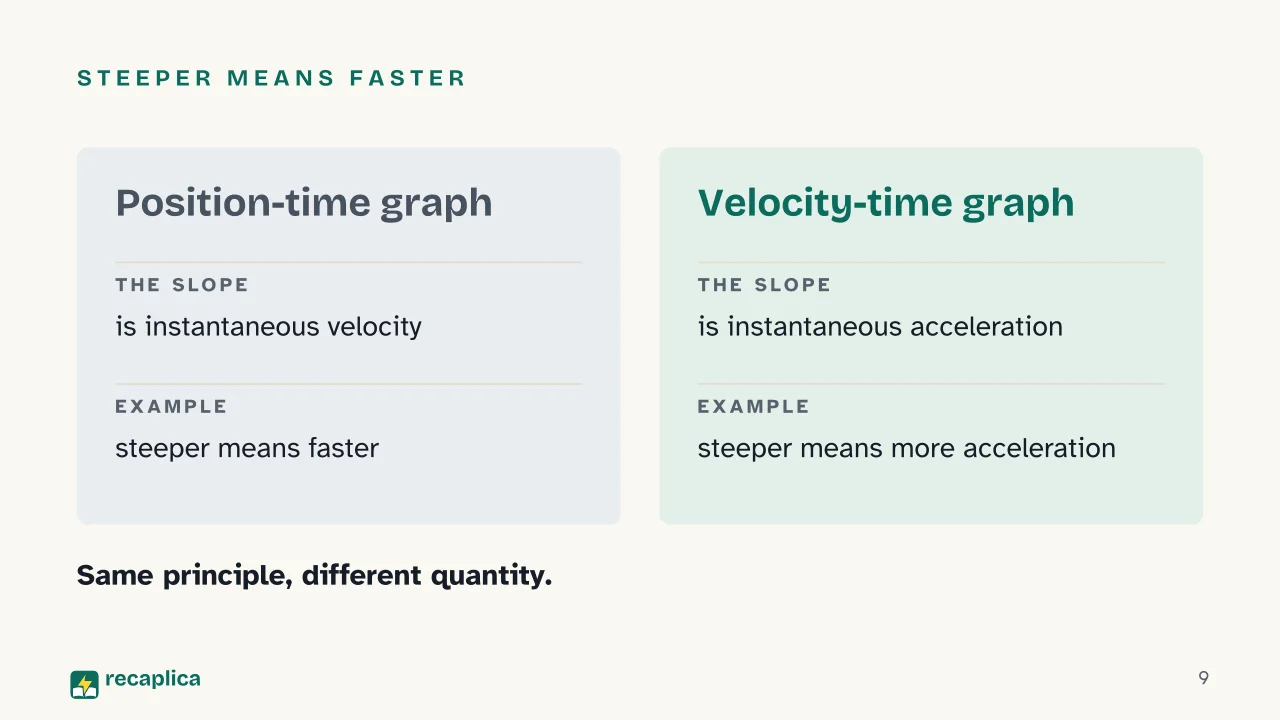
On a position-time graph, the slope of the curve at a point tells you the instantaneous velocity at that instant: a steeper curve describes a faster body. That same pattern shows up again on the velocity-time graph, where the slope of the curve tells you the instantaneous acceleration. Acceleration, in general, measures how quickly velocity changes; the Treccani Encyclopedia formalizes it as the second derivative of position with respect to time.
Graph
What the slope tells you
Position-time
Instantaneous velocity
Velocity-time
Instantaneous acceleration
Free fall: the classic case of constant acceleration
Practical example: A stone dropped from a bridge is in free fall, because its motion is caused only by gravity, as NASA’s Glenn Research Center defines it. Starting from zero initial velocity, after a time t the velocity reached equals the gravitational acceleration multiplied by the time elapsed, and the distance traveled equals half the acceleration multiplied by the square of the time. The stone’s weight, size, and shape don’t change the outcome: with no air resistance, every object receives the same acceleration.
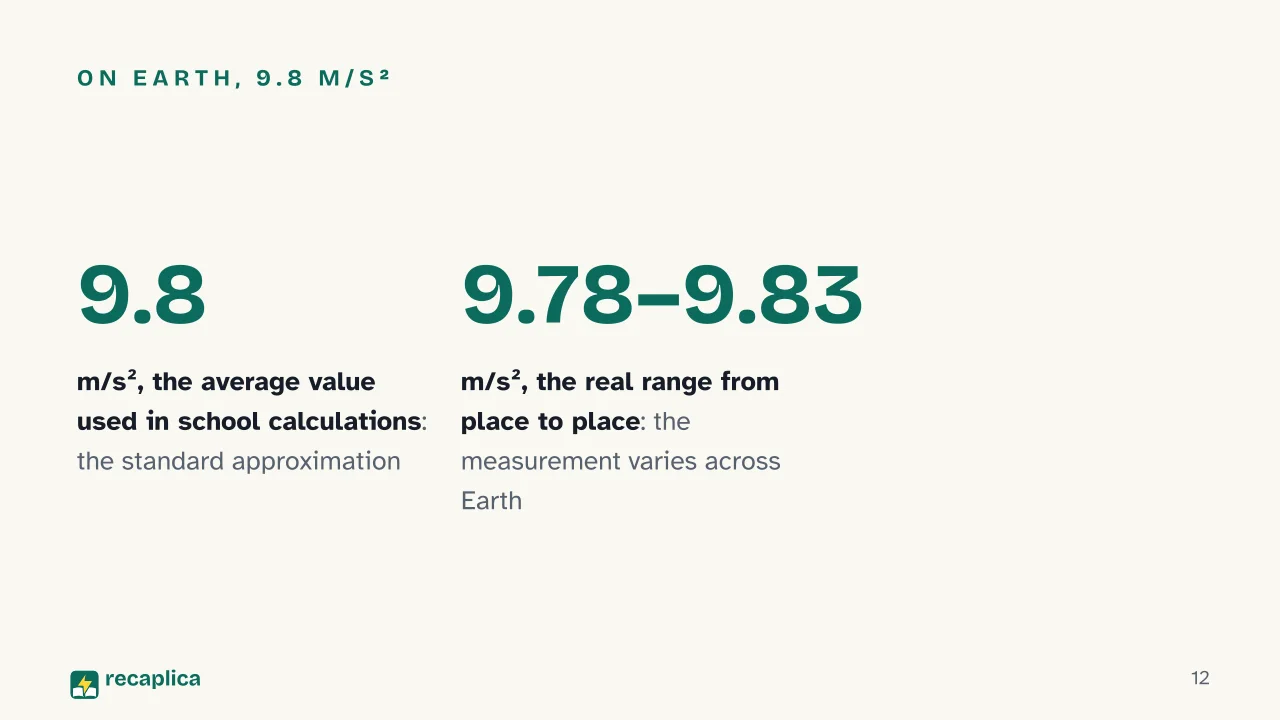
Gravitational acceleration stays constant throughout the fall: that’s why velocity grows in direct proportion to time while the distance traveled grows with the square of time, the reason the velocity-time graph of a free fall is a straight line and the position-time graph is a parabola. On Earth, gravitational acceleration ranges from place to place between 9.78 and 9.83 m/s²; school calculations use the rounded average value, 9.8 m/s².
Uniform circular motion
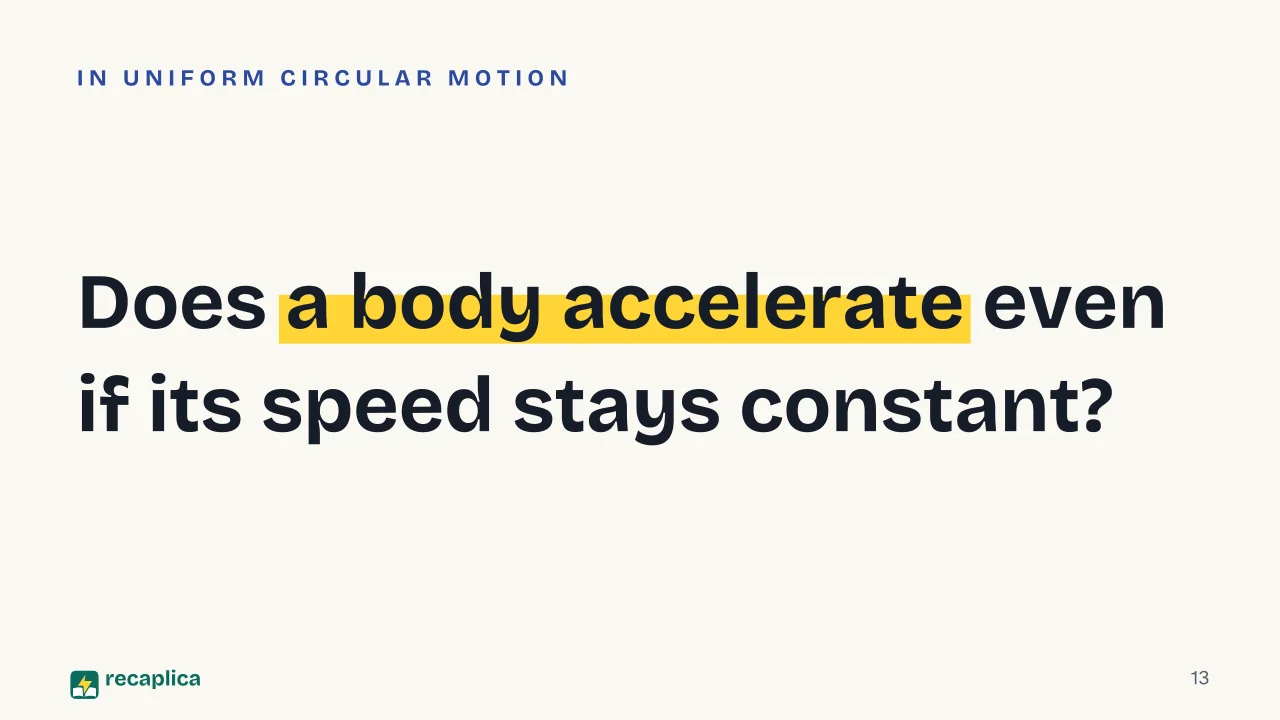
Uniform circular motion is the motion of an object traveling around a circle while keeping its speed constant. At constant speed, though, that object still accelerates: the speed doesn’t change, but the direction does, continuously, and this acceleration, called centripetal, has a magnitude equal to the square of the velocity divided by the radius, pointed toward the center of the circle. Observing and measuring these motion patterns follows the same process described in the Recap on the scientific method: the same logic of position, velocity, and acceleration also applies to the motion of the solar system’s planets, even though their orbits aren’t circular.
Slide deck
Slides ready to download and make your own in PowerPoint or Google Slides, with speaker notes. Pick the Flash cut or the Full one.
✗ Myth Many people think kinematics and dynamics are the same subject.
✓ Reality Kinematics tracks how a body moves — its position, velocity, and acceleration — while dynamics, what the Treccani Encyclopedia calls mechanics proper, studies the forces that produce that motion.
✗ Myth Many people think a heavier object falls faster than a lighter one.
✓ Reality NASA's Glenn Research Center explains that an object's weight, size, and shape do not change how it falls, because gravitational acceleration acts the same way on every object once air resistance is removed.
✗ Myth Many people think displacement and distance traveled are the same thing.
✓ Reality Displacement only counts the starting point and the ending point, while distance traveled adds up the length of the whole path: return to the starting point and displacement goes back to zero, even if the path covered stayed long.
Mind map
Drag the background to move around and the nodes to reposition them; use − and + to collapse and expand branches.
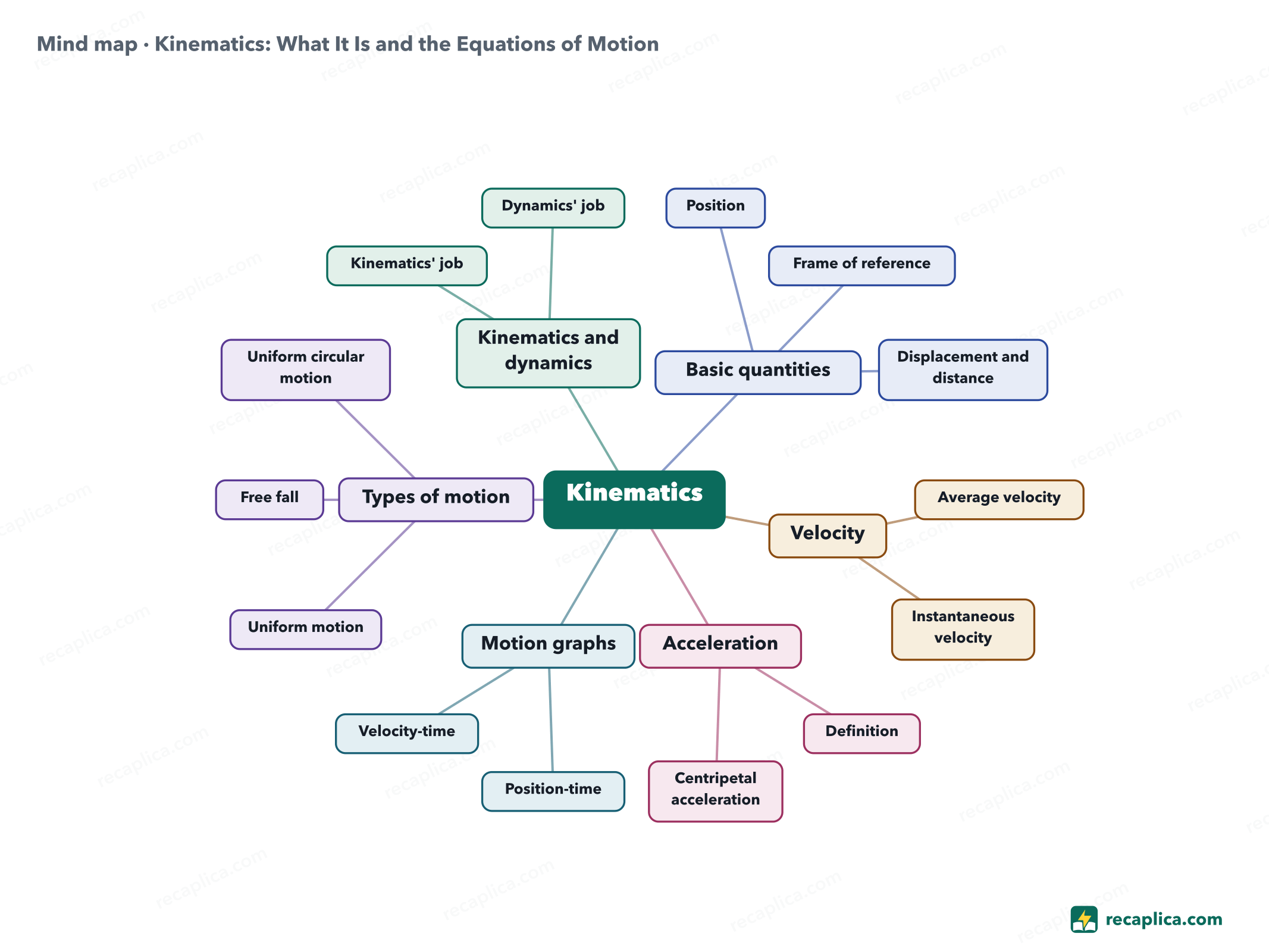
Positionthe point where a body is at one precise instant
Frame of referencethe set of axes chosen to measure positions
Displacement and distancechange of position against length of the path
Velocity
Average velocitydisplacement divided by the time it took
Instantaneous velocitythe same ratio over a vanishingly small interval
Acceleration
Definitionhow quickly velocity changes
Centripetal accelerationpoints toward the center, in circular motion
Motion graphs
Position-timethe slope of the curve is velocity
Velocity-timethe slope of the curve is acceleration
Types of motion
Uniform motionthe distance-to-time ratio stays constant
Free fallconstant acceleration, caused by gravity
Uniform circular motionconstant speed, direction always changing
Kinematics and dynamics
Kinematics' jobtracks the motion
Dynamics' jobstudies the forces that cause it
Quiz: test yourself
Answer the questions to check what you have learned: you get instant feedback and a short explanation.
Grade0/100/5
Answers: 1-A · 2-A · 3-B · 4-C · 5-B
Flashcards
Tap the card to flip it and check whether you remember the answer, then move to the next one.
1 / 7
Explain it in your own words
The ultimate test: if you can explain it in simple words, you've truly understood it. Write your explanation, then compare it with the Recap.
Your explanation is saved only on this device.
Kinematics is the branch of physics that tracks how a body moves: its position, velocity, and acceleration over time. The forces that explain why it moves belong to dynamics instead. Pinning down where an object is at a given instant always needs a fixed frame of reference, a set of measuring axes. Position-time and velocity-time graphs show the same motion as a line, with the slope telling velocity in one graph and acceleration in the other. Free fall and uniform circular motion are the two examples students meet first.
Frequently asked questions
What is kinematics in physics?
A branch of mechanics that tracks how a body's position, velocity, and acceleration change over time, setting aside the forces responsible for the motion.
What is the difference between kinematics and dynamics?
Kinematics tracks how a body moves; dynamics, called mechanics proper by the Treccani Encyclopedia, studies the forces that produce that movement.
How do you calculate average velocity?
By dividing the total displacement between two points by the time it took to cover it.
Why do two different objects fall at the same rate, with no air resistance?
A body's weight, size, and shape don't change how fast gravity pulls it down, so every object reaches the ground together.
What does the slope of a velocity-time graph tell you?
The acceleration of the body at that point on the graph.
Every Recap goes through an independent review before publication.
Statistics, only if you say so
To learn which Recaps help most we would use Google Analytics, with aggregate, anonymous data. It starts only with your OK, and you can change your mind anytime. Privacy policy