Skip to content
recaplica

    One moment: security check

    Cloudflare wants to make sure you're not a robot. Tick the box below and your search will continue on its own.

    IT
    recaplica Ugo Foscolo: Life, Exile, and Major Works
    © 2026 Recaplica · recaplica.com — All rights reserved
    Home › Literature

    Ugo Foscolo: Life, Exile, and Major Works

    By Recaplica Newsroom · Updated on September 17, 2026

    What to print

    Page numbers appear when printing with default margins.

    Slides

    Choose a cut

    Flash10 slidesThe essential thread, to present in classFull14 slidesEvery chapter and the deeper detail

    Both come with speaker notes.

    Telegram channel
    recaplica Clear in 30 seconds, yours in 10 minutes.
    In 30 seconds Key points Figures Deep dive Slides Myths Mind map Quiz Flashcards FAQ

    In 30 seconds quick read

    Ugo Foscolo was born on the island of Zante, then under Venetian rule, on 6 February 1778, and grew up between Venice and the University of Padua. After the fall of the Republic of Venice in 1797 he moved between the Cispadane Republic and Milan; in 1815 he left Italy for political reasons and never returned, travelling through Switzerland to London, where he arrived in 1816 and lived for eleven years until his death on 10 September 1827. Along the way he wrote the works that still make him a staple of Italian classrooms: the epistolary novel Last Letters of Jacopo Ortis, the poem Of the Sepulchres, his Odes and Sonnets, and the unfinished poem The Graces. Scholars place his work between the last years of the Enlightenment and the first signs of Romanticism. In 1871 his remains were brought back to Italy and buried in the basilica of Santa Croce in Florence.

    Key Points

    • Born on Zante in 1778, he was educated between Venice and the University of Padua.
    • After the fall of Venice in 1797 he moved between the Cispadane Republic and Milan, serving as a volunteer in the French army.
    • He wrote Last Letters of Jacopo Ortis (printed between 1798 and 1799) and the poem Of the Sepulchres (1807), plus Odes and Sonnets collected in 1803.
    • He left Milan on the night of 30-31 March 1815, crossed Switzerland, and settled in London from September 1816.
    • He died in London on 10 September 1827; in 1871 his remains were brought back to Italy and buried in Santa Croce in Florence.
    • He shared Neoclassical ideals while also developing themes that anticipate Romanticism, in the transition between the Enlightenment and Romanticism.

    Key figures

    • 1807 Year the poem Of the Sepulchres and the Experiment in Translating the Iliad were published. Source: Treccani, Dizionario Biografico degli Italiani
    • 1803 Year Foscolo's Odes (To Luigia Pallavicini, Fallen from Her Horse; To His Convalescent Friend) and 12 sonnets were collected in a single volume. Source: Treccani, Enciclopedia
    • 1871 Year Foscolo's remains were moved from England to the basilica of Santa Croce in Florence. Source: Treccani, Dizionario Biografico degli Italiani

    Deep Dive

    From Zante to Venice

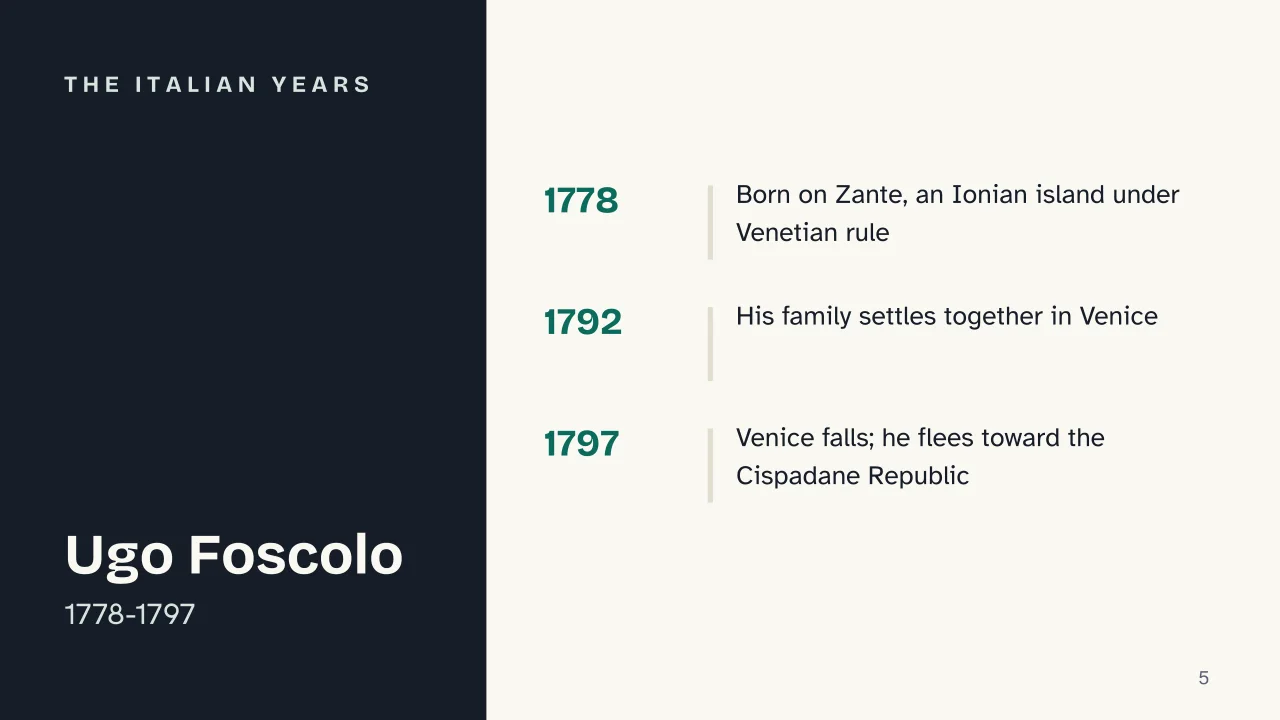
    Ugo Foscolo was born on Zante, an island in the Ionian archipelago then under Venetian rule, on 6 February 1778 (by the Gregorian calendar used by Treccani; the 1911 Encyclopædia Britannica gives 26 January under the Julian calendar then still followed in some English-language sources — it is the same day). In 1792 his family settled together in Venice, in a modest house in campo delle Gatte, and there Foscolo continued his studies, also attending the University of Padua.

    These were the years in which Europe was shaken by the upheavals set off by the French Revolution, which within a few years reached Venice as well. In 1797 the Republic of Venice fell, and Foscolo’s life changed course: in the last ten days of April he left the city and sought refuge in the Cispadane Republic, then, around mid-November, moved to Milan. During this period he served as a volunteer in the French army, taking part in the battle of the Trebbia and the siege of Genoa.

    The major works

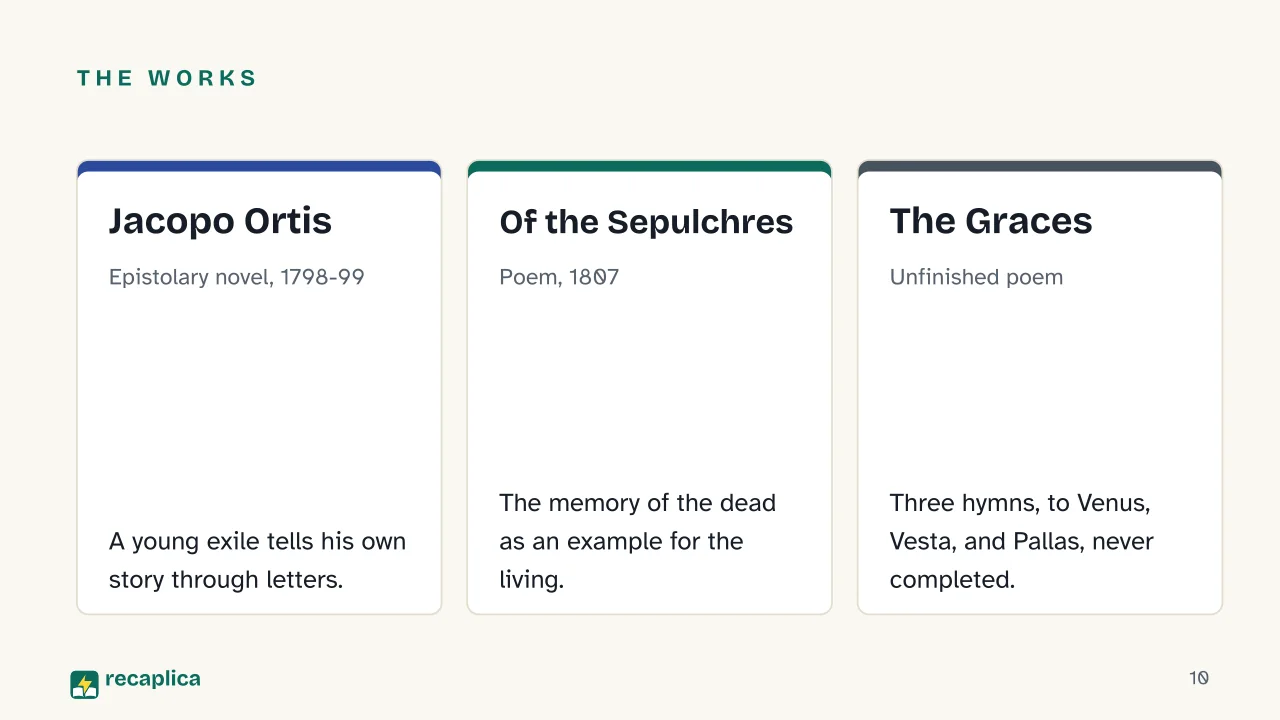
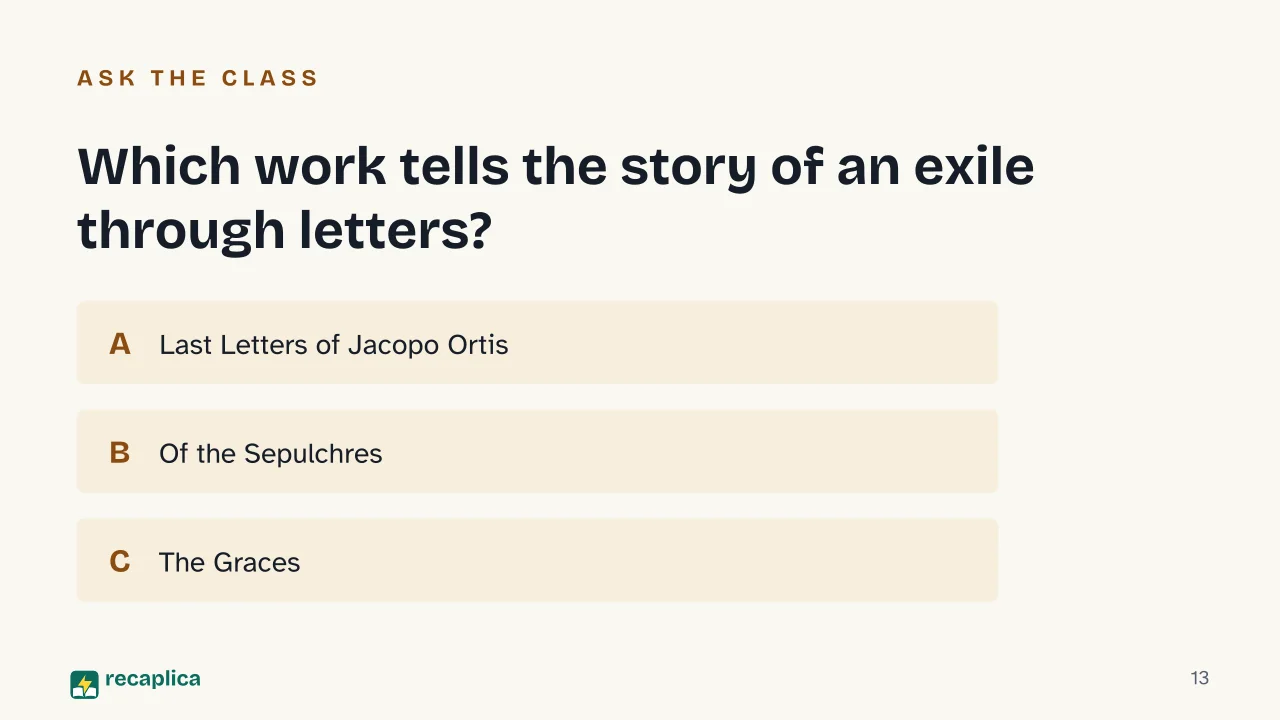
    Between September and December 1798, and in the first months of the following year, the epistolary novel Last Letters of Jacopo Ortis was printed: the story of a young man who recounts his own unrest, torn between impossible love and political disillusionment. Here it is enough to place it within the biography: its plot and themes are covered in the dedicated Recap on Last Letters of Jacopo Ortis.

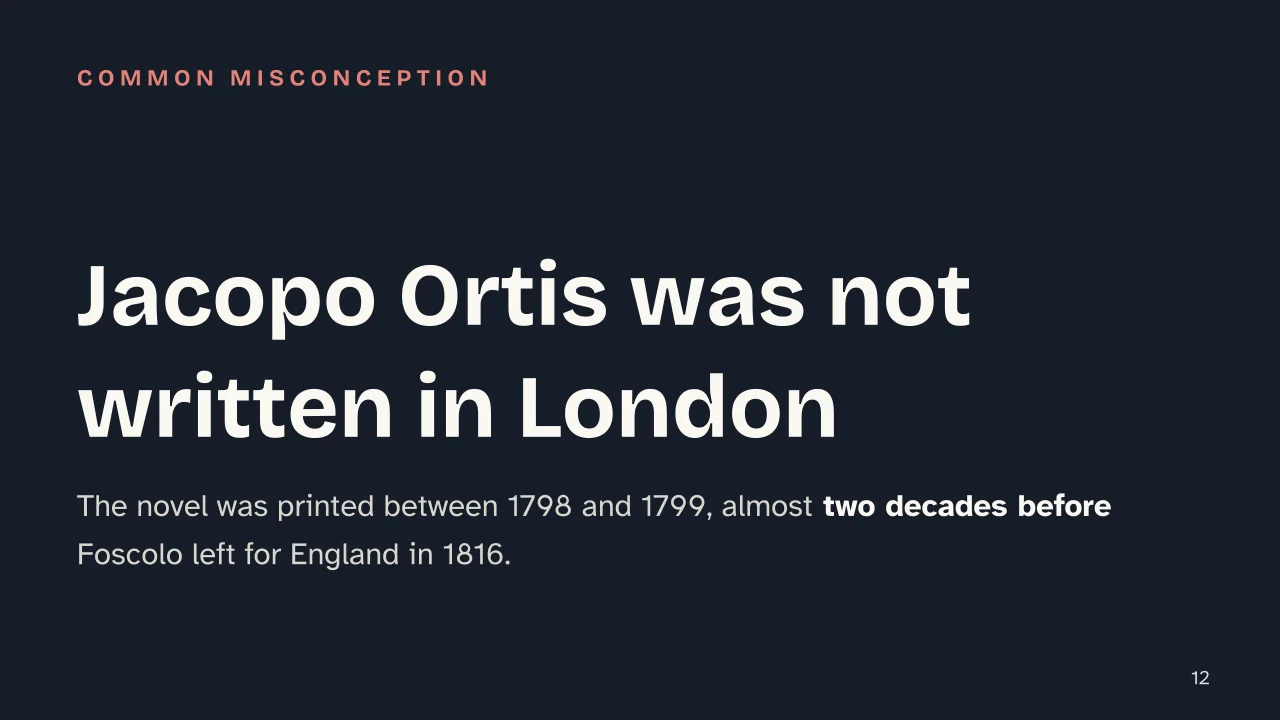
    Real-world example: students who study Foscolo in school often mix up the timeline, assuming his English exile and Jacopo Ortis belong to the same period. They don’t: the novel came out in 1798-99, when Foscolo was twenty, while his exile in London only began in 1816, nearly two decades later.

    In 1803 Foscolo collected in a single volume the Odes To Luigia Pallavicini, Fallen from Her Horse and To His Convalescent Friend, together with 12 sonnets, including On the Death of His Brother Giovanni, To Zacynthus, and To Evening. Around the same time, possibly as early as 1803, he began working on The Graces, a short poem planned as three hymns dedicated to Venus, Vesta, and Pallas — a project that, even drawing on earlier fragments, he would never bring to completion.

    In April 1807 came the high points of this phase: the poem Of the Sepulchres and the Experiment in Translating the Iliad. The poem, covered in detail in the Recap on Of the Sepulchres, sets out to stir the political emulation of Italians through the example of nations that honour the memory and the graves of their great men — a theme that ties together the cult of memory and civic indignation, and that anticipates the patriotic sensibility of authors such as Alessandro Manzoni, whose temperament and style remained quite different from his own.

    Exile and the London years

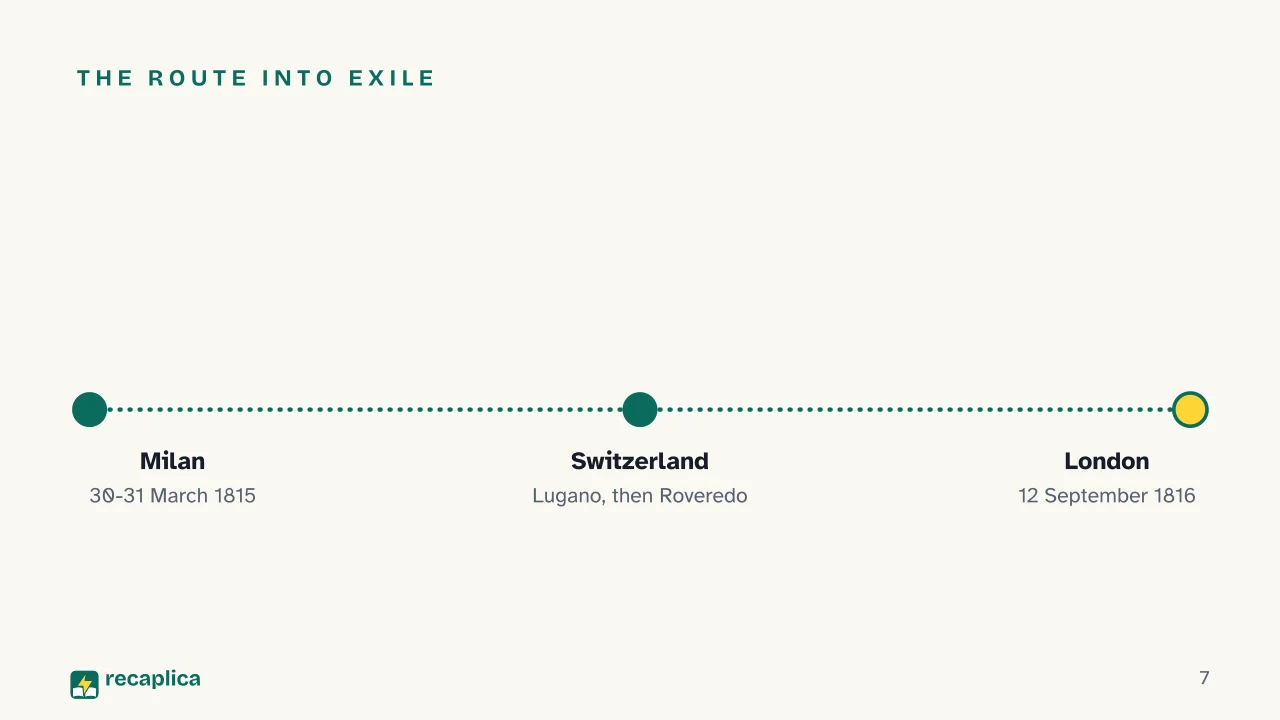
    On the night of 30-31 March 1815, Foscolo left Milan bound for Switzerland. On 1 April he reached Lugano, on 4 April he passed through Roveredo, in the Grisons. In November of the same year he gathered and annotated a series of Italian sonnets, shortly before leaving the continent: on 12 September 1816 he arrived in London and took lodgings at the Sablonière Hotel, in Leicester Square.

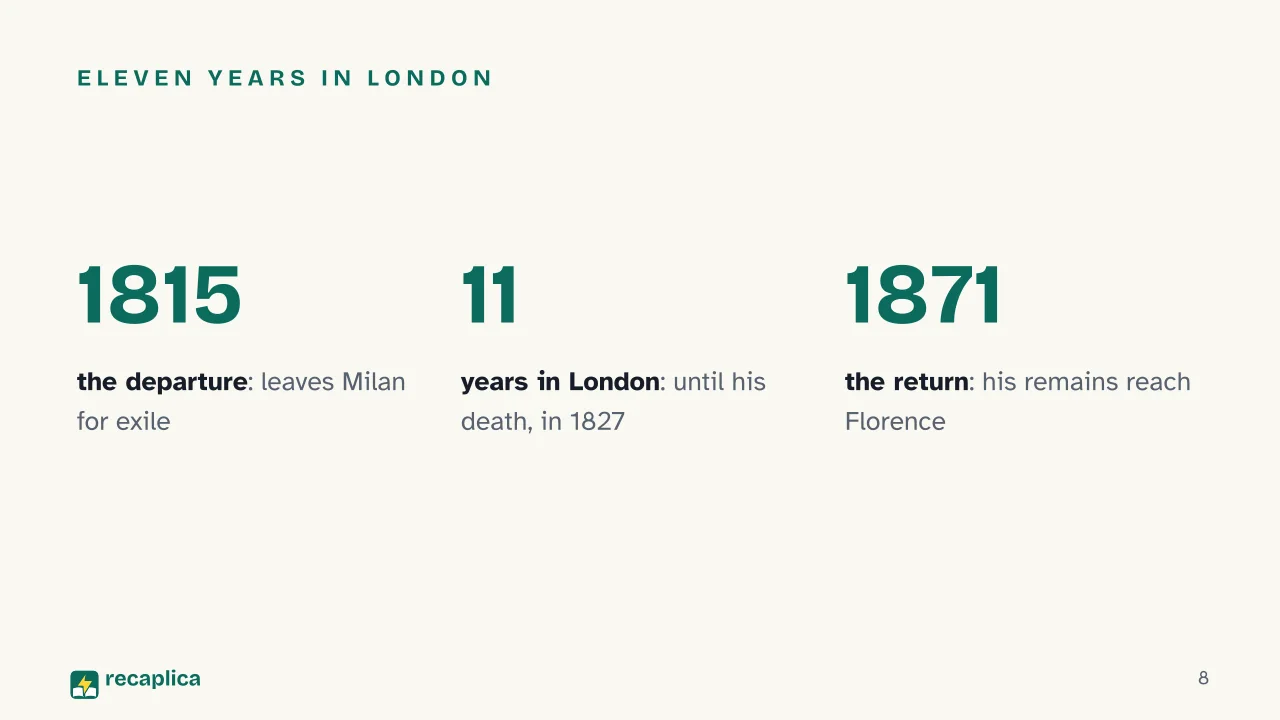
    In London, Foscolo spent eleven years, until his death on the evening of 10 September 1827 (this is the date given by Treccani; a nineteenth-century source, the 1911 Encyclopædia Britannica, instead gives 10 October, a discrepancy that looks like an error in that entry). The English public, according to the sources consulted, admired his literary fame but honoured above all the patriot and the free man — an exile’s identity that Foscolo carried to the end, and that places him, a man without a country, among the first to sense the need for Italian unification, a theme that would become central with the unification of Italy a few decades later.

    Only in 1871 were his remains brought back to Italy and buried in the basilica of Santa Croce, in Florence.

    Between Neoclassicism and Pre-Romanticism

    Foscolo’s work grows out of a deep commitment to Neoclassical ideals, which entrust to poetic language the power to resist the passing of time — a conviction that was far from superficial, and that drew support from his meditation on Lucretius’s On the Nature of Things. At the same time, themes such as exile and civic indignation, along with figures like Thyestes in one of his tragedies, carry traits that critics describe as Pre-Romantic.

    For this reason critics place Foscolo between the fading of Enlightenment rationalism and the first stirrings of Romantic taste, in the same years Giacomo Leopardi was writing. The same tension between taking refuge in the classical past and facing discontent with the present runs through his work, and remains one of the reasons Foscolo is still read as a bridge author between two literary eras.

    Slide deck

    Slides ready to download and make your own in PowerPoint or Google Slides, with speaker notes. Pick the Flash cut or the Full one.
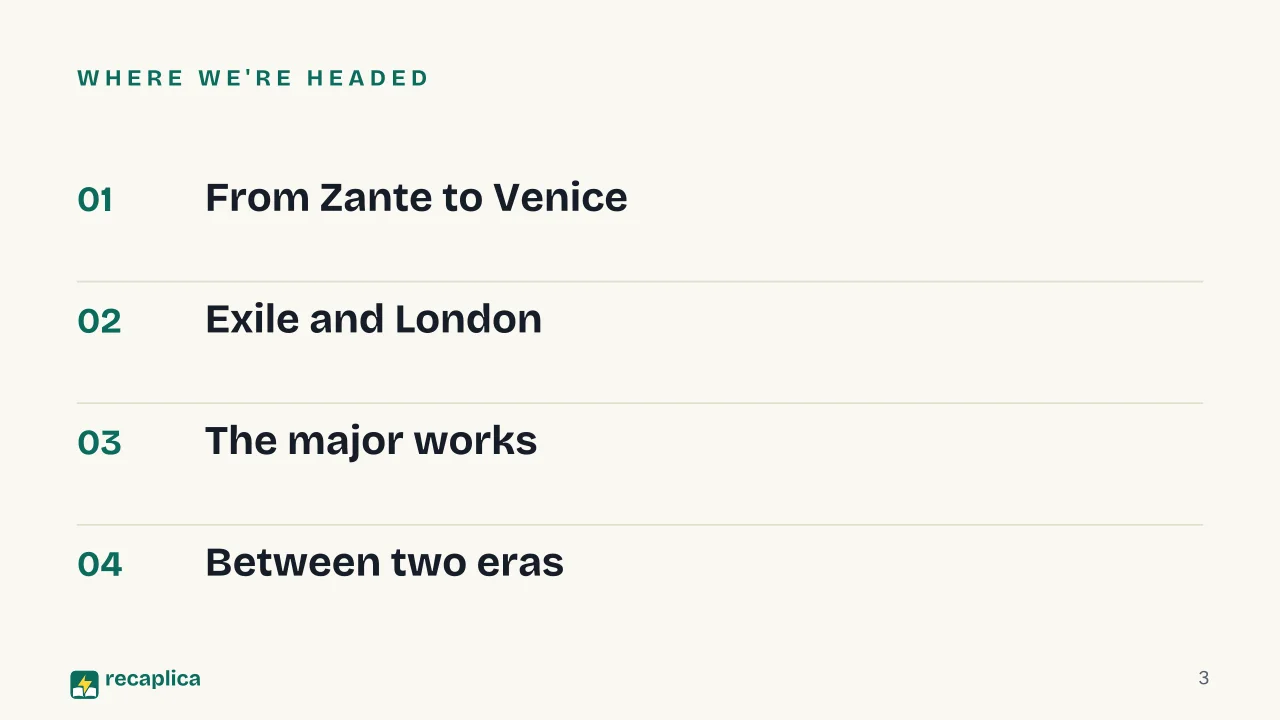
    Slide 1 of the presentation on Ugo Foscolo: Ugo FoscoloSlide 2 of the presentation on Ugo Foscolo: Why did Foscolo never go back to Italy?Slide 3 of the presentation on Ugo Foscolo: Where we're headedSlide 4 of the presentation on Ugo Foscolo: Chapter 01: From Zante to VeniceSlide 5 of the presentation on Ugo Foscolo: The Italian yearsSlide 6 of the presentation on Ugo Foscolo: Chapter 02: Exile and LondonSlide 7 of the presentation on Ugo Foscolo: The route into exileSlide 8 of the presentation on Ugo Foscolo: Eleven years in LondonSlide 9 of the presentation on Ugo Foscolo: Chapter 03: The major worksSlide 10 of the presentation on Ugo Foscolo: The works: Jacopo Ortis, Of the Sepulchres, The GracesSlide 11 of the presentation on Ugo Foscolo: Chapter 04: Between two erasSlide 12 of the presentation on Ugo Foscolo: Jacopo Ortis was not written in LondonSlide 13 of the presentation on Ugo Foscolo: Which work tells the story of an exile through letters?Slide 14 of the presentation on Ugo Foscolo: Before you go
    Flash10 slidesThe essential thread, to present in classFull14 slidesEvery chapter and the deeper detail

    Common myths

    • ✗ Myth Foscolo wrote Last Letters of Jacopo Ortis during his London exile.

      ✓ Reality The novel was printed between late 1798 and early 1799, nearly two decades before Foscolo left for England in 1815-1816. Its publishing history belongs to his Italian years, not his English ones.

    • ✗ Myth Foscolo died in Italy, the country where he had always lived.

      ✓ Reality He died in London on 10 September 1827, after eleven years in England: he had left Milan on the night of 30-31 March 1815 and never set foot in Italy again. Only in 1871 were his remains brought back and buried in the basilica of Santa Croce in Florence.

    • ✗ Myth The Graces is a finished poem, on a par with Of the Sepulchres.

      ✓ Reality Foscolo worked on it from at least 1803 but never completed it: only three hymns survive, dedicated to Venus, Vesta, and Pallas, part of a project he left open. Of the Sepulchres, by contrast, came out complete in 1807.

    Mind map

    Drag the background to move around and the nodes to reposition them; use − and + to collapse and expand branches.
    Customize
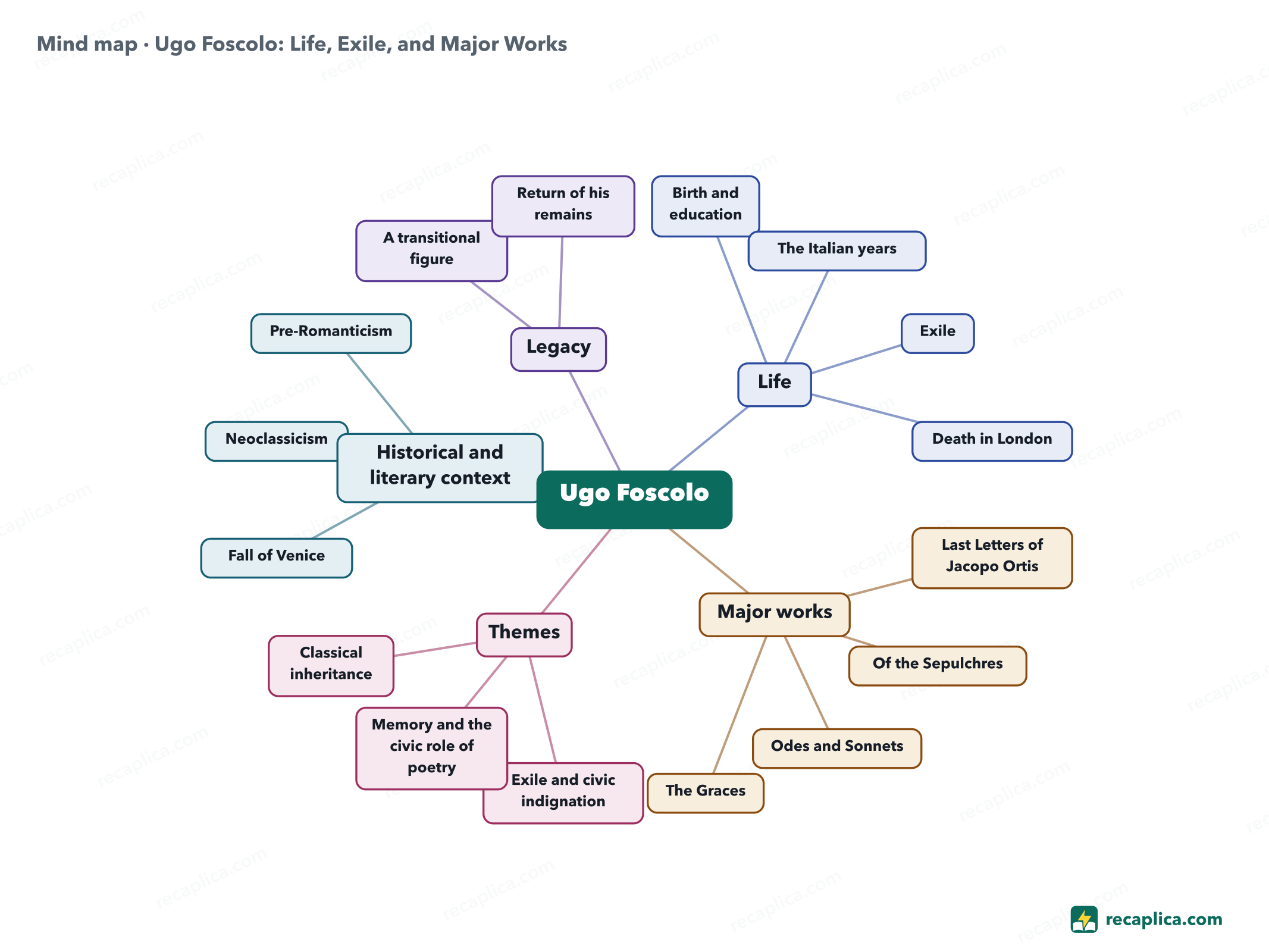
    Mind map: Ugo Foscolo: Life, Exile, and Major Works
    • Ugo Foscolo
      • Life
        • Birth and education Zante in 1778, then Venice and the University of Padua
        • The Italian years Fall of Venice in 1797, the Cispadane Republic, Milan, the French army
        • Exile Switzerland in 1815, London from 1816
        • Death in London 10 September 1827, after eleven years in England
      • Major works
        • Last Letters of Jacopo Ortis Epistolary novel, printed between 1798 and 1799
        • Of the Sepulchres Poem, published in 1807
        • Odes and Sonnets Collected in a volume in 1803
        • The Graces Unfinished poem, three hymns
      • Themes
        • Exile and civic indignation
        • Memory and the civic role of poetry
        • Classical inheritance A meditation on Lucretius's On the Nature of Things
      • Historical and literary context
        • Fall of Venice 1797, a turning point in his life
        • Neoclassicism
        • Pre-Romanticism
      • Legacy
        • A transitional figure Between two literary eras
        • Return of his remains Santa Croce, Florence, 1871

    Quiz: test yourself

    Answer the questions to check what you have learned: you get instant feedback and a short explanation.

    Grade 0/10 0/5
    1 In what year was Ugo Foscolo born?

    Foscolo was born on Zante on 6 February 1778, when the island was under Venetian rule.

    2 Which of Foscolo's works was printed between 1798 and 1799?

    Last Letters of Jacopo Ortis was printed between late 1798 and early 1799; Of the Sepulchres came out in 1807, and The Betrothed is not a work by Foscolo.

    3 Foscolo spent the final years of his life in London.

    He arrived in London on 12 September 1816 and stayed for eleven years, until his death in 1827.

    4 Why do critics place Foscolo between Neoclassicism and Pre-Romanticism?

    He shared Neoclassical ideals, partly rooted in Lucretius, while also opening up themes such as exile that anticipate Romanticism.

    5 Where have Foscolo's remains rested since 1871?

    In 1871 Foscolo's remains were brought back to Italy and buried in the Florentine church of Santa Croce.

    Answers: 1-A · 2-B · 3-A · 4-A · 5-A

    Flashcards

    Tap the card to flip it and check whether you remember the answer, then move to the next one.

    1 / 8

    Explain it in your own words

    The ultimate test: if you can explain it in simple words, you've truly understood it. Write your explanation, then compare it with the Recap.

    Your explanation is saved only on this device.

    Ugo Foscolo was born on the island of Zante, then under Venetian rule, on 6 February 1778, and grew up between Venice and the University of Padua. After the fall of the Republic of Venice in 1797 he moved between the Cispadane Republic and Milan; in 1815 he left Italy for political reasons and never returned, travelling through Switzerland to London, where he arrived in 1816 and lived for eleven years until his death on 10 September 1827. Along the way he wrote the works that still make him a staple of Italian classrooms: the epistolary novel Last Letters of Jacopo Ortis, the poem Of the Sepulchres, his Odes and Sonnets, and the unfinished poem The Graces. Scholars place his work between the last years of the Enlightenment and the first signs of Romanticism. In 1871 his remains were brought back to Italy and buried in the basilica of Santa Croce in Florence.

    Frequently asked questions

    Who was Ugo Foscolo?

    A poet and writer born on Zante in 1778, author of Last Letters of Jacopo Ortis and the poem Of the Sepulchres, who lived in exile between Switzerland and London until his death in 1827.

    Why did Foscolo go into exile?

    For political reasons tied to the post-Napoleonic period: on the night of 30-31 March 1815 he left Milan and never returned to Italy, settling in London from September 1816.

    What are Ugo Foscolo's major works?

    The epistolary novel Last Letters of Jacopo Ortis (1798-99), the poem Of the Sepulchres (1807), the Odes and Sonnets collected in a volume in 1803, and the unfinished poem The Graces.

    Why is Foscolo considered a transitional figure between Neoclassicism and Pre-Romanticism?

    Because he shared Neoclassical ideals, partly rooted in Lucretius, while also developing themes such as exile and civic indignation that anticipate Romantic sensibility.

    Where is Ugo Foscolo buried today?

    In the basilica of Santa Croce, in Florence, where his remains were moved from England in 1871.

    Sources

    • Treccani, Dizionario Biografico degli Italiani, «FOSCOLO, Ugo» (Italian)
    • Treccani, «Ugo Foscolo» (Storia della civiltà europea, ed. Umberto Eco) (Italian)
    • Encyclopædia Britannica (1911), «Foscolo, Ugo», via Wikisource
    • Treccani, Enciclopedia, «Fóscolo, Ugo» (Italian)

    Every Recap goes through an independent review before publication.

    Every evening, the day's new Recaps on our Telegram channel. Join the channel →

    Keep learning

    • Literature Carlo Goldoni: The Playwright Who Rewrote Italian Comedy Carlo Goldoni was born in Venice in 1707 and died in Paris in 1793, after training as a lawyer in Padua and practicing law in Venice. Before him, Italian comic theater relied mostly on commedia dell'arte: unscripted scenarios and fixed stock characters such as Harlequin. Goldoni moved the genre toward fully written plays with characters drawn from real life instead of stereotypes, a shift that begins with "La donna di garbo" ("The Woman of Good Sense") and spreads through his work in the 1750s. The change happened gradually: some transitional plays kept only three or four fully scripted scenes per act, with the rest still improvised. Read the Recap →
    • Literature Torquato Tasso: The Poet Behind Jerusalem Delivered Torquato Tasso was born in Sorrento in 1544 and died in Rome in 1595, having spent most of his adult life at the Este court in Ferrara. His masterwork is Jerusalem Delivered, a twenty-canto poem about the First Crusade and the fall of Jerusalem, published in its final form in 1581 after more than two decades of work. The story follows Godfrey of Bouillon as he leads the Christian army, but it keeps breaking away into private tales of love and duty: the knight Tancred, the sorceress Armida, the paladin Rinaldo. In 1593 Tasso issued a stricter revision titled Jerusalem Conquered, which never won over readers the way the original did. Read the Recap →
    • Literature Gabriele D'Annunzio: Life, Works, and Italian Decadence Gabriele D'Annunzio was born in Pescara on March 12, 1863, and spent seven formative years at the Collegio Cicognini in Prato, graduating in 1881. In the 1880s he threw himself into a restless social life of newsrooms and fashionable salons while writing the novel The Child of Pleasure, published in 1889, and later the Laudi, four volumes (1903-1912) whose first three books mark the high point of his poetry, with Alcyone as the volume critics praised most. According to the Treccani encyclopedia, D'Annunzio was the first Italian writer to bring Italian literature into full contact with the decadent currents that had emerged in France around 1885-1886 in the wake of Baudelaire, which is why he is regarded as the leading figure of Italian Decadence. His life also included a long bond with the actress Eleonora Duse and, in the 1920s, a relationship with Benito Mussolini who, by his own reckoning, never granted the poet any real political weight. He died suddenly on March 1, 1938, at his residence, the Vittoriale. Read the Recap →

    recaplica

    Clear in 30 seconds, yours in 10 minutes.

    Recaps Mind maps Request a Recap Telegram channel Mind map maker Our method About Privacy & cookies Legal notes & terms of use

    © 2026 Recaplica · A project by Curi S.r.l. — VAT IT05472000750

    Statistics, only if you say so

    To learn which Recaps help most we would use Google Analytics, with aggregate, anonymous data. It starts only with your OK, and you can change your mind anytime. Privacy policy