|
recaplica
Italian Unification (Risorgimento): Summary, Dates and Key Events | ||||||||||||||||
| © 2026 Recaplica · recaplica.com — All rights reserved | ||||||||||||||||
Italian Unification (Risorgimento): Summary, Dates and Key EventsWhat to print Page numbers appear when printing with default margins. SlidesChoose a cut Flash10 slidesThe essential thread, to present in classFull19 slidesEvery chapter and the deeper detailBoth come with speaker notes. In 30 seconds quick readItalian unification, known in Italian as the Risorgimento, is the process that turned a peninsula split among several states into a single kingdom between the late eighteenth century and 1861. It began with the failed risings of the Carbonari and with Mazzini's republican campaigning, and gathered speed once Cavour's Piedmont carried the Italian question to the table of the great powers. Three wars were fought against Austria, in 1848, 1859 and 1866, and in 1860 Garibaldi's Expedition of the Thousand toppled the Kingdom of the Two Sicilies. A short law of 17 March 1861 proclaimed the Kingdom of Italy, but Venetia and Rome only joined in 1866 and 1870. Key Points
Key figures
Deep DiveAn Italy that existed only on mapsFor centuries “Italy” was the name of a peninsula, not of a state. In the early nineteenth century someone living in Palermo and someone living in Milan answered to different rulers, paid different taxes, and spoke languages that from one region to the next were often mutually unintelligible. Lombardy and Venetia were administered directly by Austria. Historians use “Risorgimento” for a double movement: from many states to one, and from territories governed from abroad to an independent state. The two aims were distinct, and they did not always move at the same pace. A useful way to keep track of it is to picture a building site. In 1861 the sign went up, the Kingdom of Italy existed, but the site stayed open for years: pieces of territory were still missing, and so was everything else. The roads, the schools, a commonly spoken language. The failed attempts: risings, secret societies, MazziniThe first phase was one of conspiracies, and it almost always ended badly. The Carbonari organised the risings of 1820-21 and 1831, all of them crushed. In 1831 Giuseppe Mazzini founded Young Italy with a clear programme: a unitary republic built from below, through popular insurrection. His insurrections failed one after another. Reading those years as wasted time would be a mistake, though. Military failure produced a cultural result: the idea took hold that the peninsula’s inhabitants were one nation, and it circulated among people who mattered: students, lawyers, army officers, liberal aristocrats.
In 1846 the first reforms of Pope Pius IX raised moderate hopes, and in 1848 the peninsula moved along with the rest of Europe. The same waves that had crossed the continent after the French Revolution came back as demands for constitutions. Three wars against AustriaIndependence was fought against a single opponent, the Austrian Empire, in three wars separated by years of diplomatic preparation.
The first war was Charles Albert of Savoy’s isolated attempt, and it went badly. What separates 1848 from 1859 is not courage but diplomacy, and in between stands Cavour. Cavour, or how an alliance gets builtCamillo Benso, Count of Cavour, born in Turin in 1810, became prime minister of the Kingdom of Sardinia on 2 November 1852. His insight was that Piedmont could not beat Austria alone, and therefore needed a great power at its side. The opening came at the meeting in Plombières on 21 July 1858, where Cavour and Napoleon III agreed on French support in the event of war and on a new settlement for the peninsula. War broke out in April 1859 and ended sooner than expected. The armistice of Villafranca, concluded between 8 and 11 July by Napoleon III and Franz Joseph, laid down that Austria would cede Lombardy to France, which would pass it on to Piedmont; Venetia, however, stayed under the Austrian crown, and the deposed rulers of Tuscany, Modena and Parma were to return to their thrones. Cavour resigned in protest. Those restorations never happened. In central Italy the population elected provisional governments, and in the plebiscites of 11 and 12 March 1860 Tuscany, Emilia and the Romagne voted to join the Savoyard state: turnout reached 79.7% of those entitled to vote in Emilia and 71.9% in Tuscany. France, meanwhile, sent the bill for the war: plebiscites held on 12-14 March 1860 transferred Nice and Savoy across the Alps. The Thousand: four months that toppled a kingdomWhile Cavour worked the chancelleries, the south was taken by a volunteer expedition. On 5 May 1860 the Rubattino company’s steamers Piemonte and Lombardo sailed from Quarto, near Genoa, with 1,084 men aboard — the men history remembers as “the Thousand”.
The most telling political detail is that phrase spoken at Salemi, “in the name of Victor Emmanuel II”. Garibaldi was a republican, but he knew an openly revolutionary venture would alarm everyone: the European powers, Italian moderates and Piedmont itself. Placing the expedition under the Savoyard flag made it acceptable, at the cost of the republic he had wanted. The votes that held the pieces togetherBetween military conquest and the birth of the kingdom came a step that often gets skipped, and without which 17 March 1861 makes little sense: the vote. On 21 October 1860 Sicily and the Neapolitan provinces were called to approve the formula “for Italy, one and indivisible, with Victor Emmanuel as constitutional King”. Turnout was 75.2% in Sicily and 79.5% on the mainland, with more than 92.6% voting yes. On 4 and 5 November it was the turn of the Marche and Umbria, occupied by Savoyard troops.
Suffrage was universal but male only. In all, between 1860 and 1870, more than three million former subjects of the old Italian states took part in these consultations. 17 March 1861The birth of the Kingdom of Italy was a short piece of legislation. The Senate approved it on 26 February 1861 and the Chamber on 14 March; on 17 March, in Turin, Victor Emmanuel II promulgated law no. 4671, published in the official gazette the next day. Its single article stated that the sovereign took, for himself and his successors, the title of King of Italy. Among the ministers’ signatures was Cavour’s; he died in Turin that same year. One apparently minor choice says a great deal: the king remained “II” rather than becoming “I”. The numeral came from the Kingdom of Sardinia, and keeping it asserted that united Italy was not a new state but the Savoyard one enlarged. Anyone hoping for a pact among peoples read it as a defeat. 17 March is now the Anniversary of Italian Unity, a national holiday established in 1911. Venetia, Rome and the unfinished businessIn 1861 the building site was far from closed. Venetia was still Austrian and came only with the Third War of Independence in 1866, which went badly in the field: at Custoza, on 24 June, the Italian army was beaten. Despite that military failure the war ended with the acquisition of Venetia, confirmed by the plebiscite of 21 and 22 October 1866 in the Venetian provinces and in the province of Mantua. Rome was the harder problem, because taking it meant a collision with the papacy. On 20 September 1870 Italian troops under General Raffaele Cadorna attacked the stretch of wall between Porta Pia and Porta Salaria: the first artillery rounds were fired at 5:10, the papal defenders raised the white flag at 10:05, and the units began entering through the breach. On 2 October Rome and its province voted for annexation, with a turnout of 80.7%; the court and government moved there the following year. The Italian state tried to regulate relations with the Church through the Law of Guarantees in 1871, but the pope rejected it and, with the non expedit, forbade Italian Catholics to take part in the kingdom’s political life. A large share of the country stayed away from the polls as a result. Then there were the problems no law solves in a day. At the 1861 census 75% of the whole population was illiterate. Among adults alone the picture was less stark but still severe: about 40% of men and fewer than a quarter of women could read and write. The overall figure fell to 68.8% in 1871 and 61.9% in 1881. It was slow progress, and it measures how wide the distance was between the new state and the daily lives of its citizens. What the Risorgimento left behindThe Kingdom of Italy was born centralised, with laws, an army and an administration modelled on Piedmont’s and extended to regions with very different legal traditions. The tensions that followed, from the gap between north and south to the broken relationship with the Church, weighed on the decades that came after and reached the First World War and beyond. The Risorgimento soon became political material in its own right: every era reread it to suit itself, and the myth of Mussolini shows how far a shared past can be rewritten by those in power. Knowing the dates, the people involved and the business left unfinished is the best way to notice when it happens. Slide deckSlides ready to download and make your own in PowerPoint or Google Slides, with speaker notes. Pick the Flash cut or the Full one.   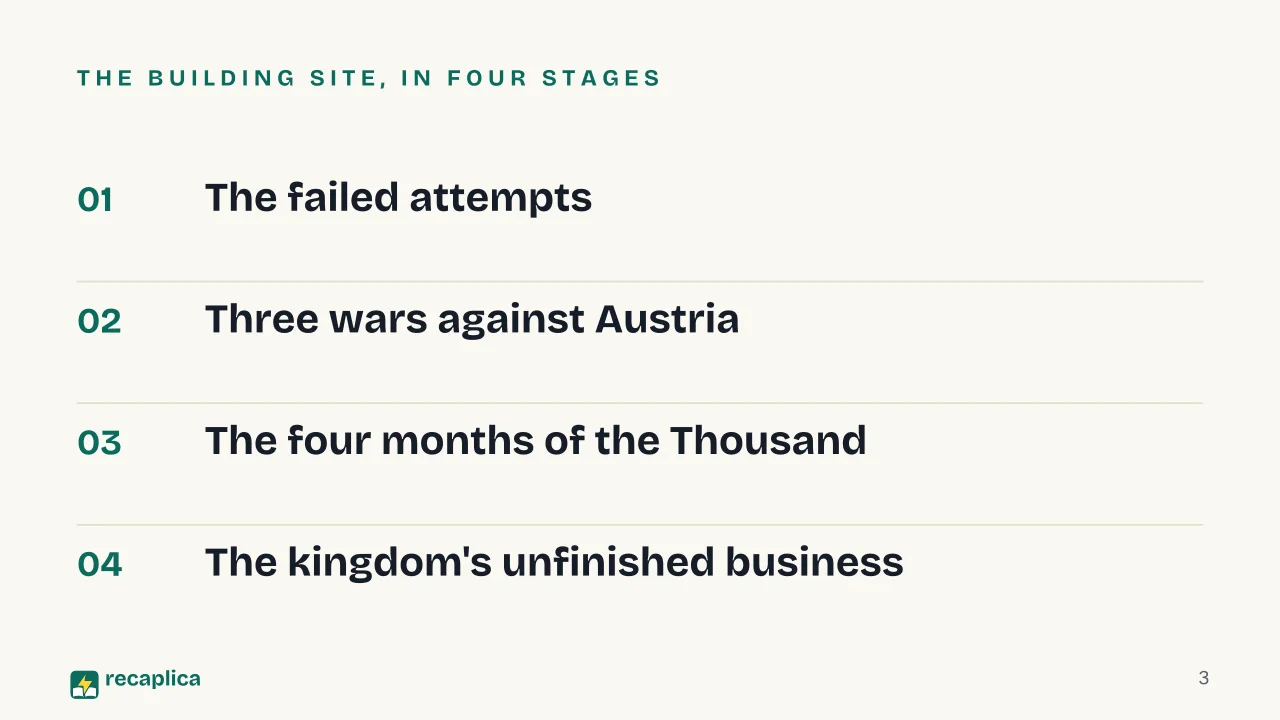  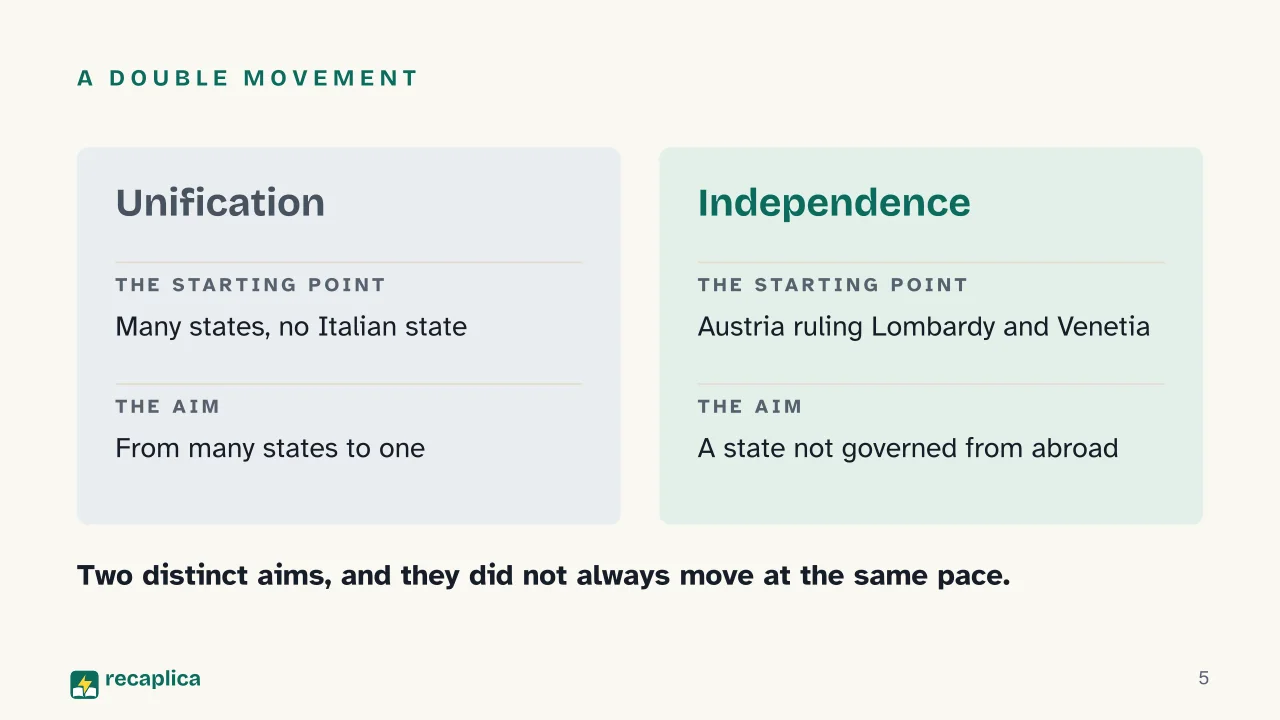 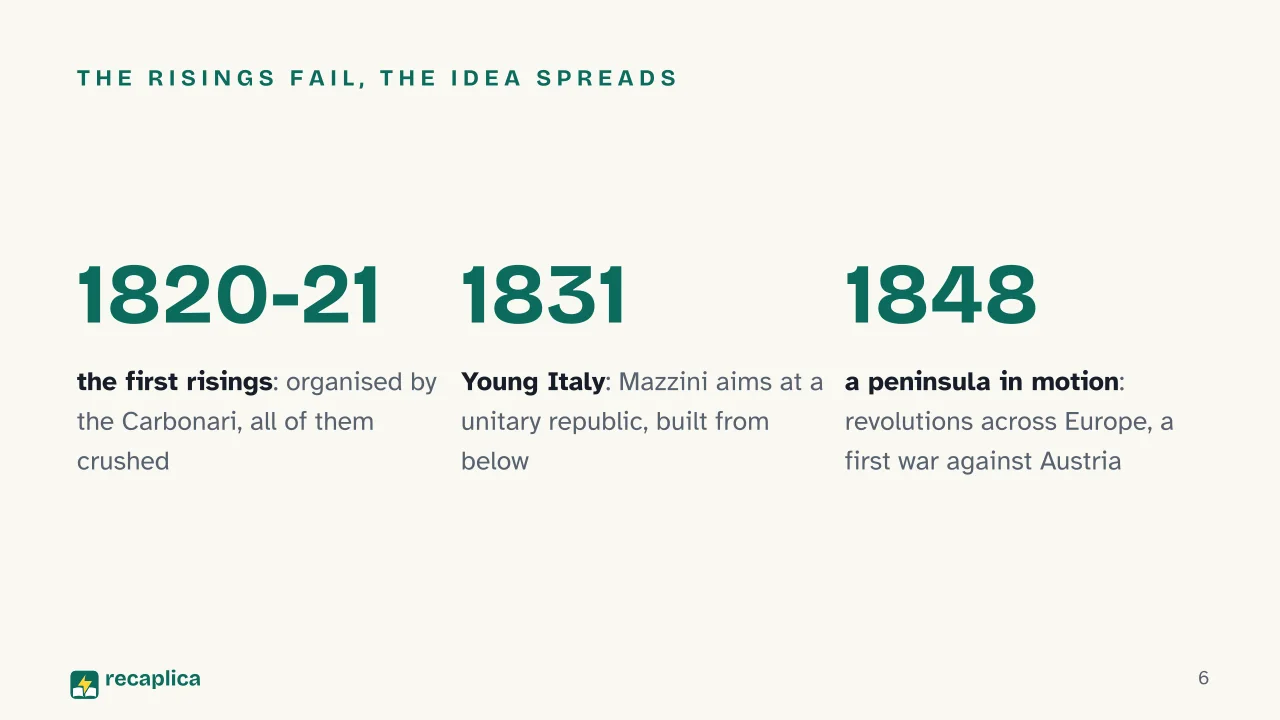 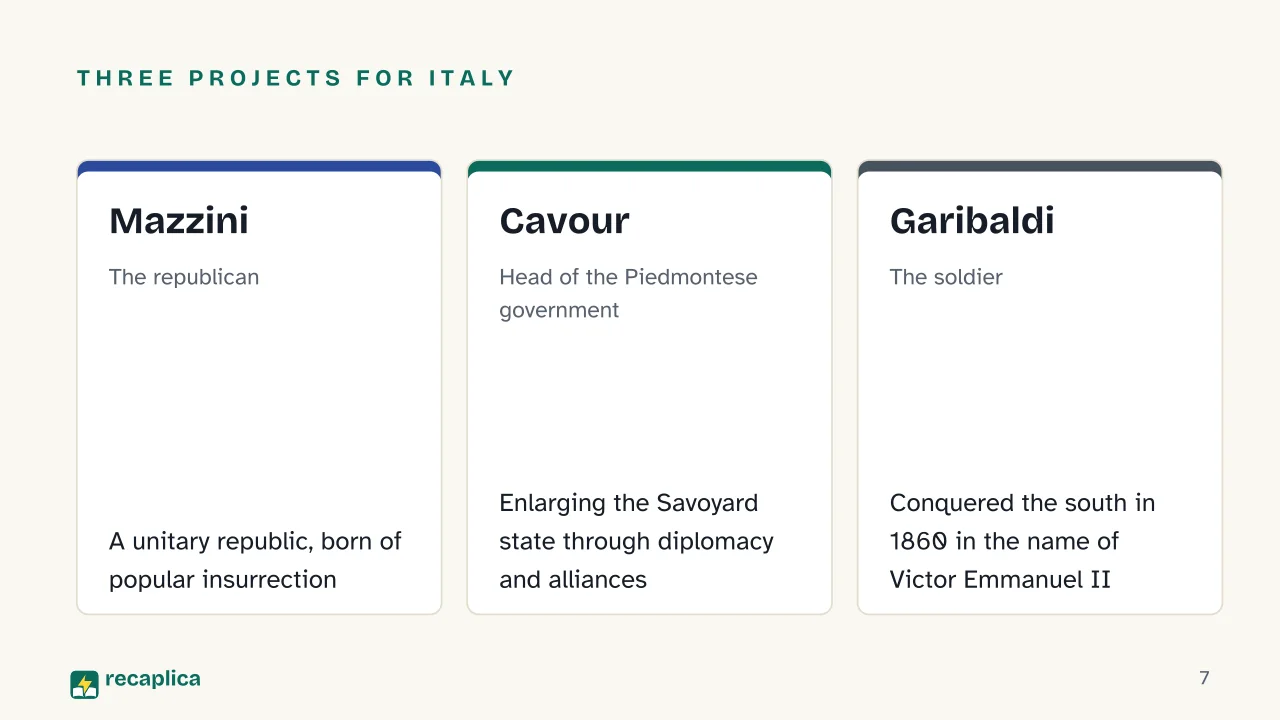  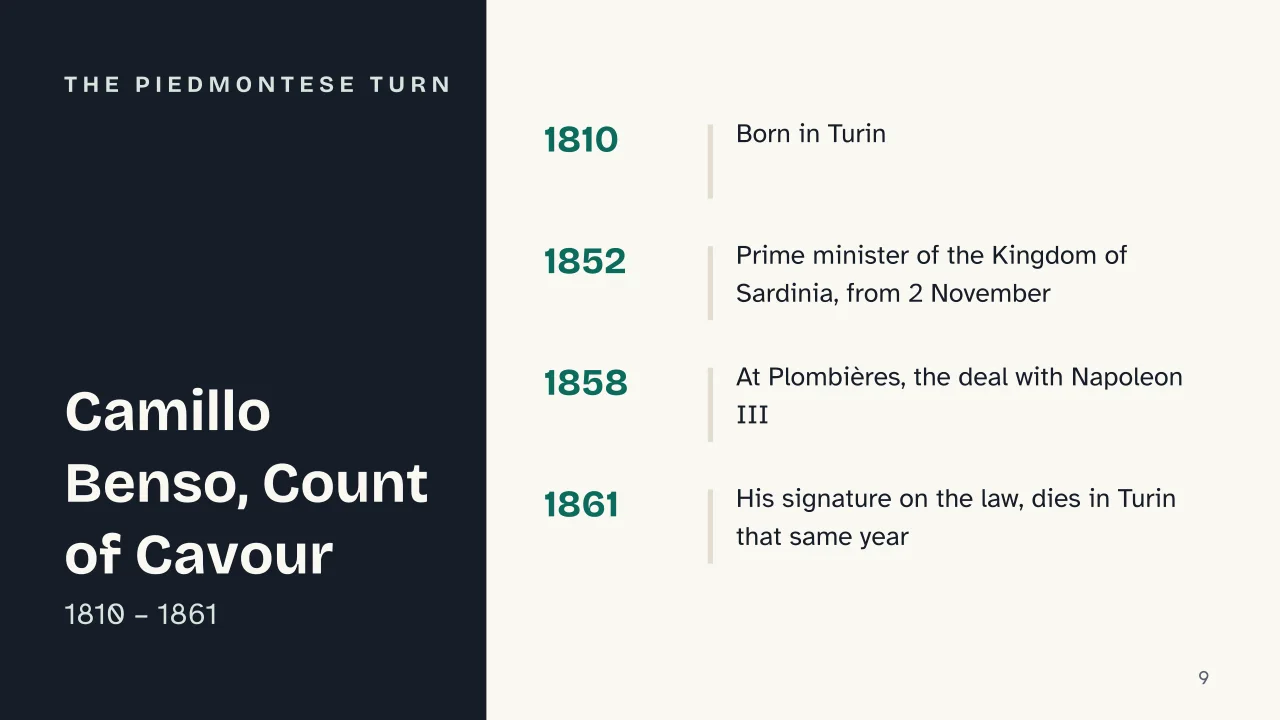 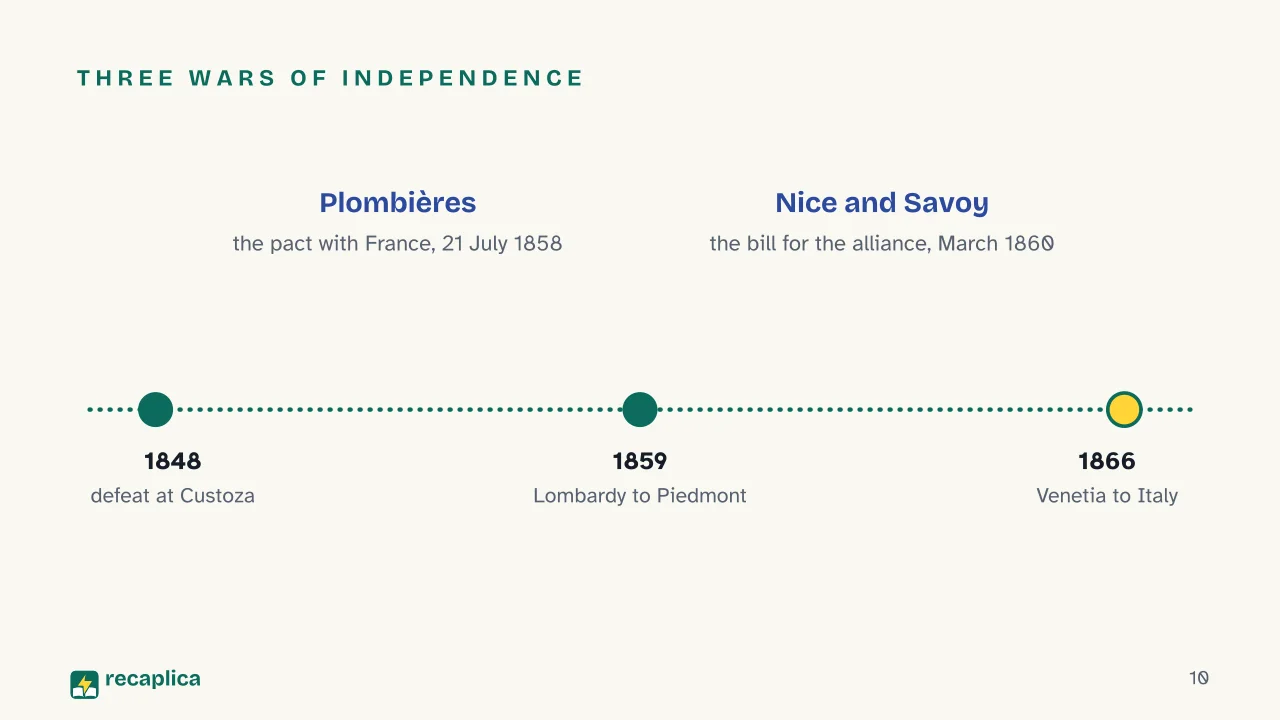  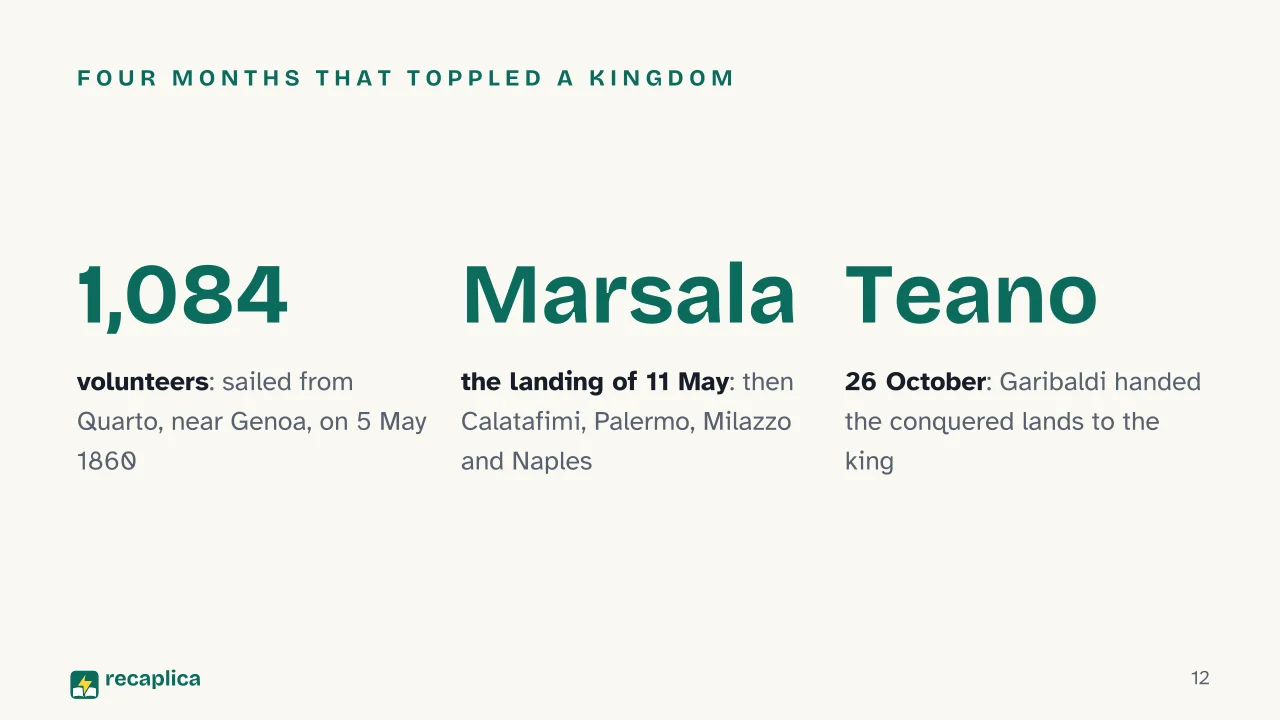 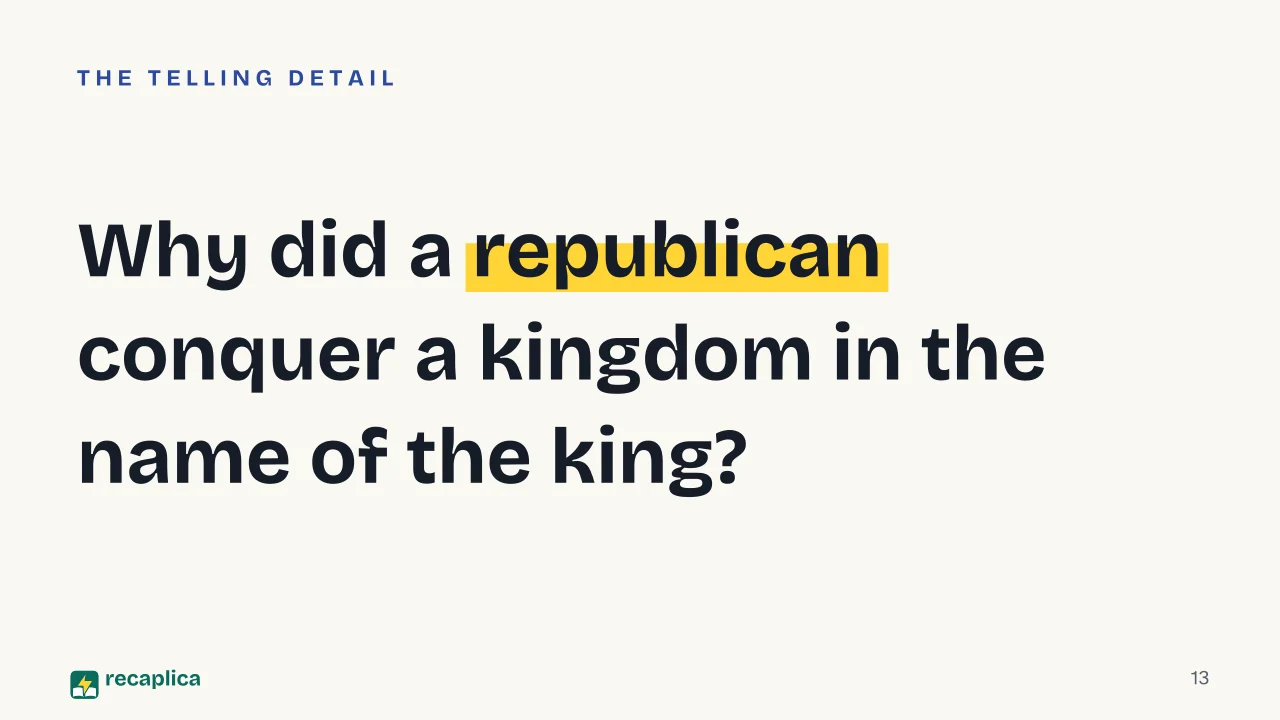  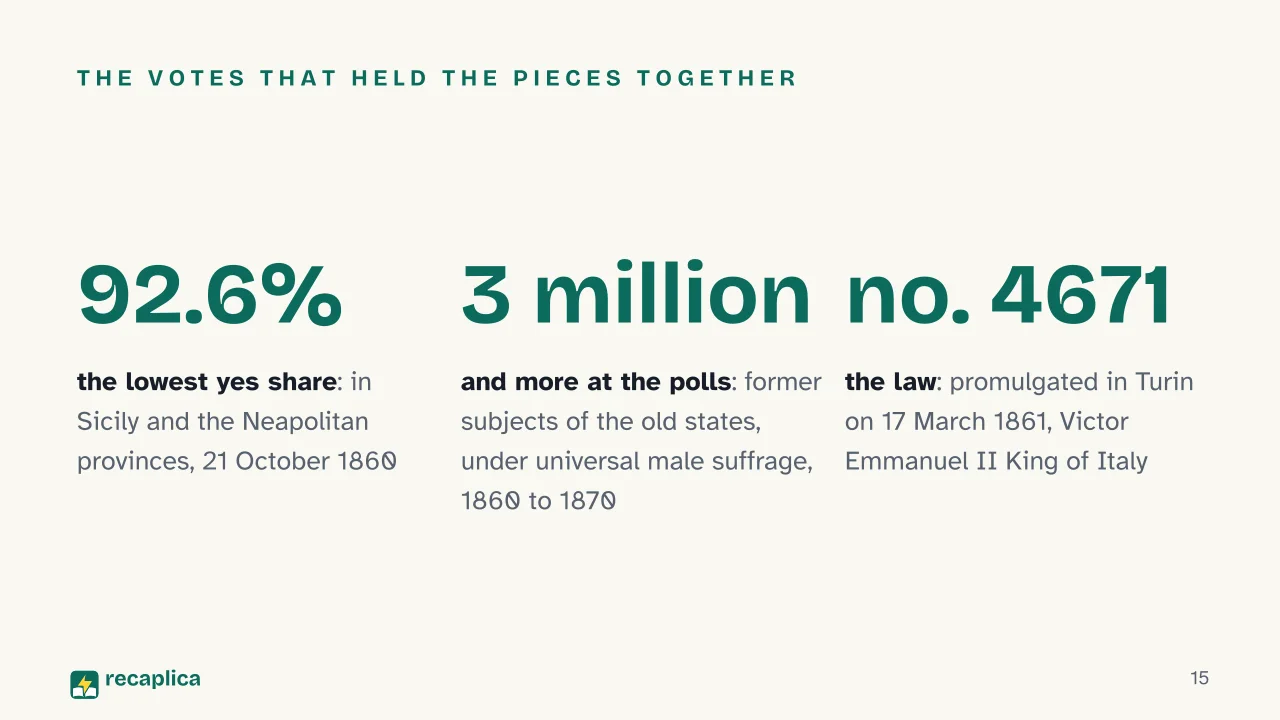 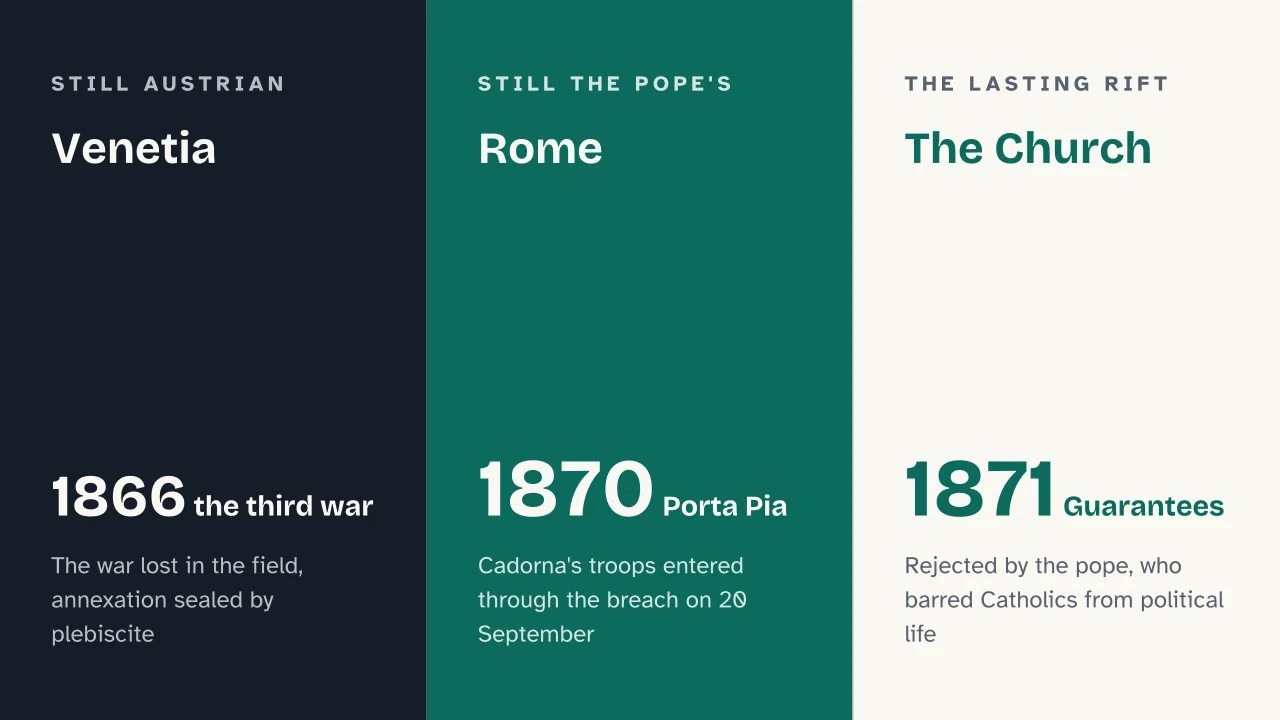 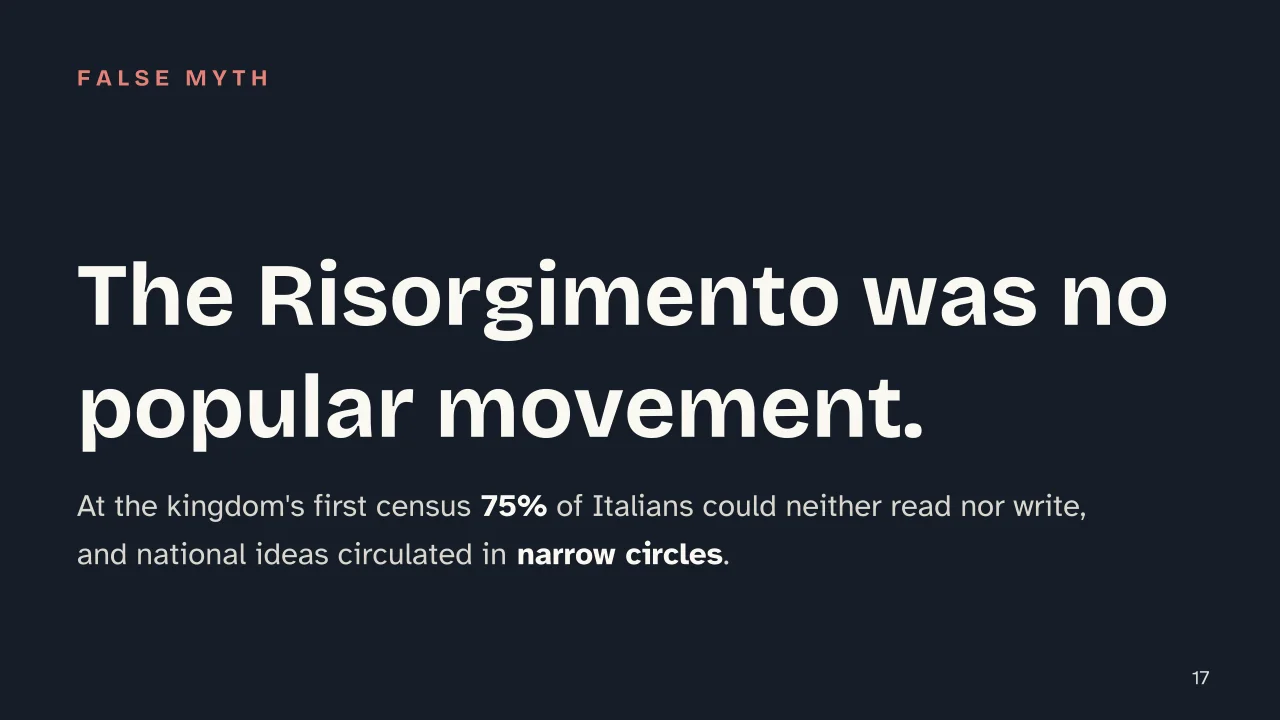 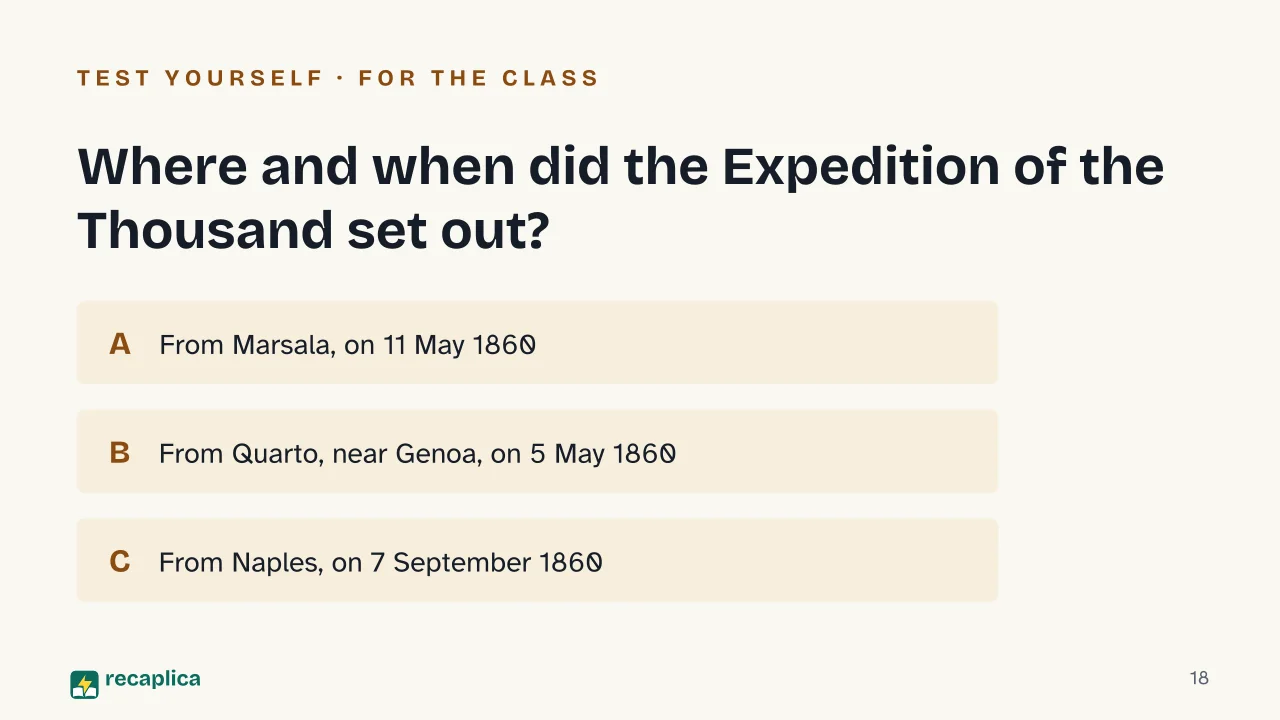  Common myths
Mind mapDrag the background to move around and the nodes to reposition them; use − and + to collapse and expand branches. 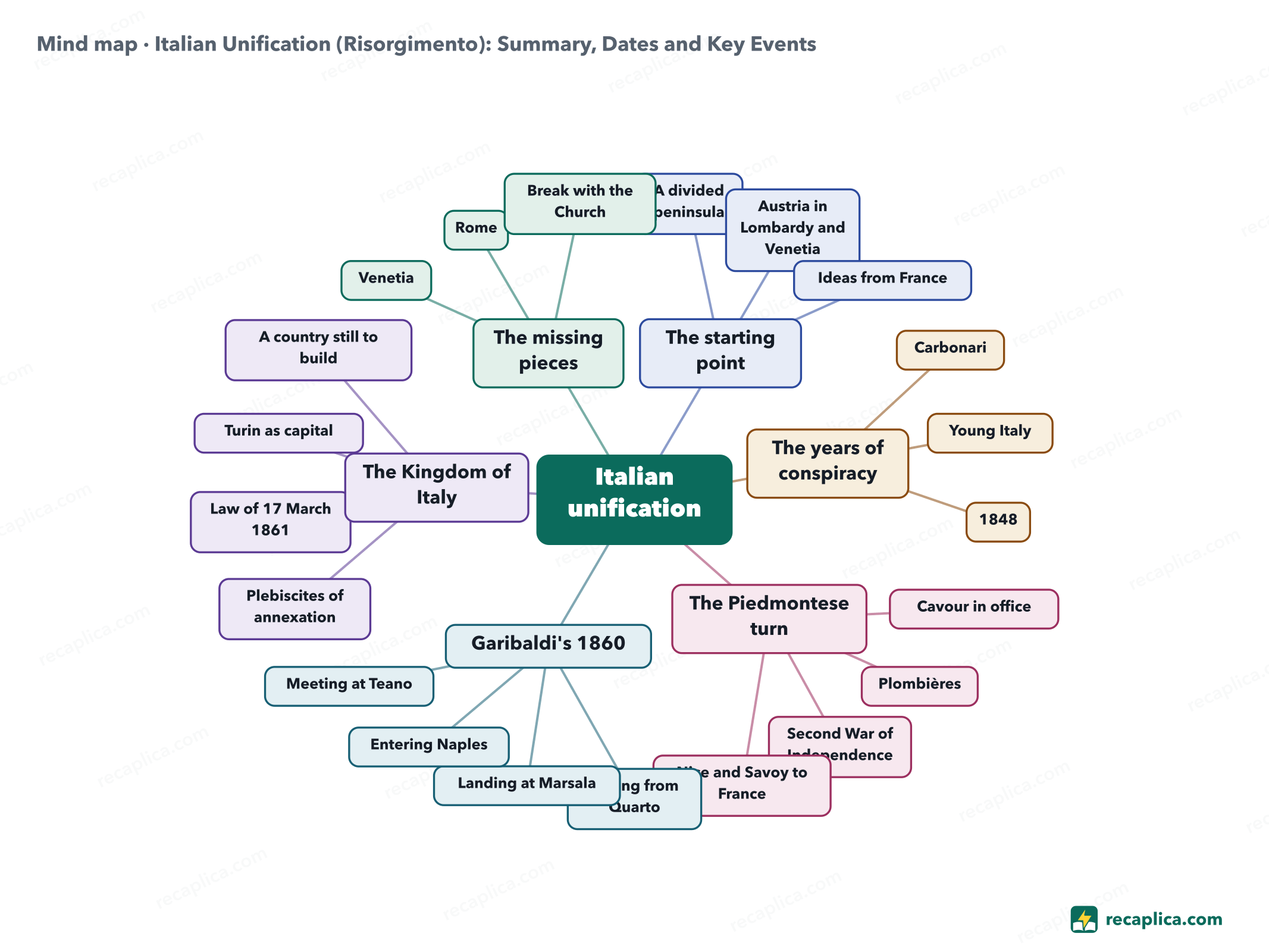
Quiz: test yourselfAnswer the questions to check what you have learned: you get instant feedback and a short explanation. Grade 0/10 0/5
FlashcardsTap the card to flip it and check whether you remember the answer, then move to the next one. 1 / 8 Explain it in your own wordsThe ultimate test: if you can explain it in simple words, you've truly understood it. Write your explanation, then compare it with the Recap. Your explanation is saved only on this device.
Frequently asked questionsWhen did Italian unification begin and end?Its roots are usually placed in the late eighteenth century, when French revolutionary ideas spread through the peninsula. The conventional end point is 1861, the year the Kingdom of Italy was proclaimed. Many accounts continue to 1870, when Rome joined the kingdom. What were the three wars of independence?The first ran from 23 March to 9 August 1848, fought by Piedmont against Austria and ended by the defeat at Custoza. The second ran from 26 April to 8 August 1859 with France as an ally: victories at Magenta (4 June) and at Solferino and San Martino (24 June) brought Lombardy to Piedmont. The third ran from 20 June to 12 August 1866; it went poorly on the battlefield but ended with Venetia passing to Italy. What did Mazzini, Cavour and Garibaldi each want?Three different projects that sometimes worked against each other. Mazzini wanted a unitary republic born of popular insurrection, and founded Young Italy to build it. Cavour, head of the Piedmontese government, aimed to enlarge the Savoyard state through diplomacy and alliances. Garibaldi was the soldier who conquered the south in 1860 in the name of Victor Emmanuel II, setting his own republicanism aside. Why wasn't Rome the capital in 1861?Because it still belonged to the Papal State, which France protected. Italian troops under General Raffaele Cadorna entered the city on 20 September 1870, after opening a breach in the walls between Porta Pia and Porta Salaria; the court and government moved there the following year. The pope never accepted the outcome, and the rift with the Italian state stayed open for decades. Was Italy really a united country in 1861?Politically yes, socially far less so. At the 1861 census 75% of the whole population was illiterate. Among adults alone the picture was less stark but still severe: about 40% of men and fewer than a quarter of women could read and write. There was no shared spoken language, no connected road and rail network, no uniform tax or school system. Every Recap goes through an independent review before publication. |