|
recaplica
The Last Letters of Jacopo Ortis: Plot and Themes of Foscolo's Novel |
| © 2026 Recaplica · recaplica.com — All rights reserved |
The Last Letters of Jacopo Ortis: Plot and Themes of Foscolo's NovelWhat to print Page numbers appear when printing with default margins. SlidesChoose a cut Flash10 slidesThe essential thread, to present in classFull14 slidesEvery chapter and the deeper detailBoth come with speaker notes. In 30 seconds quick readThe Last Letters of Jacopo Ortis is the novel in which Ugo Foscolo tells, through the letters of a young Venetian exile to his friend Lorenzo Alderani, an impossible love and the collapse of hopes for freedom after the fall of the Republic of Venice. Jacopo falls in love with Teresa, who is already promised to Odoardo, and withdraws to the Euganean Hills while Italy changes shape under Napoleon. When Teresa marries, Jacopo takes his own life. It is considered the first epistolary novel in Italian literature, written on the model of Goethe's The Sorrows of Young Werther, and its publishing history is as tangled as its plot: an unfinished 1798-99 edition, printed without Foscolo's consent, came before the definitive text of 1816-17. Key Points
Deep DiveWho is Jacopo Ortis, and how the novel came aboutJacopo Ortis is a young Venetian exile, and readers learn his story only through the letters he writes to his friend Lorenzo Alderani. Ugo Foscolo had already sketched an earlier version of the story in 1796, under the title Laura, lettere, never published: a different novel, but the same underlying idea of telling everything through letters. For the full biography of Foscolo, from his early years to his final exile, see the Recap on Ugo Foscolo. The plot of The Last Letters of Jacopo OrtisThe story is set between late 1797 and 1799, the years in which the Republic of Venice was ceded to Austria under the Treaty of Campo Formio. Jacopo takes refuge in the Euganean Hills to escape the political persecution that followed, and there he meets Signor T***, his daughters Teresa and Isabellina, and Odoardo. He falls in love with Teresa, but she is already promised to Odoardo: a love with no way out, woven through a story that ties Jacopo’s private feelings to the collapse of his political hopes.
Jacopo flees across Italy, then returns to the Euganean Hills. Once every possibility with Teresa is closed off, he takes his own life with a dagger to the heart, driven to despair by his lost love and by the collapse of the hopes for freedom tied to the Treaty of Campo Formio. The letters of Jacopo Ortis: one voice, one recipientThe novel has no outside narrator: every letter Jacopo Ortis writes is addressed to a single friend, Lorenzo Alderani, and readers learn about Teresa, Odoardo and everything else in the story only through what Jacopo chooses to put on the page. No reply from Lorenzo ever appears in the text. In September 1798 Foscolo began publishing the novel through the Bolognese bookseller Jacopo Marsigli, but the printing stopped at the forty-fifth letter. Marsigli then handed the task of finishing it to another writer, the Bolognese Angelo Sassoli, who published it anyway, without Foscolo’s knowledge. Foscolo only found out afterward, and called that text a “hodgepodge of romantic follies, doctored phrases and cowardly notes”; he published his public rejection of it on 3 January 1801 in the Gazzetta di Firenze, and again on 17 March in the Monitore di Bologna. Themes and inspiration: love, exile, civic angerThree threads hold the novel together: the unhappy love for Teresa, the political exile that followed the fall of the Republic of Venice, and the civic anger of a young man watching the hopes raised by the French Revolution betrayed. The steps that led to the Treaty of Campo Formio are covered in the Recap on the French Revolution, which traces the events that redrew the political map of Europe, Italy included. In both form and content, the novel sits close to Goethe’s The Sorrows of Young Werther, published in 1774: there too a young man tells his own story only through letters, and scholars have long pointed to that novel as Foscolo’s model. A few decades later another Italian author, Giacomo Leopardi, reaches an equally bleak outlook by a different route, through philosophical reflection on the human condition. The editions: from an unfinished text to the definitive novelAfter disowning the Sassoli edition, Foscolo published his own authorized version the following year, in 1802, in Milan and at his own expense. That was not the end of the story: the novel came back under his pen for one last, extensive revision, published in Zurich in 1816 and in London in 1817, by then during his years of exile. That is the version readers know. The Last Letters of Jacopo Ortis remains an unusual case in the history of the Italian novel: it arrives before the genre truly took hold in the country, in a form, the epistolary novel, that no other major nineteenth-century Italian novel would take up in the same way again. It would fall to a different work, Alessandro Manzoni’s The Betrothed, to become the reference point for the Italian novel a few decades later, but with an outside narrator and a completely different structure. Slide deckSlides ready to download and make your own in PowerPoint or Google Slides, with speaker notes. Pick the Flash cut or the Full one.     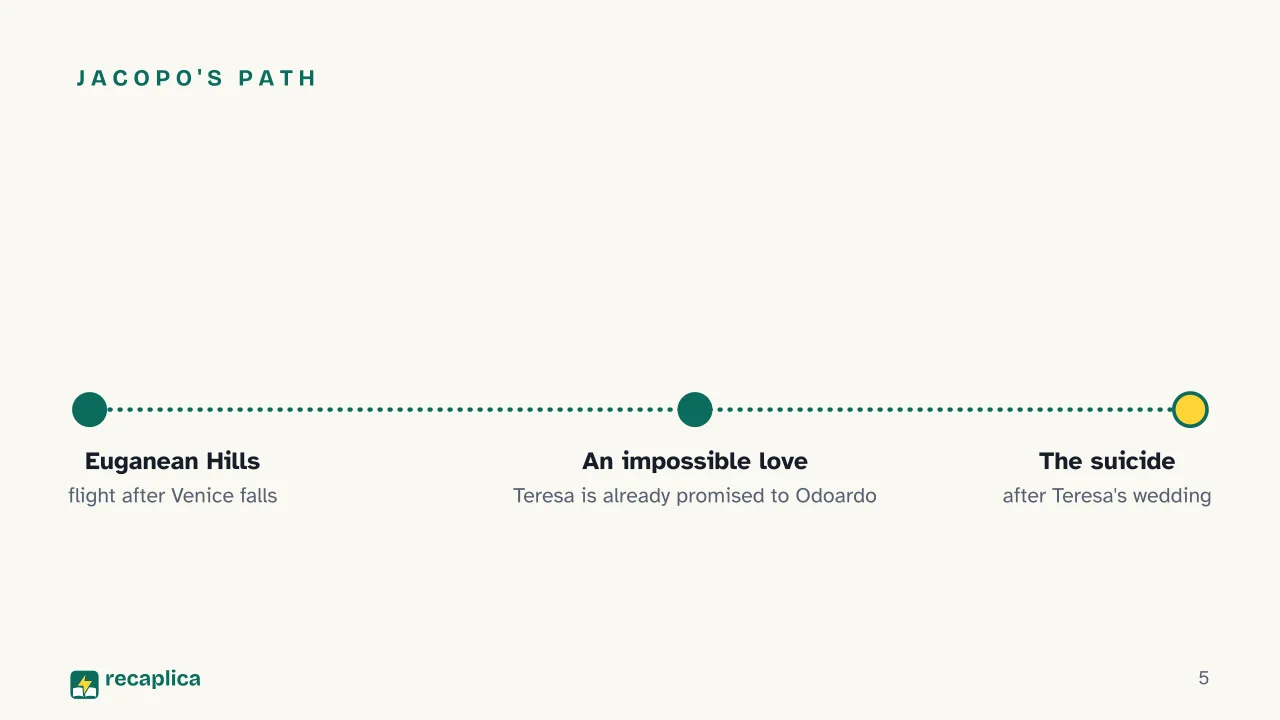  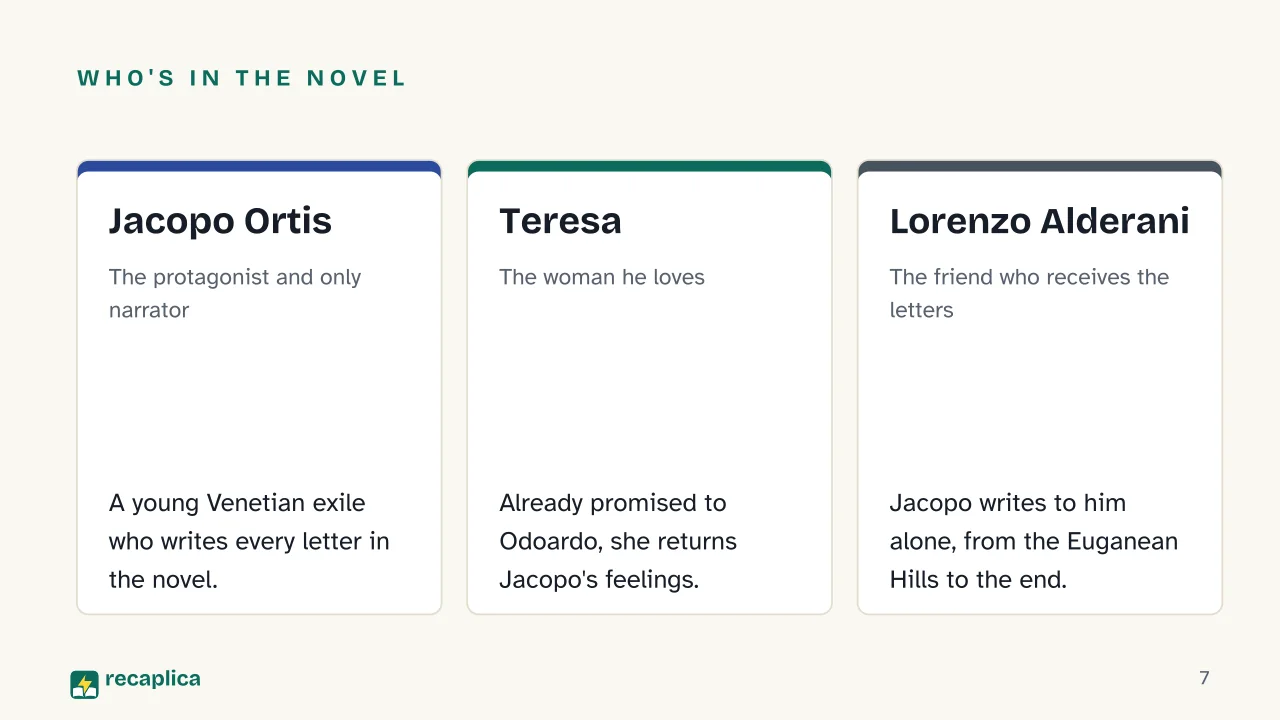  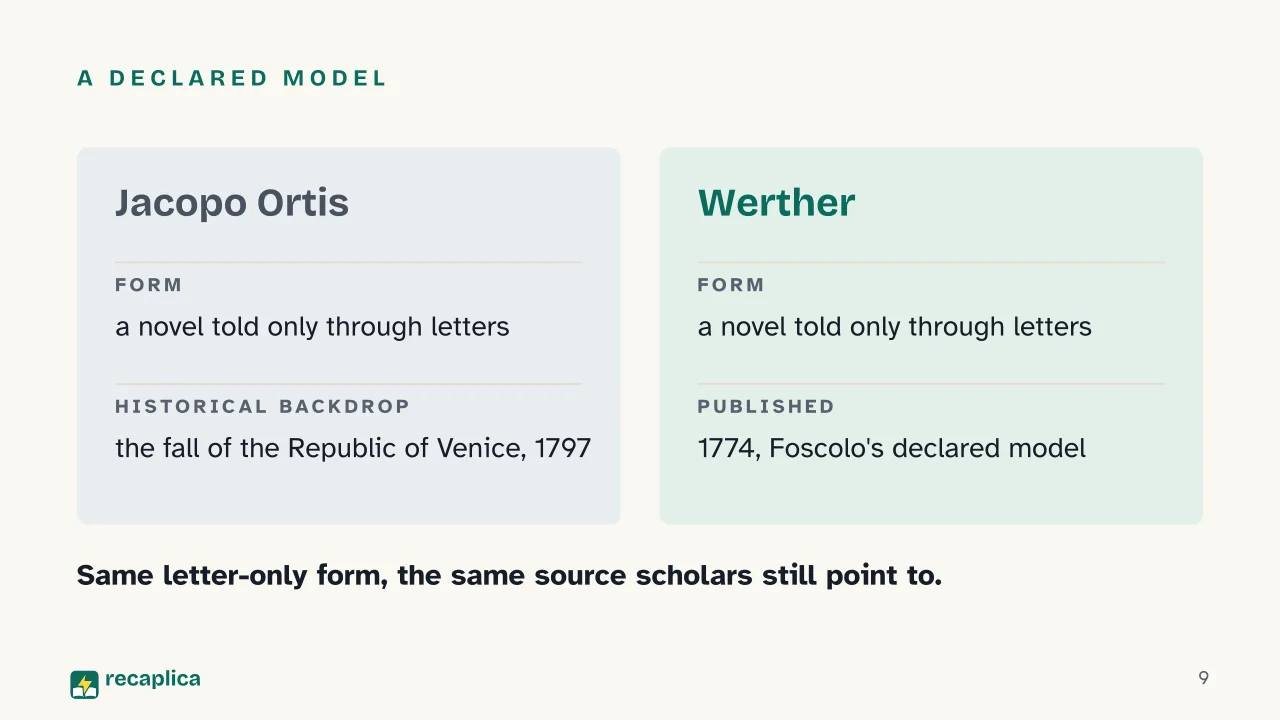 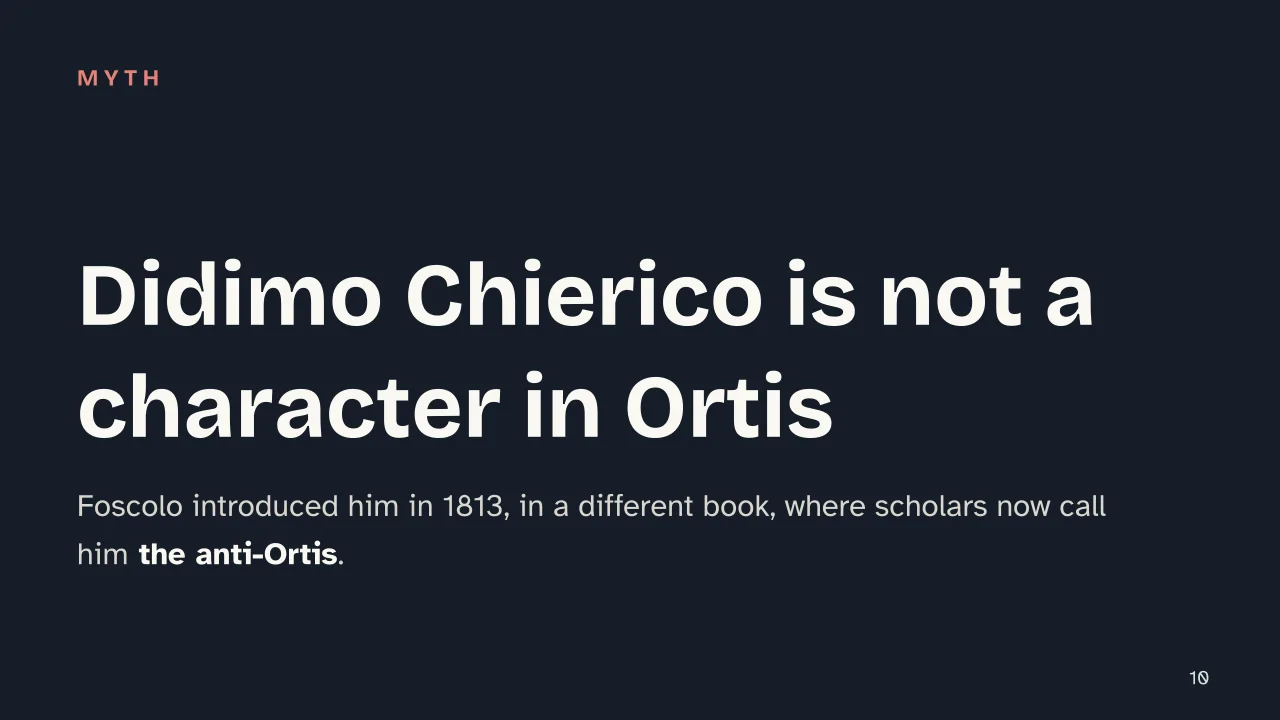  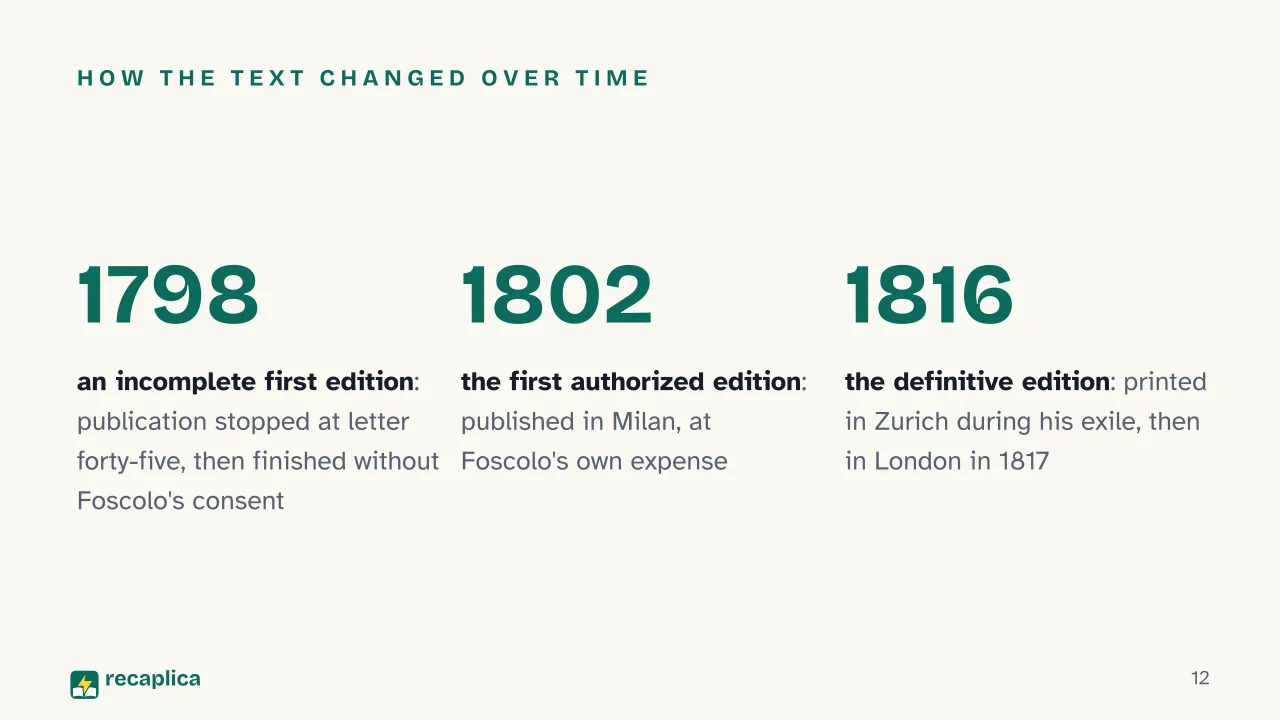 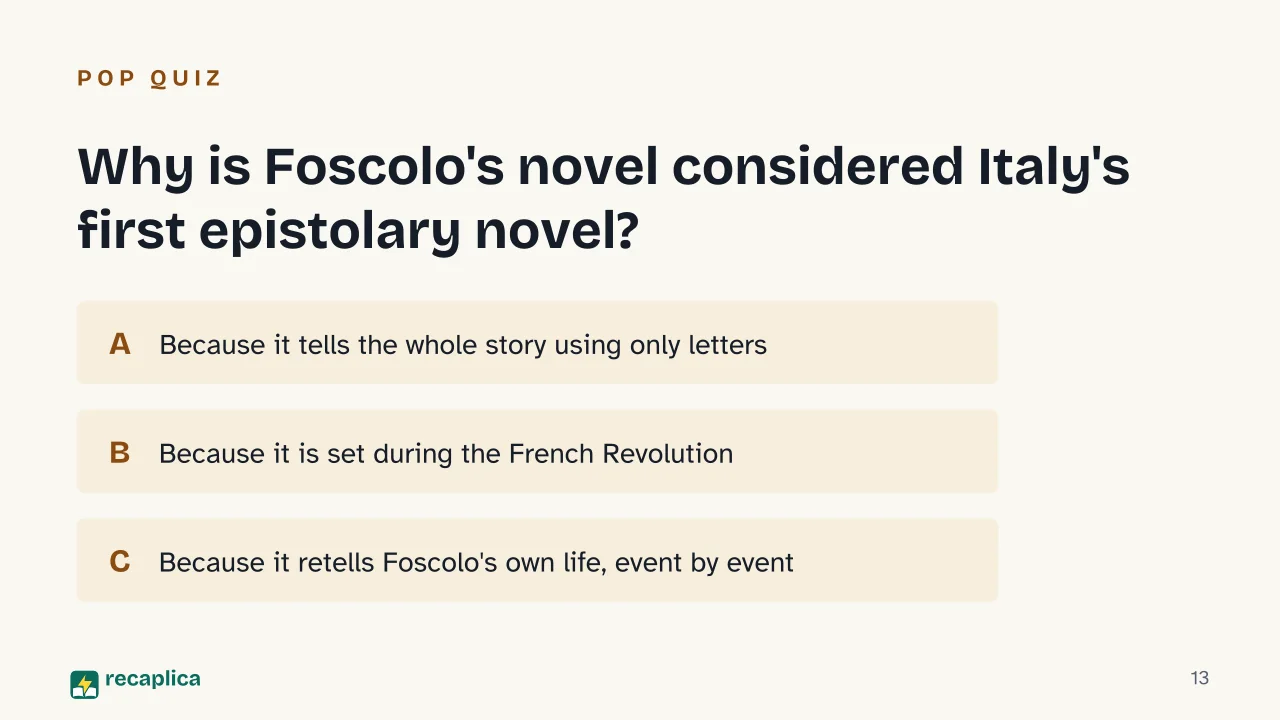  Common myths
Mind mapDrag the background to move around and the nodes to reposition them; use − and + to collapse and expand branches. 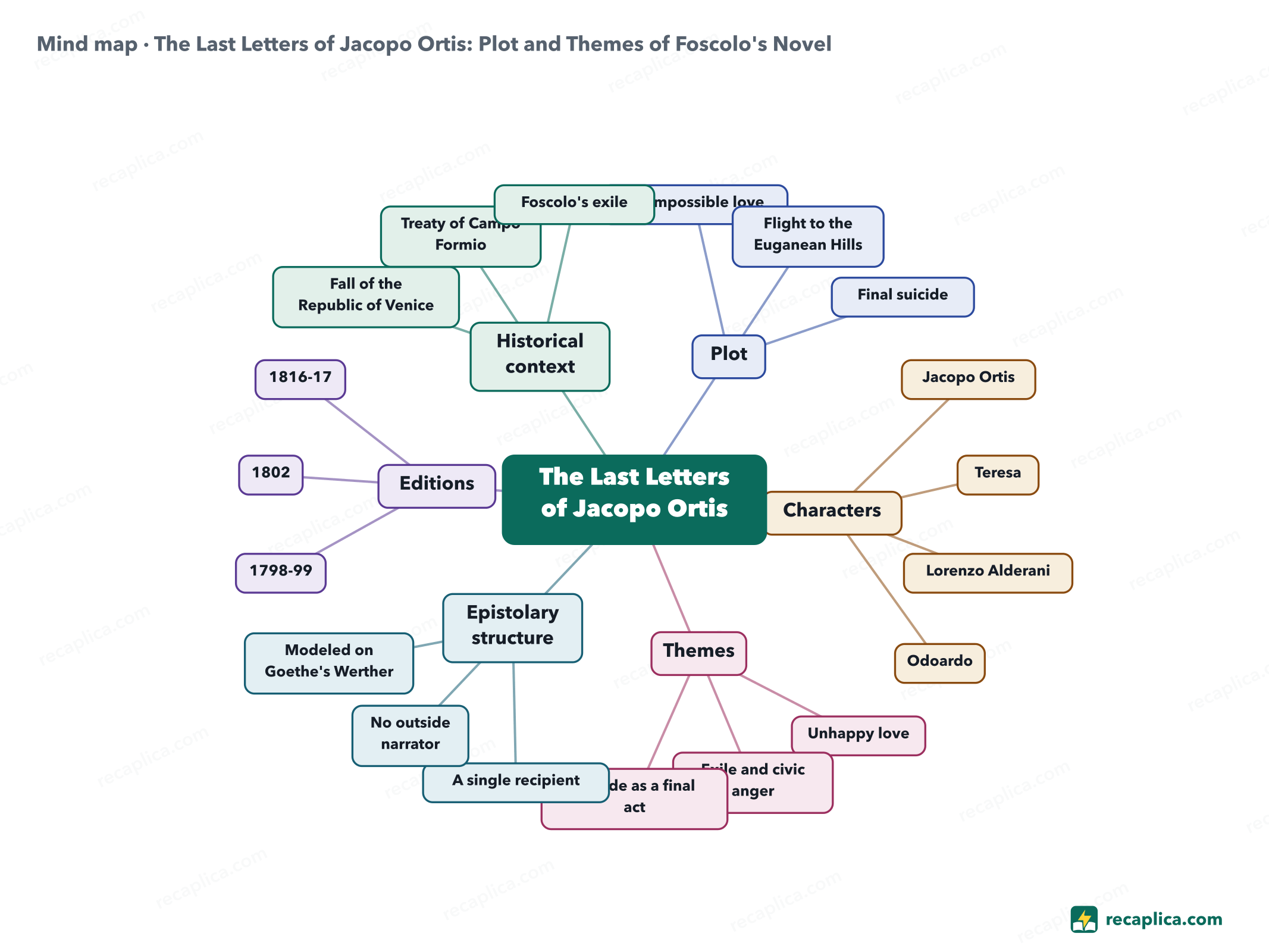
Quiz: test yourselfAnswer the questions to check what you have learned: you get instant feedback and a short explanation. Grade 0/10 0/5
FlashcardsTap the card to flip it and check whether you remember the answer, then move to the next one. 1 / 8 Explain it in your own wordsThe ultimate test: if you can explain it in simple words, you've truly understood it. Write your explanation, then compare it with the Recap. Your explanation is saved only on this device.
Frequently asked questionsWhat is The Last Letters of Jacopo Ortis about?It tells the story of Jacopo Ortis, a young Venetian exile who takes refuge in the Euganean Hills after the fall of the Republic of Venice, falls in love with Teresa (already promised to Odoardo) and, after her wedding, takes his own life. The entire novel is written as letters that Jacopo addresses to his friend Lorenzo Alderani. How are the letters in Jacopo Ortis written?They are all letters from Jacopo to a single recipient, his friend Lorenzo Alderani: the text of the novel includes no replies from Lorenzo and no outside narrator. Readers follow the story only through Jacopo's point of view, letter by letter. Is there a letter addressed to Jacopo Ortis in the novel?No letters in the novel are addressed to Jacopo: the form runs one way, with Jacopo always writing to Lorenzo Alderani. Readers looking for "a letter to Jacopo Ortis" are usually thinking of one of the letters he himself writes, which is to say a chapter of the novel. Why is it considered the first Italian epistolary novel?Because before Foscolo no Italian novel had told an entire story using only letters, following a form Goethe had already tested in Europe with The Sorrows of Young Werther. Does Didimo Chierico appear in the novel?No: he belongs to a different Foscolo work, the Notizia intorno a Didimo Chierico, published in Pisa in 1813. Outside that text, he never appears in The Last Letters of Jacopo Ortis. Every Recap goes through an independent review before publication. |