|
recaplica
Alberto Moravia: life and the novel of existential unease | ||||||||||||||||
| © 2026 Recaplica · recaplica.com — All rights reserved | ||||||||||||||||
Alberto Moravia: life and the novel of existential uneaseWhat to print Page numbers appear when printing with default margins. SlidesChoose a cut Flash10 slidesThe essential thread, to present in classFull14 slidesEvery chapter and the deeper detailBoth come with speaker notes. In 30 seconds quick readAlberto Moravia, the pen name of Alberto Pincherle, is born in Rome in 1907 and dies there in 1990. He debuts in 1929 with «The Time of Indifference», a novel that portrays the moral decline of a bourgeois family under fascism. Over the following three decades he publishes a run of novels, from «Agostino» to «The Conformist», from «A Ghost at Noon» to «Boredom», that keep returning to the tension between purity and corruption and to the social changes of his time. Sources describe his characters as figures trapped in a setting that offers no way out. Moravia is still read today to understand how one Italian author gave shape to 20th-century existential unease. Key Points
Key figures
Deep DiveWho Alberto Moravia wasAlberto Moravia is the pen name under which the world knows Alberto Pincherle, born in Rome in 1907 and dead in the same city in 1990. He chooses this name for his very first novel and signs his entire career with it. He grows up in a comfortable bourgeois family, a setting he later turns into critical material on the page. His work spans almost the whole of the Italian 20th century, from fascism through the postwar years to the economic boom. He is not an isolated case: together with Italo Svevo and Luigi Pirandello, Moravia belongs to a generation of writers who put at the center of their novels characters unable to find a stable place in the world around them. The debut novel: The Time of IndifferenceMoravia debuts in 1929 with «The Time of Indifference» (Gli Indifferenti), considered a landmark of 20th-century Italian fiction. The novel follows a bourgeois family sliding into moral decline under fascism, with characters who watch their own ruin without reacting. Encyclopedia.com reads the novel as an indictment of an Italian bourgeoisie caught in the middle of its own moral decay, translated into English first as «The Indifferent Ones» in 1932 and later as «The Time of Indifference» in 1953. That indifference the title points to marks the first portrait of an unease Moravia keeps exploring throughout his career. The same theme resurfaces, in a different form, in the work of Italo Svevo: the narrator of Zeno’s Conscience watches himself with the same detached inability to act. The novels that followedOver the next three decades Moravia publishes a run of novels that remain among his most read: «Agostino» in 1944, «Conjugal Love» in 1949, «The Conformist» in 1951, «A Ghost at Noon» in 1954, «Two Women» in 1957 and «Boredom» in 1960. Several find a publisher outside Italy quickly: «The Conformist» comes out in English the same year as the Italian edition, «A Ghost at Noon» is the English title given to «Il Disprezzo» in 1955, and «Two Women» is the English title of «La Ciociara», published in 1958.
For Treccani, these novels share two poles, purity and corruption, and a steady eye on the changes reshaping Italian society. «The Time of Indifference» and «Boredom» each have a dedicated Recap with the plot and characters. Existential unease in Moravia’s charactersAccording to another Treccani entry, Moravia’s characters remain figures of minor dramatic weight, fixed inside a grey setting that never changes. They watch their own condition without being able to alter it. Encyclopedia.com traces the root of this unease to a precise cause, according to Moravia himself: a relationship with reality that has broken down. That reading helps explain why «Boredom», published in 1960 and translated into English the following year as «The Empty Canvas», remains one of his most cited novels on the subject. In this novel specifically, Treccani sees a case of neocapitalist alienation. Comparing Moravia with other 20th-century authors helps place him. While Luigi Pirandello builds his characters’ inadequacy around the fragmentation of identity, Moravia ties it more often to the social setting his novels move through: the bourgeoisie under fascism, then postwar affluence. Recognition and place in the Italian 20th centuryMoravia receives two of the most important Italian literary prizes: the Strega Prize in 1952, two years before «A Ghost at Noon», and the Viareggio Prize in 1961, the year after «Boredom». His work circulates abroad early too. «The Time of Indifference» reaches English readers in 1932 and again in 1953, «Agostino» in 1947, «The Conformist» the same year as its 1951 Italian edition, «A Ghost at Noon» in 1955 and «Two Women» in 1958 — a pace of translation that follows nearly every novel from the 1940s onward. More than a century after his birth, his novels remain a reference point for readers looking, in 20th-century Italian fiction, for a clear-eyed portrait of existential unease. Slide deckSlides ready to download and make your own in PowerPoint or Google Slides, with speaker notes. Pick the Flash cut or the Full one.     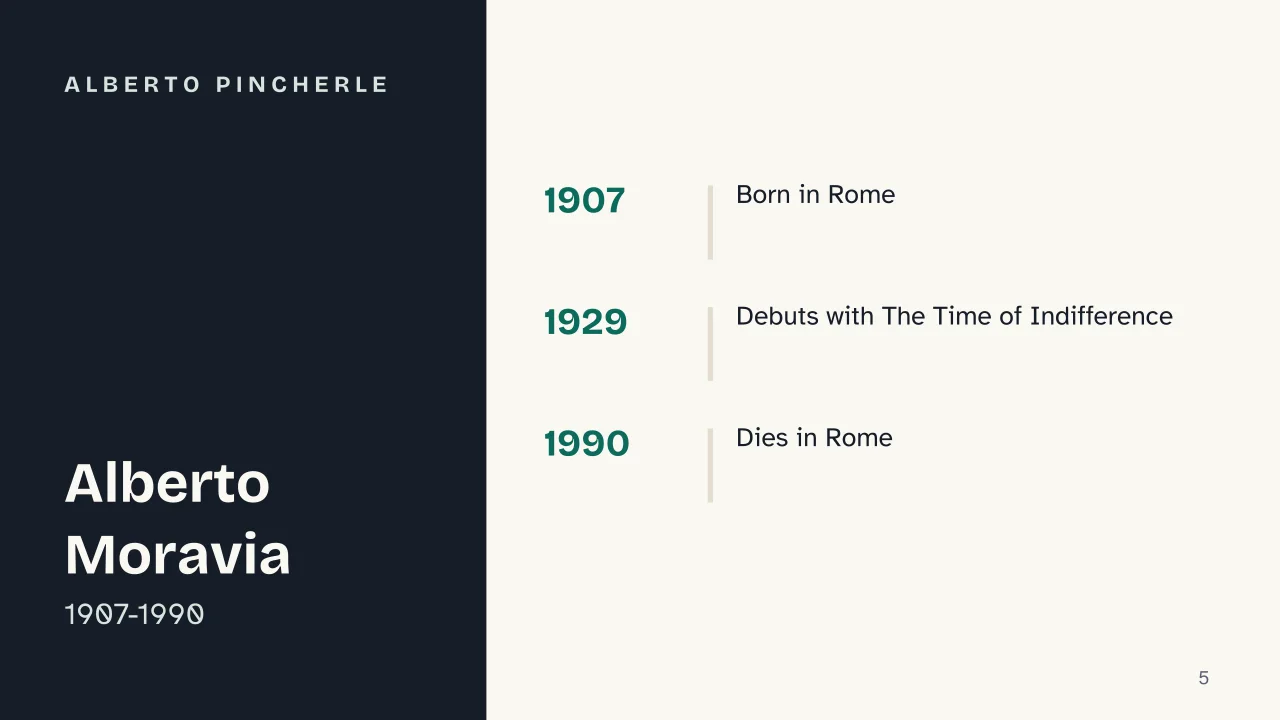  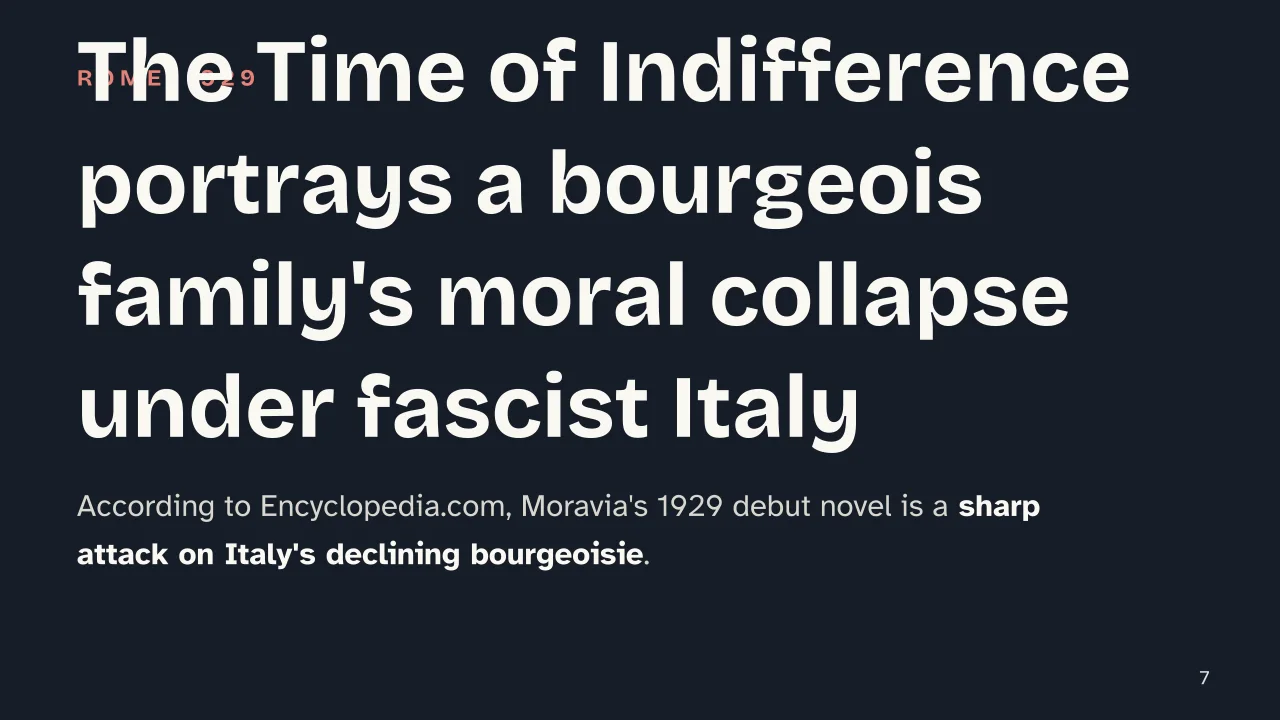  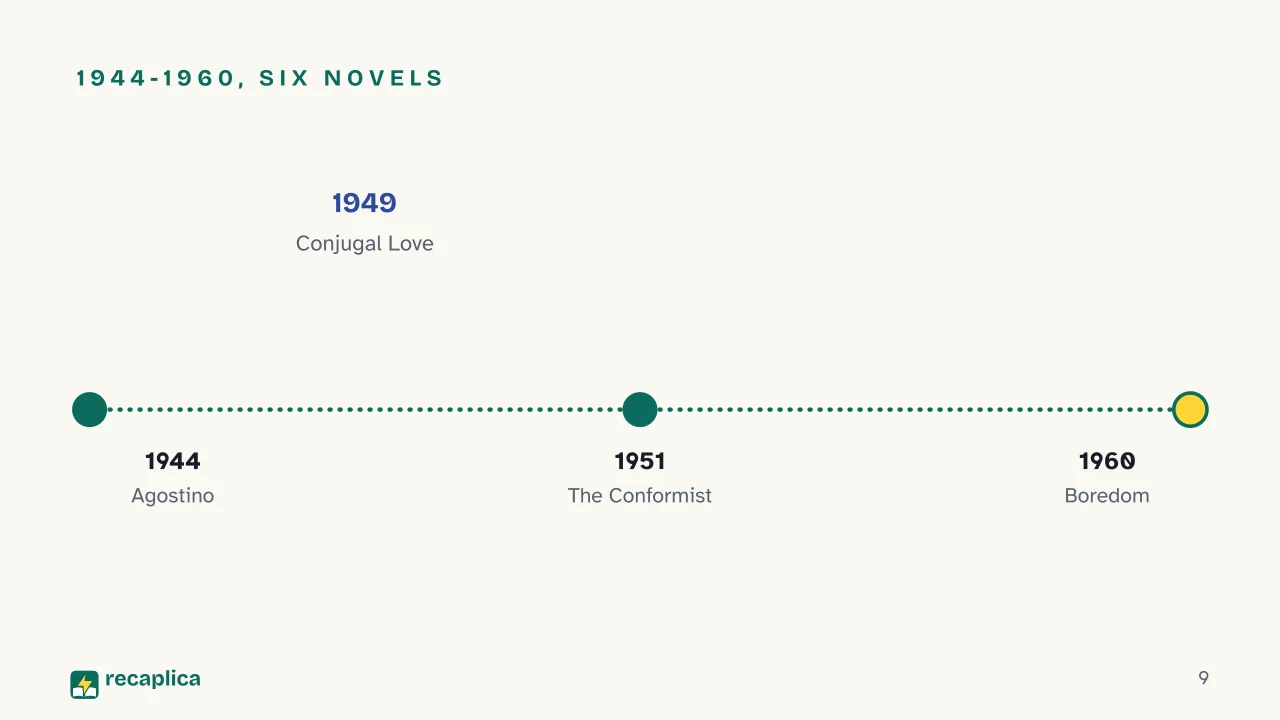 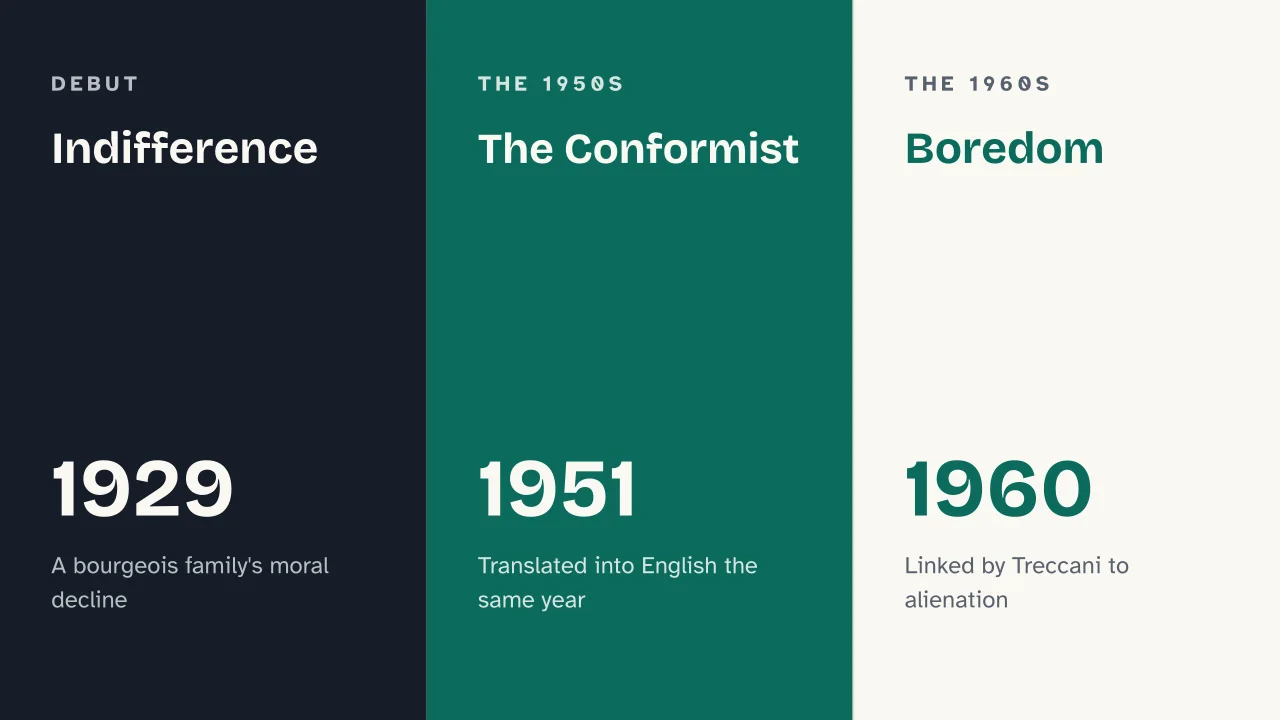  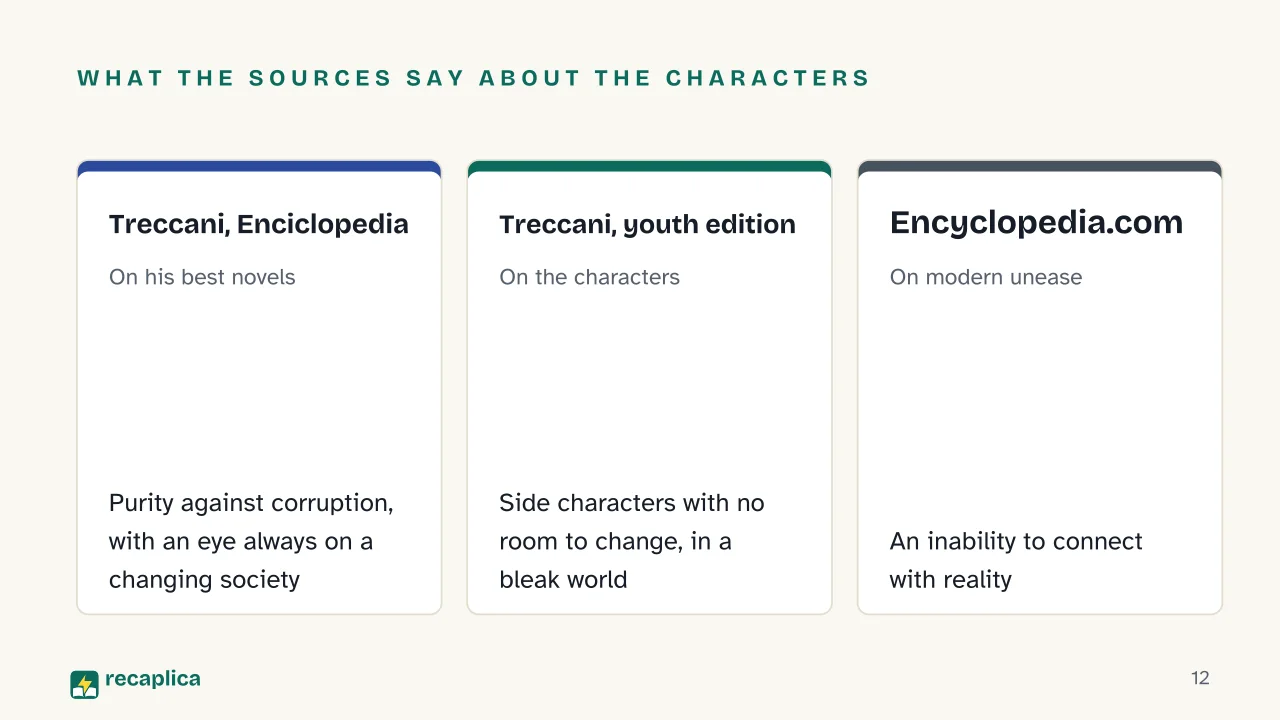 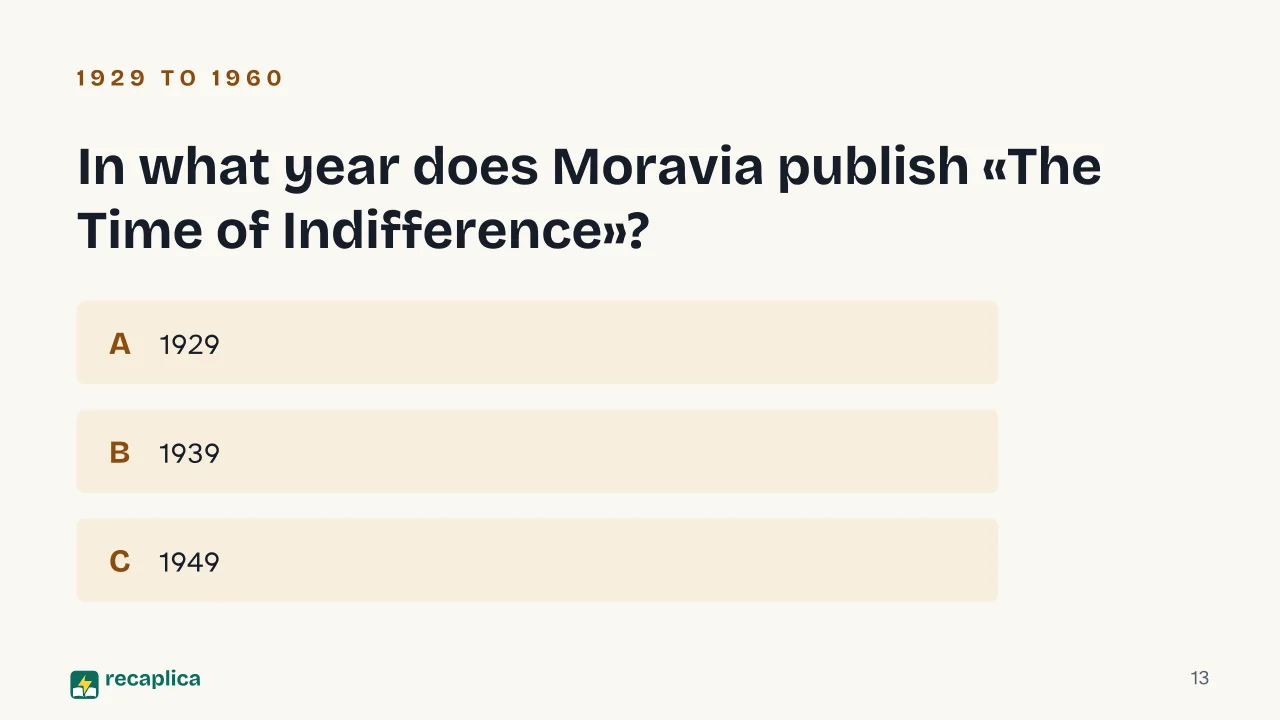  Common myths
Mind mapDrag the background to move around and the nodes to reposition them; use − and + to collapse and expand branches. 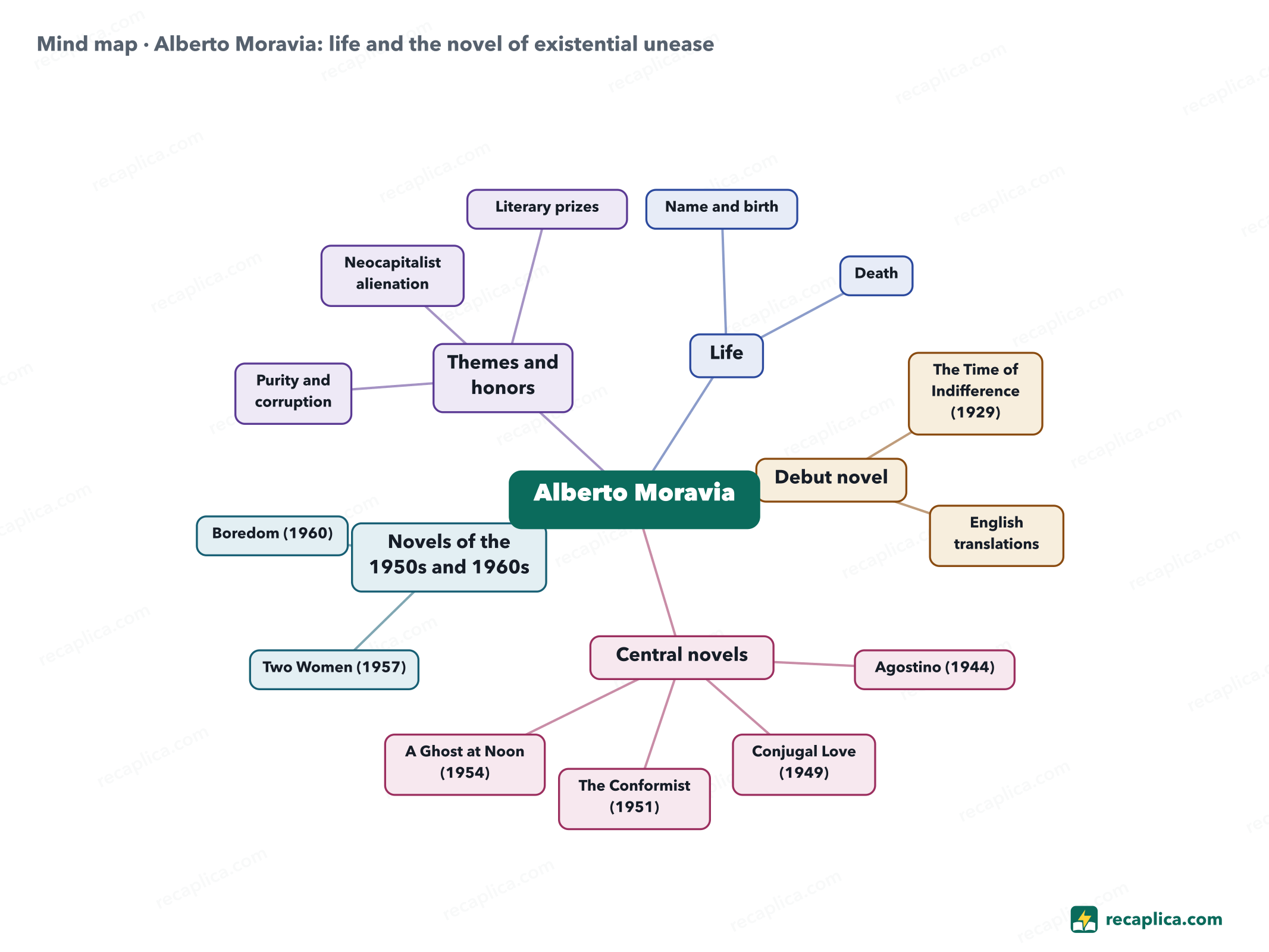
Quiz: test yourselfAnswer the questions to check what you have learned: you get instant feedback and a short explanation. Grade 0/10 0/5
FlashcardsTap the card to flip it and check whether you remember the answer, then move to the next one. 1 / 7 Explain it in your own wordsThe ultimate test: if you can explain it in simple words, you've truly understood it. Write your explanation, then compare it with the Recap. Your explanation is saved only on this device.
Frequently asked questionsWhy is he called Moravia if his surname was Pincherle?Moravia is the literary pen name that Alberto Pincherle adopts from his 1929 debut and signs his entire body of work with. What is Alberto Moravia's most important novel?«The Time of Indifference» (1929) is considered a landmark of 20th-century Italian fiction; «Boredom» (1960) also remains among his most cited titles. What are Moravia's novels about?Treccani points to two recurring themes: purity versus corruption, and the shifts under way in Italian society. When do «The Time of Indifference» and «Boredom» come out, the two novels with a dedicated Recap?«The Time of Indifference» is published in 1929 and «Boredom» in 1960: both will get a dedicated Recap with plot and analysis. What years does Alberto Moravia live?He is born in Rome in 1907 and dies in the same city in 1990. Every Recap goes through an independent review before publication. |