|
recaplica
Alessandro Manzoni's The Betrothed: Plot, Editions and Real Models | ||||||||||||||||
| © 2026 Recaplica · recaplica.com — All rights reserved | ||||||||||||||||
Alessandro Manzoni's The Betrothed: Plot, Editions and Real ModelsWhat to print Page numbers appear when printing with default margins. SlidesChoose a cut Flash10 slidesThe essential thread, to present in classFull17 slidesEvery chapter and the deeper detailBoth come with speaker notes. In 30 seconds quick readAlessandro Manzoni (Milan, 1785-1873) wrote The Betrothed (I Promessi Sposi), the novel that gave Italy a model for a national language before it even had a single state. It follows Renzo and Lucia, two young silk spinners in seventeenth-century Lombardy whose marriage is blocked by the overbearing Don Rodrigo: separated by flight, the two live through famine, war and the 1630 plague of Milan before finding each other again. Manzoni did not write the novel just once: he rewrote it three times over twenty years, ending with the Quarantana of 1840-1842, revised into a cultured Florentine meant for the whole of Italy. Characters such as the Unnamed and the Nun of Monza are not pure invention, but rework historical events that really happened. Key Points
Key figures
Deep DiveA man between reason and faithAlessandro Manzoni was born in Milan on 7 March 1785. His mother, Giulia Beccaria, was the daughter of Cesare Beccaria, the Enlightenment author of “On Crimes and Punishments”: an intellectual inheritance that weighed on his son’s upbringing. Formally, Alessandro was the son of Count Pietro Manzoni, Giulia’s husband; even during his lifetime, an unconfirmed rumor circulated about an affair between his mother and Giovanni Verri, brother of the better-known Pietro Verri. The education he received as a boy was strict: first with the Somaschi fathers, between the colleges of Merate and Lugano, then with the Barnabites at the Longone college, on the outskirts of Milan, schooling he would later, as an adult, recall in harsh terms. In 1805 he joined his mother in Paris, where he mixed with the idéologues, the intellectual heirs of the Enlightenment philosophes and of the openness that followed the French Revolution, and struck up a steady correspondence with the historian Claude Fauriel on questions of language and literature. In 1808 he married the very young Enrichetta Blondel, from a Calvinist family, in a civil and Calvinist ceremony. His path to Catholicism took several years and passed through his meeting with the spiritual father Eustachio Degola, a converted Jansenist; a famous anecdote places him on 2 April 1810, when, during the Paris celebrations for Napoleon’s wedding to Marie Louise of Austria, panic over some exploding fireworks caused fatalities in the crowd, and Manzoni, separated from Enrichetta, is said to have taken refuge on the steps of the church of Saint-Roch in a moment of religious crisis — an episode whose origin and historical accuracy critics still debate. His marriage to Enrichetta was later also celebrated with a Catholic rite, on 15 February 1810. Manzoni became the fullest representative of a synthesis between the liberal strand of the Enlightenment and the ethical depth of Catholic faith as revived by Romanticism, oriented toward the renewal of the Italian nation: a different path from that of a contemporary such as Giacomo Leopardi, who in those same years looked at Italian Romanticism with an altogether different sensibility. In 1848, during the Five Days of Milan, Manzoni took a position, with his usual reserve, on patriotic and democratic lines; in 1860 he became a senator of the Kingdom of Italy, and in 1861 he took part in the Senate session in Turin that voted in favor of proclaiming Victor Emmanuel II king of Italy, the same political season told in the recap on the Risorgimento. Widowed by Enrichetta in 1833, he later married Teresa Borri, herself a widow, and was in turn widowed by her in 1861. He died in Milan on 22 May 1873, at 88 years of age, from the effects of a fall he suffered leaving the church of San Fedele. On the first anniversary of his death, in 1874, Milan honored him in the church of San Marco with the Requiem Mass Giuseppe Verdi wrote especially for the occasion. Three editions for a single novelThe Betrothed did not reach the form everyone knows in a single pass. The first draft, written between 1821 and 1823, is titled Fermo e Lucia: it was never published during Manzoni’s lifetime, and the male lead is still called Fermo, not Renzo. It was followed by the “Ventisettana,” published in three volumes between 1825 and 1827 under the definitive title: this is where the name Renzo first appears, though the language still carries strong Lombard traits. The complete, single-volume edition came out in 1827. Manzoni then extensively revised the language into the “Quarantana,” published between 1840 and 1842, which became the standard reference text used in schools and modern editions.
After the Ventisettana was published, in 1827 Manzoni traveled to Florence specifically to submit the novel to a language revision that would align it with the cultured Florentine actually spoken there, not just written. The real work began in the summer of 1839, with the help of Emilia Luti, a Florentine housekeeper for the D’Azeglio family. On copies of the Quarantana, Manzoni left a handwritten dedication that gave the whole operation its name:
The result was not a surface polish: Manzoni systematically removed the lexical and grammatical Lombardisms that filled the Ventisettana. With the first edition he had addressed a Milanese audience; with the Quarantana he carried out his plan of speaking to a national Italian audience, at a time when a common, actually spoken Italian language barely existed. The plot, between love and bullyingThe story is set in Spanish-ruled Lombardy between 1628 and 1630, in a landscape at the foot of the Alps worn down by the Thirty Years’ War, famine and, finally, plague. Renzo and Lucia are two young commoners, silk spinners, preparing for their wedding. Standing in their way is Don Rodrigo, a local tyrant who desires Lucia: he sends his thugs to threaten Don Abbondio, the village priest, so that he will not perform the ceremony. Out of cowardice, Don Abbondio backs down. Renzo and Lucia then attempt a surprise wedding, which fails, and are forced to flee separately with the help of Fra Cristoforo, a friar who openly opposes Don Rodrigo. Lucia is kidnapped by the Unnamed at Don Rodrigo’s instigation, and later, during the 1630 plague of Milan, falls ill. At the city’s Lazzaretto, she is reconciled with a dying Don Rodrigo; only then can Renzo and Lucia finally marry. Manzoni takes a familiar plot, two lovers kept apart by an obstacle, and turns it into a rough but ultimately rewarding path toward peace and happiness, grounded in genuine moral values, one that uncovers the hypocrisy and conformism of the society of the time. For this reason the novel is considered the historical novel par excellence of Italian literature, rather than a coming-of-age story: even as it follows the two protagonists’ growth, the book’s center of gravity remains the reconstruction of seventeenth-century Lombardy and its moral judgment on society, more than the inner psychological development of the characters. History and fiction, the Unnamed and the Nun of MonzaSeveral characters in the novel are not pure invention. For the Unnamed, the feudal lord who kidnaps Lucia at Don Rodrigo’s instigation, critics point to Francesco Bernardino Visconti as a possible model, a feudal lord of Brignano Ghiaradadda: an edict of Milan’s governor declared him a bandit chief in 1603. Manzoni descended from this family on his mother’s side. Some details passed down by the seventeenth-century chronicler Giuseppe Ripamonti, a contemporary of the events, would rule out Francesco Bernardino as an exact model, in particular because he never married: the historian Giulio Scotti has proposed the alternative of his brother, Galeazzo Maria Visconti, who was also involved in criminal activity. In the novel, the Unnamed first reacts with irritation, then regrets what he did to Lucia and spends a night of remorse; the next morning, hearing the bells that announce Cardinal Federico Borromeo’s arrival, he goes to confess to him, and later helps him bring Lucia back to her mother. Federico Borromeo, a cousin of St Charles Borromeo, became Archbishop of Milan in 1595, at the age of 31; in 1609 he founded the Biblioteca Ambrosiana, sending eight emissaries across Italy, France, Spain, Germany, Flanders, Greece, Lebanon and Jerusalem to gather books and manuscripts, building a collection of some 30,000 printed volumes and 14,000 manuscripts; during the 1630 plague he distinguished himself for his zeal and charity. The Nun of Monza, Gertrude, also has a historical model: Marianna de Leyva, born in Milan in 1575 and dead in 1650, daughter of the Count of Monza. Orphaned of her mother at a young age, she was steered toward a religious career by her father and paternal aunt, and entered the monastery of Santa Margherita in Monza at thirteen. She remained confined there for about 14 years, until 1622, when Archbishop Federico Borromeo, after conversations in which he assessed her repentance, arranged for her release and gave her the task of writing letters of comfort to nuns uncertain of their vocation. The records of the trial that concerned her were made public only in 1957, more than a century after the novel was published: Manzoni knew the story only through oral tradition, and in the novel he gives Gertrude a weaker character than the historical Marianna, with her forced monastic vows imposed by her parents even more starkly. The plague of Milan, 1630In the novel, the plague arrives to close a cycle of disasters already opened by war and famine. Milan had about 250,000 residents at the start of the epidemic, between 1629 and 1630; estimates of the dead vary widely depending on the historical source, from roughly 140,000 to over 180,000 victims. The seventeenth-century chronicler Giuseppe Ripamonti, author of “La peste di Milano del 1630” and a primary source used by Manzoni himself, records 50,000 people who passed through the city’s Lazzaretto during the epidemic; the Tribunale della Sanità instead reported 100,000, a discrepancy that shows how hard it is for historians to settle on a firm number. The Lazzaretto stood in the area now covered by via San Gregorio, via Lazzaretto and corso Buenos Aires. Tied to this episode is also “Storia della colonna infame” (The Column of Infamy), the historiographical appendix Manzoni attached to the definitive edition of 1840. Drawing on Pietro Verri’s “Osservazioni sulla tortura,” it recounts the trial against the men accused of deliberately spreading the plague, Guglielmo Piazza and Giangiacomo Mora, tortured and put to death in Milan in 1630. Manzoni worked on it with renewed commitment from 1839, after leaving it out of the 1827 edition for editorial timing reasons, even though the text had already been planned as a digression as far back as Fermo e Lucia. A Florentine for all of ItalyThe Quarantana’s language project should be read alongside a figure that still surprises: according to linguist Tullio De Mauro’s estimate, at the time of Italian unification, in 1861, only 2.5% of the population was able to speak Italian. That estimate is made up of about 1% with an education beyond elementary school, plus roughly 1.5% of Tuscans or Romans who had the language for geographic reasons; the first census of the Kingdom of Italy, in the same year, recorded that over 78% of the population was illiterate. An alternative, higher estimate also exists, proposed by linguist Arrigo Castellani, which would put the share of Italian speakers at around 10%. In a country linguistically fragmented into dialects, the Quarantana, written in a cultured, actually spoken Florentine, was taken as a model for the national language, contributing, together with compulsory post-unification schooling and later television, to the spread of the standard Italian spoken across the country over the following century. It was not the first time a literary work had played that role: centuries earlier, Dante’s Divine Comedy had helped give literary dignity to the Florentine vernacular, in an Italy just as divided into a thousand dialects back then. A telescope on historyThe definitive novel runs to 38 chapters, grouped into four sections of roughly equal length, in a structure critics describe as a “telescope”: it opens on a narrow view, the village of Renzo and Lucia, and gradually widens to include historical events of European scale, such as the Thirty Years’ War, famine and plague. The first eight chapters, the so-called “village section,” cover a narrative concentrated into just four days. The main digressions concern the story of the Unnamed, between chapters 18 and 19, the famine, the war and the plague, between chapters 28 and 32, and the story of Gertrude, between the end of chapter 9 and the end of chapter 10. Manzoni opens the novel with a precise narrative device: in his Introduction, he pretends to have found and transcribed an anonymous seventeenth-century manuscript, written in a baroque, convoluted language that he claims to be “modernizing” for the reader. It is the literary topos of the “found manuscript,” which lets him take ironic distance from his own sources and step into the story as a commentator. The famous opening line, “Quel ramo del lago di Como…” (“That branch of the lake of Como…”), describes the Lecco branch of the lake, the place where Manzoni spent his childhood and adolescence, since his family had a villa at Caleotto, near Lecco: a setting chosen precisely because of the author’s firsthand knowledge of it. The novel won over readers at once and became a patriotic symbol for Italians during the nationalist Risorgimento period, going on to serve as a model for many later Italian writers. In English translation, the title was first rendered as “The Betrothed Lovers,” and later, more commonly, as “The Betrothed.” Born in a village on the Lecco branch of Lake Como, the novel became a piece of the shared language of an entire country. Few other books in Italian literary history have left as deep a mark on the language and imagination of their readers. Slide deckSlides ready to download and make your own in PowerPoint or Google Slides, with speaker notes. Pick the Flash cut or the Full one.     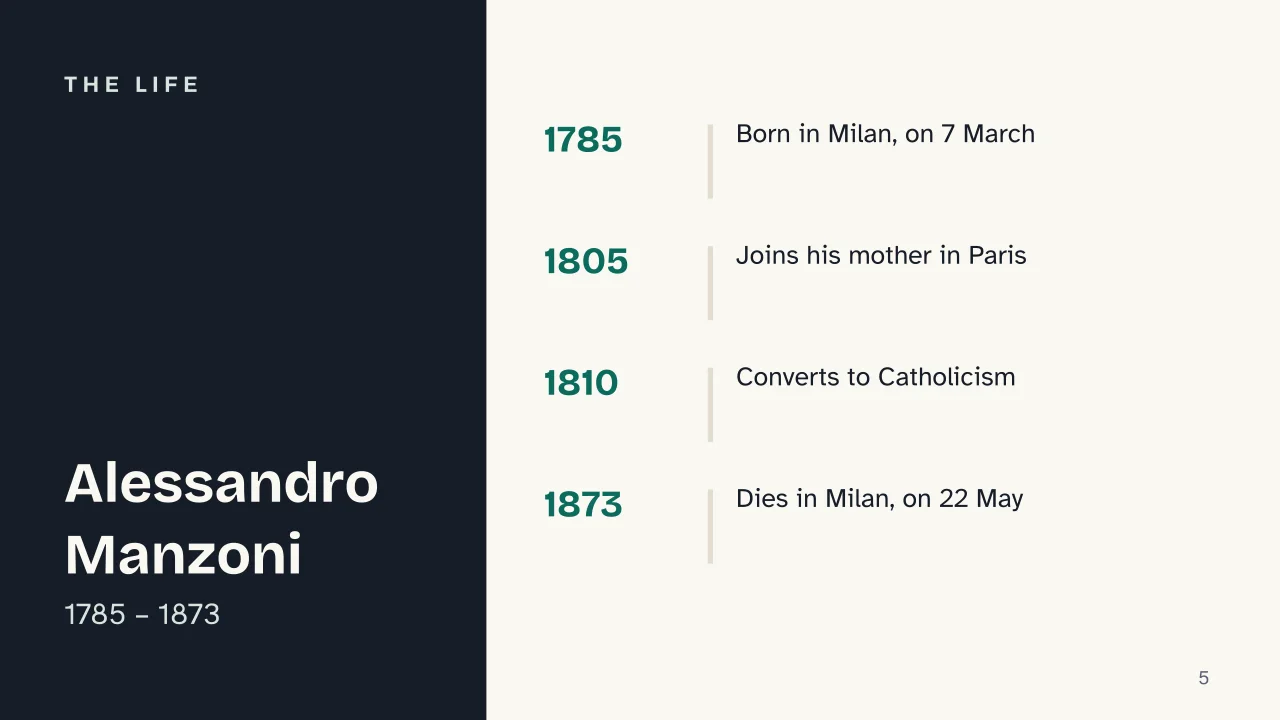  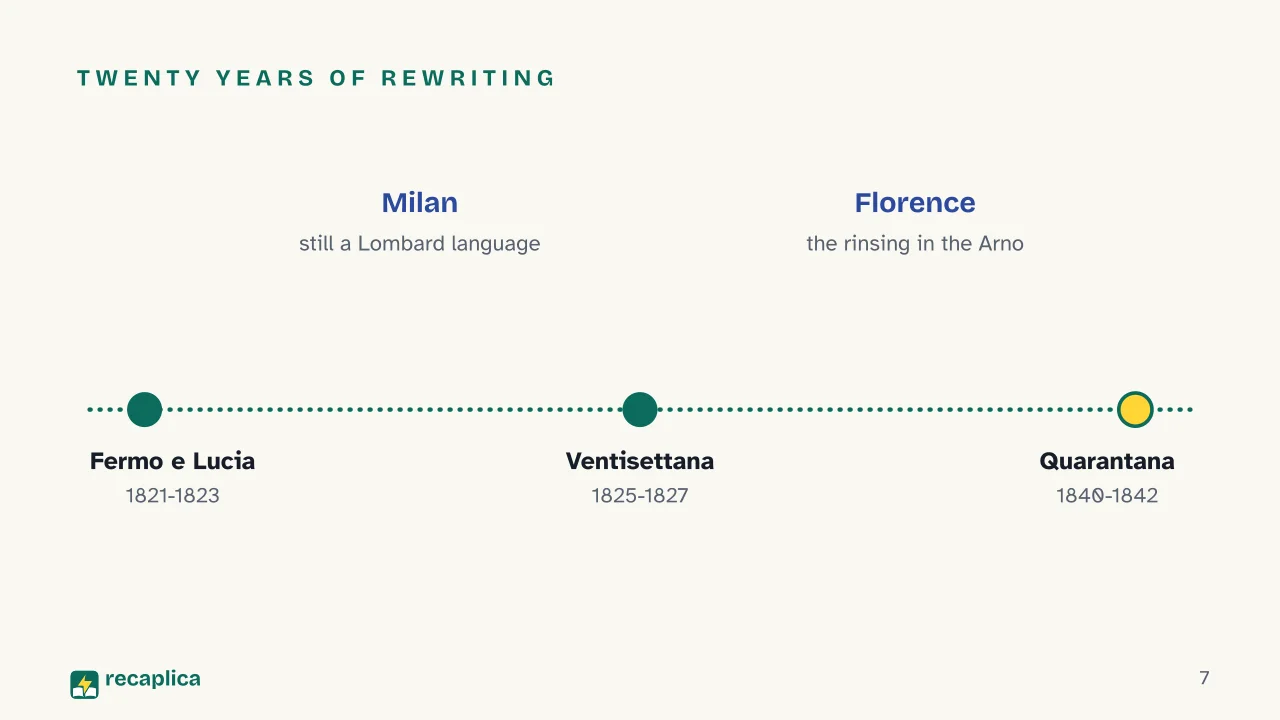  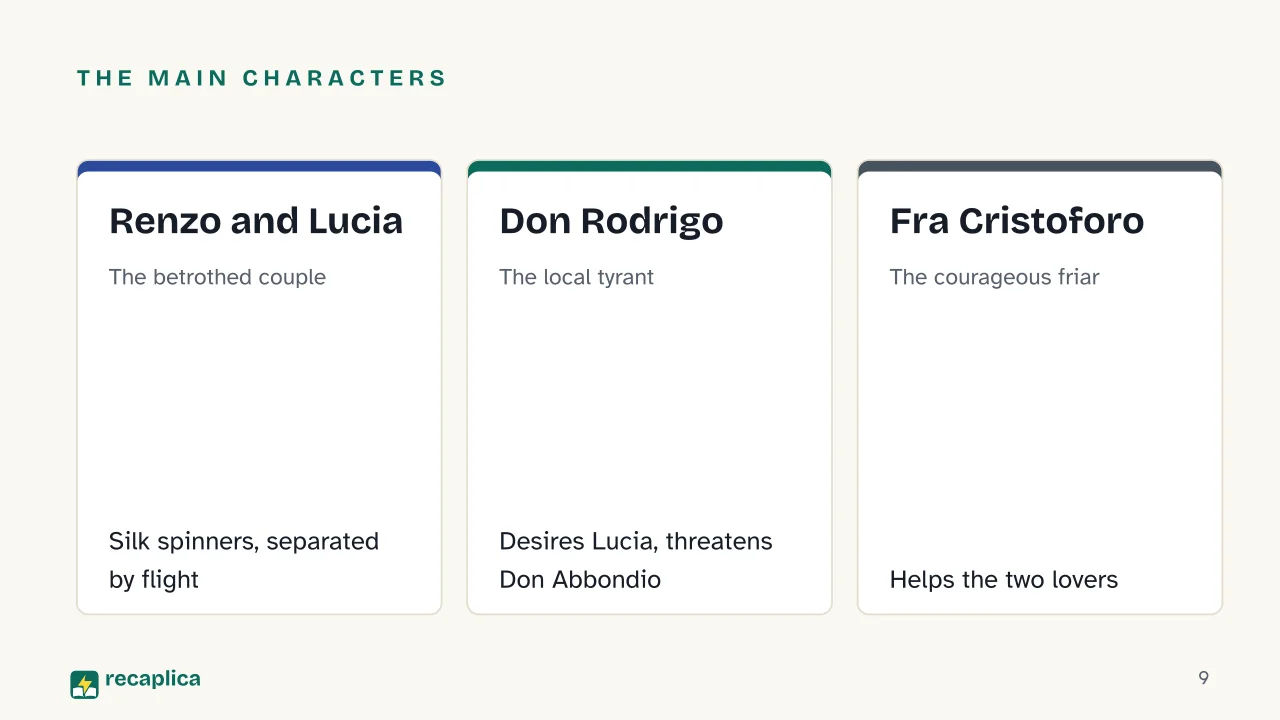 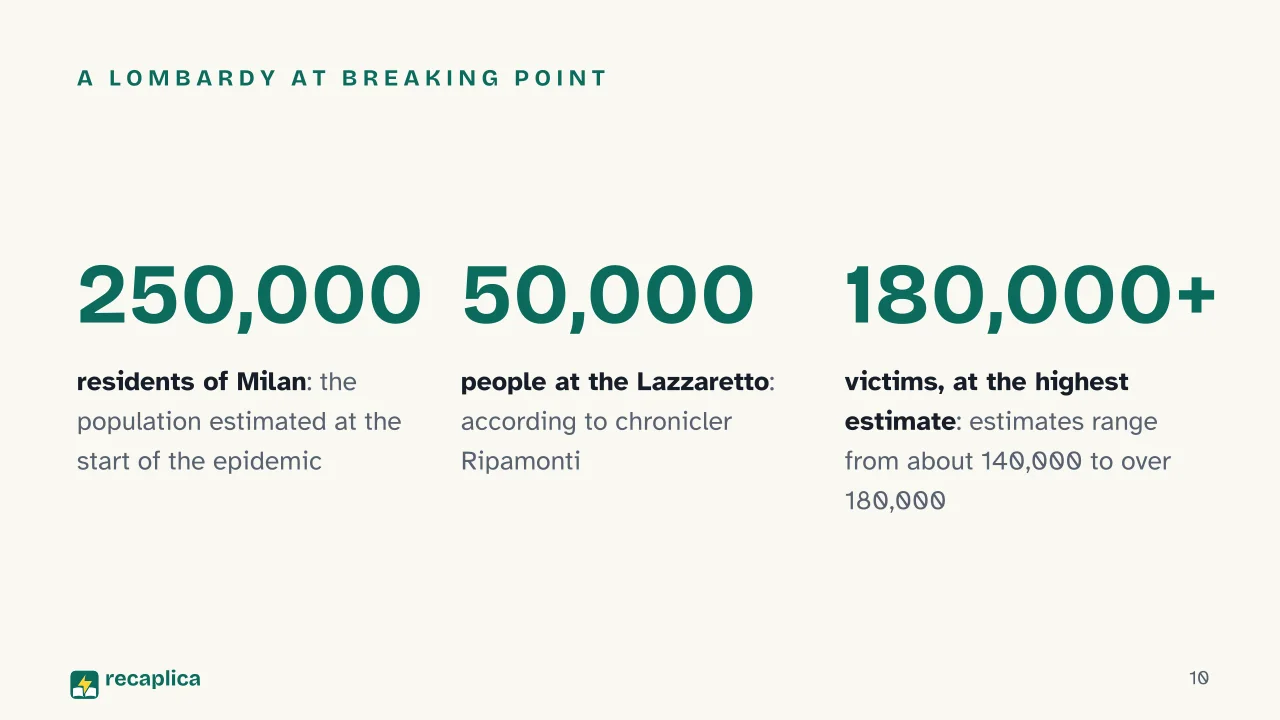  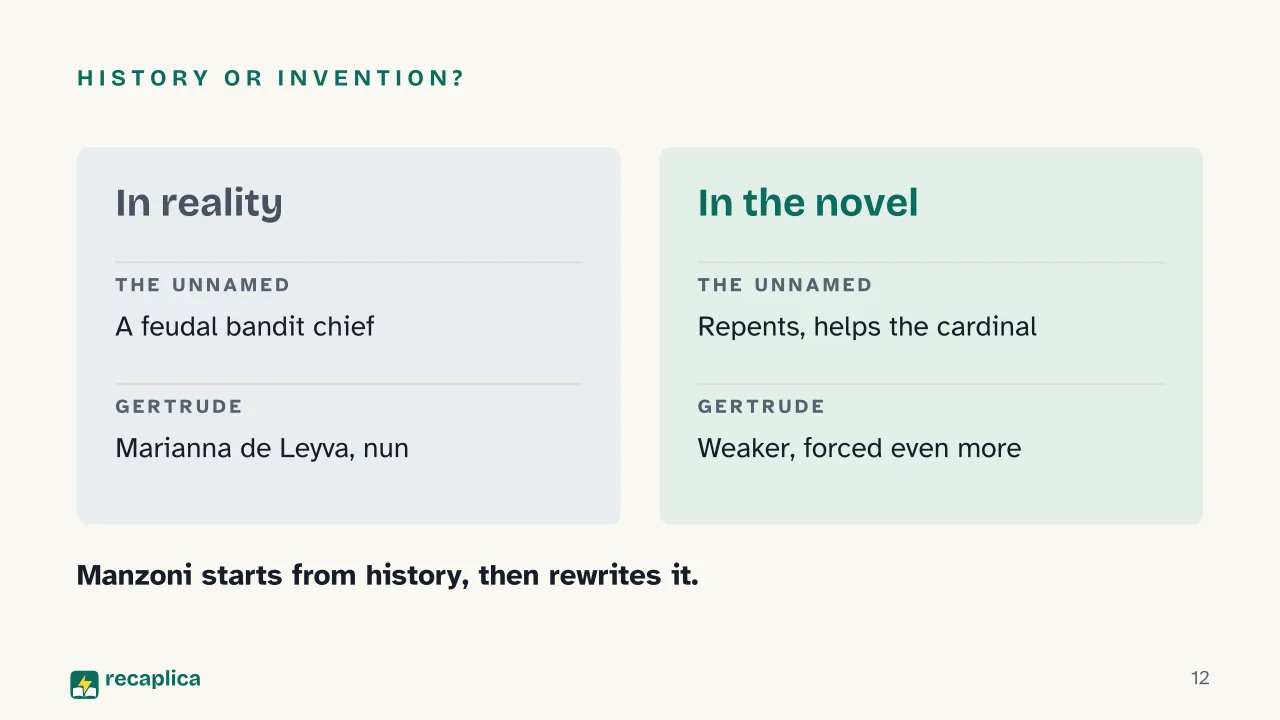  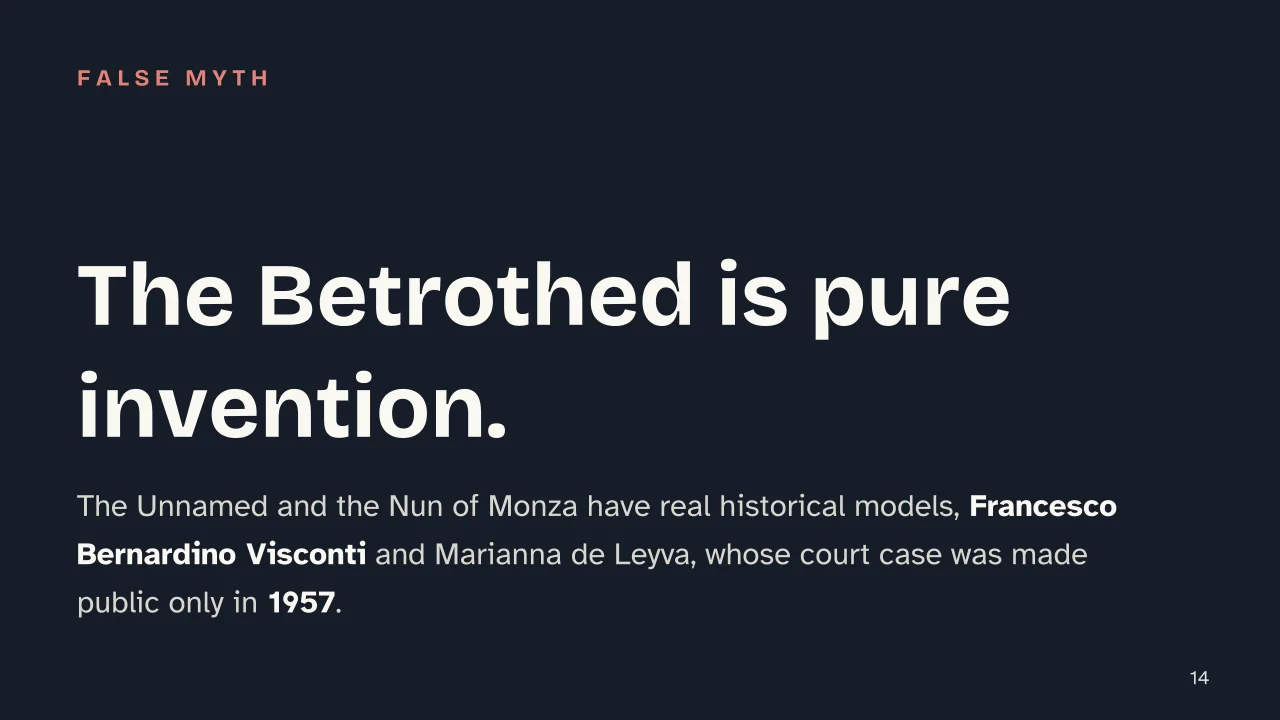 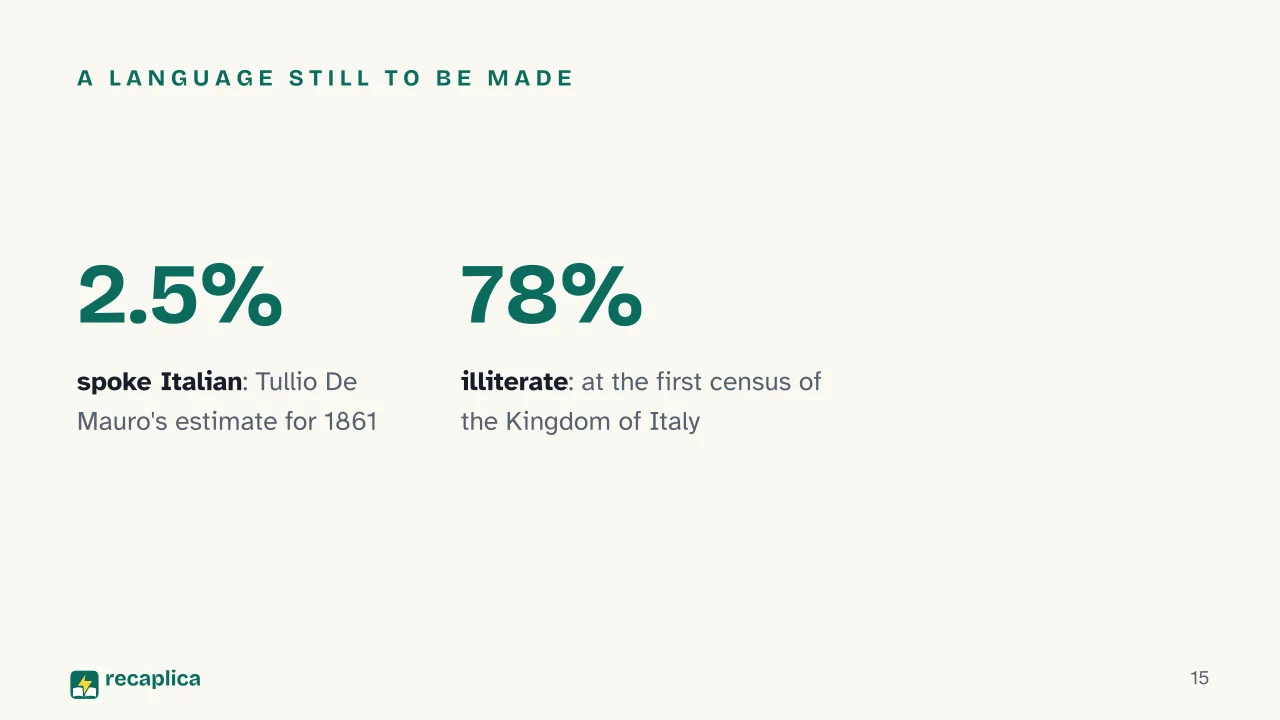 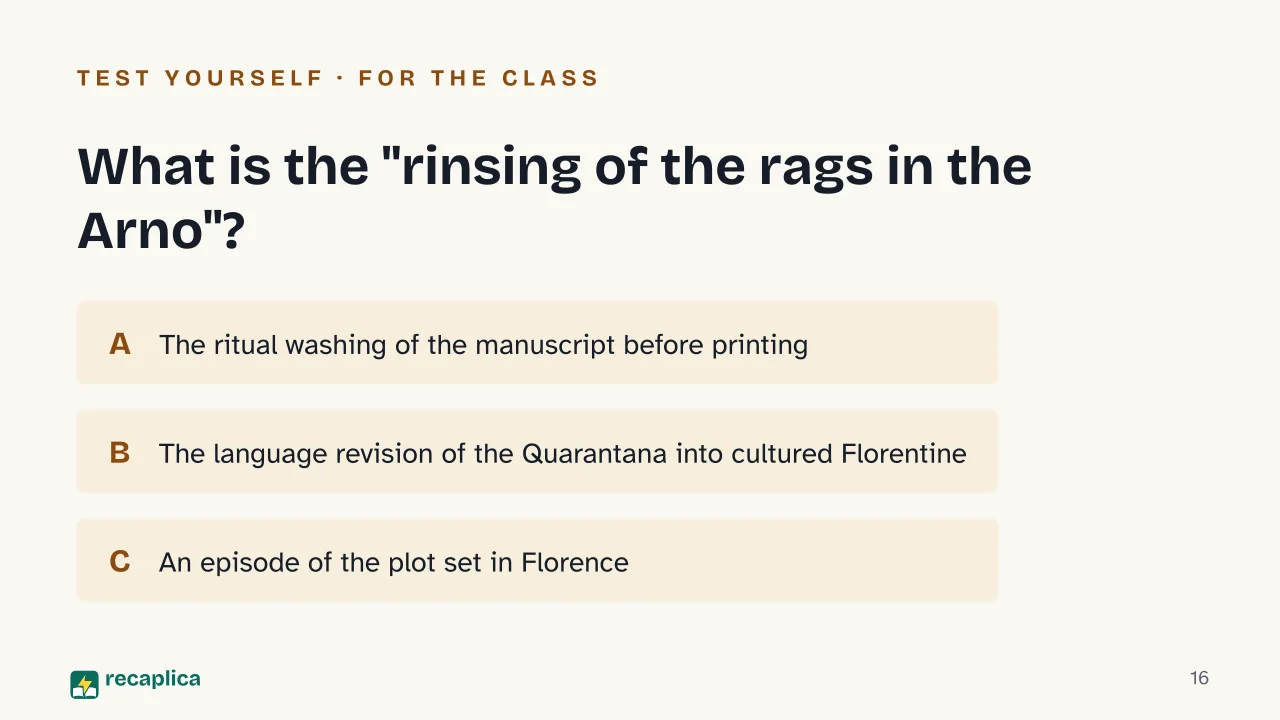  Common myths
Mind mapDrag the background to move around and the nodes to reposition them; use − and + to collapse and expand branches. 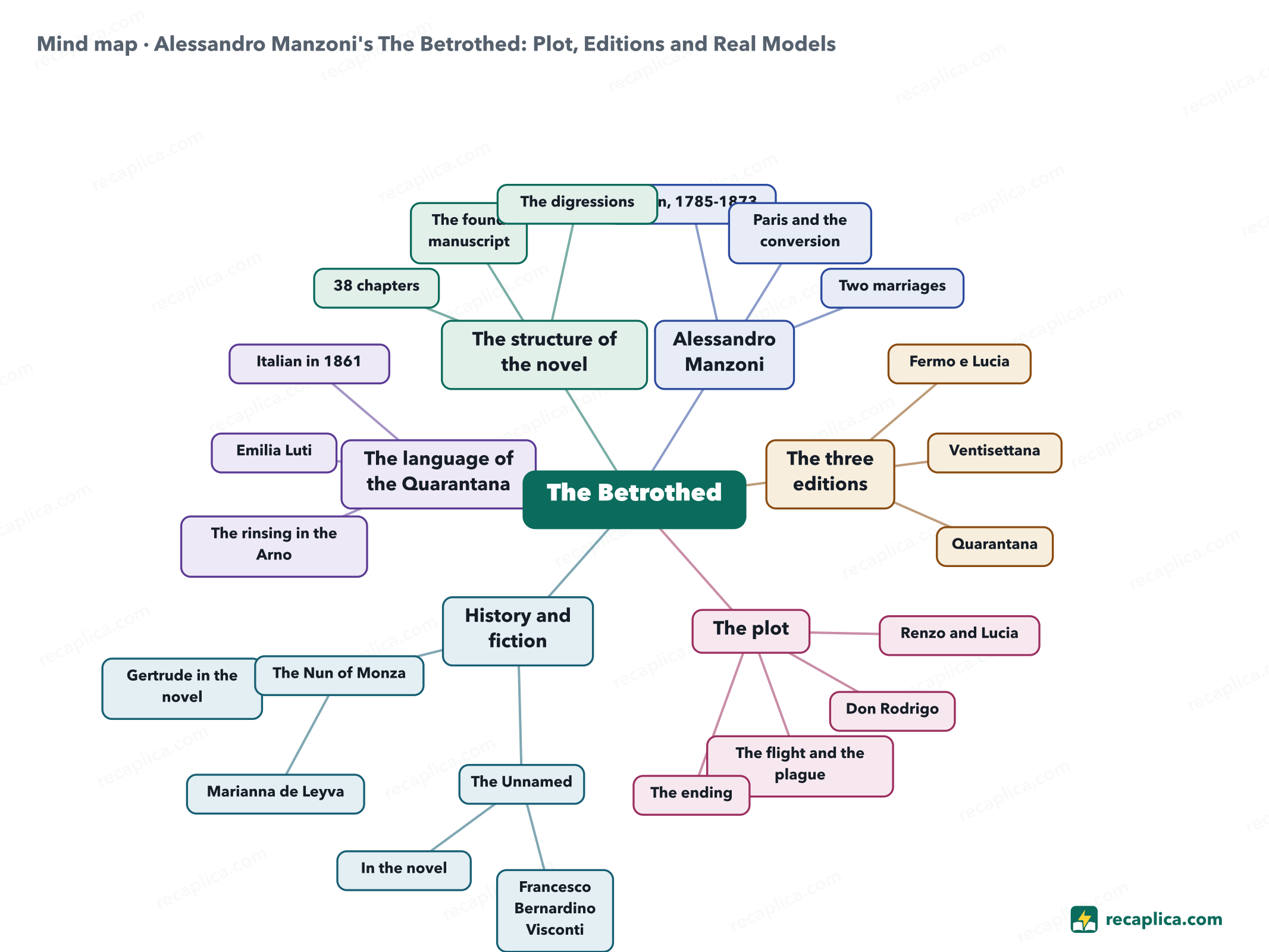
Quiz: test yourselfAnswer the questions to check what you have learned: you get instant feedback and a short explanation. Grade 0/10 0/5
FlashcardsTap the card to flip it and check whether you remember the answer, then move to the next one. 1 / 8 Explain it in your own wordsThe ultimate test: if you can explain it in simple words, you've truly understood it. Write your explanation, then compare it with the Recap. Your explanation is saved only on this device.
Frequently asked questionsWhat is The Betrothed about?It follows the blocked marriage of Renzo and Lucia, two young silk spinners in seventeenth-century Lombardy. The local tyrant Don Rodrigo desires Lucia and threatens the parish priest, Don Abbondio, so that he will not perform the wedding; the two flee separately and live through famine, the Thirty Years' War and the 1630 plague of Milan before they can finally marry. What is the difference between the Ventisettana and the Quarantana?They are two editions of the same novel. The Ventisettana (1825-1827) is the first version with the definitive title, but written with strong Lombard traits. The Quarantana (1840-1842) is the definitive edition, revised by Manzoni with the help of the Florentine informant Emilia Luti to remove the Lombardisms and write in a cultured Florentine meant for an Italian audience, not only a Milanese one. Who are the Unnamed and the Nun of Monza, really?They are not pure invention. Behind the Nun of Monza, Gertrude, stands Marianna de Leyva (1575-1650), forced to become a nun at thirteen; the records of her trial were made public only in 1957. Behind the Unnamed, critics point, with caution, to Francesco Bernardino Visconti, a feudal lord named a bandit chief in 1603, although one contemporary source would rule him out and some historians propose his brother as the model instead. How many people died in the 1630 plague of Milan described in the novel?Estimates vary widely depending on the source: between roughly 140,000 and over 180,000 victims, out of a population of Milan estimated at around 250,000 at the start of the epidemic. Manzoni also told the story in The Column of Infamy, the historical appendix he added to the 1840 edition, about the trial of two men accused of spreading the plague on purpose. Why is The Betrothed considered so important for the Italian language?Because the Quarantana, written in a cultured, spoken Florentine rather than only a literary one, was taken as a model for the national language at a time when, according to linguist Tullio De Mauro's estimate, only 2.5% of Italians could speak Italian. Together with compulsory post-unification schooling and later television, it helped spread the standard Italian that became the language spoken across the whole country over the following century. Every Recap goes through an independent review before publication. |