|
recaplica
The Name of the Rose: Plot, Characters, and Summary |
| © 2026 Recaplica · recaplica.com — All rights reserved |
The Name of the Rose: Plot, Characters, and SummaryWhat to print Page numbers appear when printing with default margins. SlidesChoose a cut Flash10 slidesThe essential thread, to present in classFull17 slidesEvery chapter and the deeper detailBoth come with speaker notes. In 30 seconds quick readThe Name of the Rose is the novel that brought Umberto Eco, already a well-known semiotician, worldwide fame in 1980. The story follows the Franciscan friar William of Baskerville and the young Adso of Melk through a Benedictine abbey in 1327, where a string of deaths is tied to a book hidden in the library. Behind the detective plot lie philosophical and theological questions, along with characters who became famous in their own right, like Salvatore and Jorge of Burgos. In 1981 the novel won the Premio Strega, and it has since been translated into dozens of languages. Key Points
Key figures
Deep DiveA scholar before a novelistWhen The Name of the Rose reaches bookshops in December 1980, Umberto Eco is no newcomer. Born in Alessandria in 1932, he graduates in 1954 with a thesis on Thomas Aquinas, within the philosophical tradition of Luigi Pareyson’s school in Turin. Over the following two decades he publishes the essays that make him, in Treccani’s words, an authoritative scholar of semiotics: Opera Aperta in 1962, La Struttura Assente in 1968, A Theory of Semiotics in 1975. That same year, 1975, he takes up the chair of semiotics at the University of Bologna, where he later becomes professor emeritus. The novel comes after, not before. That double identity, the semiotician and the storyteller, gives the book its particular shape: an investigation that reads like a mystery novel while carrying the tools of someone who studies, for a living, how signs produce meaning. The plot and settingThe story takes place in 1327, in a Benedictine abbey in the Italian Alps. Two characters arrive together: William of Baskerville, a Franciscan friar sent by the emperor to mediate a theological dispute, and the young Adso of Melk, who accompanies him as a novice. It is Adso, now an old man, who later writes down the events of that distant season. The abbey holds what Encyclopedia.com describes as the largest library in Christendom. It is the novel’s true center of gravity: a structure built like a labyrinth, as vast as the truth it holds and as deceptive as the falsehood it stores. Around that library turns a string of events that William and Adso must interpret, the way one works through a text written in a language not yet fully understood.
Main charactersWilliam of Baskerville runs the investigation with the tools of logic, while Adso of Melk narrates it through the eyes of someone who, as a young man, does not always grasp what he is seeing right away. Around them move the abbey’s other figures. Salvatore, one of the novel’s most recognizable monks, has a deformed, animal-like appearance and speaks a pastiche of several European languages, a language that is itself a small riddle inside the larger one. At the opposite end stands Jorge of Burgos, an elderly, blind monk who has spent years keeping a lost book by Aristotle on comedy out of anyone’s reach: a character who guards a secret instead of chasing one. These figures differ in role and temperament, but they share the same enclosed space and the same stakes: control over a kind of knowledge that someone in the abbey considers too dangerous to let circulate. The themes behind the plotThe novel does not stop at the investigation. One idea Encyclopedia.com highlights is that whoever loves humanity has a duty to make people laugh at the truth. It runs through the book and helps explain why the conflict over the volume guarded by Jorge of Burgos weighs so heavily on the story. Another theme is confidence in the decipherability of things: any secret piece of writing, however obscure, can eventually be read with enough patience, an idea tied closely to the investigation that drives the whole novel. The labyrinth library remains the image holding these threads together. It is not just a backdrop: it is the physical form of a kind of knowledge that defends itself against those who seek it, much as, earlier in the great tradition of Italian storytelling, Dante’s Divine Comedy uses a journey through increasingly deep spaces to tell the story of a search for truth. Success, editions, and the Premio StregaIn 1981, a year after publication, The Name of the Rose wins the Premio Strega, Italy’s most important literary prize, as Il Post reports. From there the novel’s reach grows quickly: the Umberto Eco Foundation describes translations into more than 40 languages and publication in more than 60 countries. Il Post, citing press figures, also reports more than 50 million copies sold worldwide, a figure that reads as a journalistic estimate rather than data from an official statistical body. That success did not push Eco to repeat the same formula. His second novel, Foucault’s Pendulum, does not appear until 1988, and other titles follow in later years, each different in subject and structure. Within twentieth-century Italian fiction, The Name of the Rose stands alongside other novels that marked the century while remaining very different in period and style, such as Giuseppe Tomasi di Lampedusa’s The Leopard and Italo Svevo’s Zeno’s Conscience: three books that each, in their own way, use a narrating voice to look back across time. Slide deckSlides ready to download and make your own in PowerPoint or Google Slides, with speaker notes. Pick the Flash cut or the Full one.   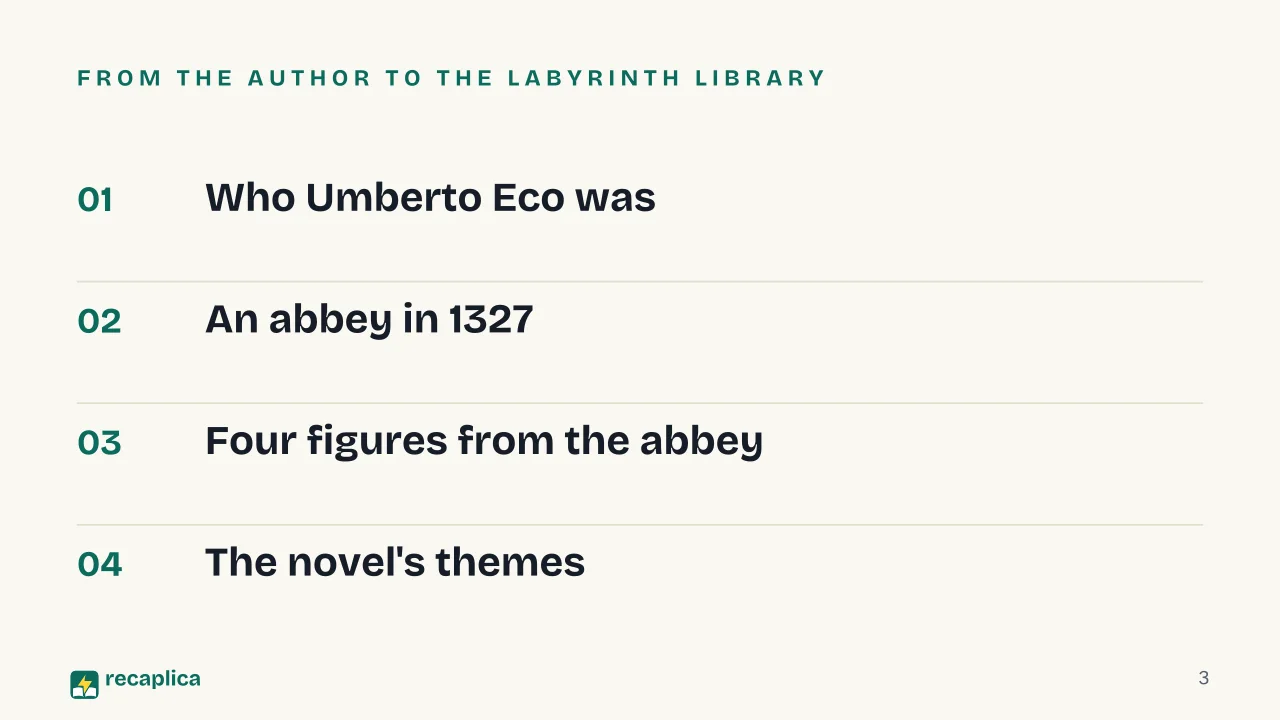  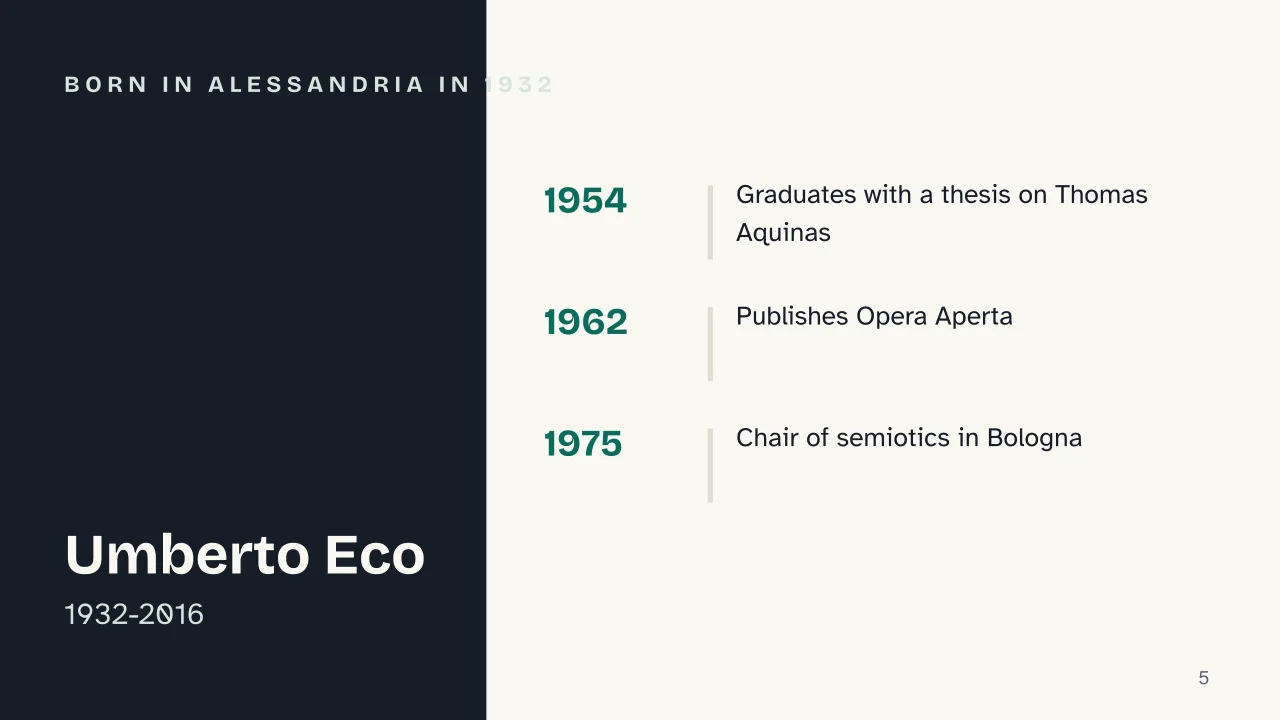 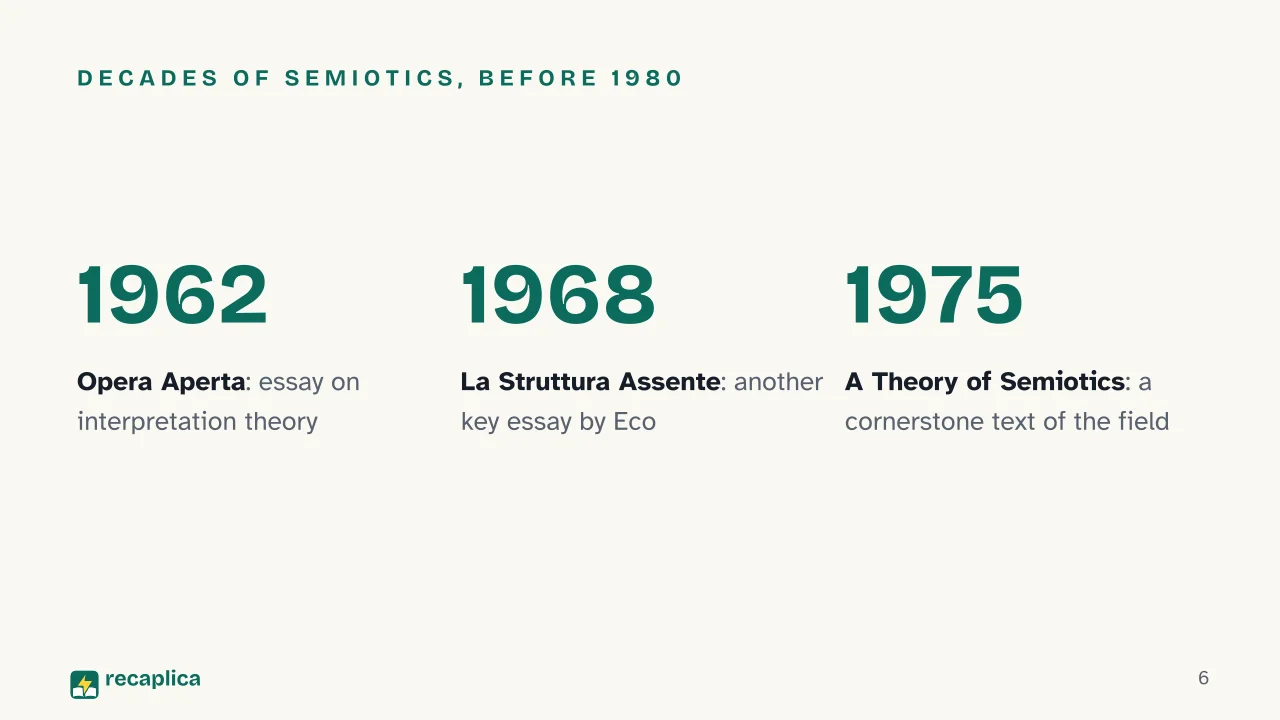  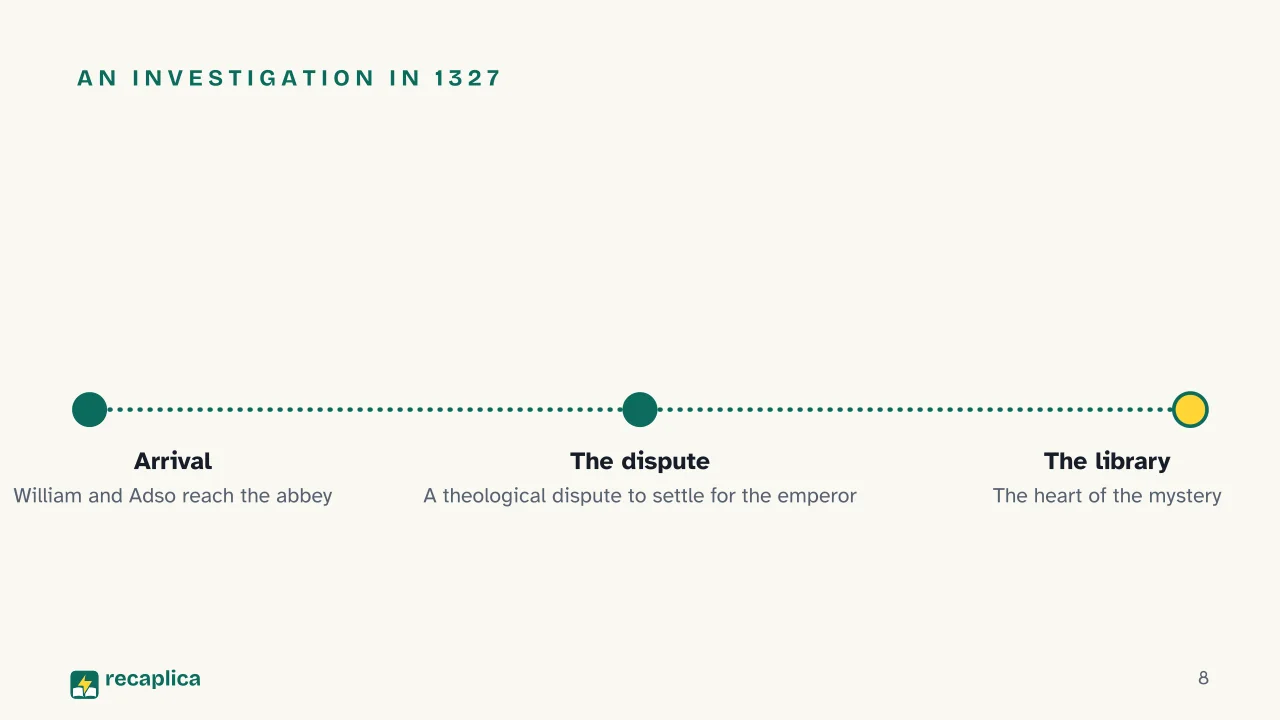 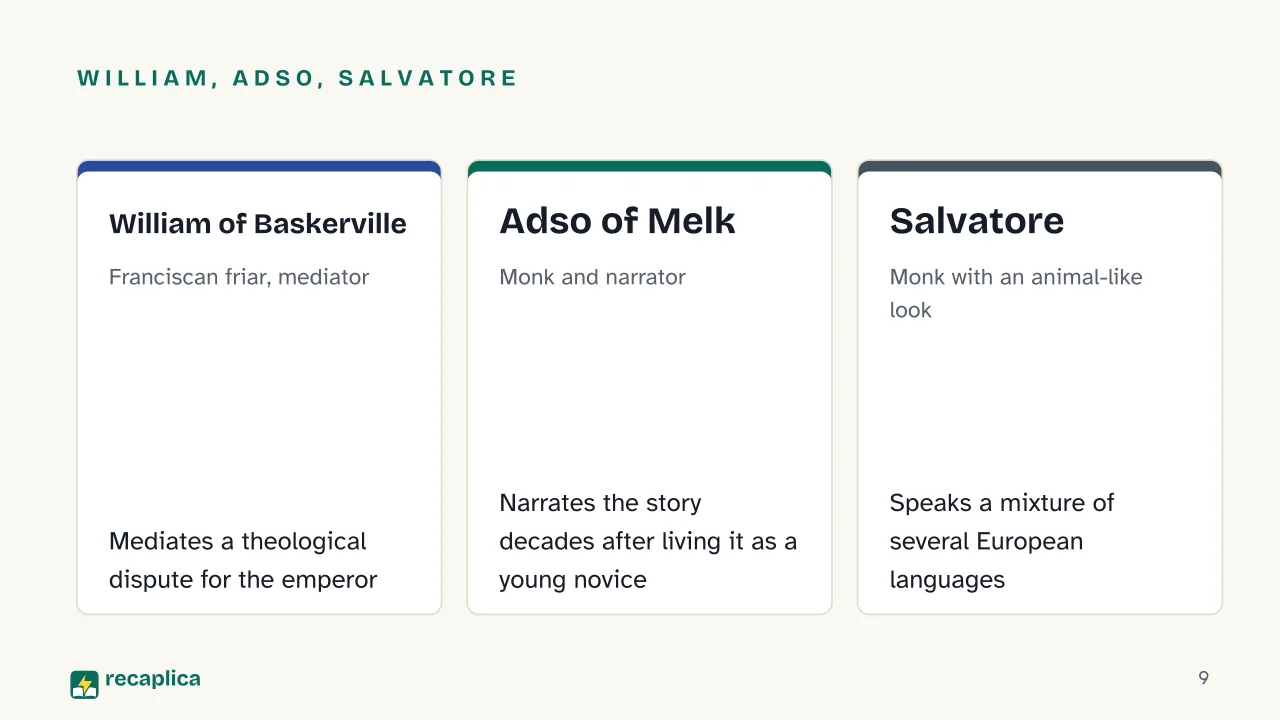 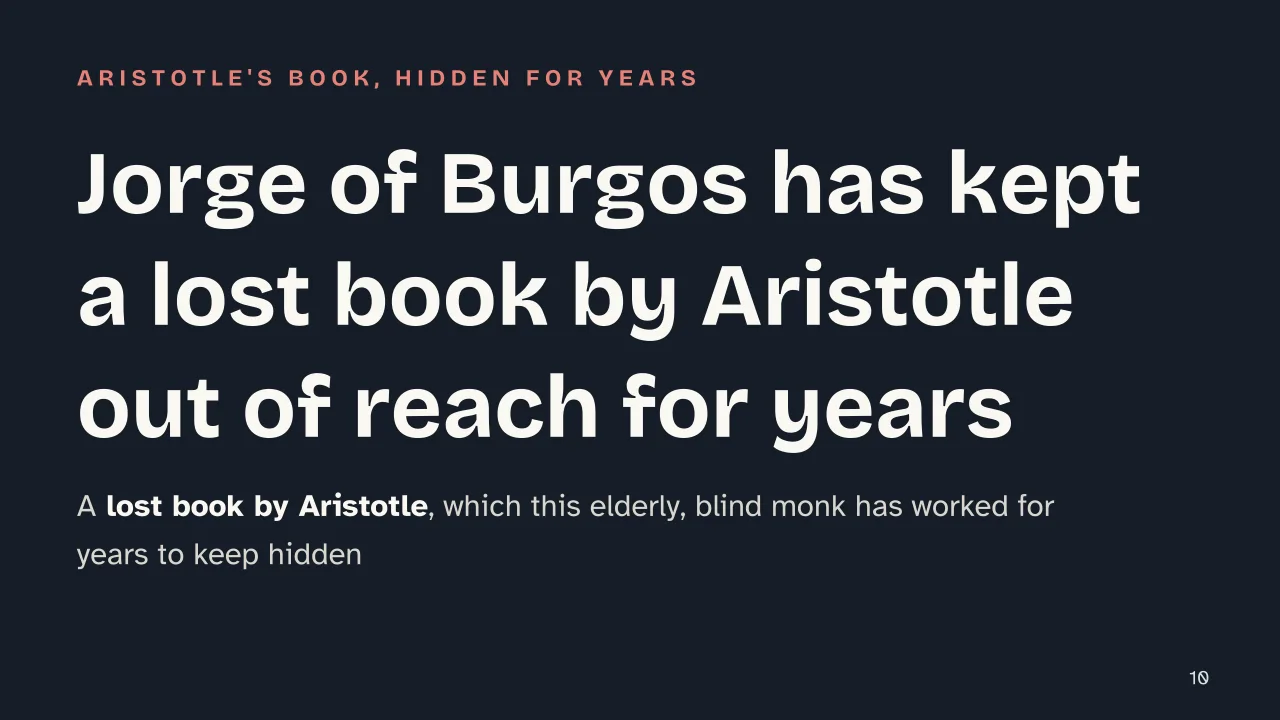   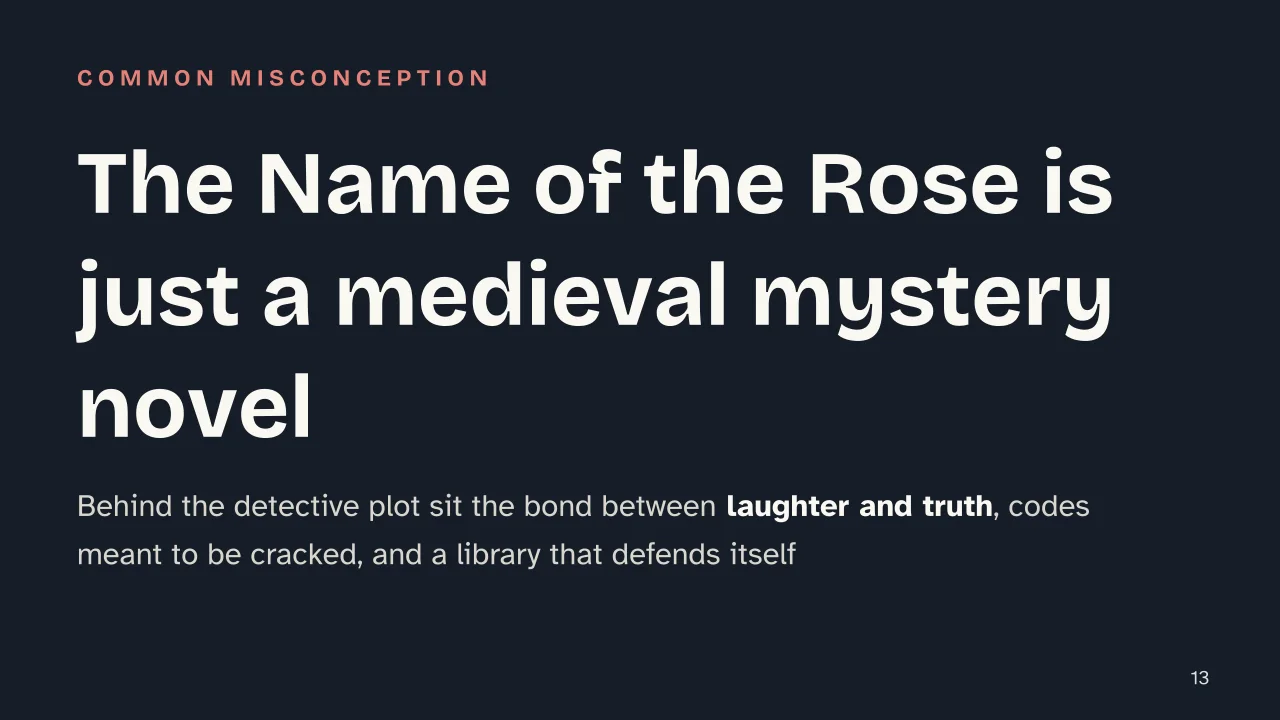  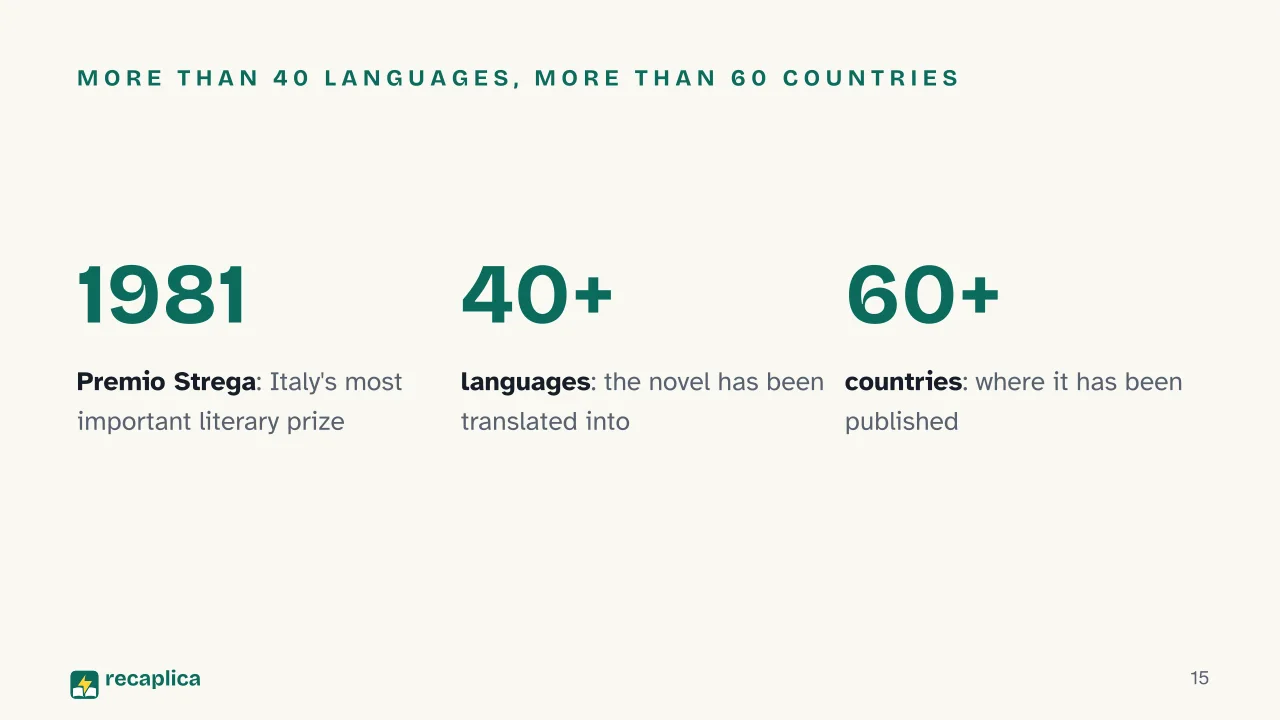 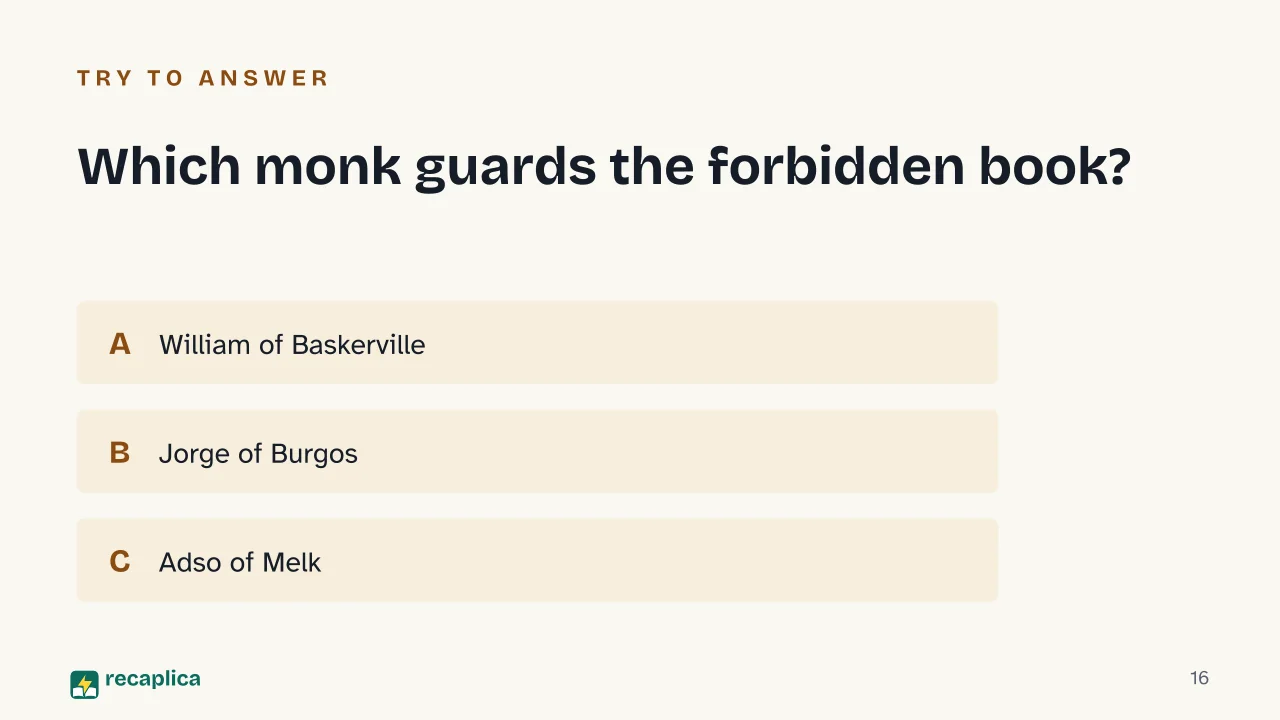  Common myths
Mind mapDrag the background to move around and the nodes to reposition them; use − and + to collapse and expand branches. 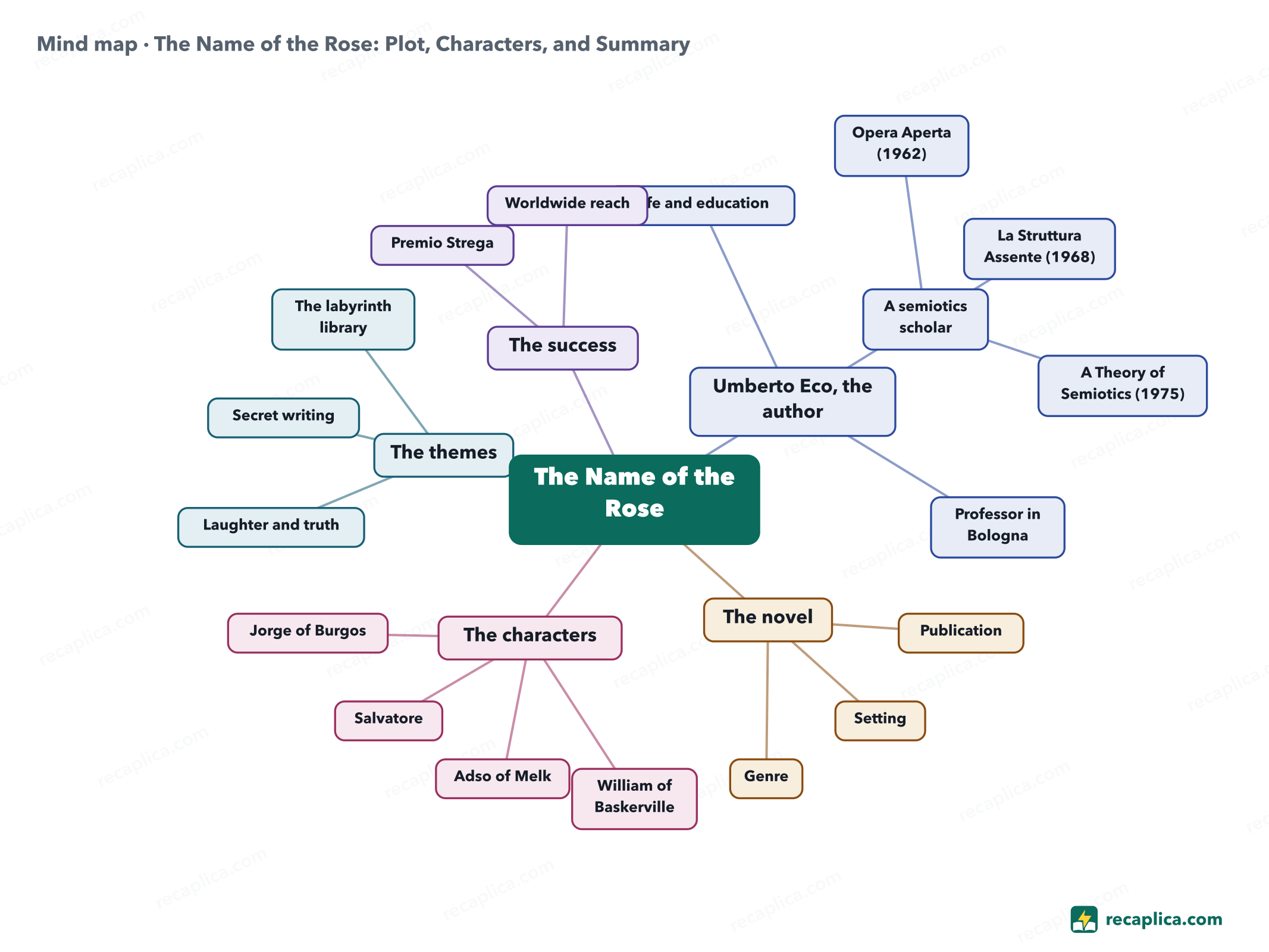
Quiz: test yourselfAnswer the questions to check what you have learned: you get instant feedback and a short explanation. Grade 0/10 0/5
FlashcardsTap the card to flip it and check whether you remember the answer, then move to the next one. 1 / 8 Explain it in your own wordsThe ultimate test: if you can explain it in simple words, you've truly understood it. Write your explanation, then compare it with the Recap. Your explanation is saved only on this device.
Frequently asked questionsWhat is The Name of the Rose about?It follows the investigation of the Franciscan friar William of Baskerville, helped by the novice Adso of Melk, into a string of events tied to a book kept in the library of a Benedictine abbey in 1327, weaving together theology, semiotics, and a detective plot. Who are the characters in The Name of the Rose?William of Baskerville leads the investigation through logic, Adso of Melk narrates it as a young novice who does not always grasp what he sees, Salvatore is unmistakable for his deformed, almost animal appearance and the jumble of European languages he speaks, and Jorge of Burgos is the elderly, blind monk guarding the forbidden book. Who is Salvatore in The Name of the Rose?Readers remember him for his grotesque, half-animal look and for the mix of European languages he speaks on the page: one of the abbey's most recognizable characters. How many languages has The Name of the Rose been translated into, and how many copies has it sold?According to the Umberto Eco Foundation, the novel has been translated into more than 40 languages and published in more than 60 countries; Il Post, citing press figures rather than an official statistical body, reports more than 50 million copies sold worldwide. Did Umberto Eco write only The Name of the Rose?No: before 1980 he was already an established semiotician, author of Opera Aperta (1962), La Struttura Assente (1968), and A Theory of Semiotics (1975); after The Name of the Rose he published other novels, including Foucault's Pendulum in 1988. Every Recap goes through an independent review before publication. |